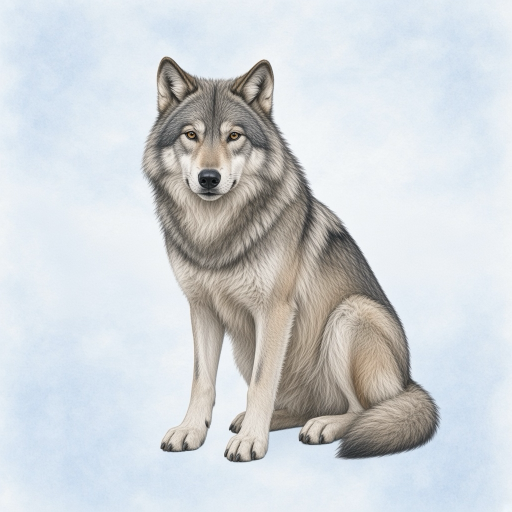
A wolf is the largest wild member of the dog family. The gray wolf is the most common kind, and it lives in family groups called packs. A big wolf can weigh more than 100 pounds (45 kg), which is much bigger than most pet dogs. Wolves are smart hunters that work together to catch large animals like deer and elk.
Why wolves are tricky to understand
Lots of people think a wolf howls at the moon. That is just a story. Wolves really howl to talk to each other. A howl tells the pack where to meet and warns other wolves to stay away. Wolves howl most often in the early morning and at night, when the moon may simply happen to be out.
People also think wolves are mean and like to attack people. In real life, wild wolves almost always stay away from humans. Attacks by healthy wild wolves are very rare. A wolf would much rather run and hide than come near a person.
One more thing surprises people. A wolf pack is usually just a family. It is a mother wolf, a father wolf, and their pups. The young wolves follow their parents, the way children follow their mom and dad.
Key facts about wolves
The gray wolf is the largest wild dog. A big male can weigh more than 100 pounds (45 kg).
Wolves live in family packs. A pack is usually a mother, a father, and their pups.
Wolves do not howl at the moon. They howl to call the pack and to warn other wolves.
A howl carries a long way. Other wolves can hear it from several miles away, sometimes up to about 6 miles (10 km).
Wolves are fast runners. A wolf can sprint about 36 to 38 miles per hour (58 to 61 km/h) for a short burst.
Wolves are meat-eaters. A pack hunts big animals like deer, elk, and moose.
Wolf pups are born helpless. They are born blind and deaf, and their eyes open after about two weeks.
A baby wolf is called a pup. A mother usually has about four to six pups at a time.
Wolves come in many colors. They can be gray, black, or white. White wolves live in the far, snowy north.
Dogs descend from an ancient wolf lineage. Their closest living wild relatives are gray wolves, but no present-day wolf population is the direct ancestral population.
Common myths about wolves
Myth: Wolves howl at the moon. Wolves howl to send messages to other wolves, not to the moon. They just happen to howl at night, when the moon is often in the sky.
Myth: Wolves love to attack people. Wild wolves almost always avoid humans. Attacks by healthy wild wolves are very rare, and wolves usually run away when they see a person.
Myth: A wolf pack is a gang of strangers. A wild pack is really a family. It is a mother, a father, and their young, not a group of strangers.
Myth: Wolves eat plants like a cow. Wolves are meat-eaters. They hunt animals such as deer, elk, and moose, and they do not graze on grass.
Myth: A baby wolf is born ready to hunt. A newborn pup is blind, deaf, and helpless. It needs its family to feed it and keep it safe for a long time.
Frequently asked questions about wolves
Why do wolves howl?
Wolves howl to talk to each other. A howl can call the pack back together when wolves are spread out. It can also warn other packs to stay out of the family’s space. A wolf does not howl at the moon, even though it may howl at night.
How fast can a wolf run?
Wolves can sprint quickly for a short chase, although wild top speeds are difficult to measure consistently. They rely more on sustained travel at lower speeds than on a track-style maximum.
What do wolves eat?
Wolves are meat-eaters, called carnivores. A pack hunts large animals such as deer, elk, and moose. The wolves work together to chase and catch prey that is much bigger than one wolf alone.
Are wolves dangerous to people?
Wild wolves almost always stay away from humans. Attacks by healthy wild wolves are very rare. A wolf would rather run and hide than be near a person.
Where do wolves live?
Gray wolves occupy varied Northern Hemisphere habitats, from Arctic tundra and boreal forest to temperate woodland, grassland, and some dry regions. Pack territories can cover hundreds of square miles where prey is sparse, but size varies greatly.
Each of this topic’s quiz questions cites a source for the fact it tests. You can play at any level: Rookie, Curious, Sharp, or Expert.
A wolf is the largest wild member of the dog family, and the gray wolf (Canis lupus) is the most widespread kind. Wolves live in family groups called packs, hunt large animals together, and communicate by howling, scent, and body language. A wolf can sprint about 36 to 38 miles per hour (58 to 61 km/h) for a short burst, but its real strength is endurance. It can trot for hours and a pack may cover more than 30 miles (48 km) in a single day.
Why wolves surprise people
The popular “alpha wolf” story says every pack has an unrelated male that fought its way to the top. Long-term fieldwork found that a typical wild pack is instead a family centered on breeding parents and offspring. Dominance behavior still occurs, and unusual packs may contain multiple breeders or adopted animals, so the correction concerns the simplistic combat hierarchy rather than denying all social rank.
A second surprise is how harmless wolves usually are to people. Old stories paint wolves as villains that hunt humans. In real life, attacks by healthy wild wolves are extremely rare. Wolves almost always avoid people and run away rather than come closer.
A third surprise is how a top predator can affect many parts of an ecosystem. After wolves returned to Yellowstone National Park in the 1990s, predation became one of several forces changing elk numbers and behavior. Some streamside plants and other animals also changed. Scientists study these linked effects as a possible trophic cascade, but they continue to debate how much of the vegetation response was caused by wolves rather than climate, water, bears, cougars, and human hunting.
Key facts about wolves
A pack is a family. Most wild packs are a breeding pair, the mother and father, plus their young.
The fighting-alpha stereotype is outdated. It grew from captive groups of unrelated wolves and poorly describes a typical wild family pack, although dominance relationships still exist.
Wolves are built for distance. A pack can travel more than 30 miles (48 km) in a day by trotting at a steady pace.
A pack needs lots of land. A single territory often covers 50 to 1,000 square miles (130 to 2,600 sq km), depending on how much prey is around.
Most hunts fail. Big prey like elk and moose are hard to catch, so only a small share of wolf hunts end in a meal.
Wolves can gorge. A hungry wolf can eat about 20 pounds (9 kg) of meat in a single meal, because it does not get to eat every day.
Big paws help in snow. A wolf’s wide paws spread out its weight like snowshoes so it does not sink into deep snow.
Young wolves move out. Many leave their birth pack and travel 50 to 100 miles (80 to 160 km) to find their own land and a mate.
Yellowstone got wolves back. In 1995 and 1996, 31 wolves from Canada were released into Yellowstone National Park.
Healthy wild wolves rarely attack people. Such attacks are extremely rare, and wolves usually avoid humans.
Common myths about wolves
Myth: Every pack is a contest won by a fighting alpha. Typical wild packs are families centered on breeding parents. Captive groups helped popularize the stereotype, though some wild packs have more complex membership and rank.
Myth: Wolves hunt and kill people. Wild wolves almost always avoid humans, and attacks by healthy wild wolves are extremely rare. People are not part of a wolf’s diet.
Myth: A wolf can sprint at top speed for miles. Wolves can move quickly in a short chase, but their wild maximum speed is difficult to measure consistently. They cover long distances mainly by traveling at lower, sustainable speeds.
Myth: Wolves catch prey almost every time. Hunting large animals is hard and risky. Most wolf hunts end in failure, with the prey escaping or standing its ground.
Myth: Wolves never lived in Yellowstone before the 1990s. Wolves did live there long ago, then were wiped out by people. The 1995 and 1996 releases brought them back.
Frequently asked questions about wolves
Is the alpha wolf real?
Not in the popular sense of an unrelated bully fighting to rule every pack. Most wild packs are families centered on breeding parents, and biologist L. David Mech argued that “alpha” is misleading for them. Dominance relationships still occur, and the term may describe breeding animals in unusually complex packs.
Why do wolves howl?
Wolves howl to stay in touch with their pack and to defend their territory. A howl can call scattered wolves back together. When a whole pack howls at once, the sound also warns nearby packs to keep their distance. Wolves do not howl at the moon, even though they often howl at night.
How fast can a wolf run?
A wolf can sprint about 36 to 38 miles per hour (58 to 61 km/h) for a short burst while chasing prey. It cannot keep that speed for long. A wolf is better at endurance, trotting steadily for hours, which lets a pack travel more than 30 miles (48 km) in a day.
What happened when wolves returned to Yellowstone?
In 1995 and 1996, 31 wolves from Canada were released into Yellowstone National Park, where wolves had been wiped out. The wolves hunted elk and changed where the elk fed. Plants near streams started to recover, which helped other animals. Scientists still study exactly how big these effects were.
How big is a wolf pack’s territory?
A pack’s territory can cover tens to hundreds of square miles and may approach 1,000 square miles (2,600 sq km) in prey-poor northern regions. Size varies with prey, pack size, neighboring packs, season, and landscape.
Each of this topic’s quiz questions cites a source for the fact it tests. You can play at any level: Rookie, Curious, Sharp, or Expert.
A wolf (Canis lupus) is the largest living canid species, a social carnivore whose size and ecology vary widely. Many packs hunt ungulates and center on breeding parents and offspring, while pack composition can also include multiple breeders, adopted animals, or unrelated wolves. Wolves can sprint quickly, but sustained travel matters more and wild maximum speeds are hard to standardize. Attacks by unhabituated wild wolves are rare.
What is often misunderstood about wolves
The persistent “alpha” myth portrays every pack as unrelated adults fighting up a linear ladder. Captive studies helped popularize that picture. Long-term fieldwork found that typical wild packs are families centered on breeding parents and offspring. Dominance behavior still occurs, and some packs have multiple breeders or unrelated members, so “alpha” is better called misleading in ordinary family packs than biologically meaningless in every context. Mech later urged writers to retire the stereotype his early book helped spread.
A second misunderstanding involves danger to humans. Attacks by wild wolves are rare, especially where wolves are not food-conditioned or habituated, and fatal attacks are rarer still. Risk is not zero, so wildlife guidance still calls for distance, secure food, and active hazing when wolves approach people.
Wolves can sprint quickly over a short distance, but wild top-speed measurement is not standardized. They excel at sustained travel and may pursue prey over distance, while many hunts also involve brief tests, ambush opportunities, and abandonment rather than one universal endurance strategy.
A fourth point concerns the pack as a hunting machine. It is tempting to assume that the bigger the pack, the more successful the hunt, but most wolf hunts of large prey end in failure. Elk, moose, and bison are big, fast, and dangerous, and a healthy adult often escapes or stands its ground. Wolves frequently test a herd and single out animals that are young, old, or weakened.
The pack as a family
Most wolf packs center on breeding parents and offspring, with size varying by prey, mortality, dispersal, and social history. Some contain multiple breeding animals, adopted young, or unrelated adults. Dispersers may settle nearby or travel hundreds of miles, so a 50-to-100-mile range is illustrative rather than universal.
Packs hold territory and defend it. A single pack’s range can span anywhere from about 50 to 1,000 square miles (130 to 2,600 sq km), and the size depends heavily on prey density. Where deer or elk are plentiful, a smaller area suffices. Where prey is sparse, a pack must roam over far more ground. Wolves advertise and defend these boundaries with scent marks, leaving urine and droppings at key spots, especially along the edges of the territory, where other wolves can detect them for days.
How wolves communicate
Howling is the wolf’s most famous signal, and it has nothing to do with the moon. Scientists have found no evidence that wolves howl more during a full moon. A howl serves as a long-distance message: a social rally call to regroup, a coordination signal before a hunt, and a territorial announcement. Yellowstone references report that howls can be heard about 7 miles (11 km) through forest and about 10 miles (16 km) across open country under good conditions. The familiar upward-facing pose probably helped create the moon myth.
Sound is only part of the system. Wolves also use scent marking to maintain territories, along with a rich set of body-language signals, from tail and ear positions to facial expressions, that manage relationships within the pack.
Bodies built for cold and distance
Wolves are adapted to cold, open country. A thick double coat insulates against winter, and coat color varies widely. Many wolves are a grizzled mix of gray and brown, but solid black and pure white both occur. Pure white is common in the high Arctic, where it blends with snow. The all-black coat in North American wolves has a notable origin: genetic studies trace it to a dark-pigment gene that wolves acquired through past interbreeding with black domestic dogs.
A wolf’s paws are large and spread the animal’s weight like snowshoes, helping it stay on top of deep snow. Body size itself follows a geographic pattern. Across the species’ range, wolves tend to get larger toward higher, colder latitudes, in line with Bergmann’s rule, so the biggest wolves live in the far north and the smallest in places like the Middle East and South Asia.
For feeding, a wolf carries 42 teeth, including the carnassials, a pair of cheek teeth that shear past each other like scissors to slice meat and tendon from bone. A wolf’s teeth are heavy and well suited to crushing bone. Because wolves do not eat every day, they gorge when they can, and a hungry wolf can consume around 20 pounds (9 kg) of meat in a single meal.
The Yellowstone comeback
Wolves were exterminated from Yellowstone National Park by the 1920s. In 1995 and 1996, 31 wolves captured in Canada were released into the park, part of a wider reintroduction effort that put 41 wolves into Yellowstone by 1997. The wolves established packs, and their numbers in the park have since settled at roughly 100 animals in about 10 packs.
The reintroduction became one of the most studied wildlife events in North America. As wolves preyed on elk and changed elk behavior, researchers documented recovery of streamside willow and other plants, along with effects on beavers, birds, and the shape of some streams. This chain of effects is called a trophic cascade. The full size and certainty of these effects are still debated among scientists, but the link between the return of a top predator and broad ecosystem change is widely recognized.
Key facts about wolves
Largest canid. The gray wolf is the largest living member of Canidae, weighing roughly 50 to 175 pounds (23 to 80 kg) depending on region.
A pack is a family. Most packs are a breeding pair plus their offspring; the “alpha” pair are simply the parents.
Built for endurance. A top sprint of about 36 to 38 miles per hour (58 to 61 km/h) lasts only briefly; wolves trot for hours to cover long distances.
Large territories. A pack’s range spans roughly 50 to 1,000 square miles (130 to 2,600 sq km), set mainly by prey density.
Most hunts fail. Large prey such as elk and moose often escape or fight back, so only a small share of chases succeed.
Howls, not at the moon. Under good conditions, a howl may be heard about 7 miles (11 km) through forest and 10 miles (16 km) across open country. It helps rally the pack and advertise territory.
42 teeth. The carnassial pair shears meat like scissors, and the teeth are built for crushing bone.
Gorge feeders. A hungry wolf can eat around 20 pounds (9 kg) of meat at once.
Coat color varies. Wolves range from gray to black to white; the black coat traces to interbreeding with domestic dogs.
Yellowstone restored. 31 wolves from Canada were released in 1995 and 1996, helping trigger a documented trophic cascade.
Common myths about wolves
Myth: Every pack is ruled by an unrelated fighting alpha. Typical packs are families centered on breeding parents. Dominance still exists, and complex packs occur, but captive-derived stereotypes do not describe ordinary wild pack formation.
Myth: Wolves are a serious danger to people. Attacks by healthy wild wolves are extremely rare. Wolves nearly always avoid humans.
Myth: Wolves can run fast for miles. The top sprint lasts only a short distance. Wolves rely on endurance, trotting steadily to travel far.
Myth: A bigger pack always hunts better. Most hunts of large prey fail regardless of pack size, and even lone wolves sometimes take large animals.
Myth: Wolves howl at the moon. Howling is communication, not a response to the moon. Wolves simply howl most during the low-light hours when the moon is often visible.
Frequently asked questions about wolves
Is the alpha wolf real?
Not in the familiar stereotype. Typical wild packs are families centered on breeding parents rather than unrelated adults fighting for permanent command. Mech argued against routine use of “alpha” for such packs. Rank and aggression still occur, especially in packs with complex membership.
How fast can a wolf run?
A wolf can sprint about 36 to 38 miles per hour (58 to 61 km/h) for a short burst while chasing prey. That speed cannot be held for long. The wolf’s real advantage is endurance: a steady trot it can sustain for hours, allowing a pack to travel a long way each day.
Do wolves really howl at the moon?
No. Scientists have found no link between howling and the phase of the moon. Wolves howl to rally the pack, coordinate, and defend territory. The head-back howling posture, combined with their habit of howling at night, likely created the moon myth.
Are wolves dangerous to humans?
Rarely. Attacks by healthy wild wolves are extremely rare, and fatal attacks are rarer still. Wolves generally avoid people. Each year, domestic dogs bite far more people than wild wolves ever have.
What did wolves do to Yellowstone?
After 31 wolves from Canada were reintroduced in 1995 and 1996, they preyed on elk and altered elk behavior. Researchers then documented recovering plants near streams and changes for other species, a chain of effects known as a trophic cascade. The exact magnitude is still studied and debated.
Source notes
Size, weight, speed, diet, and reproduction figures come from the Smithsonian’s National Zoo and the International Wolf Center. Taxonomy, dentition, coat color genetics, howling range, and the largest-canid status follow the Wolf reference page. The reframing of the alpha-wolf idea follows Scientific American, and the Yellowstone reintroduction and trophic-cascade facts follow the National Park Service.
Each trivia question in this topic’s Rookie, Curious, Sharp, and Expert quiz sets cites a primary source for the specific fact it tests.
A wolf (Canis lupus) is the largest extant member of the family Canidae, a cursorial social carnivore that hunts large ungulates in cooperative family groups and ranges across much of the Northern Hemisphere. It is a generalist predator with a flexible social system: a territorial pack built around a breeding pair and their offspring, maintained through howling, scent marking, and body language. The species shows wide geographic variation in size, color, and ecology, and it sits at the root of one of biology’s most consequential domestication events, the origin of the domestic dog. The wolf is also a textbook apex predator, and its 1990s return to Yellowstone became a landmark, and contested, case study in how top carnivores shape ecosystems.
What is often misunderstood about wolves
The dominant popular error is a universal captive-style alpha hierarchy. Schenkel’s work on captive wolves and Mech’s early synthesis helped frame packs as unrelated adults fighting for top rank. Free-ranging studies instead show that typical packs center on breeding parents and offspring. This does not erase dominance behavior or complex packs with multiple breeders and unrelated members. Mech’s later criticism was directed at indiscriminate use of “alpha” for ordinary family packs.
The captive-versus-wild distinction matters because it explains the mismatch. Unrelated adults confined together do form tension-laden hierarchies with frequent dominance displays, which is what early researchers measured. That setting does not reproduce the kinship structure of a wild family group, so it generated a model that fit captivity but misrepresented the field reality.
A second misconception concerns risk to humans. Despite deep cultural fear, attacks by healthy wild wolves are extremely rare, and lethal attacks rarer still. The hazard is dwarfed by that of domestic dogs. Where rare incidents occur, habituation and food-conditioning are common factors, which is why wildlife managers stress not feeding wild wolves.
A third error treats wolf speed as the key to predation. The top sprint of roughly 36 to 38 miles per hour (58 to 61 km/h) is brief. Wolves are endurance hunters that travel at a trot, often covering more than 30 miles (48 km) in a day, and they capture prey by testing herds, selecting vulnerable individuals, and pressing over distance rather than by raw acceleration.
Pack structure, dispersal, and territory
A wolf pack is usually better modeled as an extended family than a captive-style ranked troop. Size varies widely, and reproduction often centers on one pair, but multiple breeders, adopted animals, and unrelated members occur. Dominance relationships coexist with kinship.
Dispersal is the engine of gene flow between populations. As young wolves mature, many leave the natal pack to seek unoccupied territory and a mate, becoming the so-called lone wolves of folklore, a transient status rather than a permanent identity. Most dispersers settle within 50 to 100 miles (80 to 160 km) of their birthplace, but tracked individuals have moved several hundred miles, occasionally beyond 500 miles (800 km), linking distant subpopulations.
Territories are defended and scaled to prey. A pack’s range can span roughly 50 to 1,000 square miles (130 to 2,600 sq km), inversely related to prey density: abundant deer or elk compress a territory, while sparse prey forces a pack to range widely. Boundary maintenance relies heavily on scent. Within a pack, scent marking is unequal. The breeding pair performs most of it, and the breeding male in particular uses raised-leg urination at conspicuous sites, while subordinate offspring tend to squat. These marks persist for days and concentrate along territorial edges, functioning as chemical signposts to neighboring packs.
Communication: howling and scent
Howling is a long-range acoustic signal, and it is not keyed to lunar phase; no link between howling rates and the full moon has been demonstrated. Functions include social reassembly, coordination, and territorial advertisement, with individually distinctive howls that allow recognition. Yellowstone references report detection at about 7 miles (11 km) through forest and 10 miles (16 km) across open country under good conditions. The upward-facing posture, combined with frequent howling in low-light hours, probably helped create the howl-at-the-moon trope.
Olfactory and visual channels complete the system. Scent marking encodes territory and reproductive status, and a graded repertoire of postures, tail and ear positions, piloerection, and facial expressions regulates within-pack relationships and signals intent during encounters.
Form, dentition, and feeding
Wolf morphology reflects a cold-climate coursing predator. The double coat insulates in winter, and pelage color spans a grizzled agouti gray-brown through pure white to melanistic black. White predominates in high-Arctic populations. Melanism in North American wolves has a well-characterized origin: the dark coat arises from a dominant variant of a beta-defensin gene introduced into wolf populations through historical admixture with black domestic dogs, so the black wolf carries a coat-color allele of canine-domestic origin.
Paws are proportionally large and spread under load, producing a snowshoe effect that improves travel over deep snow. Body size broadly tracks geography in accordance with Bergmann’s rule: mean mass tends to increase with latitude, so northern populations average larger than populations in warmer parts of the range.
Dentition is that of a hypercarnivorous canid. The adult wolf has 42 teeth, including the carnassial pair formed by the upper fourth premolar and the lower first molar. These occlude in a shearing, scissor-like action that slices muscle and tendon, while the heavy molars and powerful jaw musculature crush bone to access marrow. Bite force in the gray wolf is among the highest of any extant canid. Feeding ecology is feast-and-famine: wolves may go days without a kill and then gorge, ingesting on the order of 20 pounds (9 kg) of meat in a single sitting.
Hunting performance and the cooperation question
Wolf predation on large ungulates is difficult and frequently unsuccessful. Healthy adult elk, moose, and bison are formidable, and a large fraction of hunts end without a kill, which is why wolves test herds and target the young, old, injured, or otherwise compromised. The intuitive assumption that capture success rises monotonically with pack size does not hold across prey types. For some prey, per-capita success can plateau or decline as packs grow, since additional hunters add little to a kill that must then be shared among more individuals. Lone wolves and pairs have been documented killing large prey, including moose, unaided. Pack hunting is real and important, but the relationship between group size and efficiency is prey-specific rather than a simple “more is better” rule.
Domestication and the dog
The domestic dog descends from the wolf lineage, and the relationship is close enough that some taxonomic treatments list the dog as a subspecies, Canis lupus familiaris, while others elevate it to the species Canis familiaris. The two positions reflect a real biological intimacy: dogs and gray wolves are interfertile and genetically very near one another. Current genomic work indicates that dogs derive not from any living gray wolf population but from an extinct Late Pleistocene wolf lineage, with the divergence dated broadly to the tens of thousands of years before present and the details, including the possibility of more than one ancestral source population, still under active study. The takeaway is that the dog is a domesticated wolf in the broad sense, even though its specific wild ancestor is gone.
Taxonomy and relatives
Canis lupus is a wide-ranging species with substantial described intraspecific variation. More than 30 subspecies have been named across the Northern Hemisphere, though subspecies limits remain debated and some classifications fold the domestic dog and the dingo into the species as well. Common names can mislead. The red wolf of the southeastern United States is a distinct, critically endangered canid that has interbred with coyotes; how to interpret its deeper ancestry has long been debated. The Ethiopian wolf is a separate Canis species endemic to the Ethiopian highlands, while the African wolf is another Canis species found in northern Africa. The maned wolf of South America is a more distant canid in the genus Chrysocyon.
The Ice Age dire wolf illustrates how appearance can mislead. Long imagined as a large, heavily built Canis lupus, ancient-DNA analysis instead places it on a lineage that diverged from gray wolves and their close relatives several million years ago, leading some researchers to assign it to its own genus rather than to Canis. The dire wolf was a canid, but not a true gray wolf.
The Yellowstone reintroduction and the cascade debate
Wolves were extirpated from Yellowstone National Park by the 1920s under federal predator-control policy. Restoration began in 1995, when wolves captured in Canada were released; 31 were released in 1995 and 1996, and the broader program placed 41 wolves in the park through 1997. Packs established quickly, the population rose and then stabilized, and in recent years it has hovered near 100 wolves in roughly 10 packs within the park.
The reintroduction is frequently cited as a demonstration of a trophic cascade: wolves reduce and redistribute elk, releasing browse pressure on streamside willow, aspen, and cottonwood, with downstream effects on beavers, songbirds, and channel morphology. The qualitative cascade is supported by substantial fieldwork. Its magnitude and mechanism, however, are genuinely debated. Some studies attribute much of the vegetation response to climate, hydrology, or concurrent changes in elk numbers driven by other factors, including human harvest and bears. The defensible summary is that the wolf’s return coincided with and contributed to broad ecological change, while the precise share attributable to wolves alone remains an open scientific question rather than a settled figure.
Key facts about wolves
Largest canid. Canis lupus is the largest extant member of Canidae, with mass varying widely by latitude per Bergmann’s rule.
Family packs. The pack is a breeding pair plus offspring; the “alpha” framing came from captive, unrelated wolves and was later disavowed by L. David Mech.
Dispersal. Most dispersers settle within 50 to 100 miles (80 to 160 km), but some travel several hundred miles, occasionally beyond 500 miles (800 km).
Territory. Range spans roughly 50 to 1,000 square miles (130 to 2,600 sq km), scaled inversely to prey density.
Dentition. 42 teeth, with the carnassial pair (upper fourth premolar and lower first molar) shearing meat and heavy molars crushing bone.
Feast-and-famine. A wolf can gorge on about 20 pounds (9 kg) of meat in one meal.
Coat color. Gray, black, and white all occur; the melanistic allele entered wolves via admixture with domestic dogs.
Domestication. The dog descends from an extinct Pleistocene wolf lineage and is sometimes classified as Canis lupus familiaris.
Howling. A territorial and social signal unrelated to lunar phase, reported audible for about 7 miles (11 km) through forest and 10 miles (16 km) across open country under good conditions.
Yellowstone. 31 wolves released in 1995 and 1996 (41 by 1997); the associated trophic cascade is real in direction but debated in magnitude.
Common myths about wolves
Myth: Packs are ruled by an alpha that fights to the top. Wild packs are families led by breeding parents. The dominance-hierarchy model derives from captive, unrelated wolves.
Myth: The dog descends from today’s gray wolf. Dogs descend from an extinct Late Pleistocene wolf lineage, a sister group to modern gray wolves rather than any living population.
Myth: Bigger packs always hunt better. The group-size-to-success relationship is prey-specific; per-capita returns can fall as packs grow, and lone wolves sometimes kill large prey.
Myth: The dire wolf was a giant gray wolf. Ancient DNA places the dire wolf on a separate lineage that split from gray wolves millions of years ago.
Myth: The Yellowstone cascade is a settled, quantified fact. The cascade’s direction is well supported, but its magnitude and the wolf’s exact contribution remain debated.
Frequently asked questions about wolves
Why is the popular alpha-wolf model considered misleading?
Because it generalized too broadly from captive groups of unrelated wolves. Typical wild packs center on breeding parents and offspring, so parental status explains much apparent leadership. Wild wolves still have dominance relationships, and “alpha” can occasionally describe complex packs, but it is a poor default explanation.
Did dogs come from the gray wolves alive today?
No. Genomic evidence indicates dogs descend from an extinct Pleistocene wolf lineage that is a sister group to living gray wolves, with divergence in the tens of thousands of years before present. The dog is sometimes classified as Canis lupus familiaris and sometimes as its own species, Canis familiaris.
How do wolves communicate over long distances?
Primarily by howling, which can be detected for several miles and carries information about identity, location, and territory. Scent marking, dominated by the breeding pair, encodes territorial and reproductive signals, and body language manages close-range interactions.
Does pack size determine hunting success?
Not in a simple way. For some prey, capture success plateaus or declines as packs enlarge, because added hunters contribute little to a shared kill. Lone wolves and pairs have taken large prey such as moose unaided, so cooperation is beneficial but not strictly proportional to numbers.
Is the Yellowstone trophic cascade real?
The qualitative cascade, wolves reducing and redistributing elk and thereby easing browse pressure on streamside vegetation, is supported by fieldwork. Its magnitude is debated, with some research crediting climate, hydrology, and other drivers. Wolves contributed to broad ecological change, but the exact share attributable to them remains an open question.
Source notes
Taxonomy, dentition, coat-color genetics, howling range, and the largest-canid status follow the Wolf reference page, with subspecies and domestic-dog classification drawn from Subspecies of Canis lupus. Size, reproduction, and diet figures are corroborated by the Smithsonian’s National Zoo. The reassessment of pack structure and the alpha concept follows Scientific American, and the Yellowstone reintroduction and trophic-cascade discussion follow the National Park Service.
Each trivia question in this topic’s Rookie, Curious, Sharp, and Expert quiz sets cites a primary source for the specific fact it tests.
Think you know Wolves?
Test yourself. Can you spot the true fact among 3 convincing bluffs?