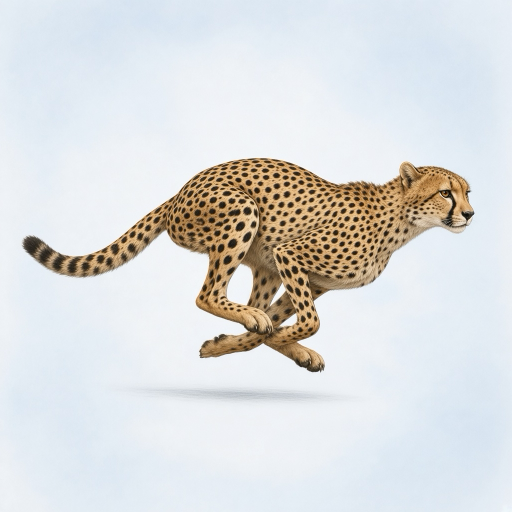
A cheetah is the fastest land animal measured over a short sprint. It is a slim, spotted wild cat found mainly in Africa, with a tiny surviving population in Iran. Wild cheetahs have been measured near 58 miles per hour (93 km/h), and a captive cheetah once reached about 64 miles per hour (103 km/h). Its long legs, light body, and flexible spine help it accelerate and turn quickly.
Why cheetahs are tricky to understand
Lots of people mix up cheetahs and leopards because both cats have spots. There is an easy way to tell them apart. A cheetah’s spots are solid round dots. A leopard’s spots are shaped like little rings. A cheetah is also slimmer, and it has black lines on its face that a leopard does not have.
People also think every big cat can roar. The lion roars. The tiger roars. But the cheetah cannot roar at all. Instead, a cheetah chirps like a bird and purrs like a pet house cat. That is one of the most surprising cheetah facts.
One more thing surprises people. A cheetah is amazingly fast, but only for a short time and distance. Real hunts mix acceleration, turning, braking, and lower-speed running rather than holding one top speed for exactly 20 seconds. Cheetahs abandon unsuccessful chases quickly, but field studies found that overheating alone does not explain when they stop.
Key facts about cheetahs
The cheetah is the fastest land animal. Instrumented wild cheetahs have reached about 58 miles per hour (93 km/h), while an older captive-animal measurement reached about 64 miles per hour (103 km/h).
A cheetah speeds up very fast. Tracking studies show exceptional acceleration and braking, but simple car-style zero-to-speed figures are rough illustrations rather than standardized wildlife tests.
Cheetahs sprint over short distances. Instrumented hunts lasted tens of seconds and involved frequent speed changes. There is no universal 20-second stopwatch limit.
A cheetah has a tan coat with round black spots. The spots help it hide in tall, dry grass.
A cheetah cannot roar. It chirps like a bird, purrs like a house cat, and growls.
A cheetah has black tear marks on its face. These lines run from its eyes toward its mouth. Glare reduction is a popular explanation, but their exact function has not been demonstrated.
A cheetah’s long tail helps it steer. The cheetah swings its tail to balance and turn at high speed.
Cheetahs often hunt in daylight. Their activity also shifts with heat, habitat, people, and other predators, and they use sharp eyesight to spot prey such as gazelles.
A baby cheetah is called a cub. A mother usually has three to six cubs at a time.
Most wild cheetahs live in Africa. They like open grasslands where they have room to run.
Common myths about cheetahs
Myth: A cheetah is the same as a leopard. They are different cats. A cheetah has solid round spots, while a leopard has ring-shaped spots. The cheetah is slimmer and has tear marks on its face.
Myth: Cheetahs can roar like lions. Cheetahs cannot roar at all. They chirp, purr, and growl instead. Only some big cats, like lions and tigers, can roar.
Myth: A cheetah can run at top speed all day. Cheetahs use short bursts and usually abandon an unsuccessful chase quickly. They need recovery after hard effort, but field measurements do not support the old story that a fixed 20-second heat limit always ends a chase.
Myth: Cheetahs hunt only in the dark of night. Cheetahs often hunt by day, but their schedule varies. Heat, habitat, human activity, and larger predators can all affect when they are active.
Myth: A cheetah’s claws retract as fully as those of most cats. A cheetah has limited claw retraction, so its main claws remain more exposed and help provide traction while running and turning.
Frequently asked questions about cheetahs
How fast can a cheetah run?
Cheetahs are the fastest land animals measured over short sprints. A tracking study recorded a wild cheetah near 58 miles per hour (93 km/h), while an older captive-animal test produced a higher figure. Real hunts usually involve lower peak speeds, hard turns, braking, and rapid acceleration. A cheetah abandons an unsuccessful chase quickly, but field research does not support the old claim that overheating alone forces it to stop.
Why does a cheetah have spots?
A cheetah has round black spots all over its tan coat. The spots help it hide in tall, dry grass while it sneaks up on its food. This kind of hiding is called camouflage. The spots make the cheetah hard for a gazelle to see.
Can a cheetah roar?
No. A cheetah cannot roar like a lion or a tiger. Instead, a cheetah chirps like a bird and purrs like a pet house cat. Cheetahs also growl and hiss when they are upset.
What do cheetahs eat?
Cheetahs are meat-eaters. They mostly hunt gazelles and other small, fast animals that look a bit like deer. A cheetah chases its prey in a quick sprint and catches it before the cheetah gets too tired.
Where do cheetahs live?
Most wild cheetahs live in Africa, in open grasslands and dry country with lots of room to run. A small number of cheetahs also live in one part of Asia, in the country of Iran. Cheetahs do not live wild in places like North America or Europe.
Each of this topic’s quiz questions cites a source for the fact it tests. You can play at any level: Rookie, Curious, Sharp, or Expert.
A cheetah (Acinonyx jubatus) is the fastest measured land animal over a short sprint, a slim spotted cat found mainly in Africa. A 2013 study recorded a wild cheetah near 58 miles per hour (93 km/h), while a much older test of a captive animal produced about 64 miles per hour (103 km/h). Long legs, a lightweight body, limited claw retraction, and a flexible spine help it accelerate, brake, and turn. It abandons unsuccessful chases quickly, but field measurements challenge the old idea that it must stop because it overheats.
Why cheetahs surprise people
The biggest surprise is how the cheetah’s speed works. A cheetah is not a long-distance runner. It accelerates, turns, brakes, and changes speed through a short pursuit rather than holding one maximum speed for a fixed 20 seconds. If it does not catch its prey quickly, it usually gives up. Field measurements found only modest temperature increases during hunts, so overheating is not accepted as the sole stopping mechanism.
A second surprise is the cheetah’s family tree. People call the cheetah a big cat, but it is not in the same group as lions and tigers. Those cats belong to a group called the roaring cats. The cheetah’s closest relatives are the puma (also called the cougar) and a smaller cat called the jaguarundi. All three of these cats can purr but cannot roar.
A third surprise is the claws. Most cats can retract their claws more completely when they are not using them. A cheetah has limited claw retraction, so its main claws remain more exposed and wear relatively blunt. They help provide traction while it runs and turns.
Key facts about cheetahs
Fastest land animal. Instrumented wild cheetahs have reached about 58 miles per hour (93 km/h); an older captive-animal measurement reached about 64 miles per hour (103 km/h).
Amazing acceleration. Tracking collars record unusually rapid acceleration, deceleration, and turning. Popular car comparisons are not standardized measurements.
Short sprints only. Chases usually cover short distances. A field study found only modest temperature increases during hunts, so overheating is not considered the sole reason a chase ends.
Limited claw retraction. Unlike most cats, a cheetah’s main claws remain more exposed and contribute traction during a run.
Solid spots. A cheetah’s spots are filled-in round dots. A leopard’s spots are open rings called rosettes.
Cannot roar. The cheetah purrs and chirps but cannot roar, because its throat is built differently from a lion’s.
Built light. A grown cheetah weighs about 75 to 140 pounds (34 to 64 kg), close to a small adult person.
Long steering tail. The tail works like a rudder, helping the cheetah balance and turn at high speed.
Often a day hunter. Cheetahs commonly hunt in daylight and rely on sharp eyesight, but activity shifts with heat, habitat, people, and competing predators.
Rare today. The IUCN assessment estimates roughly 6,500 mature cheetahs, nearly all in Africa, but counts are uncertain and change over time.
Common myths about cheetahs
Myth: A cheetah is just a fast leopard. Cheetahs and leopards are different cats. A cheetah has solid round spots, a slim body, and black tear marks on its face. A leopard has ring-shaped rosettes and a heavier, stronger build.
Myth: A cheetah can chase prey for miles. Cheetah pursuits are brief, but no universal 20-second heat limit has been demonstrated. Instrumented field studies emphasize rapid acceleration, braking, turning, and fatigue, and challenge the idea that overheating alone forces every chase to end.
Myth: Cheetahs are in the same group as lions and tigers. Lions and tigers are roaring cats. The cheetah cannot roar and is most closely related to the puma and the jaguarundi instead.
Myth: A cheetah’s claws retract as fully as a house cat’s. A cheetah has limited claw retraction, leaving its main claws more exposed so they can contribute traction during acceleration and turning.
Myth: A cheetah always keeps the food it catches. Lions, leopards, and hyenas sometimes steal cheetah kills, but reported loss rates vary by ecosystem and are not most kills.
Frequently asked questions about cheetahs
How fast can a cheetah accelerate?
Wild tracking demonstrates exceptional acceleration and braking, although the often-repeated zero-to-45-mph time comes from simplified demonstrations rather than a standardized field test. Powerful limbs and a flexible spine produce long strides, while traction and tail movements help control turns.
Why can’t cheetahs roar?
A cheetah cannot roar because the bones and parts in its throat are built differently from a lion’s. Lions, tigers, leopards, and jaguars belong to a group of cats that can roar. The cheetah belongs to a different group that can purr instead, so it chirps, purrs, and growls.
What is the difference between a cheetah and a leopard?
The easiest difference to spot is the spots. A cheetah has solid round dots, and a leopard has open ring-shaped spots called rosettes. A cheetah is also slimmer and faster, has black tear marks on its face, and cannot climb trees as well as a leopard can.
Why do cheetahs hunt in the daytime?
Cheetahs commonly hunt in daylight and use sharp eyesight to spot prey from far away. Their schedule varies with temperature, habitat, people, and competitors. Lions, leopards, and hyenas can kill cheetahs or take their food, so temporal separation may sometimes reduce encounters.
Are cheetahs endangered?
Cheetahs are in trouble. The IUCN assessment estimates roughly 6,500 mature animals across a greatly reduced and fragmented range, although a precise current census is not possible. Habitat loss, prey loss, illegal trade, and conflict with livestock owners contribute to the decline. The IUCN lists the species as Vulnerable.
Source notes
The speed, weight, and life facts in this article come from the Smithsonian’s National Zoo and the Cheetah Conservation Fund. The details on why cheetahs cannot roar, how their claws work, and how they relate to the puma come from the Cheetah reference page, and the daytime-hunting facts come from the Cheetah Conservation Fund’s article on why cheetahs hunt during the day.
Each of this topic’s quiz questions cites a source for the fact it tests. You can play at any level: Rookie, Curious, Sharp, or Expert.
A cheetah (Acinonyx jubatus) is the fastest land animal measured over a short sprint, a slender, spotted cat found mainly in Africa with a tiny surviving population in Iran. A 2013 instrumented field study recorded about 58 miles per hour (93 km/h), while an older captive-animal measurement reached about 64 miles per hour (103 km/h). The cheetah is the only living member of Acinonyx, and its closest living relatives are pumas and jaguarundis. The species is listed as Vulnerable on the IUCN Red List, with an assessment estimate of roughly 6,500 mature animals.
What is often misunderstood about cheetahs
The cheetah is a sprinter, not an endurance runner. It abandons unsuccessful chases after a short distance, but field measurements found only a modest temperature rise during hunts and rejected overheating as the sole stopping mechanism. Successful hunts depend less on theoretical maximum speed than on rapid acceleration, braking, and controlled turns.
The cheetah is often called a big cat informally, but it does not belong to Panthera alongside lions, tigers, leopards, jaguars, and snow leopards. It belongs to the puma lineage and does not produce the full roar characteristic of several Panthera species. Roaring depends on specialized laryngeal and vocal-fold anatomy, not a simple purring-cat versus roaring-cat split based only on the hyoid. Cheetahs purr and also chirp, churr, growl, and hiss.
Cheetahs and leopards get confused because both are spotted, tan cats of similar regions. The patterns differ. A cheetah’s spots are solid round dots, while a leopard’s are open ring shapes called rosettes. The cheetah is the slimmer, longer-legged of the two, and it carries two black tear marks running from the inner corners of its eyes down to its mouth, a feature the leopard lacks.
A fourth misconception involves the claws. Compared with most cats, cheetahs have limited claw retraction, so the main claws remain more exposed and become relatively blunt. They still move, and descriptions such as “non-retractable” or “without sheaths” are too absolute. Their paw and claw anatomy contributes traction during acceleration and turning.
Key facts about cheetahs
Fastest land animal. A 2013 instrumented study recorded a wild maximum near 58 miles per hour (93 km/h). An older captive-animal measurement produced about 64 miles per hour (103 km/h). The familiar 70-mph figure is an estimate, not a reliable direct measurement.
Explosive acceleration. Instrumented runs show exceptional acceleration and deceleration. Exact zero-to-speed times repeated in popular accounts depend on the individual run and measurement method.
Built for the sprint. A long, flexible spine, an enlarged heart and nostrils, lightweight bones, and semi-retractable claws all serve high-speed running. The body is slim, deep-chested, and lightly built.
Short pursuits. Hunts involve brief bursts and rapid recovery, but field data do not support overheating as the single cause that ends most chases.
Cannot roar. The cheetah purrs, chirps, churrs, growls, and hisses, but cannot roar. It belongs to the purring cats, not the roaring genus Panthera.
Solid spots and tear marks. Solid black spots cover the coat, and dark malar stripes run down the face. Glare reduction is a widespread hypothesis for the stripes, not a demonstrated function.
Weight and size. Adults weigh about 75 to 140 pounds (34 to 64 kg) and stand around 30 inches (77 cm) at the shoulder, with a body and tail together measuring roughly 6 to 7.5 feet (1.8 to 2.3 m).
Often a day hunter. Cheetahs commonly hunt in daylight using keen eyesight, but activity shifts with temperature, habitat, people, and competing predators.
Sometimes loses kills. Lions, leopards, or hyenas may take a cheetah’s kill, a behavior called kleptoparasitism, but observed loss rates vary among ecosystems.
The king cheetah. A rare coat variant with bold blotches and stripes, the king cheetah is not a separate species. The pattern comes from a recessive form of a gene called Taqpep, the same gene that controls blotched versus striped patterns in tabby cats.
Low genetic diversity. Cheetahs have unusually low genetic variation associated with more than one inferred population contraction. The timing and contribution of individual bottlenecks remain subjects of genomic research.
Conservation status. The cheetah is listed as Vulnerable. The IUCN assessment estimates roughly 6,500 mature animals in a fragmented fraction of the historical range; this is an estimate, not a live census.
Common myths about cheetahs
Myth: A cheetah can run at top speed for miles. A cheetah’s chase is brief. Field data emphasize acceleration, braking, and turning and do not support the old claim that overheating alone forces it to stop.
Myth: The cheetah is a big cat like the lion. The cheetah is not in the roaring genus Panthera. Its closest relatives are the puma and the jaguarundi, and it purrs rather than roars.
Myth: A cheetah’s spots match a leopard’s. A cheetah has solid round spots; a leopard has open ring-shaped rosettes. The cheetah is also slimmer, faster, and marked with tear lines on its face.
Myth: The king cheetah is a giant separate species. The king cheetah is an ordinary cheetah carrying a rare coat-pattern gene. It is not larger, and it is not a different species or subspecies.
Myth: A cheetah’s claws fully retract like most cats’ claws. Cheetah claws have limited retraction and remain more exposed, so the main claws wear relatively blunt and contribute traction. They are not completely immobile.
Myth: Cheetahs are common and secure. Cheetahs are Vulnerable, with only a few thousand left in the wild. Their numbers have fallen sharply over the past century.
Frequently asked questions about cheetahs
How fast is a cheetah, really?
The strongest modern field evidence comes from instrumented wild cheetahs and includes a maximum near 58 miles per hour (93 km/h). A single older captive-animal test produced about 64 miles per hour (103 km/h). The familiar 70-mph figure should be treated as a rough estimate. Real hunts reward acceleration, braking, and sharp turns more than a straight-line maximum.
Why can’t a cheetah roar?
Cheetahs lack the specialized laryngeal and vocal-fold anatomy that allows several Panthera cats to produce a full roar. Hyoid flexibility alone does not explain the difference. Cheetahs can purr and also chirp, churr, growl, and hiss.
What is a king cheetah?
A king cheetah is a cheetah with a rare coat pattern of large blotches and three dark stripes down the back. It was once mistaken for a separate species, but it is now known to be an ordinary cheetah carrying a recessive form of the Taqpep gene. The same gene produces the blotched and striped patterns seen in domestic tabby cats.
Are cheetahs endangered?
The cheetah is listed as Vulnerable on the IUCN Red List. Its assessment estimates roughly 6,500 mature animals and documents a severely reduced, fragmented range. Historical totals such as “100,000 a century ago” are reconstructions rather than counts. Habitat loss, conflict with people, prey depletion, and illegal trade are major threats.
Where do cheetahs live today?
Almost all wild cheetahs live in Africa, with the largest populations in southern and eastern regions. Outside Africa, a tiny Asiatic cheetah population survives in Iran. Local counts change and should be dated when quoted. Cheetahs use grasslands, savannas, shrublands, and some dry or mountainous habitats rather than only open running plains.
Why do cheetahs have tear marks?
The two dark facial lines are often said to reduce glare or aid visual signaling, but these explanations have not been established experimentally. Their exact function remains unresolved.
Source notes
Speed, acceleration, size, weight, hunting, and reproductive figures come from the Smithsonian’s National Zoo and the Cheetah Conservation Fund. Taxonomy, the inability to roar, the king cheetah genetics, the semi-retractable claws, and the genetic bottleneck follow the Cheetah reference page. The Vulnerable status and wild population estimate follow the IUCN Cat Specialist Group assessment, and the surviving Asiatic population in Iran follows the Asiatic cheetah entry.
Each trivia question in this topic’s Rookie, Curious, Sharp, and Expert quiz sets cites a primary source for the specific fact it tests.
A cheetah (Acinonyx jubatus) is a cursorial felid and the fastest land animal measured over a short sprint. It is the sole living species of Acinonyx, and molecular work places it in the puma lineage of Felinae rather than among pantherine cats. A 2013 instrumented field study recorded about 58 miles per hour (93 km/h), while a single older captive-animal measurement produced roughly 64 miles per hour (103 km/h); the familiar 70-mph figure is an estimate. The species is listed as Vulnerable, with an IUCN assessment estimate near 6,500 mature animals across a fragmented African range and a tiny relict population in Iran.
What is often misunderstood about cheetahs
Popular accounts overstate the role of top speed and understate the role of maneuverability. A landmark 2013 study led by Alan Wilson fitted wild cheetahs in Botswana with custom GPS and inertial sensor collars and recorded hundreds of high-speed runs in natural conditions. The data showed that cheetahs rarely approached their theoretical maximum during hunts. Instead, success depended on rapid acceleration, hard deceleration, and tight turning, with the animals frequently slowing before a capture to match a prey animal’s evasive maneuvers. The highest speed recorded during that study was about 58 miles per hour (93 km/h), and the average maximum during hunts was lower still. The classic figure of 64 miles per hour, by contrast, derives from a single mid-20th-century measurement of a captive animal running in a straight line.
The cheetah’s taxonomic placement is also widely misunderstood. Despite its size and its inclusion in the informal “big cat” category, the cheetah is not a member of Panthera. Its nearest living relatives are the puma (cougar) and the jaguarundi, and the lineage diverged from those relatives several million years ago. A practical consequence is vocal: the cheetah lacks the laryngeal and hyoid configuration that produces a true roar in Panthera, and it instead belongs functionally to the purring cats. It produces a sustained purr on both inhalation and exhalation, along with bird-like chirps, staccato churrs, growls, hisses, and other agonistic calls.
A third misconception concerns the cheetah’s claws. The genus name Acinonyx refers to limited claw movement. The principal claws retract less fully than those of most felids, remain more exposed, and abrade against the substrate. They are neither completely fixed nor literally sheathless. The dewclaw is protected from ground contact and can help secure prey.
The biomechanics of the cheetah sprint
The cheetah’s running specializations span the whole body. At full gallop it completes roughly four strides per second, and a single stride can span about 13 to 23 feet (4 to 7 m). Much of that stride length comes from a long, flexible spine that flexes and extends with each cycle, effectively lengthening the reach of the limbs. During each stride the animal passes through an airborne phase in which no foot contacts the ground, and at points the spine’s extension contributes to forward distance much as the limbs do.
Supporting hardware includes lightweight bones, a small, aerodynamic skull, and elongated limbs. Internal adaptations sustain the burst: enlarged nostrils and air passages, large lungs, and an enlarged heart move oxygen quickly during the effort. The long tail, nearly as long as the body in some measures, acts as a counterweight and rudder, allowing rapid changes of direction at speed that would otherwise destabilize the animal. The semi-retractable claws and ridged paw pads add grip.
The flat-out phase lasts only a short distance and time, and a chase that does not end quickly is usually abandoned. The traditional explanation is overheating: a 1973 treadmill study found cheetahs stopped as core temperature climbed. A 2013 field study, however, measured only a modest temperature rise during actual hunts and concluded that cheetahs do not abandon chases because they overheat, so the precise limiting factor remains debated. After a successful capture, the cheetah is frequently winded and must recover before it can feed, a window during which larger carnivores often appropriate the kill.
Sensory and ecological adaptations
The cheetah is a visual, diurnal hunter, and its retina reflects this. Compared with many other felids it carries a higher proportion of cone photoreceptors, concentrated along a horizontal band, sometimes described as a visual streak. This arrangement provides high acuity across the flat horizon of open grassland, suited to detecting and tracking prey at distance in daylight. The cheetah retains a tapetum lucidum, the reflective layer behind the retina common to cats, but its overall visual design favors day vision rather than the rod-dominated, low-light vision of nocturnal hunters.
Cheetah activity varies by habitat, temperature, human pressure, and competitors rather than being uniformly diurnal. Temporal separation can reduce encounters with lions and spotted hyenas. The dark malar stripes running down the face are popularly interpreted as glare reduction, with facial signaling another hypothesis, but neither function is experimentally established.
Cheetah social structure is sex-differentiated and unusual among cats. Females are largely solitary except when raising cubs and range over large areas. Males commonly form stable, lifelong groups called coalitions, often composed of littermate brothers, though unrelated males sometimes join. A coalition can acquire and defend a territory more effectively than a lone male and can occasionally subdue larger prey cooperatively. This combination of solitary females and grouped males does not fit the simple “all cats are solitary except lions” framing.
Reproduction, cubs, and population dynamics
Gestation lasts about three months, and litters often number three to six cubs, born blind and helpless. For the first months of life, cubs carry a distinctive mantle of long, silvery-gray hair along the back and shoulders. Camouflage and resemblance to a honey badger have both been proposed as functions, but the mimicry idea has not been demonstrated experimentally. The mantle recedes as the cub matures, though traces can persist as a short mane.
Cub mortality is extremely high in systems shared with lions and spotted hyenas, which kill cubs left in cover while the mother hunts. In some intensively studied populations such as the Serengeti, a large majority of cubs die before reaching independence, much of it attributable to predation. This demographic drag is one reason cheetah populations recover slowly even where adult survival is reasonable. Young cheetahs remain dependent on the mother for well over a year as they learn to hunt, then often disperse, with males sometimes traveling long distances before settling.
The species carries an unusual genetic signature. Cheetahs show low diversity across many measures, associated with multiple inferred demographic contractions whose timing and relative importance vary among genomic models. Some populations also show reproductive and immune-system concerns, but low diversity does not produce one uniform outcome across every individual or population.
Taxonomy and naming
The cheetah was described for science by the German naturalist Johann Christian Daniel von Schreber in the 1770s, based on a specimen from the Cape of Good Hope, and was originally placed in the broad cat genus Felis used at the time. The genus Acinonyx was proposed in the early 19th century, by Joshua Brookes in 1828, and the cheetah has since been recognized as its only living member. Several extinct relatives are known from the fossil record, but no other living species shares the genus.
Modern treatments recognize four subspecies, distributed across southern Africa, northeastern Africa, northwestern Africa, and southwestern Asia. The Asiatic subspecies is the most precarious: it survives only in Iran, and recent counts suggest the wild population there numbers only around a dozen individuals, making it one of the most endangered cats in the world.
Key facts about cheetahs
Top speed. About 58 miles per hour (93 km/h) in a modern instrumented wild study; roughly 64 miles per hour (103 km/h) in an older captive-animal test. The popular 70-mph figure is not a reliable direct measurement.
Acceleration. Instrumented wild runs demonstrate exceptional acceleration, braking, and turning; fixed car-style zero-to-speed comparisons are not standardized biological measurements.
Stride. About four strides per second, each stride spanning roughly 13 to 23 feet (4 to 7 m), with a fully airborne phase per stride.
Sprint limit. The flat-out phase lasts only a short distance; the long-standing overheating explanation is questioned by 2013 field data showing only a modest temperature rise during hunts.
Vision. A cone-rich retina with a horizontal visual streak supports daytime, long-distance prey detection.
Vocalization. Purrs, chirps, churrs, growls, and hisses; cannot roar, lacking the Panthera hyoid and laryngeal configuration.
Claws. Limited rather than absent retraction leaves the main claws relatively exposed and blunt; the protected dewclaw stays sharper and can help secure prey.
Social structure. Solitary females; males often form lifelong coalitions, frequently of brothers.
Cub mantle. A silvery-gray dorsal mantle in early life; camouflage and honey-badger mimicry are proposed functions rather than established explanations.
Genetics. Low genetic diversity associated with multiple inferred demographic contractions, not one precisely dated event.
Status. Vulnerable on the IUCN Red List, with an assessment estimate near 6,500 mature wild individuals and a tiny, critically endangered Asiatic population in Iran.
Common myths about cheetahs
Myth: Cheetahs win hunts by reaching maximum speed. Field data show that acceleration, deceleration, and turning matter more than peak speed, and cheetahs often slow before a capture to track an evading prey animal.
Myth: The cheetah is a Panthera big cat. The cheetah is the only living Acinonyx and sits in the puma lineage of Felinae. It purrs rather than roars.
Myth: The king cheetah is a distinct species. The king cheetah is a coat-pattern variant produced by a recessive allele of the Taqpep gene, not a separate species or subspecies.
Myth: Low genetic diversity makes cheetahs especially hardy. Low diversity is a liability associated with disease susceptibility and reproductive problems, not a strength.
Myth: Cheetah cubs are safe once hidden. Cub mortality is very high where lions and spotted hyenas occur, with predation accounting for much of the loss before independence.
Frequently asked questions about cheetahs
What did the 2013 Botswana GPS study reveal about cheetah hunting?
The study, led by Alan Wilson, used GPS and motion sensors on wild cheetahs to record natural hunts. It found that cheetahs seldom ran at their maximum speed and that catching prey depended on rapid acceleration, hard braking, and sharp turns. The peak speed recorded was about 58 miles per hour (93 km/h), underscoring that maneuverability, not raw top speed, drives hunting success.
Why is the cheetah placed outside the genus Panthera?
Genetic and anatomical evidence places the cheetah in the puma lineage of Felinae, with pumas and jaguarundis as its closest living relatives. It lacks the specialized laryngeal and vocal-fold configuration used for a full Panthera roar and is the only living species of Acinonyx.
How does the cheetah’s vision differ from that of nocturnal cats?
The cheetah’s retina has a comparatively high proportion of cone cells arranged along a horizontal visual streak, favoring sharp daytime vision across open terrain. Strongly nocturnal cats instead rely on rod-dominated retinas tuned for low light. The cheetah retains a tapetum lucidum but is built primarily as a diurnal visual hunter.
Why do so many cheetah cubs die?
In ecosystems shared with lions and spotted hyenas, those predators kill cubs left in cover while the mother hunts. In some well-studied populations a large majority of cubs die before reaching independence, much of it from predation. This high early mortality slows population recovery.
How endangered is the cheetah, and where does it survive?
The cheetah is listed as Vulnerable, with an IUCN assessment estimate near 6,500 mature wild individuals and a range reduced to a fraction of its historical extent. Most live in southern and eastern Africa. The Asiatic subspecies survives only in Iran; because local counts change quickly, any exact number needs a date and source.
Source notes
The 2013 GPS study findings, stride biomechanics, taxonomy and naming history, vocalization anatomy, semi-retractable claws, retinal adaptations, cub mantle, and the genetic bottleneck follow the Cheetah reference page. Speed, acceleration, size, and reproductive figures are corroborated by the Smithsonian’s National Zoo and the Cheetah Conservation Fund. The Vulnerable status and mature-population estimate follow the IUCN Cat Specialist Group assessment, and the surviving Iranian population follows the Asiatic cheetah entry.
Each trivia question in this topic’s Rookie, Curious, Sharp, and Expert quiz sets cites a primary source for the specific fact it tests.
Think you know Cheetahs?
Test yourself. Can you spot the true fact among 3 convincing bluffs?