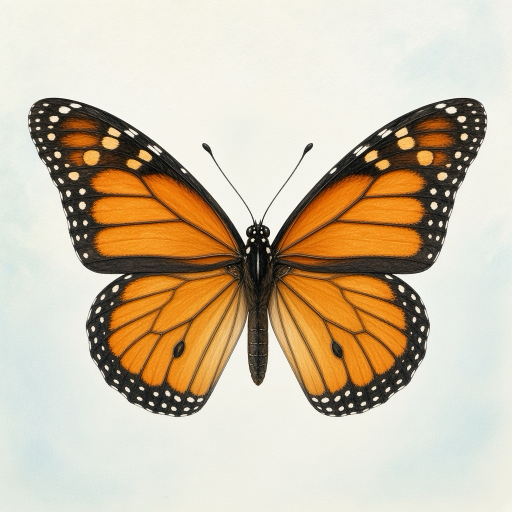
A butterfly is a flying insect with four wings covered in tiny colored scales. Butterflies start life as caterpillars, then change inside a hard case called a chrysalis, and come out with wings. There are about 17,500 to 20,000 different kinds of butterflies in the world.
Why butterflies are surprising
Butterflies do many things that sound made up but are real. They taste with their feet. They drink through a long, curly tongue that uncoils like a party blower. The blue color on a Morpho butterfly is not paint. The wings have tiny shapes on them that bounce blue light to your eyes. If you crushed the wing, the blue would disappear because the shapes would be gone.
A caterpillar does not just grow wings. Inside the chrysalis, some larval tissues break down while other organs are remodeled and kept. Groups of developing cells called imaginal primordia grow into adult structures such as wings, legs, and eyes. The caterpillar does not completely dissolve into soup.
Key facts about butterflies
Butterflies belong to the insect group Lepidoptera, which means “scale wings” in Greek. Moths belong to the same group.
A butterfly has six legs, four wings, two antennae, and two compound eyes made of thousands of tiny lenses.
Wings are covered in tiny overlapping scales. The scales give the wings their colors and patterns.
Butterflies do not chew. They have a long tube called a proboscis that they use like a straw to drink nectar.
The proboscis stays curled up under the head, then uncurls when it is time to drink.
Taste sensors called chemoreceptors sit on the feet. When a butterfly lands, it can taste through its toes.
The life cycle has four stages: egg, caterpillar (larva), chrysalis (pupa), and adult.
Caterpillars eat leaves and grow very fast. Adult butterflies drink nectar, fruit juice, and water from wet mud.
Most adult butterflies live only 2 to 4 weeks. Monarchs that fly to Mexico for the winter can live 6 to 9 months.
Monarch butterflies fly up to 3,000 miles (4,800 km) from the United States and Canada to forests in central Mexico. No single monarch makes the whole round trip; it takes several generations.
The biggest butterfly in the world is Queen Alexandra’s birdwing from Papua New Guinea. Females can have a wingspan of about 11 inches (28 cm).
The smallest butterfly in North America is the western pygmy blue. Its wingspan is only about 0.5 inch (12 mm), small enough to rest on a fingernail.
Butterflies can see colors humans cannot. Their eyes pick up ultraviolet light, and many flowers have hidden ultraviolet patterns that point to the nectar.
Butterflies pollinate flowers. When they drink nectar, pollen sticks to their bodies and rubs off on the next flower.
Most caterpillars eat only a limited range of plants. Monarch caterpillars depend on milkweeds and close relatives in the milkweed subfamily.
Common myths about butterflies
Myth: Butterflies make cocoons.
A butterfly caterpillar becomes a pupa called a chrysalis when it sheds its skin for the last time and the new outer cuticle hardens. Many moth caterpillars spin a silk cocoon around their pupae, but some moths pupate without one.
Myth: Butterflies only live one day.
Most butterflies live two to four weeks as adults. Some species, like the monarchs that fly to Mexico, live for many months. The mayfly, which is a different kind of insect, is the one that lives only a day or so.
Myth: A caterpillar grows wings on its back.
The caterpillar’s wings do not pop out. Inside the chrysalis, developing tissues that were already present in the larva grow into adult structures, while many larval tissues are remodeled or broken down.
Myth: Butterflies taste only with their mouths.
Butterflies take in liquid through mouthparts called a proboscis, but many taste a surface with sensors on their feet. A female can drum on a leaf and detect chemicals that help her decide whether it is a suitable place for eggs.
Myth: Butterfly wings are smooth and painted.
Butterfly wings are covered in thousands of tiny scales. Many colors, like the bright blue of a Morpho butterfly, come from the way the scales bend light, not from paint or pigment.
Frequently asked questions
How many kinds of butterflies are there?
About 17,500 to 20,000 species of butterflies live around the world, on every continent except Antarctica.
What do butterflies eat?
Adult butterflies drink nectar from flowers, juice from rotting fruit, and water from wet mud or sand. Caterpillars chew on leaves.
How do butterflies taste with their feet?
The feet have tiny taste sensors called chemoreceptors. When a butterfly lands, the sensors send a signal to its brain that tells it if the surface is food or a good place to lay eggs.
Why do monarchs fly to Mexico?
Mexico has cool, damp forests of oyamel fir trees high in the mountains. The trees keep monarchs from freezing and from drying out, so the butterflies can rest there until spring.
How do butterflies see color?
Butterflies have compound eyes with many color sensors. They can see ultraviolet light, which humans cannot, so flowers look different to a butterfly than they do to us.
What is the difference between a butterfly and a moth?
Butterflies usually fly during the day and have antennae ending in clubs. Many moths fly at night, and many have threadlike or feathery antennae. Resting wing position and cocoons can offer clues, but exceptions are common; both butterflies and moths pass through a pupal stage.
Source notes
The facts above come from the Smithsonian’s bug information page, the USDA Forest Service monarch butterfly pages, Encyclopaedia Britannica, and Wikipedia entries that cite peer-reviewed butterfly research. The full list of sources is in the frontmatter at the top of this page.
Each quiz question cites a source for the fact it tests. Play at Rookie, Curious, Sharp, or Expert.
A butterfly is a flying insect in the order Lepidoptera, the same group that includes moths. Butterflies have four wings covered in tiny overlapping scales, drink through a long coiled tube called a proboscis, and develop through complete metamorphosis from egg to caterpillar to chrysalis to adult. About 17,500 to 20,000 butterfly species live across every continent except Antarctica, out of roughly 160,000 to 180,000 total Lepidoptera species when moths are included.
Why butterflies are surprising
Butterflies look fragile, but a single painted lady can fly thousands of miles across deserts and oceans. They drink with a tongue that uncoils on demand. They taste with their feet. The blue of a Morpho butterfly is not pigment at all; it comes from the way light bounces off microscopic ridges on the wing scales. If you wet a Morpho wing, the blue shifts because the gaps between the ridges fill with water and the light reflects differently.
The strangest part is what happens inside a chrysalis. A caterpillar does not just sprout wings, but it does not completely dissolve either. Some larval tissues break down, many organs are remodeled, and developing tissues called imaginal primordia grow into adult structures such as wings, legs, eyes, and antennae.
Key facts about butterflies
The order Lepidoptera means “scale wings” in Greek. About 90 percent of Lepidoptera species are moths and only about 10 percent are butterflies.
Modern classifications place butterflies in the superfamily Papilionoidea, divided into seven families: swallowtails, whites and sulphurs, gossamer-wings, metalmarks, brush-foots, skippers, and the moth-like hedylids.
Butterfly wings are thin, chitin-containing membranes covered in thousands of overlapping scales. The scales are flattened, modified bristles called setae.
Wing colors come from two sources. Pigments absorb most light and reflect one color back. Structural colors, like the metallic blue of Morpho butterflies, come from light bouncing off layers of nanoscale ridges.
Butterflies have compound eyes that contain thousands of small lenses, each pointing in a slightly different direction. They can also see ultraviolet light, which is invisible to humans.
Many flowers have ultraviolet patterns called nectar guides that act like landing strips, pointing toward the nectar. The butterfly sees the pattern; we do not.
The proboscis is a long, flexible tube formed from two halves that interlock when the adult butterfly emerges. The butterfly straightens it by pumping fluid pressure into the base, then sucks liquid up using a small pump in the head.
Butterflies have taste sensors called chemoreceptors on the bottoms of their feet. A female “drums” her front feet on a leaf to taste it before laying eggs there.
Caterpillars chew with mandibles and usually shed their skin several times as they grow. The number of larval molts varies by species and conditions.
A chrysalis is the butterfly’s pupa. It is not a spun container: the pupal cuticle is revealed at the final larval molt and then hardens. Many moth caterpillars spin silk cocoons around their pupae, but not all moths do.
Most adult butterflies live two to four weeks. The monarch generation that flies to Mexico, sometimes called the Methuselah generation, can live 6 to 9 months.
Monarchs (Danaus plexippus) migrate up to 3,000 miles (4,800 km) from southern Canada and the northern United States to oyamel fir forests in the mountains of central Mexico, at elevations around 9,800 feet (3,000 m).
The painted lady (Vanessa cardui) makes the longest known butterfly migration. Up to six successive generations cover a round trip of about 9,000 miles (14,500 km) between sub-Saharan Africa and northern Europe each year.
Queen Alexandra’s birdwing (Ornithoptera alexandrae) of Papua New Guinea is the largest butterfly in the world. Females can reach a wingspan of about 11 inches (28 cm).
The western pygmy blue (Brephidium exilis) is the smallest butterfly in North America, with a wingspan of about 0.5 inch (12 mm), small enough to rest on a fingernail.
The glasswing butterfly (Greta oto) has see-through wing regions covered by irregular wax-coated nanopillars. Their changing height and spacing create a gradual optical transition that suppresses reflection across many wavelengths and viewing angles.
Monarch caterpillars depend on milkweeds and close relatives. They can store defensive chemicals called cardenolides, but the amount and potency vary with the host plant and butterfly. Predators differ in their tolerance, so monarchs are not equally unpalatable in every place.
The viceroy butterfly closely resembles the monarch. A 1991 feeding study found that viceroys from the tested population were also unpalatable, overturning the simple textbook story of a harmless mimic. Palatability varies geographically, so the relationship is more complicated than one label everywhere.
In December 2024, the U.S. Fish and Wildlife Service proposed listing the monarch as a threatened species under the Endangered Species Act because of habitat loss and pesticide use.
Common myths about butterflies
Myth: Butterflies and moths build cocoons.
A butterfly caterpillar sheds its skin one last time and reveals the pupal cuticle, which hardens as a chrysalis. Many moth caterpillars spin a silk cocoon around the pupa, but others pupate in soil, leaves, or an exposed site without a cocoon.
Myth: A caterpillar grows wings on its back.
Adult wings, legs, eyes, and antennae develop from imaginal primordia that began growing during larval life. Other tissues follow different fates: some break down, some are remodeled, and some persist. The caterpillar does not simply liquefy and get rebuilt from a few surviving discs.
Myth: Butterflies live only one day.
Most butterflies live two to four weeks as adults. The migrating monarch generation lives 6 to 9 months. The “lives only a day” insect is the mayfly, which is in a different order entirely.
Myth: All butterfly colors come from pigment.
Many of the brightest blues and greens, including the famous Morpho blue, come from light bouncing off nanoscale structures in the wing scales, not from any blue chemical. There are very few true blue pigments in nature.
Myth: Butterflies sip nectar like a straw.
Capillary action helps liquid enter the proboscis, while a muscular pump in the head creates pressure differences that sustain flow. It is an active microfluidic feeding system, not simply a passive drinking straw.
Myth: The viceroy mimics the monarch and gets away with looking dangerous.
That was the textbook story for decades, but feeding tests in 1991 found that viceroys from the studied population were also rejected by birds. Later work shows geographic variation in both species’ defenses, so shared-warning, one-sided mimicry, or an intermediate relationship may apply in different populations.
Frequently asked questions
How many butterfly species are there?
About 17,500 to 20,000 described butterfly species, plus thousands more moth species. The total number of Lepidoptera species is around 160,000 to 180,000.
Where do monarchs go in winter?
Most monarchs east of the Rocky Mountains migrate to central Mexico. Western monarchs use coastal California sites, but tagging and genetic evidence also show movement across the Rockies and migration from the West to Mexico, so the two routes are not completely separate.
How do butterflies survive long migrations?
Fall monarchs enter a state of reproductive diapause in which mating and egg development are delayed. They store fat and conserve energy, helping them live for months and migrate thousands of miles.
Why do butterflies sit on wet ground?
That behavior is called puddling. Males of many species take up sodium and other dissolved minerals from damp soil. In some species, part of that sodium can be transferred to a female in the spermatophore during mating.
Are butterflies good pollinators?
They pollinate many wildflowers. Butterflies often carry less pollen per visit than bees, but effectiveness depends on the plant, visitor behavior, and how the insect contacts the flower.
Why are monarchs in trouble?
Milkweed has disappeared from farmland and roadsides, herbicides have wiped out host plants, climate change has made weather less predictable, and logging has thinned the Mexican overwintering forest. The U.S. Fish and Wildlife Service proposed listing the monarch as threatened in December 2024.
Source notes
These facts come from the Smithsonian, USDA Forest Service, U.S. Fish and Wildlife Service, the American Museum of Natural History, Encyclopaedia Britannica, and peer-reviewed studies cited in the Wikipedia entries on the painted lady, glasswing, and viceroy. Specific numbers come from the museum collection records and migration studies linked in the frontmatter.
Each quiz question cites a source for the fact it tests. Play at Rookie, Curious, Sharp, or Expert.
A butterfly is a flying insect in the order Lepidoptera, defined by four membranous wings covered with overlapping rows of scales, a coiled feeding tube called a proboscis, and complete metamorphosis through egg, larva, pupa, and adult stages. Butterflies belong to the superfamily Papilionoidea and account for roughly 17,500 to 20,000 of the 160,000 to 180,000 described Lepidoptera species; the rest are moths. They occur on every continent except Antarctica and have been the subject of naturalist study from at least the seventeenth-century work of Maria Sibylla Merian onward.
Why butterflies are scientifically interesting
Butterflies pack an outsized amount of biology into a small body. They remodel larval anatomy and grow specialized adult tissues inside the chrysalis, complete continent-scale migrations using solar and other orientation cues, generate saturated blues from layered chitin rather than pigment, and provide well-studied examples of Batesian and Müllerian mimicry. Understanding these systems draws on optics, biochemistry, neurobiology, and evolutionary ecology.
Butterflies also serve as ecological indicators. Their populations rise and fall with land use, pesticide regimes, and climate, and large-scale citizen science programs like Monarch Watch have produced multi-decade datasets that few other groups of insects can match. The 2024 U.S. Fish and Wildlife Service proposal to list the migratory monarch as threatened under the Endangered Species Act was based in part on tag-and-recovery data collected by volunteers since the 1990s.
Key facts about butterflies
The order Lepidoptera (“scale wings” in Greek) contains 160,000 to 180,000 described species. Butterflies, in the superfamily Papilionoidea, make up about 10 to 12 percent of that total.
Modern phylogenetic classifications recognize seven living butterfly families in Papilionoidea: Papilionidae, Pieridae, Lycaenidae, Riodinidae, Nymphalidae, Hesperiidae, and the moth-like Hedylidae. Older summaries often listed six by omitting Hedylidae.
Butterfly wings consist of two thin chitin membranes covered by overlapping cover scales and ground scales. The scales are flat, modified setae, the same developmental origin as insect hairs.
Wing color comes from two physically distinct sources. Pigments such as melanins and pterins absorb specific wavelengths. Structural color arises from interference, diffraction, or scattering by nanoscale ridges, lamellae, and air gaps in the scale architecture. The metallic blue of Morpho species is structural, produced by Bragg reflection from stacked chitin lamellae arranged in a Christmas-tree cross-section on each scale ridge.
Butterfly compound eyes contain thousands of ommatidia and several distinct spectral receptor classes. The common bluebottle Graphium sarpedon has 15 measured spectral sensitivities, the largest number reported for an insect, although not all necessarily contribute to color vision. The Japanese yellow swallowtail Papilio xuthus has fewer receptor classes and behaves as a tetrachromat in tested foraging tasks.
Many flowers display ultraviolet nectar guides that are invisible to humans but appear as bullseye patterns to insect visitors.
The proboscis develops as two separate galeae in the pupa, then zips together along a row of interlocking teeth and pegs after eclosion. Capillary forces pull the two halves together; saliva and surface tension finish the assembly.
During feeding, capillary action carries liquid into the food canal and a cibarial pump in the head generates the suction. The proboscis is not a passive straw; it is a self-cleaning microfluidic system.
Tarsal chemoreceptors allow butterflies to taste with their feet. Females of many species drum their forelegs on a leaf surface to read its chemical profile before depositing an egg.
Butterflies undergo holometabolous, or complete, metamorphosis. Inside the chrysalis, tissues have varied fates: some larval tissues undergo programmed breakdown, others are extensively remodeled, and imaginal primordia that grew during larval stages form many adult structures. The popular image of an almost wholly liquid caterpillar is inaccurate.
A chrysalis is a butterfly pupa whose pupal cuticle is exposed and hardens after the final larval molt. Many moths spin silk cocoons around the pupa, while many others do not. A cocoon is a covering; a pupa is a developmental stage, so the terms are not interchangeable.
Caterpillars feed almost entirely on plant tissue, often on a narrow range of host species. Adult butterflies feed on flower nectar, tree sap, rotting fruit, and dissolved minerals from wet soil. Adults of some species, including most Heliconius, also collect and digest pollen, an unusual trait that supplies amino acids and supports adult lifespans of up to six months in the wild.
Most adult butterflies live 2 to 4 weeks. The fall generation of monarchs, sometimes called the Methuselah generation, enters reproductive diapause and lives 6 to 9 months in order to migrate to overwintering sites and return north in spring.
Eastern North American monarchs migrate up to 3,000 miles (4,800 km) to oyamel fir forests in the Transvolcanic Belt of central Mexico, at elevations of 7,900 to 11,800 feet (2,400 to 3,600 m). Western monarchs overwinter along the California coast.
The painted lady (Vanessa cardui) makes one of the longest known multigenerational butterfly migrations. Across roughly six successive generations, populations can link tropical Africa and northern Europe over a circuit estimated near 9,000 miles (14,500 km). A 2024 Nature Communications study inferred from multiple lines of evidence that a group found in French Guiana had crossed at least 2,600 miles (4,200 km) from West Africa; no individual was tracked across the ocean.
Queen Alexandra’s birdwing (Ornithoptera alexandrae) of Papua New Guinea is the largest butterfly. Female wingspans reach 10 to 11 inches (25 to 28 cm).
The western pygmy blue (Brephidium exilis) is the smallest butterfly in North America, with a wingspan of 0.5 to 0.8 inch (12 to 20 mm).
The glasswing butterfly (Greta oto) of Central and South America has transparent wings whose see-through regions are studded with irregular wax-coated nanopillars. The random distribution of pillar heights and widths produces an effective refractive-index gradient that suppresses reflections across the visible spectrum and across viewing angles.
Monarch caterpillars feed on milkweeds and close relatives in the milkweed subfamily and can sequester plant-derived cardenolides. These compounds inhibit sodium-potassium ATPase, but their abundance and potency vary among host plants and butterflies. Orange-and-black coloration can warn predators, whose tolerance also varies.
The viceroy (Limenitis archippus) was long taught as a Batesian mimic of the monarch. A 1991 Ritland and Brower feeding study found viceroys from the tested population about as unpalatable as monarchs, supporting Müllerian mimicry there. Later work found geographic variation in defense, so the interaction can vary among populations.
Butterfly populations have declined sharply in many parts of North America and Europe over the past several decades. The U.S. Fish and Wildlife Service proposed listing the monarch as threatened under the Endangered Species Act in December 2024; the IUCN Red List currently classifies the migratory monarch as Vulnerable.
Common myths about butterflies
Myth: Butterflies emerge from cocoons.
Cocoons are silk coverings that moth caterpillars build around themselves before pupating. Butterfly caterpillars form a chrysalis, which is a hardened pupal cuticle revealed when the caterpillar sheds its skin for the last time.
Myth: A caterpillar gradually grows wings.
Wings, legs, eyes, and antennae develop from imaginal primordia that grow during larval life. Other tissues do not share one fate: some undergo histolysis, some are remodeled, and some persist into the adult. The process is a coordinated transformation, not near-total dissolution.
Myth: The blue of a Morpho butterfly is pigment.
The Morpho blue is structural, produced by interference of light reflecting off layered chitin nanostructures on each wing scale. Crushing the scales destroys the geometry and removes the color, even though the underlying chitin and any actual pigments are still present.
Myth: Butterflies live only a day.
Most adult butterflies live 2 to 4 weeks. Overwintering monarchs live 6 to 9 months. Mayflies, in the order Ephemeroptera, are the insects with adult lifespans measured in hours to days.
Myth: The viceroy is a harmless mimic of the monarch.
The Ritland and Brower 1991 study found similar rejection of viceroys and monarchs from the tested populations, supporting Müllerian mimicry in that setting. Because defenses vary geographically, the balance between Müllerian and Batesian effects is not identical across the species’ entire ranges.
Myth: A butterfly drinks nectar by sucking through a straw.
The proboscis combines capillary uptake along the food canal with active pumping by a muscular cibarial pump in the head. The two-halves design relies on surface tension to interlock during eclosion and on saliva flow to keep the canal clear during feeding.
Myth: Butterflies are major crop pollinators.
Bees provide much of the documented animal pollination for cultivated crops. Butterflies pollinate many wildflowers and can be important for particular plants, but they often transport less pollen per visit than bees. Effectiveness depends on floral structure and visitor behavior.
Frequently asked questions
How many butterfly species exist?
About 17,500 to 20,000 described species in the superfamily Papilionoidea. The total Lepidoptera order, including moths, contains roughly 160,000 to 180,000 described species, with thousands more likely undescribed in the tropics.
What is the difference between a butterfly and a moth?
Butterflies are mostly diurnal, hold their wings vertically over the body at rest, and have clubbed antennae. Moths are mostly nocturnal, fold their wings flat or roof-like over the body, and have feathery or filamentous antennae. The split is taxonomic rather than crisp; some day-flying moths and some clubbed-antenna moths blur the visual rules.
How does monarch migration work without any individual making the round trip?
Three or four short-lived summer generations breed northward through the spring and summer. The fall generation enters diapause, suppresses reproduction, lives 6 to 9 months, and flies thousands of miles south. Those individuals start the return migration in spring, breed once they reach milkweed habitat, and the next generation continues north.
Why is the painted lady’s migration so long?
The painted lady tracks seasonal rainfall and host-plant availability across the Sahara and Mediterranean basin. The full cycle requires up to six generations because no single butterfly lives long enough to complete the round trip; each generation breeds, dies, and is replaced as the wave moves north or south.
Why do flowers look different to butterflies?
Butterflies have additional photoreceptor classes, including ultraviolet sensitivity and in some species multiple long-wavelength receptors. Many flowers display nectar guides in the ultraviolet that are invisible to human eyes but stand out as targets to a foraging insect.
What do butterflies eat as adults besides nectar?
Tree sap, rotting fruit, animal sweat, and dissolved minerals from damp soil. Heliconius butterflies are unusual in that they actively gather and digest pollen, which extends adult lifespan and supports egg production.
Are butterflies in trouble?
Many species are declining. The migratory monarch was proposed for listing as threatened under the U.S. Endangered Species Act in December 2024. Habitat conversion, pesticide use, herbicide-driven loss of milkweed, climate change, and degradation of the Mexican overwintering forest all contribute.
Source notes
The facts above are drawn from Encyclopaedia Britannica, the USDA Forest Service monarch program, the American Museum of Natural History, the U.S. Fish and Wildlife Service, peer-reviewed work in Nature, Nature Communications, Proceedings of the Royal Society B, and the Journal of the Royal Society Interface, and the Wikipedia entries that cite them. Specific quantitative claims, including the 28 cm Queen Alexandra’s birdwing wingspan, the 3,000-mile monarch route, the 9,000-mile painted lady cycle, and the Ritland and Brower viceroy result, are linked in the frontmatter.
Each quiz question cites a source for the fact it tests. Play at Rookie, Curious, Sharp, or Expert.
A butterfly is a holometabolous insect of the order Lepidoptera, superfamily Papilionoidea, characterized by two pairs of scaled membranous wings, a coilable galeal proboscis, usually clubbed antennae, and a four-stage life cycle of egg, larva, pupa (chrysalis), and imago. Papilionoidea contains roughly 17,500 to 20,000 described species across seven living families: Hedylidae, Hesperiidae, Papilionidae, Pieridae, Lycaenidae, Riodinidae, and Nymphalidae. Older classifications placed skippers in Hesperioidea and moth-like hedylids in Hedyloidea; molecular phylogenies place both within Papilionoidea.
Why butterflies remain interesting
Butterflies sit at the intersection of unusually deep natural-history records and several active research frontiers. Linnaeus described butterfly type specimens in the 10th edition of Systema Naturae in 1758, the edition that anchors zoological binomial nomenclature. Henry Walter Bates collected the first detailed evidence for adaptive mimicry in Amazonian Heliconius in 1862. Ronald Fisher and J. B. S. Haldane built parts of the modern evolutionary synthesis on butterfly polymorphism. Today the same group anchors work on photonic crystals, lepidopteran phylogenomics, supergene architecture (the Heliconius mimicry switch in the cortex and optix loci), insect navigation (the monarch sun compass), and large-scale insect decline. Few other animal lineages span entomology, optics, conservation genetics, and citizen science as cleanly.
The chrysalis stage concentrates extensive developmental remodeling into a short interval. Tissue fate is heterogeneous: some larval cells undergo autophagy or programmed death, some organs are remodeled, and imaginal primordia that already grew during larval instars enter morphogenetic growth under endocrine control. This coordinated transformation produces the adult wing and body patterns that make butterflies useful evo-devo models, particularly in Heliconius, Bicyclus, and Vanessa.
Key facts about butterflies
The order Lepidoptera contains roughly 160,000 to 180,000 described species. Butterflies represent only about 10 to 12 percent; the rest are moths. Total species richness is likely much higher, with substantial undescribed diversity in tropical microlepidoptera.
Lepidopteran wings carry overlapping rows of cover and ground scales, each scale a flattened, modified seta secreted by a single trichogen cell. F-actin bundles within the developing scale prefigure the longitudinal ridges that organize the mature scale’s optical and structural properties.
Wing pigments include melanins (browns and blacks), pterins (whites, yellows, oranges, reds, characteristic of Pieridae), papiliochromes (Papilionidae yellows), and ommochromes (reds and browns from tryptophan-derived pathways). True blue and green pigments are rare; most blues and greens are structural.
Structural color in Morpho species arises from one-dimensional photonic structures: stacked lamellae of cuticle and air on the sidewalls of each scale ridge, arranged in a cross-section sometimes described as Christmas-tree-like. Coherent scattering across these layers produces a strong specular reflection in the blue around 450 to 500 nm; a transparent overlying glass scale acts as a diffuser, broadening the angular response.
The glasswing Greta oto uses a different photonic strategy. Its transparent membrane is studded with irregular wax-coated nanopillars whose random height and width distribution generates an effective refractive-index gradient. The result is omnidirectional anti-reflection that holds across the visible spectrum and out to incidence angles approaching 80 degrees, as documented in a 2015 Nature Communications paper.
Many butterfly compound eyes are of the apposition type and contain thousands of ommatidia. The papilionid Graphium sarpedon has 15 measured spectral sensitivities, a record among studied insects, produced by opsins plus optical filtering; not all 15 are necessarily color-vision channels. A 2021 Journal of Experimental Biology paper demonstrated ultraviolet color discrimination in female Heliconius erato associated with two UV opsins.
The proboscis is built from two galeae that interlock after eclosion. Capillary forces draw the two halves together along rows of legulae; saliva flow finalizes the seal. During feeding, capillary uptake at the drinking region transports liquid into the food canal, while the cibarial pump in the head provides the suction. The system functions as a self-cleaning, hierarchically porous microfluidic channel rather than a simple passive straw.
Tarsal contact chemoreception is concentrated in sensilla on the foreleg tarsi. Ovipositing females can detect low concentrations of sugars and plant secondary compounds, helping them discriminate among potential host plants; thresholds vary by compound and species.
Holometaboly is regulated by ecdysteroid pulses interacting with juvenile-hormone signaling. A low juvenile-hormone environment during the final larval stage permits pupal commitment. Imaginal primordia specified earlier continue growth and morphogenesis to form many adult structures, while other adult organs arise by remodeling larval tissues.
Eastern North American monarchs (Danaus plexippus plexippus) migrate up to about 3,000 miles (4,800 km) to oyamel fir (Abies religiosa) forests in 11 to 12 mountain colonies in the Transvolcanic Belt of central Mexico, at 7,900 to 11,800 feet (2,400 to 3,600 m). The fall migratory generation enters reproductive diapause, lives 6 to 9 months, and uses a time-compensated sun compass with antennal circadian input plus magnetic-inclination cues to maintain heading.
The painted lady (Vanessa cardui) executes an exceptionally long multigenerational migration. Up to six successive generations can link sub-Saharan Africa and northern Europe over an annual circuit estimated near 9,000 miles (14,500 km). A 2024 Nature Communications study inferred from genomic, isotope, pollen, and wind evidence that a group found in French Guiana had crossed at least 2,600 miles (4,200 km) from West Africa over roughly 5 to 8 days; no individual was tracked across the ocean.
Queen Alexandra’s birdwing (Ornithoptera alexandrae), restricted to the Oro Province of Papua New Guinea, is generally recognized as the largest living butterfly. Female wingspans can reach about 10 to 11 inches (25 to 28 cm). Albert Stewart Meek collected the type material in 1906, Walter Rothschild named the species in 1907 for Queen Alexandra, and CITES lists it in Appendix I.
The western pygmy blue (Brephidium exilis), a lycaenid of the southwestern United States and adjacent Mexico, has a wingspan of 0.5 to 0.8 inch (12 to 20 mm), the smallest documented for a North American butterfly.
Monarch larvae sequester cardenolides from milkweeds and related hosts. These steroidal compounds inhibit sodium-potassium ATPase. Monarchs have evolved substitutions that reduce their own target sensitivity, while selective sequestration and metabolism can reduce exposure to some especially potent compounds. Defensive chemistry varies with host plant and is advertised by aposematic coloration.
Ritland and Brower’s 1991 Nature experiment, which offered wingless abdomens to red-winged blackbirds to control visual cues, found viceroys rejected at rates similar to monarchs in the tested populations. That result overturned the universal textbook treatment of the viceroy as a harmless Batesian mimic and supported Müllerian mimicry locally. Subsequent evidence of geographic variation means neither relationship should be imposed on every population.
Heliconius butterflies independently evolved active pollen feeding. Saliva-mediated extraction of amino acids from pollen accumulated on the proboscis supports adult lifespans of months. A 2026 synthesis reported a maximum captive record of 348 days for Heliconius hewitsoni, among the longest documented butterfly adult lifespans, and found delayed physiological decline relative to close relatives.
The U.S. Fish and Wildlife Service published a proposed rule on December 12, 2024, to list the migratory monarch butterfly as threatened under the Endangered Species Act, including a 4(d) rule. The IUCN Red List currently classifies the migratory monarch as Vulnerable, downgraded from Endangered after a population reassessment in 2023.
Common myths about butterflies
Myth: Butterflies emerge from cocoons.
Cocoons are silk structures that many moth larvae spin around a pupa. Butterfly pupae are called chrysalides and usually have an exposed pupal cuticle after the final larval molt. A cocoon is a covering and a chrysalis is a pupal stage, although pupation habits vary widely among lepidopteran families.
Myth: A caterpillar’s tissues simply rearrange into adult form.
Larval tissues follow several paths during the pupal stage: some undergo autophagy or apoptosis, some are extensively remodeled, and others persist. Adult structures arise from imaginal primordia that were specified earlier and grew during larval instars before switching to morphogenetic growth. The transformation is not a complete liquefaction followed by reconstruction from dormant discs.
Myth: Morpho blue is a pigment.
The structural color of Morpho arises from coherent scattering and interference among stacked chitin lamellae and air gaps within each scale ridge. Disrupting the geometry, for example by mechanical damage or by infiltrating the air gaps with a high-index liquid, eliminates or shifts the blue without altering any underlying pigment.
Myth: The viceroy is a Batesian mimic of the monarch.
The 1991 Ritland and Brower experiment demonstrated comparable unpalatability in the populations tested, supporting Müllerian rather than Batesian mimicry there. Subsequent work has shown geographic variation in palatability, so the old universal Batesian framing is wrong but the interaction need not be purely Müllerian everywhere.
Myth: Butterflies feed by passive capillary action alone.
Capillary uptake initiates fluid intake at the drinking region, but a muscular cibarial pump in the head supplies the negative pressure that drives sustained feeding. The proboscis also self-cleans through saliva flow and mechanical opening cycles. The system is closer to a microfluidic pump than to a soda straw.
Myth: All butterflies live only a few weeks.
The 2 to 4 week figure applies to most non-diapausing adults. Migratory monarchs in reproductive diapause live 6 to 9 months. Pollen-feeding Heliconius species routinely live for several months and have been recorded living for nearly a year in captivity.
Myth: Butterflies are major pollinators of cultivated crops.
Bees dominate cultivated-crop pollination by visit rate, pollen load, and floral fidelity. Butterflies are important pollinators of many wildflowers and contribute to ecosystem-level pollination, but their role in agricultural pollination is secondary.
Frequently asked questions
Where do butterflies fall in the lepidopteran phylogeny?
Modern molecular phylogenies place butterflies as a monophyletic clade within Lepidoptera. Within Papilionoidea, analyses consistently recover Papilionidae as an early-diverging lineage and Hedylidae close to Hesperiidae; relationships among Pieridae, Nymphalidae, Lycaenidae, and Riodinidae are resolved with increasing genomic sampling. Exact sister-group wording should follow the particular phylogeny and taxon sample used.
How does the monarch sun compass work?
Monarch orientation uses a brain sun-compass circuit informed by circadian clocks in the antennae. Classic experiments found that removing the antennae or covering them with opaque paint disrupted time-compensated direction, while clear paint did not. Laboratory studies also support an inclination-based magnetic compass under overcast conditions, although the relative use of cues in the wild remains under study.
Why are Heliconius butterflies so long-lived?
Pollen feeding supplies Heliconius adults with substantial amino acids beyond a typical nectar diet. Tracer studies show pollen-derived nutrients reaching eggs. Comparative work associates the dietary shift with longer lifespan and slower reproductive or physiological decline, while the underlying immune and oxidative-stress mechanisms remain active research topics.
What explains the variety of color receptors in butterflies?
Beyond a baseline of UV, blue, and green opsins shared with most insects, several lineages have duplicated long-wavelength opsins and added filter pigments in front of specific ommatidia, producing finer spectral discrimination. The leading hypothesis is that elaborated color vision supports both host-plant identification and the recognition of conspecifics whose own wing color is structural and strongly UV-modulated.
Why does the viceroy resemble the monarch if both are unpalatable?
Where monarchs and viceroys are both well defended, sharing a warning pattern can reduce the per-individual cost of educating naive predators, the logic of Müllerian mimicry. Where one population is less defended, the interaction can include Batesian effects instead. Their resemblance is therefore a useful example of a mimicry relationship that changes with geography and chemistry.
Why are monarch numbers declining?
The drivers are well documented: loss of milkweed across farm fields following the adoption of glyphosate-tolerant crops, broader pesticide pressure, herbicide-driven loss of nectar plants on roadsides and pastures, climate change altering breeding-range phenology, and degradation of the Mexican overwintering forest. The combined pressures motivated the 2024 U.S. Fish and Wildlife Service proposal to list the migratory monarch as threatened under the Endangered Species Act.
Are butterflies generally declining as a group?
Long-term monitoring datasets in Europe and North America document substantial declines in many common species, with land-use change and pesticide pressure as dominant drivers. The signal varies by region and species; some habitat generalists are stable or expanding, while specialists tied to specific host plants or microhabitats have declined sharply. Butterflies remain valuable bioindicators in part because the monitoring infrastructure exists to detect those changes.
Source notes
The numerical and mechanistic claims above are drawn from peer-reviewed sources: Ritland and Brower’s 1991 Nature paper on viceroy palatability, the 2015 Nature Communications glasswing nanopillar study, the 2018 Journal of the Royal Society Interface paper on proboscis self-assembly, the 2020 Proceedings of the Royal Society B review on Heliconius pollen feeding, the 2021 PNAS work on monarch cardenolide sequestration, the 2023 PNAS painted-lady Afrotropical breeding paper, and the 2024 Nature Communications report on the transatlantic painted-lady crossing. Conservation status and migration distances come from the U.S. Fish and Wildlife Service and the USDA Forest Service. Wingspan and species-distribution figures come from the American Museum of Natural History, Encyclopaedia Britannica, and Wikipedia entries that cite primary museum records. Full URLs are listed in the frontmatter.
Each quiz question cites a source for the fact it tests. Play at Rookie, Curious, Sharp, or Expert.
Think you know Butterflies?
Test yourself. Can you spot the true fact among 3 convincing bluffs?