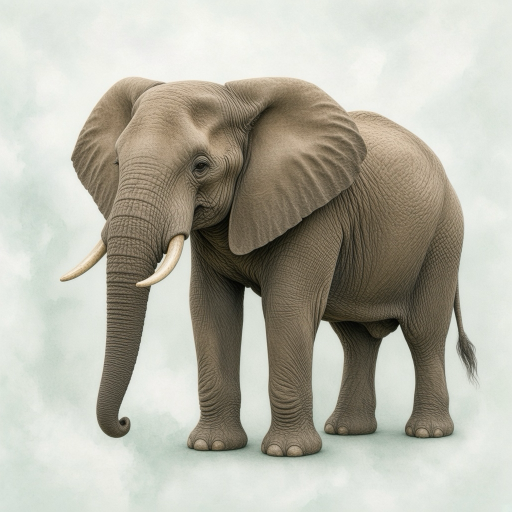
An elephant is the biggest animal that lives on land. Elephants are gray, plant-eating animals with huge ears, thick legs, and a long trunk. They live in the wild in Africa and in Asia. A big African bush elephant can weigh several tons.
Why elephants are amazing animals
The first thing people notice about an elephant is its trunk. The trunk is the elephant’s nose and its hand at the same time. An elephant breathes and smells through it, and it also uses the trunk to grab food and pull down branches. The trunk is strong enough to lift a heavy log. It is also gentle enough to pick up one single blade of grass.
An elephant’s trunk has no bones inside it. It is a muscular hydrostat, so muscle contractions let it bend, lengthen, shorten, twist, or become temporarily stiff enough to push and lift.
Elephants are also very smart. They have the biggest brain of any animal on land. Elephants remember places they have been, even years later. They can find a water hole they have not visited in a long time. They also know other elephants in their family and greet them when they meet.
Key facts about elephants
Elephants are the biggest land animals on Earth. A large African bush elephant can weigh several tons.
An elephant’s trunk works like a nose and a hand. It can smell, grab food, suck up water, and lift heavy logs.
Elephants have the biggest brain of any land animal. It weighs about 11 pounds (5 kg).
A baby elephant is called a calf. A newborn calf can weigh about 200 pounds (90 kg) and can walk within a few hours.
Elephants cannot jump. They always keep at least one foot on the ground, even when they run.
Elephants have huge ears that help them stay cool. Flapping the ears moves air and cools the blood inside them.
An elephant’s tusks are really long teeth. They keep growing as the elephant gets older.
Elephants live in family groups called herds. A herd is usually mothers, aunts, sisters, and their babies.
Elephants are plant-eaters. They eat grass, leaves, bark, and fruit, and they spend most of the day eating.
Elephants live in Africa and in Asia. African elephants have bigger ears than Asian elephants.
Common myths about elephants
Myth: Elephants drink straight through their trunk like a straw. Elephants do not swallow water down the trunk. They suck water partway up the trunk, then curl it to their mouth and squirt the water in.
Myth: An elephant’s trunk has bones in it. The trunk has no bones. Interwoven muscles let it change shape, stiffen, bend, curl, grasp, and push.
Myth: Elephants can jump. Elephants cannot jump. Their bodies are too heavy, and their legs are not built for it. They always keep a foot on the ground.
Myth: Elephants are afraid of mice. There is no good proof that elephants fear mice. An elephant might get startled if something small darts by quickly, but it is not scared of a mouse.
Myth: An elephant’s tusks are made of bone. Tusks are not bone. They are very long teeth, made of the same hard stuff as the elephant’s other teeth.
Frequently asked questions about elephants
What is the biggest land animal in the world?
The elephant is the biggest land animal in the world. The largest species is the African bush elephant, whose biggest males can weigh several tons. No living land animal is bigger.
What does an elephant use its trunk for?
An elephant uses its trunk to breathe, to smell, and to pick things up. It grabs food, pulls down branches, and sucks up water to squirt into its mouth. The trunk can lift heavy logs, and it can also pick up a single blade of grass.
Where do elephants live?
Wild elephants live in Africa and in Asia. They live in forests, grasslands, and other warm places. African elephants have bigger ears than Asian elephants. There are no wild elephants at the North Pole or the South Pole, because those places are far too cold.
Why can’t elephants jump?
Elephant limb anatomy is specialized for supporting great weight, with less spring-like movement than many running mammals. Researchers have not observed elephants jumping, and measured fast gaits keep at least one foot on the ground.
What do elephants eat?
Elephants are plant-eaters. They eat grass, leaves, bark, and fruit. An elephant has to eat a lot, so it spends most of the day feeding. It does not eat meat at all.
Each of this topic’s quiz questions cites a source for the fact it tests. You can play at any level: Rookie, Curious, Sharp, or Expert.
An elephant is the largest living land animal, a plant-eating mammal known for its long trunk, large ears, and tusks. Three kinds of elephant live today: two in Africa and one in Asia. Elephants are highly social animals that live in family groups and can communicate over long distances. The African elephant is the biggest, with males weighing several tons.
Why elephants are more surprising than they look
Most people can picture an elephant, but a lot of the details are surprising. Take the trunk. It looks like a simple hose, but it is one of the most useful body parts in the animal world. The trunk has no bones, so it can bend in any direction. It works as a nose, a hand, a hose, and even a snorkel when an elephant wades into deep water.
The way an elephant drinks is surprising too. People often think an elephant drinks straight through its trunk, like sipping through a straw. It does not. An elephant sucks water partway up the trunk, then curls the trunk back to its mouth and squirts the water in. A trunk can hold a couple of gallons of water at a time.
Another surprise is how elephants talk to each other. A lot of their calls are too low for human ears to hear. These deep rumbles, called infrasound, can travel for miles across open land. Two elephants far apart can stay in touch using sounds people standing right there would never notice.
Key facts about elephants
There are three living species of elephant. Two live in Africa, the African bush elephant and the African forest elephant, and one lives in Asia, the Asian elephant.
African elephants have bigger ears than Asian elephants. The large ears also help an elephant shed heat and stay cool.
Elephant gestation lasts about 18 to 22 months, depending on species. African elephants are near the upper end, the longest well-established gestation among living mammals.
A newborn calf weighs about 200 pounds (90 kg). It can stand and walk within a few hours, so it can keep up with the herd.
An elephant’s tusks are long teeth that keep growing. Elephants use them to dig for water, strip bark, and lift things.
An elephant has the largest brain of any land animal. It weighs about 11 pounds (5 kg) and helps with the elephant’s strong memory.
Elephants make sounds too low for people to hear. These deep rumbles can carry for miles.
Elephant family groups often follow a matriarch, typically an older, experienced female. Leadership can be distributed and group structure changes over time.
Healthy adult elephants face few natural predators. Calves are more vulnerable, and lions have sometimes attacked elephants, but full-grown adults are difficult prey.
Elephants cannot jump. They always keep at least one foot on the ground, even when running.
Common myths about elephants
Myth: There is only one kind of elephant. Scientists recognize three living species. Two live in Africa, the bush elephant and the forest elephant, and one lives in Asia.
Myth: Asian elephants have bigger ears than African elephants. It is the other way around. African elephants have the larger ears, and people sometimes say an African elephant’s ear is shaped a bit like the continent of Africa.
Myth: Elephants drink by swallowing water down their trunk. Elephants do not swallow water down the trunk. They suck it partway up, then squirt it into the mouth to drink.
Myth: An elephant family is led by the biggest male. Family groups center on related females and young and often follow an experienced matriarch. Males usually disperse as they mature, while leadership within a family can be flexible.
Myth: Elephants never forget anything. Elephants do have very good memories, but the saying is more story than science. They remember places, paths, and other elephants well, which helps them survive, but no animal remembers everything.
Frequently asked questions about elephants
How many kinds of elephant are there?
There are three living species of elephant. The African bush elephant and the African forest elephant live in Africa. The Asian elephant lives across parts of southern and southeast Asia. Many older relatives of elephants, such as the woolly mammoth, died out long ago.
What is the difference between African and Asian elephants?
The easiest difference to spot is the ears. African elephants have large ears, and Asian elephants have smaller, rounder ones. African elephants are also bigger overall. There is a difference at the tip of the trunk too: the African elephant’s trunk ends in two finger-like points, while the Asian elephant’s ends in one.
How long is an elephant pregnant?
Gestation varies by species and individual, with African elephants often near 22 months and Asian elephants commonly somewhat shorter on average. This is the longest well-established gestation among living mammals. Calves are born well developed enough to stand and walk soon after birth.
How do elephants communicate?
Elephants use many sounds, including loud trumpets and deep rumbles. Some of their rumbles are too low for human ears to hear. These low sounds, called infrasound, can travel for miles, so elephants far apart can stay in touch. Elephants also use touch, smell, and body movements to send messages.
Why are elephants endangered?
Elephant numbers have dropped because of two main problems. One is the loss of the wild land where they live, as people clear it for farms and towns. The other is poaching, where elephants are illegally killed for the ivory in their tusks. Many groups now work to protect elephants and the places they live.
Each of this topic’s quiz questions cites a source for the fact it tests. You can play at any level: Rookie, Curious, Sharp, or Expert.
An elephant is the largest living land animal, a large herbivorous mammal recognized by its long muscular trunk, broad ears, and tusks. Three species live today: the African bush elephant, the African forest elephant, and the Asian elephant. Elephants are long-lived, highly social animals that live in family groups and communicate over distances of several miles. A large male African bush elephant can weigh around 6 tons (5.4 metric tons) and stand more than 10 feet (3 m) tall at the shoulder.
Why elephants reward a closer look
An elephant is so familiar that its strangest features are easy to overlook. The trunk is the clearest example. It is a fusion of the nose and the upper lip, and it contains no bones. Instead it is packed with muscle, which lets it bend, twist, stretch, and grip in ways a jointed limb cannot. The same trunk can uproot a small tree and then pick up a single piece of fruit without crushing it. According to the San Diego Zoo, a trunk can lift around 700 pounds (320 kg) yet still handle a single blade of grass.
The way elephants drink also runs against the common picture. An elephant does not pull water all the way up the trunk and swallow it like a straw. It draws water partway into the trunk, then curls the trunk to its mouth and squirts the water in. The trunk works as a tool for collecting water, not as a drinking tube.
Elephant communication is a third surprise. Much of it happens below the range of human hearing. These low-frequency calls, known as infrasound, travel farther than higher-pitched sounds and can carry for miles across open country. Smithsonian’s National Zoo notes that elephant calls too low for people to hear can be picked up by other elephants more than 2 miles (3 km) away. The result is a kind of long-distance network that lets scattered family groups coordinate movement and respond to danger.
Key facts about elephants
There are three living species. The African bush (savanna) elephant and the African forest elephant live in Africa, and the Asian elephant lives across South and Southeast Asia. Genetic evidence helped establish the deep separation between the two African lineages.
The African bush elephant is the largest living land animal. Large bulls average around 6 tons (5.4 metric tons) and stand more than 10 feet (3 m) at the shoulder.
African and Asian elephants differ in several ways. African elephants are larger, have bigger ears, carry their highest point at the shoulder, and have two finger-like tips on the trunk. The Asian elephant has smaller ears, a domed head as its highest point, and one trunk tip.
Tusks are elongated incisor teeth that grow throughout life. In African elephants both sexes typically grow tusks; in Asian elephants prominent tusks are usually limited to some males.
Elephants replace their grinding teeth horizontally. New molars form at the back of the jaw and move forward, pushing out worn teeth at the front. An elephant goes through about six sets over its life.
Gestation lasts roughly 18 to 22 months, depending on species and individual, the longest well-established range among living mammals. Calf mass also varies; about 200 pounds (90 kg) is a useful broad illustration rather than a fixed birth weight.
An elephant has the largest brain of any land animal, about 11 pounds (5 kg), supporting strong spatial and social memory.
Family groups are matrilineal and often follow an older, experienced matriarch. Leadership is not always reducible to the single oldest animal. Young males generally disperse around maturity.
Elephants are herbivores that feed for much of the day, sometimes 16 hours or more, eating well over 100 pounds (45 kg) of vegetation.
All three species are threatened. The African forest elephant is Critically Endangered, and the African savanna and Asian elephants are Endangered.
A closer look at the trunk, tusks, and teeth
Tusks are not horns and not separate skull bones. They are elongated incisor teeth, specifically the upper incisors, and they keep growing throughout an elephant’s life. Elephants use them to dig for water and minerals, strip bark from trees, move obstacles, and spar. Because tusks are valuable as ivory, tusked elephants have been heavily targeted by poachers, which has consequences for elephant populations.
The grinding teeth at the back of the mouth work in an unusual way. Rather than growing a fixed adult set the way humans do, elephants replace their cheek teeth in a horizontal sequence. New molars form at the back of the jaw and move forward over time, pushing worn teeth out at the front. An elephant goes through about six sets over its life. When the final set wears down in old age, the animal can struggle to chew enough food, which becomes a limit on its lifespan.
Family life, intelligence, and movement
Elephant society centers on related females. A family unit includes females and young and often follows an experienced matriarch, although leadership and association patterns are flexible. Studies show that older matriarchs can improve responses to threats and resource shortages. Young males generally disperse and may range alone or in loose male groups. Other females, often called allomothers, help care for calves.
Elephants are also among the small set of animals that show signs of self-awareness. In a study published in 2006, an Asian elephant repeatedly touched a mark on its head that it could see only in a mirror. This mirror mark test is passed by very few species, including great apes and some dolphins, and is taken as evidence of an unusually complex mind.
For all their bulk, elephants are one of the few large land mammals that cannot jump. Even at top speed an elephant keeps at least one foot on the ground, so its gait has no airborne, or suspended, phase the way a galloping horse’s does. Their movement is built around supporting enormous weight rather than springing off the ground.
Common myths about elephants
Myth: There is only one species of elephant. Scientists recognize three living species: the African bush elephant, the African forest elephant, and the Asian elephant. Genetic studies helped establish that the two African lineages are deeply separated.
Myth: Asian elephants have larger ears than African elephants. African elephants have the larger ears. People sometimes compare the shape of an African elephant’s ear to the outline of the continent of Africa.
Myth: Elephants drink by drawing water all the way up the trunk and swallowing it. Elephants draw water partway into the trunk, then squirt it into the mouth. The trunk is a tool for collecting water, not a drinking tube.
Myth: An elephant family is led by a dominant male. Family units are matrilineal and often follow an experienced matriarch. Adult males generally disperse, while female leadership is more flexible than a fixed oldest-animal rule.
Myth: Elephants never forget. Elephants have strong long-term spatial and social memory, which has clear survival value, but the absolute saying is folklore rather than a measured fact.
Conservation status
All three living elephant species are at risk. In 2021 the IUCN assessed the two African species separately for the first time. It listed the African forest elephant as Critically Endangered, after a population decline of more than 80 percent over recent decades, and the African savanna elephant as Endangered. The Asian elephant has been listed as Endangered for years. The leading threats are habitat loss, as wild land is converted to farms and settlements, and poaching for ivory. Conservation programs across the elephants’ range work to protect both the animals and the habitat they depend on.
Frequently asked questions about elephants
How many species of elephant are there?
There are three living species: the African bush elephant, the African forest elephant, and the Asian elephant. Forest and bush elephants have long had a complicated classification history, and genetic studies helped establish their deep separation. All other proboscideans, such as mammoths and mastodons, are extinct.
How do elephants use their trunks?
The trunk serves as nose, hand, hose, and tool. Elephants use it to breathe and smell, to grasp and lift food and objects, to draw up water and squirt it into the mouth, to dust and bathe, and to touch and greet other elephants. It contains no bones and is controlled entirely by muscle, which gives it a wide range of fine and powerful movements.
How long do elephants live?
In good conditions elephants can live into their 60s or 70s, though many do not reach that age in the wild. Lifespan is partly limited by the elephant’s teeth. Once the final set of grinding molars wears down in old age, the animal can no longer chew its food efficiently, which becomes a natural limit on its life.
How do elephants communicate over long distances?
Elephant rumbles can contain infrasonic components below 20 hertz as well as frequencies humans can hear. Low-frequency sound can travel over long distances under suitable atmospheric conditions. Elephants also respond to ground-borne vibrations, while trumpets, posture, touch, and scent serve other communication contexts.
Are elephants endangered?
Yes. All three species are threatened. The African forest elephant is Critically Endangered, and the African savanna elephant and the Asian elephant are both Endangered, according to the IUCN. Habitat loss and ivory poaching are the main causes of decline.
Source notes
The measurements and biology in this article are drawn from the sources listed above. Species differences, trunk and tusk anatomy, communication, and life-history details follow the general Elephant reference page and the African bush elephant reference page. Gestation, diet, and additional life-history figures come from the Smithsonian’s National Zoo. Conservation status follows the IUCN Red List, and the mirror self-recognition result is reported in PNAS.
Each of this topic’s quiz questions cites a source for the fact it tests. You can play at any level: Rookie, Curious, Sharp, or Expert.
An elephant is a large herbivorous mammal of the order Proboscidea, distinguished by a muscular trunk formed from the fused nose and upper lip, tusks derived from the upper incisors, and a graviportal body plan adapted to support great mass. Three species survive: the African bush elephant (Loxodonta africana), the African forest elephant (Loxodonta cyclotis), and the Asian elephant (Elephas maximus). They are the only living members of an order that once included mammoths, mastodons, and many other lineages. The African bush elephant is the largest living terrestrial animal, with large bulls averaging around 6 tons (5.4 metric tons) and the heaviest recorded individuals exceeding that.
Why elephant biology resists easy summary
Elephants combine extreme size with fine motor control, and the structures that make this possible are unusual at almost every level. The trunk is the clearest case. It is a muscular hydrostat, a body part that moves and stiffens through muscle acting against the near-incompressible fluid of its own tissues, with no internal skeleton. The same principle governs a vertebrate tongue and an octopus arm, but the elephant trunk is the largest example in any living animal and the only such appendage of its kind among land mammals. It can generate enough force to break branches yet manipulate objects with great delicacy. A 2021 study in the Journal of the Royal Society Interface measured elephants inhaling through the trunk at speeds above 330 miles per hour (540 km/h) during suction feeding, far faster than a human sneeze, and showed that elephants use this suction to grasp items too small or fragile for a direct grip.
The feet are a second case where size forced an unusual solution. Elephants effectively walk on their toes, subunguligrade, with a thick fatty cushion under the heel. A 2011 study in Science described enlarged sesamoid bones, the predigits, sometimes called a sixth toe, that point back into this fat pad and help brace it. They are not true digits but reinforced sesamoids co-opted into a weight-bearing role, an adaptation tied to the shift from the flat-footed posture of basal proboscideans to the tip-toe posture of elephants.
Key facts about elephant biology
Order and family. Elephants are the only living members of the order Proboscidea, family Elephantidae. Mammoths and mastodons were proboscideans but are extinct.
Closest living relatives. The Sirenia (manatees and dugongs) and the hyraxes, grouped with elephants in Paenungulata within the African clade Afrotheria.
Three species.Loxodonta africana, Loxodonta cyclotis, and Elephas maximus. The two Loxodonta species diverged roughly 2.6 to 5.6 million years ago.
Trunk. A muscular hydrostat with no internal skeleton; elephants can inhale through it at speeds above 330 miles per hour (540 km/h) during suction feeding.
Tusks. Elongated upper second incisors of dentine (ivory) with open, ever-growing roots and a pulp cavity; ivory shows distinctive Schreger lines.
Dentition. Cheek teeth erupt at the rear and migrate forward in horizontal succession, about six sets over a lifetime.
Feet. Subunguligrade posture with a fatty heel pad braced by enlarged sesamoid predigits, the so-called sixth toe.
Reproduction. Gestation varies roughly from 18 to 22 months across species and individuals, the longest well-established range among extant mammals. Neonatal mass varies around broad species-specific ranges; calves can stand soon after birth.
Musth. A periodic high-testosterone condition in mature bulls, with temporal gland secretion and heightened aggression.
Conservation. As of the 2021 IUCN assessment, L. cyclotis is Critically Endangered, while L. africana and E. maximus are Endangered.
Taxonomy and living relatives
Elephants sit in the order Proboscidea, family Elephantidae. Every proboscidean lineage outside the three living elephant species is extinct, including the mammoths (Mammuthus) and the more distantly related mastodons (Mammut), so the surviving elephants represent the last branch of a once-diverse order. The genus Loxodonta contains the two African species; Elephas contains the Asian species and its many extinct relatives.
The closest living relatives of elephants are not other large herbivores but the Sirenia, the manatees and dugongs, together with the hyraxes (order Hyracoidea). These groups are united in the assemblage Paenungulata, nested within the larger African clade Afrotheria, which also includes aardvarks, sengis, golden moles, and tenrecs. The grouping is supported by molecular evidence rather than by outward resemblance: a hyrax looks nothing like an elephant, yet shares a closer common ancestry with it than an elephant shares with a rhinoceros or a horse.
The split between the two African species is deep. Genetic studies place their divergence millions of years ago, although estimates vary by model. Scientists recognized the forest elephant as distinct before 2021; that year marks the IUCN’s first separate global Red List assessments, not the species’ first formal recognition. Hybridization occurs in some contact zones, including the northern Albertine Rift.
Trunk, tusks, and dentition
The trunk integrates the functions of nose, hand, and hydraulic tool. It carries the nostrils at its tip and terminates in finger-like processes: two in Loxodonta, used for a pinching grip, and one in Elephas, which tends to wrap objects against the trunk. Beyond feeding and drinking, the trunk is central to dusting, bathing, scent detection, and tactile social behavior. Because it has no bones, its range of motion is set entirely by its dense, three-dimensional musculature.
Tusks are the second upper incisors, not canines. A newly erupted tusk bears a small cap of enamel that quickly wears away, after which the tusk is composed of dentine, the material known as ivory. The tusks retain open roots and grow throughout life, and a pulp cavity carrying nerves and blood vessels extends well into the embedded base. Roughly the proximal third of a tusk sits within the alveolus, hidden from view. Elephant ivory shows a distinctive cross-hatched pattern in cross-section, the Schreger lines, which distinguishes it from ivory of other species. In Loxodonta, both sexes typically bear tusks; in Elephas, prominent tusks are usually restricted to a subset of males, while many females and some males show only small or absent tushes.
The cheek dentition follows a horizontal succession unlike the vertical replacement of most mammals. Molariform teeth erupt at the rear of each jaw quadrant and migrate forward, with worn teeth shed at the front. An elephant progresses through roughly six sets of these teeth over its lifetime. Senescence of the dentition is a real constraint on longevity: once the final molars are worn, an aged elephant cannot process forage efficiently, and decline often follows.
Physiology of size
Sustaining a multi-ton herbivore on low-energy forage demands sustained intake. A wild elephant may feed for 16 hours or more per day and consume well over 100 pounds (45 kg) of vegetation, ranging widely to meet that requirement. The large ears of African elephants serve thermoregulation as well as hearing; their broad surface area, richly supplied with superficial vessels, sheds heat when flapped, an important function for an animal whose low surface-area-to-volume ratio makes cooling difficult.
Elephants cannot jump, and the reason is mechanical. Their limbs are built as weight-bearing columns with limited elastic recoil in the tendons, and their gait lacks a suspended phase: even at top speed, at least one foot remains in ground contact. This places elephants among the very few large terrestrial mammals with no aerial phase to their locomotion, a direct consequence of the graviportal body plan.
Mature bulls undergo musth, a periodic condition marked by a sharp rise in circulating testosterone, copious secretion from the temporal glands on the sides of the head between eye and ear, urine dribbling, and heightened aggression and dominance behavior. Musth is documented in both African and Asian males and is treated with caution by keepers and by other elephants. It is not a breeding season in the strict sense, since it can occur asynchronously among individuals, but it correlates with reproductive competition.
Cognition and society
Elephant social organization centers on matrilineal family units that often follow an older, experienced matriarch, while decisions and associations remain flexible. Studies link matriarch age and experience with better threat discrimination and resource use. Females are commonly philopatric, males generally disperse, and allomothers share calf care. Neonatal size varies by species and individual, and calves usually stand within hours.
Gestation spans roughly 18 to 22 months, depending on species and individual, the longest well-established range among living mammals. The elephant brain is the largest among living land animals by absolute mass, near 11 pounds (5 kg) in large adults. In a 2006 mirror study, one of three tested Asian elephants repeatedly investigated a visible mark on her head. That result is consistent with mirror self-recognition in at least some elephants, but the mark test is debated and should not be treated as a complete measure of self-awareness.
Conservation status
All three living species are threatened. The 2021 IUCN reassessment, which treated the African species separately for the first time, listed Loxodonta cyclotis as Critically Endangered following a population decline exceeding 80 percent over recent decades, and Loxodonta africana as Endangered. Elephas maximus has long been classified as Endangered. Habitat loss and fragmentation, together with poaching for ivory, are the principal drivers of decline; human-elephant conflict along agricultural frontiers compounds the pressure. Because tusks are continuously growing incisors prized as ivory, selective removal of large-tusked individuals has both demographic and evolutionary consequences for affected populations.
Common myths and misconceptions
Misconception: Tusks are canine teeth or modified horns. Tusks are the upper second incisors. After a thin enamel cap wears off, they consist of dentine with an open, ever-growing root, not the keratin-and-bone construction of a horn.
Misconception: The trunk contains a chain of small bones or cartilage. The trunk is a boneless muscular hydrostat. It bends and stiffens through muscle acting on its own near-incompressible tissue, the same mechanism as a tongue.
Misconception: Elephants are closely related to other large herbivores like rhinos. Rhinos and horses are perissodactyls and are not close relatives. The closest living relatives of elephants are the sea cows and hyraxes, within Afrotheria.
Misconception: The “sixth toe” is a true extra digit. The predigit is an enlarged sesamoid bone repurposed for support, not a digit with normal joints and a claw.
Misconception: Musth is a breeding season shared by the whole population. Musth is an individually asynchronous, recurring high-testosterone state in mature bulls, not a synchronized seasonal rut.
Frequently asked questions about elephant biology
What order and family do elephants belong to, and what are their closest relatives?
Elephants are the only living members of the order Proboscidea, in the family Elephantidae. Their closest living relatives are the Sirenia (manatees and dugongs) and the hyraxes, all grouped with elephants in Paenungulata within the African clade Afrotheria. The resemblance is genetic rather than morphological.
Why is the elephant trunk described as a muscular hydrostat?
The trunk contains no bones or joints. It bends, elongates, shortens, and stiffens through its own musculature acting on the near-incompressible fluid of its tissues, the defining mechanism of a muscular hydrostat. This is the same principle that operates in a tongue or an octopus arm, and it gives the trunk both high force and fine control.
What exactly are tusks, anatomically?
Tusks are the elongated upper second incisors. After a thin enamel cap wears off the newly erupted tip, the tusk is solid dentine, the substance called ivory, with an internal pulp cavity and an open, ever-growing root. They are not canines and not modified horns.
What is musth?
Musth is a recurring condition in sexually mature bull elephants characterized by elevated testosterone, secretion from the temporal glands, urine dribbling, and increased aggression. It occurs in both African and Asian males, can appear asynchronously among individuals, and is associated with reproductive competition.
How threatened are elephants today?
All three species are at risk. As of the 2021 IUCN assessment, the African forest elephant is Critically Endangered, while the African savanna elephant and the Asian elephant are Endangered. Habitat loss and ivory poaching are the leading causes.
Source notes
Higher classification, the Proboscidea-Sirenia-Hyracoidea relationship, and the extinct status of other proboscideans follow Britannica’s proboscidean entry, with size and matriarch data from the African bush elephant reference page. Gestation, communication, dentition, and life-history figures are from the Smithsonian’s National Zoo. The muscular-hydrostat trunk and suction-feeding mechanics are documented in the Journal of the Royal Society Interface, and the sesamoid predigit, or sixth toe, in Science. Musth is summarized in its reference entry. Conservation status follows the 2021 IUCN Red List reassessment, and the mirror self-recognition finding is reported in PNAS.
Each of this topic’s quiz questions cites a source for the fact it tests. You can play at any level: Rookie, Curious, Sharp, or Expert.
Think you know Elephants?
Test yourself. Can you spot the true fact among 3 convincing bluffs?