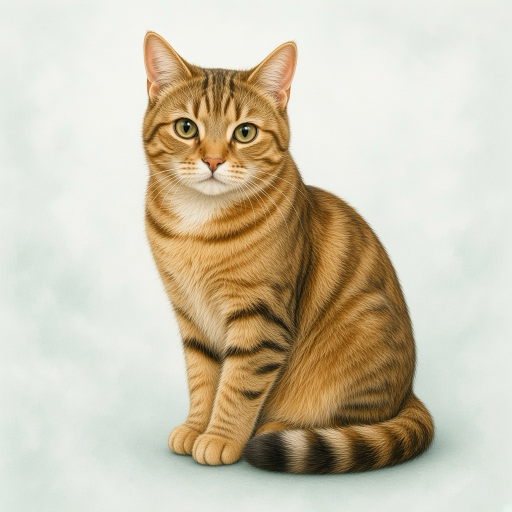
A cat is a small, four-legged animal that has lived with people for at least 9,500 years. Pet cats came from a wild ancestor called the African wildcat. Wildcats started hanging around early farms because grain stores attracted mice and rats. The cats that were good at catching those rats were welcome, and over thousands of years they slowly turned into the housecats we know today.
Why cats are full of surprises
Cats look familiar, but their bodies and senses work in some unusual ways. A cat lacks a working sweet-taste receptor. Its whiskers are sensitive touch organs that detect contact and nearby air movement, but the popular claim that they work as an exact body-width measuring tape has not been demonstrated. Orange coat color is X-linked, so solid-orange cats are more often male, but orange females are not exceptionally rare.
A few other things people often get wrong about cats: their daily activity is flexible rather than strictly nocturnal, a wagging tail does not mean the same thing it does in a dog, and many adult cats digest lactose poorly after they grow up.
Key cat facts
Cats came from the African wildcat, not from lions or tigers. They started living near humans about 9,500 years ago in the Middle East.
The earliest pet cat ever found was buried beside a person in Cyprus around 7,500 BCE, about 5,500 years before the famous cat-loving days of ancient Egypt.
A cat’s ear has more than 20 muscles, and each ear can rotate up to 180 degrees on its own. Human ears barely move at all.
Cats need much less light than humans to see. A common estimate is about one-sixth as much light. They mostly distinguish blues and yellow-greens and have much weaker red-green discrimination than people.
A cat cannot taste sweetness. Cats are missing a working copy of the gene that detects sweet flavors. The same is true for lions, tigers, and every other cat species, because their wild ancestors only ate meat.
Most cats have 18 toes, five on each front paw and four on each back paw. Cats with extra toes are called polydactyls.
A cat’s whiskers are sensitive touch organs. Nerve-rich follicles help a cat detect contact, texture, and small air movements, especially close to its face. They are not a proven body-width ruler.
Cats spend roughly 30 to 50 percent of their waking hours grooming themselves. Their tongue is covered in tiny backward-pointing barbs that work like a comb.
Cats have a tiny floating collarbone that is buried in muscle and not connected to other bones. That is part of why cats can squeeze through such small openings.
A group of cats is called a clowder.
Solid-orange cats are more often male. A 2025 study linked orange fur to a DNA deletion near the X-linked gene ARHGAP36. Males need the orange version on their one X chromosome, while females usually need it on both X chromosomes to be solid orange.
Common cat myths
Myth: Every cat is nocturnal. Many cats show activity peaks near dawn and dusk, but domestic cats can shift their schedules with feeding, their environment, and the routines of people around them.
Myth: Cats always land on their feet. Cats can twist their bodies in mid-air to land paws-down using a move called the righting reflex, but it does not always work, especially from very low or very high falls. Kittens take a few weeks to develop the reflex at all.
Myth: Cats only purr when they are happy. Cats may also purr while frightened, injured, nursing, or giving birth. Purring may sometimes be calming, but there is no controlled evidence that a cat’s natural purr heals bones or other tissue.
Myth: Cats see in black and white. Cats see colors, just fewer than people. They see blues and yellows clearly. Red and green look mostly the same to them.
Myth: Cats can drink milk. Most adult cats cannot digest milk. Kittens can, because they have an enzyme called lactase that breaks down milk sugar. Adult cats lose most of that enzyme and get sick stomachs from cow’s milk.
Myth: Meowing is a cat’s main way of talking to other cats. Adult domestic cats direct many meows toward people, though they can also meow in other contexts. Cats use scent, body language, touch, and sounds such as hisses, growls, and chirps with one another.
Frequently asked questions about cats
Where did cats come from?
Pet cats came from the African wildcat, a small striped cat that still lives in parts of Africa and the Middle East today. About 9,500 years ago, when farming villages started storing grain, mice and rats moved in to eat the grain. The wildcats followed the rodents into human settlements, and the friendlier cats slowly became part of the family.
Why are most orange cats boys?
The orange-fur variant is on the X chromosome near a gene called ARHGAP36. Males usually have one X and one Y, so one orange X can make a male fully orange. Females usually have two Xs and normally need the orange variant on both to be solid orange. A female with one orange and one non-orange X can develop a tortoiseshell or calico pattern because different X chromosomes are active in different cells.
Why can’t cats taste sweet things?
Cats are missing a working version of the Tas1r2 gene, one of two genes a body needs to make sweet-detecting taste buds. The gene broke in the common ancestor of all modern cat species, long before today’s cat family branched out, and every cat species since has been “sweet-blind.” Wild cats eat meat, not fruit, so the missing taste does not bother them.
A cat (Felis catus) is a small, meat-eating mammal that has lived alongside people for at least 9,500 years. Cats came from the African wildcat (Felis lybica), a small striped wildcat from the Middle East and northern Africa. Unlike dogs, which humans tamed on purpose, cats mostly tamed themselves. They wandered into early farming villages chasing the mice that were eating stored grain, and the people who lived there were happy to let them stay.
Why cats are tricky to study
Cats look like they should be easy to figure out. Most people grow up around them, and they seem to behave in pretty obvious ways. The truth is that cats hide most of what they actually do, partly because they are crepuscular hunters who do their best work at dawn and dusk, and partly because their wild ancestors evolved to stay quiet and unseen.
There are also a lot of widely repeated cat facts that turn out to be wrong. Cats are not nocturnal. Their meows are not how cats talk to each other. They do not have a memory measured in seconds. And the famous claim that cats always land on their feet is more of a “usually” than an “always.”
Modern researchers using high-speed cameras and DNA sequencing have shown some genuinely strange things: how cats lap water using physics rather than scooping, why they cannot taste sweet flavors at all, and how they developed a separate vocabulary just for talking to humans.
Key cat facts
Cats came from the African wildcat (Felis lybica), not from lions or any other big cat. Domestication began in the Fertile Crescent around 10,000 years ago, when humans settled into farming villages.
The earliest known pet cat was buried beside a person on the island of Cyprus around 7,500 BCE, about 5,500 years before ancient Egyptian cat reverence.
Cats hear up to about 79,000 Hz, roughly four times higher in pitch than humans. The range catches the high-frequency squeaks of mice and rats.
Each cat ear is controlled by more than 30 muscles and can rotate up to 180 degrees on its own. Ears point separately so a cat can pinpoint exactly where a sound is coming from.
Cats can see with roughly one-sixth the light humans need, aided by a high rod-cell density and a reflective layer behind the retina called the tapetum lucidum, which also produces eyeshine.
Cats are dichromats. They have two types of color-detecting cells in their eyes (humans have three) and see blues and yellows clearly while reds and greens look mostly alike.
Cats cannot taste sweetness. They are missing a working version of the Tas1r2 gene, one of two genes needed to detect sweet flavors. The gene became broken in the common ancestor of all modern cat species, long before the cat family diversified into its present-day genera.
Most cats have 18 toes, five on each front paw and four on each back paw. Polydactyl cats carry a mutation that adds extra toes.
A cat’s whiskers are specialized touch organs. Their nerve-rich follicles help detect contact, texture, and air movement close to the face. The often-repeated claim that their span exactly measures body width is unsupported.
A cat’s collarbone is a small bone embedded in shoulder muscle rather than forming the rigid bony shoulder girdle seen in humans. Together with a flexible spine and compressible shoulders, this helps cats negotiate tight openings, though head width alone is not a guarantee of fit.
A group of cats is called a clowder, plus clutter or glaring depending on the source.
Solid-orange cats are more often male because the orange variant is X-linked. In 2025, researchers identified the responsible regulatory deletion near ARHGAP36.
Common cat myths
Myth: Cats are strictly nocturnal. Many show dawn-and-dusk activity peaks, but domestic-cat schedules are flexible and respond to light, feeding, housing, prey, and human routines.
Myth: Cats always land on their feet. Cats use a righting reflex combining a flexible spine, free-floating clavicles, and balance feedback from the inner ear. The reflex takes a fraction of a second to complete a full rotation, so very short falls and very long ones can both lead to bad landings. Kittens do not develop the reflex until about three to four weeks old.
Myth: Cat purrs always mean “I’m happy.” Cats purr when content but may also purr when frightened, sick, nursing, or giving birth. Purr frequencies overlap some experimental vibration ranges, but no controlled study has shown that natural purring heals a cat’s bones or tissue.
Myth: Cats see in black and white. Cats are dichromats, not monochromats. Their world has plenty of color; it is just shifted toward blues and yellows.
Myth: Cats can drink cow’s milk. Most adult cats are lactose-intolerant. The enzyme lactase, which breaks down milk sugar, drops off after kittenhood. A bowl of cow’s milk gives most adult cats a stomachache. “Cat milk” sold in stores is made with the lactose removed.
Myth: Meowing is the main adult cat-to-cat channel. Adult domestic cats use many meows toward humans, while communication with other cats relies heavily on scent, posture, touch, and other vocalizations. Adult cats can still meow in some cat-to-cat contexts, so “only for humans” is too absolute.
Frequently asked questions about cats
Where and when were cats domesticated?
Genetic studies and archaeological finds point to the Fertile Crescent about 10,000 years ago, when humans first settled into farming villages. The oldest accepted evidence of human-cat companionship is the Shillourokambos joint burial in Cyprus, dated to around 9,500 years ago. Cyprus had no native wildcats, so the buried cat must have arrived by boat with humans. Egyptian tombs show cats fully part of households about 4,000 years ago, but Egypt was not the original place of domestication.
Why can’t cats taste sweetness?
Mammal taste buds use two paired proteins to detect sweet flavors: Tas1r2 and Tas1r3. Cats have a working version of Tas1r3 but a broken version of Tas1r2, which makes the receptor non-functional. Without that receptor, sugars do not register as sweet on a cat’s tongue. The same broken gene is found in lions, tigers, cheetahs, and every other cat species tested, so the change happened in the common ancestor of all modern felines, long before the family diversified into its present-day genera. Pure carnivores do not need to find ripe fruit, so the loss of sweet taste did not hurt them.
Why does a cat’s tongue feel like sandpaper?
A cat’s tongue is covered in tiny, backward-pointing spines made of keratin, the same protein found in claws and human fingernails. These filiform papillae help with grooming and feeding. A 2018 study showed that their hollow tips wick saliva deep into the coat, where evaporation contributes to cooling.
How do cats drink water?
High-speed video published in 2010 showed that a cat touches the water with the downward-curled tip of its tongue and retracts it rapidly. Fluid inertia draws a liquid column upward; just before gravity collapses the column, the cat closes its jaws around part of it. Dogs also use tongue-fluid dynamics, but their larger scooping motion differs from the cat mechanism.
Why do cats spend so much time grooming?
Cats spend roughly 30 to 50 percent of their waking hours grooming. The keratin spines on the tongue act as a comb, removing loose hair, dirt, and parasites. Saliva spread through the coat keeps the fur clean, distributes natural oils, and helps with cooling when it evaporates. Grooming is also a calming behavior cats use to handle stress, similar to how humans might bite a fingernail.
The domestic cat (Felis catus) is a small carnivorous mammal that has lived alongside people for at least 9,500 years. Genetic evidence traces domestic cats mainly to the African wildcat Felis lybica lybica in the Near East. Their early relationship with farming communities is widely described as a commensal pathway: wildcats benefited from rodents around stored grain, while people benefited from rodent control. Later dispersal and breed development also involved deliberate human choices.
Why cats are unusual companion animals
Early cats were not selected for the same cooperative tasks as many dogs or horses. Wildcats were drawn into settlements by rodents around stored grain, and tolerant animals gained access to food-rich human environments. Directional selection intensified much later for modern breeds, while domestic and wildcat populations have continued to interbreed in some regions.
The independence people associate with cats is grounded in physiology. Cats are obligate carnivores. Their digestive and metabolic biochemistry depends on nutrients found only in animal tissue, including taurine, arachidonic acid, and pre-formed vitamin A. They cannot taste sweetness because the gene that encodes one half of the sweet receptor, Tas1r2, has been a non-functional pseudogene since before the family Felidae diversified. Their eyes, ears, and whiskers are tuned for ambush predation in low light. Most of what looks like aloofness is the behavioral signature of an animal whose ancestors hunted alone and slept through the day.
A third feature complicates the picture. Cats communicate flexibly across social settings. Adult domestic cats direct many meows toward humans, while scent, posture, touch, and other calls play large roles between cats. Bunting, upright-tail greetings, and slow blinking can occur in affiliative interactions, but they are not an exclusively cat-to-human vocabulary.
Key cat facts
Domestication. The earliest accepted evidence of human-cat cohabitation is a joint burial in Shillourokambos, Cyprus, dated to about 9,500 years ago and reported by Vigne and colleagues in Science in 2004. Cyprus has no native wildcats, so the buried cat must have arrived by boat, indicating an established commensal relationship at least that early.
Breeds are recent. People transported cats widely for centuries, but most standardized breeds were created only within the past roughly 150 years. Registry counts differ because organizations use different recognition rules and update their lists over time.
Sweet blindness. Cats lack a functional copy of Tas1r2, the gene whose product pairs with Tas1r3 to detect sweet flavors. The pseudogene is conserved across all members of the family Felidae studied to date, including lions, tigers, and cheetahs, indicating loss of function before the felids diversified.
Hearing. A cat’s hearing extends to about 79,000 Hz, roughly an octave above the dog’s upper limit and nearly four times the 20,000 Hz human ceiling. Each ear is controlled by more than 30 individual muscles, depending on count method, and can rotate up to about 180 degrees independently.
Vision. Cats are dichromats with sensitivity centered in blue and yellow-green portions of the spectrum. Rod-rich retinas, large pupils, and a reflective tapetum lucidum let them see with roughly one-sixth the light humans require, at the cost of poorer detail and color discrimination in bright light.
Whiskers. Facial vibrissae are high-sensitivity mechanoreceptors for contact, texture, and nearby air movement. Their follicles send signals through the trigeminal system. The familiar claim that whisker span exactly matches body width and works as a gap caliper is anecdotal, not an established anatomical rule.
Skeletal anatomy. Cats have 7 cervical, 13 thoracic, 7 lumbar, and 3 sacral vertebrae, while tail-vertebra counts vary substantially. Their small clavicles lie in soft tissue rather than forming a rigid articulation with the sternum, and their mobile spine and shoulders help them negotiate tight spaces. A gap merely matching head width is not automatically safe or passable.
Toes. Most cats have 18 toes: five on each forepaw and four on each hindpaw. Polydactyl cats carry a dominant ZRS mutation that produces extra digits on one or both forepaws; a single cat once held a Guinness record for 28 toes.
Body temperature and heart rate. Resting body temperature is 100.5 to 102.5 °F (38.1 to 39.2 °C), about three degrees Fahrenheit warmer than humans. Resting heart rate ranges from 140 to 220 beats per minute, roughly twice the human resting rate.
Drinking. A 2010 Science paper by Reis and colleagues showed that cats drink by touching the water surface with the dorsal tip of the tongue and exploiting the inertia of the resulting liquid column, snapping the jaws shut before gravity can return the column. Dogs scoop water with a curled tongue, a completely different mechanism.
Coat genetics. Two 2025 studies identified a roughly 5-kilobase regulatory deletion near the X-linked gene ARHGAP36 as the long-sought Orange variant. One copy can make an XY male orange; an XX female generally needs two for a solid-orange coat. Heterozygous females form orange and non-orange patches through random X-inactivation, producing tortoiseshell patterns. The exact male-to-female ratio among orange cats varies with population allele frequencies rather than following one universal percentage.
Group noun. A group of cats is called a clowder. Other accepted collective nouns include clutter and glaring.
Common cat myths
Myth: Cats are strictly nocturnal. Many cats have activity peaks around dawn and dusk, but domestic-cat rhythms are flexible and vary with feeding, housing, prey, light, and human schedules.
Myth: Cats always land on their feet. Cats use a righting reflex that combines a flexible spine, free-floating clavicles, and proprioceptive feedback from the inner ear to reorient mid-air. The reflex requires roughly the time it takes to fall about 3 feet (90 cm); falls from below that height often produce awkward landings, and falls from any height can cause injury. The “cat righting reflex” is a remarkable kinematic, not a guarantee of safety.
Myth: A cat’s purr is exclusively a sign of contentment. Cats may also purr during nursing, illness, injury, fear, or parturition. Frequencies reported for purrs overlap some experimental vibration therapies, but there is no controlled evidence that natural purring heals feline bone or tissue.
Myth: Cats see only in black and white. Cats are dichromats. They detect blues and yellows clearly and have weak discrimination of long-wavelength reds and greens. Their advantage over humans is sensitivity in low light, not color range.
Myth: Meows are the main adult cat-to-cat channel. Adult domestic cats direct many meows toward people, while scent, posture, touch, and other vocalizations dominate much cat-to-cat communication. Adult cats can still meow to other cats, so an exclusive human-only rule overstates the evidence.
Myth: Cats can drink milk. Most adult cats are lactose-intolerant. Kittens digest the lactose in their mother’s milk via lactase, but lactase production declines after weaning. Cow’s milk causes gastrointestinal upset in many adult cats; commercial “cat milk” products are lactose-reduced.
Myth: Cats are solitary and do not form social bonds. Free-roaming domestic cats commonly form colonies of related females (queens) cooperating in kitten care. The species is best described as facultatively social: cats can live alone but readily form lasting bonds with humans, with other cats, and even with other species in shared households.
Frequently asked questions about cats
When and where were cats domesticated?
The earliest accepted archaeological evidence is the Shillourokambos joint burial in Cyprus dated to about 9,500 years ago. Whole-genome studies, especially Driscoll and colleagues’ 2007 Science paper, place the genetic origin of Felis catus in the Fertile Crescent region of the Near East roughly 10,000 years ago, with subsequent dispersal into Egypt, Europe, and East Asia. Egyptian iconography from about 4,000 years ago documents cats fully integrated into households, but Egypt was not the site of original domestication.
Why can a cat fit through a gap so much smaller than its body?
The cat’s small clavicles lie within shoulder soft tissue instead of forming a rigid bony bridge to the sternum. Its spine and shoulder girdle are highly mobile, and tail length makes the total vertebral count variable. These traits help a cat compress and turn through tight openings, but neither head width nor whisker span guarantees that the chest and abdomen will fit.
Why is the orange coat color almost always male?
A regulatory deletion near ARHGAP36 on the X chromosome produces orange coat color. An XY male needs the variant on his one X, while an XX female generally needs it on both Xs to be solid orange. Heterozygous females form tortoiseshell mosaics through random X-inactivation. Tortoiseshell or calico males can arise through XXY chromosomes, chimerism, or somatic mosaicism and are often, but not invariably, sterile.
How accurate is the claim that cats see six times better in the dark than humans?
The figure originates with comparative scotopic-sensitivity measurements that combine pupil aperture, rod density, and the tapetum lucidum. The widely cited “six times” figure is a reasonable order-of-magnitude estimate; actual gain depends on the light level, the spatial frequency of the target, and the contrast. Recent estimates put the cat advantage at roughly six to eight times in dim light, with the trade-off that cat photopic acuity (in bright light) is poorer than human acuity.
Why do cats chatter at birds through the window?
Chattering or chittering often occurs when a cat watches inaccessible prey. Excitement, frustration, and motor patterns related to predatory biting have all been proposed, but controlled evidence has not established a single function. Call mimicry observed in another felid does not demonstrate that domestic-cat chattering mimics prey.
Why do cats spend so much time grooming?
Cats spend roughly 30 to 50 percent of their waking hours in grooming behavior. The barbed papillae on the cat tongue, made of keratin, function as a comb that distributes saliva, removes loose hair and parasites, and applies sebum across the coat for thermoregulation and waterproofing. Grooming also moves saliva onto the fur, which evaporates and provides a small amount of cooling, partially offsetting the limited sweating capacity of the species. Grooming is additionally a self-soothing behavior associated with conflict avoidance.
The domestic cat (Felis catus) is a small obligate-carnivore mammal in the family Felidae and the only felid that has reached global commensal distribution. Whole-genome and mitochondrial DNA evidence place the species as a domesticated form of the African wildcat (Felis lybica lybica), a wildcat lineage with a present range across north Africa and southwest Asia. Driscoll and colleagues’ landmark 2007 Science paper traced all five major mitochondrial clades of modern domestic cats to a single Near Eastern origin in the Fertile Crescent, with population expansion coincident with the development of agriculture roughly 10,000 years ago.
Two features make cats unusual among long-domesticated animals. First, early domestication involved relatively little directional selection for specialized work, and most modern breeds were standardized only within the past 150 years. Domestic cats retain extensive wild-type morphology, and admixture with wildcats continues in some regions. Second, the species is an obligate carnivore with dietary requirements shaped by limited synthesis or conversion of nutrients including taurine, arachidonic acid, pre-formed retinol, and niacin.
Why feline biology resists tidy summary
Three features complicate generalization across the species.
The first is the breadth of evolutionary loss and metabolic specialization. The best-known example is Tas1r2, encoding one of the paired proteins in the mammalian sweet receptor. The cat gene contains a 247-base-pair deletion in exon 3 plus other inactivating mutations and is conserved as a pseudogene across studied felids, indicating loss before their diversification. Other carnivore-associated traits include low hepatic glucokinase activity and a limited ability to synthesize enough taurine to meet dietary needs.
The second is extensive preservation of wild morphology alongside flexible domestic behavior. Domestic cats retain the wildcat’s general gait and ambush-hunting anatomy, but activity schedules shift with environment and human routines. Meowing is used especially often toward humans, while adult cat-to-cat interaction relies heavily on scent, posture, touch, and other calls. Acoustic studies support domestication-related changes in meow use without establishing a human-only vocalization.
The third is the genetic infrastructure of unusual phenotypes. Common feline polydactyly variants alter the limb-bud ZRS enhancer of Sonic Hedgehog on chromosome 18 and show variable expression. In 2025, two groups identified a roughly 5-kilobase regulatory deletion near X-linked ARHGAP36 as the Orange variant. Random X-inactivation in heterozygous females produces tortoiseshell mosaics, while other coat loci add further pattern variation.
Key facts at expert level
Phylogeny.Felis catus descends from one or more populations of Felis lybica lybica in the Near East. The five mitochondrial clades of modern domestic cats are nested within wildcat populations from the Fertile Crescent, indicating a single regional origin and subsequent global dispersal alongside humans. Wildcat-domestic cat hybridization remains widespread, particularly in Europe (with Felis silvestris) and in southern Africa.
Domestication archaeology. The earliest direct evidence is the Shillourokambos joint burial in Cyprus, dated to about 9,500 years ago and reported by Vigne and colleagues in Science in 2004. Cyprus has no native wildcats, demonstrating an established commensal relationship and human-mediated dispersal. Egyptian iconography integrates cats into households by the Middle Kingdom (about 2000 BCE), and the cult of Bastet at Bubastis included industrial-scale mummification of cats during the Late Period.
Sweet-receptor pseudogene.Tas1r2 is non-functional in Felis catus. The proximate molecular cause is multiple frame-disrupting mutations including a 247-bp deletion in exon 3. Confirmed by Li and colleagues, PLoS Genetics, 2005, with subsequent work showing the pseudogene is conserved across Felidae. Phenotype: cats cannot detect sucrose, fructose, or other sugars at any concentration.
Olfaction and the vomeronasal organ. Cats have approximately 200 million olfactory neurons, fewer than dogs but substantially more than humans. The vomeronasal organ (Jacobson’s organ) opens to the oral cavity through the incisive ducts and is engaged by the flehmen response, the open-mouth grimace seen when a cat samples chemical signals from urine or other conspecific scent marks.
Audition. Cat hearing extends from approximately 55 Hz to 79,000 Hz, the broadest auditory range of any carnivoran mammal. Each pinna is controlled by approximately 32 muscles, supporting independent rotation and fine localization. The high-frequency upper limit overlaps with the ultrasonic vocalizations of small rodents, the principal wild prey of Felis lybica.
Vision. Cats are dichromats with cone opsin sensitivities peaking near 450 nm (blue) and 555 nm (yellow-green). Visual acuity is approximately 20/100 to 20/200 by Snellen equivalent. The retinal tapetum lucidum (a layer of riboflavin-zinc crystals in the choroid) reflects approximately 130 times more light than the human fundus, producing a measured retinal-illuminance gain on the order of 30 to 50 percent and contributing to the eyeshine reflex and to night-vision performance roughly six to eight times greater than humans.
Vibrissae. Mystacial whiskers are high-resolution mechanoreceptors whose follicles feed the trigeminal sensory system. They respond to touch and to whisker deflection produced by nearby air movement. No controlled evidence establishes the popular rule that whisker span always equals thorax width or serves as an exact gap gauge.
Skeletal and locomotor anatomy. The small clavicle lies in shoulder soft tissue without a rigid sternal articulation. Cats have 7 cervical, 13 thoracic, 7 lumbar, and 3 sacral vertebrae, while the number of tail vertebrae varies by individual and breed. The aerial righting reflex develops during kittenhood, but no single fall height guarantees either complete righting or safety.
Cardiopulmonary baseline. Resting body temperature is 100.5 to 102.5 °F (38.1 to 39.2 °C). Resting heart rate is 140 to 220 bpm. Respiratory rate at rest is 20 to 30 breaths per minute, climbing during stress (the species is not an obligate panter; sustained panting in a cat is a sign of significant respiratory distress).
Lapping fluid dynamics. Reis and colleagues’ 2010 Science paper used high-speed videography to show that Felis catus drinks by touching the dorsal tip of the tongue to the water surface and exploiting the inertia of the resulting liquid column, snapping the jaw shut at peak height before gravity returns the column. The lap frequency is approximately 4 Hz, tuned to a Froude number near unity, balancing inertia against gravity. Dogs use a curled-tongue scoop that is mechanically distinct, suggesting independent solutions to the same fluid-dynamics problem.
Polydactyly genetics. Cat polydactyly is most commonly inherited as an autosomal dominant trait caused by point mutations in the ZRS enhancer of Sonic Hedgehog on chromosome 18. The named alleles Hw, UK1, and UK2 produce variable expression, ranging from a single extra forepaw digit to mitten-like preaxial polydactyly. Polydactyl cats are common in Maine Coons and in cats descended from Boston-area shipping lines, including the colony at Ernest Hemingway’s Key West home. The all-time record (Guinness) is 28 toes.
Coat-color genetics. The X-linked Orange variant is a regulatory deletion near ARHGAP36. Heterozygous XX females display tortoiseshell mosaics through random X-inactivation, while females with the variant on both X chromosomes are solid orange. XY males need only one copy to be orange, making orange coats more frequent among males, but the exact sex ratio depends on allele frequency. Rare tortoiseshell males can result from XXY chromosomes, chimerism, or somatic mosaicism.
Communication. Adult-cat-to-adult-cat communication is dominated by olfactory marking (cheek and forehead glands, urine spraying, scratching), body posture (tail position, ear orientation, piloerection), and a small set of vocalizations (hisses, growls, chirps, chattering, the agonistic howl). The meow is a vocalization deployed primarily toward humans. Acoustic analyses of meows recorded from feral and house cats show feral cats meow rarely; house cats produce meows with acoustic features (higher pitch, shorter duration) that elicit faster human caregiving responses.
Common misconceptions at expert level
Misconception: Cats are descended from a wildcat that spread out of Egypt. The most heavily-cited domestication paper, Driscoll and colleagues, 2007, Science, traces all modern domestic cat mitochondrial lineages to Felis lybica lybica in the Near East, not Egypt. Egypt is the most famous archaeological site of cat reverence (and the source of the “sacred cat” cultural narrative through the cult of Bastet), but Egyptian cat domestication post-dates the original Near Eastern event by several thousand years. The Cyprus burial precedes Egyptian cat iconography by roughly 5,500 years.
Misconception: Calling cats obligate carnivores means they cannot digest any non-animal ingredient. The term describes nutrient requirements, not a claim that every plant-derived ingredient is indigestible. Cats synthesize taurine inefficiently and require it in the diet; deficiency can cause retinal degeneration and dilated cardiomyopathy. Their conversion of linoleic acid to arachidonic acid and beta-carotene to vitamin A is also too limited to meet normal requirements, so diets must supply these nutrients in usable forms.
Misconception: A cat’s purr has one fixed meaning or is proven to heal tissue. Purr acoustics vary among individuals and contexts, and cats may purr during contentment, nursing, illness, injury, or parturition. Similar-frequency mechanical stimulation has been studied separately, but no controlled experiment shows that natural feline purring accelerates bone or wound healing.
Misconception: Polydactyly is a single discrete trait. Feline polydactyly includes different digit patterns caused by multiple ZRS enhancer variants, usually inherited dominantly with variable expression. Many common forms are benign, but digit anatomy should be evaluated individually. Stories that extra toes improved shipboard balance are folklore rather than controlled evidence.
Misconception: Tortoiseshell males are common. Most tortoiseshell cats are heterozygous XX females. Rare males can have an XXY karyotype, arise as chimeras, or carry a somatic mosaic Orange variant. Many XXY males are sterile, while fertility in mosaic or chimeric animals depends on their gonadal genotype. Published population-wide ratios are often repeated without adequate sampling and should not be treated as universal.
Misconception: Cats domesticated themselves in a single event. Cyprus arrival by approximately 9,500 years ago confirms commensal cohabitation, but the domestication process was probably gradual and partial across multiple generations of admixture between Felis lybica and the cats living closest to humans. Modern domestic-cat populations carry signatures of repeated wildcat introgression, especially in regions where Felis silvestris (European wildcat) and Felis catus overlap.
Frequently asked questions about cats
Why is the Tas1r2 gene non-functional in cats?
The Tas1r2 receptor pairs with Tas1r3 to detect sweet flavors. Cats carry a 247-bp deletion in exon 3 of Tas1r2 plus other inactivating mutations, leaving the receptor non-functional. The pseudogene is shared across studied felids and predates their diversification. Behavioral experiments find little or no preference for sugars, consistent with sweet-receptor loss, but “indifference at any concentration” is broader than the tested conditions.
Why are nearly all orange cats male?
The Orange variant is a roughly 5-kilobase regulatory deletion near ARHGAP36 on the X chromosome. An XY male needs the variant on his one X to be orange, whereas an XX female generally needs it on both Xs for a solid-orange coat. Heterozygous females develop orange and non-orange patches through random X-inactivation. This inheritance makes solid orange more common in males and tortoiseshell more common in females, but it does not impose a universal 80:20 population ratio.
What is the precise mechanism of cat lapping?
Reis, Jung, Aristoff, and Stocker, Science, 2010, used high-speed videography of multiple felid species to characterize the lapping mechanism. The cat protrudes its tongue with the dorsal surface curled downward, makes ventral contact with the water, and rapidly retracts the tongue. The retraction creates an inertia-driven liquid column from the surface upward; the cat closes its jaw at the moment the column reaches peak elongation, before gravity overcomes inertia. The lap frequency in domestic cats is approximately 4 Hz, scaling with body mass across felid species in proportion to m^(-1/6), consistent with a Froude-number-tuned balance between inertial and gravitational time scales. The mechanism is independent of capillary effects and structurally distinct from canid lapping.
Why does the aerial righting reflex require a minimum fall height?
The cat uses vestibular and visual input, bends its flexible spine, and changes the moments of inertia of the front and rear body segments by alternately tucking and extending its limbs. The maneuver takes time, so a short fall may end before reorientation is complete, but righting does not make any height safe. Reports of lower injury rates at the greatest fall heights come from veterinary case series vulnerable to survival and presentation bias, so they should not be read as evidence that higher falls are safer.
What does Egyptian cat reverence actually consist of?
Cats were associated with the goddess Bastet, a daughter of Ra originally depicted with a lioness head and reformulated by the Late Period (about 1000 BCE) as a domestic cat. Her cult center was at Bubastis in the Nile Delta, where Herodotus reported large festivals in the fifth century BCE. Late Period industrial-scale cat mummification produced burials of millions of cats, primarily juveniles raised explicitly for sacrificial mummification at temple-associated breeding facilities. Egyptian reverence is real and well-documented; the often-repeated specific claim that killing a cat carried automatic capital punishment in all of Egyptian history is poorly sourced and likely apocryphal.
Are domestic-cat sensory measurements derived from controlled studies, anecdote, or extrapolation?
Hearing limits and visual sensitivity come from controlled physiological or behavioral work, while the lapping frequency comes from high-speed video. Estimates such as “one-sixth the light” summarize several optical adaptations and are not a universal performance ratio for every visual task. The claim that whisker width equals body width and functions as an exact caliper lacks controlled evidence, as do claims that cats reliably predict earthquakes or diagnose cancer.