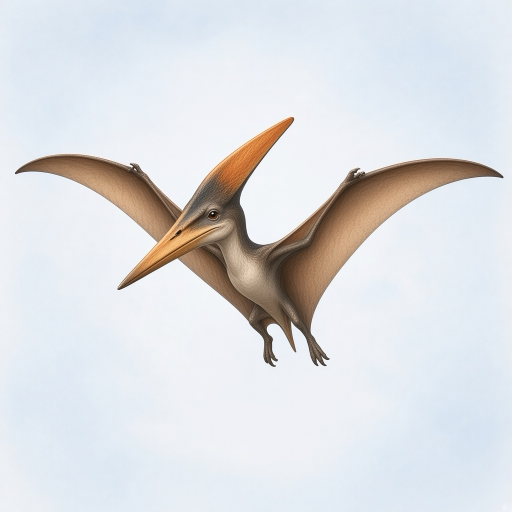
A pterosaur (say it: TERR-uh-sor) was a flying reptile that lived a long time ago, while dinosaurs walked the Earth. Pterosaurs were the first animals with backbones to fly using their own muscles, not just glide. They were not dinosaurs, and they were not the ancestors of birds. They lived from about 228 million years ago until 66 million years ago, when they died out at the same time as the big dinosaurs.
Why pterosaurs are tricky to understand
Pterosaurs lived next to dinosaurs, so people often think they were dinosaurs that flew. They were not. Pterosaurs and dinosaurs were cousins, both part of a bigger family of reptiles. Birds came from small meat-eating dinosaurs, not from pterosaurs.
Lots of people also call every pterosaur a “pterodactyl,” but that is not quite right. Pterodactylus is the name of just one kind of pterosaur, with a wingspan close to 3 feet (1 m). There were dozens of other kinds, from tiny ones the size of a sparrow to giants as tall as a giraffe.
A pterosaur’s wing was not made of feathers. It was a thin sheet of skin, like a kite stretched between bones. The wing was held up by one super-long finger on each hand. Bats use four fingers to hold their skin wings up. Pterosaurs used only one. Birds do not use fingers at all; they use feathers on their arms.
Key facts about pterosaurs
Pterosaurs were not dinosaurs. They were close relatives of dinosaurs and crocodiles, but they were their own group of reptiles.
They were the first flying animals with backbones. Insects flew first, but pterosaurs were the first animals with bones to flap wings and fly under their own power, about 228 million years ago.
Their wings were skin, not feathers. A pterosaur wing was a thin sheet of skin called a patagium (puh-TAY-jee-um), held up by one very long fourth finger.
The biggest pterosaur was as tall as a giraffe.Quetzalcoatlus (KETS-uhl-koh-AT-lus) lived in what is now Texas. It stood about 10 to 13 feet (3 to 4 m) tall on the ground and had a wingspan of about 36 feet (11 m).
The smallest known pterosaur was tiny.Nemicolopterus had a wingspan of only about 10 inches (25 cm), a bit wider than a pencil is long. Some scientists think it was a baby of a slightly larger species.
Their bones were hollow and full of air. This made pterosaurs light enough to fly. Birds have hollow bones too, inherited from the same distant ancestor that pterosaurs came from. Bats have solid bones.
They had fuzz, not fur. Many pterosaurs had hair-like fibers called pycnofibers (PIK-noh-fy-bers) covering their bodies. The fuzz helped keep them warm and probably means they were warm-blooded, like birds and mammals.
They lived all over the world. Pterosaur fossils have been found on almost every continent.
Common myths about flying reptiles
Myth: Pterosaurs were dinosaurs. Pterosaurs were not dinosaurs. They were a separate group of reptiles that lived at the same time. Saying a pterosaur is a dinosaur is like saying a wolf is a bear.
Myth: Birds came from pterosaurs. Birds came from small dinosaurs called theropods, the same group that included Tyrannosaurus rex. Pterosaurs left no living children. When the last pterosaurs died 66 million years ago, that whole group ended.
Myth: Every pterosaur is called a pterodactyl. Pterodactylus was just one type. Calling all pterosaurs pterodactyls is like calling every dog a poodle. Some pterosaurs were tiny like Nemicolopterus, and others were giants like Quetzalcoatlus.
Myth: Pterosaurs walked around on their wings. Pterosaurs walked on all four legs, but they did not use their wings as front legs. They folded the wing finger up and walked on their wrist and three small clawed fingers.
Myth: Pterosaurs needed cliffs to take off. Many scientists think even the biggest pterosaurs could launch from flat ground. One leading model says they pushed off with their powerful front limbs as well as their back legs, then opened their wings in mid-air.
Frequently asked questions about pterosaurs
How big was the biggest pterosaur?
The biggest known pterosaur was Quetzalcoatlus northropi. It had a wingspan of about 36 feet (11 m), wider than a small airplane. Standing on the ground, it was about as tall as a giraffe. It lived in Texas at the very end of the age of dinosaurs.
Were pterosaurs warm-blooded or cold-blooded?
Most scientists now think pterosaurs were warm-blooded, like birds and mammals. They had a coat of hair-like fibers called pycnofibers, and flying takes a lot of energy, which usually means a warm body. Cold-blooded animals like modern lizards do not flap-fly for long distances.
What did pterosaurs eat?
Different pterosaurs ate different things. Some snatched fish from the ocean, like seabirds do today. Some ate insects. One kind, Pterodaustro, had hundreds of tiny bristle-like teeth and probably filtered shrimp out of the water, the way a flamingo does. The big azhdarchids like Quetzalcoatlus probably stalked around on the ground and grabbed small animals, the way a stork does.
Why did pterosaurs go extinct?
The last pterosaurs died about 66 million years ago, in the same disaster that wiped out the big dinosaurs. A giant asteroid hit Earth near what is now Mexico, and the world cooled down fast. Scientists once thought pterosaurs had dwindled to only a few giant kinds by the very end, but newer fossils show several pterosaur families were still alive close to the asteroid impact.
A pterosaur was a flying reptile that lived from the Late Triassic Period, around 228 million years ago, to the end of the Cretaceous Period 66 million years ago. Pterosaurs were the first vertebrates (animals with backbones) to evolve powered flight, beating birds into the air by about 80 million years. They were close cousins of dinosaurs and crocodiles but were not dinosaurs themselves, and they were not the ancestors of birds. Their wings were thin sheets of skin held out by one very long fourth finger on each hand.
Why pterosaurs are tricky to understand
People often lump pterosaurs in with dinosaurs because they lived at the same time and shared the same world. They were not dinosaurs. Dinosaurs and pterosaurs both belong to a bigger reptile group called archosaurs (the same group that today includes crocodiles, alligators, and birds), but the two split into separate lines about 240 million years ago. Birds came later, descending from small meat-eating theropod dinosaurs around 150 million years ago. So a pigeon is closer to T. rex than it is to any pterosaur.
The casual word “pterodactyl” is also misleading. Pterodactylus is one specific genus, with a wingspan close to 3 feet (1 m) and small pointy teeth. There were over 100 known pterosaur genera, ranging from sparrow-sized animals to giants taller than a giraffe. Calling all of them “pterodactyls” is like calling every cat a tabby.
The way pterosaurs flew is also unusual. Birds use feathered arms. Bats use four long fingers webbed together with skin. Pterosaurs used a single super-long fourth finger to support a skin wing called a patagium. No animal alive today flies the same way. The wing was reinforced inside with thousands of stiff fibers called actinofibrils, which gave it shape without making it heavy.
Key facts about pterosaurs
Pterosaurs are archosaurs, not dinosaurs. They share a common ancestor with dinosaurs and crocodiles around 240 million years ago, but they branched off on their own line. The earliest known pterosaurs, like Preondactylus and Eudimorphodon, lived in Italy in the Late Triassic.
They were the first vertebrate flyers. Insects had been flying for about 100 million years already, but pterosaurs were the first animals with backbones to flap their way into the sky. Birds appeared about 80 million years later.
Their wing finger is the fourth finger. A pterosaur hand had four fingers; the first three were small with claws, and the fourth was greatly elongated to support the wing. The other three fingers stuck out from the wing’s leading edge for grip and walking.
The patagium had three sections. The propatagium ran in front of the arm. The brachiopatagium was the main wing, from the body to the tip of the long finger. The uropatagium was a smaller membrane between the legs.
Pterosaurs had pycnofibers. A pterosaur was not bare-skinned. Its body was covered in hair-like filaments called pycnofibers, first clearly identified in the 1971 fossil of Sordes pilosus from Kazakhstan. The fuzz almost certainly means pterosaurs were warm-blooded.
Their bones were hollow and air-filled. Like modern birds, pterosaurs had pneumatic bones: bone walls thinner than an eggshell, with air sacs running through the inside. This shaved enormous weight, which was the only way an animal the size of a giraffe could fly. Pterosaurs, birds, and other dinosaurs inherited the air-sac system behind these bones from a shared ancestor; bats did not, and that is part of why bats stay smaller.
Quetzalcoatlus was as tall as a giraffe.Quetzalcoatlus northropi, from the Late Cretaceous of Texas, had a wingspan of about 36 feet (11 m); its shoulder stood about 6.5 to 10 feet (2 to 3 m) up, and the head reached over 13 feet (4 m), comparable to a modern giraffe. Hatzegopteryx, from Romania, was similar in size. Both belong to the family Azhdarchidae.
The smallest known pterosaur was the size of a sparrow.Nemicolopterus crypticus, from Early Cretaceous China, had a wingspan of only about 10 inches (25 cm). It may have been a juvenile, but adult tapejarid relatives also include species not much larger.
Many had crests on their heads.Pteranodon had a long bony crest sweeping back from the skull. Tapejara and Tupuxuara had tall crests rising from the snout. In Tupuxuara, the crest bone grew backward over the top of the skull late in the animal’s life and only reached full size in adults, a growth pattern that points to display rather than fighting.
Pterosaurs went extinct 66 million years ago. They died out at the end of the Cretaceous, in the same K-Pg mass extinction that ended the non-avian dinosaurs. Scientists once thought pterosaur diversity had dwindled to mostly giant azhdarchids by the very end, but late Maastrichtian fossils from Morocco show at least azhdarchids, pteranodontids, and nyctosaurids survived close to the asteroid impact.
Common myths about flying reptiles
Myth: Pterosaurs were dinosaurs that learned to fly. Pterosaurs and dinosaurs share an ancestor in the Triassic, but they split before either group existed. A pterosaur is no more a dinosaur than a crocodile is.
Myth: Birds evolved from pterosaurs. Birds evolved from small theropod dinosaurs in the Late Jurassic. Pterosaurs left no descendants. Some shared traits between birds and pterosaurs, such as flapping flight, are examples of convergent evolution: the same problem solved twice in different lineages. Others, including the air-filled bones, came from a shared ancestor instead.
Myth: All pterosaurs are pterodactyls.Pterodactylus is one genus. The full pterosaur family tree includes long-tailed early forms (Rhamphorhynchoidea, paraphyletic), short-tailed later forms (Pterodactyloidea), giants (Azhdarchidae), filter-feeders (Ctenochasmatidae), and crested groups (Tapejaridae). Saying “pterodactyl” for all of them is like saying “labrador” for all dogs.
Myth: Pterosaurs were cold-blooded reptiles. Modern reptiles like snakes and lizards are cold-blooded, but pterosaurs were not. The pycnofiber coat, the high energy demand of flapping flight, and bone microstructure all point to a warm-blooded metabolism similar to birds.
Myth: Pterosaurs walked on their wings. Pterosaurs walked on all fours, but the “front feet” were their wrists and the three small clawed fingers, with the long wing finger folded up and out of the way. Trackways from Crayssac in southern France preserve this exact walking posture.
Frequently asked questions about pterosaurs
How big was the biggest pterosaur, and how did it get off the ground?
The biggest confirmed pterosaur was Quetzalcoatlus northropi, from the Late Cretaceous of Texas, with a wingspan of about 36 feet (11 m) and a head height of around 13 feet (4 m), on par with a modern giraffe. Paleontologist Mike Habib’s 2008 quad-launch model proposes one way it could have taken off: the pterosaur crouched on all fours and pushed off mainly with its forelimbs, which were proportionally far stronger than its hindlimbs. If that model is right, launching with the front limbs helps explain why pterosaurs could grow so much larger than the largest flying birds, although some researchers still argue for more bird-like takeoff models.
What did pterosaurs eat?
A lot of different things. Many fish-eaters like Rhamphorhynchus and Anhanguera had long jaws full of interlocking pointy teeth. Pterodaustro had hundreds of fine bristle-like lower teeth and almost certainly filter-fed on tiny crustaceans, the way a flamingo does. Pteranodon was toothless and probably grabbed fish on the wing. The giant azhdarchids like Quetzalcoatlus are now reconstructed as terrestrial stalkers, walking around on the ground and snatching small dinosaurs and other prey, in the lifestyle of an oversized stork.
Did pterosaurs lay eggs?
Yes. Pterosaur eggs and embryos have been found in China and Argentina. The 2014 and 2017 discoveries at the Hamipterus nesting site in northwestern China preserved hundreds of eggs and dozens of embryos in a single bone bed, suggesting that some pterosaurs nested in colonies. The eggshells were soft and leathery, more like a modern lizard egg than a chicken egg.
When did pterosaurs evolve, and when did they go extinct?
The earliest known pterosaurs are from the Late Triassic, about 228 million years ago. The last ones died at the end of the Cretaceous, 66 million years ago, in the same K-Pg mass extinction that killed the non-avian dinosaurs. That gives pterosaurs a total run of around 162 million years, much longer than the time that has passed since they vanished.
A pterosaur is an extinct flying archosaur, a member of the order Pterosauria, that lived from the Late Triassic Period (about 228 million years ago) to the end of the Cretaceous Period (66 million years ago). Pterosaurs were the first vertebrates to evolve powered, flapping flight, predating the earliest birds by roughly 80 million years. They were the sister group to dinosaurs within Avemetatarsalia, the bird-line archosaurs, but they were not dinosaurs and were not on the ancestral line that led to birds. Their wings were membranes of skin and muscle, called the patagium, supported by an elongated fourth manual digit on each hand.
What is often misunderstood about pterosaurs
The most persistent misconception is that pterosaurs were dinosaurs. They were not. Pterosaurs and dinosaurs share a Triassic common ancestor within the Avemetatarsalia, but the two clades diverged before either group existed in its later form. A pterosaur is no closer to a Tyrannosaurus than a crocodile is. A pigeon, by contrast, is a living theropod dinosaur and shares a more recent ancestor with T. rex than it does with any pterosaur.
The casual term “pterodactyl” also causes trouble. Pterodactylus is one Late Jurassic genus, first described by Cosimo Alessandro Collini in 1784 and reinterpreted by Georges Cuvier as a flying reptile in the early 1800s, who introduced the name “ptero-dactyle” (Greek for “wing finger”). Over 100 pterosaur genera are now known, ranging from sparrow-sized animals to giraffe-sized giants. Using “pterodactyl” for the entire order conflates a single genus with the whole group.
A third common misconception is that pterosaurs were lizard-like cold-blooded reptiles. The discovery of Sordes pilosus in Kazakhstan in 1971, with preserved hair-like fibers on its body, established that pterosaurs were covered in pycnofibers, an integumentary insulation. Pycnofibers, combined with the energetic demands of flapping flight and the bone-histology evidence for fast growth, place pterosaurs as endotherms with metabolic rates closer to those of modern birds.
A fourth: even the largest pterosaurs may not have needed cliffs. The quad-launch model published by Michael Habib in 2008 reconstructs takeoff as a four-limbed leap from flat ground, with the proportionally massive forelimbs delivering the dominant thrust. The model offers one biomechanical solution for how a 550-pound (250 kg) animal with a 36-foot (11 m) wingspan could become airborne from open terrain.
Key facts about pterosaurs
Phylogenetic position. Pterosaurs are archosaurs in the bird-line clade Avemetatarsalia, sister to Dinosauria. The two clades diverged in the Early-to-Middle Triassic. Crocodiles sit on the other archosaur branch (Pseudosuchia).
Stratigraphic range. Earliest known pterosaurs (Preondactylus, Eudimorphodon) appear in Late Triassic deposits of northern Italy. The last species died at the K-Pg boundary 66 million years ago. The total range covers about 162 million years.
Wing structure. The flight membrane (the patagium) is supported primarily by the elongated fourth digit of the manus. Bats support the wing membrane with four digits; birds use a feathered modification of arm and hand. Pterosaur wing architecture is unique among vertebrates.
Patagial divisions. The propatagium runs in front of the arm between shoulder and wrist. The brachiopatagium is the main wing membrane, attached along the body to roughly the ankle and out to the wing-finger tip. The uropatagium is a smaller membrane between the legs.
The pteroid. Pterosaurs possessed a unique slender bone, the pteroid, articulated at the wrist. The pteroid extended forward to brace the leading edge of the propatagium, a structure no other vertebrate has evolved. The bone’s exact orientation in life is still actively debated in the literature.
Pneumatic skeleton. Pterosaur bones were pneumatic: hollow with very thin cortical walls and pierced by air sacs. The pulmonary system behind this arrangement is ancestral to Ornithodira, so pterosaurs, birds, and other dinosaurs inherited it rather than evolving it separately. Bats did not, and bats remain comparatively small.
Pycnofibers. Hair-like integumentary fibers covered pterosaur bodies, first clearly identified in Sordes pilosus (1971) and later confirmed in many specimens from the Yixian Formation of China. Some recent work has interpreted certain pycnofibers as branched structures comparable to feathers, although that interpretation is contested.
Endothermy. Pycnofibers, the high power output required for flapping flight, and bone-microstructure evidence (rapid growth, fibrolamellar primary bone) together place pterosaurs as endotherms with metabolic rates similar to modern birds.
Major clades. The traditional split is between Rhamphorhynchoidea (long-tailed early pterosaurs, paraphyletic) and Pterodactyloidea (short-tailed later forms, monophyletic). Pterodactyloid families include Azhdarchidae, Pteranodontidae, Tapejaridae, Anhangueridae, and Ctenochasmatidae.
Largest pterosaurs.Quetzalcoatlus northropi, from the Late Cretaceous Javelina Formation of Texas, had a wingspan of about 36 feet (11 m) and stood roughly 10 to 13 feet (3 to 4 m) tall, comparable to a giraffe. Hatzegopteryx thambema, from the Maastrichtian Hateg Basin of Romania, was similar in size with a heavier, thicker-walled skull. Both are azhdarchids.
Smallest known.Nemicolopterus crypticus from Early Cretaceous Liaoning had a wingspan of about 10 inches (25 cm). Some authors have argued the type specimen is a juvenile of a slightly larger tapejarid, but other small pterosaurs are also known.
Diet diversity. Piscivory is documented in Rhamphorhynchus, Anhanguera, and Pteranodon (the last toothless). Pterodaustro guinazui had hundreds of fine bristle-like lower teeth and almost certainly filter-fed on small crustaceans. Witton and Naish’s 2008 PLOS ONE paper reconstructs azhdarchids as terrestrial stalkers, foraging for small animals and carrion in a stork-like ecology.
Locomotion on the ground. Trackways from Crayssac, France, and elsewhere show that pterosaurs were quadrupedal walkers. They placed weight on their wrists and on the three small clawed digits I-III, with the elongated wing finger folded back. Hindlimbs operated underneath the body, not sprawled.
Eggs. Pterosaur eggs are known from China (the Hamipterus nesting site, hundreds of eggs and embryos described in 2014 and 2017) and Argentina (Pterodaustro). Eggshells were soft and leathery, structurally closer to modern lizard eggs than to bird eggs.
Distribution. Pterosaur fossils are known from every continent. The Antarctic record was established in 2019, when Kellner and colleagues described two pterodactyloid wing bones from Upper Cretaceous rocks of the Antarctic Peninsula, one from James Ross Island and one from Vega Island.
Common myths about flying reptiles
Myth: Pterosaurs were dinosaurs. Pterosaurs are the sister group to dinosaurs within Avemetatarsalia. The two clades share an ancestor in the Triassic but diverged before either group existed as such. The misconception is reinforced by movies and popular media, but it is incorrect.
Myth: Birds evolved from pterosaurs. Birds are theropod dinosaurs. The earliest unambiguous birds appear in Late Jurassic deposits about 150 million years ago, well after pterosaurs were established. Pterosaurs and birds share several flight-related traits by convergent evolution, including flapping flight itself. Pneumatic bones are not among them: the air-sac system behind them is ancestral to Ornithodira and so was inherited by both lineages.
Myth: All pterosaurs are pterodactyls.Pterodactylus is a single Late Jurassic genus, with a wingspan close to 3 feet (1 m). The full pterosaur tree includes early long-tailed forms like Rhamphorhynchus, filter-feeders like Pterodaustro, crested forms like Tapejara, and giants like Quetzalcoatlus. Calling all of them “pterodactyls” is a common error.
Myth: Pterosaurs were cold-blooded. Pterosaurs were endotherms, comparable to birds in metabolic rate. Pycnofiber insulation, fibrolamellar bone, and the energetic cost of powered flight all point to active warm-bloodedness.
Myth: Pterosaur wings were like bat wings. Pterosaur and bat wings are both skin membranes, but the supporting architecture is different. Bats stretch the membrane between four elongated digits. Pterosaurs use only the fourth digit. The first three digits in a pterosaur form a small clawed hand at the leading edge of the wing, used for walking and climbing.
Myth: Quetzalcoatlus had to drop off a cliff to fly. Habib’s 2008 quadrupedal-launch model and subsequent biomechanical analyses by Mark Witton and others argue that even the largest pterosaurs could take off from flat ground. In that model, the forelimbs delivered far more thrust than the hindlimbs, the inverse of the bird launch pattern.
Myth: Pterosaur head crests were weapons. The mainstream interpretations are display-related rather than combat-related, centering on sexual selection and species recognition. Martill and Naish’s 2006 study of Tupuxuara found that the premaxillary crest grew backward over the skull roof late in ontogeny, a pattern they tied to sexual display. Bennett’s 1992 analysis of the large Pteranodon collection found two size classes: the larger one with big cranial crests and a narrow pelvic canal, the smaller one with small crests and a wide pelvic canal, read as males and females. Aerodynamic and thermoregulatory roles have also been proposed and are less well supported.
Myth: Pterosaurs went extinct gradually and were already gone by the K-Pg event. Scientists once thought late pterosaurs had dwindled to only a few surviving lineages, but newer late-Maastrichtian fossils from Morocco show Azhdarchidae, Pteranodontidae, and Nyctosauridae still present near the end. The evidence now points to an abrupt K-Pg extinction 66 million years ago rather than pterosaurs fading away before the asteroid impact.
Frequently asked questions about pterosaurs
What is the difference between a pterosaur and a pterodactyl?
A pterosaur is any member of the order Pterosauria. Pterodactylus is one specific genus, first described in 1784 and reinterpreted by Georges Cuvier as a flying reptile in the early 1800s. The casual use of “pterodactyl” to mean any flying reptile is technically incorrect, although extremely common.
How did pterosaurs differ anatomically from birds and bats?
Birds fly with feathered wings supported by the modified arm and hand, with all fingers reduced or fused. Bats fly with skin membranes stretched across four elongated fingers. Pterosaurs flew with a skin membrane supported by a single, greatly elongated fourth finger, plus the unique pteroid bone bracing the propatagium at the wrist. All three solutions evolved independently.
How big could a pterosaur get?
The largest known pterosaurs are azhdarchids. Quetzalcoatlus northropi had a wingspan of about 36 feet (11 m) and stood roughly 10 to 13 feet (3 to 4 m) tall, similar to a giraffe. Hatzegopteryx, from Romania, was about the same size with a heavier, thicker-walled skull. Body mass estimates for these animals run from about 440 to 550 pounds (200 to 250 kg).
How did such large animals get airborne?
Habib’s 2008 quad-launch model: all four limbs push off simultaneously, with the forelimbs (proportionally far larger and more muscular than the hindlimbs in pterosaurs) delivering the main thrust. Once airborne, the wings extend and beat. This is the inverse of birds, which use the hindlimbs to launch and the forelimbs only after they are clear of the ground. The model removes the supposed requirement for cliffs or running starts.
Were pterosaurs warm-blooded?
Yes, almost certainly. The hair-like pycnofiber coat, the metabolic cost of powered flight, and bone-histology data from rapid-growth fibrolamellar tissue all converge on endothermy.
Did pterosaurs lay eggs?
Yes. Eggs and embryos are known from China (the Hamipterus site, hundreds of eggs in a single bone bed) and Argentina (Pterodaustro). The shells were soft and leathery rather than hard and calcified, structurally similar to modern lizard eggs.
When and why did pterosaurs go extinct?
The last pterosaurs died 66 million years ago at the Cretaceous-Paleogene (K-Pg) boundary, in the same mass extinction event triggered by the Chicxulub asteroid impact. Older summaries described late pterosaurs as a dwindling group, but the late-Maastrichtian Moroccan assemblage includes at least three families, Azhdarchidae, Pteranodontidae, and Nyctosauridae, close to the boundary.
Have pterosaur fossils been found in the United States?
Yes. Some of the most important pterosaur fossils have come from North America. Pteranodon is preserved in the Niobrara Chalk of Kansas. Quetzalcoatlus was named from material in the Big Bend region of west Texas. Nyctosaurus and other taxa are also known from US deposits.
Source notes
The phylogenetic position of pterosaurs within Avemetatarsalia, the K-Pg extinction date of 66 million years ago, and the wing-finger anatomy follow standard references summarized in Pterosaur and the AMNH Pterosaurs: Flight in the Age of Dinosaurs exhibit. Body size data for Quetzalcoatlus northropi are documented in the Quetzalcoatlus entry. The terrestrial-stalking ecology of azhdarchids is from Witton and Naish’s 2008 PLOS ONE paper. The quad-launch takeoff model is from Habib 2008 in Zitteliana. Late-Maastrichtian pterosaur diversity and K-Pg extinction framing follow Longrich, Martill, and Andres’s 2018 PLOS Biology paper. Pycnofiber insulation is documented in Sordes and subsequent Yixian-Formation specimens. Filter-feeding in Pterodaustro is documented in the Pterodaustro entry. The toothless skull of Pteranodon is summarized in the same reference series.
A pterosaur is a member of the order Pterosauria, an extinct clade of flying archosaurs that occupies the sister position to Dinosauria within Avemetatarsalia (the bird-line archosaurs). The clade ranges stratigraphically from the Late Triassic, with Preondactylus and Eudimorphodon of the Italian Norian (about 228 million years ago), to the terminal Cretaceous (Maastrichtian) and disappears at the K-Pg boundary 66 million years ago. Pterosaurs were the first vertebrates to evolve powered flight, predating Avialae by approximately 80 million years. Their flight apparatus, a membranous patagium supported by an elongated manual digit IV and braced anteriorly by the autapomorphic pteroid bone, has no parallel among extant or fossil vertebrates.
Why pterosaur paleobiology is non-intuitive
Three properties of the group repeatedly violate the working assumptions a vertebrate paleontologist might bring from extant flying tetrapods.
The first is the placement of the wing finger. Bats elongate four manual digits and stretch the chiropatagium between them; birds eliminate manual digits to a fused remnant and rely on feather aerodynamics. Pterosaurs elongate only digit IV. Digits I-III remain short and clawed and project laterally from the leading edge of the wing as a small functional hand. The resulting tripartite locomotor solution, with a forelimb that is simultaneously a wing strut and a forelimb walking limb, has no living analog and constrains every reconstruction of pterosaur takeoff, landing, and ground gait.
The second is the inverted forelimb-hindlimb mass ratio. In birds, the hindlimbs are heavily built and provide the launch impulse; the forelimbs operate the wings only after the body has cleared the ground. Pterosaurs reverse the ratio. Forelimb bones are proportionally enormous, with deltopectoral crests, humeri, and antebrachia far more massively built than the relatively gracile hindlimbs. Habib’s 2008 Zitteliana analysis of comparative bone strength showed that the pterosaur forelimb is the strongest limb in the body and is biomechanically capable of contributing the major impulse for ballistic launch. The model has since been extended by Witton and Habib to Quetzalcoatlus northropi and other azhdarchid giants and is a leading alternative to older bipedal-launch reconstructions.
The third is the upper size limit. Bird flight is bounded near the great bustard at roughly 35 to 40 pounds (16 to 18 kg) and a wingspan close to 8 feet (2.5 m). Azhdarchid pterosaurs greatly exceed this. Witton and Habib estimate Q. northropi at about 440 to 550 pounds (200 to 250 kg) with a wingspan of about 36 feet (11 m). The discrepancy is partly a function of launch mechanics. A bipedal launcher is constrained by hindlimb scaling; a quadrupedal launcher with proportionally massive forelimbs faces a much higher ceiling, because the larger limbs scale up the impulse the animal can deliver against the substrate. The quad-launch reconstruction directly addresses the classical objection, raised most prominently by Sankar Chatterjee and others, that Quetzalcoatlus was too heavy to fly.
A fourth feature, less paradoxical but often understated, is that pterosaurs were endotherms. The 1971 description of Sordes pilosus (Sharov) from the Karabastau Formation of Kazakhstan documented preserved pycnofibers and demonstrated that pterosaurs carried an integumentary insulation. Subsequent Yixian Formation specimens (Lower Cretaceous, Liaoning, China) have preserved pycnofibers in many additional taxa. Some recent work, notably Yang et al. 2019 in Nature Ecology & Evolution, has interpreted certain pycnofibers as branched filament structures comparable to early feathers, although the homology assertion remains contested. The combination of pycnofibers, fibrolamellar primary bone tissue indicating rapid growth, and the unavoidable metabolic cost of powered flight places pterosaurs as endotherms with metabolic regimes similar to those of modern birds.
Key facts about pterosaurs
Phylogenetic placement. Pterosauria sits within Avemetatarsalia (the bird-line archosaurs) as the sister clade to Dinosauria. The two diverged in the Early-to-Middle Triassic. Crocodylomorpha occupies the sister branch within Archosauria proper (Pseudosuchia). Within Avemetatarsalia, Lagerpetidae (a clade of small Triassic forms previously placed near dinosaur origins) has more recently been recovered as the sister to Pterosauria itself, narrowing the morphological gap between pterosaur ancestors and the ground-dwelling Triassic avemetatarsalians.
Stratigraphic range. Late Triassic (Norian) to end-Cretaceous (Maastrichtian), 228 to 66 million years ago.
Wing membrane (patagium) divisions. Three components are recognized. The propatagium spans from the shoulder along the front of the arm to the wrist, where it is braced anteriorly by the pteroid. The brachiopatagium is the main wing membrane, attached medially along the body roughly to the level of the ankle and laterally to the tip of digit IV. The uropatagium (or cruropatagium in some authors) is a posterior membrane between the hindlimbs whose reconstruction turns on how the elongated fifth pedal digit is interpreted. Its shape is still contested, and the Sordes pilosus holotype that preserves it has been reinterpreted repeatedly since Sharov described it in 1971.
Internal patagial architecture. Soft-tissue preservation in Solnhofen and Liaoning specimens reveals actinofibrils, fine stiff collagenous fibers running through the patagium. Their orientation, running subparallel to the wing finger rather than across the chord, gave the membrane passive shape control and resisted billowing under aerodynamic load. Rhamphorhynchus preserves these fibers especially clearly.
The pteroid. A long, slender autapomorphic bone articulating at or near the medial carpal series. The pteroid extends forward to brace the leading edge of the propatagium. Whether it points anteromedially toward the body, as Bennett (2007) argued, or anteriorly along the propatagium, as Wilkinson, Unwin, and others have argued, is unsettled. The orientation matters because it determines the propatagium’s effective angle of attack at low speeds and therefore the animal’s slow-flight performance.
Pneumatic skeleton. Long bones are hollow with thin cortical walls, pierced by foramina connected to an avian-style postcranial air-sac system; some azhdarchid elements (notably the Hatzegopteryx cervicals) carry markedly thicker cortices. The pneumatic pulmonary system is ancestral to Ornithodira, so pterosaurs, birds, and other dinosaurs inherited the configuration from a common ancestor rather than evolving it separately; bats did not. The pneumatic architecture is part of why azhdarchids could exceed the bird mass ceiling.
Pycnofibers. Hair-like integumentary fibers, first clearly identified in Sordes pilosus in 1971 and now documented in numerous Yixian specimens. The Yang et al. 2019 reinterpretation of branched pycnofibers as proto-feather homologs implies a deeper origin of feather-like structures in Avemetatarsalia, although alternative explanations (taphonomic artifact, parallel filament evolution) remain in play.
Endothermy. Indicated by pycnofibers, fibrolamellar primary bone tissue (rapid growth), and the elevated power output required to sustain flapping flight at azhdarchid masses.
Major clades. Traditional split between Rhamphorhynchoidea (paraphyletic basal long-tailed forms) and Pterodactyloidea (monophyletic short-tailed crown). Within Pterodactyloidea, prominent families include Azhdarchidae (long-necked giants), Pteranodontidae (toothless marine soaring forms), Tapejaridae (crested terrestrial-frugivorous and durophagous forms), Anhangueridae (long-jawed piscivores with rosette-tipped snouts), Ctenochasmatidae (filter-feeders, including Pterodaustro), and Nyctosauridae (small late-surviving Cretaceous forms).
Largest pterosaurs.Quetzalcoatlus northropi, Maastrichtian Javelina Formation, west Texas, wingspan about 36 feet (11 m) and standing height about 10 to 13 feet (3 to 4 m), comparable to a modern giraffe. Hatzegopteryx thambema, Maastrichtian Hateg Basin, Romania, comparable wingspan with a notably heavier, thicker-walled skull and cervical series, suggesting a heavier-prey ecology than Quetzalcoatlus. Mass estimates for both run from roughly 440 to 550 pounds (200 to 250 kg) using volumetric methods, with some studies producing higher values.
Smallest known.Nemicolopterus crypticus, Early Cretaceous Jiufotang Formation, Liaoning, China; wingspan about 10 inches (25 cm). The type specimen has been argued to be a juvenile tapejarid (Andres et al.), so the genus’s standing as the smallest adult pterosaur is contested. Other small pterosaurs from the Solnhofen and Yixian deposits also fall well under 1 foot (0.3 m).
Diet diversity. Piscivory in Rhamphorhynchus (long pointed jaws with interlocking dentition), Anhanguera and other anhanguerids (rosette-tipped jaws with conical teeth), and the toothless Pteranodon longiceps. Filter-feeding in Pterodaustro guinazui (Lower Cretaceous, Argentina), with hundreds of fine bristle-like lower teeth interpreted as a baleen-like apparatus filtering small crustaceans. Insectivory inferred for several Triassic and Early Jurassic forms with multicusped teeth (e.g., Eudimorphodon). Witton and Naish’s 2008 PLOS ONE paper reconstructs azhdarchids as terrestrial stalkers analogous to modern storks and ground hornbills, foraging for small animals and carrion.
Locomotion on the ground. Trackways from the Tithonian Crayssac Lagerstätte (southern France), the Cretaceous Pteraichnus localities of North America, and elsewhere preserve quadrupedal walking. Manual prints record the wrist and the three small clawed digits I-III. Pedal prints sit beneath the body, indicating an erect-stance gait, not a sprawling one. The wing finger is folded back along the antebrachium during walking.
Quad launch. Habib’s 2008 model treats takeoff as a four-limbed ballistic launch from a crouched stance, with the forelimbs delivering most of the impulse and the hindlimbs contributing a smaller initial push. The model is supported by comparative bone-strength scaling, by the proportional mass of the forelimb musculature, and by the ground-trackway evidence for a heavily built quadrupedal stance. It removes the supposed requirement for cliffs, headwinds, or running starts that older models invoked for giant azhdarchids.
Eggs and reproduction. Soft, parchment-like leathery eggshells documented in Hamipterus tianshanensis (Lower Cretaceous, Xinjiang, China; the 2014 and 2017 Wang et al. reports include hundreds of eggs and 16 embryos from the site) and in Pterodaustro (Argentina). The leathery shell structure is closer to that of modern lepidosaurs than to that of birds. Embryonic wing development at hatching is advanced enough that some authors argue for superprecocial young capable of flight shortly after emergence; others read parental-care evidence in the colonial nest beds.
Distribution. Known from every continent. The Antarctic material comprises two pterodactyloid wing elements from the Antarctic Peninsula, described by Kellner and colleagues in 2019 as the first volant reptiles from the continent to be fully described: a distal wing-finger phalanx from the Santa Marta Formation (Lachman Crags Member, Santonian to Campanian) of James Ross Island, with an estimated wingspan of 10 to 13 feet (3 to 4 m), and a wing metacarpal IV from the Snow Hill Island Formation (Maastrichtian) of Vega Island, with an estimated wingspan of 13 to 16 feet (4 to 5 m).
Discovery and nomenclature. The first specimen was described by Cosimo Alessandro Collini in 1784 from the Solnhofen limestone; Collini suggested it might have been aquatic. Georges Cuvier reinterpreted it as a flying reptile in the early 1800s and introduced the name “ptero-dactyle.” Pterosauria comes from Greek pteron (wing) and sauros (lizard).
Extinction. All known pterosaurs disappear at the K-Pg boundary 66 million years ago. Older summaries treated the end-Maastrichtian record as mostly azhdarchid, but fossils from the upper Maastrichtian of Morocco show at least Azhdarchidae, Pteranodontidae, and Nyctosauridae close to the boundary. The Chicxulub impact event marks the formal extinction.
Common misconceptions at expert level
Misconception: Pterosauria nests within Dinosauria. Pterosauria is the sister clade to Dinosauria within Avemetatarsalia. The two diverged in the Triassic, before either group existed in its later form. The recent Lagerpetidae-as-sister-of-Pterosauria result (Ezcurra et al. 2020, Nature) brings pterosaur ancestry closer to early avemetatarsalian dinosauromorphs anatomically, but does not place pterosaurs inside Dinosauria.
Misconception: Pterosaurs are stem birds. Birds are theropod dinosaurs, nested deep within Saurischia. Pterosaurs occupy a separate clade and left no descendants. Several traits shared by pterosaurs and birds, including endothermy, large encephalization, and flapping flight, reflect parallel solutions to the demands of vertebrate flight. Pneumatic bones are not among them: the pulmonary system underlying skeletal pneumaticity is ancestral to Ornithodira and therefore inherited by both lineages.
Misconception: The pteroid points medially toward the shoulder. Bennett (2007) argued for a medial-pointing pteroid; Wilkinson and others have argued for an anterior-pointing orientation. The functional implications for slow-flight performance differ substantially, and the question is unresolved. Statements that the orientation is settled in either direction misrepresent the literature.
Misconception: Azhdarchids were obligate aerial piscivores like skim-feeding pteranodontids. The 2008 Witton and Naish reappraisal in PLOS ONE rejects skim-feeding for azhdarchids on biomechanical grounds (the necks are too rigid and the jaws too poorly suited for ram skimming) and reconstructs them as terrestrial stalkers analogous to modern storks and ground hornbills. Azhdarchid limb proportions, neck mechanics, and trackway evidence are all consistent with this reconstruction.
Misconception: Quetzalcoatlus required cliffs or strong headwinds to launch. The quad-launch model (Habib 2008, extended by Witton and Habib 2010) removes this supposed constraint. Bone-strength scaling indicates the forelimbs could deliver much of the impulse for ballistic takeoff from flat ground, even at a 550-pound (250 kg) body mass.
Misconception: All long-tailed pterosaurs belong to a single natural group. Rhamphorhynchoidea, as classically defined, is paraphyletic: it groups together a series of basal pterosaur lineages that retain the long tail and short metacarpus, but it does not represent a clade. Modern phylogenies use Rhamphorhynchoidea informally or replace it with a series of named subclades along the stem leading to Pterodactyloidea.
Misconception: Pterosaurs were already extinct before the K-Pg event. Older models emphasized a long Late Cretaceous decline, but the late-Maastrichtian Moroccan record shows a diverse assemblage with Azhdarchidae, Pteranodontidae, and Nyctosauridae close to the K-Pg boundary. The newer pattern is more consistent with abrupt extinction at the boundary than with pterosaurs already being gone.
Misconception: Pycnofibers are unambiguously homologous with feathers. Yang et al. 2019 reinterpreted certain pycnofiber morphologies as branched, comparable to filamentous proto-feathers, and proposed deep homology with theropod plumage. The interpretation has been challenged by alternative readings of the same specimens. Whether pterosaur and dinosaur integumentary filaments share a common origin in Avemetatarsalia is open.
Frequently asked questions about pterosaurs
What anatomical feature most clearly distinguishes Pterosauria from other archosaurs?
The greatly elongated fourth manual digit supporting a membranous wing. No other archosaur, living or fossil, evolved a wing on this plan. The pteroid bone is a second autapomorphic feature unique to the clade.
How do trackways constrain pterosaur ground locomotion?
The Crayssac Lagerstätte and Pteraichnus localities preserve quadrupedal manus-and-pes tracks with the manus prints showing the wrist and three small clawed digits, and the pes prints sitting beneath the body. The wing finger is folded back along the antebrachium during walking. The trackways rule out bipedal terrestrial locomotion and place the animals in an upright, parasagittal-limbed posture.
Why is the quad-launch model preferred over older bipedal-launch reconstructions?
Habib’s 2008 comparative analysis of bone strength shows the pterosaur forelimb is biomechanically the strongest limb in the body, with section moduli that exceed the hindlimb’s by a substantial margin. The forelimb is also the limb that operates the wing, so engaging both functions in launch is energetically efficient. The trackway evidence for habitual quadrupedal stance further supports a quadrupedal launch geometry. Bipedal-launch reconstructions, by contrast, require that the forelimb be passive at takeoff, leaving the strongest limb out of the initial launch impulse.
What ecological role did azhdarchids occupy?
Witton and Naish 2008 reconstruct large azhdarchids as terrestrial stalkers analogous to modern storks and ground hornbills, walking through inland habitats and foraging for small animals and carrion with their long jaws. The reconstruction is supported by limb proportions consistent with quadrupedal walking, neck mechanics inconsistent with skim-feeding, and the recovery of azhdarchid material in inland depositional settings rather than coastal marine ones.
What is the evidence that pterosaurs were endothermic?
Three converging lines. Pycnofiber integumentary insulation, first identified in Sordes pilosus (1971) and subsequently documented in many Liaoning specimens. Fibrolamellar primary bone tissue indicating sustained rapid growth, comparable to that of birds and mammals and unlike that of ectothermic lepidosaurs. The high power-to-weight ratio required for flapping flight, which sets a metabolic floor far above ectotherm baselines.
How did pterosaur reproduction differ from that of birds?
Pterosaur eggs preserve soft, parchment-like leathery shells more comparable to modern lepidosaur eggs than to bird eggs. The Hamipterus tianshanensis nesting site (Lower Cretaceous, Xinjiang) preserves hundreds of eggs and dozens of embryos in a single sandstone bed, suggesting colonial nesting and possibly some parental care. Embryonic wing development at hatching is advanced, leading some authors to argue for superprecocial young capable of flight or near-flight shortly after hatching, although the question is not fully resolved.
Did pterosaurs decline before the K-Pg event, and if so, why?
Older studies proposed that pterosaur taxonomic diversity declined through the Late Cretaceous as birds expanded into smaller-bodied flight niches. Newer late-Maastrichtian Moroccan fossils complicate that picture by showing at least three pterosaur families and seven species close to the K-Pg boundary. Competition with birds remains a hypothesis for some niche shifts, but the latest record no longer supports a simple fade-out before the impact.
What sites have produced the most informative pterosaur material?
The Solnhofen Plattenkalk (Late Jurassic, Bavaria) for exceptional preservation of small Late Jurassic forms including Pterodactylus and Rhamphorhynchus. The Yixian and Jiufotang Formations (Lower Cretaceous, Liaoning, China) for soft-tissue preservation including pycnofibers. The Santana Formation (Lower Cretaceous, Brazil) for three-dimensionally preserved skulls of anhanguerids and tapejarids. The Niobrara Chalk (Upper Cretaceous, Kansas) for Pteranodon. The Javelina Formation (Maastrichtian, Texas) for Quetzalcoatlus. The Hateg Basin (Maastrichtian, Romania) for Hatzegopteryx. The Hamipterus sandstone bed in Xinjiang for nesting and embryonic data.
Source notes
The phylogenetic placement of Pterosauria within Avemetatarsalia and its sister relationship to Dinosauria, with Lagerpetidae as the recent putative sister of Pterosauria, follow standard summaries of recent archosaur phylogeny including Avemetatarsalia and the Pterosaur entry. Body size and stratigraphic data for Quetzalcoatlus and Hatzegopteryx are from the cited reference entries. The terrestrial-stalking azhdarchid reconstruction is from Witton and Naish 2008 in PLOS ONE. The quadrupedal-launch model is from Habib 2008 in Zitteliana and is developed at length in Mark Witton’s Pterosaurs (Princeton, 2013). Pycnofiber insulation traces to the 1971 description of Sordes; subsequent reinterpretation as branched filament structures is in Yang et al. 2019. Filter-feeding in Pterodaustro and the colonial-nesting evidence at Hamipterus are from the cited references. Late-Maastrichtian pterosaur diversity and abrupt K-Pg extinction framing follow Longrich, Martill, and Andres’s 2018 PLOS Biology paper. The K-Pg extinction date of 66 million years ago is the standard ICS GSSP-based boundary age.