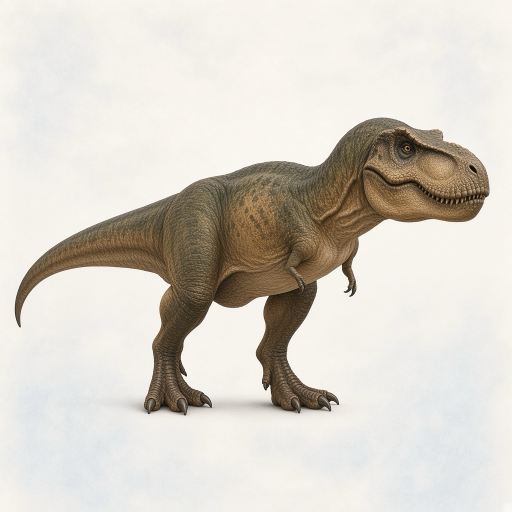
A T-Rex, short for Tyrannosaurus rex, was a giant meat-eating dinosaur that lived in western North America about 68 to 66 million years ago. Its name means “tyrant lizard king.” A grown T-Rex could be 40 feet (12 m) long from nose to tail and weigh about 9 tons (8 metric tons), which is about as much as two African elephants. T-Rex died out 66 million years ago, along with all the other big dinosaurs.
Why T-Rex is tricky to understand
T-Rex looks like a movie monster, so a lot of what people think they know about it comes from films. Real T-Rex is more interesting than the movies, but also a little less scary. It probably could not run 45 miles per hour (72 km/h) like in Jurassic Park. Most scientists who study its leg bones think it walked or jogged at about 12 to 25 miles per hour (19 to 40 km/h). That is still faster than you, but slower than a car.
T-Rex did not stand up tall like a person, with its tail dragging on the ground. It walked with its body level, like a giant chicken. Its long heavy tail stuck out behind to balance its huge head.
T-Rex lived a very long time ago. It is hard to picture how long. Stegosaurus, the dinosaur with plates on its back, lived more than 80 million years before T-Rex. That means T-Rex is closer in time to you than it is to Stegosaurus.
Key facts about T-Rex
Size. A full-grown T-Rex was about 40 feet (12 m) long and 12 feet (3.7 m) tall at the hip. It weighed around 9 tons (8 metric tons).
The biggest known T-Rex is a skeleton called Scotty, found in Saskatchewan, Canada. Scientists think Scotty weighed about 19,400 pounds (8,800 kg).
Tiny arms. A T-Rex’s arms were only about 3 feet (1 m) long, much shorter than its body. They could not even reach its mouth. But the arms had thick muscles and could lift around 400 pounds (180 kg).
Big head, big teeth. A T-Rex skull could be 5 feet (1.5 m) long. It had 50 to 60 teeth, each shaped like a banana with sharp little ridges (called serrations) for slicing meat. Old teeth fell out and new ones grew in all through its life.
Strong bite. A T-Rex’s bite was one of the strongest of any land animal ever. Scientists estimate it bit down with about 7,800 to 12,800 pounds of force, strong enough to crush bone.
Eyes the size of an orange. A T-Rex eye was about 5 inches (13 cm) across. Its eyes pointed forward, which helped it judge how far away things were.
Where it lived. T-Rex bones have only been found in western North America, in places like Montana, South Dakota, Wyoming, and Saskatchewan. None have been found in Africa, Europe, or Asia.
When it lived. T-Rex lived during the last 2 million years of the dinosaur age, from about 68 to 66 million years ago.
Famous skeletons. Sue, at the Field Museum in Chicago, is one of the most complete T-Rex skeletons ever found, about 90 percent complete. Sue was found in South Dakota in 1990 and went on display in 2000.
Common myths about T-Rex
Myth: T-Rex could run 45 miles per hour. Most scientists say no. Studies of T-Rex leg bones suggest a top speed of about 12 to 25 miles per hour (19 to 40 km/h). At higher speeds the bones would have snapped under its weight.
Myth: T-Rex could not see you if you stood still. This is from the movie Jurassic Park and is not true. Real T-Rex eyes pointed forward and worked very well. It could see you whether you were moving or not.
Myth: T-Rex roared like a lion. A 2016 study suggested T-Rex made closed-mouth rumbling sounds, more like the booming calls of a crocodile or an ostrich, not a lion-style open-mouth roar. The famous Jurassic Park roar was made for the movies by mixing the sounds of other animals.
Myth: T-Rex was a coward that only ate dead animals. A few scientists once said T-Rex only ate things that were already dead. Most scientists today disagree. T-Rex bite marks have been found on the bones of plant-eating dinosaurs, and some of those bones healed, which means the animal was alive when T-Rex bit it.
Myth: Fossils show that T-Rex had only feathers, like a bird. Preserved pieces of T-Rex skin show small, pebble-like scales. Scientists have not found skin from every part of its body or from a hatchling, so limited feathering remains possible even though the known adult skin is scaly.
Myth: Scientists know for certain that T-Rex was the biggest meat-eating dinosaur.Spinosaurus and Giganotosaurus may have been longer than some T-Rex specimens, while the biggest known T-Rex fossils belong to some of the heaviest meat-eating dinosaurs ever found. Incomplete fossils make an exact ranking difficult.
Frequently asked questions about T-Rex
Why were T-Rex’s arms so small?
Scientists are not 100 percent sure. T-Rex did not need its arms to catch food because it used its huge mouth and powerful jaws. The arms still had thick muscles, so they were strong for their size. Some scientists think they helped T-Rex push itself up off the ground after lying down, or held onto a partner.
How many teeth did T-Rex have?
About 50 to 60 teeth at any one time. The biggest T-Rex teeth, including the part stuck in the jaw, were almost 12 inches (30 cm) long. Each tooth was curved like a banana with little ridges that worked like a steak knife. T-Rex grew new teeth all through its life. If a tooth broke, a new one grew in.
Was T-Rex warm-blooded or cold-blooded?
Sort of in between. A 2014 study of dinosaur growth rates suggested T-Rex was mesothermic, meaning its body stayed warmer than the air around it but cooler than a bird or a person. Today’s tuna fish and great white sharks work the same way.
Who found the first T-Rex?
A fossil hunter named Barnum Brown found the first T-Rex bones in Montana in 1902. The bones were sent to the American Museum of Natural History in New York. A scientist there named Henry Fairfield Osborn gave T-Rex its name in 1905. Tyrannosaurus is Greek for “tyrant lizard,” and rex is Latin for “king.”
Why did T-Rex die out?
About 66 million years ago, a giant rock from space, called an asteroid, slammed into what is now Mexico. The crash threw so much dust into the air that sunlight was blocked for years. Plants died, plant-eating dinosaurs starved, and meat-eaters like T-Rex starved next. Big volcano eruptions in India around the same time made things even worse. The only dinosaurs that lived on were small feathered ones that became today’s birds.
Each quiz question cites a source for the fact it tests. Play at Rookie, Curious, Sharp, or Expert.
A T-Rex, short for Tyrannosaurus rex, was a large meat-eating dinosaur that lived in western North America during the final 2 million years of the dinosaur age, roughly 68 to 66 million years ago. Its name combines Greek and Latin: Tyrannosaurus means “tyrant lizard” in Greek, and rex means “king” in Latin. A grown adult reached about 40 feet (12 m) long, stood about 12 feet (3.7 m) tall at the hip, and weighed around 9 tons (8 metric tons). T-Rex disappeared 66 million years ago in the same mass extinction that ended the rest of the non-bird dinosaurs.
Why T-Rex is tricky to understand
A lot of what people picture when they hear “T-Rex” comes from films, especially Jurassic Park in 1993. Many of the movie details are wrong. The real T-Rex did not roar like a lion. A 2016 study of dinosaur ear and throat anatomy suggests it made closed-mouth rumbles and booms, more like a crocodile or an ostrich. T-Rex eyes worked perfectly well on still objects too; the famous “if you don’t move, it can’t see you” line is a film invention, not biology.
T-Rex also did not run at car speeds. Engineering studies of its leg bones in 2017 and later suggest a top speed of about 12 to 25 miles per hour (19 to 40 km/h). Above that, the leg bones would have shattered under the animal’s 9-ton (8 metric tons) weight. That is still fast for a giant predator, but it is closer to a fast jog than a sprinting horse.
T-Rex lived a very long time ago, but it lived much closer to us in time than to most other famous dinosaurs. Stegosaurus lived around 150 million years ago, in the Late Jurassic. T-Rex lived around 66 million years ago, in the Late Cretaceous. The gap between Stegosaurus and T-Rex is about 84 million years. The gap between T-Rex and you is about 66 million years. T-Rex is closer to you than to Stegosaurus.
Key facts about T-Rex
Length and weight. A full-grown T-Rex measured about 40 feet (12 m) long and weighed roughly 9 tons (8 metric tons). The largest known specimen, Scotty, found in Saskatchewan, is estimated at about 19,400 pounds (8,800 kg).
Skull and teeth. The skull could be 5 feet (1.5 m) long. T-Rex carried 50 to 60 teeth at a time, each shaped like a banana and edged with fine serrations, the small ridges that work like a steak knife. The largest T-Rex tooth, including the root, is the longest tooth of any known land predator at almost 12 inches (30 cm).
Bite force. Bates and Falkingham’s 2012 multi-body dynamics study put T-Rex posterior bite force at roughly 7,800 to 12,800 pounds-force, among the strongest of any land animal that has ever lived. Tooth marks show it could crush bone, not just slice meat.
Tiny arms. Each arm was only about 3 feet (1 m) long, far too short to reach the mouth, but the arm bones carry attachment scars from heavy muscles. Estimates suggest each arm could lift around 400 pounds (180 kg).
Walking posture. T-Rex walked with its body roughly horizontal and its long, heavy tail held out behind as a counterweight. Older drawings showing T-Rex standing tall and dragging its tail are wrong; verified T-Rex trackways do not show a tail drag.
Where it lived. Confirmed T-Rex fossils have only been found in western North America, in formations like the Hell Creek (Montana, the Dakotas, Wyoming) and Frenchman (Saskatchewan). No verified T-Rex remains have turned up in Asia, Africa, Europe, South America, or Alaska.
Sue, at the Field Museum. Discovered by fossil hunter Sue Hendrickson in South Dakota in 1990, Sue is about 90 percent complete and went on permanent display at Chicago’s Field Museum in 2000. Sue’s bones show many healed injuries, including ribs that broke and grew back together during life.
Lifespan and growth. Studies of growth rings in T-Rex bones (the same kind of rings that show a tree’s age) suggest it lived about 28 to 30 years. During its teenage years it grew explosively, putting on roughly 5 pounds (2.3 kg) per day at peak.
Senses. T-Rex eyes were about 5 inches (13 cm) across, larger than a baseball. They pointed forward, which gave it overlapping fields of view (called binocular vision) for judging distance. Its sense of smell was also very strong, supported by large olfactory bulbs, the brain regions that process smell.
Common myths about T-Rex
Myth: T-Rex could outrun a Jeep. Modeling studies suggest a top speed of roughly 12 to 25 miles per hour (19 to 40 km/h). The famous chase scene in Jurassic Park is fiction; at 45 miles per hour (72 km/h), the leg bones would not have survived a single stride.
Myth: T-Rex could not see still objects. T-Rex had forward-facing eyes that provided binocular vision, and studies of its braincase indicate well-developed senses of sight and smell. Nothing in its eye anatomy suggests that an object had to move before it became visible.
Myth: T-Rex roared. A 2016 study suggested it produced low-frequency, closed-mouth rumbles, similar to the calls of crocodiles and large birds like ostriches. The roar in Jurassic Park was a sound designer’s mix of baby elephant, tiger, and alligator vocalizations.
Myth: T-Rex was strictly a scavenger. A small group of paleontologists, most famously Jack Horner, argued in the 1990s that T-Rex was an obligate scavenger that only ate already-dead animals. The current scientific consensus is that T-Rex was an active predator that also scavenged when food was available. Bite marks have been found on living dinosaur bones (including a healed T-Rex tooth lodged in a Hadrosaur tail vertebra), which only happens if the bitten animal was alive at the time.
Myth: Fossils prove that adult T-Rex was fully covered in feathers. Preserved skin impressions from several body regions show pebbly scales, not feathers. Those patches do not preserve every part of the animal, and no direct skin evidence settles what hatchlings looked like. Some related tyrannosaurs, such as Yutyrannus from China, did have filamentous feather coverings.
Myth: T-Rex was unquestionably the biggest carnivorous dinosaur ever.Spinosaurus and Giganotosaurus may have exceeded some T-Rex specimens in length, while the largest well-studied T-Rex specimens rank among the heaviest known theropods. Because the fossils are incomplete and mass estimates depend on reconstruction methods, no simple size ranking is certain.
Frequently asked questions about T-Rex
Why are its arms so small?
The honest answer is that scientists are still debating it. The arms are too short to reach the mouth, so they probably did not help with feeding. They are not vestigial, though, because the bones show heavy muscle attachments and one published estimate put their lifting capacity at around 400 pounds (180 kg). Proposed uses include pushing T-Rex up from a lying position, gripping a partner during mating, or holding struggling prey close to the body. The current view is that the arms shrank as the head and jaws took over the predator’s job; oversized arms would have been dead weight on a body already pushing the limits of land-animal size.
How did T-Rex hunt with such tiny arms?
The skull and jaws did everything. T-Rex could open its jaws to a wide gape of about 60 to 70 degrees and bite down with thousands of pounds of force. The teeth crushed bone and tore through muscle in a single motion. Tooth marks on plant-eater fossils, including hadrosaur and ceratopsian bones, match T-Rex tooth shape exactly.
How smart was T-Rex?
It had a relatively large brain for a non-bird dinosaur, with well-developed regions associated with smell and other senses. Estimates of relative brain size suggest that some smaller maniraptoran theropods had larger brains for their body size, but fossil brain comparisons are approximate. T-Rex was a capable hunter without necessarily having the highest relative brain size of its era.
Could T-Rex be brought back from a fossil, like in Jurassic Park?
No. DNA breaks down quickly, and no complete dinosaur DNA has ever been recovered. The oldest sequenced DNA so far is about 1 to 2 million years old, from permafrost. T-Rex died out 66 million years ago, far beyond the survival range of DNA. Some protein fragments (the building blocks of bone and other tissue) have been claimed in T-Rex fossils, but these are not enough to clone an animal.
Why did T-Rex die out?
T-Rex lived during the very last part of the Cretaceous period (the third great age of dinosaurs). Around 66 million years ago, an asteroid roughly 6 to 9 miles (10 to 15 km) wide struck what is now the Yucatán Peninsula in Mexico, leaving the Chicxulub crater. The impact threw enough dust and aerosols into the upper atmosphere to block sunlight worldwide for years. Plants died, plant-eating dinosaurs starved, and predators like T-Rex starved soon after. Massive volcanic eruptions in India (the Deccan Traps) had already been stressing global climate. The only dinosaurs that survived the K-Pg extinction were small, feathered, and bird-like; modern birds are their living descendants.
Each quiz question cites a source for the fact it tests. Play at Rookie, Curious, Sharp, or Expert.
A T-Rex, formal name Tyrannosaurus rex, was a large bipedal theropod dinosaur that lived in western North America during the final 2 million years of the Late Cretaceous, from about 68 to 66 million years ago. Adults reached approximately 40 feet (12 m) in length, stood about 12 feet (3.7 m) tall at the hip, and weighed roughly 9 tons (8 metric tons). T-Rex belongs to the family Tyrannosauridae, within the broader clade Coelurosauria, which also includes the modern birds. It was the apex predator of the Hell Creek and Lance Formation ecosystems, and it disappeared in the K-Pg mass extinction triggered by the Chicxulub asteroid impact and accompanying Deccan volcanism 66 million years ago.
What is often misunderstood about T-Rex
T-Rex did not run at highway speeds. The widely cited 2017 University of Manchester multibody-dynamics study by Sellers and colleagues placed its top sustainable speed near 17 miles per hour (28 km/h), with subsequent biomechanical work bracketing the upper bound at roughly 12 to 25 miles per hour (19 to 40 km/h). Above that range, the femur and tibia would have failed under cyclical loading from a 9-ton (8 metric tons) body. T-Rex was fast enough to outrun most of its prey but slower than depicted in Jurassic Park.
The standing posture also disagrees with older reconstructions. Modern skeletal mounts show T-Rex carrying its body roughly horizontal, with the long, heavy tail projecting behind as a counterweight to the massive skull. The “kangaroo” pose with a tail dragging on the ground, used in early 20th-century mounts, conflicts with the articulation of the spine. Verified T-Rex trackways do not show a tail drag.
T-Rex was almost certainly an active predator, not the obligate scavenger argued by Jack Horner in the 1990s. The strongest single piece of evidence is a healed T-Rex tooth crown embedded in the tail vertebra of a hadrosaur (DePalma et al., 2013), which can only happen if the hadrosaur survived the bite and bone regrew around the broken tooth. Bite marks consistent with T-Rex tooth geometry appear on numerous Hell Creek herbivores, including the ceratopsians Triceratops and Edmontosaurus. Like most large carnivores today, T-Rex likely scavenged when given the chance and hunted otherwise.
T-Rex was probably not feathered as an adult. Skin impressions recovered from multiple specimens, including patches associated with the neck, hip, and tail, show pebbly polygonal scales similar to those of modern reptiles. A 2017 Biology Letters paper by Bell and colleagues argued that adult T-Rex was largely or entirely scaly. Closely related Asian tyrannosaurs (Yutyrannus, Dilong) preserve filamentous protofeathers, so the family had a feathered ancestor, but T-Rex itself appears to have lost most of that integument by adulthood, possibly as a heat-shedding adaptation in a large-bodied predator.
The classic “T-Rex roar” of film is fiction. A 2016 study by Riede and colleagues, drawing on closed-mouth vocalization in modern crocodilians and birds, suggested T-Rex produced low-frequency, closed-mouth rumbles and booms rather than open-mouth roars. The vocalizations would have resembled the territorial calls of an alligator more than the roar of a lion.
Key facts about T-Rex
Taxonomy.Tyrannosaurus rex is the type species of the genus Tyrannosaurus and belongs to the nested theropod clades Tyrannosauridae, Tyrannosauroidea, and Coelurosauria. Birds descend from another branch of coelurosaurs, so T-Rex and every living chicken share a coelurosaur ancestor.
Size and mass. Adult body length 40 feet (12 m), hip height about 12 feet (3.7 m), body mass approximately 9 tons (8 metric tons). The largest known specimen, Scotty (RSM P2523.8) from the Frenchman Formation in Saskatchewan, is estimated at 19,400 pounds (8,800 kg) per a 2019 Anatomical Record paper by Persons and colleagues.
Skull and dentition. Skull length up to 5 feet (1.5 m); 50 to 60 teeth in the jaws at any time, replaced continuously through life. The largest known tooth, including the embedded root, measures nearly 12 inches (30 cm), the longest tooth of any known land predator. Teeth are ziphodont, meaning blade-shaped with fine serrations along the cutting edges.
Bite force. Estimates from Bates and Falkingham (2012) and follow-up studies place posterior bite force at roughly 7,800 to 12,800 pounds-force (35 to 57 kilonewtons), the highest yet documented for a land animal. Tooth indentations on Triceratops pelvic bones demonstrate bone-crushing, not just flesh-slicing, capability.
Forelimbs. Each arm is about 3 feet (1 m) long with two functional fingers (the third digit is reduced to a metacarpal vestige). Despite the small size, the bones bear scars of well-developed biceps and brachialis muscles. Carpenter and Smith (2001) estimated each arm could support roughly 400 pounds (180 kg). The arms cannot reach the mouth.
Posture and locomotion. Bipedal, parasagittal stance with horizontal trunk and counterbalancing tail. Estimated cruising speed 6 to 12 miles per hour (10 to 19 km/h); estimated maximum 12 to 25 miles per hour (19 to 40 km/h). A 2021 Royal Society Open Science analysis suggested a resonant walking speed of roughly 3 miles per hour (4.6 km/h).
Senses. Endocast studies indicate enlarged olfactory bulbs relative to total brain volume, comparable to those of modern carrion-feeding birds, signaling a strong sense of smell. Eye sockets larger than 4 inches (10 cm) across; eyeballs roughly 5 inches (13 cm) in diameter. Forward-facing orbits gave overlapping (binocular) vision useful for depth perception.
Growth and lifespan. Osteohistological studies by Erickson and colleagues (2004) document explosive adolescent growth of about 5 pounds (2.3 kg) per day between ages 14 and 18. Maximum lifespan inferred from line-of-arrested-growth (LAG) counts is about 28 to 30 years.
Thermal physiology. Grady et al. (2014, Science), reasoning from osteohistological growth-rate data across reptiles, birds, and mammals, proposed mesothermic metabolism for tyrannosaurs: body temperature elevated above ambient but lower than that of modern endotherms like birds and mammals. Tuna and great white sharks operate on a similar middle-ground physiology.
Range and habitat. All confirmed T-Rex specimens are from western North America, primarily the Hell Creek (Montana, North Dakota, South Dakota, Wyoming), Lance (Wyoming), Frenchman (Saskatchewan), and Scollard (Alberta) Formations. The region was a low-lying coastal plain along the western shore of the Western Interior Seaway during T-Rex’s time. There are no confirmed records from Asia, Africa, Europe, South America, or Alaska.
Specimen count. Approximately 50 specimens have been cataloged worldwide, of which about a dozen are reasonably complete. Notable individuals include Sue (FMNH PR 2081, Field Museum, Chicago, ~90 percent complete, found 1990, displayed since 2000), Scotty (RSM P2523.8, Royal Saskatchewan Museum), Stan (BHI 3033), and Trix (Naturalis, Leiden).
Discovery and naming.Barnum Brown of the American Museum of Natural History recovered the first scientifically described T-Rex specimen at Hell Creek, Montana in 1902. AMNH director Henry Fairfield Osborn named the species in 1905. Tyrannosaurus combines the Greek roots tyrannos (tyrant) and sauros (lizard); rex is Latin for king.
Common myths about T-Rex
Myth: T-Rex could run 45 miles per hour. Computational and biomechanical studies converge on a top speed of 12 to 25 miles per hour (19 to 40 km/h). Hutchinson and Garcia (2002, Nature) showed that the leg muscle mass needed to sustain a 45 mph (72 km/h) sprint would have required an unphysical fraction of the animal’s body mass. The 2017 Sellers study refined the upper bound using multibody dynamics and bone-stress modeling.
Myth: T-Rex had vision-based motion blindness.Jurassic Park invented this. Endocranial casts show T-Rex had a large optic lobe, forward-facing orbits with substantial binocular overlap, and one of the highest visual acuity estimates of any non-avian dinosaur (Stevens, 2006). It could see stationary prey perfectly well.
Myth: T-Rex was strictly a scavenger. The active-predator interpretation is the consensus. Direct evidence includes the DePalma et al. (2013) hadrosaur with a healed T-Rex tooth, T-Rex bite marks on living-dinosaur bones, and the predator-prey body-size ratios that put T-Rex squarely in active-hunter territory. T-Rex almost certainly also scavenged when carcasses were available; obligate scavenging at its body size is ecologically implausible because no terrestrial environment generates enough carrion to support a 9-ton (8 metric tons) consumer.
Myth: T-Rex roared. The 2016 Riede paper on dinosaur vocalization, plus comparative anatomy with crocodilians and large flightless birds, supports closed-mouth, low-frequency rumbles. The film roar is a Foley artist’s mix of tiger, alligator, and baby elephant calls.
Myth: Adult T-Rex was covered in feathers. The 2017 Bell et al. Biology Letters paper documented scaly skin impressions across the body. Hatchlings and juveniles may have had downy filaments for thermoregulation, but the adult appears to have been predominantly scaly.
Myth: T-Rex used its tail as a weapon, dragging it on the ground. The muscular tail was carried off the ground as a horizontal counterbalance to the head and torso. Verified T-Rex trackways do not show a dragging tail. Late 19th- and early 20th-century reconstructions in the kangaroo posture did not survive review of the spinal articulation.
Myth: T-Rex could open its jaws 180 degrees. Skull-articulation studies put the maximum gape near 63 degrees, sufficient for a wide bite without dislocating the jaw joint. The 2015 Lautenschlager analysis of theropod gapes placed T-Rex among the wider-gaping carnivores but well below 180 degrees.
Myth: T-Rex DNA could be recovered. No verified dinosaur DNA has been sequenced. DNA degrades on a half-life of about 521 years and becomes effectively unrecoverable after roughly 6.8 million years under ideal conditions. T-Rex died out 66 million years ago, almost ten times that limit. Some collagen-protein fragments have been reported in T-Rex bone (Schweitzer and colleagues), but those reports remain contested and would not enable cloning even if confirmed.
Frequently asked questions about T-Rex
Why are T-Rex’s arms so small?
The functional reason is debated. The arms are too short to reach the mouth, ruling out a feeding role. The bones nonetheless carry attachment scars from substantial muscles, and Carpenter and Smith (2001) estimated each arm’s lifting capacity at around 400 pounds (180 kg), so they were not vestigial in the strict sense. Proposed uses include pushing the body up from a prone position, gripping a mate, or restraining struggling prey at close range. The likely evolutionary driver is that T-Rex’s lineage shifted prey-handling onto the head and jaws; with a 5-foot (1.5 m) skull doing all the killing, large arms became dead weight on a body already approaching the upper mass limit for terrestrial bipeds.
How fast did T-Rex actually run?
Best current estimates put the maximum speed at 12 to 25 miles per hour (19 to 40 km/h). Cruising speed was probably around 5 to 12 miles per hour (8 to 19 km/h). The constraint is bone strength: above about 25 mph (40 km/h), the femur and tibia would have failed under the cyclical loads of a sprinting 9-ton (8 metric tons) body. T-Rex was fast enough to overtake most contemporary herbivores, which were also slow.
What did T-Rex eat?
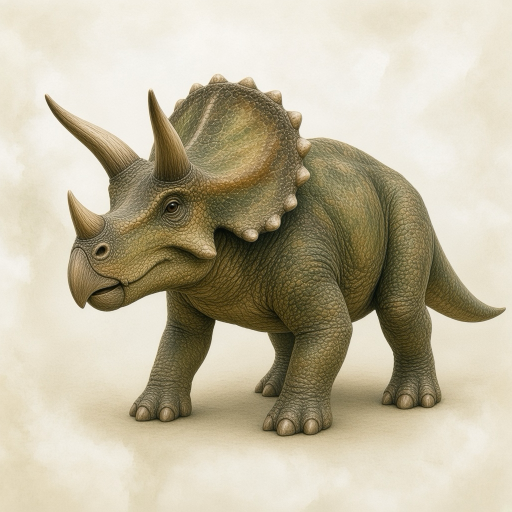
Large herbivorous dinosaurs of the Hell Creek ecosystem, principally the ceratopsian Triceratops and the hadrosaur Edmontosaurus. Tooth marks on bones of both species match T-Rex tooth geometry, and coprolites (fossilized droppings) attributed to T-Rex contain crushed bone fragments from juvenile herbivores. Younger T-Rex, with more slender skulls and bladelike teeth, probably hunted smaller, faster prey before transitioning to bone-crushing as adults.
Was T-Rex warm-blooded?
Its exact metabolic strategy remains debated. Oxygen-isotope measurements from T-Rex bone suggest that it maintained a fairly stable body temperature, and growth studies show a rapid adolescent growth phase. Those findings support an active metabolism, but they do not by themselves establish whether T-Rex regulated heat exactly like a modern bird or relied partly on its enormous body size to retain heat.
How did Sue end up at the Field Museum?
Sue was discovered in 1990 by Sue Hendrickson (the specimen’s namesake) on the Cheyenne River Reservation in South Dakota. After a complex legal dispute over land ownership, the specimen was sold at Sotheby’s in 1997 for $8.36 million to the Field Museum, with backing from Disney, McDonald’s, and the California State University system. Sue was prepared for several years and went on permanent display in May 2000. The skull mounted on the skeleton is a cast; the original 600-pound (270 kg) skull is displayed separately because it would deform the spine if mounted with the rest of the body.
Were there bigger meat-eating dinosaurs than T-Rex?
Two contenders are larger by some measures. Spinosaurus aegyptiacus (North Africa, ~99 to 93 million years ago) reached around 50 feet (15 m) in length, though it was more lightly built and partially aquatic. Giganotosaurus carolinii (Argentina, ~98 million years ago) reached around 40 to 43 feet (12 to 13 m) and may have weighed slightly more than T-Rex. T-Rex retains the title for absolute bite force; no other terrestrial carnivore has demonstrated higher.
Why did T-Rex go extinct?
T-Rex disappeared in the K-Pg mass extinction 66 million years ago. The proximate cause was the Chicxulub asteroid impact in what is now the Yucatán Peninsula, Mexico. The 6 to 9 mile (10 to 15 km) wide bolide ejected enough vaporized rock and sulfate aerosols into the upper atmosphere to suppress photosynthesis worldwide for years to decades. Plants died, herbivores starved, and apex predators starved next. The contemporaneous Deccan Traps volcanic province in India had been releasing greenhouse gases and aerosols for hundreds of thousands of years before and after the impact, compounding the climate stress. Of the dinosaurs, only small bird-line theropods survived; modern birds are their direct descendants.
Each quiz question cites a source for the fact it tests. Play at Rookie, Curious, Sharp, or Expert.
Tyrannosaurus rex is a non-avian theropod dinosaur of the family Tyrannosauridae, superfamily Tyrannosauroidea, infraorder Coelurosauria, suborder Theropoda, order Saurischia. The species inhabited western North America during the late Maastrichtian, roughly 68 to 66 million years ago, and went extinct at the Cretaceous-Paleogene (K-Pg) boundary. Adult body length is approximately 40 feet (12 m), with hip height around 12 feet (3.7 m) and body mass on the order of 9 tons (8 metric tons); the largest known specimen, Scotty (RSM P2523.8), is estimated at 19,400 pounds (8,800 kg) by Persons et al. (2019). T-Rex stands as the type species of Tyrannosaurus, named by Henry Fairfield Osborn in 1905 from material recovered by Barnum Brown in the Hell Creek Formation of Montana in 1902. Approximately 50 specimens have been formally cataloged worldwide; all confirmed material is North American.
Why T-Rex paleontology is non-intuitive
Several features of Tyrannosaurus biology run against the cinematic stereotype, and several paleontological controversies that briefly dominated public attention have since converged on inconvenient conclusions for the popular imagination.
The first is locomotion. Despite a body plan superficially evocative of a sprinting biped, biomechanical analysis severely constrains running speed. Hutchinson and Garcia (2002, Nature) demonstrated that the leg-extensor muscle mass required to support a 45 mph (72 km/h) sprint at adult body mass exceeds physiologically plausible bounds, occupying an unrealistic fraction of total body mass. The 2017 multibody-dynamics study by Sellers and colleagues at Manchester reinforced this, finding that skeletal stresses limit T-Rex to walking gaits with a maximum speed near 12 mph (19 km/h) before peak loading on the femur and tibia exceeds the safety factor for cortical bone. A 2021 Royal Society Open Science study by van Bijlert, van Soest, and Schulp inferred a preferred walking speed of about 3 miles per hour (4.6 km/h) by treating the tail as a passive resonant pendulum coupled to the trunk and stride frequency. T-Rex was, in modern terms, a powerful walker rather than a sprinter.
The second is the relationship between forelimb morphology and feeding ecology. The forelimbs are radically reduced relative to body length, with each humerus only about 13 inches (33 cm) and a manual digit count of two functional fingers (the third metacarpal is reduced and bears no functional phalanx). The arms cannot reach the rictus. Yet osteological correlates of muscle attachment, including a prominent deltopectoral crest and well-developed bicipital tubercle, indicate substantial musculature; Carpenter and Smith (2001) estimated each forelimb could lift on the order of 400 pounds (180 kg). The ecological replacement of forelimb prehension by oral prehension is the parsimonious explanation: with skull length approaching 5 feet (1.5 m) and posterior bite force in the range of 7,800 to 12,800 pounds-force (35 to 57 kilonewtons; Bates and Falkingham, 2012), the head subsumed the prey-handling functions normally distributed across forelimbs and jaws in smaller theropods. The miniaturization of the arms is the byproduct of an oversized bite, not an arrested condition.
The third is metabolic physiology. The longstanding ectothermy-versus-endothermy dichotomy has yielded to mesothermy, an intermediate strategy proposed for non-avian dinosaurs by Grady et al. (2014, Science) on the basis of growth rates inferred from osteohistology, with extant tuna, lamnid sharks, and leatherback turtles serving as living analogs. Subsequent work using clumped-isotope eggshell thermometry and biomolecular analysis of fossil bone has refined the picture, with some lines of evidence (Wiemann et al. 2022 in Nature, using fossil-bone Raman/FTIR spectroscopy of metabolic markers) arguing for endothermy more avian-like than the original mesothermy frame. Either way, the data reconcile two otherwise contradictory observations: rapid juvenile growth, about 4.6 pounds (2.07 kg) per day at peak, documented by Erickson et al. (2004) from line-of-arrested-growth (LAG) counts in long-bone microsections, and the absence of fully avian metabolic indicators such as extensive postcranial pneumaticity.
The fourth is feeding strategy. The “obligate scavenger” hypothesis advanced by Jack Horner in the 1990s, leveraging large olfactory bulbs, reduced forelimbs, and bone-crushing dentition, has been progressively undermined. The decisive specimen is the hadrosaur tail vertebra (MOR 980) reported by DePalma et al. (2013, PNAS) with a healed-over T-Rex tooth crown lodged between two centra; bone remodeling around the embedded tooth requires that the hadrosaur survived the bite. Compounding evidence includes T-Rex bite traces on conspecific (cannibalism, Longrich et al. 2010), ceratopsian, and hadrosaur material from individuals of varying preservation states, and the energetic implausibility of obligate scavenging at terrestrial body masses near 9 tons (8 metric tons), where carrion abundance is insufficient to sustain even a single individual without active predation.
The fifth concerns integument. The discovery of basal tyrannosauroids with filamentous protofeathers, Dilong paradoxus (Xu et al., 2004) and Yutyrannus huali (Xu et al., 2012) from the Yixian Formation of China, established that filamentous integument is plesiomorphic for the clade. T-Rex itself, however, preserves scaly skin impressions across the abdomen, neck, ilium, and tail (Bell et al. 2017, Biology Letters), with no direct evidence for adult feathers. The current synthesis: feathered ancestors gave rise to a derived large-bodied tyrannosaurid that secondarily reduced or lost much of its integumentary filament, plausibly under thermoregulatory selection at large body size, while juveniles may have retained natal down. Compare with extant rhinoceros and elephant skin, where derived large-bodied mammals lost most of the dense pelage of their ancestors.
Key facts
Phylogeny. Tyrannosauridae is nested within Tyrannosauroidea, a coelurosaurian clade. Coelurosauria also contains Maniraptora, the lineage that gave rise to Aves. Birds are tyrannosaurs’ closest extant relatives, with the most recent common ancestor estimated in the Middle Jurassic, around 165 million years ago. Sister-taxon relationships within Tyrannosauridae include Tyrannosaurinae (genera Tyrannosaurus, Tarbosaurus, Daspletosaurus, Zhuchengtyrannus) and Albertosaurinae (Albertosaurus, Gorgosaurus).
Taxonomic synonymy.Manospondylus gigas (Cope, 1892) is technically the senior synonym for Tyrannosaurus rex. Under the conditions of ICZN Article 23.9, Tyrannosaurus rex qualifies as a nomen protectum given over a century of dominant usage, though no formal ICZN ruling has been issued and Manospondylus has not been formally suppressed.
Mass and length. Adult body length 40 feet (12 m), maximum reported length about 43 feet (13 m). Body mass estimates have grown over time as better skeletal models incorporate volumetric reconstruction. Recent estimates (Persons et al. 2019; Hutchinson et al. 2011) center on 8 to 9 tons (7 to 8 metric tons) for typical adults, with Scotty as the heaviest documented specimen.
Population estimates. Marshall et al. (2021, Science) estimated, using Damuth’s rule for population density of large carnivores, that approximately 20,000 individual T. rex lived at any one time over a geographic range of about 890,000 square miles (2.3 million km²), with cumulative species abundance over its 2-million-year span on the order of 2.5 billion individuals. The fossilization rate inferred from those numbers and the recovered specimen count is approximately one in 80 million.
Skull morphology. Skull length up to 5 feet (1.5 m), with reinforced rear cranial buttressing and fused premaxillae. Heterodont dentition: anterior premaxillary teeth are smaller and D-shaped in cross-section; posterior maxillary and dentary teeth are recurved, laterally compressed, ziphodont, and serrated on both anterior and posterior carinae. Largest tooth, including root, almost 12 inches (30 cm).
Bite mechanics. Bates and Falkingham (2012, Biology Letters) reconstructed posterior bite forces of about 35 to 57 kN (7,800 to 12,800 pounds-force), the highest documented for a terrestrial animal, with peak instantaneous tooth-tip pressures sufficient to fracture cortical bone in Triceratops pelvic and frill elements. Cost et al. (2019, Anatomical Record) added cranial-kinesis biomechanics constraining how those forces propagate through the palate. The puncture-pull mechanism inferred from tooth marks and modeled jaw kinematics is consistent with bone-crushing rather than mere flesh-shearing.
Forelimb anatomy. Two functional manual digits (digits I and II), with digit III reduced to a vestigial metacarpal. Each forelimb approximately 3 feet (1 m) total length. Hindlimb-to-forelimb length ratio is among the highest of any theropod.
Endocranial morphology. Endocasts (Witmer and Ridgely 2009, Anatomical Record) document large olfactory bulbs comparable in relative size to those of modern carrion-feeding birds, large optic lobes, and a forward-shifted cerebrum. The cochlea is elongate, suggesting sensitivity to low-frequency sound. The encephalization quotient (EQ) is around 2.0 to 2.4, high for a non-avian dinosaur but below that of troodontids and dromaeosaurids.
Ontogeny. Erickson et al. (2004, Nature) reconstructed a sigmoidal growth curve from LAG counts: slow growth from hatching to age ~14, exponential growth between ages 14 and 18 reaching about 4.6 pounds (2.07 kg) per day, then asymptotic mass at age ~18 to 20. Maximum recorded individual age, from Sue’s femur LAGs, is about 28 years.
Pneumaticity. Air-sac diverticula invaded parts of the vertebral column in T. rex, as indicated by pneumatic openings and internal spaces in some vertebrae. The limb bones were not pneumatized in the same way. This distribution lightened parts of the axial skeleton while leaving the load-bearing limbs structurally robust.
Hell Creek paleoenvironment. The Hell Creek Formation (latest Maastrichtian, ~68 to 66 Ma) of Montana, North Dakota, South Dakota, and Wyoming records a coastal-plain ecosystem with fluvial channel sands, overbank mudstones, and lignites along the western shore of the Western Interior Seaway. Its dinosaur assemblage includes Triceratops, Edmontosaurus, Ankylosaurus, Pachycephalosaurus, Anzu, and Thescelosaurus. The K-Pg boundary interval, marked by evidence including an iridium anomaly and shocked quartz, occurs at the top of the formation.
Notable specimens. Sue (FMNH PR 2081, ~90 percent complete, age ~28, Field Museum); Stan (BHI 3033); Scotty (RSM P2523.8, largest by mass); Trix (Naturalis, Leiden); Black Beauty (RTMP 81.6.1); Wankel (MOR 555, lent to Smithsonian as the “Nation’s T. rex”).
Common misconceptions at expert level
Misconception: Nanotyrannus is a valid taxon distinct from juvenile T. rex. The juvenile-Tyrannosaurus interpretation has dominated the literature for two decades, supported by ontogenetic transformations in cranial proportions and dentition documented in Carr (1999) and Carr and Williamson (2004). A 2024 Fossil Studies paper by Longrich and Saitta revived the Nanotyrannus hypothesis on the basis of fused sutures and discrete morphological characters in the “Bloody Mary” specimen, but the consensus position as of this article’s review date treats the relevant specimens (CMNH 7541, “Jane,” BMRP 2002.4.1) as juvenile T. rex unless and until counterevidence is broadly accepted.
Misconception: T-Rex was the largest theropod. Several theropods rival or exceed T-Rex in length. Spinosaurus aegyptiacus of the Kem Kem Group (~99 to 93 Ma) reached approximately 50 feet (15 m); recent work by Ibrahim et al. (2014, 2020) recasts its lifestyle as semi-aquatic. Giganotosaurus carolinii of the Candeleros Formation (~98 Ma) reached approximately 40 to 43 feet (12 to 13 m) and may have exceeded T-Rex in mass. T-Rex retains the highest documented bite force; absolute body size is not the same metric as predator power.
Misconception: T-Rex hunted in coordinated packs. Pack-hunting in tyrannosaurs has been argued for Albertosaurus (Currie 2001) and proposed for T-Rex on the basis of multi-individual bonebeds. The evidence is associative rather than behavioral: individuals of multiple ontogenetic stages occurring in the same depositional setting do not in themselves demonstrate cooperative hunting and may reflect shared habitat or scavenging aggregations. Direct evidence of coordinated pack predation in T-Rex is absent.
Misconception: The Chicxulub impactor was the sole cause of the K-Pg extinction. The Chicxulub bolide (~6 to 9 mile, 10 to 15 km diameter, impacting at 66.052 ± 0.043 million years ago per Sprain et al. 2018) is the proximate trigger and the only event that explains the global iridium anomaly, shocked-quartz layer, and tektite spherules at the K-Pg boundary. The Deccan Traps flood basalt province in India, however, was active across roughly 250,000 years before and after the impact, releasing on the order of 240,000 cubic miles (1 million km³) of basaltic lava and significant sulfate aerosols and CO₂. The current synthesis (Schoene et al. 2019; Sprain et al. 2019) treats the Deccan eruptions as having pre-stressed terrestrial ecosystems before Chicxulub delivered the killing blow. Ocean acidification, photosynthesis suppression, and impact winter together explain why the extinction selected against large-bodied tetrapods, marine reptiles, and ammonites while sparing small endotherms, freshwater taxa, and detritus-based ecosystems.
Misconception: T-Rex roared in the Jurassic Park style. Closed-mouth vocalization in modern crocodilians and large flightless birds (Riede et al. 2016) supports low-frequency, infrasound-rich rumbles for non-avian dinosaurs, with peak frequencies likely below 250 Hz. The cinematic open-mouth roar is a Foley construction (tiger, alligator, baby elephant) and has no anatomical basis in tyrannosaur cranial or laryngeal morphology.
Misconception: T-Rex DNA can be recovered from amber-preserved tissue. No verified ancient DNA has been sequenced from any non-avian dinosaur. The empirical half-life of DNA in fossil bone is approximately 521 years (Allentoft et al. 2012), with effective recoverability under ideal taphonomic conditions extending no more than about 6.8 million years. T-Rex died out 66 million years ago, almost an order of magnitude beyond that horizon. Reports of putative T-Rex collagen-protein fragments (Schweitzer et al. 2007; San Antonio et al. 2011) remain methodologically contested and would not in any case enable cloning. The premise of Jurassic Park, recovery of dinosaur DNA from blood-feeding insect specimens preserved in amber, fails on three independent grounds: amber-preserved DNA does not survive on the relevant timescale, blood meals in amber-trapped insects are not reliably recovered, and host DNA in such meals would be degraded, sparse, and contaminated.
Misconception: Tyrannosaurus tongue protruded like a lizard’s. Li et al. (2018, PLOS ONE) studied hyobranchial elements in modern birds, crocodilians, and dinosaurs and concluded that non-avian dinosaur tongues, including those of theropods, were largely fixed to the floor of the mouth in a crocodile-like configuration rather than freely extensible as in modern lizards. Reconstructions showing T-Rex with a long protrusible tongue are inconsistent with the hyoid morphology.
Frequently asked questions
What is the current best estimate of T-Rex top speed?
Skeletal stresses cap the maximum at roughly 12 mph (19 km/h). The 2017 Sellers et al. multibody-dynamics study at Manchester concluded T-Rex was limited to walking gaits, with bone failure expected above that speed; Hutchinson and Garcia (2002) provided the original muscle-mass-based limit ruling out 45 mph sprints. The lower walking-speed estimate of about 3 miles per hour (4.6 km/h) from van Bijlert et al. (2021) treats the tail as a coupled resonant pendulum and applies to comfortable cruising rather than maximum effort. The bone-stress safety factor against fast running is the binding constraint at a 9-ton (8 metric tons) body mass.
How is T-Rex related to modern birds?
T-Rex sits within Coelurosauria, the same major theropod clade that contains Maniraptora, and Maniraptora contains Aves. Birds are not descended from tyrannosaurs but share a common coelurosaurian ancestor with them in the Middle Jurassic, around 165 million years ago. Among living animals, birds are T-Rex’s closest relatives; crocodilians are next-closest, separated by hundreds of millions of years.
Why is the largest specimen Scotty rather than Sue?
Sue (FMNH PR 2081) is more complete (~90 percent) and has been studied more intensively, but Scotty (RSM P2523.8), described in detail by Persons et al. (2019), edges Sue in mass-bearing femoral and tibial dimensions. Mass estimates are model-dependent, and the comparative ranking of large T-Rex specimens depends on which volumetric reconstruction is used. Stan (BHI 3033) is comparable in size to Sue and Scotty.
What did T-Rex juveniles eat?
Juvenile dentition is more bladelike and the skull is more gracile than in adults. Stable-isotope work and tooth-mark studies suggest juveniles occupied a different ecological niche from adults, hunting smaller, faster prey such as juvenile hadrosaurs and ornithomimids before transitioning to bone-crushing on large herbivores in adulthood. Holtz (2021) and earlier work argue that this ontogenetic niche shift may have functionally replaced the absent mid-sized predator guild in the Hell Creek ecosystem.
Was T-Rex cannibalistic?
Longrich et al. (2010, PLOS ONE) reported tyrannosaurid tooth marks on T-Rex pedal phalanges, metatarsals, and a humerus, with bite-mark geometry matching T-Rex tooth morphology and excluding other Hell Creek carnivores. Whether the bite marks reflect active predation or scavenging on conspecific carcasses is not resolvable from the marks alone, but cannibalism in some form is supported by direct fossil evidence.
How does the Chicxulub impact selectively favor avian survival?
Refuge analysis (Field et al. 2018, Current Biology) supports a model in which only ground-dwelling, generalist-feeding small-bodied birds survived. Tree-canopy-dependent neornithes did not survive the impact-induced global firestorm and subsequent forest collapse; the surviving lineage radiated from a small ground-foraging stock. This selective filter explains why all extant birds descend from a narrow Late Cretaceous bottleneck rather than the full range of pre-impact avian diversity.
What is the geological evidence that the K-Pg boundary is sharp?
The boundary is defined by a thin clay layer with anomalously high iridium concentrations (Alvarez et al. 1980), shocked quartz with planar deformation features, microspherules of impact-melt glass (the Caribbean tektites), and an immediate biostratigraphic break in foraminiferal assemblages above the layer. ⁴⁰Ar/³⁹Ar dating of impact tektites by Renne et al. (2013) places the impact at 66.043 ± 0.043 Ma, within ~32,000 years of the floral and faunal extinction levels in the same sections.