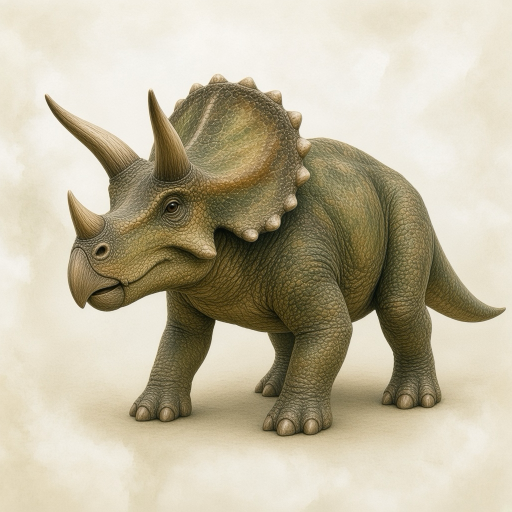
Triceratops was a large plant-eating dinosaur with three horns on its head and a big bony shield, called a frill, behind its face. Its name means “three-horned face.” Triceratops lived in what is now western North America about 68 to 66 million years ago, near the very end of the time when dinosaurs ruled the Earth. It could grow about as long as a school bus and weighed more than a big truck.
Why Triceratops is fun to learn about
Triceratops had two long brow horns and a large frill. Its beak and dental batteries show that it ate plants, but “plant-eater” does not mean harmless or peaceful. Healed injuries on some skulls are consistent with combat between individuals, while the horns could also have helped in defense or display.
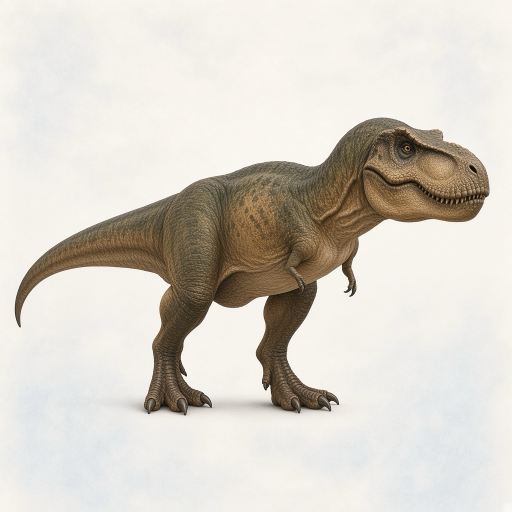
Triceratops shared its world with the famous meat-eater T-Rex. The two lived at the same time and in the same place. Scientists have found T-Rex bite marks on Triceratops bones, so we know they sometimes met. A few Triceratops bones show wounds that healed, which means that animal survived the attack and lived on.
People often imagine Triceratops in big herds, like buffalo. In real life, most Triceratops fossils are found alone. So we are not sure how social it really was.
Key facts about Triceratops
Three horns. Triceratops had two long horns above its eyes that could reach about 3 feet (1 m) long. A third, shorter horn sat on its nose.
The big frill. A wide, bony frill spread out from the back of its skull. The frill was made of solid bone, which is why it lasted millions of years as a fossil.
A giant head. The Triceratops skull was one of the biggest heads of any land animal ever. The largest ones were about 8 feet (2.5 m) long, which is around one-third of the whole animal.
A parrot-like beak. The front of its mouth ended in a sharp, hooked beak, a bit like a giant parrot. It used the beak to snip off tough plants.
Hundreds of teeth. Behind the beak, Triceratops had hundreds of teeth packed into stacked rows. As the top teeth wore down, new teeth grew in to replace them.
Size. A grown-up Triceratops was about 26 to 30 feet (8 to 9 m) long. It weighed around 6 to 12 tons (5 to 11 metric tons).
Four legs. Triceratops walked on four sturdy legs, holding its heavy head low to the ground, much like a rhinoceros.
Where it lived. Its fossils come only from western North America, in places like Montana, South Dakota, Wyoming, and Colorado.
Common myths about Triceratops
Myth: Triceratops ate meat with those big horns and beak. Triceratops was a plant-eater. Its beak and teeth were built for snipping and slicing plants, not for catching animals.
Myth: Triceratops lived at the same time as Stegosaurus. Stegosaurus lived more than 80 million years before Triceratops. The two never met. Triceratops is actually closer in time to you than it is to Stegosaurus.
Myth: Triceratops could shoot its horns like arrows. Its horns were solid bone fixed to its skull. They could not be launched. No animal can shoot its horns.
Myth: The frill had only one job. It supported jaw muscles and may also have served display, combat, or defense roles. Fossils do not establish one exclusive function.
Myth: Triceratops still lives somewhere today. Triceratops died out about 66 million years ago. The only dinosaurs alive today are birds.
Frequently asked questions about Triceratops
How big was Triceratops?
About 26 to 30 feet (8 to 9 m) long, roughly the length of a school bus. It weighed around 6 to 12 tons (5 to 11 metric tons), heavier than a big truck.
What did Triceratops eat?
Only plants. It snipped tough, low-growing plants with its beak, then sliced them up with hundreds of teeth.
Who found and named Triceratops?
A scientist named Othniel Charles Marsh named Triceratops in 1889. The first horns were dug up in Colorado in 1887. At first people thought they belonged to a giant extinct bison, until more fossils showed they came from a dinosaur.
Why did Triceratops die out?
About 66 million years ago, a giant space rock called an asteroid crashed into Earth. The crash blocked sunlight for years, so plants died and the dinosaurs that ate them starved. Triceratops was one of the last dinosaurs alive before this happened.
Is Triceratops a state fossil?
Yes. Triceratops is the official state fossil of South Dakota and the official state dinosaur of Wyoming, two states where many of its fossils have been found.
Trivia question references throughout this topic’s Rookie, Curious, Sharp, and Expert quiz sets each cite a primary source for the specific fact tested.
Triceratops was a large, four-legged, plant-eating dinosaur known for the three horns on its head and the wide bony frill behind its face. Its name comes from Greek words meaning “three-horned face.” It lived in western North America during the Late Cretaceous, about 68 to 66 million years ago, right up to the asteroid impact that ended the age of dinosaurs. A full-grown Triceratops reached about 26 to 30 feet (8 to 9 m) long and weighed around 6 to 12 tons (5 to 11 metric tons).
Why Triceratops is tricky to understand
A lot of people picture Triceratops in a giant stampeding herd. In real life, most Triceratops fossils are found as single animals. Some other horned dinosaurs are found in huge bone piles with many bodies together, but Triceratops usually is not. So scientists are careful about claiming it lived in big herds.
It is easy to think the horns and frill were only weapons for fighting off T-Rex. They probably did help in defense sometimes. But many researchers think the frill and horns were just as useful for showing off to other Triceratops, the way a deer’s antlers help it impress rivals and mates. The honest answer is that scientists are still debating exactly what the frill was for.
Another surprise is how much a Triceratops changed as it grew up. A baby looked quite different from an adult. The horns even pointed in different directions at different ages.
Key facts about Triceratops
Three horns. Two long brow horns above the eyes could reach about 3 feet (1 m) long. A shorter horn sat on the nose. The nose horn varied a lot from one animal to another, so no two are exactly alike.
The frill. The bony frill spread out from the back of the skull. In Triceratops it was mostly solid bone. (Its close relative Torosaurus had a longer frill with two big holes in it.)
A huge skull. The largest known skulls reached about 8 feet (2.5 m) long, around one-third of the whole animal. That is one of the biggest heads of any land animal ever.
Beak and dental batteries. The front of the mouth was a sharp, parrot-like beak. Behind it were hundreds of teeth stacked in rows called dental batteries. New teeth grew in to replace worn ones.
Plant-eater. Triceratops ate only plants, snipping tough, low-growing leaves, ferns, and similar plants with its beak and slicing them with its teeth.
Posture. It walked on four legs with its limbs fairly upright, in a stance closer to a rhinoceros than to a sprawling lizard.
Where it lived. Every Triceratops fossil comes from western North America, in formations like Hell Creek and Lance, in modern Montana, the Dakotas, Wyoming, and Colorado.
Triceratops and T-Rex
Triceratops and Tyrannosaurus rex lived side by side at the end of the Cretaceous. They were a real predator and a real prey animal. Scientists have found T-Rex tooth marks on Triceratops bones, including the heavy hip and frill bones.
The most interesting clue is a Triceratops brow horn and frill that carry tyrannosaur bite marks which had partly healed. Healed bone means the Triceratops survived the bite and lived for a while afterward. That gives us rare, direct proof of a fight that the plant-eater walked away from. Other Triceratops were clearly killed and eaten, so the rivalry went both ways.
Common myths about Triceratops
Myth: Triceratops lived with all the famous dinosaurs at once. It lived only at the very end of the dinosaur age. Stegosaurus, for example, had been extinct for more than 75 million years by the time Triceratops appeared.
Myth: Triceratops had only a few flat teeth. It had hundreds of teeth at a time, packed into stacked dental batteries. The teeth sliced plants rather than grinding them flat.
Myth: A baby Triceratops looked just like a small adult. Young Triceratops changed a lot as they grew. Their brow horns curved backward when young, then straightened, then curved forward in adults. The frill changed shape too.
Myth: The frill was only for defense. Defense may have been one use, but display and signaling to other Triceratops were probably important as well. Scientists have not settled the question.
Myth: Triceratops and T-Rex were friends. T-Rex was a predator of Triceratops. The bite marks on Triceratops bones show conflict, not friendship.
Frequently asked questions about Triceratops
What is the Torosaurus debate?
In 2010, two scientists suggested that Torosaurus, a similar horned dinosaur, was really just a very old, fully grown Triceratops, and that its frill holes opened up late in life. Other scientists studied the bones and argued they are two different animals. The debate is not settled, and most experts still list Torosaurus as separate.
How many kinds of Triceratops were there?
About 17 species were named over the years, but most were combined as scientists realized they were the same animals at different ages. Today two species are widely accepted: Triceratops horridus and Triceratops prorsus.
Was Triceratops smart?
Its brain was modest for its body size. Studies of the inside of its skull suggest a fairly weak sense of smell and ears tuned to low-pitched sounds. It was built for eating plants and watching for danger, not for solving puzzles.
Who discovered Triceratops?
The scientist Othniel Charles Marsh named it in 1889, during a fierce fossil-hunting rivalry with Edward Drinker Cope known as the Bone Wars. The first horns had been found in Colorado in 1887 and were mistaken for a giant bison.
Where can I see a Triceratops?
Many natural history museums display Triceratops. The largest known skeleton, nicknamed Big John, was found in South Dakota in 2014 and sold at a Paris auction in 2021 for about $7.7 million.
Trivia question references throughout this topic’s Rookie, Curious, Sharp, and Expert quiz sets each cite a primary source for the specific fact tested.
Triceratops was a large ceratopsian dinosaur, a four-legged herbivore distinguished by two long brow horns, a shorter nasal horn, and a broad bony frill at the back of the skull. The genus name comes from Greek roots meaning “three-horned face.” It lived in western North America during the latest Cretaceous (the Maastrichtian age), roughly 68 to 66 million years ago, and was among the last non-bird dinosaurs before the end-Cretaceous mass extinction. Adults reached about 26 to 30 feet (8 to 9 m) in length and weighed roughly 6 to 12 tons (5 to 11 metric tons). Triceratops belongs to the subfamily Chasmosaurinae, the long-frilled, long-browed branch of horned dinosaurs.
What is often misunderstood about Triceratops
Triceratops is usually drawn charging in a herd, but its fossil record does not strongly support herding. Most specimens are found as lone individuals. Several other ceratopsians, including Centrosaurus, are known from dense bonebeds containing dozens to hundreds of animals, yet comparable mass graves are scarce for Triceratops. The social life of the animal is therefore less certain than popular images suggest, with one small bonebed of juveniles in Montana standing out as an exception.
The function of the frill and horns is also more open than it looks. The classic story is that they were defensive armor against Tyrannosaurus. Defense was plausibly one role, but many paleontologists now emphasize display and signaling: structures that helped Triceratops recognize its own species, compete for mates, or settle dominance. Researchers such as Hone and Naish have pushed back on simple “species recognition” explanations, arguing the evidence is mixed and that several factors, including intraspecific combat, likely shaped these structures together. The takeaway is that no single function is settled.
The animal’s posture has been revised as well. Early reconstructions gave Triceratops sprawling, lizard-like front legs. Trackway evidence and limb-bone studies now indicate a more upright stance, with the elbows bent and bowed only slightly outward, comparable to a modern rhinoceros rather than a crocodile.
Triceratops and Tyrannosaurus rex
Triceratops and Tyrannosaurus rex shared the Hell Creek ecosystem, and their interaction is one of the best-documented predator-prey relationships in the fossil record. Tyrannosaur tooth marks appear on Triceratops bones, including heavily scored ilium (hip) and sacrum material that records feeding. A particularly important specimen preserves partially healed tyrannosaur bite marks on a Triceratops brow horn and squamosal: healed bone shows the Triceratops survived the encounter, evidence of a real attack rather than mere scavenging after death. Other individuals were clearly killed and consumed.
The popular framing of “T-Rex versus Triceratops” as a fixed duel dates in part to Charles R. Knight’s 1928 mural at the Field Museum, which cemented the pairing in the public imagination. The fossils support genuine conflict, while leaving the outcome of any single fight unknown.
Key facts about Triceratops
Classification. Family Ceratopsidae, subfamily Chasmosaurinae. Chasmosaurines typically have long brow horns and large frills; the other ceratopsid branch, the centrosaurines, often have a prominent nasal horn and shorter frills.
Horns. Two postorbital (brow) horns up to about 3 feet (1 m) long, plus a shorter nasal horn that varies considerably between individuals. The horns are bony cores that in life were sheathed in keratin.
Frill. Formed by the parietal and squamosal bones. In Triceratops the frill is a solid bony sheet, in contrast to the large parietal openings (fenestrae) of Torosaurus.
Skull. Among the largest skulls of any land animal, reaching about 8 feet (2.5 m) in the biggest specimens, roughly one-third of total body length.
Beak and teeth. A deep, narrow, parrot-like beak (the rostral and predentary bones) was used to grip and pluck plants. Behind it sat dental batteries built from 15 to 35 tightly packed vertical tooth columns per jaw side, each column stacking two to five teeth, so hundreds of teeth were present at once with continuous replacement.
Diet. Herbivorous, feeding on tough, low-growing Cretaceous vegetation. The dental batteries sheared plant material rather than grinding it.
Posture and size. Quadrupedal, with a semi-upright limb posture; body length about 26 to 30 feet (8 to 9 m); mass about 6 to 12 tons (5 to 11 metric tons).
Senses. Endocranial casts suggest a relatively poor sense of smell compared with many dinosaurs and an inner ear tuned to low-frequency sounds.
Range. Restricted to western North America (the Late Cretaceous landmass of Laramidia), in the Hell Creek, Lance, Denver, Scollard, and related formations.
Abundance. One of the most common large dinosaurs of its time and place, known from more than 50 skulls, though complete postcranial skeletons are comparatively rare.
How its teeth worked
A 2015 study in Science Advances examined Triceratops teeth in microscopic detail and found a more sophisticated cutting tool than expected. Each tooth contained several distinct tissue types of differing hardness. As the tooth wore during feeding, the softer tissues abraded faster than the harder ones, leaving a self-sharpening, fuller-shaped edge that sliced fibrous plants efficiently. This is a different mechanism from the broad, flat grinding surfaces of mammalian molars or the millstone-style grinding sometimes imagined for plant-eating dinosaurs. Triceratops did not crush its food into pulp; it cut it.
Common myths about Triceratops
Myth: Triceratops lived in the Jurassic with Stegosaurus and Allosaurus. Triceratops is a latest-Cretaceous animal. Stegosaurus and Allosaurus were extinct tens of millions of years before it appeared.
Myth: Triceratops had a frill full of holes. It is Torosaurus, the close relative, that has large parietal fenestrae. The Triceratops frill is solid bone, which is part of why the two genera can be distinguished.
Myth: The frill was purely defensive. Defense may have contributed, but display, species signaling, and intraspecific combat are all candidate functions. The debate is genuinely open, and overstating “armor” misrepresents the evidence.
Myth: Triceratops sprawled like a lizard. Trackways and limb anatomy indicate a semi-upright, rhino-like posture, not a belly-dragging sprawl.
Myth: Triceratops and Torosaurus are definitely the same animal. The 2010 “Toroceratops” hypothesis is debated, not confirmed. Several studies argue they are distinct genera, and most references still list them separately.
Myth: Triceratops always traveled in large herds. The fossil record mostly preserves lone individuals; strong evidence for big herds is lacking for this genus.
Frequently asked questions about Triceratops
Was Triceratops warm-blooded or cold-blooded?
This is unresolved. A 2022 study of molecular markers in fossil bone pointed toward a slower, more reptile-like (ectothermic or gigantothermic) metabolism rather than the fast metabolism of a bird or mammal, while other 2022 isotope work suggested higher rates, so the answer is method-dependent. At several tons, a large body retains heat well regardless, so “cold-blooded” does not mean the animal was sluggish or unable to move until warmed by the Sun. Dinosaur metabolism remains an active research area.
How did Triceratops defend itself?
Its size, horns, and frill were all potential deterrents, and the brow horns could be used in pushing or stabbing. Importantly, healed frill injuries that match Triceratops horn geometry suggest the horns were used in combat with other Triceratops, not only against predators.
Why are there so many Triceratops fossils?
Triceratops was abundant in its ecosystem, and its massive, heavily built skull preserves and is collected especially well. Skull material is far more common than complete skeletons, which biased early naming toward many species based on skull differences that were later combined.
What is Triceratops’s place in the Bone Wars?
Triceratops was named by Othniel Charles Marsh in 1889 during his intense rivalry with Edward Drinker Cope, the competition known as the Bone Wars. The first horns, found near Denver in 1887, were initially misidentified as belonging to an extinct bison (Bison alticornis) before more material revealed their dinosaurian nature.
Why did Triceratops go extinct?
Triceratops disappeared in the K-Pg mass extinction about 66 million years ago, driven by the Chicxulub asteroid impact and compounded by the long-running Deccan Traps volcanism in India. The impact suppressed photosynthesis for years, collapsing plant-based food chains. Triceratops was one of the last non-bird dinosaurs alive when it happened.
Trivia question references throughout this topic’s Rookie, Curious, Sharp, and Expert quiz sets each cite a primary source for the specific fact tested.
Triceratops is a genus of chasmosaurine ceratopsid dinosaur from the latest Maastrichtian of western North America, roughly 68 to 66 million years ago. It is defined by an elongate skull bearing paired postorbital (brow) horns, a nasal horn, and a broad parietosquamosal frill, set on a quadrupedal, multi-ton herbivorous body. The genus is one of the last-surviving non-avian dinosaur lineages, recovered from the uppermost Cretaceous strata that terminate at the Cretaceous-Paleogene (K-Pg) boundary. The type species is Triceratops horridus, erected by Othniel Charles Marsh in 1889 on holotype YPM 1820 at the Yale Peabody Museum; the species epithet refers to the rugose (“rough”) cranial bone texture.
Phylogenetic placement
Triceratops sits within Ceratopsidae, the derived clade of large, frilled, horned ornithischians restricted to the Late Cretaceous of Laramidia and Asia. Within Ceratopsidae it belongs to Chasmosaurinae, characterized broadly by elongate frills and prominent postorbital horns, as opposed to the Centrosaurinae, which more often emphasize the nasal horn and bear shorter frills. Triceratops is among the most derived and geologically youngest chasmosaurines, closely associated with Torosaurus, Nedoceratops, and other latest-Maastrichtian taxa. The genus illustrates a recurring problem in ceratopsid systematics: cranial ornamentation is the primary diagnostic system, yet that same ornamentation changes dramatically through ontogeny, generating taxonomic noise. Of roughly 17 historically named species, only T. horridus and T. prorsus are widely retained today, with stratigraphic work suggesting the two may represent an anagenetic sequence (an ancestor-descendant succession through the Hell Creek section rather than two contemporaneous species).
Cranial ontogeny
The landmark study of Triceratops growth is Horner and Goodwin (2006), published in the Proceedings of the Royal Society B, which assembled a growth series spanning a baby skull about 38 cm long to adult skulls roughly 2 m in length. The series documents profound ontogenetic transformation. Postorbital horns begin as straight stubs in the smallest individuals, curve posteriorly (backward) in juveniles, straighten in subadults, and recurve anteriorly (forward) in adults. The frill margin transitions from a deeply scalloped edge in babies to a wavier and then smoother outline in adults. Marginal ossifications along the frill, the epoccipitals (formally epiparietals on the parietal and episquamosals on the squamosal), are tall, triangular, and distinct in juveniles, then resorb and fuse to the frill margin as the animal matures.
This ontogenetic plasticity is central to several taxonomic controversies. It demonstrates that features once used to diagnose separate species can simply reflect age, and it set the stage for reinterpreting some previously named taxa as growth stages of a single animal.
The Toroceratops debate
In 2010, Scannella and Horner proposed that Torosaurus represents the senescent (“old adult”) terminal growth stage of Triceratops, with the diagnostic large parietal fenestrae of Torosaurus developing late in life through resorption of the solid Triceratops frill. The hypothesis predicted intermediate forms and pointed to thinned regions of some subadult Triceratops frills as incipient fenestrae.
The proposal has not been accepted as settled. Farke (2011) re-examined Nedoceratops and argued against the synonymy on morphological grounds. Longrich and Field (2012), in “Torosaurus Is Not Triceratops,” argued that the ventral depressions on Triceratops parietals differ in shape and position from true Torosaurus fenestrae, that putative transitional specimens are absent, and that some Torosaurus specimens are themselves immature, the opposite of what the old-adult model requires. Maiorino and colleagues applied geometric morphometrics and likewise recovered the two as distinct. A 2022 description of Canadian Torosaurus material further supported its validity as a separate taxon. The current consensus leans toward keeping the genera separate, while acknowledging that ceratopsid ontogeny genuinely complicates species boundaries. The honest framing is that the question remains open rather than resolved in either direction.
Dental microstructure and feeding
Ceratopsid dental batteries are convergently similar to those of hadrosaurids in gross organization: vertically stacked tooth families forming a continuously replacing occlusal surface. Ostrom’s 1964 analysis of Triceratops jaws described each battery as 15 to 35 closely packed vertical tooth columns implanted in the dentary or maxilla, with four or five teeth stacked in the columns near mid-battery and as few as two near either end, so hundreds of teeth sat in the functional and replacement series at once. Unlike a hadrosaurid battery, a ceratopsid battery never has more than one functional tooth in a given column.
A 2015 study in Science Advances by Erickson and colleagues analyzed the wear biomechanics of Triceratops dentition and identified a five-tissue tooth architecture (including enamel, orthodentine, and additional dentine-derived tissues) with differing wear resistance. Differential abrasion of these tissues produced a self-maintaining, fuller-shaped (concave) cutting edge. The functional implication is that ceratopsid teeth operated predominantly in a vertical shearing mode, slicing high-fiber vegetation, rather than in the transverse grinding mode typical of mammalian molars or the millstone-style crushing sometimes assumed for large herbivorous dinosaurs. This high-precision slicing dentition, combined with the deep narrow rostrum and powerful adductor musculature anchored in part on the frill, points to a feeding strategy optimized for cropping and sectioning tough low-browse.
Frill and horn function
The function of ceratopsid cranial ornamentation has cycled through several dominant hypotheses: jaw-muscle attachment, predator defense, thermoregulation, and socio-sexual display or species recognition. The frill does provide surface area for the origin of jaw musculature and could shed heat, but neither fully accounts for the scale and variability of the structures.
Direct paleopathological evidence bears on the combat hypothesis. Farke, Wolff, and Tanke (2009), in “Evidence of Combat in Triceratops,” compared cranial lesion frequencies between Triceratops and the centrosaurine Centrosaurus. Squamosal frill lesions were significantly more frequent in Triceratops than in Centrosaurus, a pattern consistent with the long-horned Triceratops engaging in face-to-face horn-locking that drove horn tips against an opponent’s frill, whereas the short-horned Centrosaurus likely employed flank-oriented or display-based contests. The lesions are predominantly periosteal reactive bone with some healed fracture calluses, indicating non-lethal intraspecific combat followed by survival and healing.
For the display and species-recognition hypotheses, Hone and Naish (2013) argued that species recognition is poorly supported as the primary evolutionary driver of exaggerated structures, noting inconsistencies between ornament complexity and sympatry. The prevailing synthesis treats display and socio-sexual signaling as plausibly important while declining to assign a single exclusive function. Defense against tyrannosaurs is best regarded as a possible secondary benefit rather than the demonstrated primary cause.
Taphonomy, abundance, and paleoecology
Triceratops is the single most abundant large dinosaur in the Hell Creek Formation by relative element count, with skulls dramatically over-represented relative to postcrania. This skull bias reflects both the preservational robustness of the heavily ossified skull and historical collecting preferences, and it shaped the proliferation of skull-based species names in the late 19th and early 20th centuries.
The Hell Creek paleoenvironment was a low-relief coastal plain on the eastern margin of Laramidia, bordering the regressing Western Interior Seaway, under a warm, seasonally wet climate. Triceratops co-occurs with Tyrannosaurus rex, the hadrosaurid Edmontosaurus, the pachycephalosaurs, the ankylosaurid Ankylosaurus, and the thescelosaurids, among others.
The Tyrannosaurus-Triceratops interaction is unusually well documented. Heavily tooth-scored Triceratops ilia and sacra record carcass processing by tyrannosaurs. A specimen preserving partially healed tyrannosaur bite marks on a Triceratops squamosal and brow horn demonstrates a survived attack, distinguishing predation attempts from post-mortem scavenging. Evidence for Triceratops herding is comparatively weak: most individuals are isolated finds, in contrast to the multi-individual bonebeds typical of several centrosaurines, though a juvenile aggregation reported from southeastern Montana indicates at least some gregarious behavior in immature animals.
Integument
Direct skin evidence comes chiefly from the specimen nicknamed Lane, recovered near Lusk, Wyoming, and now at the Houston Museum of Natural Science, which preserved integument over large portions of the body. The skin consists of large, interlocking polygonal scales, some bearing low, conical or nipple-like central projections roughly 1 to 3 cm tall, with flatter scales and scute-like coverage on the underside. The conical projections prompted speculation that Triceratops bore bristle-like or quill-like structures, by analogy with the filamentous integument inferred for the basal ceratopsian Psittacosaurus. That quill hypothesis remains speculative and is not well supported by the Lane material itself, where the features read more as ornamented scales than as bases for elongate bristles. The horns and the rostral beak were sheathed in keratin in life, so the preserved bony cores underestimate the original length and sharpness of both.
Locomotion and posture
Reconstructions have shifted from a sprawling, lizard-like forelimb posture to a more parasagittal stance. The hindlimbs were held vertically beneath the body, while the forelimbs were somewhat more flexed and slightly abducted, an intermediate configuration often compared to that of a modern rhinoceros rather than a fully erect mammal or a sprawling reptile. Manus (hand) impressions and the short, columnar forelimb proportions are consistent with a graviportal, weight-bearing animal rather than a cursorial one. The phalangeal arrangement of the manus concentrated load on the inner digits. Estimates of top speed are modest for an animal of this mass; Triceratops was built for stability and power, not sustained running, and there is no trackway or skeletal evidence for galloping or bipedal locomotion in the genus.
Physiology
Ceratopsid thermophysiology is debated. A 2022 analysis of molecular markers preserved in fossil bone placed Triceratops toward the slower, more ectothermic-to-gigantothermic end of the metabolic spectrum, closer to a large extant reptile than to the elevated metabolic rates of birds, while separate 2022 isotope work instead pointed toward higher, gigantothermic-to-endothermic rates. Body mass on the order of 6 to 12 tons (5 to 11 metric tons) confers substantial thermal inertia (gigantothermy), so a comparatively low mass-specific metabolic rate is fully compatible with sustained activity; a “more reptile-like” metabolism does not imply a basking-dependent, torpid animal. As with most non-avian dinosaur metabolic reconstructions, conclusions remain provisional and method-dependent.
Discovery history
The first recognized Triceratops material was a pair of postorbital horn cores found near Denver, Colorado, in 1887 and initially described by Marsh as the extinct bovid Bison alticornis. The dinosaurian affinity became clear with additional cranial material, and Marsh erected Triceratops in 1889. The naming occurred during the Bone Wars, the bitter competition between Marsh and Edward Drinker Cope that drove rapid, sometimes careless, description of new taxa, a factor in the inflated early species count. Among notable specimens, the skeleton nicknamed Big John, recovered in South Dakota in 2014, is recognized as the largest documented Triceratops and sold at a 2021 Paris auction for approximately $7.7 million; it is more than 60 percent complete, with a skull more than 75 percent complete. Triceratops is the state fossil of South Dakota and the state dinosaur of Wyoming.
The K-Pg extinction
Triceratops occurs in the uppermost Cretaceous, with specimens recovered close beneath the K-Pg boundary, making it a key datum in debates over whether non-avian dinosaur diversity was in gradual decline or terminated abruptly. The extinction itself, about 66 million years ago, is attributed primarily to the Chicxulub bolide impact on the Yucatán Peninsula, with the Deccan Traps flood-basalt volcanism in India contributing prolonged environmental stress before and after the impact. Suppression of photosynthesis following the impact collapsed terrestrial primary productivity, removing the plant base on which a large herbivore like Triceratops depended. Only the avian theropod lineage survived among dinosaurs.
Trivia question references throughout this topic’s Rookie, Curious, Sharp, and Expert quiz sets each cite a primary source for the specific fact tested.
Think you know Triceratops?
Test yourself. Can you spot the true fact among 3 convincing bluffs?