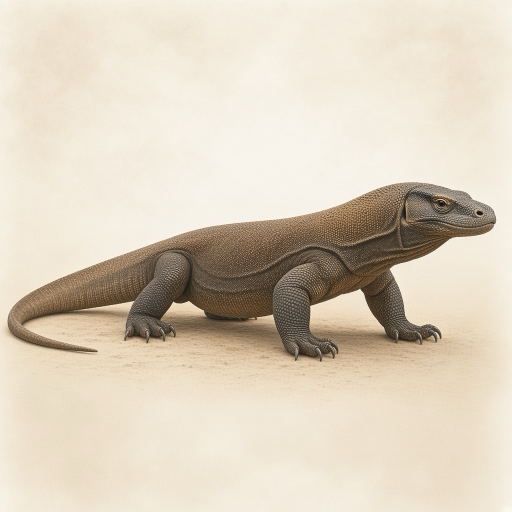
A Komodo dragon is the biggest lizard in the world. It is a large, heavy reptile that lives on a few islands in Indonesia. A big Komodo dragon can grow about 10 feet (3 m) long, which is longer than a small car. It is a real animal, not a make-believe dragon from a story, and it cannot breathe fire.
Why Komodo dragons are tricky to understand
People hear the word “dragon” and picture a fire-breathing monster with wings. A Komodo dragon is nothing like that. It has no wings, it cannot fly, and it cannot breathe fire. It is simply a very large lizard with four legs, a long tail, and scaly skin.
Another surprise is how the Komodo dragon finds its food. It does not really use its nose the way you do. Instead, it flicks out its long, forked tongue to taste tiny smells in the air. That is how the dragon can find a meal that is far away, even one it cannot see yet.
One more thing surprises people. Newly hatched Komodo dragons are much more likely to use trees than larger juveniles and adults. Big dragons sometimes eat smaller ones, so time above the ground can help hatchlings avoid danger.
Key facts about Komodo dragons
The Komodo dragon is the largest lizard alive. A big one can grow about 10 feet (3 m) long.
A large dragon is heavy. Wild adult males often weigh around 150 to 200 pounds (70 to 90 kg), while exceptional, well-fed individuals have approached 300 pounds (140 kg).
They live in only one place in the wild. Wild Komodo dragons live only on a few islands in Indonesia, such as Komodo, Rinca, and Flores.
They are meat-eaters. Komodo dragons hunt animals like deer and wild pigs, and they also eat animals that are already dead.
They have a forked tongue. The dragon flicks its long yellow tongue to taste the air and find food.
They have many sharp teeth. A Komodo dragon has about 60 teeth with jagged edges, like little saws.
They can run in quick bursts. A Komodo dragon can run about 12 miles per hour (20 km/h) for a short distance.
Mothers lay eggs. A female may lay roughly 15 to 30 eggs in a nest, and the babies hatch months later.
Hatchlings use trees. Field research found that hatchlings were mostly tree-dwelling, while larger juveniles spent more time on the ground.
The dragon is named after an island. The Komodo dragon gets its name from Komodo Island, one of the places it lives.
Common myths about Komodo dragons
Myth: Komodo dragons breathe fire like fairy-tale dragons. A Komodo dragon is a real lizard, and it cannot breathe fire. Only made-up dragons in stories breathe fire.
Myth: Komodo dragons can fly with big wings. A Komodo dragon has no wings and cannot fly. It walks and runs on four legs on the ground.
Myth: Komodo dragons live all over the world. Wild Komodo dragons live in only one place: a few islands in Indonesia. You cannot find a wild one anywhere else.
Myth: Komodo dragons eat plants like a bunny. Komodo dragons are meat-eaters. They hunt animals such as deer and wild pigs, not grass and leaves.
Myth: A Komodo dragon is just a small pet lizard. A Komodo dragon is the largest lizard in the world. A big one can grow about 10 feet (3 m) long, far bigger than a pet gecko.
Frequently asked questions about Komodo dragons
How big is a Komodo dragon?
A Komodo dragon is the largest living lizard. Exceptional males can approach 10 feet (3 m), while typical adults are smaller. Wild adult males often weigh roughly 150 to 200 pounds (70 to 90 kg); weights near 300 pounds (140 kg) represent unusually large or recently fed animals.
Where do Komodo dragons live?
Wild Komodo dragons live only on a few islands in Indonesia, such as Komodo, Rinca, and Flores. They do not live wild anywhere else in the world. The islands are warm, with dry grass, bushes, and forests.
What do Komodo dragons eat?
Komodo dragons are meat-eaters. They hunt animals such as deer and wild pigs. They will also eat animals that are already dead. A Komodo dragon can eat a very large meal at one time and then rest for days.
How does a Komodo dragon find food?
A Komodo dragon flicks out its long, forked tongue to taste tiny smells in the air. A special spot in the roof of its mouth reads those smells. This is how the dragon finds a meal that is far away, even one it cannot see.
Are Komodo dragons real dragons?
Komodo dragons are real animals, but they are lizards, not the dragons from fairy tales. They cannot breathe fire and they have no wings. People call them dragons because they are so big.
Each of this topic’s quiz questions cites a source for the fact it tests. You can play at any level: Rookie, Curious, Sharp, or Expert.
A Komodo dragon (Varanus komodoensis) is the largest living lizard, restricted to a few Indonesian islands. Exceptional males can approach 10 feet (3 m), but wild dragons typically weigh about 154 pounds (70 kg). It hunts and scavenges using serrated teeth, powerful neck movements, chemical sensing, and oral secretions that may contribute to blood loss and shock.
Why Komodo dragons surprise people
The old story that a special load of deadly mouth bacteria poisons prey is unsupported. Komodo dragons have lower-jaw glands that produce compounds affecting clotting and blood pressure. Deep wounds from serrated teeth and forceful pulling are central to a kill; researchers still debate how much venom contributes in natural attacks.
A second surprise is the dragon’s sense of smell. A Komodo dragon does not sniff through its nose the way you do. It flicks its long, forked tongue to collect tiny scent particles from the air. Then it presses the tongue against a special organ in the roof of its mouth, called the Jacobson’s organ. Using this system, a Komodo dragon can pick up the scent of a dead animal from up to 2.5 miles (4 km) away.
A third surprise is how young dragons survive. Larger Komodo dragons sometimes eat smaller ones, and juveniles spend substantial time in trees where heavy adults are less able to follow. Reports that youngsters roll in feces to repel adults are repeated in popular accounts but are not as well established as the arboreal behavior.
Key facts about Komodo dragons
Largest living lizard. Exceptional males can approach 10 feet (3 m), while wild dragons typically weigh about 154 pounds (70 kg).
Found in only one place. Wild Komodo dragons live only on a few Indonesian islands, including Komodo, Rinca, and Flores.
They have venom-producing glands. A 2009 study documented anticoagulant and blood-pressure effects. Deep mechanical wounds remain central, and venom’s natural contribution is still discussed.
A powerful sense of smell. Using its forked tongue, a Komodo dragon can smell a dead animal up to 2.5 miles (4 km) away.
Huge meals. Wildlife references report that an adult can eat up to about 80 percent of its own body weight in one feeding.
They lay eggs. Females may lay roughly 15 to 30 eggs, which take months to hatch.
Hatchlings use trees. Field research found hatchlings to be mostly tree-dwelling; larger juveniles used the ground more often.
They are cold-blooded. A Komodo dragon is a reptile, so it basks in the sun in the morning to warm up before hunting.
Their lifespan is still being studied. Wildlife references commonly estimate about 30 years.
They are endangered. The IUCN published an Endangered assessment in 2021, citing projected habitat loss from climate change among the threats.
Common myths about Komodo dragons
Myth: Komodo dragons rely on uniquely deadly mouth germs. No special pathogen explains their predation. Serrated teeth and pulling create severe wounds, while venom compounds may worsen bleeding and shock.
Myth: A Komodo dragon has a crocodile-like crushing bite. Skull models estimate relatively low jaw-adductor force for its size. The animal uses serrated teeth plus neck and body pulling; model outputs should not be confused with direct measurements of every bite.
Myth: Komodo dragons can chase prey for miles. A Komodo dragon can briefly reach about 12 miles per hour (20 km/h). Large adults commonly use ambush tactics rather than a long, high-speed chase.
Myth: A female Komodo dragon always needs a mate to produce young. Females can sometimes produce young from unfertilized eggs. This is called parthenogenesis, and the viable offspring documented in the original study were male.
Myth: Komodo dragons are too tough to be in any danger. Komodo dragons are listed as endangered. Being a strong predator does not protect a species from threats like climate change and lost habitat.
Frequently asked questions about Komodo dragons
Do Komodo dragons have venom?
Yes. A 2009 study documented lower-jaw glands and compounds with anticoagulant and blood-pressure effects. This displaced the unsupported special-bacteria story, but it does not make venom the sole mechanism. Teeth and forceful pulling produce severe blood loss and tissue damage.
How do Komodo dragons hunt?
A large Komodo dragon often hunts from ambush, waiting near a game trail before rushing and biting. Its cutting teeth and forceful pulling can open deep wounds. Oral secretions may compound bleeding and falling blood pressure, although their contribution during natural attacks remains debated.
How big can a Komodo dragon get?
A Komodo dragon is the largest living lizard. Exceptional males can approach 10 feet (3 m), while wild dragons typically weigh about 154 pounds (70 kg). Males tend to grow larger and bulkier than females.
Can a Komodo dragon have babies without a mate?
Yes, sometimes. A female Komodo dragon can produce young from unfertilized eggs, an ability called parthenogenesis. In 2006, genetic tests identified parthenogenetic offspring from two zoo females, including Flora at Chester Zoo. Because females have ZW sex chromosomes, the viable offspring documented from this process were ZZ males.
Are Komodo dragons endangered?
Yes. The IUCN assessment published in 2021 moved the Komodo dragon from Vulnerable to Endangered. That assessment estimated 1,383 mature animals, not 1,383 dragons of all ages. Climate models project substantial losses of suitable habitat under some warming and sea-level scenarios.
Source notes
Size, diet, reproduction, and life-history figures come from the Smithsonian’s National Zoo and the San Diego Zoo Wildlife Alliance. The venom findings follow the 2009 study in PNAS, the genetic evidence for reproduction without fertilization follows the 2006 report in Nature, and the conservation status follows the 2021 IUCN Red List assessment.
Each of this topic’s quiz questions cites a source for the fact it tests. You can play at any level: Rookie, Curious, Sharp, or Expert.
A Komodo dragon (Varanus komodoensis) is the largest living lizard, a monitor native to a handful of islands in eastern Indonesia. Exceptional males can approach 10 feet (3 m), while wild dragons typically weigh about 154 pounds (70 kg). It hunts and scavenges using serrated teeth, powerful pulling movements, chemical sensing, and oral secretions that may compound severe wounds. The IUCN published an Endangered assessment in 2021.
What is often misunderstood about Komodo dragons
The special-bacteria account of Komodo predation is unsupported: the 2009 study found no consistent deadly pathogen and documented lower-jaw glands with compounds affecting clotting and blood pressure. Severe mechanical trauma from serrated teeth and forceful pulling is central. Venom may worsen bleeding and shock, but its contribution to natural kills remains debated.
A second misconception involves the bite itself. The Komodo dragon looks like it should have a bone-crushing jaw, but studies of its skull and muscles show a relatively weak bite for its size, far weaker than that of a similarly sized crocodile. The dragon compensates with a “bite-and-pull” technique: it clamps onto prey and pulls back with its powerful neck and body, letting its sharp, serrated teeth slice deep, gaping wounds. The teeth do the cutting that the jaw muscles cannot do by force alone.
The teeth themselves are more specialized than they look. A Komodo dragon carries about 60 curved teeth, and multiple replacements can develop behind each functional tooth. A 2024 study found orange, iron-enriched coatings along unworn tips and serrations. The researchers interpreted the coating as an adaptation for maintaining cutting edges, but found no comparable iron concentration along the serrations of the theropod dinosaur teeth they tested.
A third surprise is the dragon’s reproduction. Female Komodo dragons can reproduce without fertilization through parthenogenesis. A 2006 study used genetic fingerprinting to identify parthenogenetic offspring from two zoo females, including Flora at Chester Zoo. Females have ZW sex chromosomes, and all viable offspring documented in that study were ZZ males.
A fourth point that catches people off guard is where Komodo dragons live. They occur naturally only in a small part of Indonesia. Whole-genome research sampled populations on Komodo, Rinca, Gili Motang, Nusa Kode, and coastal Flores. Padar lost its historical population, but dragons were later translocated there; Indonesian monitoring estimated 28 animals on Padar in 2024.
Key facts about Komodo dragons
Largest living lizard. Exceptional males approach 10 feet (3 m), while wild dragons typically weigh about 154 pounds (70 kg).
A monitor lizard. The Komodo dragon belongs to the family Varanidae, the monitor lizards, and is the largest living member of that group.
No special bacterial weapon. Venom-producing glands are anatomically established, but predation combines slicing trauma, blood loss, and possible venom effects rather than one replacement slogan.
Weak bite, sharp teeth. Its jaw-adductor force is modest for its size, but about 60 cutting teeth and powerful pulling movements can open deep wounds.
Exceptional sense of smell. Using its forked tongue and Jacobson’s organ, a Komodo dragon can detect carrion up to 2.5 miles (4 km) away.
Huge meals. A Komodo dragon can consume up to about 80 percent of its body weight in a single feeding.
Bony armor. A 2019 CT study found an elaborate mesh of osteoderms around the head of one old adult; a two-day-old specimen lacked them.
Reproduction without fertilization. Females can reproduce by parthenogenesis, and the viable offspring in the foundational study were male.
Arboreal hatchlings. Field research found hatchlings mostly using trees, with larger juveniles becoming less arboreal.
Lifespan estimate. Wildlife references commonly give about 30 years, while noting that lifespan is still being studied.
Endangered. The 2021 IUCN assessment estimated 1,383 mature animals and cited projected climate-driven habitat loss.
Common myths about Komodo dragons
Myth: Komodo dragons cultivate uniquely toxic mouth bacteria. The evidence does not support a consistent septic weapon. Slicing injuries drive rapid blood loss, and venom compounds may add anticoagulant and cardiovascular effects.
Myth: A Komodo dragon has one of the strongest bites on Earth. Its bite force is actually weak for its size. The dragon relies on slicing teeth and a bite-and-pull motion, not on crushing power.
Myth: Komodo dragons live across many parts of the world. Their natural range is limited to a small part of Indonesia. Padar’s historical population disappeared, but later translocations and 2024 monitoring recorded dragons there again.
Myth: Female Komodo dragons always need a mate. Females can reproduce by parthenogenesis, producing young from unfertilized eggs. The viable offspring documented in the original genetic study were male.
Myth: Komodo dragons have no bony protection in their skin. A CT study found dense, diverse osteoderms around the head of one old adult. Their development and protective role across ages still need broader testing.
Myth: Komodo dragons are common and secure. The species is listed as Endangered. Its tiny range makes it vulnerable even though protected populations are intensively monitored.
Frequently asked questions about Komodo dragons
Do Komodo dragons kill with venom or bacteria?
They kill primarily through severe bite-and-pull trauma, with venom a plausible contributor. A 2009 study documented lower-jaw glands and anticoagulant and blood-pressure effects, while rejecting a special-pathogen explanation. The relative importance of venom in free-ranging attacks is not fully resolved.
How big do Komodo dragons get?
A Komodo dragon is the largest living lizard. Exceptional males can approach 10 feet (3 m), while wild dragons typically weigh about 154 pounds (70 kg). Captive or recently fed individuals can be much heavier, which is why extreme weight figures need context.
How does a Komodo dragon find food?
A Komodo dragon relies on an extraordinary sense of smell. It flicks its forked tongue to gather scent particles from the air, then presses the tongue to the Jacobson’s organ in the roof of its mouth. By comparing the scent on each tip of the tongue, the dragon can tell which direction a smell is coming from, and it can detect a dead animal up to 2.5 miles (4 km) away.
Can Komodo dragons reproduce without a mate?
Yes. Female Komodo dragons can reproduce by parthenogenesis, developing young from unfertilized eggs. Genetic testing reported in 2006 confirmed cases in two zoo females, including Flora at Chester Zoo. Because females have ZW sex chromosomes, the viable offspring documented in that study were ZZ males.
Are Komodo dragons dangerous to people?
A Komodo dragon is a large wild predator that can seriously injure or kill a person. Visitors should keep their distance, follow park rules, and stay with trained guides rather than treating a wild dragon like a zoo animal.
Are Komodo dragons endangered?
Yes. The IUCN assessment published in 2021 moved the Komodo dragon from Vulnerable to Endangered and estimated 1,383 mature animals across eight subpopulations. That mature-animal estimate is not a total head count. Separately, Indonesian monitoring estimated 3,270 plus or minus 371 dragons of all ages within Komodo National Park in 2024. Climate models project habitat and abundance losses whose severity varies widely by emissions scenario.
Each trivia question in this topic’s Rookie, Curious, Sharp, and Expert quiz sets cites a primary source for the specific fact it tests.
A Komodo dragon (Varanus komodoensis) is the largest living lizard and the largest extant member of the monitor family, Varanidae. Exceptional males can approach 10 feet (3 m), while wild dragons typically weigh about 154 pounds (70 kg). The species hunts large prey such as Timor deer, wild pigs, and water buffalo using serrated dentition, powerful pulling movements, and oral secretions that may compound blood loss. The IUCN published an Endangered assessment in 2021, citing the species’ fragmented range and projected climate-driven habitat loss.
What is often misunderstood about Komodo dragons
The narrative that Komodo dragons use a cultivated septic mouth flora is unsupported. A 2009 study reported lower-jaw glands and secretion components that affect clotting and blood pressure, while finding no pathogen common to all sampled dragons. The gland anatomy is well established. How much secreted toxin enters wounds and contributes to natural predation remains debated, so mechanical trauma and venom should not be framed as mutually exclusive single causes.
The bite mechanics are equally counterintuitive. Skull modeling and feeding studies show that the Komodo dragon generates a weak bite for an animal of its size, far below that of a comparably sized crocodile. Its skull is relatively lightly built, and the jaw-closing muscles are modest. The dragon resolves this by recruiting its neck and trunk: it anchors its serrated teeth in the prey and pulls backward, so that slicing, not crushing, opens the wound. This division of labor, weak adductors paired with powerful axial and cervical musculature, is a recurring theme in how the dragon’s anatomy is interpreted.
A third area of confusion is the dragon’s evolutionary home. A 2009 fossil analysis assigned Pliocene and Pleistocene Australian material to V. komodoensis and concluded that the species evolved in Australia before dispersing west. Fossils on Flores show that already-large Komodo dragons had arrived there by about 900,000 years ago, arguing against the idea that the species became giant only after reaching the island.
Venom biochemistry and the genome of self-resistance
The 2009 study characterized lower-jaw glands and secretion proteins with anticoagulant and blood-pressure effects. These functions could impair recovery from severe wounds, although ecological dosage and delivery remain under study. “Toxicofera” is also a proposed squamate clade whose evolutionary interpretation and broad use of the term venom have been debated.
A chromosome-scale Komodo dragon genome published in 2019 revealed positive-selection signatures in genes involved in energy metabolism, cardiovascular homeostasis, and blood clotting. The authors suggested that selection on coagulation genes may help dragons withstand anticoagulants in the oral secretions of other dragons, but they also noted high blood pressure and vascular protection as another possible explanation. The study also found lineage-specific expansions in a vomeronasal-receptor gene family associated with chemical sensing.
The dentition received its own revision. A 2024 study in Nature Ecology and Evolution reported a thin, orange, iron-enriched coating concentrated on unworn tooth tips and serrations. The authors interpreted this as an adaptation for maintaining cutting edges. They found no corresponding iron concentration on the sampled theropod dinosaur serrations; some theropods instead had specialized enamel microstructure around their cutting edges.
Reproduction, parthenogenesis, and sex determination
Komodo dragons are oviparous. Wildlife-care references report clutches of roughly 15 to 30 eggs and incubation lasting several months, with substantial variation. Radio-tracking found hatchlings predominantly arboreal, while larger juveniles used trees less. This size-related shift reduces overlap with the much larger dragons that sometimes eat smaller ones.
The species is a documented example of facultative parthenogenesis in a vertebrate. In 2006, genetic fingerprinting identified parthenogenetic offspring from two zoo females, including Flora at Chester Zoo. Komodo females use a ZW sex-chromosome system, whereas males are ZZ. The viable parthenogens in that study were male and highly homozygous, a result consistent with restoration of paired Z chromosomes without fertilization. The study established the genetic outcome but did not directly observe a single cellular mechanism for restoring diploidy.
Sensory biology and feeding ecology
The Komodo dragon is a diurnal, visually and chemically guided predator. Its deeply forked tongue delivers samples to paired vomeronasal organs, helping it follow chemical gradients. Observational references report carrion detection from several kilometers under favorable conditions, but that is not a fixed sensory radius.
Komodo dragons are primarily diurnal and rely heavily on vision and chemical sensing. Popular accounts repeat a cone-only retina and a precise 300-meter detection distance, but those claims do not capture the task-dependent nature of acuity, contrast, movement detection, and low-light performance. Their visual ecology needs more direct experimental study.
Feeding ecology centers on vertebrate prey and carrion, with diet changing markedly as dragons grow. Large adults take Timor deer, wild pigs, and sometimes water buffalo. Wildlife references report meals up to about 80 percent of body weight, an extreme capacity that can inflate weights recorded soon after feeding.
Armor and intraspecific combat
A 2019 study used high-resolution CT to compare the heads of two specimens: a 19-year-old captive adult and a two-day-old hatchling. The adult’s head contained an elaborate mesh of osteoderms in four shapes and was almost fully encased except around openings; the hatchling’s head lacked osteoderms. The authors proposed that this age contrast fits a defensive role in conflicts with other dragons. Because only one old adult and one hatchling were scanned, the timing, variation, and function of armor development remain hypotheses for wider testing.
Taxonomy, discovery, and conservation
People on Komodo and Flores knew the animal long before it entered international zoological literature. Peter Ouwens published the first formal scientific description and the name Varanus komodoensis in 1912. Walter Auffenberg later began an extended field study on Komodo in 1969 and published The Behavioral Ecology of the Komodo Monitor in 1981, a foundational synthesis for later research.
Indonesia established Komodo National Park in 1980, and UNESCO inscribed it as a World Heritage Site in 1991. The IUCN assessment published in 2021 classified the species as Endangered and estimated 1,383 mature animals across eight subpopulations; that figure is not a count of all ages. Separately, Indonesian monitoring estimated 3,270 plus or minus 371 dragons of all ages in Komodo National Park in 2024, including animals on Padar after earlier translocations. Climate models project habitat and abundance losses by 2050, with a wide range of outcomes across emissions scenarios.
Key facts about Komodo dragons
Largest living lizard. Exceptional males approach 10 feet (3 m); wild dragons typically weigh about 154 pounds (70 kg).
Oral glands. A 2009 study described anticoagulant and blood-pressure effects, displacing the special-bacteria hypothesis without establishing venom as the sole cause of every kill.
Possible self-resistance. A 2019 genome found positive selection in coagulation genes; resistance to anticoagulant oral secretions is one proposed explanation, not a demonstrated mechanism.
Iron-coated teeth. A 2024 study reported iron concentrated on unworn serrations and tips and interpreted it as an adaptation for maintaining cutting edges.
Weak bite, slicing teeth. Bite force is low for the body size; about 60 serrated teeth slice through a bite-and-pull attack.
Parthenogenesis to males. The viable parthenogenetic offspring in the foundational genetic study were highly homozygous ZZ males.
Sensory profile. Tongue-flicking delivers chemical samples to the vomeronasal organs. Detection distance varies with wind and odor source; precise mileage and a cone-only retinal account should be treated cautiously.
Osteoderm armor. One old adult had an osteoderm-rich head while one hatchling did not; defense against other dragons is the study’s hypothesis.
Australian origin. A 2009 fossil analysis concluded that the species evolved in Australia and reached Flores by about 900,000 years ago.
Endangered. The 2021 IUCN assessment estimated 1,383 mature animals and cited projected climate-driven habitat decline.
Common myths about Komodo dragons
Myth: The dragon’s saliva contains a special deadly bacterial weapon. The 2009 study found no pathogen common to all sampled dragons and documented bioactive gland secretions. Deep mechanical wounds remain central, and venom’s natural contribution is still debated.
Myth: The Komodo dragon has a bone-crushing bite. Its bite force is weak for its size. Slicing teeth and a bite-and-pull motion, powered by the neck and trunk, do the work instead.
Myth: The documented Komodo dragon parthenogens were females. The viable offspring in the 2006 genetic study were highly homozygous ZZ males. The study did not directly observe a single chromosome-restoration mechanism.
Myth: The species became giant only after reaching Flores. Australian fossils assigned to the species predate its Flores record, and the Flores material shows little body-size change over about 900,000 years.
Myth: The Komodo dragon is the only lizard with venom glands. Venom systems are also well established in helodermatids such as the Gila monster and Mexican beaded lizard. How broadly the term should apply across other lizards remains debated.
Frequently asked questions about Komodo dragons
What does Komodo dragon venom actually do?
The 2009 study identified secretion proteins with anticoagulant and blood-pressure effects. These could compound deep slicing wounds, but field dosage and the relative role of venom are not fully resolved. The evidence does reject the idea of a consistent, specially pathogenic oral flora.
Why doesn’t the dragon’s own venom harm it?
The 2019 genome revealed positive selection in genes controlling blood clotting. The authors proposed resistance to anticoagulants in other dragons’ oral secretions as one explanation, because dragons bite one another during disputes. They also noted protection from vascular damage associated with high blood pressure as another possibility. The study did not directly test venom resistance.
Why are all parthenogenetic Komodo dragons male?
Komodo dragons use a ZW sex-determination system: females are ZW and males are ZZ. Genetic fingerprinting showed that the viable parthenogens in the 2006 study were highly homozygous males consistent with ZZ. The paper established that no male contributed DNA, but it did not directly observe which cellular route restored the paired chromosome set.
Where did Komodo dragons originally evolve?
A 2009 analysis assigned Australian fossils dating to the Pliocene and Pleistocene to V. komodoensis and concluded that Australia was the species’ ancestral source. The oldest Flores material in that study was about 900,000 years old and already fell within the modern species’ size range.
How endangered is the Komodo dragon?
The IUCN assessment published in 2021 classified the species as Endangered and estimated 1,383 mature animals across eight subpopulations. This should not be confused with counts that include juveniles: Indonesian monitoring estimated 3,270 plus or minus 371 dragons of all ages within Komodo National Park in 2024. A 2020 modeling study projected habitat losses of 8 to 87 percent and abundance declines of 27 to 99 percent by 2050 across its scenarios, illustrating both the risk and the uncertainty.