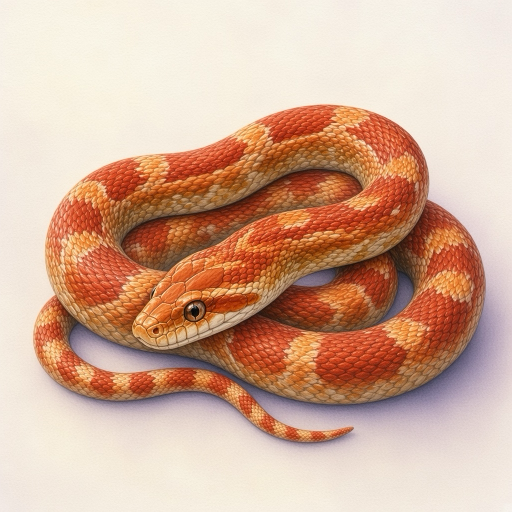
A snake is a long reptile with no legs. It moves by bending its body and pushing against the ground. A snake does not produce enough internal heat to keep a steady body temperature, so it may bask in sunshine to warm up and move into shade to cool down. The Reptile Database listed 4,229 living snake species in January 2026, and snakes live on every continent except Antarctica.
Why snakes are tricky to understand
A snake looks very different from most animals. It has no arms, no legs, and no ears you can see. A snake is simply an animal that is very good at living with a long, low body.
A snake does not walk or run. It slithers. To slither, the snake bends its body into curves and pushes against rocks, plants, and bumps in the ground. The pushing moves the snake forward. A snake can also climb trees and swim this way.
People often think snakes feel wet and slimy. They do not. Snake skin is dry. It is covered in smooth scales that overlap like the shingles on a roof, made of keratin, the same stuff as your fingernails.
Key facts about snakes
Snakes have no legs at all. They move by bending their bodies and pushing against the ground. This sliding is called slithering.
Snakes are cold-blooded. Their body gets warmer or cooler with the world around them. A snake warms up in the sun and cools off in the shade.
A snake smells with its tongue. When a snake flicks its forked tongue, it picks up tiny smell bits from the air. The tongue carries them to a special smell spot in the roof of the mouth.
Snakes cannot blink. They have no eyelids. A clear scale called a spectacle covers each eye, so a snake’s eyes stay open even when it sleeps.
Snakes swallow food whole. Their teeth hold prey but cannot chew. A snake opens its mouth very wide and swallows the whole animal in one piece.
Every snake is a meat eater. Snakes hunt other animals, such as mice, frogs, fish, birds, eggs, and even other snakes. No snake eats plants.
Snakes shed their old skin as they grow. The old skin often peels off in one long piece, like turning a sock inside out.
Most snakes do not pose a serious venom risk to people. A 2026 scientific update included 508 species on its revised global list of snakes in the World Health Organization’s two medically important categories, out of more than 4,200 living snake species.
The longest snake is the reticulated python. Big ones grow about 20 feet (6 m) long, longer than a full-size car. It lives in the forests of Southeast Asia.
The smallest snake is the Barbados threadsnake. A grown-up is only about 4 inches (10 cm) long, as thin as a strand of spaghetti.
Common myths about snakes
Myth: Snakes are slimy. Snake skin is dry, not slimy. People often mix snakes up with slugs and frogs, which really are slimy. A snake feels smooth and dry, like a leather belt.
Myth: Snakes unhinge their jaws to eat. Snakes do not pop their jaws out of place. The two halves of the lower jaw are joined at the front by a stretchy band, not a stiff joint, so they can spread far apart. That lets a snake swallow food wider than its own head without breaking anything.
Myth: All snakes are dangerous to people. Most are not. A 2026 scientific update included 508 species in the World Health Organization’s two medically important categories, out of more than 4,200 living snake species. Many snakes catch food by grabbing it or squeezing it, without a medically significant venom-delivery system.
Myth: Snakes are deaf. Snakes are not deaf. They have no ear holes on the outside, but they still sense sound. A small bone in the head connects to the jaw, which rests on the ground, so a snake can feel footsteps and other movements coming through the ground.
Myth: A snake’s tongue can sting you. A snake’s tongue is soft and harmless. It cannot sting or poke. The tongue flicks in and out only to smell the air.
Frequently asked questions about snakes
How do snakes move without legs?
A snake bends its long body into S-shaped curves. As it pushes the curves against the ground, rocks, and plants, the pushing slides the snake forward. This works on land, in water, and even up the side of a tree.
Why do snakes flick their tongues?
A snake is smelling the air. The tongue picks up tiny smell bits and carries them to a special smell spot in the roof of the mouth. The fork at the end has two tips, so the snake can tell which side a smell is coming from. This is how a snake finds food.
Are snakes slimy?
No. Snake skin is dry. It is covered in smooth, overlapping scales made of keratin, the same material as your fingernails. Snakes only look shiny because the scales are smooth.
What do snakes eat?
Snakes eat other animals. Different snakes hunt different prey, such as mice, rats, frogs, fish, birds, and eggs. Some snakes even eat other snakes. A snake catches its meal and swallows it whole, without chewing.
How do snakes eat animals bigger than their heads?
A snake’s lower jaw is in two halves joined by a stretchy band, so the halves can spread wide apart. The skull bones are loosely connected too. This lets the mouth open very wide and stretch around large prey, and nothing pops out of place.
Do snakes blink or sleep with their eyes open?
Snakes have no eyelids, so they cannot blink. A clear scale covers each eye like a tiny window. Even when a snake sleeps, that scale stays in place and its eyes look open.
Each of this topic’s quiz questions cites a primary source for the specific fact tested. You can play at any level: Rookie, Curious, Sharp, or Expert.
A snake is a legless reptile with a long body, dry scales, and no eyelids or external ears. Snakes are cold-blooded, which means their body temperature follows the temperature of their surroundings instead of staying steady on its own. Every snake is a carnivore that swallows its prey whole. The Reptile Database listed 4,229 living species in January 2026, distributed on every continent except Antarctica.
Why snakes are surprising
Snakes seem to break the usual rules for animals. They get around with no legs, find food with no nose in the normal sense, and eat meals far wider than their own heads. Each of these tricks has a clear explanation once you look closely.
A snake’s forked tongue is a smelling tool, not a stinger. When the tongue flicks out, it collects tiny scent particles from the air and ground. Then it pulls back and touches two openings in the roof of the mouth that lead to a sense organ called the vomeronasal organ, or Jacobson’s organ. Each tip of the fork delivers scent to its own side, so the snake can compare the two and tell which direction a smell is stronger. Scientists call this directional, or “stereo,” smell.
Some snakes have infrared-sensitive facial pits. Pit vipers use loreal pits, while certain pythons and boas have differently evolved labial pits. These organs help detect warm animals in darkness, but they do not occur in every python or boa and are not vision in the ordinary sense.
Key facts about snakes
Snakes have no external ears, so they sense vibrations through the ground. A small bone in the head connects to the jawbone, which rests against the ground and picks up movement nearby.
A snake’s forked tongue smells in stereo. Each tip samples scent from its own side, so the snake can follow a trail by sensing which direction a smell is strongest.
Most snakes are not medically dangerous to people. A 2026 scientific update included 508 species on its revised global list of snakes in the World Health Organization’s two medically important categories, out of more than 4,200 living species.
Snakes shed their whole skin as they grow, often leaving behind one long, see-through piece. A see-through scale over each eye, called the spectacle, sheds along with it.
Some snakes lay eggs and some give live birth. Many pythons and cobras lay eggs, while boa constrictors and most rattlesnakes give birth to live young.
The longest snake is the reticulated python, which can grow about 20 feet (6 m) long. It lives in Southeast Asia and squeezes its prey instead of using venom.
The heaviest snake is the green anaconda, which can weigh well over 150 pounds (70 kg). It lives in the rivers and swamps of South America and is thicker around the middle than any other snake.
The smallest snake is the Barbados threadsnake, only about 4 inches (10 cm) long and as thin as a strand of spaghetti. Scientists first described it in 2008.
The king cobra is the longest venomous snake, reaching about 18 feet (5.5 m). Its scientific name, Ophiophagus, means snake-eater, and it feeds mainly on other snakes.
Large pythons can go weeks or months between meals. Because snakes are cold-blooded, they use far less energy than warm-blooded animals, so one big meal lasts a long time.
Common myths about snakes
Myth: Snakes unhinge or dislocate their jaws to eat. Nothing in a snake’s jaw pops out of place. The two halves of the lower jaw are joined at the front by a stretchy ligament instead of being fused like ours. The halves can spread apart and move on their own, and loosely connected skull bones add even more stretch, so the snake swallows wide prey without dislocating anything.
Myth: Snakes are slimy. Snake skin is dry, not slimy. It is covered in smooth, overlapping scales made of keratin, the same material as your fingernails. People often confuse snakes with slugs or amphibians, which really do feel slimy.
Myth: All snakes are dangerous to people. Only a minority pose a medically important venom risk. A 2026 update included 508 species in the World Health Organization’s two medically important categories, out of more than 4,200 living species. Many snakes catch food by grabbing or squeezing it.
Myth: Snakes are deaf. Snakes are not deaf. They lack outer ear flaps and ear holes, but they still detect ground vibrations through the jawbone and can pick up some airborne sound. They simply hear differently than animals with external ears.
Myth: You can tell a rattlesnake’s age by counting its rattle segments. Counting segments does not give a snake’s age. A rattlesnake can shed its skin several times a year, adding a segment each time, and segments often break off, so the count is not reliable.
Frequently asked questions about snakes
How do snakes smell with their tongues?
The forked tongue flicks out and picks up scent particles from the air and ground. It then pulls back and touches two openings in the roof of the mouth that lead to the vomeronasal organ, also called Jacobson’s organ. Because each tip of the fork delivers scent to its own side, the snake can tell which direction a smell is coming from.
Are most snakes dangerous?
No. The Reptile Database listed 4,229 living species in January 2026. A separate 2026 study revised the World Health Organization category 1 and 2 list to 508 medically important species. These totals depend on taxonomy and definitions, and actual risk also depends on venom delivery, dose, exposure, and access to treatment.
Why do snakes shed their skin?
A snake’s outer skin does not grow with the rest of its body. As the snake gets bigger, the old skin gets tight and worn, so the snake grows a fresh layer underneath and wriggles out of the old one. A healthy snake often sheds in one long piece, including the clear scale over each eye.
Do snakes lay eggs or give birth?
Both, depending on the species. Many pythons and cobras lay eggs that hatch later. Others, such as boa constrictors and most rattlesnakes, give birth to fully formed live baby snakes.
How can some snakes sense heat?
Some snakes have heat-sensing pits on their faces. Pit vipers use loreal pits, while some pythons and boas have labial pits that evolved differently. These organs respond to infrared radiation from warm objects and can help a snake locate prey in darkness.
How often do snakes need to eat?
Far less often than mammals. Because snakes are cold-blooded and use little energy, many eat only once every week or two. After swallowing one large meal, a big python can go for weeks or even months before needing to eat again.
Each of this topic’s quiz questions cites a primary source for the specific fact tested. You can play at any level: Rookie, Curious, Sharp, or Expert.
A snake is a limbless, elongated reptile in the suborder Serpentes, part of the order Squamata that also contains lizards. Snakes are ectothermic (cold-blooded), so they regulate body temperature by moving between warm and cool parts of their environment rather than generating steady internal heat. Every snake is a carnivore that swallows prey whole, aided by a highly flexible skull and a body built from hundreds of vertebrae and ribs. The Reptile Database listed 4,229 living species in January 2026, and the count changes as species are described, split, lumped, or restored from synonymy.
What is often misunderstood about snakes
Snakes do not dislocate or “unhinge” their jaws. The phrase is everywhere, and it is wrong. In a snake, the two halves of the lower jaw are not fused at the chin the way a human mandible is. They are connected at the front by an elastic ligament, so each half can move independently and spread outward. The skull also has loosely hinged bones rather than a single rigid unit. Together these features let a snake swallow prey wider than its own head, without any joint ever popping out of its socket.
Constriction is not simply suffocation. A 2015 experiment with boa constrictors and anesthetized rats documented rapid cardiovascular collapse: venous pressure rose, arterial pressure fell, and circulation failed. This provides strong evidence that circulatory arrest is central in that predator-prey system, while the exact balance of effects can vary with snake, prey, and coil placement.
Snakes are not slimy, and they are not deaf. Their skin is dry and covered in keratin scales. They lack external ears, yet they detect substrate vibrations through a bone in the skull that connects to the jaw, and they can hear some airborne sound as well. The popular image of a snake charmer responding to flute music is misleading: the cobra is tracking the movement of the instrument far more than any tune.
Key facts about snakes
Species count. The Reptile Database listed 4,229 living snake species in January 2026, ranging from the giant reticulated python to tiny threadsnakes.
Body plan. A snake’s vertebral column typically holds 200 to 400 vertebrae, far more than the 33 in a human. Most of those vertebrae carry a pair of ribs, which support the body and aid several modes of movement.
Locomotion. Snakes use multiple gaits, including S-shaped lateral undulation, concertina motion in tight spaces, and sidewinding. During sidewinding, separated regions of the body make static contact while other regions lift and advance, producing a distinctive series of angled tracks.
Asymmetrical lungs. Because a snake’s body is narrow, the right lung is large and elongated while the left lung is reduced or absent. The right lung does most of the breathing.
Medically important venom is the exception. A 2026 scientific update included 508 species on its revised list of World Health Organization category 1 and 2 medically important snakes, out of more than 4,200 living species. Pythons and boas subdue prey without a venom-delivery system.
Records. The reticulated python is the longest snake at about 20 feet (6 m). The green anaconda is the heaviest, exceeding 150 pounds (70 kg). The king cobra is the longest venomous snake at about 18 feet (5.5 m). The Barbados threadsnake is the smallest at about 4 inches (10 cm).
Speed. The black mamba is widely described as a fast-moving snake, but robust standardized measurements do not support a precise world ranking. Its common name refers to the dark mouth lining, not its olive-to-gray body.
Venom toxicity. Inland taipan venom produces exceptionally low mouse LD50 values in some standard assays, but rankings change with test species, injection route, and metric. Laboratory potency is not the same as real-world human mortality.
Spitting cobras. Some cobras spray venom through small openings near the tips of the fangs, aiming for the eyes of a threat. The spray causes intense pain and can damage eyesight if it is not rinsed away.
Feeding intervals. Snakes eat infrequently. Cold-blooded metabolism means a large python can go weeks or months between meals after swallowing one big prey item.
Common myths about snakes
Myth: Snakes unhinge or dislocate their jaws. A snake’s jaw never leaves its joint. The two halves of the lower jaw are linked at the front by a stretchy ligament, not fused, so they spread apart on their own. Loosely connected skull bones add flexibility. The mouth opens wide because of this architecture, not because anything dislocates.
Myth: Constriction is only suffocation. A 2015 boa study documented rapid circulatory collapse in rats. It strongly supports cardiovascular failure as a central mechanism, without proving that every constrictor-prey pairing has an identical physiological sequence.
Myth: Snakes are slimy. Snake skin is dry. It is covered in overlapping scales made of keratin, the same protein as fingernails and hair. The confusion comes from amphibians such as frogs and salamanders, which keep their skin moist.
Myth: All snakes are dangerous to people. Most are not. A 2026 update included 508 species in the World Health Organization’s two medically important categories, out of more than 4,200 living species. Many snakes subdue prey by constriction or by simply seizing and swallowing it.
Myth: Snakes are deaf. Snakes have no external ears, but they are not deaf. They sense vibrations traveling through the ground via a bone that links the skull to the jaw, and they detect some airborne sound. They perceive the world acoustically, just without ear flaps or ear holes.
Frequently asked questions about snakes
How do snakes swallow prey larger than their heads?
The two halves of a snake’s lower jaw are joined at the front by an elastic ligament rather than fused, so each half can move separately and spread outward. The skull bones are loosely connected as well. This combination lets the mouth stretch around prey wider than the snake’s own head. Nothing dislocates, despite the common phrase about unhinging the jaw.
How does constriction actually kill prey?
In the 2015 boa experiment, coils rapidly raised venous pressure, reduced arterial pressure, and disrupted circulation in anesthetized rats. The results overturned a simple suffocation model and support circulatory arrest as a major mechanism. Other prey sizes and species can alter the details.
Can snakes hear?
Yes, in their own way. Snakes lack outer ears, but a bone in the skull connects to the jaw, which rests against the ground and conducts vibrations to the inner ear. Snakes also respond to some airborne sound. They are not deaf, despite the old belief.
How many snake species are there?
The Reptile Database listed 4,229 living species in January 2026. The total changes as herpetologists describe species, split or lump populations, and revisit older names with genetic and anatomical evidence.
What is the difference between venomous and poisonous snakes?
Venomous animals inject toxins, usually through fangs, while poisonous animals are harmful when eaten or touched. Snakes that deliver toxins through a bite are venomous, not poisonous. The two words are often swapped, but they describe different delivery methods.
Why do snakes flick their tongues?
To smell. The forked tongue collects scent particles and transfers them to the vomeronasal organ, also called Jacobson’s organ, in the roof of the mouth. Each fork tip samples its own side, giving the snake directional, or stereo, smell that helps it follow trails.
Which snake is the most dangerous to humans?
That depends on the measure. Inland taipan venom ranks among the most potent in particular mouse LD50 assays, but there is no assay-independent “most toxic” title. Species such as saw-scaled vipers cause far greater public-health burdens because exposure, bite frequency, treatment access, and venom delivery matter alongside laboratory potency.
Each of this topic’s quiz questions cites a primary source for the specific fact tested. You can play at any level: Rookie, Curious, Sharp, or Expert.
A snake is a limbless squamate reptile of the suborder Serpentes, descended from within the lizard radiation and characterized by an elongate body, a kinetic skull, hundreds of vertebrae, and the loss or extreme reduction of the limbs and limb girdles. Snakes are ectotherms that rely on behavioral thermoregulation, and all are obligate carnivores that ingest prey whole. The Reptile Database listed 4,229 living species in January 2026, spanning the burrowing scolecophidian threadsnakes, the constricting boas and pythons, and the venomous elapids and viperids. Body size varies enormously: the largest snake known from the fossil record, the extinct Titanoboa cerrejonensis, has been estimated at roughly 42 feet (13 m), while the smallest living species barely exceeds 4 inches (10 cm).
Why serpent biology is non-intuitive
Several features of snake anatomy contradict casual intuition. The most repeated error is that snakes “unhinge” or dislocate the jaw to swallow large prey. No dislocation occurs. The two mandibular rami are not fused at a symphysis as in mammals; they are joined anteriorly by an elastic ligament and can move independently. Combined with a highly kinetic skull, in which the quadrate, pterygoid, and supratemporal bones articulate loosely, this lets the gape expand around prey of large cross-section by alternately advancing each side of the jaw. The mechanism is one of mobile but intact articulations, not joint failure.
Constriction is not adequately described as suffocation. A 2015 study instrumented anesthetized rats constricted by boa constrictors and found rising peripheral venous pressure, collapsing arterial pressure, and rapid circulatory failure. The result strongly supports cardiovascular collapse in that system. Extrapolation to every constrictor and prey species should remain qualified.
The chemosensory system is also distinctive. The bifid (forked) tongue is not a taste or sting organ. It samples nonvolatile and volatile molecules and delivers them to the paired ducts of the vomeronasal (Jacobson’s) organ in the palate. Because each tine deposits its sample into the ipsilateral duct, the animal extracts a spatial gradient, an effective stereo-olfaction that supports trailing. Pit-bearing lineages add a separate modality: the facial or labial pit organs of crotaline vipers, pythons, and boas contain a thin membrane densely innervated by thermosensitive trigeminal fibers, forming an infrared image that is integrated with vision in the optic tectum.
Key facts
Fang typology. Dentition is classified by fang position and structure. Aglyphous snakes have no enlarged grooved fangs. Opisthoglyphous (“rear-fanged”) snakes carry grooved fangs at the back of the maxilla. Proteroglyphous snakes (elapids: cobras, mambas, sea snakes) have fixed, relatively short fangs at the front. Solenoglyphous snakes (viperids) possess the most derived arrangement: long, hollow, hinged fangs mounted on a rotating maxilla that folds them against the palate at rest and erects them on striking. This hinging permits the longest fangs of any snake; the Gaboon viper bears fangs near 2 inches (5 cm).
Venom protein families. Venom is a complex proteinaceous secretion of the postorbital venom gland, not modified saliva alone in function. Major toxin families include phospholipases A2, three-finger toxins, snake-venom metalloproteinases, serine proteases, and C-type lectins. As a broad pattern, elapid venoms skew neurotoxic, often through postsynaptic three-finger alpha-neurotoxins that block acetylcholine receptors, while many viperid venoms skew hemotoxic, degrading tissue and disrupting coagulation. These are tendencies, not strict categories, since many venoms blend both.
Antivenom production. Antivenom is immunoglobulin raised by hyperimmunizing a host animal, classically a horse, with sub-lethal, escalating venom doses. The harvested plasma is processed into purified whole IgG or enzymatically cleaved Fab or F(ab’)2 fragments. The product neutralizes venom by antigen binding; it is not derived from the snake’s own gland or diet.
Cardiorespiratory asymmetry. The elongate body cavity drives strong left-right asymmetry. In most snakes the right lung is large and elongate while the left is vestigial or absent; basal lineages such as boids retain a small functional left lung. Developmental research links this asymmetry to different growth timing in the left and right lung buds.
Modular breathing. Boa constrictors can ventilate different regions of their long lung by moving different sets of ribs. Experiments show that when one body region is constrained, the snakes can shift ventilation to ribs farther back, an ability relevant to constriction and swallowing large prey.
Vestigial hind limbs. Boids and pythonids retain pelvic spurs, paired claw-like keratin structures flanking the cloaca that articulate with reduced pelvic and femoral remnants. They are vestiges of the hindlimb and are used by males to grip and stimulate the female during courtship.
Locomotor repertoire. Serpentine locomotion includes lateral undulation, concertina, rectilinear (caterpillar-like) creeping, and sidewinding. The arboreal Chrysopelea gliders flatten the body by splaying the ribs into a concave aerofoil and undulate in air, achieving controlled gliding rather than powered flight.
Deep fossil record. Unambiguous snakes appear in the Cretaceous, well over 100 million years ago, and several, such as Najash and Pachyrhachis, retained small hind limbs. Older candidate snakes push the origin toward the Middle Jurassic, though their status is debated. Snakes are nested phylogenetically within squamates, not a separate lineage.
Aposematism and mimicry. Many New World coral snakes have conspicuous red, black, and pale banding, and phylogenetic evidence supports repeated Batesian mimicry by harmless lineages, including some king and milk snakes. The familiar “red touches yellow” rhyme is not a safe identification rule: atypical native patterns and lookalikes create exceptions even in the United States, and many species elsewhere use different patterns.
Common misconceptions at expert level
Misconception: A snake dislocates its mandible to feed. The mandibular symphysis is ligamentous, not bony, so the two rami separate without leaving any joint. The high cranial kinesis of the macrostomatan skull, with its mobile quadrate and palatomaxillary arches, supplies the gape. Calling this dislocation misstates the mechanism.
Misconception: All snake venoms are interchangeable neurotoxins. Venom composition is taxon-specific and even population-specific. Three-finger neurotoxins dominate many elapid venoms, while snake-venom metalloproteinases and serine proteases drive the hemorrhagic and coagulopathic effects typical of viperids. Treating venom as a single substance ignores the proteomic diversity that complicates antivenom design.
Misconception: Constriction is merely asphyxiation. The 2015 boa-and-rat experiment demonstrated rapid circulatory failure inconsistent with a simple slow-suffocation account. It does not establish one invariant mechanism for every constricting snake and prey combination.
Misconception: Snakes are deaf because they lack external ears. Snakes lack a tympanic membrane and external ear, but the columella (stapes) couples to the quadrate and lower jaw, transmitting substrate-borne vibration to the inner ear. Studies also show sensitivity to low-frequency airborne sound. The system is reduced relative to many tetrapods, not absent.
Misconception: Pelvic spurs are functional legs. Pelvic spurs are vestigial. They never form jointed walking limbs, do not bear the animal’s weight for locomotion, and function in tactile courtship. Their retention is evidence of limbed ancestry, not of surviving leg function.
Frequently asked questions
What distinguishes proteroglyphous from solenoglyphous dentition?
Both deliver venom through anterior fangs, but the mechanics differ. Proteroglyphous elapids have relatively short, fixed front fangs that cannot fold, which constrains fang length. Solenoglyphous viperids mount long, hollow fangs on a maxilla that rotates, folding the fangs against the palate when the mouth is closed and erecting them during the strike. The hinge is what permits the extreme fang lengths seen in vipers.
How does the vomeronasal organ produce directional smell?
The forked tongue collects molecules on two physically separated tines. On retraction, each tine delivers its sample to the ipsilateral vomeronasal duct in the palate, so the two organs receive spatially distinct inputs. The brain compares the bilateral signals to resolve the direction of a chemical gradient, which underlies prey trailing and mate searching.
Why is the left lung reduced in most snakes?
The narrow, elongate coelom cannot easily accommodate paired organs side by side, so the respiratory and cardiovascular systems became strongly asymmetric. The right lung elongated to occupy much of the body length while the left regressed. Developmental work links this to heterochronic shifts in the timing of left-right patterning during embryogenesis. Basal boids retain a small functional left lung, indicating the reduction deepened over evolutionary time.
Is the “red touches yellow” rhyme reliable?
No. The rhyme often matches common United States coral-snake patterns, but atypical individuals and harmless lookalikes create exceptions. Coral snakes outside the United States show still more variation. Color rhymes are memory aids, not safe diagnostics, so an unknown snake should be left alone.
How big was Titanoboa, and when did it live?
Titanoboa cerrejonensis is the largest snake known from the fossil record, estimated at roughly 42 feet (13 m) and more than a metric ton in mass, far larger than any living species. It lived about 58 million years ago in the Paleocene, several million years after the non-avian dinosaurs went extinct. Researchers have used its size to investigate the warm equatorial climate of that interval, although temperature estimates based on giant ectotherm size involve biological assumptions.
Did snakes evolve from lizards?
Yes. Morphological, molecular, and fossil evidence place snakes deep within Squamata, the clade that also contains lizards. Transitional Cretaceous fossils such as Najash and Pachyrhachis retained reduced hind limbs and pelvic elements, recording the progressive loss of the limbs along the snake stem lineage rather than a separate origin.
Why does antivenom often fail to cover every species in a region?
Because venom is proteomically diverse and antibody binding is antigen-specific. An antivenom raised against the venoms used in immunization neutralizes those venoms well, but its cross-reactivity to the venom of a different species, or even a different population of the same species, can be limited. Geographic variation in toxin abundance means a monovalent product may underperform outside the range it was designed for. Polyvalent antivenoms pool venoms from several medically important species to widen coverage, at the cost of lower potency against any single one. This is why region-appropriate antivenom and accurate identification of the offending snake both matter clinically.
How do snakes breathe while swallowing a large meal that fills the mouth for a long time?
Many snakes can project the glottis, the opening of the windpipe, toward the front of the mouth during feeding. This keeps an airway available while prey occupies much of the mouth. Research on boa constrictors also shows that they can shift ventilation among different rib regions when part of the body wall is constrained.