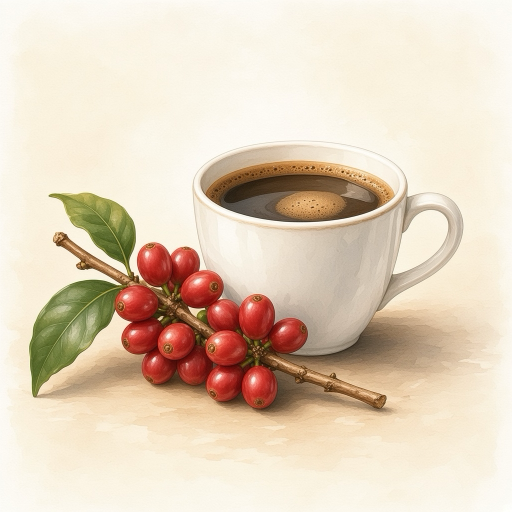
A coffee bean is not really a bean. It is a seed that grows inside a small red fruit called a coffee cherry. Coffee plants grow these cherries in tropical countries like Brazil, Vietnam, and Colombia. After the seeds are taken out and roasted in a hot machine, they turn brown and smell like the coffee adults drink in the morning.
Why coffee is more interesting than it looks
The coffee plant is a small tree that grows in warm, rainy parts of the world. It can grow over 15 feet (about 5 m) tall in the wild, but on farms it is usually trimmed down to about 6 feet (about 2 m) so people can pick the cherries. Each plant can grow coffee cherries for 20 years or more.
Most coffee cherries turn bright red when they are ripe, just like a small cherry. Inside each one are usually two seeds with their flat sides pressed together. Those two seeds are what we call coffee beans, even though they are really just seeds.
The seeds start out pale green. They turn brown only after they are roasted in a hot machine. Roasting changes the smell, color, and flavor of the seeds. The longer they roast, the darker brown they get.
Key facts about coffee
Coffee beans are seeds, not beans. They grow inside small red fruits called coffee cherries, two seeds per cherry.
The wild coffee plant comes from Ethiopia, in eastern Africa. It still grows in the forests there today.
Brazil grows the most coffee in the world. About 1 out of every 3 coffee beans on the planet comes from Brazil. Vietnam is second, and Colombia is third.
The first people to grow and drink coffee lived in Yemen, an Arab country, more than 600 years ago. They used coffee to stay awake during long nighttime prayers.
Coffee plants need a warm climate. They do not grow in places where it gets very cold in winter. Most of the world’s coffee comes from countries near the equator.
A coffee plant has to grow for 3 to 4 years before it makes its first cherries.
Decaf coffee has almost no caffeine, but not zero. US rules say at least 97 out of every 100 bits of caffeine have to be removed for it to be called decaf.
Espresso is a small, strong cup of coffee made by pushing hot water through ground coffee under high pressure. Espresso machines were invented in Italy in the early 1900s.
Sri Lanka used to be a big coffee country, but a plant disease wiped out the coffee farms in the 1870s. The farmers planted tea instead. Today Sri Lanka is one of the world’s biggest tea growers.
Common myths about coffee
Myth: Coffee beans are real beans, like kidney beans. They are not. They are seeds inside a fruit. The plants that make coffee are not related to bean plants at all.
Myth: Coffee plants come from Italy or France. They do not. The wild coffee plant is from Ethiopia in eastern Africa. Italy is famous for making espresso, but Italy is too cool to grow coffee plants.
Myth: Decaf coffee has no caffeine in it. Decaf has only a tiny bit of caffeine, but not zero. Most of it has been removed before the beans are roasted.
Myth: Coffee cherries are blue or purple. Most coffee cherries turn bright red when ripe, although a few special types turn yellow or orange. They are never blue.
Myth: Coffee is just hot water with brown coloring. Coffee gets its color, smell, and flavor from real coffee seeds that have been roasted and ground up. The brown color is not added afterward.
Frequently asked questions about coffee
Where do coffee beans come from?
Coffee beans are seeds. They grow inside small red fruits called coffee cherries, on a small tree called the coffee plant. Most of the world’s coffee comes from warm countries near the equator, especially Brazil, Vietnam, and Colombia.
Why is the bean called a bean if it is really a seed?
The seeds inside a coffee cherry look a lot like the beans you can eat in chili or burritos. People have called them coffee beans for hundreds of years, even though they are not in the same plant family as real beans.
Why are coffee plants only grown in some countries?
Coffee plants need warm weather, plenty of rain, and rich soil. They cannot survive cold winters. Most of the countries that grow lots of coffee are near the equator, where the temperature stays warm all year. The strip of land where coffee grows best is sometimes called the Bean Belt.
How do green coffee beans turn brown?
Workers at a coffee roasting plant put the green seeds in a big rotating drum and heat them with hot air. As the heat reaches about 370 °F to 470 °F (about 190 °C to 240 °C), the sugars and other things in the seed change, and the seed turns brown. The longer the roasting goes, the darker brown the seed gets, and the stronger the flavor.
Where was coffee first invented as a drink?
The first people known to grow and drink coffee lived in Yemen, an Arab country south of Saudi Arabia, in the 1400s. They drank it to stay awake during long nighttime prayers. The habit spread from Yemen north to Egypt and Turkey, and then west to Europe in the 1600s.
You can play this topic at the Rookie level. Each quiz question cites a primary source for the specific fact tested.
Coffee is a hot drink made from the roasted seeds of a tropical plant called Coffea. The seeds grow in pairs inside small fruits called coffee cherries, which turn red when ripe. After the fruit is removed, the green seeds get roasted at high heat, which turns them brown and gives them their familiar smell. Most of the world’s coffee comes from two species: arabica, which makes up about 60 percent of the global crop, and robusta, which makes most of the rest.
Why coffee is more interesting than it looks
The word “coffee bean” is a little misleading. The brown thing in the bag is not really a bean. It is a seed from inside a fruit, and most coffee cherries actually contain two seeds with their flat sides pressed together. The plants that produce coffee are not related to the plants that produce real beans like soybeans or kidney beans.
The popular story that coffee was discovered by an Ethiopian goat herder named Kaldi, who supposedly noticed his goats acting energetic after eating coffee cherries, sounds like history but is really a folk legend. The first written version of the Kaldi tale dates from 1671, hundreds of years after Yemenis were already growing and drinking coffee. The actual record of coffee cultivation begins in Yemen in the 1400s, where Sufi monks drank it to stay awake during long nighttime prayers.
Coffee also plays a surprising role in modern history. London’s Lloyd’s of London, one of the world’s biggest insurance markets, started in a coffeehouse run by a man named Edward Lloyd in 1686. The 1773 Boston Tea Party, in which colonists threw British tea into Boston Harbor, helped make coffee the popular American drink it is today, because drinking tea afterward was seen as siding with the British.
Key facts about coffee
Two main species.Coffea arabica makes about 60 percent of the world’s coffee and tastes smoother and less bitter. Coffea canephora, almost always called robusta, makes most of the rest. Robusta has roughly twice as much caffeine by weight (about 2.2 percent) as arabica (about 1.2 percent).
Top producers in 2024. Brazil grew about 3.98 million metric tons (about 8.8 billion pounds) of coffee, more than any other country. Vietnam was second with about 1.81 million metric tons (about 4.0 billion pounds), almost all of it robusta. Colombia was third with about 774,000 metric tons (about 1.7 billion pounds), almost all of it arabica.
A typical 8 oz (240 ml) cup of brewed coffee has about 95 mg of caffeine. A 1 oz (30 ml) shot of espresso has about 60 to 75 mg. Decaf coffee has about 2 to 5 mg per cup.
Coffee plants are tropical. Arabica grows best at high altitudes, between 2,000 and 6,500 feet (about 600 to 2,000 m), in warm but not hot places with steady rainfall. Robusta tolerates lower altitudes and warmer temperatures.
Coffee was first cultivated in Yemen, in the 1400s. Sufi monasteries used coffee to remain awake during late-night prayer. From Yemen, coffee spread to Mecca, Cairo, and Constantinople, and then to Europe in the 1600s.
The first coffeehouses in Europe opened in the 1600s. Constantinople had public coffeehouses by 1554. London’s first coffeehouse opened in 1652, founded by a man named Pasqua Rosée. Paris got its first around 1672, and Vienna in 1683.
Lloyd’s of London insurance market began as a London coffeehouse in 1686, where ship captains and merchants gathered to share news.
Bach’s Coffee Cantata. The composer Johann Sebastian Bach wrote a comic musical piece around 1734, called the Coffee Cantata, about a young woman who refuses to give up coffee no matter what her father says.
Coffee leaf rust ended Sri Lanka’s coffee era. A fungal disease called Hemileia vastatrix arrived in Ceylon (now Sri Lanka) in 1867 and within 20 years had wiped out 90 percent of the coffee fields. Farmers replaced the dead coffee trees with tea, and Sri Lanka became one of the world’s biggest tea producers instead.
Caffeine sticks around in the body. In a typical adult, half of a caffeine dose is still in the bloodstream about 5 hours after drinking it, which is why a late-afternoon coffee can disrupt sleep that night.
Common myths about coffee
Myth: Dark roast coffee has more caffeine than light roast. Caffeine is heat-stable and does not get destroyed by roasting. Light- and dark-roast coffee contain similar amounts of caffeine when measured by weight. Dark-roast beans expand and weigh less per scoop, so dark-roast coffee dosed by volume can actually have slightly less caffeine than light roast.
Myth: Decaf coffee has zero caffeine. Decaf still has a small amount. US food rules require at least 97 percent of the caffeine to be removed for the coffee to be sold as decaf. A typical 8 oz (240 ml) cup of decaf has about 2 to 5 mg of caffeine, compared to about 95 mg in regular coffee.
Myth: Coffee dehydrates you. Studies in regular coffee drinkers show that coffee provides about as much hydration as water. Caffeine is a mild diuretic, but the water in the cup more than makes up for it.
Myth: Coffee was discovered by Kaldi the Ethiopian goat herder. This is a folk story, not history. The earliest written version dates from 1671, centuries after coffee was already grown and drunk in Yemen. Coffee plants are native to Ethiopia, but the cultivation history starts in Yemen.
Myth: Coffee is the second-most-traded commodity in the world after oil. This line is often repeated but is not true. Coffee ranks far below oil, natural gas, soybeans, wheat, iron ore, and copper in global trade by value.
Myth: Espresso has more caffeine than a regular cup. A single shot of espresso has about 60 to 75 mg of caffeine, less than a typical 8 oz (240 ml) cup of brewed coffee, which has about 95 mg.
Frequently asked questions about coffee
Where does coffee come from?
The coffee plant is native to the highlands of southwestern Ethiopia, in eastern Africa, where wild coffee still grows in the forest. The first written records of people actually cultivating and brewing coffee come from Yemen in the 1400s. Sufi monks there drank it to stay awake during long nighttime prayers, and the practice spread north to Mecca, Cairo, and then Constantinople.
What is the difference between arabica and robusta?
Arabica and robusta are the two main coffee species. Arabica grows best at higher altitudes, has a smoother, sweeter flavor, and is what most specialty coffee shops sell. Robusta grows at lower altitudes, has roughly twice the caffeine, tastes more bitter, and is the main bean in instant coffee and many espresso blends. Arabica makes up about 60 percent of world production; robusta most of the remaining 40 percent.
How is decaf coffee made?
Decaf coffee starts with regular green (unroasted) coffee beans. Different methods then pull most of the caffeine out before the beans are roasted. The Swiss Water process uses only water and a charcoal-like filter. Other methods use chemical solvents or pressurized carbon dioxide. The US food rules say at least 97 percent of the caffeine has to be removed, so decaf still has a small amount left.
How did coffeehouses start?
The earliest documented coffeehouses opened in the Ottoman Empire in the 1500s, including Constantinople in 1554. Coffeehouses spread west to London (1652), Paris (around 1672), and Vienna (1683). They were popular places to read, talk, do business, and gossip about politics. Lloyd’s of London, the famous insurance market, began at Edward Lloyd’s coffeehouse in 1686.
Why did Sri Lanka stop growing coffee?
In 1867, a fungal disease called coffee leaf rust appeared on the coffee plantations of Ceylon, the British colony that is now Sri Lanka. Within about 20 years, 90 percent of the coffee plantings had been abandoned. Farmers replaced the dead coffee trees with tea bushes, which were not affected by the same fungus. Sri Lanka has been one of the world’s leading tea-growing countries ever since.
You can play this topic at the Curious level. Each quiz question cites a primary source for the specific fact tested.
Coffee is a brewed beverage made from the roasted seeds of fruits produced by plants in the genus Coffea, principally Coffea arabica (about 60 percent of world output) and Coffea canephora, sold under the trade name robusta (about 40 percent). The seeds are paired inside a small drupe called a coffee cherry, and become the familiar brown bean only after roasting between roughly 370 °F and 470 °F (about 190 °C and 240 °C). The plant is native to the highlands of southwestern Ethiopia. Cultivation and beverage-style coffee preparation are first documented in 15th-century Yemen.
What is often misunderstood about coffee
The “coffee bean” is not a bean. It is a seed inside a fleshy fruit, paired with a second seed in most cherries. The seeds become beans only after the fruit is removed in processing and the green seed is later roasted. Botanically, the coffee plant belongs to the family Rubiaceae and is unrelated to the legume family that includes soybeans and lentils.
The most popular origin story for coffee, the Ethiopian goat herder Kaldi who notices his flock dancing after eating coffee cherries, is a folk legend, not a contemporary record. The earliest written version was set down in 1671 by the Maronite scholar Antoine Faustus Nairon, several centuries after Yemenis were already growing and drinking coffee. Documented coffee cultivation begins in 15th-century Yemen, where Sufi orders adopted the drink to stay alert during late-night prayers. From Yemen the practice moved north into Mecca, Cairo, and Constantinople, and then west into Europe in the 17th century.
Coffee is not the world’s second-most-traded commodity after oil. The line is a marketing claim repeated even in congressional testimony, most visibly by a Starbucks executive before the Senate Foreign Relations Committee on May 4, 2017. Ranked by export value in UN Comtrade product data, coffee came 86th among traded goods in 2024, at about $49 billion. Soybeans, wheat, iron ore, copper ore, aluminum, and crude oil all trade above the coffee market, crude oil by more than 25 times.
Roasting does not destroy caffeine. Caffeine is unusually heat-stable and survives the typical roasting process largely intact. Light- and dark-roast brewed coffee deliver similar amounts of caffeine when measured by weight; the popular myth that dark roast is “stronger” rests on roasted beans expanding and weighing less per scoop, which can produce a slightly weaker brew when dosing by volume.
Decaffeinated coffee is not caffeine-free. US labeling rules require at least 97 percent of the caffeine to be removed from the green beans, so a typical 8 oz (240 ml) cup of decaf still contains about 2 to 5 mg of caffeine compared to roughly 95 mg in a regular cup. Several methods clear the threshold: solvent processes using methylene chloride or ethyl acetate, the Swiss Water process using only water and activated carbon, and supercritical CO₂ extraction.
Coffee does not, on net, dehydrate the people who drink it. The 1928 study often cited for the dehydration claim used non-habituated subjects given the caffeine equivalent of five to eight cups in a single sitting. Subsequent randomized trials in habitual drinkers find no measurable difference in 24-hour urine output or hydration markers between coffee and water. Caffeine has a mild diuretic effect; the water in the coffee more than compensates.
Key facts about coffee
Two species, two roles. Arabica makes about 60 percent of world coffee and is preferred for its smoother, sweeter flavor and lower bitterness. Robusta makes most of the remainder, contains roughly twice as much caffeine by weight (around 2.2 percent versus 1.2 percent for arabica), and is dominant in instant coffee and many espresso blends.
Top producers, 2024. Brazil produced about 3.98 million metric tons (about 8.8 billion pounds) and supplies roughly a third of world coffee. Vietnam ranked second at about 1.81 million metric tons (about 4.0 billion pounds), almost all robusta. Colombia ranked third at about 774,000 metric tons (about 1.7 billion pounds), almost all washed arabica. Ethiopia, Indonesia, and Honduras round out the top six.
Caffeine content. A typical 8 oz (240 ml) cup of brewed coffee contains about 95 mg of caffeine. A 1 oz (30 ml) shot of espresso contains roughly 60 to 75 mg. Decaf at the same volume contains about 2 to 5 mg.
Coffee’s first written history is Yemeni. Sufi monasteries in Yemen are documented growing and drinking coffee in the 15th century. From Yemen, coffee reached Mecca, Cairo, and Damascus by the early 1500s, then Constantinople (1554) and Western European cities (London 1652, Paris around 1672, Vienna 1683 after the siege).
Pasqua Rosée and London. London’s first commercial coffeehouse opened in 1652 in St. Michael’s Alley, Cornhill, run by Pasqua Rosée, a servant of the Levant Company merchant Daniel Edwards. The Jamaica Wine House now occupies the site and bears a plaque marking the founding.
Lloyd’s of London. Edward Lloyd opened a coffeehouse in 1686, first on Tower Street and later on Lombard Street. Sailors, merchants, and ship owners gathered there to share shipping news and write informal insurance contracts. The customers eventually formalized themselves as Lloyd’s of London, the insurance market that still bears the coffeehouse’s name.
Bach’s Coffee Cantata. Johann Sebastian Bach composed Schweigt stille, plaudert nicht (BWV 211) around 1734 in Leipzig. The miniature comic cantata, in which a young woman refuses to give up her coffee habit, premiered at Café Zimmermann, the coffeehouse where Bach directed the city’s Collegium Musicum.
Boston Tea Party. After the 1773 protest in Boston Harbor, drinking coffee instead of British tea became a way to signal support for the American cause. John Adams’s letters describe being told at a friend’s house that the household had renounced tea, but could offer coffee.
Coffee leaf rust and Ceylon’s switch to tea.Hemileia vastatrix, a fungus, was first reported on coffee in Ceylon (now Sri Lanka) in 1867 and formally described in 1869. Within two decades, about 90 percent of the area once planted with coffee had been abandoned. Planters replaced coffee with tea, and Sri Lanka became one of the world’s leading tea producers.
Espresso parameters. The Specialty Coffee Association defines espresso as 7 to 9 g of coffee (14 to 18 g for a double) brewed with water at 195 to 205 °F (90 to 96 °C) at about 9 bars of pressure, with a 25 to 30 second extraction. The crema layer on a fresh shot is a foam of CO₂ bubbles, emulsified bean lipids, and fine particulates, and dissipates within minutes.
Caffeine pharmacokinetics. In healthy adults, caffeine is metabolized in the liver primarily by the cytochrome P450 enzyme CYP1A2 with a mean plasma half-life of about 5 hours. Smoking shortens it; oral contraceptives and pregnancy lengthen it. The estimated lethal dose is roughly 150 to 200 mg/kg, well above what brewed coffee can deliver in a single sitting.
Brazilian frosts and price spikes. The July 1975 “Black Frost” killed an estimated 1.5 billion coffee trees in Paraná and São Paulo and pushed world prices to record highs by 1977. A 1994 frost damaged 15 to 30 percent of Brazil’s upcoming crop and lifted New York ‘C’ contract prices to about $4.48 per pound, then a record.
Civet coffee.Kopi luwak is produced from coffee cherries eaten and excreted by the Asian palm civet, mainly in Indonesia. Wild-collected beans can sell for several hundred dollars per pound. Animal-welfare groups have criticized the rapid expansion of caged-civet farms, where the animals are force-fed cherries.
Common myths about coffee
Myth: Coffee was discovered by an Ethiopian goat herder named Kaldi. The Kaldi story is a folk legend first written down in 1671 by Antoine Faustus Nairon, several centuries after Yemenis were already cultivating coffee. The earliest documented coffee preparation is the 15th-century Yemeni Sufi context, not 9th-century Ethiopian goat herding.
Myth: Coffee is the world’s second-most-traded commodity after oil. Trade rankings do not back this up. Coffee sits well outside the top ten globally by value, behind crude oil, natural gas, and several agricultural commodities including soybeans and wheat. PolitiFact rated the line “Pants on Fire” in 2017.
Myth: Dark roast has more caffeine than light roast. Caffeine is heat-stable and roasting does not destroy it. By weight, the two roasts brew similar amounts of caffeine. Differences appear only when the dose is measured by volume (scoops), because dark-roasted beans expand and lose mass.
Myth: Decaf is caffeine-free. US rules require at least 97 percent caffeine removal, not 100 percent. A typical decaf cup still contains about 2 to 5 mg of caffeine.
Myth: Coffee dehydrates you. Habitual coffee drinkers show no net dehydration on randomized trials. Caffeine is mildly diuretic, but the water in the cup more than compensates over a 24-hour window.
Myth: Espresso has more caffeine than a regular cup. A 1 oz (30 ml) espresso shot contains about 60 to 75 mg of caffeine, less than the roughly 95 mg in an 8 oz (240 ml) brewed cup. Espresso is more concentrated per ounce, but smaller in total volume.
Myth: The “mocha” flavor is named after a chocolatier. Mocha is the Yemeni Red Sea port of Al-Mukha, which exported coffee for two centuries. European traders called Yemeni beans “mocha” after the port; centuries later the term came to describe coffee with chocolate.
Frequently asked questions about coffee
What is the difference between arabica and robusta?
Arabica (Coffea arabica) and robusta (Coffea canephora) are the two commercial coffee species. Arabica grows at higher altitudes (typically 2,000 to 6,500 feet, or about 600 to 2,000 m), produces a smoother and less bitter cup, and contains roughly 1.2 percent caffeine by weight. Robusta tolerates lower elevations and warmer temperatures, contains about 2.2 percent caffeine, and brews a heavier, more bitter cup. Arabica makes up about 60 percent of world production; robusta dominates the rest, especially in instant coffee and as a base for many espresso blends.
Where did coffee actually come from?
Wild Coffea arabica still grows in the highland forests of southwestern Ethiopia, particularly in the Kaffa region whose name may have given the world the word “coffee.” The first documented cultivation and beverage-style preparation comes from 15th-century Yemen, where Sufi monasteries used coffee to remain alert during late-night devotions. From Yemen, coffee spread north and east through the Arab world, then to Europe via Venetian and Levantine trade in the 17th century. The Kaldi-and-the-goats story was first written down in 1671, well after coffee had become a staple drink across the Middle East.
How does decaffeination work?
Decaffeination is performed on green (unroasted) beans, before the roast. The four common methods all start by softening the beans with water or steam to mobilize caffeine. Solvent methods use methylene chloride or ethyl acetate to selectively dissolve the caffeine; the solvent is later removed before roasting. The Swiss Water process uses no solvent at all: a “green coffee extract” saturated with non-caffeine flavor compounds is run against the beans, so caffeine migrates out without flavor leaving with it, and the spent extract is filtered through activated carbon that traps the caffeine. Supercritical CO₂ uses CO₂ at high pressure (around 73 bars) and modest heat to dissolve caffeine selectively. The FDA requires at least 97 percent of the original caffeine to be removed; a typical decaf cup still contains about 2 to 5 mg of caffeine.
Which countries produce the most coffee?
Brazil has been the world’s leading coffee producer for more than 150 years, supplying roughly a third of global output. Vietnam is second, with most of its crop being robusta from the Central Highlands. Colombia is third, supplying high-altitude washed arabica. Ethiopia, Indonesia, Honduras, and Uganda also feature in the top ten. Arabica is concentrated in Latin America and East Africa; robusta dominates in Vietnam, Indonesia, and parts of West Africa.
How much caffeine is too much?
The US FDA notes that for healthy adults, caffeine intake up to about 400 mg per day, roughly four 8 oz (240 ml) cups of brewed coffee, has not been associated with negative effects in most studies. Individual sensitivity varies widely with CYP1A2 genetics, smoking status, oral contraceptive use, and pregnancy. The estimated acutely lethal dose is around 150 to 200 mg/kg, well above what brewed coffee can deliver in any practical session. Documented overdose deaths almost always involve caffeine pills, powders, or pre-workout supplements rather than coffee.
You can play this topic at the Sharp level. Each quiz question cites a primary source for the specific fact tested.
Coffee is a brewed beverage prepared from the roasted seeds of Coffea spp. drupes, predominantly Coffea arabica (an allotetraploid hybrid of C. canephora and C. eugenioides) and Coffea canephora (commercially robusta). The two species jointly supply nearly all of world output, in a ratio close to 60:40. Arabica is preferred for its lower caffeine content (around 1.2 percent dry mass), lower bitterness, and more developed sugar-and-acid profile; robusta provides higher caffeine (around 2.2 percent), greater disease resistance, and lower production cost. Beverage-style preparation of coffee is first documented in 15th-century Yemen and reached the Ottoman urban network by the 16th century, with Constantinople hosting public coffeehouses by 1554. The most-cited “fact” associating coffee with second place in global commodity trade is unsupported by trade data; coffee sits well outside the top tier of traded commodities by total value.
Why coffee chemistry and history are non-intuitive
The visible coffee bean is the endosperm-bearing seed of a drupaceous fruit. Coffea drupes consist of an exocarp (skin), a sweet mesocarp (mucilage and pulp), an endocarp (parchment), a silverskin (testa), and the paired seeds. Most cherries contain two seeds with their flat sides apposed, producing the characteristic ridged morphology after parchment removal. Roughly 5 to 10 percent of cherries develop a single rounded seed (a peaberry) when only one ovule is fertilized; peaberries are routinely sorted and sold separately. Coffee belongs to family Rubiaceae, order Gentianales, unrelated to true beans (Fabaceae); the “bean” terminology is purely morphological resemblance.
Caffeine in Coffea is a defensive xanthine alkaloid synthesized through a four-step pathway from xanthosine: xanthosine → 7-methylxanthosine → 7-methylxanthine → theobromine → caffeine, with three sequential N-methylation steps catalyzed by SAM-dependent N-methyltransferases. Synthesis occurs in young leaves and developing seeds. Caffeine concentration in mature seeds varies from about 0.8 to 1.5 percent dry mass for arabica to 1.7 to 4 percent for robusta. C. liberica falls within or below the arabica range at roughly 1.2 to 1.4 percent dry mass. The defensive role is twofold. At high tissue concentrations, caffeine is an insecticidal alkaloid effective against many leaf-feeding herbivores, and it is allelopathically active against neighboring seedling growth via inhibition of mitosis and germination. At the much lower concentrations found in Coffea floral nectar, Wright et al. (Science, 2013) demonstrated that subthreshold caffeine doses pharmacologically enhance honey bee olfactory long-term memory in mushroom-body neurons, increasing return-rate to caffeinated nectar sources. The same molecule therefore functions as both poison and pollinator-loyalty enhancer at different concentrations and tissue contexts.
The popular discovery narrative for coffee, the Ethiopian goat herder Kaldi who notices his flock energized by coffee cherries, is a folk legend whose first known written attestation is the 1671 Latin tract De Saluberrima Cahue Seu Cafe Nuncupata Discursus by the Maronite scholar Antoine Faustus Nairon. By 1671, Yemen had been exporting coffee through Al-Mukha for two centuries, and Constantinople had had public coffeehouses for over a century. The historically documented record of cultivation is Yemeni and 15th-century, with the Sufi monasteries of the Shadhiliyya order using coffee to remain alert during dhikr devotions. The Ethiopian role is botanical, not documentary: wild C. arabica still grows in the highland forests of the Kaffa region of southwestern Ethiopia, the likely autochthonous range and the etymological source for “coffee.”
The popular trade-rank claim (“coffee is the world’s second-most-traded commodity after oil”) fails on contemporary data. In the BACI product tables that MIT’s Observatory of Economic Complexity builds from UN Comtrade returns, coffee ranked 86th of roughly 1,200 traded products by export value in 2024, at about $49 billion, and 104th in 2023. Crude petroleum alone moved about $1.3 trillion in 2024, and refined petroleum, petroleum gas, gold, iron ore, copper ore, soybeans, aluminum, and wheat all traded above coffee. Mark Pendergrast, who printed the line in his 1999 history Uncommon Grounds, retracted it in 2009; it persists chiefly as marketing copy.
Key facts about Coffea biology, chemistry, and trade
Genome and species.C. arabica is an allotetraploid (2n = 4x = 44) descended from a hybridization between C. canephora (robusta) and C. eugenioides whose date is contested, with a 2024 genome analysis placing it 350,000 to 610,000 years ago and earlier simulation work arguing for a far more recent event, with the genome roughly the sum of the two diploid parents. C. canephora is diploid (2n = 2x = 22). The polyploidy of arabica is associated with self-compatibility, while robusta is largely self-incompatible and outcrossing.
Caffeine biosynthesis pathway. Xanthosine → 7-methylxanthosine → 7-methylxanthine → theobromine → caffeine, with three N-methyltransferase steps consuming S-adenosyl methionine. The pathway is constitutively active in developing seeds and in young leaves; mature leaves of C. arabica contain caffeine in the 1 to 3 percent dry-mass range, depending on tissue age and stress.
Caffeine pharmacokinetics in adults. Mean plasma half-life is about 5 hours, with substantial inter-individual variation (about 1.5 to 9.5 hours) driven primarily by CYP1A2 activity. About 95 percent of an oral caffeine dose is metabolized hepatically by CYP1A2 through demethylation to paraxanthine (the dominant metabolite, about 84 percent), theobromine (about 12 percent), and theophylline (about 4 percent). Smoking induces CYP1A2 and shortens the half-life by 30 to 50 percent. Oral contraceptives inhibit CYP1A2 and roughly double the half-life. Pregnancy prolongs it further, with values up to 15 hours in the third trimester.
Caffeine toxicity. Estimated oral LD50 in adults is roughly 150 to 200 mg/kg body mass. For a 154 lb (70 kg) adult, this corresponds to roughly 10.5 to 14 g, or 75 to 100 typical 8 oz (240 ml) cups consumed in a short window. Lethal outcomes from brewed coffee are virtually unrecorded; documented fatal overdoses involve concentrated supplements (anhydrous caffeine powder, pre-workout products, weight-loss pills), where teaspoon-sized doses can deliver near-lethal quantities.
Brewed-coffee composition. A typical 8 oz (240 ml) cup contains about 95 mg of caffeine, several hundred mg of chlorogenic acids and their roast-derived breakdown products (caffeic, quinic, and ferulic acids), trigonelline and its decomposition products (nicotinic acid, pyridines, and related compounds), 0.6 to 1.0 g of carbohydrates, traces of lipids in the case of espresso (filtered drip removes most diterpenes through paper trapping of cafestol and kahweol), and over 800 identified volatile aroma compounds.
Roasting chemistry. Roasting at about 370 to 470 °F (about 190 to 240 °C) drives Maillard reactions between free amino acids and reducing sugars (primarily fructose and glucose released from sucrose hydrolysis), Strecker degradation of amino acids, caramelization, and pyrolysis of chlorogenic acids and trigonelline. The reactions generate furans, pyrazines, pyrroles, thiols, aldehydes, ketones, and the brown high-molecular-weight melanoidins that contribute body and color. Caffeine is heat-stable across the roast range, so caffeine content per bean is largely constant; per-mass content rises slightly because beans lose moisture during roasting.
Top producers, 2024. Brazil supplied about 3.98 million metric tons (about 8.8 billion pounds), Vietnam about 1.81 million metric tons (about 4.0 billion pounds, almost entirely robusta), Colombia about 774,000 metric tons (about 1.7 billion pounds, almost entirely arabica), with Ethiopia, Indonesia, Honduras, and Uganda completing the top tier. Brazil and Vietnam together account for over half of world output.
Three primary processing methods. Washed (wet) processing depulps cherries, ferments seeds in water tanks for 12 to 72 hours to remove residual mucilage, then dries the parchment. Natural (dry) processing dries whole cherries on patios or raised beds for 3 to 5 weeks, allowing fruit-derived sugars and microbial activity to influence the seed. Honey processing depulps the skin but retains a controlled fraction of mucilage during drying; the term references mucilage texture, not added honey. Each method produces a recognizably different cup profile from the same cultivar.
Decaffeination chemistry. All commercial methods operate on green beans pre-roast. (1) Direct or indirect methylene chloride (dichloromethane) selectively partitions caffeine, with FDA permitting up to 10 ppm residual. (2) Ethyl acetate, sometimes marketed as “natural process” or “sugarcane process,” operates similarly with a higher-vapor-pressure solvent. (3) The Swiss Water process saturates a green-coffee extract with non-caffeine flavor solubles, then runs caffeinated beans against it so caffeine migrates out by concentration gradient without flavor compounds leaving with it; the spent extract is regenerated by activated-carbon adsorption of caffeine. (4) Supercritical CO₂ uses CO₂ above its critical point (304 K, 73 bar) as a tunable, selective solvent for caffeine. The FDA threshold for “decaffeinated” is at least 97 percent removal of original caffeine; typical decaf contains about 2 to 5 mg per 8 oz (240 ml) cup compared to 95 mg in regular brewed coffee.
Espresso physics. Specialty Coffee Association reference parameters: 7 to 9 g of finely ground coffee (14 to 18 g for a double), water at 195 to 205 °F (90 to 96 °C), about 9 bars of pressure (about 9 atm), 25 to 30 second extraction. Crema is a metastable polyphasic foam stabilized by emulsified bean lipids, melanoidins, surface-active proteins, and CO₂ released from porous roasted beans during pressurized extraction. The foam dissipates within minutes after extraction as CO₂ degasses and the temperature falls.
Coffee leaf rust and Ceylon (Sri Lanka).Hemileia vastatrix is an obligate biotrophic basidiomycete that infects the abaxial leaf surface of Coffea, producing the characteristic orange uredinia. First reported on coffee in Ceylon in 1867 and formally described by Berkeley and Broome in November 1869, the rust collapsed Ceylon’s coffee industry within two decades; by 1890 about 90 percent of the cultivated area had been abandoned. Ceylon planters shifted to Camellia sinensis (tea), and Sri Lanka has remained one of the world’s largest tea producers since.
Brazilian frost shocks. The July 1975 Black Frost destroyed an estimated 1.5 billion coffee trees across Paraná and São Paulo and lifted world prices to record highs by 1977. The June 1994 frost damaged 15 to 30 percent of the upcoming Brazilian crop and pushed New York ‘C’ contract prices to about $4.48 per pound, then a record. Because Brazil consistently supplies a third of world coffee, frosts in its growing regions remain the single largest source of supply-side global price volatility.
Instant coffee. US Patent 735,777 was issued to Satori Kato in August 1903 for a soluble-coffee process. George Constant Louis Washington (a Belgian-American chemist, no relation to the US president) launched G. Washington’s Refined Coffee in 1910, the first commercial instant-coffee brand. David Strang of Invercargill, New Zealand, had patented an earlier soluble-coffee process in 1890; Nestlé’s Nescafé followed in 1938 with spray-drying improvements that became the modern industry standard.
The mocha port. Al-Mukha (Mocha) on Yemen’s Red Sea coast was the principal export port for Yemeni coffee from the 15th to the late 17th century. European traders called Yemeni beans “mocha” after the port, and the term later attached to the chocolate-and-coffee flavor profile. Yemen’s monopoly on coffee export ended in the early 18th century when the Dutch and French began plantation-scale production in their tropical colonies.
Common misconceptions at expert level
Misconception: Caffeine biosynthesis proceeds from chlorogenic acid. Caffeine biosynthesis in Coffea uses the xanthosine-derived purine alkaloid pathway, distinct from the phenylpropanoid pathway that produces chlorogenic acids. The two pathways co-occur in the same tissues but are biosynthetically independent. Chlorogenic acids are quinic-acid esters of caffeic, ferulic, and p-coumaric acids; their roast-derived breakdown produces much of the bitterness and astringency of dark-roast coffee.
Misconception: Arabica’s lower caffeine reflects a less effective biosynthesis. Arabica’s lower seed caffeine is partly explained by genome dosage and partly by lower expression of the methyltransferases compared to robusta. The trait is not a defect; arabica grows at higher altitudes where insect pressure is reduced, and its allotetraploid genome carries different regulatory architecture from the robusta diploid. The lower caffeine is co-selected with the more developed sugar-and-acid profile that defines arabica’s cup quality.
Misconception: Dark roast contains more caffeine than light roast. Caffeine is heat-stable through the roast temperature range (about 370 to 470 °F, or about 190 to 240 °C) and survives roasting largely intact. Per-bean caffeine is therefore approximately constant across roast levels. Mass loss during roasting (mainly water and CO₂) makes per-mass caffeine slightly higher in dark roast, but per-volume caffeine slightly lower because roasted beans expand. Cup-level caffeine is dominated by dose-by-mass, not roast level.
Misconception: The crema layer is a permanent gel. Crema is a metastable foam, not a gel. It is stabilized briefly by emulsified bean lipids and adsorbed melanoidins coating CO₂ bubbles released from porous roasted beans under espresso pressure. Once pressure is released and temperature falls, the bubbles coarsen and rupture, the lipids re-aggregate, and the foam dissipates within minutes.
Misconception: Decaf is caffeine-free and pharmacologically inert. US labeling rules require at least 97 percent caffeine removal, leaving roughly 2 to 5 mg per 8 oz (240 ml) cup of decaf. The chlorogenic acids, trigonelline derivatives, and other bioactives in coffee are largely retained, and decaf produces measurable gastrocolic-reflex stimulation and acid-secretion responses similar to regular coffee. Decaf’s effect on alertness is small but not strictly zero in most individuals.
Misconception: Coffee dehydrates regular drinkers. Randomized crossover trials in habitual coffee drinkers show no measurable difference in 24-hour urine output or hydration markers between coffee and water at typical doses. Acute caffeine ingestion in non-habituated subjects is mildly diuretic, but tolerance to the renal effect develops within days. The 1928 study often cited for the dehydration claim used non-habituated subjects given high doses in a single sitting and does not generalize.
Misconception: The 1671 Kaldi narrative documents 9th-century events accurately. Nairon’s 1671 account is a folk legend recorded centuries after coffee was already a staple of Yemeni and Ottoman urban life. Modern food historians treat the Kaldi story as cultural mythography, not as a historical record of coffee’s discovery. The actual documentary record begins in 15th-century Yemen with Sufi monastery use.
Frequently asked questions
What is the genetic relationship between Coffea arabica and Coffea canephora?
C. arabica is an allotetraploid hybrid (2n = 4x = 44) descended from a natural cross between C. canephora (robusta, 2n = 22) and C. eugenioides (2n = 22), with the hybridization dated by a 2024 genome analysis to roughly 350,000 to 610,000 years ago in the Ethiopian highlands, a figure that supersedes but has not fully settled earlier estimates of only tens of thousands of years. The polyploidy stabilized self-compatibility in arabica, in contrast to robusta’s outcrossing system. Arabica’s genome is roughly the sum of the two diploid parents, but expression of the caffeine-biosynthesis methyltransferase genes is lower than in robusta, contributing to arabica’s lower seed caffeine.
How is caffeine metabolized in humans?
Roughly 95 percent of an ingested caffeine dose is metabolized hepatically by the cytochrome P450 isoform CYP1A2, with sequential N-demethylations producing paraxanthine (about 84 percent of metabolites), theobromine (about 12 percent), and theophylline (about 4 percent). All three metabolites have their own pharmacological activity; paraxanthine retains adenosine-receptor antagonism similar to caffeine. Mean plasma half-life in healthy adults is about 5 hours, with individual values ranging from 1.5 to 9.5 hours. CYP1A2 induction (smoking) shortens the half-life; CYP1A2 inhibition (oral contraceptives, fluvoxamine, cimetidine) prolongs it. Pregnancy roughly doubles the half-life by the third trimester.
What is the chemistry of the Maillard reaction during coffee roasting?
The Maillard reaction in coffee operates on free amino acids (alanine, asparagine, and phenylalanine are the most abundant in green beans, at roughly 180 to 1,400 micrograms per gram) and reducing sugars (primarily fructose and glucose released from sucrose hydrolysis during the early roast). Condensation of an amino group with a reducing sugar forms a Schiff base that rearranges into an Amadori product, or a Heyns product when the sugar is a ketose. Later stages break these down through Strecker degradation to aroma-active aldehydes and ketones, and through dehydration and enolization to furans, furanones, and pyranones. Pyrazines arise from the aminoketone intermediates that Strecker degradation releases. The high-molecular-weight melanoidin polymers dominate the brown color and contribute substantially to body. Trigonelline pyrolysis adds nicotinic acid, pyridines, and N-methylpyridinium. The full inventory of identified volatiles in roasted coffee exceeds 800 compounds, of which a few dozen carry the perceived aroma.
How does the Swiss Water decaffeination process work?
A batch of green coffee beans is first soaked in hot water; caffeine and other water-soluble compounds dissolve. The resulting “green coffee extract” is run through activated carbon that selectively adsorbs caffeine, leaving most other solubles in the extract. The flavor-saturated, caffeine-stripped extract is then used to soak a fresh batch of green beans. Because the extract is already saturated in non-caffeine flavor compounds, only caffeine moves down its concentration gradient out of the new beans. The result is a green decaf at the FDA’s at-least-97-percent threshold without the use of any organic solvent. The process is patent-protected and is run primarily at the company’s facilities in Burnaby and Delta, British Columbia.
Why is the “second-most-traded commodity after oil” claim wrong?
The line implies coffee dwarfs other agricultural and industrial commodities in trade value. The Observatory of Economic Complexity, working from UN Comtrade returns, ranked coffee 86th by export value in 2024, 104th in 2023, and 102nd in 2022. Crude oil, refined petroleum, natural gas, gold, copper ore, iron ore, soybeans, aluminum, and wheat all trade above the coffee market, several of them by an order of magnitude. The line nevertheless circulated through coffee-industry marketing and into broader media. PolitiFact rated a 2017 restatement of it, delivered in Senate Foreign Relations Committee testimony by a Starbucks executive, “Pants on Fire.”