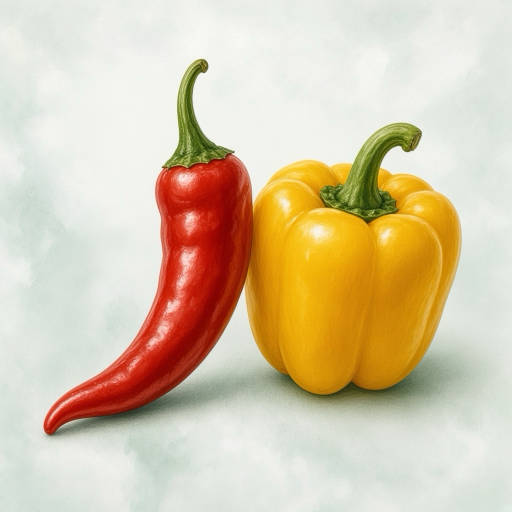
A chili pepper feels hot because of a chemical inside it called capsaicin. Capsaicin sticks to the same nerve ending in your mouth that warns your brain about hot food and hot drinks. The nerve sends a “hot!” message even though the pepper is not actually warm. Your tongue is fooled, and that is the whole trick.
Why hot peppers are tricky to understand
A spicy pepper is not really burning your mouth. The capsaicin in the pepper just turns on the same nerve that turns on when you eat soup that is too hot. Your brain gets the same kind of signal, so it feels the same.
Capsaicin is an oil, and oil and water do not mix. If you drink water after a spicy bite, the water just spreads the oil around your mouth. Milk works much better. Milk has a protein called casein that grabs the capsaicin and washes it away. Bread and rice help too, because they soak up the oil.
Most of the heat in a pepper is not in the seeds. The hot part is the white spongy stuff inside, called the placenta, which holds the seeds in place. Bell peppers have no heat at all because they are missing the gene that makes capsaicin.
Key facts about hot peppers and spice
The Scoville scale measures how spicy a pepper is. A bell pepper is 0. A jalapeño is about 2,500 to 10,000 Scoville Heat Units (SHU). A habanero is around 100,000 to 350,000. A Carolina Reaper averages about 1.6 million.
The Scoville scale was invented in 1912 by an American pharmacist named Wilbur Scoville. He had people taste pepper extract mixed with sugar water until they could no longer taste any heat.
Birds do not feel chili heat. Their nerves do not respond to capsaicin, so they can eat the hottest peppers and not notice. The plant counts on birds to fly its seeds far away.
Chili peppers come from the Americas. People in Mexico and South America were growing them about 6,000 years ago. Until 1492, no one in Europe, Africa, or Asia had ever tasted one.
Bell peppers and jalapeños are the same kind of plant (Capsicum annuum). The bell pepper has a broken gene that turns off the heat.
A jalapeño has a lot of vitamin C. One medium jalapeño has about 16 mg, roughly 18 percent of an adult’s daily need.
Black pepper is not a chili pepper. Its bite comes from a different chemical called piperine, and it is a totally different plant. Wasabi and horseradish are different again, with their own kind of heat that goes up the nose.
Common myths about hot peppers
Myth: The seeds are the spiciest part. The seeds carry only a little heat. Most of the capsaicin is in the white spongy tissue inside the pepper, called the placenta, where the seeds attach.
Myth: Drinking water cools your mouth after a spicy bite. Water actually spreads the heat around because capsaicin is an oil and oil does not mix with water. Milk, yogurt, ice cream, and bread work much better.
Myth: Hot peppers can hurt your tongue. Capsaicin tricks the heat nerve in your mouth, but it does not actually burn the skin or damage the tongue. The feeling fades on its own as the capsaicin wears off.
Myth: Hot peppers are from India or Thailand. Chili peppers are originally from the Americas. They reached Asia and Africa only after European traders carried them there in the late 1400s and the 1500s.
Frequently asked questions about hot peppers
Why do chili peppers feel hot?
A chemical in the pepper called capsaicin sticks to a nerve ending in your mouth. That nerve usually fires when something is actually hot, like a sip of soup. Capsaicin fools the nerve, and your brain feels heat even though nothing in your mouth is warm.
Why does milk help more than water?
Capsaicin is an oil, and oil does not mix with water. Drinking water just spreads the oil around your mouth. Milk has a protein called casein that grabs the capsaicin and pulls it off your tongue.
Where do hot peppers come from?
Wild chili peppers grew in the Americas first. People in Mexico and the Andes were growing them about 6,000 years ago. Sailors and traders carried seeds to Africa, India, China, and Southeast Asia in the late 1400s and 1500s.
Why do birds eat hot peppers?
Birds do not feel the heat. The pepper plant counts on birds to eat the fruit and carry the seeds far away. Mammals usually crunch the seeds up, so the plant uses spiciness to keep mammals away and let birds in.
Source notes
The numbers in this article come from standard reference entries on capsaicin and the Scoville scale, the Capsicum plant family, and the biography of pharmacist Wilbur Scoville. The Carolina Reaper Scoville value comes from Guinness World Records measurements.
A chili pepper tastes hot because of a chemical called capsaicin, which binds to a heat-sensing receptor in your mouth called TRPV1. TRPV1 normally fires when something is hot enough to be a burn risk, around 109 °F (43 °C). Capsaicin tricks the receptor into firing without any real heat, so your brain reads “hot” even though nothing in your mouth is warm. The amount of capsaicin a pepper contains is rated on the Scoville scale, which runs from 0 for a bell pepper to over 2.6 million for the hottest peppers grown today.
Why hot peppers are tricky to understand
The “heat” of a chili pepper is not heat at all. It is a chemical signal sent through a nerve. The nerve cannot tell the difference between hot soup and a molecule that fits its receptor, so the brain treats them the same. That is why eating a habanero feels like a burn, why your eyes can water, and why your skin can flush; your body is reacting to a temperature that is not really there.
Capsaicin is also an oil, not a water-soluble compound. A glass of water does not wash it off; it just spreads the oil around. Whole milk works because it has fat plus a protein called casein that wraps around capsaicin molecules and rinses them away. Yogurt, ice cream, and rice all help for the same reason.
A pepper’s heat is also not stored where most people think. Most of the capsaicin is in the white spongy tissue inside the pepper called the placenta, the part that holds the seeds. The seeds carry only traces, and the outer flesh has even less.
Key facts about hot peppers and spice
The Scoville scale starts at 0 and runs into the millions. A bell pepper is 0 SHU. A pepperoncini is under 500. A jalapeño is 2,500 to 10,000. A serrano is 10,000 to 25,000. A cayenne is 25,000 to 50,000. A habanero is 100,000 to 350,000. A Carolina Reaper averages about 1,640,000. These are typical published ranges, and any one variety covers a wide band, because a pepper’s heat depends on both its genetics and its growing conditions.
The hottest pepper measured to date is Pepper X, verified by Guinness World Records in October 2023 at about 2,693,000 SHU. It was bred by Ed Currie, the same grower who created the Carolina Reaper.
Pure capsaicin is about 16,000,000 SHU.
The Scoville scale was invented in 1912 by Wilbur Scoville, a pharmacist working in Detroit. He diluted pepper extract in sugar water until tasters could no longer detect heat. Modern labs use High-Performance Liquid Chromatography (HPLC) to measure capsaicin amounts directly and convert to SHU equivalents.
Capsaicin binds to TRPV1, a heat-sensing protein in nerve cells that normally activates around 109 °F (43 °C). Capsaicin produces the perception of heat without any real temperature change. The 2021 Nobel Prize in Physiology or Medicine went partly to David Julius for showing how TRPV1 works.
Birds lack the version of TRPV1 that responds to capsaicin. They eat hot peppers without feeling heat. The plant uses this difference to push birds (which scatter the seeds far away) and discourage mammals (whose teeth and stomach acid would destroy the seeds).
Bell peppers, jalapeños, poblanos, and cayennes are all the same species, Capsicum annuum. Bell peppers carry a recessive mutation in the Pun1 gene that disables capsaicin production.
Habaneros, scotch bonnets, and Carolina Reapers are a different species,Capsicum chinense. The five domesticated Capsicum species also include C. frutescens (tabasco), C. baccatum (ají amarillo), and C. pubescens (rocoto, manzano).
Chili peppers reached the rest of the world after 1492. Portuguese traders carried them from the Americas to West Africa, India, China, and Southeast Asia in the late 1400s and 1500s. Before that, “spicy” food in Asia and Africa came from black pepper, ginger, long pepper, and similar native plants.
Common myths about hot peppers
Myth: The seeds are the spiciest part. Most of the capsaicin is in the white pith holding the seeds, called the placenta. Seeds get coated by it but are not the source.
Myth: Drinking water cools the burn. Water spreads capsaicin around because oil and water do not mix. Milk, yogurt, sour cream, ice cream, and starchy foods like bread or rice work much better.
Myth: Black pepper and chili pepper are related. Black pepper is Piper nigrum, a flowering vine native to South Asia and long placed in the Western Ghats of southern India, though a recent genetic study suggests it may instead have originated in Sri Lanka and reached the Malabar Coast early through trade. Its bite comes from a chemical called piperine, not capsaicin. The two plants are not related, and the receptors they trigger are different.
Myth: Wasabi is the same kind of heat as chili. Wasabi, mustard, and horseradish produce a sharp sinus burn from a different molecule called allyl isothiocyanate (AITC). AITC activates a different receptor (TRPA1), so the sensation hits the nose and clears quickly, while chili heat hits the tongue and lingers.
Myth: Indian and Thai food have always been spicy. Capsicum peppers are originally from the Americas. Indian, Thai, Korean, Chinese, and African cuisines started using chilies only after Portuguese traders introduced them in the late 1400s and 1500s.
Frequently asked questions about hot peppers
What is capsaicin?
Capsaicin is the main chemical that makes chili peppers hot. It is a colorless, oily compound made by the pepper plant in the placenta tissue around its seeds. When capsaicin touches the heat-sensing nerve receptor in your mouth (TRPV1), the receptor fires the same signal it would send if you actually ate something hot.
How is the Scoville scale measured today?
The original 1912 method used human tasters and dilutions of pepper extract in sugar water. Modern labs use HPLC, which separates capsaicin from other plant chemicals and measures its concentration directly in parts per million. The result is converted into Scoville Heat Units using a fixed multiplier, so the modern numbers can be compared with old taste-test values.
Why do birds eat the hottest peppers without flinching?
Birds have a different version of the TRPV1 receptor that does not respond to capsaicin. From the plant’s point of view, this is the whole point of being spicy. Birds carry the seeds long distances and pass them through their digestive system intact. Mammals, which would crunch and destroy the seeds, are warned off by the burn.
How did chili peppers spread around the world?
All Capsicum species are native to the Americas. After Christopher Columbus’s 1492 voyage, Spanish and especially Portuguese traders carried seeds along their shipping routes. Within a few decades, chili peppers were growing in West Africa, India, the East Indies, southern China, and Korea. Cuisines that today seem inseparable from chili heat, such as Sichuan, Thai, Indian, and Hungarian, all picked them up after European contact.
What is the hottest pepper anyone has officially measured?
Pepper X, bred by Ed Currie of Puckerbutt Pepper Company in South Carolina, was certified by Guinness World Records in October 2023 at about 2,693,000 SHU. The previous record holder, Carolina Reaper, was bred by the same person and averages about 1,640,000 SHU.
A chili pepper feels hot because capsaicin binds to the TRPV1 ion channel, a heat-and-pain receptor on sensory neurons in the mouth and skin. TRPV1 normally opens at temperatures above about 109 °F (43 °C); capsaicin opens the same channel at body temperature, so the brain receives a signal that is indistinguishable from a real thermal burn even though no temperature change has occurred. The amount of capsaicin in a pepper is rated on the Scoville scale, originally a taste-dilution test devised in 1912 and now measured in laboratories using High-Performance Liquid Chromatography (HPLC). Pepper X, certified by Guinness World Records in October 2023 at about 2,693,000 SHU, currently holds the world record.
What is often misunderstood about chili heat
Heat from a chili pepper is not a flavor in the strict sense; it is a chemesthetic signal carried by the trigeminal nerve, the same nerve that registers actual temperature, pressure, and pain on the face and inside the mouth. Taste buds detect sweet, salty, sour, bitter, and umami. Capsaicin bypasses them entirely. That is why chili heat lingers after the food is swallowed and why it persists when sense of taste itself is dulled.
The seeds are not the spiciest part of the pepper. The placenta, the white spongy tissue that anchors the seeds inside the fruit, is where capsaicin is synthesized and concentrated. Seeds carry only trace amounts. Outer flesh has the least. Cooks who want a pepper’s flavor without the full heat slice the fruit lengthwise and scrape the placenta out before chopping.
Water does not relieve the burn because capsaicin is fat-soluble, not water-soluble. Whole milk works because casein, the dominant milk protein, binds capsaicin and lifts it off the oral mucosa. Fatty foods (yogurt, ice cream, peanut butter) work for the same reason. Bread and rice help by mechanically absorbing capsaicin oil. Beer, soda, and water spread the oil around the mouth and rarely help.
Spicy food does not damage the tongue. Capsaicin activates pain-and-heat receptors but does not cause physical injury at culinary doses. Repeated exposure desensitizes TRPV1 and depletes a neurotransmitter called Substance P from the affected sensory neurons. That is why people who eat spicy food regularly experience the same peppers as much milder. The effect is reversible over weeks to months. Topical capsaicin creams used for nerve pain rely on this same desensitization.
Three other “hot” sensations in food come from completely different molecules. Wasabi, horseradish, and mustard owe their burn to allyl isothiocyanate (AITC), a volatile compound that activates the TRPA1 channel. AITC vaporizes easily, so the burn rises into the sinuses and clears quickly. Black pepper owes its bite to piperine, a different alkaloid that activates TRPV1 but more weakly than capsaicin and with a sharper, shorter profile. Sichuan peppercorn produces a distinctive tingling and numbness from hydroxy-alpha-sanshool, a fatty acid amide that activates mechanoreceptors at a frequency researchers have measured at about 50 Hz, more like a vibration than a burn.
Key facts about hot peppers and spice
Capsaicin and TRPV1. Capsaicin (8-methyl-N-vanillyl-6-nonenamide) binds inside the TRPV1 ion channel and lowers its activation temperature. The 2021 Nobel Prize in Physiology or Medicine was awarded jointly to David Julius (for the discovery of TRPV1 as the capsaicin receptor) and Ardem Patapoutian (for PIEZO mechanoreceptors). Pure capsaicin is rated at about 16,000,000 SHU.
Scoville reference values. Bell pepper 0 SHU. Pepperoncini under 500. Jalapeño 2,500 to 10,000. Serrano 10,000 to 25,000. Cayenne 25,000 to 50,000. Habanero 100,000 to 350,000. Bhut jolokia (ghost pepper) about 1,000,000 (Guinness, 2007). Carolina Reaper averages about 1,640,000. Pepper X averages about 2,693,000 (Guinness, October 2023). The cultivar figures are typical published ranges; measured heat varies with genetics and growing conditions.
The Scoville method. Pharmacist Wilbur Scoville devised the Scoville Organoleptic Test in 1912 while working in Detroit. Pepper extract was diluted in sugar water until trained tasters could no longer detect heat; the dilution factor became the SHU rating. Modern HPLC measurement quantifies major capsaicinoids directly in parts per million and converts to SHU using a fixed multiplier, eliminating taster variability.
Capsicum species. Five domesticated species supply the world’s chilies: Capsicum annuum (bell, jalapeño, poblano, cayenne, serrano), C. chinense (habanero, scotch bonnet, ghost, Carolina Reaper, Pepper X), C. frutescens (tabasco, malagueta), C. baccatum (ají amarillo), and C. pubescens (rocoto, manzano). All five are native to the Americas.
Bell peppers. Bell peppers are the same species as jalapeños but carry a recessive loss-of-function mutation in the Pun1 gene that disables a key step in capsaicin biosynthesis. The plant produces no capsaicin, so the fruit registers 0 SHU.
Capsaicin’s evolutionary purpose. Birds lack the residue in their TRPV1 channels that responds to capsaicin and feel no heat from chilies; they swallow whole peppers, fly, and disperse the seeds intact. Mammals, whose teeth and digestive tracts destroy seeds, are deterred by the burn. Capsaicin also has antifungal activity against the fungi that attack pepper fruits in humid climates.
Spread after 1492. All Capsicum species are native to Mesoamerica and South America. Domestication evidence dates back roughly 6,000 years in southern Mexico and Bolivia. Spanish and especially Portuguese traders carried seeds along their 16th-century shipping routes; chilies reached West Africa, India, the East Indies, southern China, and Korea within decades. Cuisines now considered defining chili users (Sichuan, Thai, Hungarian, Korean) all adopted them after European contact.
Why a jalapeño can be milder than its label suggests. Capsaicin levels rise with drought stress, heat stress, and ripeness. The same cultivar grown in two fields can vary by an order of magnitude. Crop SHU values are typically reported as ranges, not single numbers.
Vitamin C. A medium fresh jalapeño (about 14 g) supplies roughly 11 to 17 mg of vitamin C, about 12 to 19 percent of the adult recommended daily allowance. Bell peppers are an even denser source per fresh weight.
Common myths about hot peppers
Myth: The seeds are the hot part of the pepper. Most of the capsaicin is in the placenta, the white pith that holds the seeds. Seeds carry only trace amounts because they sit in contact with the placenta, not because they produce capsaicin themselves. Removing the placenta during prep substantially reduces a dish’s heat.
Myth: Drinking water relieves chili burn. Capsaicin is oil-soluble. Water spreads it around the oral mucosa instead of removing it. Whole milk works because casein binds capsaicin; fatty and starchy foods help for related reasons.
Myth: Black pepper, wasabi, and chili pepper are the same kind of “hot.” Three different molecules and at least two different receptors are involved. Capsaicin activates TRPV1. AITC (in mustard, wasabi, and horseradish) activates TRPA1. Piperine (in black pepper) activates TRPV1 less potently than capsaicin and with a sharper, shorter profile.
Myth: Indian, Thai, and Sichuan cuisines are ancient chili-using traditions. Capsicum peppers are New World plants. They reached Asia and Africa via Portuguese trade only after about 1500 CE. Pre-contact “heat” in these regions came from black pepper, long pepper, ginger, garlic, mustard, and Sichuan peppercorn.
Myth: Most “wasabi” served outside Japan is real wasabi. True wasabi (Wasabia japonica) is rare and expensive. The bright green paste served with sushi at most restaurants outside Japan is dyed horseradish, sometimes blended with mustard powder. The active compound is the same (AITC), but the flavor profile of fresh wasabi is more delicate.
Myth: Spicy food damages the tongue or stomach. Capsaicin tricks pain-and-heat receptors but does not injure mucosal tissue at culinary doses. There is also no direct evidence that spicy food causes ulcers; the dominant cause of stomach ulcers is Helicobacter pylori infection.
Frequently asked questions about hot peppers
What exactly is capsaicin?
Capsaicin is a vanilloid alkaloid synthesized in the placental tissue of Capsicum fruits. Chemically it is 8-methyl-N-vanillyl-6-nonenamide. It is colorless, odorless, oil-soluble, and stable in dry storage. Its target in animals is TRPV1, an ion channel that opens in response to heat above about 109 °F (43 °C), low pH, and certain inflammatory chemicals. Capsaicin lowers TRPV1’s activation threshold so that the channel opens at body temperature, producing the perception of burning heat without any actual temperature change.
How does the Scoville scale work?
The original 1912 test, devised by pharmacist Wilbur Scoville, mixed dried pepper extract into sugar water in serial dilutions until five trained tasters could no longer detect heat. The dilution factor at the threshold was the SHU rating. Modern labs use HPLC to separate and quantify the major capsaicinoids (capsaicin, dihydrocapsaicin, nordihydrocapsaicin, and a few minor analogs), then convert to SHU using a fixed multiplier per compound. HPLC values are reproducible and species-independent in a way the original tasting protocol was not.
Why does milk help and water doesn’t?
Capsaicin is oil-soluble and water spreads it without removing it. Whole milk, yogurt, ice cream, and butter contain casein, a phosphoprotein that binds the hydrophobic tail of capsaicin and rinses it away. Cooking oils work in principle but are unpleasant to drink. Starchy foods like bread and rice help by mechanically absorbing the oil. Alcohol dissolves capsaicin but spreads it around the mouth before evaporating, and is therefore mixed in effect.
Why don’t birds feel chili heat?
Bird TRPV1 channels lack the specific binding-pocket residues that mammalian TRPV1 uses to recognize capsaicin. Birds eat hot peppers without any pain response. From the plant’s standpoint this is the entire point of capsaicin: birds disperse seeds across far greater distances than mammals and pass the seeds intact, while mammalian molars and stomach acid destroy the seeds. The argument was first laid out experimentally in a 2001 Nature paper by Tewksbury and Nabhan.
How did chili peppers spread from the Americas?
All five domesticated Capsicum species are native to the Americas. Christopher Columbus’s 1492 contact carried seeds back to Spain. Within decades, Portuguese traders had carried chilies along their shipping routes to West Africa, the Indian subcontinent (especially Goa), the East Indies, southern China, and Korea. Hungarian paprika, Thai bird’s eye, Korean gochugaru, Indian guntur, and Sichuan dried chili are all post-Columbian additions to those cuisines.
What is the hottest pepper officially recorded?
Pepper X, bred by Ed Currie of Puckerbutt Pepper Company in South Carolina, was certified by Guinness World Records in October 2023 with an average rating of about 2,693,000 SHU across multiple plants. Currie also bred the previous record holder, the Carolina Reaper, which averages about 1,640,000 SHU and held the record from 2013 to 2023. Pure capsaicin, by comparison, is around 16,000,000 SHU.
Does eating spicy food regularly increase tolerance?
Yes. Repeated capsaicin exposure desensitizes TRPV1 channels and gradually depletes Substance P, a neuropeptide involved in pain signaling, from local sensory neurons. The same physiological mechanism is used clinically: prescription capsaicin patches are applied to skin to treat chronic neuropathic pain by deliberately downregulating local nociceptors. Tolerance is reversible; abstinence for several weeks restores typical sensitivity.
Source notes
The molecular biology of capsaicin and TRPV1 in this article follows standard reference entries on capsaicin and the TRPV1 channel, plus the 2021 Nobel Prize in Physiology or Medicine summary recognizing David Julius and Ardem Patapoutian. Scoville values come from the Scoville scale entry and Guinness records, including the Pepper X certification of October 2023. Other “hot” molecules are documented in the allyl isothiocyanate and piperine reference entries. The taxonomy and post-1492 spread of Capsicum species follow the Capsicum entry and standard references on the Columbian Exchange.
A chili pepper registers as hot because capsaicin binds to the TRPV1 ion channel, a non-selective cation channel of the transient receptor potential family that gates open in response to noxious heat above about 109 °F (43 °C), protons below pH 6, and a number of endogenous lipid mediators. Capsaicin opens the same channel at body temperature; the brain receives a signal indistinguishable from a thermal burn while no temperature change occurs. The 2021 Nobel Prize in Physiology or Medicine was awarded jointly to David Julius for the molecular identification of TRPV1 as the capsaicin receptor and to Ardem Patapoutian for the discovery of the PIEZO mechanosensors, formally recognizing the molecular basis of somatosensation. The amount of capsaicin in a fruit is reported on the Scoville scale, originally a sensory dilution assay devised by Wilbur Scoville in 1912 and now reported as HPLC-derived capsaicinoid content multiplied by a fixed conversion factor.
Why capsaicin chemistry is non-intuitive
Capsaicin is a chemical signal targeting a channel that exists for an entirely different purpose. TRPV1 is part of an ancient nociceptive sensor set responsible for warning vertebrates against thermal injury, low pH, and certain inflammatory lipids. Capsicum plants stumbled, evolutionarily, onto a small molecule whose vanillyl head group and lipophilic tail occupy a binding pocket in the channel’s S3-S4 region, lowering its thermal activation threshold so that body-temperature exposure is read by the central nervous system as a real burn. The signal is encoded by spike trains in C-fiber nociceptors, the same fibers that carry actual heat and pain. The brain has no peripheral mechanism to distinguish chemical activation from thermal activation of the same channel; this is why “spicy food makes you sweat” is a literal thermoregulatory response.
Capsaicin is also a useful case study in receptor pharmacology. It is a low-nanomolar agonist of TRPV1 (typical EC50 around 100 to 700 nM in vitro depending on cell line), inactive at TRPA1 and TRPM8, and orally non-toxic at culinary doses despite the dramatic perceptual effect. The sensory channels for the other major culinary “heats” are distinct: TRPA1 is the receptor for allyl isothiocyanate (mustard, wasabi, horseradish), cinnamaldehyde (cinnamon), and reactive electrophiles generally; TRPM8 is the menthol-activated cold receptor responsible for the cooling sensation of mint and the menthol additive in cigarettes; and Sichuan peppercorn’s tingling traces to a different mechanism altogether, namely hydroxy-alpha-sanshool modulation of two-pore-domain potassium (KCNK) channels in mechanoreceptors at frequencies measured around 50 Hz.
A second source of non-intuition is that capsaicin’s apparent severity is uncoupled from physical injury. Topical and oral exposure at culinary doses causes intense perceptual heat without tissue damage. At pharmacological doses, capsaicin acts as a transient agonist followed by a prolonged desensitization phase, with depletion of Substance P from local nerve terminals. This is the mechanism behind the prescription capsaicin patch (8% dermal patch, marketed as Qutenza), which treats post-herpetic neuralgia, painful HIV-associated neuropathy, and diabetic peripheral neuropathy by selectively defunctionalizing TRPV1-expressing nociceptors over weeks. The vastly more potent vanilloid resiniferatoxin (RTX), isolated from the latex of Euphorbia resinifera, a spurge native to Morocco, is in clinical trials as an even longer-acting agent for intractable pain.
Key facts
TRPV1 structure. TRPV1 is a homotetramer of six-transmembrane subunits with a central ion-conduction pore, a topology shared with voltage-gated potassium and sodium channels. Cryo-electron microscopy structures published by the Julius and Cheng labs (2013 and subsequent years) resolved capsaicin and resiniferatoxin in the binding pocket between the S3-S4 helix bundle. The 2021 Nobel committee cited this structural work in awarding the prize to David Julius. The 1997 Nature paper by Caterina, Schumacher, Tominaga, Rosen, Levine, and Julius first cloned the channel and identified it as the receptor for both capsaicin and noxious heat.
Capsaicinoid family.Capsicum fruits produce a family of vanilloid amides, of which capsaicin (about 69% of total in typical hot peppers) and dihydrocapsaicin (about 22%) account for the bulk of the heat. Minor capsaicinoids include nordihydrocapsaicin, homocapsaicin, and homodihydrocapsaicin, each with slightly different SHU equivalents per unit mass. Pure capsaicin rates at about 16,000,000 SHU; pure dihydrocapsaicin at about 15,000,000 SHU.
The Scoville reference ladder. Bell pepper 0 SHU. Pepperoncini under 500. Jalapeño 2,500 to 10,000. Serrano 10,000 to 25,000. Cayenne 25,000 to 50,000. Habanero 100,000 to 350,000. Bhut jolokia (ghost pepper) about 1,000,000, certified by Guinness in 2007. Carolina Reaper averages about 1,640,000. Pepper X averages about 2,693,000, certified by Guinness in October 2023. Pure capsaicin is about 16,000,000. The cultivar figures are typical published ranges; HPLC surveys report far wider spreads within a single cultivar, because capsaicinoid content depends on genotype, climate, and soil.
Resiniferatoxin. A diterpene daphnane orthoester from the latex of Euphorbia resinifera (a Moroccan spurge, not a cactus), with a Scoville-equivalent rating around 16,000,000,000 SHU, roughly 1,000 times the potency of capsaicin per unit mass. RTX binds the same TRPV1 pocket as capsaicin but with longer residence time and produces near-irreversible activation followed by ablation of TRPV1-expressing neurons. The compound is in clinical trials for refractory pain in advanced cancer.
Domesticated Capsicum species.Capsicum annuum (bell, jalapeño, serrano, poblano, cayenne, paprika), C. chinense (habanero, scotch bonnet, ghost, Carolina Reaper, Pepper X), C. frutescens (tabasco, malagueta, Thai bird’s eye in some classifications), C. baccatum (ají amarillo, ají limón), and C. pubescens (rocoto, manzano). All five are native to the Americas. Archaeological evidence places domestication around 6,000 years ago in southern Mexico (for C. annuum) and the Andes (for C. baccatum and C. pubescens).
The Pun1 locus. Bell peppers (C. annuum) carry a recessive deletion in Pun1 (also called CS or capsaicin synthase), eliminating expression of the acyltransferase that completes capsaicinoid biosynthesis. Heterozygotes produce capsaicin at near-normal levels, which is why the non-pungent trait is recessive; homozygotes produce none. The phenotype is recessive because a single functional allele suffices for synthesis at typical levels.
Tewksbury and Nabhan (2001). A Nature paper by Tewksbury and Nabhan demonstrated experimentally that birds disperse Capsicum seeds intact while mammals destroy them, and that capsaicin specifically deters mammals (which feel the burn) without affecting birds (whose TRPV1 channels lack the capsaicin-sensitive residues). The paper provided the experimental foundation for the directed-deterrence hypothesis of capsaicin function.
Tolerance, desensitization, and Substance P. Repeated TRPV1 activation desensitizes the channel and triggers depletion of Substance P, a tachykinin neuropeptide stored in C-fiber terminals. Both effects reduce subjective heat perception. The process is reversible over weeks of abstinence. The same mechanism underlies the analgesic effect of high-dose topical capsaicin in chronic neuropathic pain.
Wilbur Scoville and the 1912 method. Wilbur Scoville devised the Scoville Organoleptic Test in 1912 while at Parke-Davis in Detroit. Pepper extract was diluted in sugar water until five trained tasters could no longer detect heat; the dilution factor at threshold was the SHU rating. The method has substantial taster variability and was superseded for analytical purposes by HPLC-based capsaicinoid quantitation, but the SHU unit and Scoville’s name remain the conventional reporting standard.
TRPA1 and TRPM8 contrasts. Wasabi, horseradish, and mustard burn through AITC (allyl isothiocyanate) at TRPA1, a polymodal channel that responds to reactive electrophiles. The volatility of AITC is why wasabi heat rises into the sinuses and clears within seconds, in marked contrast to capsaicin’s prolonged oral persistence. Mint and menthol activate TRPM8, the same channel that responds to environmental cooling between about 46 and 79 °F (8 and 26 °C).
Sichuan peppercorn.Zanthoxylum species (Sichuan peppercorn, Japanese sansho) contain hydroxy-alpha-sanshool, a polyene fatty-acid amide that produces tingling rather than heat. Sanshool inhibits two-pore-domain potassium channels (KCNK3, KCNK9, KCNK18) on mechanoreceptive nerve fibers; sensory psychophysics by Bautista and colleagues identified a perceptual frequency around 50 Hz, comparable to a low-frequency tactile vibration on the lip. Zanthoxylum is a member of the Rutaceae and unrelated to Capsicum or Piper.
Black pepper.Piper nigrum derives its bite from piperine, a piperidine alkaloid that activates TRPV1 with substantially lower potency than capsaicin and somewhat distinct kinetics. Piper and Capsicum are unrelated; “pepper” as a shared name in English derives from black pepper’s market dominance before chilies reached Europe.
Domestication and global spread. Charred Capsicum remains have been recovered from Mesoamerican sites dated to roughly 6,000 years ago. Spanish contact in 1492 carried Capsicum seeds back to Iberia within months. Portuguese traders propagated chilies along their Indian Ocean and South China Sea routes through the early 1500s; by 1542 chilies were documented in India, by the late 1500s in Sichuan. Cuisines now considered defining chili users are post-Columbian on this point.
Non-culinary applications. Bear deterrent sprays formulated to EPA standards typically contain 1.0 to 2.0 percent total capsaicinoids. Self-defense pepper sprays use similar concentrations. Capsaicin-impregnated cable insulation is used in regions with high rodent damage; rodents are mammals and avoid the coating, while birds are not deterred. Capsaicin is also used as an antifouling agent in marine paints to discourage barnacle and tubeworm settlement on hulls.
Stress and capsaicin biosynthesis. Capsaicinoid concentrations rise with drought stress, high soil temperature, and fruit damage. The same cultivar grown in two locations can vary substantially in measured SHU, which is why nearly all commercial pepper data is reported as a range. Ripening also affects content; many cultivars peak in capsaicin a few days before color change.
Common misconceptions at expert level
Misconception: Capsaicin and piperine activate the same receptor at similar potency. Both interact with TRPV1, but capsaicin is a low-nanomolar agonist with a vanilloid head group that occupies a defined binding pocket; piperine is a higher-micromolar full agonist, less potent than capsaicin but with greater maximal efficacy, and with different residency kinetics, producing a sharper, shorter sensation than capsaicin. The spices are perceptually distinct because their pharmacology is.
Misconception: Resiniferatoxin comes from a cactus.Euphorbia resinifera, the source of RTX, is a leafless succulent endemic to the Anti-Atlas mountains of Morocco. It is a member of the Euphorbiaceae and is unrelated to true cacti (Cactaceae); the resemblance is convergent succulent morphology. The latex was used medicinally in classical antiquity (Pliny the Elder records it), and the active principle was isolated and structurally characterized in the 1970s.
Misconception: The Scoville method directly counts capsaicin molecules. Scoville’s 1912 protocol measured perceptual threshold by serial dilution with five trained tasters, an inherently variable measurement. Modern SHU values come from HPLC quantitation of total capsaicinoids in parts per million, multiplied by a fixed conversion factor (typically about 16 for capsaicin, somewhat less for dihydrocapsaicin and the minor capsaicinoids). The published SHU value is therefore an analytical chemistry result expressed in a historically named unit.
Misconception: Bird TRPV1 simply lacks the capsaicin binding pocket. Avian TRPV1 channels conserve most of the capsaicin-binding region but differ at a small number of residues (notably Y511 in the rat numbering) that disrupt high-affinity vanilloid binding. The channels remain heat-sensitive in birds; they are specifically not capsaicin-sensitive. Single-residue substitutions in either direction can transfer or remove sensitivity in heterologous expression systems, providing a clean structural assignment.
Misconception: Most Pepper X-grade peppers contain just capsaicin. Superhot cultivars in the C. chinense family, including the Carolina Reaper and Pepper X, accumulate elevated levels of dihydrocapsaicin and unusual capsaicinoid analogs (including some highly hydrophobic minor compounds) in addition to capsaicin proper. Heat profile differences between Reaper and Pepper X cannot be reduced to a single capsaicin number; the kinetics of perceptual onset and decay reflect the full mixture.
Misconception: Sanshool is a “Sichuan capsaicin.” Hydroxy-alpha-sanshool produces tingling and numbness, not heat; it acts on KCNK two-pore-domain potassium channels rather than TRPV1; and the perceptual quality is closer to a 50 Hz tactile vibration than to a thermal sensation. Sichuan cuisine’s má là (numbing-spicy) flavor combines Zanthoxylum (sanshool) with chili (capsaicin), producing a compound sensation generated by two completely different ion-channel pathways.
Frequently asked questions
What is the mechanistic difference between TRPV1, TRPA1, and TRPM8?
All three are TRP-family ion channels expressed in primary sensory neurons but they are gated by different stimuli. TRPV1 opens in response to noxious heat above about 109 °F (43 °C), low pH, anandamide and related endovanilloids, and capsaicin. TRPA1 opens in response to reactive electrophiles, including AITC (mustard, wasabi, horseradish), cinnamaldehyde, and acrolein, plus noxious cold in some species. TRPM8 opens in response to cold below about 79 °F (26 °C) and to menthol. The three channels together encode a substantial fraction of the body’s somatosensory response to small molecules in food.
How was TRPV1 cloned and what did the Nobel Prize recognize?
David Julius’s group at UCSF identified TRPV1 by expression cloning in 1997, transfecting pools of rodent dorsal-root-ganglion cDNAs into HEK293 cells and screening for capsaicin-induced calcium influx. The Caterina et al. 1997 Nature paper established that the cloned channel responded to both capsaicin and noxious heat, providing molecular identity for the long-postulated heat-and-pain sensor. Subsequent work, including cryo-EM structures of TRPV1 with capsaicin and resiniferatoxin bound, provided the structural basis for vanilloid agonism. The 2021 Nobel Prize in Physiology or Medicine was awarded jointly to David Julius (TRPV1) and Ardem Patapoutian (PIEZO mechanosensors).
How does the capsaicin patch treat chronic pain?
The Qutenza 8% dermal patch saturates TRPV1 channels on cutaneous C-fiber nociceptors. Acute application produces local heat and erythema, mediated by Substance P release; over the following hours and days, those same neurons retract their TRPV1-expressing terminals from the epidermis and lose nociceptive function for weeks to months. The net clinical effect is selective, reversible defunctionalization of pain-sensing fibers without affecting tactile, motor, or proprioceptive function, which use different channels and different fiber classes.
Why is resiniferatoxin so much more potent than capsaicin?
RTX shares the vanilloid pharmacophore that defines capsaicin’s binding to TRPV1, but its complex daphnane diterpene scaffold establishes additional contacts in the binding pocket and dramatically slows dissociation. In functional assays RTX is approximately three orders of magnitude more potent than capsaicin and produces near-irreversible activation followed by neuronal ablation rather than the reversible desensitization seen with capsaicin. The resulting Scoville-equivalent rating is on the order of 16 billion SHU.
What is the genetic basis of the bell pepper’s loss of heat?
Bell peppers carry a loss-of-function mutation at the Pun1 (Pungency 1) locus, encoding a putative acyltransferase required for the final condensation step in capsaicinoid biosynthesis. Most non-pungent C. annuum cultivars carry a 2.5 kb deletion in this gene; molecular characterizations were published in the early 2000s by Stewart, Mazourek, and others. The phenotype is recessive: heterozygous plants produce capsaicin at near-normal levels.
What is the experimental evidence that capsaicin is targeted at mammalian seed predators?
Tewksbury and Nabhan’s 2001 Nature paper compared bird and mammal handling of wild Capsicum fruit in the field. Birds preferentially consumed pungent fruits and passed seeds intact. Mammals preferentially consumed non-pungent fruits when available and destroyed seeds when forced to consume pungent ones. The paper provided the empirical foundation for the directed-deterrence hypothesis that capsaicin selectively repels mammals while permitting bird-mediated dispersal.
Source notes
The TRPV1 molecular biology, capsaicinoid pharmacology, and Nobel context follow standard reference entries on capsaicin, TRPV1, TRPA1, TRPM8, and the 2021 Nobel Prize in Physiology or Medicine summary recognizing David Julius and Ardem Patapoutian. The resiniferatoxin entry documents its source in Euphorbia resinifera and its TRPV1 pharmacology. The Tewksbury and Nabhan 2001 Nature paper is the empirical basis for the directed-deterrence hypothesis. The Scoville scale entry documents the 1912 method and modern HPLC conversion practice; Pepper X’s October 2023 record is from Guinness World Records. Capsicum species taxonomy and the Pun1 genetic basis of the bell-pepper phenotype are reviewed in the linked entries. The hydroxy-alpha-sanshool entry documents Sichuan peppercorn’s distinct KCNK-channel pharmacology.