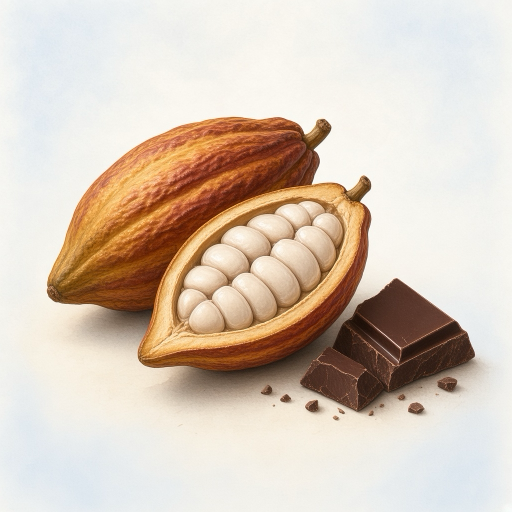
Chocolate starts with seeds from the cacao tree, Theobroma cacao. Cacao trees need warm, humid conditions, so farmers grow them in tropical regions. The seeds are usually called cocoa beans after harvest, even though they are not true beans.
From a colorful pod to a chocolate bar
Cacao pods grow from the tree’s trunk and older branches. Inside each pod, the seeds sit in a sweet, sticky pulp. Tiny midges are important pollinators of cacao flowers.
Fresh cacao seeds do not taste like a finished chocolate bar. After workers open the pods, the seeds and pulp ferment together. Microbes use sugars in the pulp, while heat and acids help create flavor-building changes inside the seeds.
The fermented seeds are dried and then roasted. Machines crack the roasted seeds and remove most of their shells, leaving pieces called nibs. Grinding the nibs releases cocoa butter and makes a thick paste called chocolate liquor, which contains no alcohol despite its name.
Chocolate makers mix that paste with ingredients such as sugar and extra cocoa butter. Milk chocolate also contains dairy ingredients. The mixture is refined, stirred, cooled in a controlled way, and shaped in molds.
Key facts about chocolate
The word Theobroma comes from Greek words meaning “food of the gods.”
A cacao bean is the seed of a fruit, not a member of the bean family.
Cacao use has a long American history, with archaeological evidence from South America that is more than 5,000 years old.
In the early 1500s, Aztec elites drank frothy cacao beverages, and cacao beans also served as tribute and currency.
Chocolate was enjoyed as a drink for centuries before molded eating chocolate became common.
Daniel Peter is credited with developing milk chocolate in Switzerland in 1875.
Rodolphe Lindt developed conching in 1879, a process that helped make eating chocolate smoother.
White chocolate contains cocoa butter but no dark, nonfat cocoa solids.
Under current U.S. rules, white chocolate must contain at least 20 percent cacao fat and specified amounts of milk ingredients.
The latest free ICCO balance published in May 2026 estimates that the world produced 4.723 million metric tons of cocoa beans in the 2024/25 cocoa year.
Common myths about chocolate
Myth: Cocoa beans taste like candy as soon as a pod opens. Fresh seeds are bitter and astringent, and the familiar flavor develops through fermentation, drying, roasting, and later factory steps.
Myth: White chocolate has nothing from a cacao tree. Its cacao ingredient is cocoa butter, the natural fat pressed from cacao.
Myth: The pale coating on an old bar must be mold. Chocolate can develop fat bloom when fats recrystallize or sugar bloom after moisture reaches the surface; bloom changes appearance and texture, but it is different from mold.
Myth: A small chocolate snack is always safe for a dog. Chocolate contains theobromine and caffeine, and the risk depends on the dog’s size, the amount eaten, and the type of chocolate.
Frequently asked questions
Where does chocolate come from?
It comes from cacao seeds grown in tropical regions, then fermented, dried, roasted, and processed into chocolate.
Why is dark chocolate bitter?
Dark chocolate usually has a larger share of cacao ingredients and less milk than milk chocolate, so its bitter and astringent cocoa flavors are easier to notice.
What should I do if a dog eats chocolate?
Tell an adult and contact a veterinarian or animal poison service promptly rather than waiting for symptoms, because the safe response depends on the animal, dose, and chocolate type.
Does chocolate liquor contain alcohol?
No. In U.S. food rules, chocolate liquor is the food made by finely grinding cacao nibs.
Source notes
Botany comes from the Royal Botanic Gardens, Kew. Processing chemistry comes from a peer-reviewed review. Historical claims come from Smithsonian reporting and the Swiss chocolate manufacturers’ association. U.S. composition rules come from the current Electronic Code of Federal Regulations, pet guidance comes from Cornell veterinary specialists, and the dated production figure comes from the May 2026 ICCO bulletin.
Chocolate begins inside the fruit of Theobroma cacao, a tropical evergreen native to the Americas. Its seeds are fermented, dried, roasted, shelled, and ground before they can become a bar. Each stage changes the flavor or texture, so chocolate making is more than simply adding sugar to a raw seed.
Why fermentation matters
Workers open ripe cacao pods and gather the seeds with the sweet pulp around them. Yeasts and bacteria grow through the fermenting mass, consuming pulp sugars and producing substances that include ethanol and acetic acid. Heat and acid stop the seed from growing and allow enzymes inside it to form flavor precursors.
Drying slows those reactions and lowers the beans’ moisture for storage. Roasting then produces much of chocolate’s familiar aroma and brown color through reactions involving sugars, amino acids, and other bean compounds.
After roasting, the shells are separated from the nibs. Grinding the nibs makes chocolate liquor, a paste containing cocoa butter and nonfat cocoa material. Refining reduces particle size, conching mixes and aerates the warm chocolate, and tempering guides the cocoa butter into a useful crystal structure.
From ancient drinks to smooth bars
Researchers have found evidence of cacao use at Santa Ana-La Florida in present-day Ecuador from about 5,300 years ago. That discovery shows that cacao’s human story began in South America before its later importance in Mesoamerica.
Maya and Aztec societies prepared cacao drinks long before Europeans reached the Americas. Cacao was also economically valuable: Aztec authorities received it as tribute, and its seeds circulated as currency.
Two Swiss developments changed the texture and ingredients of modern eating chocolate. Daniel Peter is credited with successfully combining milk and chocolate in 1875. Rodolphe Lindt developed conching in 1879, producing a smoother, melting style of chocolate.
Key facts about chocolate
Cacao flowers can grow on the trunk and older branches, a habit called cauliflory.
Tiny midges are important pollinators of cacao flowers.
The seeds are commonly called beans, but botanically they are seeds inside a fruit.
Fermentation helps reduce harshness and creates precursors that roasting later turns into chocolate aromas.
The papery shell is removed after roasting to leave the edible nib.
Chocolate liquor is ground cacao nibs and does not contain beverage alcohol.
Cocoa butter is the fat portion of cacao, while cocoa powder contains mostly nonfat cacao material after much of the fat is pressed out.
“Cacao” and “cocoa” overlap in English usage; they do not mark a universal scientific boundary between raw and processed products.
Current U.S. rules define milk chocolate, sweet chocolate, semisweet or bittersweet chocolate, and white chocolate, but do not create a separate standard named “dark chocolate.”
Semisweet and bittersweet chocolate under the U.S. standard must contain at least 35 percent chocolate liquor.
The current U.S. white-chocolate standard requires at least 20 percent cacao fat, 14 percent total milk solids, and 3.5 percent milkfat.
The May 2026 ICCO balance estimates 4.723 million metric tons of world cocoa production and 4.628 million metric tons of grindings for the 2024/25 cocoa year.
Common myths about chocolate
Myth: The words “cacao” and “cocoa” always describe different stages. Writers often prefer “cacao” for the plant and “cocoa” for processed ingredients, but the terms overlap, and U.S. regulations even allow both “cacao nibs” and “cocoa nibs.”
Myth: A higher cocoa percentage proves a bar is better. The percentage reports how much of the recipe comes from cacao ingredients; it does not by itself measure fermentation, roast quality, recipe balance, or flavor.
Myth: White chocolate contains no cacao ingredient. It lacks dark cocoa solids, but its defining cacao ingredient is cocoa butter.
Myth: Pale bloom means microbes are growing. Fat bloom and sugar bloom are physical changes at the surface, although any food with an unknown storage history still deserves normal food-safety judgment.
Myth: All chocolate is equally dangerous to a dog. Cocoa powder and darker chocolates usually contain more methylxanthines than milk or white chocolate, so veterinarians consider the product, dose, and animal’s weight.
Frequently asked questions
Why does dark chocolate taste more bitter than milk chocolate?
Dark styles generally contain a greater proportion of cacao material and little or no milk, leaving more of cacao’s bitter and astringent compounds noticeable relative to sugar and dairy flavors.
What does conching do?
Conching subjects warm chocolate to sustained mixing and shear, helping distribute fat around particles and remove some moisture and volatile acids while flavor and flow properties change.
Why is chocolate tempered?
Cocoa butter can crystallize in several arrangements, and controlled heating and cooling encourages crystals that give a bar gloss, firmness, and a clean snap.
What should happen after a dog eats chocolate?
A veterinarian or animal poison service should assess it promptly, because symptoms can be delayed and the dose cannot be judged from the size of the piece alone.
Source notes
Plant facts come from Kew, and the early-use date comes from the published archaeological study. Processing chemistry comes from a peer-reviewed review. History is supported by Smithsonian reporting and Chocosuisse. Regulatory definitions, veterinary guidance, and dated production estimates come from the eCFR, Merck Veterinary Manual, and ICCO respectively.
Chocolate is a particle-filled suspension: sugar and cacao solids are dispersed through a continuous fat phase dominated by cocoa butter. Its final behavior depends on the cacao genotype and farm processing, the chemical reactions of fermentation and roasting, the particle changes of refining and conching, and the crystal structure established during tempering.
Cacao diversity is larger than three names
Chocolate writing often divides cacao into Criollo, Forastero, and Trinitario. Those traditional names remain useful in trade and history, but they are not a complete genetic classification. A large marker study of 952 retained accessions identified ten major genetic clusters, with Criollo and Amelonado among the cluster names and Trinitario understood as hybrid ancestry rather than one of those ten clusters.
Archaeology also complicates a Mexico-only origin story. Evidence from Santa Ana-La Florida in Ecuador places human cacao use about 5,300 years ago. Later Mesoamerican societies built their own important cacao traditions, including beverages, tribute, and exchange.
Fermentation, roasting, and conching
Fermentation begins in the sugary pulp around newly harvested seeds. Yeasts produce ethanol, and later microbial activity includes the production of lactic and acetic acids. The fermenting mass warms, the seed loses viability, and internal enzymes transform proteins and polyphenols.
Drying limits microbial activity and prepares beans for storage. During roasting, Maillard chemistry and other reactions turn flavor precursors into many aroma compounds. Roasting conditions vary with bean size, prior fermentation, and the flavor target, so one temperature and duration cannot describe every process.
Refining reduces the size of sugar and cacao particles. Conching then applies heat, mixing, and shear; it changes flow properties, distributes fat around particles, and removes some moisture and volatile acids. Conching time alone is not a quality score because equipment, recipe, temperature, and particle size all matter.
Key facts about standards and production
U.S. regulations define sweet chocolate, semisweet or bittersweet chocolate, milk chocolate, and white chocolate under 21 CFR Part 163.
“Dark chocolate” is a common market term, not a separate standard of identity in that regulation.
Sweet chocolate must contain at least 15 percent chocolate liquor under the U.S. calculation method.
Semisweet and bittersweet chocolate must contain at least 35 percent chocolate liquor under the same method.
Milk chocolate must contain at least 10 percent chocolate liquor, 12 percent total milk solids, and 3.39 percent milkfat.
White chocolate must contain at least 20 percent cacao fat, 14 percent total milk solids, and 3.5 percent milkfat, with no more than 55 percent nutritive carbohydrate sweetener.
Chocolate liquor is finely ground cacao nibs and is specified at 50 to 60 percent cacao fat in the U.S. standard.
“Cacao” and “cocoa” do not have a universal processing boundary; the regulation itself permits names such as “cacao nibs” and “cocoa nibs” for the same standardized food.
ICCO’s May 2026 release estimates world cocoa-bean production at 4.723 million metric tons for 2024/25, compared with 4.362 million metric tons for 2023/24.
The same ICCO release estimates 2024/25 world grindings at 4.628 million metric tons and a supply surplus of 48,000 metric tons.
ICCO cautions that its cocoa balances can be revised as new information arrives.
Cocoa butter crystal science
Cocoa butter is rich in triacylglycerols commonly abbreviated POP, POS, and SOS. Different molecular packings produce multiple polymorphs, and the widely used Wille-Lutton convention numbers six forms from I through VI.
Chocolate makers usually target Form V because it supports gloss, snap, contraction from a mold, and melting near body temperature. Tempering uses controlled crystallization to seed the desired structure rather than simply cooling melted chocolate once. Form VI is more stable and can appear during storage, but real fat bloom has several pathways, including poor tempering, temperature cycling, and fat migration from fillings.
Sugar bloom is a separate defect. Moisture dissolves sugar at the surface, and the sugar recrystallizes when the water evaporates. Neither kind of bloom is the same process as mold, though bloom is not proof that an otherwise mishandled product is safe.
Common myths about chocolate
Myth: Criollo, Forastero, and Trinitario are the only biological varieties. They are traditional categories, while genetic studies reveal a richer population structure and substantial hybrid ancestry.
Myth: Every bar sold as dark chocolate must meet one legal cocoa percentage. U.S. law standardizes related names such as sweet, semisweet, and bittersweet chocolate, but does not set a standalone “dark chocolate” identity.
Myth: Longer conching always means better chocolate. Conching results depend on the machine, recipe, temperature, moisture, particle size, and intended sensory profile as well as time.
Myth: White chocolate contains no cacao. Its cacao component is cocoa butter, even though it contains no nonfat cacao solids.
Myth: Cocoa percentage measures flavor quality. It measures the recipe’s cacao-derived share, not the genetics, fermentation, roast, or manufacturing skill behind the bar.
Frequently asked questions
What creates chocolate flavor during fermentation?
Fermentation does not create the finished aroma by itself; it changes the seed and forms precursors that later react during drying and roasting.
Why does properly tempered chocolate snap?
A strong network of the desired cocoa-butter crystals gives the solid bar its characteristic fracture, while particle size and recipe also affect texture.
Why is chocolate dangerous for dogs?
Theobromine and caffeine are readily absorbed methylxanthines that can affect the digestive, cardiovascular, and nervous systems, and dogs clear theobromine slowly.
What doses worry veterinarians?
The Merck Veterinary Manual reports that dogs may show mild signs around 20 milligrams of methylxanthines per kilogram of body weight, cardiac effects around 40 to 50 milligrams per kilogram, and seizures at 60 milligrams per kilogram or more; individual susceptibility varies, so these figures are not a home-treatment guide.
Is white chocolate harmless to pets?
It is a negligible source of methylxanthines compared with darker products, but pets should not be fed candy, and any concerning ingestion should be discussed with a veterinarian.
Source notes
The botanical and archaeological sections use Kew and the published Ecuador study. Genetic classification comes from the PLOS population study. Processing and crystallization use peer-reviewed chemistry reviews and tempering research. Composition rules come from the current eCFR. Veterinary thresholds come from the Merck Veterinary Manual, and the dated global balance comes from ICCO’s May 2026 release.
Chocolate is a concentrated suspension of solid particles in a continuous fat phase. Sugar, nonfat cacao material, and any milk solids are dispersed in cocoa butter and other permitted fats, while emulsifiers and processing determine how that suspension flows. The finished bar therefore records decisions made from plant genetics through crystallization.
Domestication and population structure
The traditional labels Criollo, Forastero, and Trinitario compress a much richer history. A 2008 microsatellite analysis retained 952 accessions after excluding apparent misidentifications and resolved ten major genetic clusters: Marañon, Curaray, Criollo, Iquitos, Nanay, Contamana, Amelonado, Purús, Nacional, and Guiana. In that framework, Trinitario describes hybrid ancestry rather than a discrete ancestral cluster, while “Forastero” covers material from more than one genetic population.
Archaeological evidence from Santa Ana-La Florida in Ecuador includes cacao starch grains, ancient DNA, and theobromine residues dating to about 5,300 years ago. Those indicators establish early cacao use but do not prove that every residue came from a modern-style chocolate drink. A 2024 archaeogenomic study further documented dispersal and admixture across pre-Columbian South and Central America, making a single linear domestication story inadequate.
Mesoamerican societies later developed extensive cacao beverage, ritual, tribute, and exchange systems. The Aztec contribution was historically important, but cacao use long predates the Aztec Empire. Likewise, the popular derivation of “chocolate” from a single Nahuatl word translated as “bitter water” is disputed and should not be treated as settled etymology.
Fermentation as microbial and seed biochemistry
Harvested cacao seeds remain enclosed in a sugar-rich, acidic pulp. Fermentation is a succession rather than one organism doing one reaction: yeasts are prominent early, lactic acid bacteria participate, and acetic acid bacteria become important as oxygen enters the mass. Ethanol, organic acids, and microbial heat alter both the pulp environment and the seed.
Acetic acid and heat contribute to loss of seed viability and disruption of cellular compartments. Endogenous enzymes then act on storage proteins, sugars, and polyphenols, reducing some bitterness and astringency while generating precursors for later aroma chemistry. Species composition and timing vary with geography, pod handling, fermentation design, turning, temperature, and aeration, so a fixed five-day or seven-day recipe is not universal.
Drying continues chemical change while reducing water activity for storage. Roasting drives Maillard, Strecker, caramelization, and oxidation pathways whose products depend on precursor supply and the time-temperature profile. A list of a few pyrazines or aldehydes cannot by itself define good chocolate aroma because sensory character arises from a large mixture and from concentration-dependent interactions.
Refining and conching
Grinding nibs produces chocolate liquor, a semiplastic cacao material in which fat released from broken cells suspends nonfat particles. Formulation adds sugar, cocoa butter, and, for milk styles, dairy ingredients. Refining narrows the particle-size distribution, which changes both perceived smoothness and the fat needed to coat particle surfaces.
Conching combines mechanical shear, mixing, and heat. It helps redistribute fat, modifies agglomerates, and removes some moisture and volatile acids while flavor continues to change. Equipment geometry, fill, temperature, recipe, and prior refining all influence the result, so conching duration is not a portable measure of quality.
Cocoa butter polymorphism
Cocoa butter contains a mixture of triacylglycerols, especially species conventionally abbreviated POP, POS, and SOS. Their packing produces multiple crystalline states. The widely used Wille-Lutton nomenclature describes six forms, I through VI in increasing melting point, although other naming systems exist and do not always map cleanly onto the Roman numerals.
Forms V and VI are the stable triclinic forms most relevant to finished chocolate. Form V is the usual manufacturing target because a suitable crystal network supports gloss, snap, mold release, and melting near body temperature. Form VI is more thermodynamically stable, and transformations involving it can accompany storage changes.
Tempering creates and preserves appropriate crystal nuclei through controlled thermal and mechanical treatment. It is not simply a three-temperature recipe, because milk fat, minor lipids, particle surfaces, shear, and thermal history can shift crystallization behavior. Research showing accelerated crystallization from selected minor lipid components reinforces that nucleation depends on composition as well as thermometer readings.
Fat bloom is not synonymous with one polymorphic transition. Poor initial tempering, temperature cycling, phase separation, and migration of fats from fillings can all change the surface crystal population and light scattering. Sugar bloom has a separate moisture-driven mechanism in which dissolved surface sugar recrystallizes after water evaporates.
U.S. standards of identity
Current 21 CFR Part 163 standardizes specific cacao products rather than every marketing term used on a wrapper. It defines sweet chocolate at a minimum 15 percent chocolate liquor and semisweet or bittersweet chocolate at a minimum 35 percent under the regulation’s calculation method. It does not define “dark chocolate” as a separate identity.
Milk chocolate requires at least 10 percent chocolate liquor, 12 percent total milk solids, and 3.39 percent milkfat. White chocolate requires at least 20 percent cacao fat, 14 percent total milk solids, and 3.5 percent milkfat, and permits no more than 55 percent nutritive carbohydrate sweetener. The white-chocolate standard relies on cacao fat rather than chocolate liquor, which explains both its cacao connection and its lack of nonfat brown cacao material.
The standard defines chocolate liquor as finely ground cacao nibs containing 50 to 60 percent cacao fat. Its name does not imply alcohol. The same rules permit “cacao nibs” and “cocoa nibs” as alternative names, illustrating why claims of a strict legal raw-versus-processed distinction between cacao and cocoa are unreliable.
Global balance and labor evidence
The latest freely available ICCO balance reviewed here was published in May 2026 and covers the 2024/25 cocoa year. It estimates world production at 4.723 million metric tons, grindings at 4.628 million metric tons, and a surplus at 48,000 metric tons. The corresponding 2023/24 estimates are 4.362 million metric tons of production, 4.810 million metric tons of grindings, and a deficit of 492,000 metric tons.
Those balances are estimates, not immutable counts. ICCO revises them as crop, grinding, trade, and stock information develops, and a cocoa year does not align exactly with a calendar year. Production volume also should not be confused with finished chocolate output because beans cross borders and are ground in different countries.
Labor conditions are part of cocoa economics. A NORC survey for the 2018/19 harvest estimated 1.56 million children in child labor in cocoa production across cocoa-growing areas of Côte d’Ivoire and Ghana, including 1.48 million in hazardous child labor. Those are dated survey estimates for defined regions and methods, not a live worldwide counter, but they document the scale of the problem that monitoring and remediation programs must address.
Common myths about chocolate
Myth: The three traditional cacao labels are three clean genetic species. All cultivated cacao is Theobroma cacao, and population-genetic work resolves more structure and admixture than the three commercial labels suggest.
Myth: Fermentation microorganisms directly manufacture the final chocolate aroma. Fermentation changes the pulp and seed and creates many precursors; drying and roasting then generate much of the aroma recognized as chocolate.
Myth: Form VI alone explains every case of fat bloom. Polymorphic change matters, but fat migration, formulation, temperature history, and initial tempering can produce different bloom pathways.
Myth: U.S. law assigns one minimum percentage to all dark chocolate. The regulation defines sweet, semisweet, and bittersweet categories, while “dark chocolate” remains a broader market term.
Myth: White chocolate is safe to feed a dog because it has little theobromine. Merck identifies white chocolate as a negligible methylxanthine source, but high-fat and high-sugar candy is not appropriate pet food, and ingestion concerns belong with a veterinarian.
Frequently asked questions
Why does cocoa butter melt over a narrow, useful range?
Its dominant triacylglycerols have related structures, and the crystal form determines their packing and melting behavior; a well-tempered network can remain firm at room temperature yet melt readily in the mouth.
Does Form V inevitably become Form VI?
Form VI is more stable, but the rate and visible consequences depend on composition, storage time, temperature, and physical pathways available in the product.
Can cocoa percentage compare two bars fairly?
It compares the total cacao-derived fraction declared by a recipe, not the ratio of cocoa butter to nonfat solids or the quality of genetics, fermentation, roasting, refining, and storage.
Why are global cocoa figures revised?
Harvest estimates, unofficial flows, stock measurements, and grinding data arrive with delays, so ICCO updates its balance as evidence improves.
Source notes
Domestication and genetics are based on the published archaeological, archaeogenomic, and population-genetic studies. Processing claims come from a peer-reviewed chemistry review. Crystallography uses the original six-form paper, a modern molecular review, and experimental tempering research. Standards are quoted from the current eCFR, economics from the May 2026 ICCO release, veterinary context from Merck, and child-labor estimates from the named NORC survey.