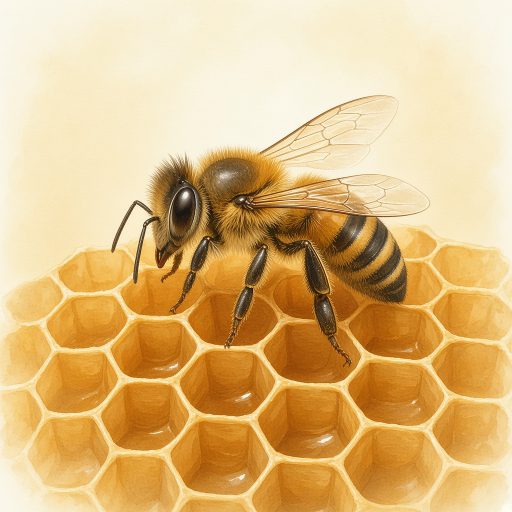
A bee is a small flying insect that visits flowers to collect a sweet liquid called nectar. Bees take the nectar back to their home, which is called a hive, and turn it into honey. Bees live in big groups called colonies, with thousands of bees all working together. The bees we know best are honeybees, but there are over 20,000 different kinds of bees in the world, and most of them are not honeybees at all.
Why bees are tricky to understand
A honeybee colony works like a city, with each bee doing a different job. The most important bee in the colony is the queen. There is usually only one queen, and her main job is to lay eggs, sometimes more than 1,500 a day. Most of the bees in the hive are female workers, and they do almost all the work, cleaning the hive, feeding the babies, building the honeycomb, guarding the door, and flying out to collect nectar.
The queen does not give orders. The hive is more like a team where every bee follows simple rules and pays attention to chemical signals called pheromones. With those signals and a lot of teamwork, the colony can survive winter, make honey, and even split in two when it grows too large.
The other surprise is what honey actually is. A bee swallows nectar from a flower into a special pouch in its body called a honey stomach (not its regular digestive stomach). Back at the hive, the bee passes the nectar to other workers, who chew it and pass it again. The bees then store the liquid in honeycomb cells and fan it with their wings until most of the water evaporates. What is left is honey, much thicker and sweeter than the nectar that started it all.
Key honey and bee facts
A honeybee colony in summer can have up to 80,000 bees. Most are female workers. There is one queen. There are also hundreds to a few thousand male bees called drones, whose only job is to mate with new queens.
Honey can keep for a very long time when it is sealed and stored properly. Its low water content and natural acidity make it difficult for most microbes to grow.
Ancient Egyptians stored and valued honey. Museum collections include containers and fragments labeled for honey, but those records do not document the popular story of archaeologists opening a pot of still-edible tomb honey.
One worker bee makes only about 1/12 of a teaspoon of honey in its whole life. To make a single jar of honey, thousands of bees must visit millions of flowers.
Bees have five eyes. They have two big compound eyes on the sides of the head, plus three tiny eyes, called ocelli, on the top. The two big eyes see colors and movement. The three tiny eyes mostly help the bee tell light from dark and find the horizon.
Bees can see colors humans cannot. They see blue, green, and ultraviolet light, but they cannot see red. Many flowers have special ultraviolet patterns that look like landing strips to bees but are invisible to people.
The queen bee can live for 3 to 5 years. Worker bees in summer live only about 6 weeks because they wear themselves out. Worker bees born in autumn live longer, sometimes through the whole winter.
Bees do a special “waggle dance” to tell each other where the best flowers are. The angle of the dance shows the direction to the flowers, and the length of the wiggling part shows the distance. Karl von Frisch decoded this dance and won the Nobel Prize for the discovery in 1973.
Honeybees are not from North America. They came from Africa and Europe. European settlers brought them to North America in the early 1600s. Native Americans called them “white man’s flies.”
Common myths about bees
Myth: Bees make honey from flowers in their regular stomach. They do not. Bees have a special pouch called the honey stomach that is completely separate from the digestive stomach. The nectar never mixes with the bee’s food. So when people say honey is “bee vomit,” that is not really true either; the nectar comes from a different organ.
Myth: Bumblebees should not be able to fly. This famous “fact” is wrong. The 1930s scientists who said it used the wrong math. They used the math for an airplane wing, which is a stiff fixed wing. Bee wings flap and twist, which makes flight work in a totally different way. Bumblebees fly just fine.
Myth: All bees can sting more than once. Most bees can sting many times, but honeybees are special. The honeybee’s stinger is barbed, which means it has tiny hooks on it. When a honeybee stings a person, the stinger gets stuck and is torn out of the bee’s body when the bee tries to fly away. The honeybee dies soon after. Other bees, like bumblebees, can sting again and again.
Myth: All bees live in big hives. Most of the world’s 20,000 bee species live alone, not in colonies. These are called solitary bees. They build small nests in dirt, hollow plant stems, or wood, and one female does everything by herself.
Myth: Bees and wasps are the same. Bees and wasps are related, but they are different. Bees are usually fuzzier and eat only flower nectar and pollen. Wasps are smoother and many of them hunt other insects to feed their young. Yellow jackets, the wasps that often show up at picnics, are not bees.
Frequently asked questions about bees and honey
How does a bee make honey?
A worker bee drinks nectar from a flower into her honey stomach. Back at the hive, she passes the nectar to other workers, who chew it and pass it around. They put it into honeycomb cells, then fan it with their wings until most of the water evaporates. What is left is thick, sweet honey, which the bees seal with a wax cap to save for later.
Why do bees make honey at all?
Honey is the bees’ food for winter. When flowers stop blooming and the weather is cold, the bees stay inside the hive and eat the honey they stored up over the summer. In cold or temperate places, a strong colony may need about 60 to 100 pounds (27 to 45 kg) of honey to get through winter, depending on the region. Anything beyond the colony’s needs, beekeepers can take.
Who is the queen bee?
The queen is the only bee in the hive that lays eggs. She is bigger than the workers, has a longer body, and can lay over 1,500 eggs a day at her peak. She lives 3 to 5 years, much longer than the workers (about 6 weeks in summer). The queen does not boss the colony; the workers run the hive together by following chemical signals.
What do drones do?
Drones are male bees. They are bigger than worker bees but have no stinger. The only job of a drone is to fly out and mate with new queens from other colonies. After mating, the drone dies. Drones that do not get to mate are kicked out of the hive in autumn and do not survive the winter.
Why is honey safe to give to most people but not to babies?
Honey can sometimes contain tiny amounts of a bacteria called Clostridium botulinum. In adults and older children, the stomach kills these bacteria with no problem. But babies under 12 months old have softer, less developed digestive systems, and the bacteria can grow inside them and cause a serious illness called infant botulism. Doctors say no honey for kids under one year old.
How important are bees to people?
Very. Bees pollinate many of the crops we eat, including apples, almonds, blueberries, strawberries, melons, and squash. About one third of the food humans eat depends on insect pollinators, and honeybees are a big part of that work. If bees disappeared, many of our favorite fruits and vegetables would become much harder to grow.
A bee is a flying insect that feeds on nectar (a sugary liquid produced by flowers) and pollen (the powdery grains plants use to reproduce). The European honeybee, Apis mellifera, is the bee most people think of, but it is one species among more than 20,000. Honeybees live in highly organized colonies of tens of thousands and convert flower nectar into the food we know as honey. They are also among the world’s most important pollinators, helping to grow about a third of human food crops.
Why bees are tricky to understand
The first surprise is that the honeybee colony is not a kingdom run by a queen, but a self-organizing system. The queen does not give orders or coordinate the hive. She lays eggs, releases chemical signals called pheromones that affect the behavior of nearby bees, and that is mostly it. The workers run the hive collectively by responding to local conditions, smells, and signals from their nestmates. The result looks intentional but is built up from thousands of individual decisions.
The second surprise is how bees communicate. Karl von Frisch discovered that honeybees describe the location of food sources by performing a waggle dance on the vertical surface of the comb. The angle of the dance run relative to vertical corresponds to the direction to the food relative to the sun. The duration of the waggle phase corresponds to distance. Other bees follow along behind the dancer, then fly out to find the food themselves. Von Frisch shared the 1973 Nobel Prize in Physiology or Medicine for this work, and the bee waggle dance is still considered one of the most sophisticated symbolic communication systems known outside humans.
The third surprise is that properly sealed honey can remain stable for a very long time. Honey resists spoilage because it has very low moisture, low pH, and antimicrobial compounds produced through bee-added enzymes.
Ancient Egyptian containers and texts provide evidence that honey was stored and valued. A museum record for a surviving jar fragment identifies an inscription for honey, but it does not document the often-repeated story that archaeologists recovered a pot of still-edible honey.
Key facts about honey and bees
A honeybee colony in summer can hold 60,000 to 80,000 bees. One queen lays the eggs. Most of the rest are female workers. Several hundred to a few thousand are male drones, whose only role is to mate with queens from other colonies.
The queen lays up to about 1,500 to 2,000 eggs per day during the peak season. Workers feed the new larvae, build the wax comb, clean and guard the hive, and forage. Workers shift jobs as they age, a pattern called temporal polyethism: indoor jobs first, outdoor foraging later.
One worker bee produces about 1/12 of a teaspoon of honey in her entire lifetime. A jar of honey on a kitchen shelf represents the work of thousands of bees and visits to millions of flowers.
Honey is made from flower nectar, swallowed into the bee’s honey stomach (a separate pouch from the digestive stomach), then regurgitated and passed mouth-to-mouth between worker bees. Each pass adds enzymes and removes some water. The bees fan the partly finished honey with their wings until water content drops below about 18 percent, then seal each cell with a thin wax cap.
The waggle dance describes both direction and distance. The dance angle relative to vertical equals the angle from the sun to the target. The length of the waggle run encodes the distance, longer waggle, farther target.
Bumblebee flight is real. The “scientifically impossible bumblebee flight” claim came from a 1930s calculation that used fixed-wing aircraft equations. Real bee wings flap, twist, and create lift through complex unsteady aerodynamics. The math works fine when the right model is used.
The queen lives 3 to 5 years. Summer worker bees live only about 6 weeks because they exhaust themselves. Winter bees, born in autumn, live up to 6 months and survive the winter by clustering with the queen in the hive.
Honeybees are not native to North America. They came from Africa and Europe and were brought to the Americas by European colonists in the early 1600s. Native Americans called them “white man’s flies.” All wild honeybee colonies in North America descend from imported European stock.
People have gathered honey and managed bees for thousands of years. Spanish rock art dating to roughly 6000 BC (about 8,000 years ago) shows people gathering honey from wild combs. Ancient Egyptian art from about 2400 BC shows organized beekeeping. The modern Langstroth removable-frame hive, developed by Lorenzo Langstroth in 1851 and patented in 1852, made it possible to inspect and harvest honey without destroying the colony.
Honey may contain tiny amounts of Clostridium botulinum spores. In adults and older children, stomach acid neutralizes them harmlessly. But babies under 12 months have immature gut flora; the spores can grow and produce a toxin causing infant botulism. Doctors recommend no honey at all for kids under one year old.
Common myths about bees
Myth: Honey is bee vomit. Not really. Bees swallow nectar into their honey stomach, a special pouch that is separate from the digestive stomach. The nectar is regurgitated, but it never enters the bee’s actual digestive system. So while the term vomit sounds memorable, it is not biologically accurate.
Myth: All bee species live in hives with queens. Most of the world’s 20,000 bee species are solitary. A single female builds a small nest in soil, hollow plant stems, or wood, and raises her own offspring without help. Honeybees and a few other social species are the exception, not the rule.
Myth: Africanized honeybees are more venomous. They are not. Their venom is chemically the same as European honeybees. What makes them dangerous is behavior: they react to disturbance much more aggressively, attack in larger numbers, and pursue intruders longer. The danger is behavioral, not chemical.
Myth: All bees die after stinging. Only honeybees die from stinging, and only when they sting mammals with thick skin. The honeybee’s stinger has tiny barbs that catch in skin and tear out of the bee’s body when she pulls away. Other bees (and queen honeybees) have smoother stingers and can sting many times.
Myth: Crystallized honey has gone bad. Crystallized honey is honey that has formed sugar crystals over time. It is still good. Gently warming it in warm water (below about 105 °F or 40 °C) will dissolve the crystals back into liquid. Honey crystallizes naturally because it is a supersaturated sugar solution, and the speed depends on the type of nectar and the storage temperature.
Myth: Colony Collapse Disorder is caused by one thing. Scientists currently believe Colony Collapse Disorder (sudden unexplained loss of a colony’s worker bees) results from many causes acting together: the parasitic mite Varroa destructor, neonicotinoid pesticides, viral and fungal pathogens, poor nutrition from monoculture farming, and the stress of being trucked across the country for crop pollination.
Frequently asked questions about bees and honey
How does the bee dance actually tell other bees where to go?
The dancing bee returns to the hive and performs a figure-eight pattern on the vertical surface of the comb. The center “waggle run,” in which she shakes her body and beeps with her wings, holds the information. The angle of that run relative to straight up matches the angle between the sun and the food source as seen from the hive. The duration of the waggle (typically about 1 second per kilometer) tells distance. Other workers follow the dancer, learn the directions, and fly out to find the food on their own.
What is royal jelly?
Royal jelly is a special food that nurse bees produce in their head glands and feed to all young larvae for the first three days of life. Larvae destined to become queens continue receiving royal jelly throughout their development, while worker larvae switch to a mix of honey and pollen. Royal jelly contains a unique protein called royalactin and a different mix of fats and sugars from regular larva food. Constant royal jelly feeding turns a normal larva into a queen, with longer life, full reproductive ability, and a much larger body.
Why do honeybees die after stinging people?
A honeybee’s stinger is barbed, like a tiny harpoon. When she stings something with thick skin (a person, a mammal), the barbs catch and the stinger tears out of her body when she pulls away, taking her venom sac with it. The bee dies within a few minutes, but the venom sac keeps pumping for up to a minute, which is why you should scrape a sting away rather than pull it. Honeybees can still sting other insects, like wasps invading the hive, without losing their stingers, because the barbs do not catch in soft insect bodies.
What is happening to honeybees today?
Honeybee colonies in many parts of the world have suffered higher-than-normal losses since the mid-2000s. The most severe form, Colony Collapse Disorder, involves the sudden disappearance of nearly all worker bees from a hive. Causes are still debated but are believed to involve Varroa mites (parasites that weaken bees and spread viruses), pesticides like neonicotinoids that impair bee navigation, lack of varied food sources from monoculture farming, and viral and fungal infections. The European honeybee (Apis mellifera) is not in danger of dying out worldwide, and beekeepers kept about 101.7 million hives in 2024 compared with 69.4 million in 1990. Wild honeybee colonies that live on their own, with no beekeeper, are a different case: the IUCN listed those wild colonies in the European Union as endangered in 2025.
Why is honey better in some seasons than others?
Honey takes its color, flavor, and even some health properties from the flowers the bees visited. Spring clover honey is light and mild. Buckwheat honey from late summer is dark and strong. Avocado honey is dark but smooth. Manuka honey from New Zealand is famous for high antibacterial activity from a chemical called methylglyoxal (MGO), which comes from manuka flower nectar. Each region has its own typical honeys based on local plants and bloom schedules.
How long has beekeeping been a thing?
At least 8,000 years for honey gathering. Spanish rock art dating to about 6000 BC shows a person climbing a cliff to collect honey from a wild bee colony. Ancient Egyptian art shows organized beekeeping by about 2400 BC. The big modern jump was Lorenzo Langstroth’s 1851 development of the removable-frame hive, patented in 1852, which let beekeepers inspect every part of the hive and harvest honey without destroying the colony. Modern commercial beekeeping is still broadly based on Langstroth-style hives.
A honeybee (Apis mellifera) is a social insect that lives in colonies of tens of thousands and converts flower nectar into the energy-dense food called honey. Honey serves the colony as a winter food reserve and serves humans as a sweetener that people have gathered for at least about 8,000 years. Honeybees are also the world’s most economically important managed pollinators, contributing to many pollinator-dependent crops, including almonds, apples, blueberries, and squash. The honeybee colony is a model of decentralized self-organization, communicating with one of the most sophisticated symbolic systems known outside humans.
What is often misunderstood about bees
The colony is not a kingdom. The queen does not direct work, give orders, or coordinate behavior. She lays eggs (up to about 1,500 to 2,000 per day at peak season), produces queen mandibular pheromone (QMP) that suppresses worker reproduction and signals her presence, and that is the extent of it. Hive operations are run by tens of thousands of female workers responding to chemical cues, local conditions, and signals from each other. The output looks intentional but is bottom-up.
Properly sealed honey can remain stable for a very long time. Low water content, acidity, and antimicrobial compounds inhibit most microbial growth, though added moisture or contamination can still cause spoilage. Crystallization is a normal physical process and is not itself spoilage; gentle warming can re-dissolve the crystals.
Ancient Egyptian records and labeled vessels attest to honey storage. A surviving jar fragment in a museum collection bears a label identifying honey, but that record does not substantiate the popular story of edible liquid honey recovered thousands of years later.
The waggle dance, decoded by Karl von Frisch (Nobel Prize in Physiology or Medicine, 1973), is a symbolic communication system unique among invertebrates. A returning forager performs a figure-eight pattern on the vertical comb. The angle of the central waggle run relative to gravity equals the angle from the sun (a celestial reference, corrected for the sun’s motion across the sky) to the food source as seen from the hive. The duration of the waggle phase encodes distance, typically about 1 second per kilometer of flight. Recruits follow the dancer, depart, and locate the food independently. The system continues to be studied for what it reveals about animal cognition.
Key facts about bees and honey
Colony composition. A summer colony of Apis mellifera contains 30,000 to 80,000 bees: one queen, several hundred to several thousand drones, and the rest female workers. Drones (males) develop from unfertilized eggs (haplodiploidy), have no stinger, do not forage, and exist only to mate with virgin queens from other colonies during nuptial flight. Drones unable to mate are expelled from the hive in autumn and die.
Queen biology. The queen develops from a normal fertilized egg fed continuously on royal jelly containing the protein royalactin. Worker larvae receive royal jelly only for the first three days, then switch to a mix of pollen and honey. The continuous royal jelly diet and resulting epigenetic regulation produce a queen with full ovaries, longer life (3 to 5 years versus 6 weeks for summer workers), and larger body. The queen mates once, on her nuptial flight, with about 10 to 20 drones in mid-air, storing sperm in her spermatheca for the rest of her life.
Worker temporal polyethism. Workers shift roles as they age. Days 1 to 3: cell cleaning. Days 3 to 11: feeding larvae as nurse bees. Days 12 to 17: producing wax and building comb, processing nectar. Days 18 to 21: guarding the hive entrance. Days 22 onward: foraging outside the hive. The pattern allows the colony to balance roles even as individual workers die off rapidly.
Honey production process. A forager collects nectar from a flower into her honey stomach (crop), a separate organ from the digestive stomach. Returning to the hive, she regurgitates the nectar to a receiver bee, who passes it from worker to worker through trophallaxis (mouth-to-mouth transfer). Each pass adds enzymes (invertase and glucose oxidase). The bees deposit the partly processed nectar in honeycomb cells, then fan it with their wings to evaporate water until moisture drops below 18 percent. Cells are then sealed with wax caps.
Wax production. Worker bees secrete tiny wax flakes from glands on the underside of the abdomen, then chew and mold them into honeycomb cells. Wax production is energy-expensive, so drawn comb is valuable to both bees and beekeepers. The hexagonal cell geometry minimizes wax use per unit storage volume, a result independently verified mathematically (the honeycomb conjecture, proved by Thomas Hales; preprint 1999, formal paper in Discrete & Computational Geometry 2001).
Beeswax versus propolis. Beeswax forms the structural comb. Propolis is a separate substance, made by bees collecting plant resins (mostly from poplar and conifer buds) and mixing them with beeswax and saliva. Propolis seals cracks, smooths interior surfaces, and reduces the hive entrance. It has demonstrated antimicrobial properties from its plant-resin polyphenols, effectively functioning as a hive disinfectant.
Bee vision and ocelli. Five eyes total: two large compound eyes for color and motion vision, plus three small simple eyes (ocelli) on the top of the head for light intensity and horizon detection. Compound eyes detect blue, green, and ultraviolet wavelengths but not red. Many flowers display ultraviolet patterns invisible to humans that act as visual landing strips for bees.
Foraging range and energy budget. Honeybees typically forage within 1 to 2 mi (about 2 to 3 km) of the hive, with maximum documented ranges around 5 to 7 mi (8 to 12 km) under stress. Foragers measure distance by integrating optic flow during flight. A worker bee’s individual lifetime honey production averages about 1/12 of a teaspoon, reflecting the small payload per trip and the exhausting nature of late-life foraging.
Honey and infant botulism. Honey may contain spores of Clostridium botulinum in trace concentrations. Adult and older-child digestive systems neutralize them safely. Infants under 12 months have immature gut flora, allowing the spores to germinate and produce botulinum toxin in the intestines, causing infant botulism (the largest U.S. cause of foodborne botulism in infants). The American Academy of Pediatrics and CDC recommend no honey under age 1.
Honeybee origins and global distribution.Apis mellifera is native to Europe, Africa, and the Middle East, with multiple regional subspecies. European colonists brought honeybees to the Americas in the early 1600s; Indigenous peoples reportedly called them “white man’s flies.” All wild honeybee colonies in the Americas descend from imported European stock. The genus Apis includes about 7 to 9 other species across South and Southeast Asia.
Beekeeping antiquity. Spanish rock art at the Cueva de la Araña in Valencia, dated to roughly 6000 BC (about 8,000 years ago), depicts honey gathering from a wild colony. Egyptian beekeeping is documented in art from about 2400 BC. Lorenzo Langstroth’s removable-frame hive, developed in 1851 and patented in 1852, used “bee space,” a small gap bees do not fill with comb or propolis. It made non-destructive honey harvesting practical and underlies many modern commercial hives.
Manuka honey antimicrobial activity. Manuka honey, from New Zealand bees foraging on Leptospermum scoparium (manuka), contains elevated levels of methylglyoxal (MGO), produced from dihydroxyacetone in the nectar. MGO contributes to documented antibacterial activity, and Manuka honey is used in some clinical wound dressings (Medihoney). Many other raw, unprocessed honeys also have measurable antibacterial activity from hydrogen peroxide; the Manuka premium reflects marketing as much as uniquely superior efficacy.
Common myths about bees
Myth: Honey is bee vomit. Bees do regurgitate nectar from the honey stomach, but this organ is structurally separate from the digestive stomach and is dedicated to nectar transport. The nectar never enters the digestive system. The “vomit” framing is technically inaccurate.
Myth: Bumblebees defy aerodynamic theory. A 1934 book by Antoine Magnan reported a simplified calculation by André Sainte-Laguë that treated insect wings too much like fixed wings and concluded that insect flight should be impossible. Real bee wings flap, twist, and create lift through unsteady aerodynamic effects, including leading-edge vortices and force peaks during stroke reversal, that the simple model ignored. Modern unsteady-aerodynamics studies explain bee flight; the impossibility claim was always a mismodeling.
Myth: All bees die after stinging. Only honeybee workers die when they sting mammals with thick, elastic skin. Their barbed stingers catch and tear out, taking the venom sac, and the bee dies within minutes. Honeybees can sting other insects without dying because the barbs do not catch in soft insect cuticle. Other bees (bumblebees, carpenter bees, solitary bees) and queen honeybees have less barbed stingers and can sting repeatedly.
Myth: Bees navigate by Earth’s magnetic field in total darkness. Bees do contain magnetite particles and show some magnetoreception sensitivity. Primary navigation uses the sun (with internal time-of-day correction), polarized light patterns in the sky, and learned visual landmarks. Bee navigation in total darkness is heavily impaired, not perfect.
Myth: Africanized honeybees have stronger venom. Their venom is chemically the same as European honeybees. The increased danger comes from defensive behavior: lower threshold for triggering an attack, larger numbers of bees attacking, and longer pursuit distances. The danger is behavioral, not chemical.
Myth: Honey crystallizes because it has gone bad. Crystallization is a normal physical process: glucose comes out of supersaturated solution and forms crystals over weeks to months. Crystallized honey is fully edible. Gentle warming (below about 105 °F / 40 °C) re-dissolves the crystals. Aggressive heating destroys some flavor and antimicrobial enzymes.
Myth: Colony Collapse Disorder has a single primary cause. Current scientific consensus identifies a combination of factors: Varroa destructor mites and the viruses they vector, neonicotinoid pesticides at sub-lethal exposures, fungal pathogens like Nosema, monoculture-driven nutritional poverty, and the migratory beekeeping stress of trucking colonies thousands of miles for crop pollination. No single factor explains the pattern alone.
Myth: Honeybees are endangered.Apis mellifera is not globally threatened with extinction, and it is not listed under the US Endangered Species Act. FAO estimates put managed colonies at 101.7 million hives worldwide in 2024, up from 69.4 million in 1990. The IUCN assessment applies to a specific population: in October 2025, free-living Apis mellifera colonies within the 27 European Union member states were reclassified from Data Deficient to Endangered, while the wider pan-European assessment remains Data Deficient. Many native bee species face genuine declines as well, including the rusty patched bumble bee (Bombus affinis), listed as federally endangered in the United States in 2017, and popular coverage often merges these separate cases.
Frequently asked questions about bees and honey
How does the waggle dance encode location precisely?
The dancer aligns the waggle run on the vertical comb to indicate direction relative to the sun: straight up means “fly toward the sun,” straight down means “fly away from the sun,” 45 degrees right of vertical means “fly 45 degrees right of the sun’s current bearing.” The bee internally corrects for the sun’s motion across the sky, so a dance returning hours later still gives the right direction. Distance is encoded in the duration of the waggle phase (typically about 1 second per kilometer), measured by the dancer through optic flow during the original flight. Receiver bees follow the dancer through several runs, learn the directions, and depart with sufficient information to find the food.
Why is hexagonal honeycomb the most efficient shape?
Hexagons tile a plane without gaps and minimize the total wall length per unit area, the honeycomb conjecture, proved mathematically by Thomas Hales (arXiv preprint 1999; formal paper in Discrete & Computational Geometry 2001). For bees, this means efficient use of energy-expensive wax for a given storage volume. Bees do not actively design hexagons; studies of comb construction indicate that cells begin rounded or cylindrical, then physical forces and worker-bee construction behavior help produce the familiar hexagonal pattern.
What ends a bee colony’s growth season?
In temperate climates, declining day length and dropping temperatures in late summer trigger several behavioral shifts. The queen reduces or stops egg-laying. Workers stop feeding drones, who are pushed out of the hive and die. The colony forms a winter cluster, a tight ball of bees vibrating their flight muscles to generate heat, with the queen at the warm center. Winter bees, born in autumn, have higher fat body reserves and live up to 6 months, surviving on stored honey through to the next spring’s bloom.
Are honey’s medical claims supported?
Honey has documented antibacterial activity from low water, low pH, and hydrogen peroxide production. Manuka honey adds methylglyoxal-mediated activity. Medical-grade honey (Medihoney and similar) is used in wound care for chronic wounds, burns, and certain infected wounds, supported by clinical trials. Claims about honey treating allergies (the local-honey-cures-pollen-allergies idea) are not well supported; the pollen in honey is primarily flower pollen, not the wind-pollinated grass and tree pollens that cause hay fever.
What happens during swarming?
When a colony grows too large or its queen ages, the colony reproduces by swarming. Workers raise several new queens. The original queen leaves with about half the workers in a flying mass (the swarm), which lands on a tree or structure while scouts search for a new nesting site. Once found, the swarm flies to the new site and establishes a colony. Back at the original hive, the first new queen to emerge kills her unhatched rivals, mates on her nuptial flight, and takes over egg-laying. Swarming is the colony-level equivalent of reproduction.
How important are honeybees to human food?
Pollinator-dependent crops account for roughly 35 percent of global food production volume, although the share directly attributable to pollination is lower because many of those crops are only partly dependent on animal pollinators (Klein et al. 2007, Proceedings of the Royal Society B). Honeybees are the most-managed pollinator and the dominant pollinator for many commercial crops, particularly almonds (which are nearly impossible to grow at California scale without trucked-in commercial honeybee colonies). Wild and native pollinators (bumblebees, mason bees, hoverflies, butterflies, and many others) contribute substantially to crops like blueberries, tomatoes, and squash. The “honeybees pollinate one third of human food alone” framing overstates honeybees’ individual contribution, since they share the work with many other species.
Source notes
The honey and bee facts in this article come from Britannica’s honey entry, honeybee entry, beekeeping entry, the Karl von Frisch biography, the Nobel Prize 1973 press release, Smithsonian’s honey shelf-life explainer, and the Nature paper on waggle-dance optic flow. Royal jelly composition, Colony Collapse Disorder, Western honey bee, and Manuka honey details follow standard secondary literature; royal jelly chemistry follows the Wikipedia summary. Foraging range and lifetime honey-output figures follow FDA and NASA Goddard honey bee summaries. Pollination-production framing follows the USDA summary of Klein et al. 2007. The honeycomb conjecture proof is Hales (arXiv preprint 1999; published Discrete & Computational Geometry 25:1-22, January 2001), and cell-shape development follows Nazzi 2016 in Scientific Reports. The bee-flight myth and its correction follow Caltech’s summary of Magnan and Sainte-Laguë and the PNAS honeybee-flight study by Altshuler et al. 2005.
The honeybee (Apis mellifera, family Apidae, tribe Apini) is a eusocial insect with sophisticated colony-level organization, symbolic communication, and economic importance as the world’s leading managed pollinator. The genus Apis contains seven commonly recognized living species, with some taxonomic treatments historically splitting additional species; A. mellifera (the western honeybee) is the most widely managed. Subspecies of A. mellifera, including A. m. mellifera (European dark bee), A. m. ligustica (Italian honeybee), A. m. carnica (Carniolan), A. m. caucasica, and A. m. scutellata (African, the source of Africanized “killer bee” hybrids in the Americas), differ in temperament, swarming behavior, hygienic behavior, and disease susceptibility. Apicultural practice, the empirical foundation of which dates to Lorenzo Langstroth’s 1851 movable-frame hive based on his observation of “bee space” (the 0.25 to 0.375 inch gap bees do not fill with comb or propolis), now supports a global industry serving both honey production and contract pollination.
Why apiology is non-intuitive
Three structural features of honeybee biology make it difficult to map onto naive intuitions about social organization, communication, and ecology.
The first is decentralized colony organization without command hierarchy. The queen does not command. She lays eggs and produces queen mandibular pheromone (QMP, a blend dominated by 9-oxo-2-decenoic acid, 9-ODA), which suppresses worker ovary activation, signals her presence, and mediates retinue behavior. Hive operations, including comb construction, larval feeding, foraging task allocation, hygienic removal of diseased brood, swarming decisions, nest-site evaluation, and defensive responses, run as bottom-up self-organized processes through chemical cues, vibrational signals, and individual responses to local conditions. Thomas Seeley’sHoneybee Democracy (2010) documents the swarm-cluster nest-site decision process as an iterative competitive scout-and-vote algorithm whose output is mathematically near-optimal.
The second is the dance language. Karl von Frisch’s decoding of the waggle dance (Nobel Prize in Physiology or Medicine, 1973) remains one of the best-documented symbolic communication systems among invertebrates. The dance encodes direction relative to the sun (compensating for solar azimuth motion using an internal clock), distance via the duration of the waggle phase (calibrated by optic flow during the original flight, not by metabolic cost or wing-beat count), and quality via dance vigor and follow-up bouts. Adrian Wenner’s “odor plume” alternative hypothesis (1967), proposing that recruits home in on volatile cues rather than dance information, was sharply contested into the 1980s but is now considered to play at most a supplementary role; modified-environment experiments by Mandyam Srinivasan and others, plus the harmonic radar tracking of Joe Riley et al. 2005 (Nature), confirm the symbolic content of the dance.
The third is caste determination via differential nutrition and epigenetic regulation. Worker and queen larvae are genetically identical; the difference is induced by the food regime. Royal jelly, secreted from nurse bee hypopharyngeal and mandibular glands, was linked by Masaki Kamakura 2011 (Nature) to the protein royalactin, which he proposed as a queen-inducing factor acting through the EGF receptor pathway. Later work by Buttstedt et al. 2016 challenged royalactin as a single necessary-and-sufficient determinant, so the current expert view is that queen development reflects the sustained queen diet, larval environment, juvenile-hormone signaling, and epigenetic regulation rather than one isolated royal-jelly protein. Worker larvae receive royal jelly only in the first 3 days, then transition to a pollen-and-honey “bee bread” diet that switches off the queen developmental pathway. DNA methylation differences mediated by Dnmt3 support the colony as a model system for epigenetic phenotypic plasticity.
Key facts
Apis mellifera subspecies and management. Subspecies including ligustica, carnica, mellifera, caucasica, and scutellata. Italian (ligustica) is the most widely commercially managed in temperate climates for gentle temperament and prolific brood production. Carniolan (carnica) is favored in cooler climates for winter hardiness. Africanized hybrids (scutellata x European) descended from queens released in Brazil in 1957 by Warwick Kerr expanded across the Americas with the same venom chemistry as European bees but markedly elevated defensive responsiveness.
Caste determination and royalactin. Kamakura 2011 (Nature) proposed that royalactin from royal jelly could induce queen-like development in A. mellifera larvae and act through the EGF receptor pathway. Buttstedt et al. 2016 (Nature) challenged royalactin as a single queen-making determinant, and the stronger statement is that genetically identical fertilized eggs produce divergent castes through sustained larval feeding, endocrine signaling, and epigenetic regulation. Dnmt3 knockdown experiments show that DNA methylation can shift larvae toward queen-like development.
Honey biochemistry. Approximately 80% sugar (roughly equal glucose and fructose, with smaller amounts of sucrose, maltose, and other oligosaccharides), 17 to 18% water, less than 1% combined ash, protein, vitamins, organic acids, and trace amino acids. Bee-added enzymes include invertase (sucrose to glucose plus fructose), glucose oxidase (glucose to gluconolactone, generating low-level hydrogen peroxide), and diastase (starch to maltose). Low pH (about 3.9), low water activity (a_w typically below 0.6), and hydrogen peroxide production give properly sealed honey unusually long shelf stability, but moisture uptake, contamination, or fermentation can still spoil it.
Crystallization. Driven by glucose precipitating from supersaturated solution. Rate depends on glucose-to-water ratio, presence of crystallization nuclei (pollen grains, dust), and temperature. Crystallization is fastest around 50 to 59 °F (10 to 15 °C); colder temperatures slow molecular movement, while warmer temperatures increase solubility and slow crystal growth. Reversible by warming below about 105 °F (40 °C).
Manuka methylglyoxal.Leptospermum scoparium nectar contains dihydroxyacetone (DHA), which non-enzymatically converts to methylglyoxal (MGO) in honey over weeks to months. UMF (Unique Manuka Factor) and MGO ratings quantify activity; MGO 250 to 550 mg/kg is typical of high-grade Manuka. Used clinically in wound dressings (Medihoney) for diabetic ulcers, burns, and infected wounds. Most other honeys derive antibacterial activity primarily from glucose oxidase-generated hydrogen peroxide, which is lost when honey is heated or diluted.
Waggle dance encoding. Direction: angle of waggle run relative to vertical equals angle from solar azimuth to target as seen from hive. Distance: duration of the waggle phase, with calibration constants varying among species and populations. Encoded distance reflects optic flow integration during the original flight, not metabolic energy expenditure (Esch and Burns 1996; Tautz et al. 2004). Recruits combine the dance vector with odor cues and local search after leaving the hive.
Pheromone communication. Queen mandibular pheromone (QMP) signals presence and suppresses worker reproduction. Nasonov pheromone (released from glands at the base of the abdomen) marks home location. Alarm pheromone (isoamyl acetate, dominantly) released from sting recruitment glands signals threat. Drone congregation areas may be marked by a still-incompletely-characterized pheromone. Brood pheromones modulate worker hypopharyngeal-gland activity and forager-recruitment thresholds.
Foraging and energy budget. Foraging distance varies with landscape and food availability. Visscher and Seeley 1982 (Ecology 63) tracked foragers from a wild colony in upstate New York and reported a median foraging distance of 1.1 mi (1.7 km), with 95% of foragers within 3.7 mi (6.0 km), illustrating the tail of long-distance trips that extend the colony’s effective area. A worker bee’s lifetime honey production averages about 1/12 of a teaspoon.
Beeswax production economics. Workers secrete wax from abdominal wax glands as small flakes, then chew and mold them into honeycomb cells. Drawn comb is energetically valuable because wax production diverts carbohydrate and labor from other colony work. Hexagonal cell geometry minimizes wax per unit storage volume; Thomas Hales announced a proof of the honeycomb conjecture in 1999 (arXiv preprint), with the formal paper appearing in Discrete & Computational Geometry 25 in January 2001. The result settled an isoperimetric problem that had stood since Pappus of Alexandria (about 300 AD).
Varroa destructor. Ectoparasitic mite native to A. cerana in Asia, jumped to A. mellifera in the mid-20th century, now nearly globally distributed. Reproduces in capped brood cells, feeding on developing pupae and (per Ramsey et al. 2019, PNAS) on the fat body rather than hemolymph as long believed. Vectors deformed wing virus (DWV) and several other pathogens. Considered the single largest factor in elevated colony losses worldwide. Treatment options include miticide rotations (amitraz, oxalic acid, formic acid, thymol), drone-brood removal, and selective breeding for hygienic behavior.
Colony Collapse Disorder (CCD). Defined by sudden loss of adult worker bees from a colony with ample brood, food, and the queen still present. Identified as a distinct syndrome in the United States from 2006. Considered multifactorial: Varroa and DWV, sub-lethal neonicotinoid exposure (per Henry et al. 2012, Science, with pesticide-impaired homing), Nosema ceranae fungal infection, monoculture-induced nutritional deficiency, and migratory beekeeping stress. Reported CCD cases later declined substantially, but elevated overall colony losses continue.
Pollination economics. Klein et al. 2007 (Proceedings of the Royal Society B) estimated that 87 of 124 leading global crop species (about 70%) benefit from animal pollination, accounting for about 35% of global food production by volume. California almond pollination has used more than 70% of U.S. commercial honeybee colonies in some recent estimates, with the exact share varying by almond acreage and colony supply. The brief February to March almond bloom is the largest managed-pollination event globally.
Antiquity of beekeeping. Spanish rock art at the Cueva de la Araña, Valencia, dated to roughly 6000 BC (about 8,000 years ago), depicts honey collection from a wild colony. Egyptian hieroglyphic records from the Old Kingdom (about 2400 BC) document organized beekeeping. The Tel Rehov apiary in the Jordan Valley, dated to the early Iron Age (about 900 BC) and excavated by Mazar and Panitz-Cohen (Antiquity 2007), contained the oldest unambiguous evidence of intensive beekeeping (over 100 estimated hives). Lorenzo Langstroth’s movable-frame hive, developed in 1851 and patented in 1852, remains foundational because it used the bee space principle.
Common misconceptions at expert level
Misconception: The waggle dance was uncontroversially accepted upon discovery. Adrian Wenner and colleagues mounted a substantial 1960s and 1970s challenge (“the bee language controversy”) arguing that recruits used odor cues rather than dance information. The dispute lasted decades and was resolved largely by experiments where dance information and odor cues were dissociated (notably Gould 1975, harmonic radar work by Riley et al. 2005), establishing that dance information genuinely drives recruit flight directions. The historical controversy is sometimes elided in popular accounts.
Misconception: Royal jelly is exclusively distinct from worker food. All bee larvae receive royal jelly or related glandular food for the first three days. Worker larvae then transition to a less-rich mixture that includes pollen and honey. The qualitative difference is mostly the persistence of queen-destined feeding into the later larval period, plus the queen-cup environment and the absence or presence of other dietary cues. Treating royal jelly as a wholly worker-vs-queen distinction oversimplifies.
Misconception: Varroa feeds on hemolymph. Decades of textbooks describe Varroa as a hemolymph parasite. Ramsey et al. 2019 (PNAS) demonstrated that Varroa primarily feeds on the fat body, the bee’s primary metabolic and immune organ, explaining the disproportionate damage from relatively small mite loads. The hemolymph framing is now obsolete.
Misconception: Neonicotinoids are the primary cause of CCD. Neonicotinoid effects on bee navigation and immunity are documented, but no single factor explains CCD alone. Multifactorial models combining Varroa-DWV, sub-lethal pesticide exposure, Nosema, monoculture nutrition, and migratory stress fit the data best. EU restrictions on neonicotinoid use (2013, expanded 2018) reduced exposure but did not eliminate elevated colony losses, supporting the multifactorial view.
Misconception: Honey antibacterial activity is uniformly high. Antibacterial activity varies dramatically between honeys based on floral source, processing, and storage. Manuka’s MGO-based activity differs in mechanism from peroxide activity in most other honeys (lost on heating). Many commercially marketed “active” honeys overstate their efficacy without standardized testing. Medical-grade honey for clinical use is irradiated to eliminate spores and standardized for activity.
Misconception: All bees can sting multiple times. Worker honeybees lose their stingers and die when they sting mammals with elastic skin because the stinger barbs catch and the apparatus tears free. They can sting other insects multiple times. Queens have less barbed stingers and can sting repeatedly. Other bees (bumblebees, carpenter bees, mason bees) and wasps generally have less barbed stingers and can sting many times.
Misconception: Honeybees are an endangered species. Managed and wild Apis mellifera follow different trajectories, and the claim collapses them into one. Managed stocks are growing: FAO estimates 101.7 million colonies worldwide in 2024 against 69.4 million in 1990, even though annual colony losses remain high. Free-living colonies are a separate case. In October 2025, the IUCN reassessed wild Apis mellifera within the 27 European Union member states from Data Deficient, its status in the 2014 assessment, to Endangered, while the pan-European assessment remains Data Deficient because data from the Balkans, the Baltics, Scandinavia, and eastern Europe are too sparse. Several native bees hold legal protection that honeybees do not, including Bombus affinis, listed as endangered under the US Endangered Species Act in 2017.
Misconception: The honeycomb hexagon is built deliberately. Honeycomb cell formation begins as approximately circular cells with surface tension and worker bee adjustments deforming them into hexagonal packing. The hexagonal pattern emerges from physical constraints rather than deliberate construction. Bees do, however, contribute through specific worker behaviors (rim-thinning, wax-warming) that finalize the geometry.
Frequently asked questions
How precisely does the dance language convey distance?
The waggle phase duration scales approximately linearly with flight distance, but with significant individual variability and population differences. Esch et al. 2001 (Nature) demonstrated that distance is encoded by optic flow integration, the total visual motion experienced during the flight, not by metabolic cost or wing-beat count. Bees flying through a tunnel with closely-spaced visual texture overestimate distance, while bees over featureless terrain underestimate. The mechanism makes the dance distance scale environment-dependent in a quantitative way that confused early calibration studies.
Why is royalactin controversial in queen development?
Kamakura 2011 reported that royalactin activated an EGF-receptor-linked pathway and induced queen-like traits, including larger body size, shorter developmental time, and greater ovary development. Buttstedt et al. 2016 retested the single-factor claim and argued that monomeric MRJP1, the protein called royalactin, is not by itself the key driver of queen caste determination. Royalactin remains historically important, but the article should be read as part of a broader nutrition, endocrine, and epigenetic model rather than as a one-protein switch.
What is the empirical evidence for the honeycomb conjecture?
The honeycomb conjecture, that the regular hexagonal tiling minimizes total perimeter for any partition of the plane into equal-area regions, was stated by Pappus of Alexandria around 300 AD and finally proved rigorously by Thomas Hales, who posted the proof as an arXiv preprint in June 1999 and published the formal paper in Discrete & Computational Geometry 25 (January 2001). The proof completed an isoperimetric problem standing for nearly 17 centuries. Bees do not solve the conjecture; they construct circular cells that pack into the optimal hexagonal pattern through the physics of cell-wall surface tension and worker behavior. The result is mathematical optimization arising from physical and behavioral constraints rather than design.
How did Africanized honeybees spread, and what is their current status?
Warwick Kerr imported A. m. scutellata queens from southern Africa to Brazil in 1956, intending to develop a hybrid better adapted to tropical climates. In 1957, 26 queens escaped from the experimental apiary near Rio Claro and interbred with local European bees. The resulting hybrid spread north through South America, Central America, Mexico, and into the southern United States, reaching Texas in 1990. Current Africanized populations occupy much of the southern U.S. The bees produce honey at competitive rates and have largely replaced European stocks in tropical and subtropical Americas, but their elevated defensive behavior makes them more dangerous to handle and to bystanders.
Why is winter survival so dependent on honey reserves?
Honeybees do not hibernate or enter true diapause. They form a winter cluster, a tight ball of bees whose outer mantle bees insulate the warmer core where the queen sits. The bees vibrate their flight muscles to generate metabolic heat, maintaining cluster core temperature around 95 °F (35 °C) even in subfreezing ambient conditions. The metabolic cost is substantial; many temperate-climate beekeeping guides target at least 50 lb (22 kg) of honey stores before winter. Queen egg-laying is minimal in deep winter and resumes or increases after midwinter as spring buildup begins.
How is dance language calibration affected when honeybee species share a colony?
Asian A. cerana and European A. mellifera have similar but quantitatively distinct dance “dialects.” Direct cross-species mixed-colony experiments (Su et al. 2008, PLOS ONE) showed that A. cerana and A. mellifera workers could follow one another’s dances and recruit to the advertised feeder, while their waggle-duration calibration curves remained distinct. The dialect difference is evidence that the dance code has an inherited component, while the cross-species recruitment result leaves room for learning in how bees interpret an unfamiliar code. The finding has implications for both communication evolution research and managed breeding programs.
Source notes
The honey and bee facts in this article are drawn from Britannica’s honey entry, honeybee entry, beekeeping entry, and the Karl von Frisch biography. Caste-determination discussion follows Kamakura 2011 (Nature 473), Buttstedt et al. 2016 (Nature 537), and Kucharski et al. 2008 (Science 319) on Dnmt3 methylation. Honey crystallization follows Venir et al. 2010 (Food Chemistry 122). Varroa biology follows Ramsey et al. 2019 (PNAS 116). CCD review follows EPA’s CCD summary, Henry et al. 2012 (Science 336), and European Commission neonicotinoid status documents. Pollination economics follow Klein et al. 2007 (Proceedings of the Royal Society B 274) and almond-pollination economics literature. The honeycomb conjecture proof is Hales (arXiv preprint 1999; published Discrete & Computational Geometry 25:1-22, January 2001). Beekeeping history follows Langstroth’s patent record, Cornell University Library’s Langstroth exhibit, and Tel Rehov archaeology reports. Standard reference articles on Apis mellifera, royal jelly, Colony Collapse Disorder, Varroa destructor, Manuka honey, and the honeycomb conjecture summarize the secondary literature.