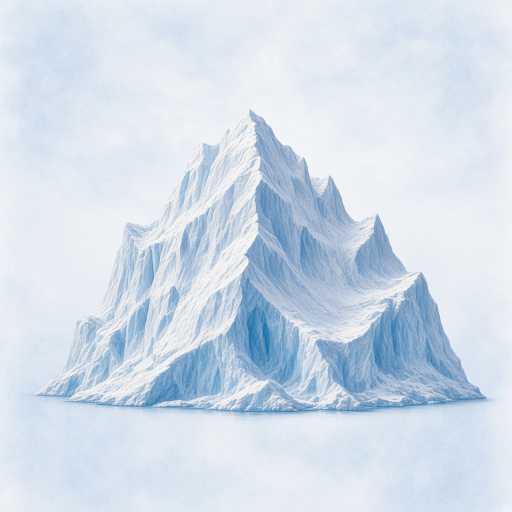
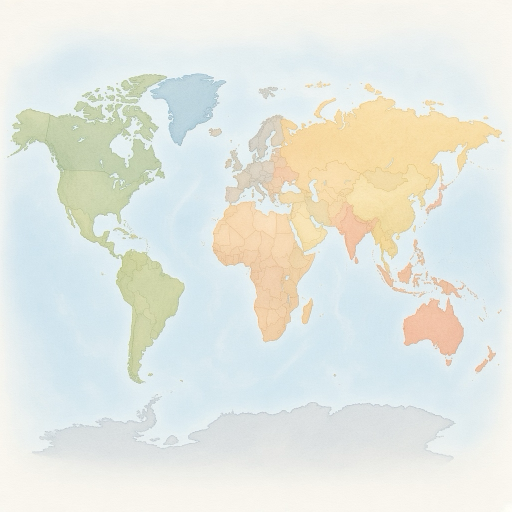
Antarctica is the continent at the very bottom of the world, all around the South Pole. It is covered in a thick layer of ice that almost never melts. Antarctica is the coldest place on the whole Earth, far colder than your freezer at home. No one lives there forever. Only scientists stay for a while to study the ice, the weather, and the animals.
Why Antarctica is surprising
Antarctica is a giant continent of land, but you almost never see the ground. Ice covers about 98 out of every 100 parts of it. The ice is so deep that in many places it is more than 1 mile (1.6 km) thick. That is taller than five stacked Empire State Buildings of solid ice.
Even though Antarctica is buried in ice, it is actually a desert. A desert is any place that gets very little rain or snow, and Antarctica gets almost none. The ice you see did not fall last week. It built up slowly over many thousands of years.
Antarctica also has very strange days. In summer the sun can stay up all night long. In winter it can stay dark for weeks and weeks. The South Pole has just one long day and one long night each year.
Key facts about Antarctica
Antarctica is at the bottom of the world. It sits around the South Pole, the southernmost point on Earth.
It is the coldest place on Earth. The coldest temperature ever measured anywhere was about -128.6 °F (-89.2 °C), recorded in Antarctica.
Almost all of it is ice. About 98 out of every 100 parts of Antarctica are covered in thick ice.
It holds most of the world’s ice. About 90 out of every 100 pieces of ice on Earth are in Antarctica.
It is a frozen desert. Antarctica gets so little rain or snow that it counts as a desert, even under all that ice.
Penguins live there, but polar bears do not. Penguins, seals, and tiny shrimp called krill live around Antarctica. Polar bears live far away in the Arctic, at the top of the world.
It is surrounded by ocean. Water touches Antarctica on every side. You cannot walk there from any other land.
No one lives there forever. Only scientists stay, and only for a few months or a winter at a time.
It is the windiest continent. Some of the strongest winds on Earth blow across the ice.
The sun acts strangely. In summer the sun can shine all night, and in winter it can stay dark for a very long time.
Common myths about Antarctica
Myth: Polar bears live in Antarctica. Polar bears do not live in Antarctica at all. They live in the Arctic, near the North Pole, which is on the opposite side of the world. In Antarctica you find penguins, seals, and whales instead.
Myth: Penguins and polar bears live together. They never meet in the wild. Penguins live near the South Pole, and polar bears live near the North Pole. The two poles are about as far apart as two places on Earth can be.
Myth: Antarctica is just a sheet of ice floating on the sea. Antarctica is real land, with mountains and rock, hidden under the ice. The Arctic is the opposite: it is mostly ocean with floating ice, ringed by land.
Myth: Antarctica gets tons of snow because it is so white. Antarctica is actually a desert. Very little new snow falls. In a whole year the snow that lands there would melt into only about 6 inches (150 mm) of water. The thick ice took thousands of years to build up, a little at a time.
Frequently asked questions about Antarctica
Where is Antarctica?
Antarctica is at the very bottom of the world, around the South Pole. It is surrounded by ocean on every side. To get there, people travel by ship or by airplane, because no roads lead to it.
Why is Antarctica so cold?
Antarctica is cold because the sun’s light hits it at a low, slanted angle, so it never warms the ground much. The thick white ice also bounces sunlight back into the sky. On top of that, the land is very high up, and high places are colder.
Do polar bears live in Antarctica?
No. Polar bears live in the Arctic, near the North Pole, at the top of the world. Antarctica is at the bottom of the world. The animals there are penguins, seals, whales, and tiny krill, but no polar bears.
Does anyone live in Antarctica?
No one lives in Antarctica forever. There are no towns or families that stay year after year. Scientists from many countries live at research stations for a few months or for one winter, then go home.
Is Antarctica really a desert?
Yes. A desert is a place that gets very little rain or snow, and Antarctica gets almost none. It still counts as a desert, even though it is covered in ice. The ice built up slowly over thousands of years.
Why does the sun act so strangely there?
Antarctica is at the bottom of the Earth, which tilts toward and away from the sun through the year. In summer the sun can stay up all night. In winter it can disappear for weeks. The South Pole gets one long day and one long night each year.
Each of this topic’s quiz questions cites a source for the specific fact tested. You can play at any level: Rookie, Curious, Sharp, or Expert.
Antarctica is the southernmost continent, a landmass around the South Pole and within the Southern Ocean. Ice covers about 98 percent and holds roughly 90 percent of Earth’s ice and 70 percent of its fresh water. Seven states maintain territorial claims, some overlapping, while other states reject or do not recognize them. The Antarctic Treaty preserves each side’s legal position and bars new or enlarged claims while in force. There is no Indigenous or permanent resident population, although stations operate year-round.
Why Antarctica is full of surprises
Antarctica breaks records in almost every direction. It is the coldest continent, the windiest continent, and the driest continent, all at once. The lowest natural temperature ever recorded anywhere on Earth, about -128.6 °F (-89.2 °C), was measured in Antarctica. Because it gets so little rain or snow, scientists count it as a polar desert.
It is also the highest continent on average, but not because of tall mountains. The reason is the ice itself. The ice sheet is about 1.2 to 1.4 miles (roughly 2 km) thick on average, and almost 3 miles (close to 4.8 km) deep at its thickest point. All that piled-up ice lifts the average height of the continent above every other.
One detail trips up almost everyone. The Arctic, around the North Pole, is mostly ocean ringed by land. Antarctica is the opposite: it is land ringed by ocean. So polar bears, which hunt on Arctic sea ice, do not live in Antarctica at all. The animals you find near the South Pole are penguins, seals, whales, and tiny shrimp-like creatures called krill.
Key facts about Antarctica
It is the bottom of the world. Antarctica surrounds the South Pole, the southernmost point on the planet.
The ice sheet is enormous. It covers about 98 percent of the continent and holds about 90 percent of Earth’s ice.
It stores most fresh water. Roughly 70 percent of all the fresh water on Earth is locked in Antarctica’s ice.
It is the coldest place on Earth. The record low was about -128.6 °F (-89.2 °C), set at a research station in 1983.
It is a desert. A year of snowfall across Antarctica adds up to only about 6 inches (150 mm) of water, which is why it counts as a polar desert.
It is the windiest and highest continent. Strong winds sweep the coast, and the thick ice gives it the highest average elevation.
Sovereignty is unresolved. Seven states maintain claims, while the Antarctic Treaty preserves rather than settles those positions and supports international cooperation.
Amundsen reached the Pole first. Roald Amundsen of Norway led the first party to the geographic South Pole, in December 1911.
Penguins live there, not polar bears. Emperor penguins are the only penguin species that breeds during the Antarctic winter. Adélie penguins, the other species native to the continent itself, breed in a short summer season instead.
Krill feed the food web. Tiny krill are a key food for whales, seals, penguins, and fish in the surrounding ocean.
Mount Erebus is a volcano. Antarctica has Mount Erebus, the southernmost active volcano on Earth.
Common myths about Antarctica
Myth: Polar bears and penguins live together. They never meet in the wild. Polar bears live in the Arctic, near the North Pole. Penguins live near the South Pole, in and around Antarctica. The two animals are at opposite ends of the planet.
Myth: Antarctica is just floating sea ice. Antarctica is a real continent of rock and mountains, buried under a thick ice sheet. The Arctic is the one that is mostly floating ice over the ocean. This is the key difference between the two polar regions.
Myth: Antarctica is the snowiest place on Earth. It is the opposite. Antarctica is a desert. So little new snow falls that the interior gets less than 2 inches (about 50 mm) of water each year. The deep ice took many thousands of years to build up.
Myth: One country controls Antarctica. Seven states maintain claims, and many governments do not recognize them. The Treaty neither accepts nor rejects existing claims and prohibits new or enlarged ones while it remains in force.
Myth: Penguins are in danger from polar bears. Penguins never encounter polar bears, because the two live at opposite poles. In the water, penguins watch out for leopard seals and orcas instead.
Frequently asked questions about Antarctica
Where is Antarctica, and how do people get there?
Antarctica is the continent surrounding the South Pole, at the bottom of the world. It is ringed by the Southern Ocean, so no roads or land bridges reach it. Researchers travel there by ship or by airplane, mostly during the Antarctic summer from about October to February.
Who reached the South Pole first?
Roald Amundsen of Norway led the first team to reach the geographic South Pole, on December 14, 1911. A British team led by Robert Falcon Scott arrived about a month later, in January 1912. Amundsen’s careful planning, including the use of sled dogs, helped his party get there first and return safely.
Why are there no polar bears in Antarctica?
Polar bears evolved in the Arctic, where they hunt seals on floating sea ice near the North Pole. Antarctica is on the opposite side of the planet and was never connected to that habitat. The native animals there are penguins, seals, whales, and krill, none of which a polar bear could replace.
How is Antarctica a desert if it is covered in ice?
A desert is defined by how little precipitation it gets, not by temperature or sand. Antarctica’s interior receives less than 2 inches (about 50 mm) of water-equivalent precipitation a year, far below the threshold for a desert. The ice you see is old snow that piled up slowly over thousands of years and rarely melts.
Does anyone own or live in Antarctica?
No single state exercises generally recognized sovereignty over Antarctica. Seven maintain claims, and the Treaty preserves each participant’s legal stance while requiring peaceful use and scientific cooperation. There is no Indigenous or self-sustaining permanent population; staffing at research stations varies by year and season.
What animals live in Antarctica?
The best-known are penguins, including the emperor, the only penguin species that breeds through the Antarctic winter. Seals and seabirds use Antarctic habitats, whales feed offshore, and krill support much of the marine food web.
Is Antarctica getting bigger or smaller?
Antarctica’s land has not changed size, but scientists watch its ice closely. Parts of the ice sheet are losing mass as the climate warms, which adds water to the ocean. Because the ice sheet holds so much of the world’s fresh water, even small changes there matter for sea levels everywhere.
Each of this topic’s quiz questions cites a source for the specific fact tested. You can play at any level: Rookie, Curious, Sharp, or Expert.
Antarctica is Earth’s southernmost continent, a roughly 5.4 million square mile (about 14 million km2) landmass centered on the South Pole and within the Southern Ocean. About 98 percent lies beneath ice holding roughly 90 percent of the world’s ice and 70 percent of its fresh water. Seven states maintain claims, some overlapping, while other governments reject or do not recognize them. The Antarctic Treaty preserves those positions without settling sovereignty, prohibits new or enlarged claims, and reserves the region for peaceful purposes and scientific cooperation.
What is often misunderstood about Antarctica
Antarctica is land, not sea ice. Beneath the ice lies a continent of rock, mountain ranges, and buried valleys, the fifth-largest landmass on the planet, larger than Europe and larger than Australia. This is the mirror image of the Arctic, which is an ocean basin covered by floating sea ice and ringed by the northern edges of three continents. The distinction is not a technicality. It explains why polar bears, which evolved to hunt on Arctic sea ice, have never lived in Antarctica, and why the southern continent’s signature animals are penguins, seals, and krill instead.
It is also a desert, despite holding most of the planet’s ice. A desert is defined by precipitation, not temperature, and the Antarctic interior receives less than 2 inches (about 50 mm) of water-equivalent precipitation a year. Averaged over the whole continent, coast included, a year of snowfall is equivalent to only about 6 inches (150 mm) of rain. The ice sheet did not accumulate from heavy snowfall. It built up over hundreds of thousands of years because the trickle of snow that does fall almost never melts.
The ice itself drives a third surprise. Antarctica has the highest average elevation of any continent, not because of its mountains but because of the depth of its ice. The sheet averages about 1.2 to 1.4 miles (roughly 2 km) thick and reaches nearly 3 miles (close to 4.8 km) at its deepest measured point. Pile that much ice onto a continent and its average surface height rises above every other landmass.
Key facts about Antarctica
Area and rank: about 5.4 million square miles (roughly 14 million km2), the fifth-largest continent, larger than both Europe and Australia.
Ice cover: roughly 98 percent of the surface is ice. The ice sheet holds about 90 percent of Earth’s ice and about 70 percent of its fresh water.
Coldest temperature on Earth: a ground-station reading of about -128.6 °F (-89.2 °C), recorded at Russia’s Vostok Station on July 21, 1983, and recognized by the World Meteorological Organization as the lowest reliably measured air temperature on the planet.
Climate superlatives: the coldest, windiest, and driest continent, and a polar desert from the coast to the interior.
Highest average elevation: the deep ice sheet, averaging about 1.2 to 1.4 miles (roughly 2 km) thick, gives Antarctica the highest mean elevation of any continent.
Governance: the 1959 Antarctic Treaty prohibits measures of a military nature but allows military personnel or equipment for science and other peaceful purposes. It preserves existing legal positions and bars new or enlarged claims while in force.
No permanent population: only research-station staff live there, roughly 1,000 through the winter and several thousand in summer. McMurdo Station, run by the United States, is the largest and can support more than 1,000 people in the austral summer.
First to the Pole: Roald Amundsen of Norway led the first party to reach the geographic South Pole, on December 14, 1911, about a month ahead of Robert Falcon Scott’s British party.
Mount Erebus: an active stratovolcano on Ross Island, the southernmost active volcano on Earth, holding one of the world’s few long-lived lava lakes.
Ozone hole: discovered in 1985 by British Antarctic Survey scientists, the finding led directly to the 1987 Montreal Protocol that phased out ozone-damaging chemicals.
Wildlife: penguins, seals, whales, seabirds, fish, and krill dominate visible food webs. Emperor penguins are the only penguin species that breeds through the Antarctic winter. There are no polar bears or native fully terrestrial mammals.
Surrounding ocean: the Southern Ocean rings the continent, and around it flows the Antarctic Circumpolar Current, the largest ocean current on Earth.
Common myths about Antarctica
Myth: Polar bears live in Antarctica. Polar bears live only in the Arctic, near the North Pole. Antarctica, at the opposite pole, has never had polar bears. Its predators on land and ice are seals and skuas, and its waters hold leopard seals and orcas, but no bears.
Myth: Antarctica is a sheet of ice floating on the sea. Antarctica is a continent of rock and mountains under a thick ice sheet. The Arctic, by contrast, is an ocean covered by floating sea ice. Confusing the two is the most common error about the polar regions.
Myth: Antarctica is the snowiest place on Earth. Antarctica is a desert. Its interior receives less than 2 inches (about 50 mm) of precipitation a year. The vast ice sheet reflects a long, slow buildup over geologic time, not heavy modern snowfall.
Myth: A country has uncontested ownership of Antarctica, or could buy it. Seven states maintain territorial claims, but other governments reject or do not recognize them. The Antarctic Treaty preserves those legal positions, bars new or enlarged claims while in force, and supports peaceful scientific cooperation without deciding sovereignty.
Myth: Penguins and polar bears share a habitat. They live at opposite ends of the planet and never meet in the wild. Penguins are concentrated in the Southern Hemisphere, with the densest populations around Antarctica, while polar bears are confined to the Arctic.
Myth: Antarctica is the same size as the Arctic ice cap, so it barely matters. Antarctica is a full continent that stores about 70 percent of the world’s fresh water. If its ice melted entirely, global sea level would rise on the order of 190 feet (about 58 m), which is why scientists track its ice mass so closely.
Frequently asked questions about Antarctica
What is the coldest temperature ever recorded on Earth?
About -128.6 °F (-89.2 °C), measured at Russia’s Vostok Station in the Antarctic interior on July 21, 1983. The World Meteorological Organization recognizes it as the lowest reliably measured air temperature on the planet. Satellites have detected even colder ice-surface temperatures in East Antarctica, near -135 °F (about -93 °C), but those are remote-sensed surface readings rather than the official ground-station air-temperature record.
Why is Antarctica considered a desert?
Because deserts are defined by precipitation, not heat. The Antarctic interior gets less than 2 inches (about 50 mm) of water-equivalent precipitation a year, far below the threshold for a desert. That makes the continent a polar desert, even though it is covered in ice. The ice is ancient snowfall that accumulated over hundreds of thousands of years.
Who governs Antarctica?
Seven states maintain territorial claims, some overlapping, while other states reject or do not recognize them. The Antarctic Treaty, signed in 1959 and in force since 1961, does not settle sovereignty: it preserves legal positions and prohibits new or enlarged claims. It bars military measures but permits military personnel and equipment for science or other peaceful purposes. Later agreements add environmental and resource-management rules.
Who was first to reach the South Pole?
Roald Amundsen of Norway. His party reached the geographic South Pole on December 14, 1911. The British expedition led by Robert Falcon Scott arrived about a month later, in January 1912, and Scott’s polar party did not survive the return journey. Amundsen’s success is often credited to careful planning and the use of sled dogs.
Are there active volcanoes in Antarctica?
Yes. Mount Erebus, on Ross Island, is an active stratovolcano and the southernmost active volcano on Earth. NASA notes that it has held one of the world’s few persistent lava lakes, a pool of molten rock churning in its summit crater since at least the early 1970s. Antarctica has other volcanoes as well, both above and beneath the ice.
What animals live in Antarctica, and why no polar bears?
The native fauna centers on penguins, seals, whales, seabirds, and krill, the small shrimp-like animals that anchor the Southern Ocean food web. Emperor penguins are the only penguin species that breeds during the Antarctic winter; Adélie penguins, the other species native to the continent itself, breed in a short summer season instead. Polar bears live in the Arctic and never colonized Antarctica, which sits at the opposite pole and was never connected to the bears’ sea-ice habitat. Antarctica also has no native fully terrestrial mammals.
What is the Antarctic ozone hole?
It is a seasonal thinning of the protective ozone layer high above Antarctica, first reported in 1985 by British Antarctic Survey scientists who had been measuring ozone from the ice for years. The discovery led to the 1987 Montreal Protocol, an international agreement that phased out ozone-damaging chemicals. The ozone layer has been slowly recovering since.
How much ice does Antarctica hold, and why does it matter?
The ice sheet holds about 90 percent of the world’s ice and roughly 70 percent of its fresh water. According to the National Snow and Ice Data Center, complete melting would raise global sea level by about 190 feet (58 m). Even partial loss from the most vulnerable parts of the sheet would reshape coastlines worldwide, which is why ice-mass change in Antarctica is a central question in climate science.
Each of this topic’s quiz questions cites a primary source for the specific fact tested. You can play at any level: Rookie, Curious, Sharp, or Expert.
Antarctica is Earth’s southernmost continent, an ice-covered landmass of roughly 5.4 million square miles (about 14 million km2) centered on the geographic South Pole and bounded by the Southern Ocean. It is the coldest, windiest, driest, and highest continent on average, and a polar desert from the coast to the interior. An ice sheet buries about 98 percent of its surface and holds roughly 90 percent of the world’s ice and about 70 percent of its fresh water. No state holds generally recognized sovereignty over it. The Antarctic Treaty System supports peaceful scientific cooperation, prohibits measures of a military nature while allowing military personnel and equipment for peaceful purposes, and preserves the parties’ positions on existing territorial claims without settling sovereignty.
Why Antarctica resists easy generalization
Most of Antarctica’s superlatives trace back to a single feature: the ice sheet. Because the sheet averages about 1.2 to 1.4 miles (roughly 2 km) thick and reaches nearly 3 miles (about 4.8 km) at its deepest surveyed point, it lifts the continent to the highest mean elevation on Earth, far above any range of rock. That elevation in turn intensifies the cold, since temperature falls with altitude and the high interior plateau radiates heat efficiently under clear polar skies. The lowest reliably measured air temperature on the planet, about -128.6 °F (-89.2 °C), was recorded at Vostok Station on the East Antarctic plateau on July 21, 1983. Satellite radiometers have since detected ice-surface temperatures near -144 °F (about -98 °C) in shallow snow-surface hollows on the high East Antarctic plateau, but those are remote-sensed skin temperatures, not the World Meteorological Organization’s official air-temperature record.
The cold and the topography together generate the wind. Antarctica’s notorious coastal gales are largely katabatic winds: cold, dense air forms over the high interior, then drains downhill under gravity, accelerating as it funnels through coastal valleys and off the ice margin. These are not passing weather systems but a near-permanent gravity-driven flow, which is why some coastal sites rank among the windiest places on Earth. Strong, dry down-valley winds keep the McMurdo Dry Valleys nearly snow-free, scouring and sublimating what little snow reaches them and leaving bare ground in one of the driest landscapes on the planet. Those valley winds are foehn winds, produced when airflow is modified in the lee of the surrounding mountain barriers, and are often misread as katabatic drainage off the plateau.
The continent is also structurally two-sided. The Transantarctic Mountains, one of the longest mountain ranges on Earth at roughly 2,200 miles (about 3,500 km), divide it into East Antarctica and West Antarctica. East Antarctica is an ancient continental shield capped by a thick, relatively stable ice sheet sitting mostly above sea level. West Antarctica is smaller, partly a marine ice sheet grounded below sea level, and far more sensitive to ocean warming. That asymmetry is central to modern sea-level science: the full ice sheet, if it melted, would raise global sea level by about 190 feet (58 m), but the near-term risk is concentrated in the marine-based sectors of the west.
Key facts about Antarctica
Area and rank: about 5.4 million square miles (roughly 14 million km2), the fifth-largest continent, larger than Europe and larger than Oceania.
Ice budget: about 98 percent ice cover; roughly 90 percent of global ice and about 70 percent of global fresh water are stored in the sheet, which averages about 1.2 to 1.4 miles (roughly 2 km) thick and reaches nearly 3 miles (about 4.8 km) at its thickest.
Coldest air temperature on Earth: about -128.6 °F (-89.2 °C) at Vostok Station, July 21, 1983, recognized by the World Meteorological Organization.
Highest peak: Mount Vinson, about 16,050 feet (4,892 m), in the Sentinel Range of the Ellsworth Mountains.
Mount Erebus: an active stratovolcano on Ross Island, the southernmost active volcano on Earth, hosting one of the few persistent lava lakes in the world, active since at least the early 1970s.
Transantarctic Mountains: roughly 2,200 miles (about 3,500 km) long, dividing the continent into East and West Antarctica.
Ross Ice Shelf: the largest ice shelf in Antarctica, a floating slab of roughly the area of France, fed by glaciers draining off the interior.
Lake Vostok: the largest of Antarctica’s hundreds of subglacial lakes, sealed beneath about 2.5 miles (4 km) of ice in East Antarctica near Vostok Station.
Southern Ocean: rings the continent; the Antarctic Circumpolar Current that flows around it is the largest ocean current on Earth, the only current to connect the Atlantic, Pacific, and Indian basins.
Governance: the Antarctic Treaty, signed December 1, 1959, by 12 nations and in force June 23, 1961. Seven nations hold pre-existing claims; Article IV suspends them, neither recognizing nor rejecting any claim and barring new ones while the treaty is in force.
Population: no permanent inhabitants. Roughly 1,000 personnel overwinter, rising to several thousand on station in summer. McMurdo Station, run by the United States, is the largest, supporting more than 1,000 people at peak.
Native life: penguins, seals, whales, seabirds, and krill. No polar bears and no native land mammals. The largest fully terrestrial animal is a wingless midge, Belgica antarctica, only about 0.08 to 0.24 inch (2 to 6 mm) long.
Common misconceptions at expert level
Misconception: the Antarctic Treaty assigned ownership of the continent. It did the opposite. Seven nations had asserted territorial claims before 1959, and Article IV of the treaty freezes the legal status quo: no act under the treaty supports or denies any claim, and no new or enlarged claims may be made while it remains in force. Two major parties, the United States and Russia, reserve a basis of claim without having lodged one. The result is a continent governed by consensus among parties rather than by any sovereign.
Misconception: Antarctica’s record cold is a satellite measurement of about -144 °F (-98 °C). The official figure is the ground-station reading of -128.6 °F (-89.2 °C) at Vostok in 1983. The colder satellite values, near -144 °F (-98 °C), are remote-sensed ice-surface temperatures from shallow hollows on the East Antarctic plateau, a different quantity measured by a different method, and they are not the recognized air-temperature extreme.
Misconception: the Antarctic ice sheet behaves as one uniform mass. East and West Antarctica differ in basic ways. The East Antarctic ice sheet is large, old, and mostly grounded above sea level. The West Antarctic ice sheet is smaller and largely marine-based, grounded below sea level on a bed that deepens inland, which makes it susceptible to marine ice-sheet instability when warm water reaches its grounding lines. Sea-level projections hinge on this distinction.
Misconception: the strong coastal winds are storm systems blowing in from the ocean. They are predominantly katabatic, an outflow driven by gravity acting on cold, dense air that forms over the high interior and accelerates as it descends. The flow is persistent rather than episodic, which is why it shapes the climate of coastal sites and ice-free areas so consistently.
Misconception: the McMurdo Dry Valleys are a minor curiosity. They are the largest ice-free region in Antarctica and among the most extreme cold deserts on Earth. Their stability and aridity make them a long-running natural laboratory, including as a terrestrial analog for the surface of Mars, where similar cold, dry, low-precipitation conditions prevail.
Frequently asked questions about Antarctica
How does the Antarctic Treaty handle territorial claims?
Through Article IV, which suspends rather than settles them. Seven states (Argentina, Australia, Chile, France, New Zealand, Norway, and the United Kingdom) had asserted claims before the treaty, some overlapping. Article IV provides that nothing done while the treaty is in force constitutes a basis for asserting, supporting, or denying a claim, and that no new claim or enlargement may be made. The arrangement preserves each party’s legal position without resolving the underlying question, which is why Antarctica is often described as governed but not owned.
What makes Antarctica’s winds so extreme?
The dominant mechanism is katabatic flow. Radiative cooling over the high interior chills the air near the surface, increasing its density, and that dense air drains downslope under gravity. As it funnels toward the coast through glacial valleys, it accelerates, producing strong and persistent surface winds. Because the driver is the continent’s own topography and cold, rather than transient pressure systems, the wind is a near-permanent feature of many coastal and ice-free sites.
What is the highest mountain in Antarctica?
Mount Vinson, about 16,050 feet (4,892 m), the high point of the Vinson Massif in the Sentinel Range of the Ellsworth Mountains. It was not sighted until 1958 and first climbed in 1966, reflecting how recently parts of the interior were explored. As the highest summit on the continent, it is one of the Seven Summits sought by mountaineers.
Why is the East versus West Antarctica distinction important?
Because the two ice sheets respond very differently to a warming climate. The East Antarctic ice sheet is largely grounded above sea level and comparatively stable. The West Antarctic ice sheet is largely marine-based, grounded below sea level on a reverse-sloping bed, which makes it vulnerable to instability once warm ocean water reaches its grounding lines. Most concern about rapid, near-term Antarctic contributions to sea-level rise focuses on the marine sectors of West Antarctica.
What lives on land in Antarctica?
Very little, and nothing large. There are no native land mammals, no reptiles, and no amphibians. The vertebrates people associate with Antarctica, penguins and seals, depend on the ocean. The largest purely terrestrial animal is a flightless midge, Belgica antarctica, roughly 0.08 to 0.24 inch (2 to 6 mm) long, alongside mites, springtails, and microscopic life. Polar bears, an Arctic species, have never lived there.
How early was Antarctica explored, and what happened on Scott’s expedition?
Antarctica was first sighted around 1820, the last continent seen by humans, and the priority among the 1820 expeditions is still debated. The race to the South Pole came nearly a century later. Roald Amundsen’s Norwegian party reached the Pole on December 14, 1911. Robert Falcon Scott’s British party arrived on January 17, 1912, about a month later, and the five members of that polar party did not survive the return journey, a loss that became one of the defining episodes in the history of polar exploration.
What is the Antarctic Circumpolar Current, and why does it matter?
It is the ocean current that flows clockwise around Antarctica, the largest current on Earth and the only one that links the Atlantic, Pacific, and Indian Oceans into a single connected system. By circling the continent without a continental barrier, it isolates Antarctic waters and helps maintain the cold conditions that sustain the ice sheet. It also plays a major role in global ocean circulation and the distribution of heat, nutrients, and carbon.
How was the ozone hole discovered, and why does Antarctica matter for it?
British Antarctic Survey scientists reported the Antarctic ozone hole in 1985, after years of ground-based ozone measurements revealed a steep springtime decline over the continent. The extreme cold of the Antarctic stratosphere forms polar stratospheric clouds that catalyze ozone destruction, which is why the thinning appears first and most severely there. The finding prompted the 1987 Montreal Protocol, and the ozone layer has been gradually recovering since.