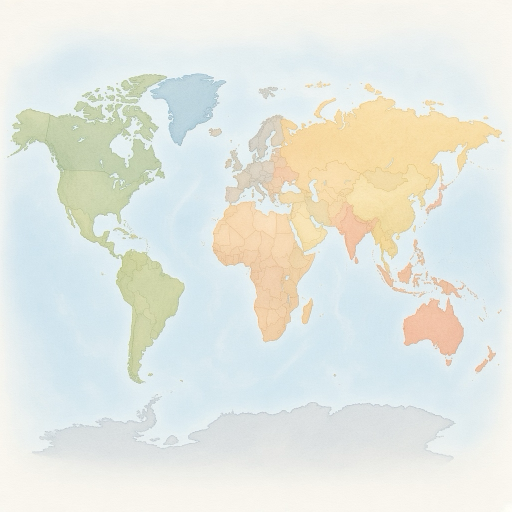
A continent is one of Earth’s main divisions of land. In the seven-continent model, their names are Asia, Africa, North America, South America, Antarctica, Europe, and Australia. National Geographic ranks them in that order from largest to smallest.
Why continents can be tricky
Seven is a widely taught answer, but it is not the only way people group the same land. Some classroom traditions combine North and South America as the Americas, while others combine Europe and Asia as Eurasia. These models change the labels and count, not the shape of Earth.
Australia is another naming puzzle. In the seven-continent model, Australia is both the name of a country and the name of the smallest continent. The country occupies most of that continental land area, but broader regional terms such as Oceania can include many Pacific islands too.
Antarctica is a desert even though it is covered in ice. Deserts are places with very little precipitation, meaning rain or snow. NOAA explains that Antarctica qualifies as a desert and is larger than the Sahara, the world’s largest hot desert.
Key facts about the seven continents
Asia is the largest continent. It also has the largest human population, with roughly 60 percent of the world’s people.
Africa is the second-largest continent. The United Nations African Group contains 54 member states, while the African Union has 55 members, so country totals should always say which list they use.
North America includes Canada, the United States, Mexico, Central America, and Caribbean islands. Its landscapes range from Arctic tundra to tropical forests.
South America contains the Amazon Basin. That basin supports the world’s largest rainforest, and the Andes along western South America form the world’s longest continental mountain range.
Antarctica is the coldest, driest, and windiest continent. Its ice sheet contains about 90 percent of the world’s fresh water.
Europe and Asia share one continuous stretch of land. Their separation into two continents is a long-standing geographic convention rather than an ocean divide.
Australia is the smallest continent. It lies mainly in the Southern Hemisphere between the Indian and Pacific oceans.
Antarctica has no permanent human population. Researchers and support staff, including pilots and cooks, live and work at stations for limited periods.
Polar bears and penguins do not meet in the wild. Polar bears live across the Arctic, while penguins are Southern Hemisphere birds, including species that live in and around Antarctica.
Continents move very slowly. Their present positions are temporary because the land travels with moving tectonic plates.
Common myths about the continents
Myth: Every school must teach exactly seven continents. Seven is one common model. Other traditions join the Americas or join Europe and Asia, producing a different count from the same world map.
Myth: Every desert is hot and sandy. A desert is a place that gets very little rain or snow. Antarctica is dry enough to count as one, and it covers more ground than the Sahara. The Sahara is the largest hot desert.
Myth: Australia can be only a country or only a continent. In the seven-continent model, the name is used for both. Context tells you whether someone means the country, the continent, or the wider Oceania region.
Myth: Only scientists stay in Antarctica. Research is the main reason people go, but stations also need support workers such as cooks, mechanics, pilots, and medical staff. What Antarctica lacks is a permanent resident population.
Myth: The continents have always been where they are now. The present continents contain fragments of Pangaea, a supercontinent that began breaking apart more than 200 million years ago. Plate motion continues today.
Frequently asked questions about the continents
How many continents are there?
The model most often taught in the United States names seven: Asia, Africa, North America, South America, Antarctica, Europe, and Australia. Other educational traditions combine some of these land divisions and use a smaller number.
What is the largest continent?
Asia is the largest by land area and the most populous. National Geographic estimates that about three-fifths of the world’s people live there.
What is the smallest continent?
Australia is the smallest in the seven-continent model. Australia is also a country, which is why the same word can mean two related geographic areas.
Which continent has the most countries?
Africa is commonly given that distinction. A precise answer should note that the United Nations African Group has 54 member states and the African Union has 55 members.
Is Antarctica a continent?
Yes. Antarctica surrounds the South Pole and is larger than Europe or Australia. It has research stations but no permanent human population.
Each of this topic’s quiz questions cites a source for the fact it tests. You can play at any level: Rookie, Curious, Sharp, or Expert.
A continent is one of Earth’s main divisions of land. The familiar seven-continent model names Asia, Africa, North America, South America, Antarctica, Europe, and Australia. That list is useful, but it is a geographic convention rather than the output of one universal scientific test.
Why the count is not the same everywhere
People can group the same land in different ways. A six-continent scheme may combine North and South America as the Americas, or it may combine Europe and Asia as Eurasia. Some five-continent teaching schemes combine more than one pair or omit uninhabited Antarctica. The important step is to identify which model a map, textbook, or trivia question is using.
Europe and Asia show why the definition is flexible. They form one connected landmass, and National Geographic notes that their boundary has no clear geological barrier based on tectonic plates or natural formations. Lines through the Urals, the Caspian region, and the Caucasus are conventions, and published maps do not all choose exactly the same route.
Antarctica creates a different kind of surprise. It is covered by ice but qualifies as a desert because it receives little precipitation. Its area is also larger than the Sahara, which is the largest hot desert.
The seven continents in size order
Asia is the largest and most populous continent. Roughly 60 percent of the world’s population lives there.
Africa is second in area. The United Nations assigns 54 member states to its African Group, while the African Union has 55 members.
North America is third. It reaches from the high Arctic through Central America and includes Caribbean islands in the common geographic model.
South America is fourth. The Amazon is the world’s largest river by discharge, and the Andes form the world’s longest continental mountain range at about 5,500 miles (8,850 km).
Antarctica is fifth, so it is larger than Europe and Australia. It has no permanent human population.
Europe is sixth and shares continuous land with Asia. The boundary between them is based on geographic history and convention.
Australia is seventh and smallest. The same name is used for the country and, in the seven-continent model, the continent.
The Seven Summits
The Seven Summits are the highest peaks assigned to the seven continents. The commonly listed peaks are Everest in Asia, Aconcagua in South America, Denali in North America, Kilimanjaro in Africa, Elbrus in Europe, Vinson Massif in Antarctica, and either Kosciuszko or Puncak Jaya for the last slot.
That final choice depends on the map. The Bass list uses Mount Kosciuszko, the highest point on mainland Australia. The Messner list uses Puncak Jaya on New Guinea because it is the highest peak in the wider Australia-Oceania region. The disagreement reflects the same continent-boundary problem found elsewhere in geography.
Mount Everest is the highest point above sea level. Nepal and China announced an agreed summit elevation of 29,031.69 feet (8,848.86 m) in 2020 after new surveys.
How moving plates rearrange continents
Continents travel with tectonic plates, but a continent and a plate are not the same thing. A single plate can carry both continental land and ocean floor, and some continents extend across more than one plate.
Pangaea was the most recent supercontinent to contain nearly all of today’s continental land. It began breaking apart more than 200 million years ago, and continued plate motion opened ocean basins and carried the fragments toward their present positions.
The continents are still moving. Their speeds differ by plate and location, and precise satellite positioning can measure motion of only a few centimeters per year.
Common myths about the continents
Myth: The number of continents is a fixed scientific measurement. There is no single numerical rule that produces one worldwide count. Geographic traditions make different choices about connected land.
Myth: An ocean separates Europe from Asia. No ocean divides them. Their boundary is a conventional line across a connected landmass.
Myth: Africa simply has 54 countries in every official system. The United Nations African Group has 54 member states, but the African Union has 55 members. A careful claim names the system being counted.
Myth: The Olympic rings assign one color to each named continent. The Olympic symbol represents worldwide union, but the individual colors are not officially assigned to specific continents.
Myth: Pangaea was the first or only supercontinent. It was the most recent. Geological evidence points to older cycles of continental assembly and breakup too.
Frequently asked questions about the continents
How many continents are there?
Seven is a common English-language classroom model. Other schemes use six or five by combining connected regions or, in some contexts, leaving out uninhabited Antarctica.
What are the continents from largest to smallest?
National Geographic orders them as Asia, Africa, North America, South America, Antarctica, Europe, and Australia. Exact area totals vary slightly depending on where island and boundary lines are drawn, but the order stays the same.
Which continent has the most countries?
Africa under common country lists. The exact number needs a definition: 54 United Nations member states are in the African Group, while the African Union has 55 member states.
Why is Antarctica called a desert?
A desert is defined by low precipitation, not by heat or sand. Antarctica receives so little snow and rain that it is a polar desert, and it covers more ground than the Sahara.
Were the continents ever joined together?
Nearly all of today’s continental land was assembled in Pangaea. Its breakup began more than 200 million years ago, and plate tectonics continues to alter the positions and shapes of continents.
Each of this topic’s quiz questions cites a source for the fact it tests. You can play at any level: Rookie, Curious, Sharp, or Expert.
A continent is one of Earth’s principal named land divisions. In the seven-continent convention, the list is Asia, Africa, North America, South America, Antarctica, Europe, and Australia. That scheme mixes physical geography with historical convention, which is why connected land can receive separate continent names.
Why seven is a model, not a measurement
There is no global authority that decrees a single continent count. Five-, six-, and seven-continent schemes group the Americas, Europe and Asia, Australia, and nearby islands differently. A count is meaningful only when its naming rules are stated.
Europe and Asia are the clearest example. They share continuous land, and there is no single tectonic or natural barrier that cleanly separates the full continental areas. The Urals and nearby waterways form part of a common conventional boundary, while competing maps use different lines around the Caucasus.
The Olympic rings are often mistaken for a geography lesson. The International Olympic Committee describes their historical meaning as the union or meeting of the world’s five parts or continents. It does not assign each ring color to a specific named continent, and the symbol should not be treated as proof of one formal geographic model.
The seven continents by the numbers
Asia ranks first in land area and population. It contains about 30 percent of Earth’s land area and roughly 60 percent of its population.
Africa ranks second in area. The United Nations African Group has 54 member states, while the African Union counts 55 members.
North America ranks third in area. Its conventional extent includes Central America and the Caribbean as well as Canada, the United States, Mexico, and Greenland.
South America ranks fourth. Its Amazon River leads the world in discharge, and its Andes extend about 5,500 miles (8,850 km), making them the longest continental mountain range.
Antarctica ranks fifth and is larger than Europe and Australia. It is the highest, driest, windiest, and coldest continent and has no permanent human population.
Europe ranks sixth. It is the western part of the connected Europe-Asia landmass under physical geography, but tradition treats it as a separate continent in the seven-continent model.
Australia ranks seventh. The country of Australia covers most of the continental landmass, while Oceania is a regional term that can include many Pacific islands.
Exact area figures differ among references because geographers do not always assign islands or boundary regions the same way. National Geographic gives the combined continental area as about 148 million square kilometers (57 million square miles), close to 29 percent of Earth’s surface.
Antarctica: desert, ice sheet, and continent
Antarctica is a desert because precipitation is scarce, not because the continent lacks water. Most of its water is locked in ice, and the Australian Antarctic Program estimates that its ice sheet stores about 90 percent of the world’s fresh water.
The continent has no permanent human population. Scientific stations house researchers and support staff temporarily, so claims that Antarctica has “only scientists” leave out many people essential to station operations.
Continents and tectonic plates
Continents do not match tectonic plates one for one. Plates are moving slabs of lithosphere that may carry both continental and oceanic crust, and present-day continental margins often lie far from active plate boundaries.
The Australian continent provides a measurable example. Geoscience Australia reports that it moves northeast about 7 centimeters (2.8 inches) per year and describes it as the fastest-moving continental landmass.
Plate motion also explains Pangaea. Nearly all of today’s continental land assembled into that supercontinent before rifting began more than 200 million years ago. The breakup occurred through multiple stages, so saying that Pangaea simply split once into today’s seven continents hides a much more complex history.
Why continents stand above ocean basins
Continental crust is generally thicker and less dense than oceanic crust. U.S. Geological Survey summaries give oceanic crust a typical thickness near 5 to 7 kilometers, while continental crust varies much more and becomes especially thick beneath mountain ranges.
This density and thickness contrast helps continental regions sit higher in isostatic balance. Most continental crust is not recycled as readily as oceanic crust, allowing very old rocks to remain preserved on land.
Common myths about the continents
Myth: Every model with five continents is the same. Different schemes can reach five by making different combinations or exclusions. The names must be stated before the count is useful.
Myth: Each Olympic ring represents one particular continent. The interlocked rings symbolize worldwide union and the meeting of athletes. Official explanations do not map individual colors to particular continents.
Myth: Africa has an uncontested country count of 54. Fifty-four is the United Nations African Group count. The African Union has 55 members, so the institutional definition matters.
Myth: Europe and Asia are separated by an ocean or a tectonic seam. They are connected by land, and their conventional boundary does not follow one simple plate edge.
Myth: Continents are identical to tectonic plates. A plate can include continent and ocean floor together, and a named continent can interact with several plates.
Frequently asked questions about the continents
How many continents are there?
Seven in one widely taught convention, six when one major pair is combined, and five in some other geographic or historical schemes. No single physical test makes every tradition use the same count.
What is the area order of the seven continents?
Asia, Africa, North America, South America, Antarctica, Europe, and Australia. Exact totals depend on boundary and island conventions, but the ranking is stable in standard references.
Is Antarctica a desert?
Deserts are classified by low precipitation. Antarctica receives very little, and its continental area is larger than the Sahara, which is the largest hot desert.
Were Laurasia and Gondwana the first products of Pangaea’s breakup?
They are useful names for the broad northern and southern assemblages associated with Pangaea, but breakup involved many rifts, seaways, and moving blocks over a long interval. “First split” is too simple for the full geological sequence.
How fast do continents move?
Rates vary. The Australian continent moves northeast about 7 centimeters (2.8 inches) per year, while other regions move at different speeds and directions with their plates.
Each of this topic’s quiz questions cites a primary source for the specific fact tested. You can play at any level: Rookie, Curious, Sharp, or Expert.
A continent can mean a conventional geographic division or a large region of continental crust. Those ideas overlap, but they are not interchangeable. The familiar seven names belong to a geographic model, while geological arguments examine crustal composition, thickness, elevation, extent, and separation from other continental regions.
Geography does not provide one automatic count
The seven-continent model names Asia, Africa, North America, South America, Antarctica, Europe, and Australia. It separates Europe from Asia and North America from South America, even though each pair is connected by land.
Other schemes combine one or both pairs. Five-, six-, and seven-continent counts therefore can describe the same planet under different naming rules. Four very large connected land groupings can also be constructed by combining Africa, Europe, and Asia as Afro-Eurasia and combining the Americas, but that consolidation should not be presented as a universally taught formal model.
The International Olympic Committee historically described the five rings as symbolizing the union or meeting of five parts of the world. That language reflects the symbol’s international purpose, not a technical ruling on continent boundaries, and official explanations do not assign individual colors to named continents.
No model becomes geologically correct merely because it uses fewer names. A geographic continent is shaped by physical features, cartographic practice, education, and history, while tectonic plates and crustal provinces answer different questions.
Europe and Asia expose the convention
Europe and Asia form continuous land with no ocean between them. National Geographic notes that their boundary lacks a clear geological barrier based on tectonic plates or natural formations.
The Ural Mountains form part of a common modern boundary, but the route farther south can vary around the Caspian Sea, Caucasus, and nearby depressions and waterways. This disagreement affects whether particular places are described as European, Asian, or transcontinental.
It is also inaccurate to say that all of Europe and Asia sit neatly on one Eurasian plate. The named continents include regions influenced or carried by several plates, including the Arabian and Indian plates. Continental names and plate boundaries do not map one to one.
Continental crust, oceanic crust, and isostasy
Oceanic and continental crust differ in more than elevation. Oceanic crust is generally thinner and denser, while continental crust is generally thicker, less dense, and more compositionally varied.
A global U.S. Geological Survey model gives oceanic crust a typical thickness of about 6 to 7 kilometers. Continental crust in that model ranges from about 16 to 80 kilometers and averages about 41 kilometers, with major variation among shields, platforms, margins, and mountain belts.
The thickness and density contrast contributes to isostasy, the tendency of crustal blocks to maintain gravitational equilibrium over the mantle. Thicker, lower-density continental regions stand higher than thin, dense ocean basins, though elevation also responds to temperature, tectonics, erosion, sediment, and ice loading.
Continental crust is harder to recycle wholesale than oceanic crust, but it is not immune to subduction or destruction. The U.S. Geological Survey summarizes the broad result cautiously: most continental crust does not sink deep enough to be recycled and therefore remains largely preserved.
Cratons and ancient continental material
Many continents have old, stable interiors called cratons, surrounded or joined by younger and more deformed belts. A craton is not required to occupy the exact center of every geographic continent, and not every continental margin is an active plate boundary.
Recent U.S. Geological Survey work describes stable cratonic nuclei as thick, long-lived continental cores with lithospheric roots roughly 150 to 250 kilometers thick. Their persistence helps preserve an exceptionally long record of Earth’s history.
The Acasta Gneiss in northwestern Canada includes rocks close to 4 billion years old. Detrital zircon grains from the Jack Hills in Western Australia reach about 4.4 billion years, but those mineral grains are older than the sedimentary rock that now contains them.
Deformation, earthquakes, and volcanism concentrate strongly near many active plate boundaries, but continental interiors are not universally quiet. Australia, for example, experiences intraplate earthquakes as stresses accumulate within its plate.
Plates carry continents across a solid mantle
The lithosphere is broken into moving tectonic plates that include the crust and rigid uppermost mantle. Continents travel as parts of those plates, and a single plate may carry continental land together with a large area of ocean floor.
The asthenosphere beneath the lithosphere is not a global ocean of magma. The U.S. Geological Survey describes mantle rock as solid on short timescales but able to flow over geological time; small amounts of melt occur locally.
Plate speeds vary. Geoscience Australia measures the Australian continent moving north-northeast about 7 centimeters (2.8 inches) per year, a rate large enough to matter for centimeter-accurate coordinates and reference frames.
Continental coastlines usually do not coincide with plate boundaries. The eastern coast of North America, for example, is a passive margin within the North American Plate, whereas active boundaries lie elsewhere.
Pangaea and earlier continental cycles
Pangaea was the latest supercontinent to assemble nearly all of today’s continental land. Its breakup began more than 200 million years ago and proceeded through multiple rifts and moving blocks rather than one clean split into seven modern units.
Laurasia and Gondwana are useful names for broad northern and southern assemblages associated with that history, but calling them the single first split oversimplifies a long sequence. Different sectors rifted at different times, new ocean basins opened, and later collisions rearranged fragments again.
Pangaea was not the first supercontinent. Older continental assemblies existed, although their histories are harder to reconstruct because later tectonic activity destroyed or altered much of the evidence.
The contrast between old continental rocks and young ocean floor is central to that reconstruction. U.S. Geological Survey summaries place the oldest present oceanic crust near 180 million years, while preserved continental rocks approach 4 billion years and contain still older zircons.
Zealandia and a geological continent argument
In 2017, Nick Mortimer and colleagues presented a formal case for Zealandia as a geological continent. They described a coherent region of continental crust with elevated bathymetry, varied silica-rich rocks, relatively thick low-velocity crust, a large area, and well-defined separation from Australia.
Their mapped area is about 4.9 million square kilometers (1.9 million square miles). Roughly 94 percent lies below present sea level, leaving New Zealand, New Caledonia, and other islands as exposed parts.
Zealandia was formerly part of Gondwana. Its widespread crustal thinning before breakup and later isostatic balance help explain why most of it is submerged.
The Zealandia paper does not prove that every classroom must teach eight continents. It shows that a specified geological definition can identify a coherent continent that the conventional seven-name geographic list does not include.
Common misconceptions at expert level
Misconception: Geographic continents are tectonic plates. Plates can contain both oceanic and continental lithosphere, and plate edges often do not follow coastlines or familiar continent boundaries.
Misconception: The asthenosphere is a liquid magma sea. It is predominantly solid mantle that deforms and flows over long timescales, with only limited local melt.
Misconception: Continental crust never subducts. Its buoyancy makes wholesale recycling less common than for oceanic crust, but continental material can enter subduction zones and undergo major transformation.
Misconception: Every continent has one craton at its center. Many continents contain multiple old cratonic blocks joined by younger belts, and the relationship depends on whether the discussion uses geographic or geological boundaries.
Misconception: Europe and Asia occupy one simple plate and therefore form one geological continent. Their geographic boundary is conventional, but crustal provinces and tectonic plates across the region are more complicated than a single-block statement suggests.
Frequently asked questions
What is the difference between a geographic and geological continent?
A geographic continent is a named division shaped partly by convention. A geological continent argument uses physical evidence such as continental crust, elevation relative to nearby ocean floor, area, and geological boundaries. There is no single universally binding checklist for every purpose.
Why do continent counts range from five to seven?
Different traditions combine connected land divisions differently and sometimes use Australia or Oceania in different ways. Four consolidated land groupings can be described analytically, but the best answer to any count question identifies the model rather than declaring every scheme equally standard.
Why do continents usually stand above the ocean floor?
Continental crust is generally thicker and less dense than oceanic crust. Isostatic balance helps that crust stand higher, while tectonics, heat, erosion, sediment, and ice cause substantial regional differences.
How old is the oldest continental material?
The Acasta Gneiss includes rocks close to 4 billion years old, and Jack Hills zircons reach about 4.4 billion years. A zircon age records the mineral’s formation, not the age of the younger sedimentary rock in which it was later deposited.
Is Zealandia an eighth continent?
Mortimer and colleagues make a strong geological case for a distinct 4.9-million-square-kilometer continent that is about 94 percent submerged. Whether a map labels it an eighth continent depends on whether that map follows their geological criteria or a conventional geographic list.