Japan is an island country in eastern Asia, surrounded by the sea on every side. It is made up of thousands of islands, but most people live on just 4 big ones. The largest island is called Honshu, and the capital city, Tokyo, is there. Because Japan is surrounded by water, you cannot drive a car from Japan to another country. People go by airplane or by boat instead.
Why Japan is surprising
Japan is not one island. It is a whole group of islands, about 14,125 of them by Japan’s latest count. The 4 biggest are named Honshu, Hokkaido, Kyushu, and Shikoku. Almost everyone lives on these 4, and the smaller islands are mostly tiny.
Japan looks small on a map, but it holds a lot of people. About 123 million people live there. They are squeezed onto the flat parts of the land, because most of Japan is covered in steep mountains.
The country is also famous for being modern and old at the same time. Japan has some of the fastest trains in the world. It also has ancient temples, old castles, and traditions that are hundreds of years old.
Key facts about Japan
Japan is an island country. It sits in the Pacific Ocean, off the eastern edge of Asia.
The capital is Tokyo. Tokyo is one of the biggest cities in the whole world, with millions of people.
There are 4 main islands: Honshu, Hokkaido, Kyushu, and Shikoku. Honshu is the largest.
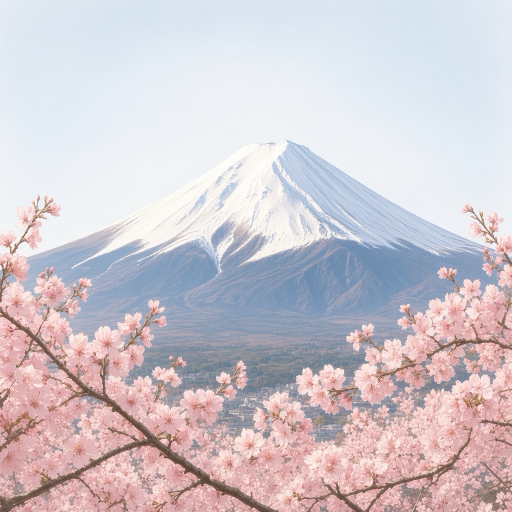
The tallest mountain is Mount Fuji. It is about 12,389 feet (3,776 m) high and has a snow-capped top shaped almost like a triangle.
Most of Japan is mountains. About three-quarters of the country is too steep and hilly to build on easily.
The money is the yen. People in Japan pay for things with yen, not dollars.
The flag is white with a red circle. The red circle stands for the sun. People call the flag the Hinomaru, which means “circle of the sun.”
Japan is nicknamed the “Land of the Rising Sun.” Japan sits in the far east of Asia, where the sun seems to rise first.
Japan has fast “bullet trains.” They are nicknamed bullet trains because they go so fast and have a smooth, pointed front. In Japanese, they are called the Shinkansen.
Cherry blossoms bloom in spring. Pink and white flowers called sakura open for only a short time. In Tokyo, the trees usually reach full bloom about a week after the first flowers open.
Common myths about Japan
Myth: Kyoto is the capital of Japan. Kyoto was the capital long ago, but it is not anymore. The capital moved to Tokyo in the 1860s. Today the capital is Tokyo.
Myth: Mount Fuji is a dead volcano that can never erupt. Mount Fuji is still an active volcano. It last erupted in the year 1707, more than 300 years ago. Scientists keep a close watch on it just in case.
Myth: Japan is bigger than California. Japan is actually a little smaller than the U.S. state of California. It just holds many more people, packed into less space.
Myth: Japanese is written with one alphabet like English. Japanese uses 3 kinds of writing at once. They are called hiragana, katakana, and kanji. The kanji characters can each stand for a whole word, like “mountain” or “river.”
Frequently asked questions about Japan
Where is Japan?
Japan is in eastern Asia, in the Pacific Ocean. It is a chain of islands off the coast of the Asian mainland. Because it is surrounded by water, Japan does not share a land border with any other country.
What is the capital of Japan?
The capital is Tokyo. It is the biggest city in Japan and the place where the country’s government works. Tokyo sits on the coast of Honshu, the largest island. Millions of people ride trains there to school and work every day.
How many islands does Japan have?
Japan has about 14,125 islands, by a count made in 2023. Most of them are very small. Almost everyone in Japan lives on the 4 main islands: Honshu, Hokkaido, Kyushu, and Shikoku.
What is the tallest mountain in Japan?
The tallest mountain is Mount Fuji, at about 12,389 feet (3,776 m). It is a volcano with a wide, snow-capped top. Many people hike to the top in summer, and the mountain shows up in a lot of Japanese art.
Why is Japan called the “Land of the Rising Sun”?
The nickname comes from where Japan sits on the map. Japan is in the far east of Asia, the direction where the sun appears to rise first. The same idea is on the flag, which shows a red sun on a white background.
What language do people speak in Japan?
People in Japan speak Japanese. It is written with 3 sets of characters at the same time: hiragana, katakana, and kanji. Children in Japan spend years in school learning to read and write all 3.
Each of this topic’s quiz questions cites a source for the specific fact tested. You can play at any level: Rookie, Curious, Sharp, or Expert.
Japan is an island country in eastern Asia, made up of a long chain of islands in the Pacific Ocean. It has 4 main islands, named Honshu, Hokkaido, Kyushu, and Shikoku, plus thousands of smaller ones. The capital is Tokyo, on the largest island, Honshu. Japan is a constitutional monarchy, which means it has an emperor as a national symbol and a prime minister who actually leads the government.
Why Japan is full of surprises
Japan packs a lot into a small space. The whole country is about 145,937 square miles (377,975 km2), a little smaller than the U.S. state of California. Yet roughly 123 million people live there, far more than in California. The reason so many people are squeezed together is geography: about three-quarters of Japan is covered in mountains, so cities and farms have to fit onto the flat land near the coast.
That mountainous land is also tectonically active. Japan lies near several plate boundaries, including subduction zones that generate earthquakes, volcanoes, and hot springs. Counts depend on the magnitude threshold and whether instruments or people detect the event, so “1,500 earthquakes a year” is a rough popular figure rather than a fixed total.
Japan is also a place of contrasts in time. It runs some of the fastest trains on Earth, but it is also home to one of the oldest businesses in the world: a construction company called Kongo Gumi, which dates its founding to the year 578.
Key facts about Japan
Japan has 4 main islands. Honshu is the largest. Hokkaido, in the north, is the second-largest and is known for cold, snowy winters.
The capital is Tokyo. The Greater Tokyo Area is the most populous metropolitan area in Japan, with around 37 million people. About 1 in every 3 people in Japan lives in this region.
The country is divided into 47 prefectures. A prefecture is a bit like a U.S. state or a province. Tokyo, Osaka, Kyoto, and Hokkaido are all prefectures.
About three-quarters of Japan is mountainous. Roughly 73 percent of the land is too steep and hilly for cities or farms.
Japan records many earthquakes. Annual totals depend on the magnitude and detection threshold; most instrumentally detected events cause little or no damage.
The tallest mountain is Mount Fuji. It is about 12,389 feet (3,776 m) high and is an active volcano that last erupted in 1707.
Japan’s population is shrinking. About 123 million people live there, and the number is slowly falling, because fewer babies are born than the number of people who pass away each year.
The largest lake is Lake Biwa, on the island of Honshu near the old city of Kyoto. It is a freshwater lake shaped a bit like a musical instrument called the biwa.
The Japanese name for the country is Nihon or Nippon. It means roughly “origin of the sun,” which is where the nickname “Land of the Rising Sun” comes from.
Written Japanese uses 3 systems together: hiragana, katakana, and kanji.
Common myths about Japan
Myth: Kyoto still performs Japan’s capital functions. The emperor and national government moved to Tokyo in 1868. Tokyo is universally treated as the national capital, although no single general statute simply declares it in those words.
Myth: Mount Fuji is an extinct volcano. Mount Fuji is classified as active, not extinct. Its last eruption was in 1707. Scientists monitor it closely because it could erupt again someday.
Myth: Japan is larger than California. Japan covers about 145,937 square miles (377,975 km2), which is somewhat smaller than California’s roughly 164,000 square miles (424,000 km2). California is the larger of the two by area.
Myth: Japanese is written with a single alphabet. Japanese uses 3 writing systems at once. Hiragana and katakana each stand for sounds, while kanji are characters borrowed from China long ago that stand for whole words or ideas.
Myth: Most of Japan is flat farmland. It is the opposite. About three-quarters of Japan is mountainous, and only about a quarter is flat enough for farms and cities.
Frequently asked questions about Japan
What are the 4 main islands of Japan?
The 4 main islands are Honshu, Hokkaido, Kyushu, and Shikoku. Honshu is the largest and holds the capital, Tokyo. Hokkaido, to the north, is the second-largest and the snowiest. Kyushu is in the south, and Shikoku is the smallest of the four.
Why does Japan have so many earthquakes?
Japan sits at a place where several tectonic plates meet. As these giant slabs of the Earth’s crust push together, one slides beneath another, and the sudden movements cause earthquakes. Japan’s weather agency counted 1,964 earthquakes people could feel in 2022 and 4,456 in 2025, and most of them were small. This is also why Japanese buildings and trains are designed to handle shaking safely.
How big is Japan compared with the United States?
Japan is about 145,937 square miles (377,975 km2), which makes it a little smaller than the single state of California. Even though it is not large, Japan holds roughly 123 million people, because so many of them live close together on the flatter land.
What is the capital of Japan, and was it always Tokyo?
Tokyo performs Japan’s capital functions. Kyoto was the imperial seat for more than a thousand years before the emperor and central government moved east in 1868. The legal history is more nuanced than one formal capital-transfer decree.
Why is Japan called the “Land of the Rising Sun”?
The Japanese name for the country, Nihon or Nippon, means roughly “origin of the sun.” Japan lies in the far east of Asia, in the direction of the sunrise. The English nickname “Land of the Rising Sun” is a translation of that idea, and the red sun on the flag reflects it too.
How is Japan governed?
Japan is a constitutional monarchy. It has an emperor who serves as a symbol of the nation but does not run the country or make laws. The day-to-day governing is led by a prime minister and an elected parliament.
Each of this topic’s quiz questions cites a source for the specific fact tested. You can play at any level: Rookie, Curious, Sharp, or Expert.
Japan is an island country in eastern Asia, an archipelago of thousands of islands stretching along the western edge of the Pacific Ocean. A 2023 government survey put the number of islands at about 14,125, but four of them, Honshu, Hokkaido, Kyushu, and Shikoku, hold the great majority of the country’s roughly 123 million people. The capital is Tokyo, on Honshu. Japan is a constitutional monarchy: Emperor Naruhito serves as a symbol of the nation, while an elected parliament and a prime minister run the government.
What is often misunderstood about Japan
The capital is not Kyoto. Kyoto served as the imperial seat for more than a thousand years, but the capital function moved east to Tokyo around 1868, after the Meiji Restoration. Tokyo had been a castle town called Edo; its new name means “Eastern Capital.” Edo was no minor town before the change: by the 18th century it had passed 1 million residents and was, by many estimates, the largest city in the world.
Japan is smaller than people often assume. Its total area is about 145,937 square miles (377,975 km2), somewhat smaller than California, yet it holds far more people than that single state. The crowding is a product of terrain. About three-quarters of Japan is mountainous, so cities, farms, and rail lines compete for the limited flat land near the coast.
The number of islands itself is a moving target. For decades the official figure was 6,852, set by a 1987 survey. In 2023 the Geospatial Information Authority of Japan recounted using modern digital mapping and arrived at about 14,125 islands, counting only natural islands with a coastline of at least 330 feet (100 m). The recount did not add territory or change Japan’s land area. Better surveying simply separated landmasses that older methods had merged.
Key facts about Japan
Islands: about 14,125, per the 2023 recount, up from the previous official figure of 6,852. The 4 main islands are Honshu, Hokkaido, Kyushu, and Shikoku.
Largest island: Honshu, which contains Tokyo, Osaka, Nagoya, and Mount Fuji.
Capital: Tokyo. The Greater Tokyo Area, with around 37 million people, is the most populous metropolitan area in Japan and home to roughly 1 in 3 of the country’s people.
Area: about 145,937 square miles (377,975 km2), making Japan somewhat smaller than the U.S. state of California.
Terrain: roughly 73 percent of the country is mountainous. Japan also has one of the longest coastlines of any country, ranking among the top ten worldwide.
Tectonics: Japan lies near several converging plates and subduction zones. It records many earthquakes and has more than 100 active volcanoes; earthquake and global-volcano shares vary with definitions and time windows.
Mount Fuji: an active stratovolcano on Honshu, about 12,389 feet (3,776 m) tall, straddling Shizuoka and Yamanashi prefectures. It last erupted in 1707 and became a UNESCO World Heritage cultural site in 2013.
First Shinkansen: the Tokaido line between Tokyo and Osaka opened on October 1, 1964, days before the Tokyo Summer Olympics. It was the world’s first high-speed rail line and has since carried more than 10 billion passengers with no passenger death from a derailment or collision.
Largest lake: Lake Biwa, a freshwater lake on Honshu near Kyoto, named for its resemblance to the shape of a stringed instrument called the biwa.
Administration: Japan is divided into 47 prefectures, each with its own elected local government. The country also keeps an emperor as a national symbol, beginning the Reiwa era in 2019.
People: roughly 123 million, with a declining trend. Japan has one of the world’s highest life expectancies and one of the highest verified centenarian rates; raw cross-country totals depend on population size and reporting quality.
Head of state: Emperor Naruhito, whose reign, the Reiwa era, began in 2019.
Common myths about Japan
Myth: Kyoto is still Japan’s capital. Kyoto was the capital for over a thousand years, but the capital moved to Tokyo around 1868. Tokyo, the former Edo, has been Japan’s political center ever since.
Myth: Mount Fuji is an extinct volcano. Mount Fuji is classified as active. Its last eruption, the Hoei eruption, was in 1707. The volcano is monitored continuously because it remains capable of erupting.
Myth: Japan is larger than California. Japan covers about 145,937 square miles (377,975 km2), which is smaller than California’s roughly 164,000 square miles (424,000 km2). California is the larger of the two by land area.
Myth: Japanese is written with a single alphabet. Japanese combines 3 writing systems. Hiragana and katakana are phonetic, with each character standing for a sound. Kanji are characters adopted from Chinese that represent whole words or ideas. A typical sentence uses all 3.
Myth: The Shinkansen was invented in France. The Shinkansen opened in Japan in 1964 as the world’s first high-speed rail line. France’s high-speed TGV came later, in 1981.
Myth: Japan’s emperor runs the government. Under Japan’s constitution, the emperor is a symbol of the state with no governing power. Laws are made by the elected parliament, and the prime minister leads the government.
Frequently asked questions about Japan
How many islands does Japan have?
About 14,125, according to a 2023 recount by the Geospatial Information Authority of Japan. That figure replaced the previous official number of 6,852, which dated to 1987. The increase came from improved digital surveying, not from new land. Only natural islands with a coastline of at least 330 feet (100 m) were counted.
What are the four main islands of Japan?
Honshu, Hokkaido, Kyushu, and Shikoku. Honshu is by far the largest and most populous, holding Tokyo, Osaka, and Nagoya. Hokkaido in the north is the second-largest and the coldest. Kyushu lies to the south, and Shikoku is the smallest of the four.
Is Tokyo or Kyoto the capital of Japan?
Tokyo. Kyoto was the imperial capital for more than a thousand years, but the capital moved to Tokyo around 1868 during the Meiji Restoration. Kyoto remains a major cultural city, but it is no longer the capital.
Why does Japan have so many earthquakes and volcanoes?
Japan lies near a complex set of subduction zones on the Pacific Ring of Fire. Plate motion produces frequent earthquakes, more than 100 volcanoes classified as active under Japanese criteria, and many hot springs. Annual earthquake totals depend strongly on the instrument, magnitude, and felt-event threshold.
Is Mount Fuji still active?
Yes. Mount Fuji is an active stratovolcano, even though its last eruption was in 1707. Scientists monitor it continuously. It was recognized as a UNESCO World Heritage cultural site in 2013 for its long influence on Japanese art and religion.
When did the bullet train start running?
The first Shinkansen line, the Tokaido line between Tokyo and Osaka, opened on October 1, 1964, just before the Tokyo Olympic Games. It was the world’s first high-speed rail line and cut the Tokyo to Osaka trip from more than 6 hours to about 4.
How many people live in Japan?
Roughly 123 million, with the exact estimate depending on date. The population is declining because deaths exceed births and net migration does not offset the gap. Japan has very high life expectancy and one of the world’s highest documented centenarian rates; international raw totals are less directly comparable.
How is Japan divided and governed?
Japan is divided into 47 prefectures, each with an elected governor and assembly, all under a single national government. The country is a constitutional monarchy: the emperor is a national symbol with no governing power, while the prime minister and the elected National Diet run the country. Era names, such as the current Reiwa era that began in 2019, are used alongside the Western calendar to mark years within an emperor’s reign.
Source notes
Population, area, and governance figures come from reference sources including Britannica and the geography of Japan entry. The 2023 island recount to about 14,125 is reported by Nippon.com, citing the Geospatial Information Authority of Japan. The opening date of the first Shinkansen line, the status and 2013 UNESCO listing of Mount Fuji, the reign of Emperor Naruhito, and Japan’s record centenarian population are documented in the linked sources. The history of Edo as the world’s largest city and the Shinkansen safety record are covered in the additional sources.
Each of this topic’s quiz questions cites a primary source for the specific fact tested. You can play at any level: Rookie, Curious, Sharp, or Expert.
Japan is an island nation in eastern Asia, an archipelago of roughly 14,125 islands arrayed along the western rim of the Pacific Ocean. It is a unitary constitutional monarchy: sovereignty rests with the people, an elected bicameral parliament (the National Diet) legislates, a prime minister heads the government, and the emperor is, in the words of the postwar constitution, “the symbol of the State and of the unity of the people” with no governing power. The four principal islands, Honshu, Hokkaido, Kyushu, and Shikoku, account for the overwhelming majority of the national territory and of the roughly 123 million inhabitants. The capital is Tokyo, on Honshu.
Why Japan resists easy generalization
Japan’s tectonic setting involves several major and microplates rather than one uncontested four-plate junction. Subduction builds trenches, drives arc volcanism, and accumulates earthquake strain. Japan records many earthquakes, hosts more than 100 volcanoes classed as active under national criteria, and has extensive geothermal activity. Annual event counts and shares of the world’s active volcanoes depend on definitions and observation windows.
The terrain follows from the tectonics. Roughly 73 percent of Japan is mountainous, so the population, agriculture, and infrastructure concentrate on a small fraction of habitable lowland, chiefly the coastal plains of the Pacific seaboard. This is the resolution of an apparent paradox: Japan’s total area, about 145,937 square miles (377,975 km2), is somewhat smaller than California, yet the country supports a population several times larger, because density on the usable land is extreme. The Greater Tokyo Area alone, with around 37 million people, is the most populous metropolitan area in Japan and holds close to a third of the national population.
The country also confounds attempts to fix it as either old or new. The Tokaido Shinkansen of 1964 was the world’s first high-speed rail line, and the Seikan Tunnel later set the record for the longest railway tunnel of its era. Yet urban scale in Japan long predates the modern era: Edo, the city renamed Tokyo in 1868, had passed 1 million residents by the 18th century and was, by many estimates, the largest city in the world at the time, even as the country pursued a policy of limited foreign contact. Japan’s institutional continuity is equally striking. The imperial line is among the longest-running hereditary monarchies in the world, and the construction firm Kongo Gumi traces its founding to the year 578, operating independently for more than 1,400 years before being absorbed into a larger group in 2006.
Key facts about Japan
Archipelago: about 14,125 islands, per the 2023 recount by the Geospatial Information Authority of Japan, which replaced the 1987 figure of 6,852. The count includes only natural islands with a coastline of at least 330 feet (100 m) and did not change the national land area.
Honshu: the largest island, about 88,000 square miles (227,943 km2) in the Geospatial Information Authority of Japan’s April 2026 area survey. Only six islands on Earth are larger: Greenland, New Guinea, Borneo, Madagascar, Baffin Island, and Sumatra, which ranks Honshu seventh. It contains the Tokyo, Osaka (Keihanshin), and Nagoya metropolitan areas and Mount Fuji.
Subduction setting: Japan lies on the Pacific Ring of Fire at a multi-plate junction. Subduction drives its seismicity and volcanism. The Japan Meteorological Agency counted 1,964 earthquakes in 2022 and 4,456 in 2025 at seismic intensity 1 or above, the threshold at which shaking is felt.
Active volcanoes: Japan’s meteorological agency lists about 111 active volcanoes, using a standard that counts those active within roughly the last 10,000 years. Because the criterion has been revised, published totals vary slightly.
Mount Fuji: an active stratovolcano about 12,389 feet (3,776 m) high, straddling Shizuoka and Yamanashi prefectures. Its most recent activity, the Hoei eruption of 1707, opened vents on the southeastern flank rather than the summit and dusted Edo with ash. No eruption has been recorded since. Fuji became a UNESCO World Heritage cultural site in 2013.
Japanese Alps: three ranges in central Honshu, the Hida (Northern), Kiso (Central), and Akaishi (Southern), with numerous peaks above 10,000 feet (about 3,000 m). The name was borrowed from the European Alps in the late 1800s.
Seikan Tunnel: a railway tunnel about 33.5 miles (53.85 km) long beneath the Tsugaru Strait, linking Honshu and Hokkaido. It opened in 1988 and remains the longest undersea rail tunnel in the world.
Shinkansen: the Tokaido line of 1964 was the world’s first high-speed rail line. The network has since carried more than 10 billion passengers without a single passenger fatality from a derailment or collision, a record attributed in large part to its Automatic Train Control system.
Ryukyu Islands: a subtropical chain of more than a hundred islands stretching southwest from Kyushu toward Taiwan, including Okinawa. The chain was the independent Ryukyu Kingdom, a maritime trading state, until Japan annexed it in 1879 and abolished its monarchy.
Administration: 47 prefectures, each with an elected governor and assembly. The eight conventional regions (Hokkaido, Tohoku, Kanto, Chubu, Kansai, Chugoku, Shikoku, Kyushu) are informal groupings, not a formal tier of government.
Reiwa era: the current imperial era, begun when Emperor Naruhito acceded on May 1, 2019. Its name was drawn from the Manyoshu, Japan’s oldest poetry anthology, the first era name taken from a Japanese rather than a Chinese classical source.
Common misconceptions at expert level
Misconception: Tokyo has been the capital for a thousand-plus years. The city that became the imperial capital in 794 was Heian-kyo, modern Kyoto. The seat of power shifted east to Edo, renamed Tokyo (“Eastern Capital”), only around 1868 with the Meiji Restoration. Japan has never enacted a law formally designating a capital, which is why Tokyo’s status is sometimes described as de facto.
Misconception: Mount Fuji’s last eruption reshaped its summit in 1923. The 1923 date belongs to the Great Kanto earthquake, a separate event. Fuji’s most recent eruption was the Hoei eruption of December 1707, a flank eruption that built the Hoei crater on the southeastern slope without removing the summit. The volcano has not erupted in the more than three centuries since.
Misconception: Honshu is one of the world’s largest islands by a wide margin. Honshu is large, the seventh-largest island on Earth, but Greenland covers roughly nine times its area and New Guinea more than three times. Its global significance comes less from area than from population: Japan’s three major metropolitan areas, Kanto, Chukyo, and Kinki, are centered on Honshu and together held 52.6 percent of the national population in the 2020 census.
Misconception: the 2023 island recount enlarged Japan. The recount changed only the count, not the territory. Modern digital mapping separated coastlines and landmasses that earlier surveys had merged, and the agency excluded artificial and reclaimed land. The national land area was unchanged.
Misconception: the Reiwa era replaced the Western calendar. Japanese era names (gengo) are used alongside the Gregorian calendar, not instead of it. A given year carries both a Reiwa year number and its Western equivalent. The system marks years within an emperor’s reign and persists in official and everyday use.
Frequently asked questions about Japan
Why is Japan so seismically and volcanically active?
Japan sits at a junction of tectonic plates on the Pacific Ring of Fire. Oceanic plates subduct beneath the plates carrying the islands, generating the magma that feeds stratovolcanoes and accumulating the strain released in earthquakes. The Japan Meteorological Agency counted 1,964 earthquakes at seismic intensity 1 or above in 2022 and 4,456 in 2025, and it classes more than 100 volcanoes as active. The Tohoku earthquake of 2011, one of the most powerful ever recorded, was a megathrust event on this subduction boundary.
How many islands does Japan have, and why did the number change?
About 14,125, per a 2023 recount by the Geospatial Information Authority of Japan, up from the 1987 figure of 6,852. The jump reflects better surveying: modern digital methods resolved complex coastlines and separated landmasses that older counts had merged. Only natural islands with a coastline of at least 330 feet (100 m) were included, and the land area did not change.
When and why did Tokyo become the capital instead of Kyoto?
Kyoto served as the imperial seat from 794. With the Meiji Restoration around 1868, the imperial court and the apparatus of government moved east to Edo, which was renamed Tokyo, meaning “Eastern Capital.” The move reflected the political reorganization of the era and the strategic importance of the city, formerly the center of the Tokugawa shogunate.
Is Mount Fuji likely to erupt again?
Mount Fuji is classified as active and is monitored continuously, so a future eruption is considered possible rather than ruled out. Its last eruption was the Hoei event of 1707, a flank eruption that left the Hoei crater. There has been no eruption in the more than 300 years since, but the long dormancy does not make the volcano extinct.
What is the Seikan Tunnel, and what does it connect?
The Seikan Tunnel is a railway tunnel about 33.5 miles (53.85 km) long that runs beneath the Tsugaru Strait to link Honshu and Hokkaido. It opened in 1988 and was for years the longest railway tunnel of any kind in the world. It remains the longest undersea rail tunnel. It carries trains within Japan and does not connect Japan to the Asian mainland.
What were the Ryukyu Islands before they were part of Japan?
The Ryukyu Islands, a subtropical chain stretching from Kyushu toward Taiwan, were the Ryukyu Kingdom, an independent maritime state whose tribute trade with China funded commerce with Siam, Java, Malacca, Sumatra, and other Southeast Asian ports. Japan annexed the kingdom in 1879, abolished its monarchy, and established Okinawa Prefecture. Okinawa is the best-known island in the group, and the chain’s climate and history set it apart from the cooler main islands.
Where does the name Reiwa come from?
Reiwa, the era that began with Emperor Naruhito’s accession in 2019, takes its name from a passage in the Manyoshu, Japan’s oldest collection of poetry. It was the first era name drawn from a Japanese literary source rather than a Chinese classic. Era names are used together with the Western calendar to count years within an emperor’s reign.
Source notes
Governance, demographic, and geographic figures come from reference sources including Britannica and the Honshu entry. The 2023 recount to about 14,125 islands is reported by Nippon.com, citing the Geospatial Information Authority of Japan. The flank character and dating of the 1707 Hoei eruption, the relocation of the capital under the Meiji Restoration, the dimensions of the Seikan Tunnel, the three ranges of the Japanese Alps, the history of the Ryukyu Islands, and the literary source of the Reiwa era name are documented in the linked entries. The growth of Edo into the world’s largest city and the Shinkansen safety record are covered in the additional sources.
Each of this topic’s quiz questions cites a primary source for the specific fact tested. You can play at any level: Rookie, Curious, Sharp, or Expert.
Think you know Japan?
Test yourself. Can you spot the true fact among 3 convincing bluffs?