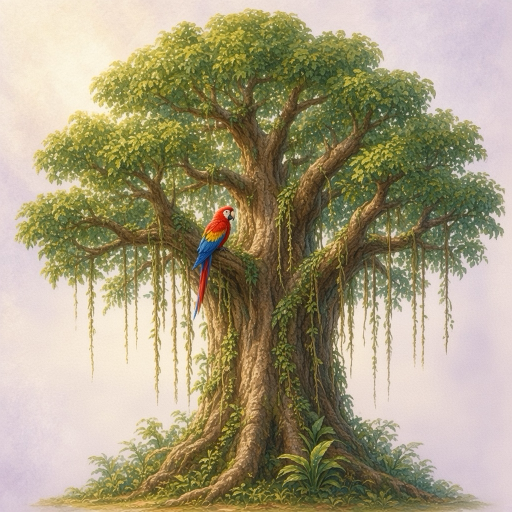
The Amazon Rainforest is the largest tropical rainforest in the world. It is a warm, wet forest in South America, full of tall trees and amazing animals. It is so big that it covers about 2.3 million square miles (6 million sq km). That is more than half of all the rainforest left on Earth.
Why the Amazon is so surprising
The first surprise is the size. The Amazon is so huge that it spreads across nine different countries and territories. Most of it sits in one country, Brazil. If you tried to walk across it, it would take you many weeks.
The second surprise is the rain. The word “rainforest” gives away the secret. Most of the Amazon has a wet season and a drier season, and in the wettest months it can rain nearly every day. All that warm rain helps the giant trees and plants grow thick and green.
The third surprise is how dark it can be on the ground. The tallest trees grow close together and spread their leaves into a leafy roof called the canopy. This roof blocks most of the sunlight. Down on the forest floor, it stays shady even when the sun is shining.
Key facts about the Amazon Rainforest
The Amazon is the largest tropical rainforest on Earth. It covers about 2.3 million square miles (6 million sq km).
It is found in South America. Most of it is in Brazil, and it spreads into eight more countries and territories.
The Amazon River runs right through it. This river carries more water than any other river in the world.
About one in ten of all known animals and plants lives here. That makes the Amazon one of the most crowded places for wildlife.
Jaguars live in the Amazon. The jaguar is the biggest wild cat in North and South America.
Sloths live here too. They are some of the slowest animals on Earth and spend their days high in the trees.
Pink river dolphins swim in the Amazon River. Unlike most dolphins, they live in fresh water, not the salty sea.
The Amazon has layers, like floors of a building. Tall trees make the canopy, and shorter plants grow in the shade below.
People have lived here for thousands of years. Today, millions of people live in and around the forest.
The Amazon is very old. Its forest formed long, long before people ever lived there.
Common myths about the Amazon Rainforest
Myth: The Amazon is a frozen forest with snow. The Amazon is hot and wet, near the middle of the Earth. It never snows there. It is one of the rainiest places on the planet.
Myth: Penguins live in the Amazon. Penguins like cold places near the South Pole, not the warm Amazon. The Amazon is home to jaguars, monkeys, frogs, and colorful birds instead.
Myth: The Amazon is the “lungs of the Earth” and makes most of our air. People often say this, but scientists explain it is not really true. The forest uses nearly all the oxygen it makes as its plants, animals, and microbes live and decompose. Earth’s huge store of breathable oxygen built up over geological time, so no living forest or ocean region supplies most of each breath.
Myth: Nobody lives in the Amazon. People have made their homes in the Amazon for thousands of years. Hundreds of different groups live there today.
Myth: Bright sunlight reaches the whole forest floor. The thick canopy of treetops blocks most of the light. The forest floor stays dim and shady most of the day.
Frequently asked questions about the Amazon Rainforest
Where is the Amazon Rainforest?
The Amazon is in South America, the continent just south of North America. Most of it is in the country of Brazil. It also reaches into eight more countries and territories nearby.
Why is it called a rainforest?
It is called a rainforest because it gets a great deal of rain, especially during the wet season. The warm rain helps the trees and plants grow big and green. A rainforest is any forest that gets a lot of rain all year.
What animals live in the Amazon Rainforest?
So many animals live there. Jaguars hunt near the rivers, slow sloths hang in the trees, and bright frogs hop on the forest floor. Pink dolphins swim in the river, and thousands of kinds of birds fly through the trees.
How big is the Amazon Rainforest?
The Amazon is the largest tropical rainforest in the world. It covers about 2.3 million square miles (6 million sq km). That is more than half of all the rainforest left on the whole planet.
Is the Amazon River really that big?
Yes. The Amazon River carries more water than any other river on Earth. About one fifth of all the river water that flows into the oceans comes from the Amazon. It is so wide in places that no road bridge crosses its main path.
Each of this topic’s quiz questions cites a source for the fact it tests. You can play at any level: Rookie, Curious, Sharp, or Expert.
The Amazon Rainforest is the largest tropical rainforest on Earth. It covers about 2.3 million square miles (6 million sq km) in South America, more than half of all the rainforest left in the world. A tropical rainforest is a warm, wet forest near the equator that gets heavy rain almost all year. The Amazon is famous for its enormous river, its towering trees, and its astonishing variety of wildlife.
Why the Amazon surprises people
Most people picture the Amazon as one country’s forest, but it actually spreads across nine countries and territories: Brazil, Peru, Colombia, Ecuador, Bolivia, Venezuela, Guyana, Suriname, and French Guiana. About 60 percent of it sits in Brazil. The rest is shared by its neighbors.
The river is just as surprising. The Amazon River carries more water than any other river on the planet. It moves about one fifth of all the river water that reaches the world’s oceans, roughly ten times the flow of the Mississippi River. The river is so wide and floods so much each year that no road bridge crosses its main path. People cross by boat or ferry instead.
The biggest surprise of all might be the wildlife. About one in ten of all the species scientists have named on Earth lives in the Amazon. The Amazon River and its tributaries hold more freshwater fish species than any other river system on Earth. A single study estimated the forest holds around 390 billion trees from roughly 16,000 different species.
Key Amazon Rainforest facts
Largest tropical rainforest: About 2.3 million square miles (6 million sq km), over half of the rainforest remaining on Earth.
Nine countries and territories: Most of it is in Brazil, with the rest shared by eight neighbors.
The mighty Amazon River: Carries about one fifth of all the river water that flows into the oceans.
390 billion trees: Belonging to about 16,000 species, according to a major study.
One in ten known species: The Amazon is one of the most biodiverse places on the planet.
Layered forest: The treetops form a canopy that blocks most sunlight, leaving the forest floor in shade.
The jaguar: The largest cat in the Americas and the third-largest cat in the world, after the tiger and lion.
The green anaconda: One of the heaviest snakes in the world, growing up to about 30 feet (9 m) long.
Pink river dolphins: Freshwater dolphins, called botos, that are dark gray when young and pink as adults.
Cattle ranching: Clearing land for cattle is the leading cause of forest loss in the Brazilian Amazon.
Common myths about the Amazon
Myth: The Amazon is the “lungs of the Earth” and makes 20 percent of our oxygen. This is one of the most repeated rainforest myths. Plants release oxygen, but respiration and decay in a mature forest consume nearly all of it, leaving little net addition. Ocean phytoplankton perform a large share of current photosynthesis too, but atmospheric oxygen is a reservoir accumulated over geological time rather than a yearly product of one ecosystem.
Myth: The whole Amazon is inside Brazil. Brazil holds the largest share, about 60 percent, but the forest also reaches into eight more countries and territories. The Amazon is shared by many nations.
Myth: Lions live in the Amazon. Lions live in Africa and a small part of Asia. The big cat of the Amazon is the jaguar, a strong swimmer that often hunts near the water.
Myth: There are bridges all across the Amazon River. The main Amazon River has no road bridge at all. Engineers point out that the bigger reason is not that a bridge would be impossible to build, but that the banks have few roads and few people, so there is little demand for one.
Myth: The Amazon has no people. People have lived in the Amazon for more than 11,000 years. More than 30 million people live there today, including hundreds of distinct groups.
Frequently asked questions
How big is the Amazon Rainforest?
The Amazon is the largest tropical rainforest in the world, covering about 2.3 million square miles (6 million sq km). It sits inside a river basin of roughly 2.7 million square miles (7 million sq km). That single forest holds more than half of all the rainforest still standing on Earth.
Why is the Amazon River so important?
The Amazon River carries more water than any other river. It alone supplies about one fifth of all the river water that reaches the oceans. So much fresh water pours out of it that it dilutes the salt of the Atlantic Ocean far from shore.
What lives in the Amazon Rainforest?
A huge range of life. Jaguars, sloths, capybaras, harpy eagles, pink river dolphins, green anacondas, and poison dart frogs all live there, along with thousands of kinds of birds, fish, and insects. About one in ten of all known species on Earth is found in the Amazon.
Does the Amazon really make most of our oxygen?
No. The “lungs of the Earth” nickname is misleading. The forest uses up nearly all the oxygen it produces, so its net contribution is close to zero. Atmospheric oxygen accumulated over geological time through photosynthesis and the burial of some organic carbon; it does not depend on one ecosystem replenishing each breath. The Amazon still matters for climate because it stores huge amounts of carbon and recycles water.
Why does the Amazon lose forest?
The leading cause of forest loss in the Brazilian Amazon is clearing land for cattle ranching. Trees are also cut for farming and other uses. Conservation groups around the world now work to protect the forest that remains.
Source notes
The figures in this article come from the sources listed above. Area, species, and population facts come from Wikipedia, and the river discharge fact from NASA Earth Observatory. The 390 billion trees estimate comes from a study reported by CBS News, the oxygen myth from National Geographic, and the green anaconda facts from the Smithsonian’s National Zoo. The boto’s color change with age comes from the Animal Diversity Web account maintained by the University of Michigan Museum of Zoology, and the freshwater-fish record from WWF.
Each of this topic’s quiz questions cites a source for the fact it tests. You can play at any level: Rookie, Curious, Sharp, or Expert.
The Amazon Rainforest is the largest tropical rainforest on Earth, covering roughly 2.3 million square miles (6 million sq km) of South America within a basin of about 2.7 million square miles (7 million sq km). It accounts for more than half of the rainforest remaining on the planet and is drained by the Amazon River, which carries more water than any other river. The forest spans nine countries and territories, with about 60 percent lying in Brazil, and holds roughly one in ten of all known species on Earth.
Why the Amazon defies easy summary
The Amazon is hard to grasp because almost every figure attached to it sits at the top of some global ranking, and the popular shorthand for those figures is often wrong. The most famous example is the claim that the forest is the “lungs of the Earth,” producing 20 percent of the world’s oxygen. The reality is more subtle, and the forest’s true importance lies elsewhere.
Scale is part of the difficulty. The basin is so large that a single study of its trees, drawing on more than 1,100 forest surveys, could only estimate the totals: about 390 billion individual trees from roughly 16,000 species. The distribution is strikingly uneven. Around 227 species, the so-called hyperdominants, account for roughly half of all the trees, while thousands of rare species are known from only a handful of individuals.
The river is its own superlative. The Amazon discharges about one fifth of all the river water that reaches the world’s oceans, roughly ten times the flow of the Mississippi. So much fresh water leaves its mouth that it measurably lowers the salinity of the Atlantic far offshore. The river is also so wide, and floods so dramatically each year, that not a single road bridge crosses its main stem.
Quick Amazon Rainforest facts
Area: About 2.3 million square miles (6 million sq km) of forest, more than half of all rainforest left on Earth.
Basin: Roughly 2.7 million square miles (7 million sq km), the largest river drainage system in the world.
Countries: Nine countries and territories, with about 60 percent in Brazil.
River discharge: About 20 percent of global river water reaching the oceans, ten times the Mississippi.
Trees: An estimated 390 billion individual trees from about 16,000 species.
Biodiversity: Roughly one in ten known species on Earth, and more freshwater fish species than any other river system.
Carbon storage: On the order of 90 to 140 billion metric tons held in the forest’s biomass and soils.
People: More than 30 million residents across hundreds of distinct ethnic groups.
The structure of the forest
A tropical rainforest is organized vertically into layers, and the Amazon shows the pattern clearly. At the top is the emergent layer, made of scattered giant trees that rise above the rest, some exceeding 150 feet (45 m). Below them lies the canopy, a dense, continuous roof of leaves and branches that intercepts most of the incoming sunlight. The canopy holds the majority of the forest’s plant and animal life, from monkeys and sloths to countless insects and epiphytes.
Beneath the canopy sit the understory and the forest floor, both deeply shaded. Only a small fraction of sunlight filters down to ground level, which keeps the floor relatively open and dim. The litter of fallen leaves decomposes quickly in the warm, wet conditions, and most of the forest’s nutrients are held in the living plants rather than the soil.
Wildlife of the Amazon
The Amazon’s animal life matches its plant diversity. The jaguar, the largest cat native to the Americas and generally ranked behind tigers and lions by body mass, prowls near rivers and is a capable swimmer. Overhead, the harpy eagle uses exceptionally large talons to hunt arboreal mammals such as monkeys and sloths.
The waters hold their own remarkable species. The Amazon River dolphin, or boto, is a freshwater dolphin that is dark gray as a juvenile and pink as an adult, with males significantly pinker than females; its unfused neck vertebrae let it turn its head to move through the flooded forest. The green anaconda, one of the heaviest snakes on Earth, can reach about 30 feet (9 m) and spends much of its life in slow rivers and swamps. On land, the capybara, the world’s largest rodent, grazes along the riverbanks, while brightly colored poison dart frogs advertise their toxicity on the forest floor.
Many of these species are specialists shaped by the flooded forest. Each year, rising water spreads across vast areas of forest known as varzea and igapo, turning dry ground into a shallow underwater world for months at a time. Fish swim among the tree trunks and feed on fallen fruit, dispersing seeds as they go. The boto follows the water into the trees, and the seasonal pulse of flood and retreat sets the rhythm for fishing, farming, and travel for the people who live along the rivers.
Common myths about the Amazon
Myth: The Amazon produces 20 percent of the world’s oxygen. This is the best-known rainforest misconception. Gross oxygen production is not the same as a net addition to the atmosphere. The forest consumes nearly all the oxygen it produces through respiration and decay, leaving a net contribution close to zero. Ocean phytoplankton also produce oxygen, but today’s atmospheric reservoir accumulated over geological time as a small fraction of organic carbon escaped oxidation and was buried.
Myth: The Amazon’s importance is about oxygen. The forest’s real climate significance is carbon. Its trees and soils store an estimated 90 to 140 billion metric tons of carbon. When forest is cleared and burned, that carbon is released as carbon dioxide, which is why deforestation matters so much.
Myth: The Amazon grows on rich soil. Most Amazonian soils are heavily weathered and low in nutrients, especially phosphorus. The forest’s fertility is locked in its living biomass, and the nutrients cycle rapidly between dying and growing plants rather than building up in the ground.
Myth: Bridges cross the Amazon River. No road bridge spans the main Amazon River. Extreme width, powerful currents, drifting debris, and seasonal flooding all raise the cost, but engineers argue the decisive factor is demand: the banks are thinly populated and served by few roads, so river transport already meets the need.
Myth: The Amazon was pristine, untouched wilderness before modern times. People have lived in the Amazon for more than 11,000 years. Archaeological evidence, including patches of human-made fertile soil, shows large, settled societies shaped the forest long before European contact.
Frequently asked questions
How big is the Amazon Rainforest?
The Amazon covers about 2.3 million square miles (6 million sq km) of forest, sitting within a drainage basin of roughly 2.7 million square miles (7 million sq km). That makes it both the largest tropical rainforest and the largest river basin on Earth. It holds more than half of all the rainforest still standing.
Which countries share the Amazon?
Nine: Brazil, Peru, Colombia, Ecuador, Bolivia, Venezuela, Guyana, Suriname, and French Guiana, an overseas territory of France. Brazil contains by far the largest share, about 60 percent of the forest.
Why is the Amazon River so significant?
It carries more water than any other river, discharging about one fifth of all the river water that reaches the oceans, roughly ten times the Mississippi’s flow. Its volume is so large that the Atlantic is noticeably less salty for many miles beyond the river’s mouth.
Does the Amazon really make most of our oxygen?
No. The “lungs of the Earth” claim is misleading because the forest consumes nearly as much oxygen as it produces. Its net oxygen contribution is close to zero. The atmosphere’s oxygen reservoir accumulated over geological time from photosynthesis and organic-carbon burial, not from the current output of one ecosystem. The Amazon matters far more as a carbon store and part of the water cycle than as an oxygen source.
What is the biggest cause of Amazon deforestation?
Clearing land for cattle ranching is the leading cause in the Brazilian Amazon, followed by other agriculture. Because clearing and burning forest releases stored carbon, deforestation is also a major source of greenhouse gas emissions.
Each of this topic’s quiz questions cites a primary source for the specific fact tested. You can play at any level: Rookie, Curious, Sharp, or Expert.
The Amazon Rainforest is the largest contiguous tropical moist forest on Earth, occupying roughly 2.3 million square miles (6 million sq km) within a drainage basin of about 2.7 million square miles (7 million sq km), the largest river basin on the planet. It spans nine countries and territories, holds on the order of one in ten of all described species, and stores an estimated 90 to 140 billion metric tons of carbon. Its origins as a humid tropical forest trace back tens of millions of years, and its ecology is governed less by rich soil than by tightly cycled nutrients, recycled rainfall, and deep human history.
A forest that makes its own weather
One of the Amazon’s defining features is that it recycles a large share of its own rainfall. Trees draw water from the soil and release it to the atmosphere through transpiration, where it condenses and falls again downwind. These atmospheric moisture streams are nicknamed “flying rivers,” and the volume of water they carry is enormous, comparable to the discharge of the Amazon River itself. The flying rivers transport moisture from the basin toward southern South America, supplying rainfall to regions far from the forest.
This moisture recycling makes the forest partly self-sustaining and partly self-reinforcing. Because each band of forest helps water the next, large-scale clearing can reduce rainfall both locally and far downwind. Researchers studying the system have warned that losing too much forest could weaken the flying rivers enough to shift parts of the basin toward a drier, savanna-like state, a threshold often discussed as a tipping point.
The nutrient paradox
The lushness of the Amazon suggests uniformly fertile ground, but many upland soils are ancient, deeply weathered, and poor in readily available nutrients, especially phosphorus. The vast basin also contains younger and more fertile soils, including sediment-rich floodplains. Much of the forest sustains itself by holding nutrients in living biomass and recycling them rapidly: fallen leaves and wood decompose quickly in the warm, humid conditions, and roots and fungi reclaim the released nutrients before heavy rains can leach them away.
The system still loses phosphorus over time, and one source of replacement is mineral dust lifted from the Sahara, carried across the Atlantic, and deposited over the basin. One NASA satellite analysis estimated average delivery on the order of 22,000 tons of phosphorus a year during the period studied, similar in scale to estimated hydrological losses. The amount varies greatly from year to year, but the transport shows how a desert on one continent can fertilize a rainforest on another.
Terra preta and the human-shaped forest
The idea of the Amazon as pristine wilderness collapses under archaeological scrutiny. Scattered through the basin are patches of dark, exceptionally fertile soil called terra preta, or Amazonian dark earth. These soils are anthropogenic, created by pre-Columbian peoples who enriched the ground with charcoal, pottery fragments, bone, and organic waste over many centuries. The charcoal, a form of what is now called biochar, is porous and chemically stable, allowing the soil to retain nutrients and stay fertile far longer than the surrounding earth.
Terra preta is significant for two reasons. First, it shows that large, organized societies lived in and managed the Amazon long before European contact, contradicting the older view of a sparsely populated, untouched forest. Second, it demonstrates a durable method of building fertility on poor tropical soils, which has drawn modern interest in biochar as a tool for agriculture and carbon storage. Today more than 30 million people live across the Amazon region, including hundreds of distinct ethnic groups, some of whom remain largely isolated from the outside world.
Rivers, blackwater, and whitewater
The hydrology of the Amazon is as distinctive as its ecology. The main river discharges about one fifth of all river water entering the world’s oceans, roughly ten times the flow of the Mississippi, and its plume of fresh water lowers Atlantic salinity hundreds of miles offshore. The basin’s tributaries fall into broad categories that ecologists distinguish by color and chemistry. Whitewater rivers like the Solimoes carry heavy loads of Andean sediment and run pale and turbid. Blackwater rivers like the Rio Negro drain ancient, sediment-poor lowlands and run dark and clear, stained by dissolved plant compounds called tannins.
The contrast is on dramatic display at the Meeting of the Waters near Manaus, where the dark Rio Negro joins the sandy Rio Solimoes. The two run side by side for several miles without mixing, separated by differences in temperature, flow speed, and density rather than any physical barrier. Only downstream, where turbulence overcomes those differences, do the waters finally blend.
The water type also shapes which animals live where. Blackwater systems are acidic and nutrient-poor, generally supporting lower primary productivity while harboring distinctive fish assemblages adapted to the chemistry. Whitewater floodplains, enriched by Andean sediment, are generally more productive and support fish communities that, in turn, sustain dolphins, caimans, and human fisheries. The annual flood pulse links these waters to the forest itself, as months of high water let fish and other animals feed and breed among the inundated trees before the rivers retreat again.
Specialists and superlatives
The Amazon’s animal life includes finely tuned specialists. Jaguars have unusually robust skulls and powerful bites for large cats, adaptations that help them pierce hard-shelled prey and sometimes kill by biting the skull rather than the throat. Harpy eagles use exceptionally large talons to hunt arboreal mammals through the canopy. Absolute cross-species rankings depend on which measurements and specimens are compared.
The rivers hold their own extremes. In a 2019 species description, researchers recognized three electric-eel species and reported one Electrophorus voltai specimen discharging 860 volts, then the highest published voltage measurement for a living animal and above the long-cited benchmark of about 650 volts. The eel generates this charge with thousands of stacked, electricity-producing cells called electrocytes. The Amazon River dolphin, or boto, navigates the seasonally flooded forest using echolocation and a flexible neck made possible by unfused cervical vertebrae, an unusual trait among cetaceans. The basin holds the richest freshwater fish fauna of any river system on Earth, with the peak of species richness in the western Amazon rather than near the river mouth, although totals change as species are described and ranges revised.
The oxygen myth and the carbon reality
No claim about the Amazon is repeated more often, or more incorrectly, than the idea that it supplies 20 percent of the world’s oxygen. Gross oxygen production is not the same as a net addition to the atmosphere. The mature forest consumes nearly all the oxygen it produces through plant respiration and the microbial decay of dead organic matter, so its net contribution is close to zero. Atmospheric oxygen accumulated over geological time as photosynthetic organisms produced oxygen and a small fraction of organic carbon was buried rather than oxidized; it cannot be assigned mainly to any present-day forest or ocean region.
The forest’s genuine climate importance lies in carbon. By holding an estimated 90 to 140 billion metric tons of carbon in its vegetation and soils, the intact Amazon has long functioned as one of the planet’s great carbon sinks, drawing down atmospheric carbon dioxide. That role is now under strain. Studies have found that parts of the basin, particularly the heavily deforested and degraded southeast, have begun emitting more carbon than they absorb, driven by clearing, fire, and drought. A forest that switches from sink to source amplifies the warming it once helped restrain, which is why keeping the standing forest intact is central to its value.
Common myths about the Amazon
Myth: The Amazon produces 20 percent of atmospheric oxygen. The forest’s net oxygen output is near zero because respiration and decay consume nearly everything it produces. The breathable oxygen reservoir accumulated over geological time through photosynthesis and organic-carbon burial, not the current output of one ecosystem.
Myth: The Amazon grows on rich soil. Most of the basin’s soil is nutrient-poor and heavily weathered. Fertility lives in the biomass and is topped up by Saharan dust delivering phosphorus.
Myth: Flying rivers are literal rivers in the sky. They are streams of water vapor produced by transpiration, a metaphor for atmospheric moisture transport, not suspended liquid water.
Myth: The Amazon was untouched before European contact. Terra preta and other archaeological evidence show large, settled societies managed the forest for thousands of years.
Myth: The Amazon will always be a carbon sink. Deforestation, fire, and drought have pushed parts of the basin toward becoming a net carbon source, reversing its historical role.
Frequently asked questions
What are the Amazon’s flying rivers?
They are large flows of atmospheric water vapor generated by the forest’s transpiration. Trees release moisture that condenses and falls as rain downwind, carrying water from the basin toward southern South America. The volume rivals the discharge of the Amazon River, and the system helps the forest sustain its own rainfall.
If the soil is poor, why is the forest so lush?
Because the nutrients are held in the living plants, not the ground, and are recycled quickly. Rapid decomposition and efficient uptake by roots and fungi keep nutrients in circulation, while windborne Saharan dust resupplies phosphorus lost to runoff. The lushness reflects tight nutrient cycling, not rich soil.
What is terra preta?
Terra preta, or Amazonian dark earth, is fertile, charcoal-rich soil created by pre-Columbian peoples. They built it up with charcoal, organic waste, pottery, and bone, producing a soil that stays fertile for centuries. Its existence shows the Amazon was shaped by sizable human societies long before European arrival.
Is the Amazon still a carbon sink?
The intact forest remains a major carbon store, but the basin’s overall balance is shifting. Research indicates that heavily deforested and burned areas now release more carbon than they absorb, while undisturbed forest continues to take up carbon. Protecting standing forest is what preserves the sink.
Does the Amazon make most of the world’s oxygen?
No. The forest consumes nearly all the oxygen it produces, so its net contribution is close to zero. Atmospheric oxygen accumulated over geological time through photosynthesis and the burial of some organic carbon. The Amazon’s climate value lies in carbon storage and water cycling, not in supplying a large share of today’s oxygen.