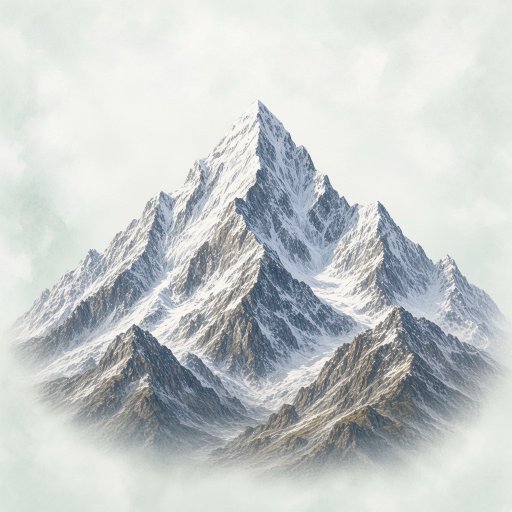
The tallest mountain in the world depends on how you measure it. Mount Everest is the highest peak above sea level, standing 29,032 feet (8,849 m) tall on the border between Nepal and China. Mauna Kea, a volcano in Hawaii, is taller from base to top because most of it is hidden under the ocean. From the seafloor to its summit, Mauna Kea is about 33,500 feet (10,210 m) high.
Why measuring the tallest mountain is tricky
Mount Everest is not the tallest mountain by every measure. Mountains can be measured three different ways, and each way picks a different winner.
The first way is height above sea level. Everest wins at 29,031.69 feet (8,848.86 m). The second way is the full distance from base to top. NOAA identifies Mauna Kea as the winner at more than 33,500 feet (10,210 m), with much of it underwater. The third way is distance from the center of Earth. Earth bulges at the equator. Mount Chimborazo in Ecuador sits near that bulge, so its summit is more than 6,800 feet (2,072 m) farther from Earth’s center than Everest’s.
All three answers are correct. Most people mean Everest by “tallest” because they are comparing height above sea level.
Key facts about the tallest mountains
Mount Everest has an official snow-surface height of 29,031.69 feet (8,848.86 m). Nepal and China jointly announced the figure in 2020. Sagarmatha and Chomolungma are widely used local names.
K2 is the second tallest, at 28,251 feet (8,611 m). It sits in the Karakoram range on the border between Pakistan and China.
There are 14 mountains taller than 26,247 feet (8,000 m). Climbers call them the eight-thousanders. All 14 are in Asia.
Mauna Kea in Hawaii is the tallest mountain from base to summit. From the seafloor to the top, it is about 33,500 feet (10,210 m), taller than Everest.
The Seven Summits challenge uses the highest peak associated with each continent: Everest, Aconcagua, Denali, Kilimanjaro, Elbrus, Vinson, and either Mount Kosciuszko for mainland Australia or Puncak Jaya for the wider Oceania region.
Edmund Hillary of New Zealand and Tenzing Norgay of Nepal were the first to reach the top of Everest, on May 29, 1953. Junko Tabei of Japan was the first woman to reach the top, on May 16, 1975.
Kami Rita Sherpa reached Everest’s summit for a record 32nd time on May 17, 2026.
NASA calls Olympus Mons on Mars the tallest volcano in the solar system. From its broad base it rises about 17 miles (27 km), and its base spans about 373 miles (600 km).
Common myths about tall mountains
Myth: Mountains stay the same size forever. The Indian and Eurasian plates still converge by about 1.6 to 2 inches (4 to 5 cm) per year. Uplift, erosion, glaciers, and earthquakes can all change measured mountain heights, and movement differs from place to place.
Myth: It is easy to climb Everest with the right gear. Above 26,247 feet (8,000 m), the region climbers call the death zone, air pressure is about one-third of sea-level pressure. The percentage of oxygen in air is still about the same, but each breath contains far fewer oxygen molecules. Severe cold, hypoxia, exhaustion, and altitude illness remain dangerous even when climbers use supplemental oxygen.
Myth: Olympus Mons is just a much bigger Everest. Olympus Mons is a broad shield volcano built by lava, not a sharp folded mountain like Everest. Its flanks rise only a few degrees at a time across most of the volcano.
Frequently asked questions
How tall is Mount Everest?
Mount Everest’s official snow-surface height is 29,031.69 feet (8,848.86 m) above sea level. Nepal and China jointly announced that figure in December 2020.
Where is Mount Everest?
Mount Everest is on the border between Nepal and China’s Tibet Autonomous Region. The Nepalese side lies in Sagarmatha National Park.
Why is the air thin on tall mountains?
Gravity holds the atmosphere around Earth. Air pressure falls as altitude increases, so a breath at Everest’s summit contains roughly one-third as many oxygen molecules as a same-sized breath at sea level, even though oxygen remains about 21 percent of the air.
How are mountains made?
Mountains form in different ways. The Himalayas began forming about 40 to 50 million years ago as the Indian and Eurasian plates collided and thickened the crust. Hawaiian mountains such as Mauna Kea grew from repeated volcanic eruptions.
What is the tallest mountain on another planet?
NASA describes Olympus Mons on Mars as the solar system’s tallest volcano. It is a shield volcano about 17 miles (27 km) high from its base and roughly 373 miles (600 km) across.
The world’s tallest mountain depends on the rule you pick for measuring. Mount Everest wins the contest for height above sea level at 29,032 feet (8,849 m). Mauna Kea in Hawaii wins the contest for total base-to-summit height at about 33,500 feet (10,210 m), with most of the mountain hidden under the Pacific Ocean. Chimborazo in Ecuador wins the contest for distance from the center of the Earth, because it sits almost on the equator where the planet bulges outward.
Why measuring the tallest mountain is tricky
A mountain is a piece of rock that rises above the land around it. That sounds simple until you ask where the mountain starts. If you start at sea level, Everest wins. If you start at the bottom of the mountain even when that bottom is underwater, Mauna Kea wins. If you start at the center of the Earth, Chimborazo wins. None of those rules is wrong. They measure different things.
Height above sea level is the standard used on maps, which is why Everest is normally called the world’s highest mountain. Base-to-summit relief and distance from Earth’s center answer different questions.
Mountains are harder to measure than they look. Surveyors need a reference surface, and snow, ice, tectonic motion, and earthquakes can affect measurements. In December 2020, Nepal and China jointly announced Everest’s snow-surface height as 8,848.86 m.
Key facts about the tallest mountains
Mount Everest has an official snow-surface height of 29,031.69 feet (8,848.86 m), jointly announced by Nepal and China in 2020.
Everest, Sagarmatha, and Chomolungma are three widely used names for the mountain in English, Nepali, and Tibetan contexts.
K2 is the second-highest peak at 28,251 feet (8,611 m). It sits in the Karakoram on the Pakistan-China border.
There are 14 mountains taller than 26,247 feet (8,000 m). They are called the eight-thousanders. All 14 are in the Himalaya or Karakoram ranges of Asia. The list: Everest, K2, Kangchenjunga, Lhotse, Makalu, Cho Oyu, Dhaulagiri, Manaslu, Nanga Parbat, Annapurna, Gasherbrum I, Broad Peak, Gasherbrum II, and Shishapangma.
Mauna Kea measures about 33,500 feet (10,210 m) from the seafloor to its summit. Above sea level, only 13,803 feet (4,207 m) of it is visible.
Chimborazo in Ecuador rises only 20,548 feet (6,263 m) above sea level, a height measured by a satellite survey in 2016, but its summit is about 6,800 feet (2,072 m) farther from the center of the Earth than Everest’s summit, because Chimborazo sits about 1.5 degrees south of the equator.
The tallest peaks on each continent are called the Seven Summits. The Bass list uses Mount Kosciuszko in Australia at 7,310 feet (2,228 m). The Messner list uses Carstensz Pyramid in New Guinea at 16,024 feet (4,884 m). The two lists reflect different ways of defining the Australia or Oceania continent.
The first confirmed Everest summit was on May 29, 1953, by Edmund Hillary of New Zealand and Tenzing Norgay of Nepal, on a British expedition led by Colonel John Hunt.
Junko Tabei of Japan was the first woman to summit Everest, on May 16, 1975.
Reinhold Messner of Italy was the first person to climb all 14 eight-thousanders without bottled oxygen. He finished the set in 1986 by reaching the top of Lhotse on October 16.
Kami Rita Sherpa extended his record to 32 Everest summits on May 17, 2026.
NASA calls Olympus Mons on Mars the tallest volcano in the solar system. It rises about 17 miles (27 km) from its base and spans roughly 373 miles (600 km).
Common myths about tall mountains
Myth: Mount Everest is the tallest mountain by every measure. Everest is only the tallest above sea level. Mauna Kea is taller from base to summit, and Chimborazo is farther from the center of the Earth.
Myth: Mountains stop changing once they form. The India-Eurasia collision began about 40 to 50 million years ago and continues. USGS reports plate convergence of about 1.6 to 2 inches (4 to 5 cm) per year and uplift in parts of the range, while erosion and earthquakes also reshape it.
Myth: Bottled oxygen makes Everest safe. Climbers call the region above 26,247 feet (8,000 m) the death zone. Low pressure produces extreme hypoxia, and supplemental oxygen does not remove the risks of altitude illness, cold, exhaustion, falls, or weather.
Myth: All mountains form the same way. Continental collision built the Himalayas by thickening and deforming crust. Repeated lava eruptions built volcanic mountains such as Mauna Kea. Different geological processes produce different mountain shapes.
Myth: Olympus Mons is just a much bigger Everest. Olympus Mons is a shield volcano whose flanks rise only a few degrees at a time. Everest is part of a continent-continent collision zone.
Frequently asked questions
Why is the official height of Everest 29,031.69 feet (8,848.86 m)?
Nepal and China jointly announced 8,848.86 m, or 29,031.69 ft, in December 2020. The announcement identifies it as the snow-surface height based on the international height reference system.
How is Mauna Kea taller than Everest?
Mauna Kea sits on the floor of the Pacific Ocean. Its base is about 19,700 feet (6,000 m) below sea level. From base to summit, it measures about 33,500 feet (10,210 m), which is taller than Everest’s 29,032 feet (8,849 m).
Why does the air get thin on tall mountains?
Air pressure decreases with altitude. Near Everest’s summit it is about one-third of sea-level pressure. Oxygen still makes up about 21 percent of the air, but a same-sized breath contains roughly one-third as many oxygen molecules.
What are the Seven Summits?
The Seven Summits are Everest, Aconcagua, Denali, Kilimanjaro, Elbrus, Vinson, and one of two choices for the final region. The Bass list uses Mount Kosciuszko for mainland Australia. The Messner list uses Puncak Jaya, also called Carstensz Pyramid, for the wider Oceania region.
What is the tallest mountain in the solar system?
Olympus Mons on Mars. NASA describes the shield volcano as about 17 miles (27 km) high from its base and approximately 373 miles (600 km) wide.
The tallest mountain on Earth is Mount Everest only by the standard rule of measuring height above mean sea level, where it stands at 29,031.69 feet (8,848.86 m). Two other definitions produce different winners. Measured from base to summit, the tallest mountain is Mauna Kea on the Big Island of Hawaii, which rises about 33,500 feet (10,210 m) from the Pacific seafloor. Measured as distance from the center of the Earth, the highest point is the summit of Chimborazo in Ecuador, which sits closer to the equatorial bulge of the Earth’s oblate spheroid shape than any peak in the Himalayas.
Why measuring the tallest mountain is tricky
Three definitions of “tallest” coexist because they use different reference surfaces. Mean sea level is the standard used for mapped elevations. Base-to-summit relief depends on where a landform’s base is defined, which is especially important for an oceanic volcano. Distance from Earth’s center accounts for the planet’s equatorial bulge. That bulge puts Chimborazo’s summit farther from the geocenter than Everest’s even though Chimborazo is much lower above sea level.
Even within the sea-level convention, surveyors must specify the reference surface and whether they are reporting snow or rock. Tectonic movement and earthquakes can also shift positions. In December 2020, Nepal and China jointly announced 29,031.69 feet (8,848.86 m) as Everest’s snow-surface height.
Historical surveys used long chains of triangulation from the plains, while modern surveys can combine satellite navigation, gravity measurements, and radar. That change in method is one reason historical Everest heights need context.
Key facts about the tallest mountains
Mount Everest stands at 29,031.69 feet (8,848.86 m) above sea level, the snow-surface height Nepal and China jointly announced in December 2020. Local names include Sagarmatha in Nepali and Chomolungma in Tibetan. The English name honors Sir George Everest, Surveyor General of India from 1830 to 1843.
K2 is the second-highest peak at 28,251 feet (8,611 m). It lies in the Karakoram on the China-Pakistan border. Its survey label combines “K” for Karakoram with the number assigned during the 19th-century survey.
The classic 14 eight-thousanders are Everest, K2, Kangchenjunga, Lhotse, Makalu, Cho Oyu, Dhaulagiri I, Manaslu, Nanga Parbat, Annapurna I, Gasherbrum I, Broad Peak, Gasherbrum II, and Shishapangma. The UIAA uses this classic list while acknowledging debate about the classification of separate peaks.
Mauna Kea measures about 33,500 feet (10,210 m) from its base on the Pacific seafloor, with 13,803 feet (4,207 m) above sea level and approximately 19,700 feet (6,000 m) submerged.
Chimborazo has a sea-level elevation of 20,548 feet (6,263 m) as measured by a 2016 GNSS survey, but its summit lies about 6,800 feet (2,072 m) farther from Earth’s center than Everest’s because Chimborazo sits at roughly 1.47 degrees south of the equator, near the maximum of the equatorial bulge.
The Seven Summits are the highest peaks associated with each continent. Both major lists include Everest, Aconcagua, Denali, Kilimanjaro, Elbrus, and Vinson. The Bass list uses Mount Kosciuszko for mainland Australia, while the Messner list uses Puncak Jaya, also called Carstensz Pyramid, for the wider Oceania region.
The first confirmed Everest summit took place on May 29, 1953, when Edmund Hillary and Tenzing Norgay reached the top at about 11:30 a.m. local time on the British expedition led by Colonel John Hunt.
Climbers call elevations above 26,247 feet (8,000 m) the death zone. Near Everest’s summit, pressure is about one-third of sea-level pressure. Extreme hypoxia compounds cold, fatigue, and weather risk. High-altitude pulmonary edema (HAPE) and high-altitude cerebral edema (HACE) are medical emergencies at altitude.
Junko Tabei of Japan became the first woman to summit Everest on May 16, 1975, as a member of the Japanese Women’s Everest Expedition.
Reinhold Messner completed the first ascent of all 14 classic eight-thousanders in 1986. He climbed every one without supplemental oxygen.
Kami Rita Sherpa extended the record for most Everest ascents to 32 on May 17, 2026.
NASA describes Olympus Mons on Mars as the tallest volcano in the solar system. It rises about 17 miles (27 km) from its base, which spans roughly 373 miles (600 km).
Common myths about tall mountains
Myth: Mount Everest is the tallest mountain on Earth by every measure. Everest is the highest above mean sea level. Mauna Kea is taller measured from its base on the seafloor. Chimborazo is the highest measured from the center of the Earth.
Myth: The Himalayas are finished changing. The collision between the Indian and Eurasian plates began about 40 to 50 million years ago and continues. USGS gives their relative convergence as about 1.6 to 2 inches (4 to 5 cm) per year. Uplift varies across the range and competes with erosion, while earthquakes can produce abrupt local changes.
Myth: Supplemental oxygen controls every Everest risk. Supplemental oxygen can reduce hypoxic stress, but it does not remove the risks of HAPE, HACE, frostbite, falls, exhaustion, or severe weather. Suspected HAPE or HACE requires urgent action; the CDC emphasizes descent and oxygen when available.
Myth: Sherpa is just a job title. Sherpa is the name of an ethnic group native to mountainous Nepal. Many Sherpa people work in mountaineering, but the word names the people rather than a profession.
Myth: George Mallory and Andrew Irvine are confirmed as the first summiters. They disappeared during their 1924 attempt, and the available evidence does not establish that either reached the summit. Hillary and Norgay’s 1953 ascent remains the first confirmed summit.
Myth: Olympus Mons is a steep peak. It is a broad shield volcano. NASA describes slopes that typically rise only a few degrees at a time, despite the volcano’s great total height.
Frequently asked questions
Why does Everest’s official height keep changing?
Surveying methods and precision improve, surveys may distinguish snow from rock, and tectonic or seismic motion can change a summit’s position. A new number can therefore reflect method, definition, physical movement, or more than one of these factors. The 2020 value is specifically a jointly announced snow-surface height.
Why is K2 considered more dangerous than Everest?
K2’s common routes involve sustained steep rock, snow, and ice climbing, and its remote Karakoram setting brings severe weather and difficult rescue logistics. The Abruzzi Ridge route passes the Bottleneck below hanging glacial ice. Exact fatality ratios change with the date range and denominator, so they should not be treated as a fixed property of the mountain.
What is the death zone, and how long can a climber survive there?
The death zone is the mountaineering term for elevations above 26,247 feet (8,000 m). Low pressure causes extreme hypoxia. HAPE affects the lungs; HACE affects the brain. Both can progress rapidly and are medical emergencies. The CDC advises urgent descent for suspected cases when feasible, with oxygen and other treatment as available.
Are the eight-thousanders all in the same range?
The classic 14 lie in the adjoining Himalaya and Karakoram systems of Asia. The UIAA retains this historic list but also explains why topographic prominence has reopened the question of what counts as a separate 8,000-meter peak.
How was the original height of Everest calculated?
Nineteenth-century surveyors observed the peak by triangulation from the plains and had to account for effects such as atmospheric refraction and Earth’s curvature. Modern surveys add satellite navigation, radar, and improved gravity reference models. Results can also differ because one survey reports the rock summit while another reports the snow surface.
What is the tallest mountain in the solar system?
NASA describes Olympus Mons as a shield volcano about 17 miles (27 km) high from its base and approximately 373 miles (600 km) wide. A relatively static Martian crust allowed repeated lava flows to accumulate in one region. Comparing it with impact-basin peaks depends on how base and relief are defined, so “tallest volcano” is the clearest label.
Mount Everest is Earth’s highest mountain above mean sea level at 29,031.69 feet (8,848.86 m), the snow-surface height Nepal and China jointly announced in 2020. Change the reference surface and the answer changes: Mauna Kea rises more than 33,500 feet (10,210 m) from its base on the Pacific seafloor, while Chimborazo’s equatorial location places its summit more than 6,800 feet (2,072 m) farther from Earth’s center than Everest’s. These are different measurements, not competing measurements of the same quantity.
Why measuring the tallest mountain is tricky
The ambiguity is geodetic, not just rhetorical. Elevation above sea level uses a gravity-based reference surface rather than a perfect sphere. Earth also bulges at the equator, so a summit’s distance from the planet’s center depends on both its elevation and its latitude. Chimborazo is much lower than Everest above sea level, but its location close to the equator puts its summit farther from Earth’s center.
Base-to-summit measurement raises a different problem: where does a mountain begin? NOAA’s comparison uses Mauna Kea’s base on the Pacific seafloor and gives a rise of more than 33,500 feet (10,210 m). Only 13,803 feet (4,207 m) of that volcanic edifice stands above sea level.
Sea-level elevation is also sensitive to definitions and methods. Surveys can measure a rock summit or the snow and ice above it, and modern satellite navigation and gravity models differ from nineteenth-century triangulation. Tectonic motion and earthquakes can move rock, but the often-quoted 1.6 to 2 inches (40 to 50 mm) per year is the rate at which India and Eurasia converge, not a universal annual rise for every Himalayan summit.
Key facts about the tallest mountains
Mount Everest (Sagarmatha / Qomolangma) stands 29,031.69 feet (8,848.86 m) above sea level. Nepal and China jointly announced that snow-surface height in December 2020.
K2 stands 28,251 feet (8,611 m) above sea level, making it the second-highest mountain. Its standard routes involve sustained steep climbing and serious objective hazards.
The classic 14 eight-thousanders are Everest, K2, Kangchenjunga, Lhotse, Makalu, Cho Oyu, Dhaulagiri I, Manaslu, Nanga Parbat, Annapurna I, Gasherbrum I, Broad Peak, Gasherbrum II, and Shishapangma. The UIAA uses this classic list while acknowledging that modern topographic criteria have prompted debate about which high points qualify as separate peaks.
The Himalayan collision began roughly 40 to 50 million years ago as India met Eurasia. The plates still converge at about 1.6 to 2 inches (40 to 50 mm) per year, deforming the range and producing major earthquakes. Local uplift and erosion rates vary and should not be confused with that horizontal convergence rate.
Mauna Kea rises more than 33,500 feet (10,210 m) from its base on the Pacific seafloor, although only 13,803 feet (4,207 m) stands above sea level.
Chimborazo stands 20,548 feet (6,263 m) above sea level as measured by a 2016 GNSS survey, but its near-equatorial summit is Earth’s farthest surface point from the planet’s center.
The death zone is the mountaineering term for elevations above about 26,247 feet (8,000 m). The oxygen fraction of the air remains close to 21 percent, but the falling pressure means each breath contains far fewer oxygen molecules. Measurements place Everest summit pressure near 253 Torr (337 mbar), about one-third of sea-level pressure.
Extreme-altitude physiology can be severe even in acclimatized climbers. A field study near 27,559 feet (8,400 m) measured arterial oxygen pressures from 19.1 to 29.5 mmHg. High-altitude pulmonary edema and high-altitude cerebral edema are medical emergencies for which descent is the essential response; oxygen can also be lifesaving when available.
Climbing history includes Edmund Hillary and Tenzing Norgay’s first confirmed Everest ascent on May 29, 1953, Junko Tabei’s first ascent by a woman in 1975, and Reinhold Messner and Peter Habeler’s first ascent without supplemental oxygen in 1978. Messner completed the classic 14 eight-thousanders without supplemental oxygen in 1986.
Kami Rita Sherpa extended the record for most Everest ascents to 32 on May 17, 2026.
The Mallory-Irvine question remains unresolved. George Mallory and Andrew Irvine disappeared during their 1924 attempt, and the available evidence does not establish that they reached the summit.
Olympus Mons is Mars’s tallest volcano. NASA describes it as about 17 miles (27 km) high from base to summit and about 373 miles (600 km) across, with broad, gently sloping flanks.
Common myths about tall mountains
Myth: “Tallest” is unambiguous. The three reference surfaces (sea level, base of edifice, geocenter) are each defensible and each yield different winners. Standard usage selects sea level, but the underlying ambiguity is geodetic, not pedantic.
Myth: Every Himalayan summit rises at the plate-convergence rate. India-Eurasia convergence is largely horizontal shortening across a broad deforming region. Vertical motion differs by location, while erosion and earthquakes can alter surface elevation too.
Myth: The Himalayas formed when India collided with Asia, then stopped. The collision is ongoing. USGS measurements place India-Eurasia convergence at roughly 1.6 to 2 inches (4 to 5 cm) per year, and the active deformation produces earthquakes across the region.
Myth: There is less oxygen in the composition of summit air. Dry air still contains about 21 percent oxygen. The problem is much lower atmospheric pressure, which sharply reduces the amount and partial pressure of oxygen available with each breath.
Myth: Different published Everest heights prove that one survey failed. Historical values used different instruments, gravity models, and summit definitions. The 2020 value explicitly measures the snow surface, so it should not be compared casually with every earlier rock-height estimate.
Myth: Olympus Mons looks like a narrow, pointed terrestrial peak. It is a huge shield volcano with gentle flanks. Its approximately 373-mile (600 km) width is central to understanding its scale.
Frequently asked questions
Why are all 14 eight-thousanders in Asia?
The classic 14 all lie in the Himalaya and Karakoram, where continuing India-Eurasia convergence has thickened and uplifted a vast region. The label is historical as well as numerical: the UIAA notes continuing debate over whether some subsidiary high points should be classified as independent peaks.
Why is K2 substantially more dangerous than Everest at similar elevation?
K2’s standard routes are steeper and more technically demanding than Everest’s most frequently used commercial routes. Climbers also face avalanche and icefall hazards, severe weather, and a more difficult retreat. A fixed claim that K2 is a certain number of times deadlier is misleading because such ratios change with the selected years and denominator.
What controls atmospheric pressure at extreme altitude?
Atmospheric pressure falls rapidly with altitude. Measurements and modeling place Everest’s summit near 253 Torr (337 mbar), about one-third of sea-level pressure. Temperature and weather cause the exact pressure to vary, but the oxygen percentage remains close to 21 percent; it is oxygen’s partial pressure and the number of molecules per breath that fall.
What is the role of orographic uplift in mountain climate?
Air forced over a mountain barrier expands and cools. Condensation and precipitation often favor the windward side, while descending air warms on the lee side and can create a rain shadow. The Himalayas therefore help shape wet monsoon-facing slopes and much drier conditions across parts of the Tibetan Plateau.
Are the Himalayas still rising or eroding faster?
Both processes occur, but there is no single rate for the entire range. Ongoing convergence drives deformation and uplift, erosion removes material, and earthquakes can cause abrupt local movement. The balance differs from one part of the Himalayas to another.
What is the tallest mountain in the solar system?
NASA identifies Olympus Mons as the tallest volcano in the solar system. It rises about 17 miles (27 km) from base to summit and spans about 373 miles (600 km). Mars’s relatively static crust allowed repeated eruptions to build an enormous shield volcano over the same region.