California is a state on the west coast of the United States. It sits right next to the Pacific Ocean. California is famous for sunny beaches, the movies made in Hollywood, and the tallest trees on Earth. More people live in California than in any other US state.
Why California is tricky to understand
Many people guess that Los Angeles is the capital of California. It is not. The capital is Sacramento, where the state government works. Los Angeles is the biggest city, but a capital and the biggest city are not always the same place.
People also think California is warm and sunny everywhere. Most of it is, but not all of it. High in the mountains, called the Sierra Nevada, deep snow falls every winter. People even go skiing there. So California has hot beaches and snowy peaks at the same time.
One more thing surprises people. California is huge. It has sandy beaches, tall mountains, a hot desert called Death Valley, and giant forests. You could spend a whole summer there and still not see it all.
Key facts about California
California is on the west coast. The Pacific Ocean runs along its whole western edge.
The capital is Sacramento. That is where the state makes its laws, not Los Angeles.
Los Angeles is the biggest city. It is the second-biggest city in the whole United States.
California has the most people. About 39 million people live there, more than in any other state.
The tallest trees on Earth grow there. These are the coast redwoods, and the tallest is about 380 feet (116 m) high.
Hollywood makes movies. Film companies moved to this part of Los Angeles in the 1910s. The city became the world’s center for making movies.
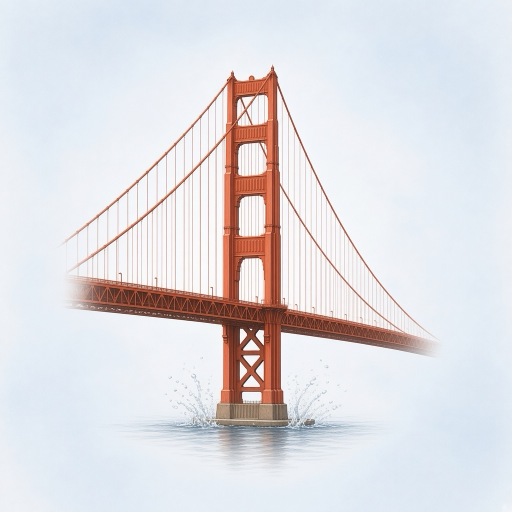
The Golden Gate Bridge is in San Francisco. It is a famous bridge painted bright orange.
California has sunny beaches. People swim, surf, and play in the sand along the Pacific Ocean.
Long ago there was a Gold Rush. Gold was found in 1848, and people rushed in to look for more.
California’s nickname is The Golden State. The nickname became official in 1968 and is strongly associated with the Gold Rush.
Common myths about California
Myth: Los Angeles is the capital of California. The capital is Sacramento. Los Angeles is the biggest city, but the state government works in Sacramento.
Myth: It never gets cold or snowy in California. The Sierra Nevada mountains get heavy snow every winter. People ski and snowboard there, even while beaches far away stay warm.
Myth: California is one big city. California has big cities, but it also has forests, deserts, mountains, and farms. Much of the state is wide open land.
Myth: The grizzly bear on California’s flag still roams the state. Wild grizzly bears used to live in California, but the last one was gone by the 1920s. Today the bear lives on only as a symbol on the flag.
Myth: The tallest trees on Earth are somewhere far away. They grow in California, along the foggy northern coast. The coast redwoods there are the tallest trees on the whole planet.
Frequently asked questions about California
What is the capital of California?
The capital of California is Sacramento. It is the city where the state government works and makes laws. Many people guess Los Angeles, but that is the biggest city, not the capital.
What is the biggest city in California?
Los Angeles is the biggest city in California, home to millions of people. It is also the second-biggest city in the whole United States, after New York City. Lots of movies and TV shows are made in and around Los Angeles.
Why is California called The Golden State?
California’s official nickname is The Golden State. It is strongly associated with the Gold Rush, while golden poppies and dry summer grass also fit the image. Histories offer several influences rather than one proven origin story.
Where are the tallest trees on Earth?
The tallest trees on Earth grow in California, near the cool, foggy northern coast. They are called coast redwoods. The tallest one is about 380 feet (116 m) high, taller than a 30-story building.
Does it ever snow in California?
Yes. High in the Sierra Nevada mountains, heavy snow falls every winter, and people ski and snowboard there. At the same time, beaches near the ocean can stay warm and sunny. California is so big that it can be hot in one place and snowy in another on the same day.
Each of this topic’s quiz questions cites a source for the fact it tests. You can play at any level: Rookie, Curious, Sharp, or Expert.
California is a state on the west coast of the United States, bordered by the Pacific Ocean to the west and Mexico to the south. It is the most populous US state, with about 39 million people. California is also the third-largest state by area, after Alaska and Texas. Inside its borders are some of the most famous places in the country: Hollywood, the Golden Gate Bridge, Death Valley, and the giant redwood forests.
Why California surprises people
A common surprise is the capital. The biggest city is Los Angeles, but the capital is Sacramento. Sacramento has been the capital since 1854, and it is where lawmakers run the state. A capital is chosen for government, not for size, so the two are different cities here.
Another surprise is how different California is from one place to the next. Near the coast, summers are warm and dry, and winters are mild and rainy. In the Sierra Nevada mountains, winters bring heavy snow. Out in Death Valley, summer days are some of the hottest on Earth. All of this fits inside one state.
A third surprise is California’s size and history together. It became a state in 1850, soon after gold was discovered there. The Gold Rush pulled in so many people, so fast, that California grew from a quiet region into a state in just a couple of years.
Key facts about California
California became the 31st state in 1850. It joined the United States on September 9, 1850.
The Gold Rush started in 1848. Gold was found at Sutter’s Mill, and gold seekers poured in during 1849.
The capital is Sacramento. Los Angeles is the largest city, but Sacramento is the seat of state government.
It is the third-largest state. California covers about 163,696 square miles (423,970 sq km), behind Alaska and Texas.
It has the most people. About 39 million people live in California, more than any other state.
Death Valley is one of the hottest places on Earth. The World Meteorological Organization recognizes its 1913 reading as the world air-temperature record, although some researchers dispute that measurement.
The Golden Gate Bridge opened in 1937. It crosses the water where San Francisco Bay meets the Pacific Ocean.
Silicon Valley is the tech center. Many of the world’s biggest technology companies are based near San Francisco Bay.
California borders Mexico. The southern edge of the state is the United States border with Mexico.
California is The Golden State. The nickname is strongly associated with the Gold Rush and became official in 1968.
Common myths about California
Myth: Los Angeles is the capital. Sacramento is the capital and has been since 1854. Los Angeles is the largest city, but it does not hold the state government.
Myth: The forty-niners arrived in 1949. They were named for the year 1849. The Gold Rush happened a full century before 1949, after gold was found in 1848.
Myth: California never gets cold or snowy. The high Sierra Nevada gets heavy snow each winter, enough for ski resorts. Coastal cities stay milder, but the mountains can be deep in snow.
Myth: California is the largest US state. Alaska is the largest, and Texas is second. California is third in size, which still makes it very large.
Myth: Death Valley is too dangerous to visit. Death Valley is extremely hot in summer, but it is a national park that people visit safely with the right planning. Its record heat is part of what makes it famous.
Frequently asked questions about California
When did California become a state?
California became the 31st state on September 9, 1850. It joined the United States soon after the Gold Rush brought a huge wave of new people. Unlike most states, California skipped the usual step of being a territory first and became a state directly.
What was the California Gold Rush?
The California Gold Rush began after gold was discovered at Sutter’s Mill in January 1848. News of the gold spread fast, and in 1849 huge numbers of people traveled to California hoping to strike it rich. Those gold seekers were nicknamed the forty-niners, after the year 1849.
How hot does Death Valley get?
Death Valley is one of the hottest places on Earth. The World Meteorological Organization recognizes a 134 degrees F (56.7 degrees C) reading from 1913 as the world air-temperature record, although some researchers dispute its reliability. Very little rain falls there, and the low, dry desert basin helps push temperatures to extremes.
Why is the Golden Gate Bridge famous?
The Golden Gate Bridge opened in 1937 and crosses the Golden Gate strait near San Francisco. It is famous for its size and its bright orange color, officially called International Orange. People travel from all over the world to see it.
What is Silicon Valley?
Silicon Valley is an area near the southern end of San Francisco Bay in California. Many of the world’s biggest computer and technology companies are based there. The name comes from silicon, a material used to make computer chips.
Does California border another country?
Yes. The southern edge of California is the United States border with Mexico. Cities such as San Diego sit close to that border, and people and goods cross between California and Mexico every day.
Each of this topic’s quiz questions cites a source for the fact it tests. You can play at any level: Rookie, Curious, Sharp, or Expert.
California is a state in the western United States, bordered by the Pacific Ocean to the west, Oregon to the north, Nevada and Arizona to the east, and Mexico to the south. It is the most populous US state, with 39,538,223 residents counted in the 2020 Census, and the third-largest by area at about 163,696 square miles (423,970 sq km). California includes the highest and lowest points in the contiguous United States, the known tallest living tree, the largest known living single-stem tree by volume, and the site of the World Meteorological Organization’s officially recognized air-temperature record. It joined the Union as the 31st state on September 9, 1850.
What is often misunderstood about California
California’s most striking feature is the range packed into its borders. The highest point in the contiguous United States and the lowest point in North America both lie in eastern California, only about 85 miles (137 km) apart. Mount Whitney rises to 14,505 feet (4,421 m) in the Sierra Nevada. Badwater Basin in Death Valley sits about 282 feet (86 m) below sea level. A person can stand on the highest ground in the lower 48 and look out toward the lowest ground in North America within the same state.
The capital is a frequent surprise. Sacramento, not Los Angeles, has served as the state capital since 1854. Los Angeles is the largest city in California and the second-largest in the United States after New York City, but size is not what makes a capital. The seat of the state legislature is what does, and that is Sacramento.
California’s trees illustrate three different kinds of longevity and scale. The coast redwood is the tallest living tree species, and the known tallest individual reaches about 380 feet (116 m). The giant sequoia named General Sherman is the largest known living single-stem tree by trunk volume. Great Basin bristlecone pines are among the oldest known non-clonal living trees, with Methuselah dated to over 4,800 years. People often blur redwoods and sequoias together, but they are distinct species that grow in different parts of the state.
The climate is also widely misjudged. Much of coastal and central California has a Mediterranean climate, with mild, wet winters and warm, dry summers. That does not mean the whole state is warm year-round. The Sierra Nevada gets heavy snow each winter, and the high country can stay buried in snow for months while the coast stays mild.
California’s history as a state is shorter than its fame suggests. It became the 31st state in 1850, only two years after gold was found at Sutter’s Mill in 1848. The Gold Rush brought hundreds of thousands of people in a few years, and the surge in population let California skip the usual organized-territory stage and enter the Union directly. The Gold Rush became strongly associated with the nickname The Golden State, which was made official in 1968; accounts also connect the image to golden poppies and dry summer grass. The grizzly bear pictured on the state flag is a reminder of an earlier California: the California grizzly once lived across the state but was gone from the wild by the 1920s.
Key facts about California
Most populous state. The 2020 Census counted 39,538,223 residents, more than any other US state.
Third-largest by area. California covers about 163,696 square miles (423,970 sq km), behind only Alaska and Texas.
Highest point in the lower 48. Mount Whitney reaches 14,505 feet (4,421 m) in the Sierra Nevada.
Lowest point in North America. Badwater Basin in Death Valley lies about 282 feet (86 m) below sea level.
High and low points are close. Mount Whitney and Badwater Basin sit only about 85 miles (137 km) apart in eastern California.
Official heat record. The World Meteorological Organization recognizes Furnace Creek’s 134 degrees F (56.7 degrees C) reading from July 10, 1913, as the world air-temperature record, although some researchers dispute it.
Tallest trees on Earth. Coast redwoods grow to about 380 feet (116 m) along the foggy northern coast.
Largest known living single-stem tree by volume. The giant sequoia named General Sherman has a trunk volume of about 52,500 cubic feet (1,487 cubic meters).
Among the oldest trees. A bristlecone pine named Methuselah, in the White Mountains, is over 4,800 years old.
Capital and largest city differ. Sacramento is the capital; Los Angeles is the largest city and second-largest in the United States.
Statehood in 1850. California entered the Union as the 31st state on September 9, 1850, as a free state under the Compromise of 1850.
International Orange. The Golden Gate Bridge, opened in 1937, is painted a color officially named International Orange.
Common myths about California
Myth: Los Angeles is the capital of California. Sacramento has been the capital since 1854. Los Angeles is the largest city, but the state government works in Sacramento.
Myth: Mount Whitney is the highest point in North America. Mount Whitney is the highest in the contiguous United States. Denali in Alaska is far higher and is the highest peak in North America.
Myth: Badwater Basin is the lowest point on Earth. Badwater is the lowest point in North America. The shore of the Dead Sea, in the Middle East, lies much lower.
Myth: Redwoods and giant sequoias are the same tree. They are different species. Coast redwoods are the tallest trees; giant sequoias are the most massive by volume. They even grow in different regions of California.
Myth: California is warm everywhere. Coastal California has a Mediterranean climate, but the Sierra Nevada gets heavy snow each winter. Elevation, not just location, shapes how cold a place gets.
Myth: The Death Valley heat record was set recently. The 134 degrees F (56.7 degrees C) reading dates to 1913. It is one of the oldest standing world weather records.
Frequently asked questions about California
What are the highest and lowest points in the contiguous United States?
Both are in California. Mount Whitney, at 14,505 feet (4,421 m), is the highest point in the contiguous United States. Badwater Basin in Death Valley, at about 282 feet (86 m) below sea level, is the lowest point in North America. The two lie only about 85 miles (137 km) apart in eastern California.
What is the hottest temperature ever recorded on Earth?
The World Meteorological Organization recognizes 134 degrees F (56.7 degrees C), measured at Furnace Creek in Death Valley on July 10, 1913, as the world air-temperature record. Some researchers have questioned the measurement’s reliability, but the official record has not been overturned.
What is the difference between a redwood and a giant sequoia?
Coast redwoods and giant sequoias are two different California species. Coast redwoods are the tallest living tree species, with the known tallest individual reaching about 380 feet (116 m), and grow in the foggy coastal belt of northern California. General Sherman, a giant sequoia, is the largest known living single-stem tree by volume; the species grows on the western slopes of the Sierra Nevada. Redwoods are known for height, sequoias for trunk volume.
What is the oldest tree in California?
Some of the oldest known individual living trees on Earth are Great Basin bristlecone pines in the White Mountains of eastern California. The most famous, named Methuselah, is over 4,800 years old. These trees survive in a cold, dry, high-elevation environment that few other plants can tolerate.
Is Sacramento or Los Angeles the capital of California?
Sacramento is the capital and has been since 1854. Los Angeles is the largest city in California and the second-largest in the United States, but it is not the capital. The state legislature and the governor’s office are in Sacramento.
When did California become a state?
California became the 31st state on September 9, 1850, entering the Union as a free state under the Compromise of 1850. It grew so quickly after the 1848 gold discovery that it skipped the usual organized-territory stage and was admitted directly as a state.
Why is the Golden Gate Bridge orange?
The Golden Gate Bridge, which opened in 1937, is painted a deep red-orange officially named International Orange. The bridge’s consulting architect chose the color because it blends with the surrounding hills and stands out against the ocean, the sky, and the fog that often rolls through the strait. Crews repaint the bridge continuously to protect the steel from rust in the salty coastal air. The bridge’s name comes from the Golden Gate strait it crosses, not from its color.
Which big cities are in California?
California has several of the largest cities in the United States. Los Angeles is the biggest, with about 3.9 million residents, followed by major cities including San Diego, San Jose, and San Francisco. The San Francisco Bay Area is also home to Silicon Valley, the center of the United States technology industry. Despite all these cities, much of California remains mountains, deserts, forests, and farmland.
Each trivia question in this topic’s Rookie, Curious, Sharp, and Expert quiz sets cites a primary source for the specific fact it tests.
California is a US state on the Pacific coast of North America, the most populous state with 39,538,223 residents recorded in the 2020 Census, and the third-largest by total area at about 163,696 square miles (423,970 sq km). Its terrain spans the Pacific shore, the Coast Ranges, the broad Central Valley, the Sierra Nevada, and the deserts of the southeast, and it includes both the highest point in the contiguous United States and the lowest point in North America. California sits astride the boundary between two of Earth’s major tectonic plates, a major influence on its faulting, earthquakes, and landscape alongside older subduction and other geological processes. It was admitted to the Union as the 31st state on September 9, 1850.
What is often misunderstood about California
The deepest misunderstanding about California is geological. The San Andreas Fault is not a divergent rift or a simple crack; it is a transform boundary where the Pacific Plate and the North American Plate slide horizontally past each other. The Pacific Plate moves roughly northwest relative to the North American Plate, and the strain that builds along locked sections of the fault is released in earthquakes. The whole San Andreas fault system runs more than 800 miles (1,300 km) through California. The transform boundary drives much of the state’s seismic activity and deforms parts of its landscape, while mountain building also reflects compression, uplift, erosion, and the legacy of older subduction.
The climate is frequently flattened into a single idea of endless sunshine. Much of coastal and central California has a Mediterranean climate, defined by mild, wet winters and warm, dry summers, with most annual precipitation falling between late fall and early spring. This is one of only a handful of regions on Earth with that pattern. It does not describe the entire state. The Sierra Nevada has an alpine climate with heavy winter snowpack, the southeastern basins are true deserts, and the far north is wetter and cooler. The dry-summer pattern is also what makes irrigation so central to California agriculture.
The state’s elevation extremes are closer together than most people expect. Mount Whitney reaches 14,505 feet (4,421 m), the highest summit in the contiguous United States. Badwater Basin in Death Valley lies about 282 feet (86 m) below sea level, the lowest point in North America. These two points are only about 85 miles (137 km) apart in eastern California. The modern Whitney figure of 14,505 feet reflects the current vertical datum; an older survey gave 14,494 feet, a difference that comes from improved measurement of sea level, not from any change in the mountain.
California’s notable trees are also routinely confused. Coast redwoods are the tallest living tree species, with the known tallest individual reaching about 380 feet (116 m), and they grow in a narrow, fog-dependent belt along the northern coast. General Sherman, a giant sequoia of about 52,500 cubic feet (1,487 cubic meters), is the largest known living single-stem tree by volume; giant sequoias grow on the western slopes of the Sierra Nevada. Great Basin bristlecone pines in the White Mountains are among the oldest known non-clonal living trees, with Methuselah dated to over 4,800 years. Height, trunk volume, and age are different distinctions held by different trees in different parts of the state.
California’s economy is often underestimated in scale. If it were a separate country, its total output would rank among the largest in the world. Based on 2024 figures, its economy was reported to rank around fourth globally, ahead of several large national economies. That ranking depends on the year and the measure used, but the broad point holds: California alone produces more than most countries.
Key facts about California
Most populous state. The 2020 Census counted 39,538,223 residents, the largest of any US state.
Third-largest by area. California covers about 163,696 square miles (423,970 sq km), behind Alaska and Texas.
Transform plate boundary. The San Andreas Fault marks the boundary between the Pacific Plate and the North American Plate, sliding past each other along a system more than 800 miles (1,300 km) long.
Highest point in the lower 48. Mount Whitney reaches 14,505 feet (4,421 m) in the Sierra Nevada.
Lowest point in North America. Badwater Basin in Death Valley lies about 282 feet (86 m) below sea level, only about 85 miles (137 km) from Mount Whitney.
Official heat record. The World Meteorological Organization recognizes Furnace Creek’s 134 degrees F (56.7 degrees C) reading from July 10, 1913, as the world air-temperature record, although some researchers dispute it.
Mediterranean climate. Coastal and central California have mild, wet winters and warm, dry summers, with most rain falling in winter.
Central Valley farming. The Central Valley is one of the world’s most productive agricultural regions, growing about 40 percent of the nation’s fruits, nuts, and other table foods on less than 1 percent of US farmland.
Three tree distinctions. Coast redwoods are the tallest living tree species, General Sherman is the largest known living single-stem tree by volume, and White Mountains bristlecone pines include some of the oldest known non-clonal living trees.
Economy among the world’s largest. Measured by total output, California’s economy would rank around fourth in the world if it were a country, based on 2024 figures.
Capital and largest city. Sacramento has been the capital since 1854; Los Angeles is the largest city in California and second-largest in the United States.
Statehood in 1850. California entered the Union directly as the 31st state on September 9, 1850, as a free state under the Compromise of 1850.
Common myths about California
Myth: The San Andreas Fault is where two plates pull apart. The San Andreas is a transform boundary, where plates slide past each other. Plates pull apart at divergent boundaries, which lie mostly along mid-ocean ridges.
Myth: Los Angeles is the capital of California. Sacramento has been the capital since 1854. Los Angeles is the largest city and the second-largest in the United States, but the state government works in Sacramento.
Myth: California has one climate. Coastal and central California have a Mediterranean climate, but the state also has alpine mountains, hot deserts, and wetter northern forests. Elevation and region both shape local climate.
Myth: California farms run on summer rain. California’s Mediterranean climate brings dry summers, so the Central Valley depends heavily on irrigation. Without that water, its output would be far smaller.
Myth: Coast redwoods and giant sequoias are the same species in the same place. They are different species. Coast redwoods grow in the coastal fog belt and are the tallest trees; giant sequoias grow on the western Sierra Nevada slopes and are the most massive by volume.
Myth: California was a US territory for decades before statehood. California skipped the usual organized-territory stage. After the 1848 gold discovery drew a rush of people, it was admitted directly as a state in 1850.
Frequently asked questions about California
What kind of fault is the San Andreas Fault?
The San Andreas Fault is a transform boundary between the Pacific Plate and the North American Plate. Along it, the two plates slide horizontally past each other, with the Pacific Plate moving roughly northwest relative to the North American Plate. The entire San Andreas fault system runs more than 800 miles (1,300 km) through California, and the strain released along it produces the state’s major earthquakes.
Why does California have a Mediterranean climate?
Coastal and central California have a Mediterranean climate, with mild, wet winters and warm, dry summers. The pattern comes from seasonal shifts in pressure systems off the Pacific coast that steer winter storms onto the land and push them away in summer. The result is that nearly all of the yearly rain falls between late fall and early spring, leaving long, dry summers.
How important is the Central Valley to agriculture?
The Central Valley is one of the most productive agricultural regions in the world. On less than 1 percent of US farmland, it grows about a quarter of the nation’s food, including 40 percent of its fruits, nuts, and other table foods. Its flat terrain and long growing season help, but its output depends on large-scale irrigation, since the region’s Mediterranean climate brings little summer rain.
Where are the highest and lowest points in the contiguous United States?
Both are in California, about 85 miles (137 km) apart. Mount Whitney, at 14,505 feet (4,421 m) in the Sierra Nevada, is the highest point in the contiguous United States. Badwater Basin in Death Valley, at about 282 feet (86 m) below sea level, is the lowest point in North America. The pairing of the highest and lowest points of the lower 48 within one state is unusual.
What is the hottest temperature ever recorded on Earth?
The World Meteorological Organization recognizes 134 degrees F (56.7 degrees C), measured at Furnace Creek in Death Valley on July 10, 1913, as the world air-temperature record. It holds that place because a WMO panel that investigated the case in 2010 and 2011 rejected an older reading of 136.4 degrees F (58 degrees C) from El Azizia, Libya, dated September 13, 1922, citing questionable instrumentation, an inexperienced observer, and an unrepresentative observation site. Some researchers question the 1913 figure, but the official record has not been overturned.
How big is California’s economy?
California has by far the largest economy of any US state. Measured by total output, it would rank among the largest economies in the world if it were a separate country. Based on 2024 figures, its economy was reported to rank around fourth globally, ahead of several large national economies. Rankings shift from year to year and depend on the measure used, but California’s economy consistently ranks near the top worldwide.
Why did California become a state so quickly?
The 1848 discovery of gold at Sutter’s Mill set off a rush that brought hundreds of thousands of people to California within a few years. The sudden growth created pressure for full statehood, and California was admitted directly as the 31st state on September 9, 1850, as a free state under the Compromise of 1850. It never passed through the usual organized-territory stage that most states experienced first.
What makes California prone to earthquakes?
California straddles the boundary between the Pacific and North American plates, and the San Andreas Fault is the best-known break along that boundary. The two plates do not slide smoothly; sections of the fault lock together, build up strain over years or decades, and then slip suddenly, producing earthquakes. Because the plate boundary runs the length of the state, many faults beyond the San Andreas itself are active, which is why earthquake preparedness is a feature of daily life in much of California.
How do California’s three record-holding trees differ?
They are three different species associated with different distinctions. The coast redwood is the tallest living tree species, with the known tallest individual at about 380 feet (116 m), and grows in the coastal fog belt of northern California. General Sherman, a giant sequoia of about 52,500 cubic feet (1,487 cubic meters), is the largest known living single-stem tree by volume; the species grows on the western slopes of the Sierra Nevada. The Great Basin bristlecone pine is among the oldest known non-clonal living trees, with Methuselah dated to over 4,800 years, growing high in the White Mountains. No single species holds all three distinctions.