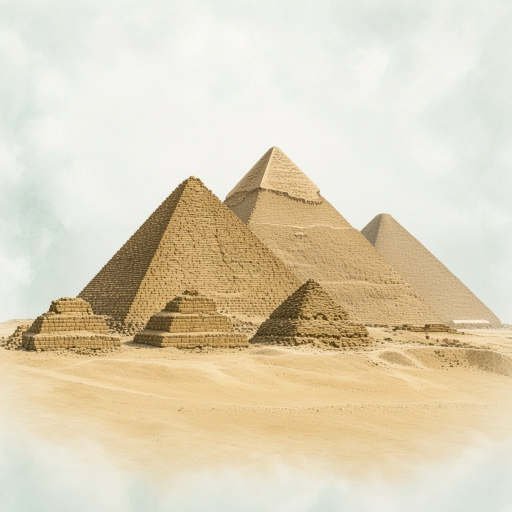
Ancient Egypt was a civilization that grew up along the Nile River about 5,000 years ago and lasted for more than 3,000 years. Egypt was ruled by kings called pharaohs, who built giant stone pyramids, made elaborate tombs filled with treasure, and left behind a writing system that nobody could read for almost 1,500 years after their civilization ended.
Why ancient Egypt is full of surprises
A lot of the most popular ideas about ancient Egypt turn out to be a bit different from what really happened. The pyramids were not built by enslaved people; they were built by paid Egyptian workers who lived in their own villages right next to the building site. Cleopatra, the most famous Egyptian queen, was actually Greek by family. The kid-king Tutankhamun (King Tut) was a small, sickly boy who only became famous thousands of years after he died, when his tomb was finally found.
Ancient Egypt also lasted so long that calling something just “ancient Egyptian” is a bit like calling something just “European.” The Egyptians who built the Great Pyramid lived almost 2,500 years before Cleopatra. To Cleopatra, the Great Pyramid was already an ancient monument.
Key ancient Egypt facts
Egypt was unified around 3100 BCE, when the kingdoms of Upper Egypt and Lower Egypt were joined under one king, often called Narmer. The pharaohs after him wore a special double crown that combined the white crown of the south and the red crown of the north.
The Great Pyramid of Giza was built for the pharaoh Khufu around 2560 BCE. It originally stood about 481 feet (147 m) tall and is made from about 2.3 million giant stone blocks. It was the tallest building in the world for over 3,800 years.
The pyramids were built by paid workers, not by enslaved people. Archaeologists have found the workers’ villages right next to the pyramids, including bakeries, breweries, hospitals, and even the workers’ tombs.
Hieroglyphs are pictures used as writing. The system has about 700 to 1,000 different signs that can stand for objects, sounds, or whole ideas. Only specially trained writers, called scribes, knew how to read and write them.
The Egyptian year had 365 days, the same as our modern calendar. The Egyptians divided their year into 12 months of 30 days, plus 5 extra “festival” days at the end. Their year had three seasons, named after what was happening on the Nile: flood, planting, and harvest.
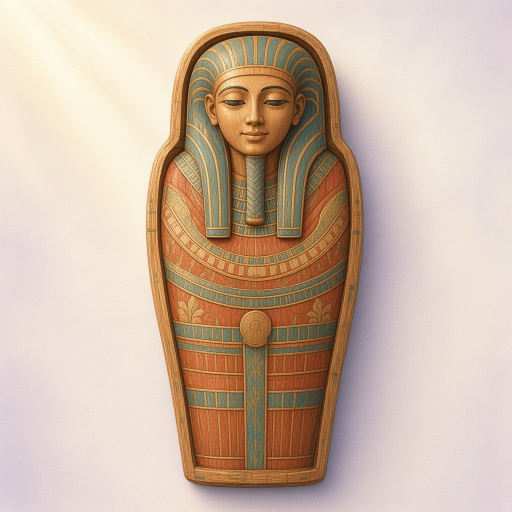
Mummies were made to keep the body safe for the afterlife. Workers covered the body with a kind of natural salt called natron to dry it out, then wrapped it in long strips of linen. The whole process took about 70 days.
Egyptians thought the heart, not the brain, was the most important organ. They left the heart inside the body during mummification and removed the brain.
The Rosetta Stone is a black stone from 196 BCE that has the same message written in three scripts: hieroglyphs, a faster Egyptian script called demotic, and Greek. Because scholars could read the Greek part, the stone became the key that finally unlocked hieroglyphs in 1822.
King Tutankhamun’s tomb was found by Howard Carter in November 1922. It was the only king’s tomb in the Valley of the Kings that had not been thoroughly robbed, so the inside was still full of golden treasure, including King Tut’s famous solid-gold mask.
Cleopatra (Cleopatra VII) was the last pharaoh of Egypt. She lived from 69 to 30 BCE. After she died, Egypt became part of the Roman Empire. Cleopatra was actually Greek, not Egyptian by family, although she did learn the Egyptian language.
The board game Senet was played in Egypt as far back as 3100 BCE, making it one of the oldest known board games in the world. Pieces and boards have been found in tombs, including King Tut’s.
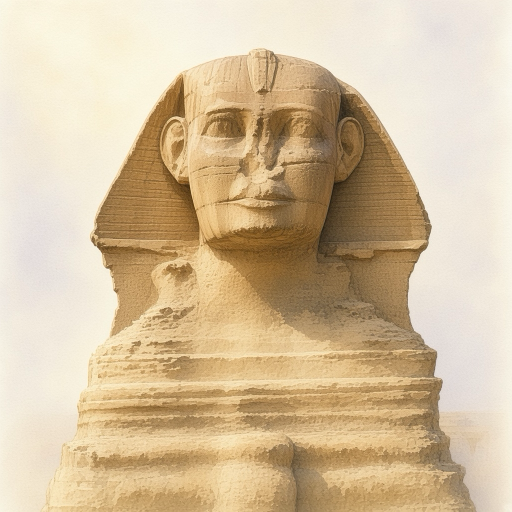
The Sphinx at Giza is a giant stone statue with the body of a lion and the head of a person. It is about 240 feet (73 m) long, carved from a single piece of bedrock, and probably represents an early pharaoh, most likely Khafre.
Common ancient Egypt myths
Myth: The pyramids were built by enslaved Hebrews. No ancient Egyptian writing or modern dig has ever found evidence for this. The workers who built the pyramids were Egyptian, paid in food and beer, and lived in nearby villages. The story of Hebrew enslavement comes from later religious books and is not supported by any Egyptian record.
Myth: The pyramids were built using iron tools. Iron was not in everyday use in Egypt at the time. The Great Pyramid was built with copper chisels, wooden sledges, and ramps. Bronze did not become the common metal for Egyptian tools until much later.
Myth: Cleopatra was Egyptian by family. Cleopatra VII was a member of the Ptolemaic family, which came from Greece. They had ruled Egypt for about 300 years before her. Cleopatra was actually the first Ptolemaic ruler known to have learned the Egyptian language.
Myth: King Tut was a famous and powerful pharaoh in his own time. Tutankhamun was a child when he became king and only ruled for about 9 or 10 years before he died at around age 19. He was not an important king during his life. He is famous today only because his tomb was the only royal tomb in the Valley of the Kings to be found nearly untouched, in 1922.
Myth: The word “pharaoh” means “son of the sun god.” The word pharaoh comes from the Egyptian per-aa, which means “great house” and originally referred to the royal palace itself. Over time, people used it as a polite way to talk about the king without using his real name.
Frequently asked questions about ancient Egypt
Why did the Egyptians make mummies?
The Egyptians believed that a person’s soul needed the body to live in after death. If the body fell apart, the soul would have nowhere to go. To stop the body from rotting, mummy makers dried it out with a salt called natron, took out the organs that would spoil first, and wrapped the body in long strips of linen. The whole process took about 70 days. The Egyptians also made mummies of cats, birds, crocodiles, and even bulls.
How were the pyramids actually built?
The Great Pyramid was built by an organized team of about 20,000 to 30,000 Egyptian workers, working in named crews like “Friends of Khufu.” The workers cut limestone with copper tools, dragged the blocks on wooden sledges across paths kept slippery with poured water, and stacked them up using ramps of earth and rubble. The pyramid was finished in about 20 to 30 years.
Why was finding the Rosetta Stone such a big deal?
For more than 1,400 years, no one in the world could read hieroglyphs. The Rosetta Stone, discovered by French soldiers in 1799 in a town called Rashid (the French called it Rosetta), changed that. The stone has the same official message written three times: in hieroglyphs at the top, in demotic in the middle, and in Greek at the bottom. People in 1799 could already read Greek, so they could match the Greek words to the hieroglyphs. In 1822, the French scholar Champollion finished cracking the system, and ancient Egyptian writing could be read again. The Rosetta Stone has been at the British Museum in London since 1802.
What happened to ancient Egypt in the end?
Ancient Egypt slowly weakened over hundreds of years. It was conquered by the Persians, then by Alexander the Great in 332 BCE, and then ruled for nearly 300 years by Alexander’s general’s family, the Ptolemies. The last Ptolemaic ruler was Cleopatra VII. After her death in 30 BCE, Egypt became a province of the Roman Empire, and the long line of Egyptian pharaohs ended.
Source notes
The history and archaeology in this article come from Britannica’s ancient Egypt entry and the ancient Egypt reference page. The Rosetta Stone is documented at the British Museum, and the Egyptian calendar details come from the linked reference entry.
Ancient Egypt was a civilization on the lower Nile River that lasted from about 3100 BCE to 30 BCE, a span of more than 3,000 years. That is longer than the time between the first Egyptian pharaoh and Cleopatra and the time between Cleopatra and us today. Egypt was famous in its own time for its giant stone monuments, its picture-writing system, and its careful preparation of the dead, and it stayed famous after its end because the dry desert preserved a huge amount of evidence about how its people lived.
Why ancient Egypt is hard to summarize
The civilization is so old, and lasted so long, that “ancient Egyptian” is a bit like the word “European.” It covers thousands of years and dozens of dynasties (royal families). Historians group those dynasties into three big periods of strong central rule, called the Old Kingdom, Middle Kingdom, and New Kingdom, separated by shorter “Intermediate Periods” when Egypt was weaker or split. The Egyptians who built the Great Pyramid (around 2560 BCE) lived 1,300 years before the Egyptians who built the giant Karnak temple, and Cleopatra (69 to 30 BCE) lived closer in time to today than to the building of the Great Pyramid.
A lot of what people think they know about ancient Egypt is also slightly off. The pyramids were not built by enslaved foreigners. Cleopatra was Greek by family. Tutankhamun was a minor child-king who only became famous in 1922. The mummy makers thought the heart, not the brain, was where you did your thinking, and they threw the brain out. Each of these is in the actual historical record; each gets reworded in popular culture all the time.
Key ancient Egypt facts
Unification. Egypt was unified around 3100 BCE under a king often called Narmer (sometimes equated with the legendary Menes). Pharaohs after him wore a double crown that combined the white crown of Upper Egypt (the southern Nile valley) and the red crown of Lower Egypt (the northern Delta), as a sign that they ruled both regions.
Hieroglyphs. Hieroglyphic writing first appears around 3200 BCE, making it one of the oldest writing systems in the world. The system used about 700 to 1,000 different signs, which could stand for whole words, sounds, or “silent classifiers” that told you what category a word belonged to. Two faster, joined-up styles also developed: hieratic (used by priests) and later demotic (used by ordinary scribes).
The Rosetta Stone. In 1799, soldiers in Napoleon’s army in Egypt discovered a black stone slab in the town of Rashid (called Rosetta in French). It carried a single official message from 196 BCE in three scripts: hieroglyphs at the top, demotic in the middle, and Greek at the bottom. After Napoleon’s defeat, the stone passed to British custody under the Capitulation of Alexandria in 1801, and it has been at the British Museum since 1802.
Cracking hieroglyphs. The decipherment of hieroglyphs took more than 20 years. The British scholar Thomas Young showed that royal names were spelled out phonetically inside oval rings called cartouches. The French scholar Jean-François Champollion then proved in 1822 that the same phonetic system worked for native Egyptian names too, not just Greek and Roman ones. Champollion is the famous name, but the work was a team effort across two countries.
The Great Pyramid. Built for the pharaoh Khufu around 2560 BCE during the Fourth Dynasty. It was originally about 481 feet (147 m) tall and is now about 455 feet (139 m) due to erosion and the loss of its outer casing. It contains roughly 2.3 million stone blocks averaging about 2.5 tons (2.3 metric tons) each. The Great Pyramid was once covered in polished white Tura limestone, which was stripped off in the Middle Ages to build parts of medieval Cairo.
How the pyramids were built. The pyramids were built by paid Egyptian workers, not by enslaved foreigners. Excavations at Giza have uncovered the workers’ villages, including bakeries, breweries, hospitals, and named work-gangs (like “Friends of Khufu”). A papyrus discovered in 2013 at Wadi al-Jarf, called the Diary of Merer, even records a specific work crew transporting limestone for the Great Pyramid by boat along the Nile.
The 365-day calendar. The Egyptian civil year had 365 days: 12 months of 30 days each (totaling 360), plus 5 extra “days outside the year.” The year was divided into three seasons named for the Nile cycle: Akhet (flood), Peret (planting), and Shemu (harvest). The Egyptian New Year began with the dawn appearance of the star Sirius, which roughly matched the start of the Nile flood.
Mummification (the 70-day process). The Egyptians believed the soul needed the body to survive after death, so the body had to be preserved. Embalmers removed most of the internal organs (lungs, liver, stomach, intestines) and stored them in canopic jars under the protection of the four sons of Horus. They left the heart in place, because they thought it was the seat of intelligence and feeling. The brain was removed and discarded. The body was then dried with a natural salt called natron for about 40 days and wrapped in long linen strips. The full process took about 70 days.
The afterlife test. In Egyptian belief, the dead person’s heart was weighed against the feather of Ma’at, the goddess of truth and order. If the heart was as light as the feather, the person passed on to the Field of Reeds (Aaru), an ideal version of Egypt. If the heart was heavy with bad deeds, it was eaten by a creature called Ammit, and the person did not pass on. Scenes of this judgment appear in the Book of the Dead, a collection of spells meant to help the soul through the test.
Tutankhamun. A minor king of the late 18th Dynasty who ruled from about 1332 to 1323 BCE and died around age 19. His historical importance was small, and he was almost forgotten until Howard Carter discovered his tomb (KV62) in the Valley of the Kings in November 1922. Tut’s tomb was the only royal tomb in the valley to escape major looting, so the inside, including the famous solid-gold death mask, survived nearly untouched.
Cleopatra VII. The last active pharaoh of Egypt, who lived from 69 to 30 BCE. She was a member of the Ptolemaic dynasty, descended from one of Alexander the Great’s generals, and was Greek by family. She was the first member of her dynasty known to have learned the Egyptian language. After her death in 30 BCE, Egypt became part of the Roman Empire.
Women’s legal rights. Egyptian women had more legal independence than women in many other ancient societies. They could own property, inherit it, sign contracts, sue in court, get divorced, and act as witnesses without needing a male representative. Several women ruled as pharaoh in their own right, including Hatshepsut in the New Kingdom, who reigned for about 21 years and built one of Egypt’s most famous temples at Deir el-Bahari.
Senet, the oldest board game.Senet was a two-player board game played on a 30-square grid. Boards have been found in tombs dated back to about 3100 BCE, making Senet one of the oldest known board games in the world. Tutankhamun was buried with several sets.
Common ancient Egypt myths
Myth: The pyramids were built by enslaved Hebrews. No Egyptian record from the time mentions a Hebrew enslaved labor force, and excavations at the workers’ villages at Giza show paid Egyptian crews who ate well, lived in dedicated housing, and were buried with honor when they died. The Hebrew enslavement story comes from much later religious texts and is not supported by Egyptian evidence.
Myth: The Great Pyramid was built using iron tools. Iron was rare in Egypt during the Old Kingdom and not yet used for everyday tools. The pyramid was built with copper chisels, wooden sledges, ramps of earth and rubble, and very large numbers of skilled human workers. Bronze did not become the usual metal for Egyptian tools until the New Kingdom, and Egypt entered the Iron Age only in the Late Period, nearly 1,900 years after Khufu.
Myth: Cleopatra was ethnically Egyptian. Cleopatra VII was a descendant of Ptolemy I, a Macedonian Greek general of Alexander the Great. The Ptolemaic dynasty kept its Greek language and culture for about 300 years. Cleopatra’s reported ability to speak Egyptian was unusual for her family, not the rule.
Myth: The pharaoh’s title means “son of the sun god.” The word pharaoh comes from the Egyptian per-aa, meaning “great house” and originally referring to the royal palace itself. The Egyptians sometimes called the king sa-Ra (“son of Ra”) in religious texts, but that is a separate phrase. The word “pharaoh” itself has nothing to do with “son of Ra.”
Myth: Champollion alone deciphered hieroglyphs in a single moment of insight. The decipherment took place over more than two decades. Thomas Young (working from 1814 to 1819) showed that royal names inside cartouches were spelled out phonetically. Champollion (in 1822) extended that idea to the rest of the writing system. Both contributions were needed; neither was sufficient on its own.
Frequently asked questions about ancient Egypt
How long did ancient Egypt actually last?
The dynastic period, when Egypt was ruled by pharaohs, lasted from about 3100 BCE to 30 BCE, more than 3,000 years. To put that in perspective, the Roman Empire lasted about 1,500 years; the United States is just under 250 years old. Egyptologists divide that long span into the Early Dynastic period, the Old Kingdom (the pyramid builders, around 2700 to 2200 BCE), the Middle Kingdom, the New Kingdom (Tutankhamun, Ramesses II, Hatshepsut, around 1550 to 1070 BCE), the Late Period, and finally the Greek and Roman periods.
How did the Egyptians build the pyramids?
Modern archaeology combines several lines of evidence: copper tools used to cut and shape the limestone blocks, wooden sledges dragged on prepared roads with water poured in front to reduce friction (a tomb painting from around 1880 BCE shows exactly this technique), earthen and wraparound ramps for raising the blocks, and a workforce of about 20,000 to 30,000 Egyptian laborers organized into named work-gangs of about 1,000 men each. The 2013 discovery of the Diary of Merer at Wadi al-Jarf gave a first-person papyrus record of one such gang transporting limestone for the casing of Khufu’s pyramid by boat down the Nile.
Why did the Egyptians remove the brain but keep the heart?
In Egyptian medicine and religion, the heart (ib) was the center of thought, memory, decision-making, and identity. It was the organ that would be tested in the afterlife. The brain was thought to be a less important organ, with no clear function. During the 70-day mummification process, the heart was preserved in place, the lungs, liver, stomach, and intestines were stored in canopic jars, and the brain was extracted (often through the nostrils with a hooked tool) and discarded.
Who actually deciphered hieroglyphs?
The decipherment of hieroglyphs spanned about two decades and two countries. The British polymath Thomas Young worked out, between 1814 and 1819, that royal names inside cartouches were spelled phonetically and identified some sound values. The French scholar Jean-François Champollion, building on Young’s work and on his own knowledge of Coptic (a later form of the Egyptian language still used in some Egyptian Christian church services), announced in 1822 that the phonetic principle covered the whole writing system. The famous modern image of “Champollion alone in a flash of insight” leaves Young’s contribution out of the picture.
Why is King Tutankhamun so famous if he was a minor king?
Tutankhamun’s reign was short, his policies were unremarkable, and he died young. His fame is almost entirely due to the survival of his tomb. Most of the kings buried in the Valley of the Kings had their tombs broken into and stripped within centuries of burial. Tut’s tomb, KV62, was hidden under workers’ rubble from a later king’s tomb, and it was missed by ancient grave-robbers. When Howard Carter found it in November 1922, the inside was still full of golden funeral equipment, including the king’s solid-gold death mask. Tut became famous in death in a way he never was in life.
Ancient Egypt was a civilization of the lower Nile valley that lasted from approximately 3100 BCE to 30 BCE, a span of over 3,000 years. It was unified under a single king around 3100 BCE by the legendary first pharaoh Narmer (often equated with Menes) and ended with the Roman annexation following the death of Cleopatra VII in 30 BCE. Few civilizations in human history have lasted as long, and none has produced a more recognizable visual identity: the pyramids of Giza, the Sphinx, the gold mask of Tutankhamun, and the painted tomb walls of the Valley of the Kings remain among the most universally identifiable images of any past society.
Why ancient Egypt resists casual summary
Three properties of the civilization complicate generalization.
The first is its extreme duration. Calling something “ancient Egyptian” without specifying a kingdom or dynasty is like saying “European” without specifying a country or century. The Egyptians who built the Great Pyramid (around 2560 BCE during the Fourth Dynasty) lived about 1,300 years before the Egyptians who built Karnak’s Hypostyle Hall (around 1250 BCE), a gap wider than the one separating us from the Norman conquest of England. Cleopatra VII (69 to 30 BCE) lived closer in time to the modern smartphone than to the construction of the Great Pyramid.
The second is the well-defined chronological framework. Egyptologists conventionally divide the dynastic period into three “kingdoms” of strong central rule (Old, Middle, New) separated by three “intermediate periods” of fragmentation, plus a Late Period and a Greco-Roman period at the end. The 30-dynasty division comes from Manetho, an Egyptian priest who wrote a history of Egypt in Greek under the first two Ptolemies in the third century BCE. He grouped the kings into ruling houses, though some of his dynastic breaks mark a move of the capital or a shift in the center of power rather than a change of family. The kingdom-and-intermediate-period labels are far more recent, introduced by European Egyptologists between the 1840s and the 1970s. The numbering is a useful organizing structure, not a religious or political claim.
The third is the persistent gap between popular imagery and historical reality. Tutankhamun was a minor king of no military importance. Cleopatra was Greek by descent. The pyramids were built by paid Egyptian laborers, not by enslaved Hebrews. The Rosetta Stone was deciphered through the combined work of several scholars, not by Champollion alone. Each of these is well-supported by primary sources, and each is regularly misstated in popular treatments.
Key facts about ancient Egypt
Chronology. The dynastic period spans approximately 3100 BCE to 30 BCE: Early Dynastic (1st-2nd Dynasties), Old Kingdom (3rd-6th, including the pyramid builders), First Intermediate Period, Middle Kingdom (11th-12th), Second Intermediate Period (the Hyksos), New Kingdom (18th-20th, including Tutankhamun, Hatshepsut, Akhenaten, and Ramesses II), Third Intermediate Period, Late Period, and the Ptolemaic / Roman periods.
Unification. Egypt was unified around 3100 BCE under Narmer, often equated with the legendary Menes. The pharaonic regalia after unification combined the white crown of Upper Egypt (Hedjet, southern Nile valley) and the red crown of Lower Egypt (Deshret, the northern Delta) into the double crown (Pschent).
Hieroglyphic writing. Hieroglyphic writing first appears around 3200 BCE, making it among the oldest writing systems in the world. The system used roughly 700 to 1,000 distinct signs in the classical period, combining logograms (a sign for a whole word), phonograms (a sign for a sound), and determinatives (silent classifiers indicating semantic category). Two cursive descendants developed: hieratic (priestly) and later demotic (popular).
The Rosetta Stone. Discovered by French soldiers in 1799 near the Egyptian town of Rashid (Rosetta), the stone bears a single decree by Ptolemy V from 196 BCE inscribed in three scripts: hieroglyphic, demotic, and Greek. After France’s defeat in Egypt, the stone passed to British custody under the Capitulation of Alexandria in 1801 and has been displayed at the British Museum since 1802.
Hieroglyphic decipherment.Jean-François Champollion announced his breakthrough in Lettre à M. Dacier in September 1822 by demonstrating that hieroglyphs are partially phonetic and identifying the names of Greek and Roman rulers in cartouches. Champollion built directly on prior work by the British polymath Thomas Young, who had already established that cartouches contained royal names and that some hieroglyphs were phonetic. The decipherment was a collaborative achievement spread across more than a decade.
The Great Pyramid. Built for Khufu (Cheops) around 2560 BCE during the Fourth Dynasty. Original height approximately 481 feet (147 m), since reduced by erosion to about 455 feet (139 m). It contains roughly 2.3 million stone blocks averaging about 2.5 tons (2.3 metric tons) each. The pyramid was originally encased in polished white Tura limestone, which was stripped during the Middle Ages for use as building material in Cairo.
Pyramid labor. Excavations by Mark Lehner and Zahi Hawass at the Giza pyramid-builders’ settlement have produced clear evidence of paid laborers receiving rations of bread, beer, and meat, organized into named work-gangs (“Friends of Khufu”), housed in dedicated villages, and treated for orthopedic injuries. The popular narrative of Hebrew slave labor has no historical basis; the pyramids were built by Egyptian conscripts and skilled artisans.
Mummification. The Egyptian belief system identified the heart (ib), not the brain, as the seat of intelligence and the soul. During mummification, the brain was removed (typically liquefied and extracted through the nostrils with a hooked tool) and discarded. The viscera were removed and preserved in canopic jars under the protection of the four sons of Horus. The heart was left inside the body for later weighing in the afterlife.
The afterlife judgment. In the Book of the Dead, the deceased’s heart was weighed against the feather of Ma’at (truth and cosmic order). If the heart was lighter than or equal to the feather, the soul passed to the Field of Reeds (Aaru), a fertile paradise resembling an idealized Egypt. If heavier, the heart was devoured by the monster Ammit (“Devourer of the Dead”), a composite of crocodile, lion, and hippopotamus, and the soul was destroyed.
The civil calendar. The Egyptian civil year had 365 days: twelve months of 30 days totaling 360, plus five intercalary “days outside the year.” The year was divided into three seasons of four months each: Akhet (inundation), Peret (emergence / sowing), and Shemu (harvest). The civil New Year was tied to the heliacal rising of Sirius (Sopdet), the first dawn appearance of the star after a 70-day absence, which coincided with the start of the Nile flood.
Cleopatra VII. The last active pharaoh of Egypt was Cleopatra VII Philopator (69 to 30 BCE), a Greek-Macedonian descendant of Ptolemy I, one of Alexander the Great’s generals. She was the first member of the Ptolemaic dynasty (305 to 30 BCE) reported to have learned the Egyptian language; her predecessors spoke Greek. Egypt became a Roman province following her death by suicide in 30 BCE.
Tutankhamun. A minor king of the late 18th Dynasty, who reigned from approximately 1332 to 1323 BCE and died around age 19. His historical importance is small; his fame is entirely a product of the November 1922 discovery by Howard Carter of his nearly intact tomb (KV62) in the Valley of the Kings, the only royal tomb to escape major looting.
Senet and other recreations.Senet, a board game played on a 30-square grid, has been recovered from tombs dated to approximately 3100 BCE, making it one of the oldest known board games in the world. Children’s toys recovered from Egyptian tombs include wooden dolls with movable limbs, pull-toys on wheels, leather balls, and spinning tops.
Women’s legal rights. Egyptian women held more legal autonomy than women in most other ancient societies. They could own and inherit property, enter into contracts, sue and be sued in court, initiate divorce, and serve as witnesses without male intermediaries. Several women, most notably Hatshepsut in the New Kingdom, reigned as pharaoh in their own right.
Common misconceptions about ancient Egypt
Misconception: The pyramids were built by enslaved Hebrews. No primary or contemporary source supports the claim. Excavations of the workers’ villages at Giza show paid Egyptian labor under organized state administration. The Hebrew enslavement narrative comes from much later religious texts and is not corroborated by any Egyptian or independent ancient source.
Misconception: The Great Pyramid was built using iron tools. Iron metallurgy was not in widespread use in Egypt during the Old Kingdom. The pyramids were built using copper tools, wooden sledges, earthen ramps, and large-scale human labor. Bronze became the usual metal for Egyptian tools only in the New Kingdom, and Egypt entered the Iron Age in the Late Period, nearly 1,900 years after Khufu.
Misconception: Cleopatra was ethnically Egyptian. Cleopatra VII was the descendant of Ptolemy I, a Macedonian Greek general of Alexander the Great. The Ptolemaic dynasty maintained relatively strict Greek cultural and linguistic identity through approximately 300 years of rule. Cleopatra’s reported ability to speak Egyptian was unusual for her dynasty rather than expected.
Misconception: The pharaonic title means “son of Ra.” The word pharaoh derives from the Egyptian per-aa, meaning “great house” and originally referring to the royal palace itself. The word came to be used for the king as a metonym in the New Kingdom and was preserved in Greek as pharaō. It has no etymological connection to “son of Ra,” though the king was indeed regarded as a son of the sun god Ra in religious doctrine.
Misconception: Champollion deciphered hieroglyphs alone in a flash of insight. The decipherment was incremental. Thomas Young identified that royal cartouches contained phonetic spellings of foreign rulers’ names (notably Ptolemy and Berenice) by 1814 to 1819. Champollion’s 1822 Lettre à M. Dacier extended the phonetic principle to native Egyptian names, recognizing the bilingual structure of hieroglyphic writing. Both contributions were necessary; neither was sufficient alone.
Frequently asked questions about ancient Egypt
How was the Great Pyramid actually built?
The current consensus combines several lines of evidence: copper tools for cutting limestone, a total Giza workforce of roughly 20,000 to 30,000 men organized into named crews of about 2,000 each and sub-divided into gangs of about 1,000, wooden sledges dragged on prepared roadways with water poured in front to reduce friction (depicted in the tomb of Djehutyhotep around 1880 BCE), and earthen or wraparound ramps for vertical movement. Recent papyri found at Wadi al-Jarf in 2013, the Diary of Merer, document a crew transporting Tura limestone for the casing of Khufu’s pyramid by boat along the Nile. The pyramid was completed in approximately 20 to 30 years.
Why did the Egyptians remove the brain but preserve the heart?
Egyptian medical and religious texts identified the heart (ib) as the seat of thought, memory, intention, and moral judgment, the organ that would face judgment in the afterlife. The brain was understood as a generator of mucus or as a passive organ of unclear function. During the 70-day mummification process, the heart was preserved in place; the lungs, liver, stomach, and intestines were removed, dehydrated with natron, and stored in canopic jars; and the brain was extracted (often through the nostrils) and discarded.
What is the Rosetta Stone, and why did it matter?
The Rosetta Stone is a granodiorite stele bearing a single decree of Ptolemy V, dated to 196 BCE, in three scripts: hieroglyphic (top), demotic (middle), and Greek (bottom). The Greek text was readable in 1799; the other two were not. Because the three texts were known to express the same content, the stone provided the bilingual key needed to decode hieroglyphic writing. Champollion’s 1822 work cracked the system using the cartouches of Ptolemy and Cleopatra as anchor points. The Rosetta Stone has remained on display at the British Museum since 1802; modern requests from Egypt for repatriation have not been granted.
Who actually deciphered hieroglyphics?
The decipherment was a collaborative process spanning approximately two decades. The British scholar Thomas Young, working from 1814, established that hieroglyphic cartouches contained phonetic spellings of foreign royal names and identified individual phonetic values. The French scholar Jean-François Champollion, drawing on Young’s work and on Coptic linguistic evidence, demonstrated in 1822 that the phonetic principle extended to native Egyptian names and to the writing system as a whole. Champollion is the figure most associated with the decipherment because of the conceptual completeness of his 1822 announcement, but Young’s prior contribution remains essential.
How accurate is the popular image of King Tutankhamun?
It is largely a product of his tomb’s preservation and of subsequent media attention. Tutankhamun’s reign was brief, confined to childhood and adolescence, and unremarkable in policy. CT-scan and DNA analyses published in JAMA in 2010 indicated multiple congenital conditions and a death around age 19, possibly from complications following a leg fracture compounded by malarial infection. His tomb (KV62) was the only royal tomb in the Valley of the Kings to escape thorough looting, which is why the funerary equipment, including the gold death mask, survived intact.
Ancient Egypt denotes the dynastic civilization of the lower Nile valley, conventionally dated from the unification of Upper and Lower Egypt around 3100 BCE to the Roman annexation of Ptolemaic Egypt in 30 BCE. The civilization is the longest continuous political-cultural entity for which a fully recognized chronology exists: more than 3,000 years of pharaonic rule across the 30 dynasties of Manetho’s scheme, to which a 31st and sometimes a 32nd are added for the later Persian and Macedonian rulers, spanning three major kingdoms and three intermediate periods, followed by Late Period foreign domination (Persian, Macedonian) and the Ptolemaic-Roman epoch. Egypt’s combination of strong central administration, hieroglyphic record-keeping, monumental construction, and arid preservation conditions has made it the most archaeologically productive of all ancient civilizations and the foundational test bed for modern field archaeology.
Two features structure the modern study of pharaonic Egypt. First, the chronology rests on a hybrid framework combining Manetho’s Hellenistic dynastic system, internal Egyptian king lists (the Palermo Stone, the Turin King List, the Abydos and Saqqara king lists), astronomical synchronisms (especially the heliacal rising of Sirius, Sothis), and radiocarbon calibration. The dating is densely cross-checked but carries non-trivial uncertainties at the century scale through the Old Kingdom and at the decade scale through the New Kingdom. Second, the linguistic record is unbroken from the late fourth millennium BCE Predynastic to medieval Coptic, providing roughly 4,500 years of continuous attestation in the same lineage. The Coptic survival was decisive in the 1822 hieroglyphic decipherment.
Why ancient Egyptian chronology resists tidy summary
Three properties of the dynastic record complicate confident dating.
The first is the synthetic origin of the dynastic framework itself. The 30-dynasty division was constructed by Manetho of Sebennytos, an Egyptian priest (probably of Ra at Heliopolis) who wrote a Greek-language history of Egypt, the Aegyptiaca, under Ptolemy I Soter or Ptolemy II Philadelphus in the early third century BCE. The original work is lost and survives only through later epitomes (Africanus, Eusebius, Syncellus) and Josephus’s polemical citations. Modern Egyptologists retain Manetho’s dynastic numbering as a useful organizational device while recognizing that his dynastic breaks are not purely familial: several mark a move of the royal capital or a shift in the center of political power rather than a change of ruling house. The regnal figures preserved in the epitomes also disagree with one another, since the reign length given for the same king often varies substantially from one intermediate source to the next, so they are corrected against contemporary Egyptian documents wherever possible.
The second is the layered nature of the absolute-dating evidence. Egyptian civil-calendar dating provides relative chronology with high precision (the year of a king’s reign and the day of the regnal-year are routinely recorded), but absolute calibration requires astronomical anchors. The most famous is the Sothic cycle, the 1,460-year period over which the heliacal rising of Sirius drifts through the 365-day civil calendar. Three Sothic observations from the Middle and New Kingdoms (the Illahun papyrus, Ebers papyrus, and Elephantine records) provide nominal anchors, but their interpretation depends on the assumed observation latitude and on whether the civil calendar was strictly 365 days throughout. The result is competing “high,” “middle,” and “low” chronologies that differ by roughly 50 to 150 years through the early second millennium BCE. Radiocarbon calibration from the Bronk Ramsey 2010 Science synthesis has substantially narrowed the range while showing that some previous historical estimates were too late.
The third is the discontinuity introduced by the three Intermediate Periods. The First Intermediate Period (Dynasties 7 through 10 and part of the 11th), Second Intermediate Period (Dynasties 13 through 17, including Hyksos rule from Avaris), and Third Intermediate Period (Dynasties 21 through 25) are characterized by political fragmentation, overlapping regional kingships, and partial loss of the documentary record. Rival lines in these periods ruled at the same time rather than in sequence, so their regnal totals cannot simply be added, which leaves the elapsed length of each period less securely fixed than a continuous succession would allow.
Key facts at expert level
Linguistic stages. The Egyptian language is the only attested member of its branch of Afro-Asiatic. Five chronological stages are conventionally distinguished: Old Egyptian (Old Kingdom, c. 2700-2200 BCE), Middle Egyptian (the classical literary language, used as a prestige register through the New Kingdom), Late Egyptian (vernacular of the New Kingdom), Demotic (Late Period through Ptolemaic), and Coptic (Greek-script Egyptian, Christian-era through medieval). Coptic survived in liturgical use in the Coptic Orthodox Church and was the linguistic key to Champollion’s decipherment.
Hieroglyphic writing system. The script comprises roughly 700 to 1,000 signs in the classical period (expanded to several thousand under Ptolemaic and Roman rule). Each sign functions as one of three sign types depending on context: logogram (a sign for a whole word), phonogram (a sign for a sound, encoding 1 to 3 consonants without vowels), and determinative (an unpronounced classifier indicating the semantic field of the preceding word). Two cursive descendants developed: hieratic (a chancery script used for administrative and religious documents) and later demotic (a more rapidly written script for everyday and legal use).
Manetho’s dynastic system. Manetho’s Aegyptiaca (early third century BCE) divided pharaonic history into 30 dynasties, to which a 31st is often added for the Second Persian Period (343 to 332 BCE). Modern Egyptology retains the dynastic numbering largely unchanged. The kingdom-and-intermediate-period overlay was added by European scholars much later: Christian von Bunsen proposed the Old, Middle, and New Kingdom division in the 1840s in Ägyptens Stelle in der Weltgeschichte, and the intermediate-period labels followed in the twentieth century: Georg Steindorff and Henri Frankfort introduced the First in 1926 and Hanns Stock the Second in 1942, while the Third came into general use later in the century, entrenched by the title of Kenneth Kitchen’s study of the period, whose author wrote that he would have preferred the term be abolished in favor of “Post-Imperial epoch”.
Sothic dating and the civil calendar. The Egyptian civil year had exactly 365 days (12 months of 30 plus 5 epagomenai), shorter than the tropical year by about a quarter day. Without intercalation, the civil New Year drifted relative to the solar year by one full day every four years and one full year every approximately 1,460 years (one Sothic cycle). Ancient observers noted the heliacal rising of Sirius (called Sopdet, Sothis in Greek) returning to a fixed civil date once per Sothic cycle. Three documented Sothic risings from the Middle and New Kingdoms anchor the Egyptian chronology to the Julian calendar, with residual uncertainty from the latitude of observation (Memphis vs Thebes vs Elephantine).
The Great Pyramid logistics. Construction of Khufu’s Great Pyramid (c. 2580-2560 BCE) is documented from multiple complementary sources. The internal architecture (King’s Chamber, Queen’s Chamber, Grand Gallery, descending and ascending passages) is mapped; the original height was approximately 481 feet (147 m); the casing was Tura limestone (largely stripped during the Mamluk period for Cairo construction); and the workforce settlement at Giza has yielded bakeries, breweries, infirmary remains, and named work-gang inscriptions. The 2013 discovery of the Diary of Merer at Wadi al-Jarf (excavated by Pierre Tallet and Gregory Marouard) provides a contemporary papyrus record of an Old Kingdom inspector transporting Tura limestone by Nile boat for the casing of Khufu’s pyramid, the only known first-person logistical record from the construction.
Mummification process. Conventional New Kingdom mummification ran approximately 70 days. The standard procedure (reconstructed from Herodotus’s account, archaeological evidence, and the Apis-bull mummification papyri) included: removal of the brain through the ethmoid bone with a hooked instrument; evisceration through a left-flank incision; preservation of the viscera (lungs, liver, stomach, intestines) in canopic jars under the protection of the Four Sons of Horus (Hapi, Imsety, Duamutef, Qebehsenuef); retention of the heart in situ as the seat of ib (intelligence and moral identity); body desiccation in natron for approximately 40 days; anointment with resins and oils; and wrapping in linen with placement of protective amulets. The brain was discarded; the heart was scrutinized at the Weighing of the Heart judgment in the Book of the Dead.
Religious cosmology. The Egyptian religious system was polycentric. Major theological schools developed at Heliopolis (the Ennead of Atum, Shu, Tefnut, Geb, Nut, Osiris, Isis, Set, and Nephthys), Hermopolis (the Ogdoad, eight primordial deities arranged in four male-female pairs), Memphis (creation by Ptah, held by his priests to have made the world through thought and speech rather than by physical generation), and Thebes (Amun, patron of the city from the 11th Dynasty and elevated to state god in the New Kingdom after Ahmose I expelled the Hyksos). The royal afterlife doctrine identified the dead king with Osiris, lord of the dead and the underworld, while the living king was identified with Horus, the son begotten after Osiris’s resurrection. The ethical principle of Ma’at (truth, balance, order) anchored the funerary judgment, in which the heart of the deceased was weighed against Ma’at’s feather.
Akhenaten and the Amarna period. Pharaoh Amenhotep IV (c. 1353-1336 BCE) renamed himself Akhenaten in the fifth year of his reign, demoted the Theban Amun cult, elevated the previously minor sun-disc deity Aten to near-monolatric status, founded a new capital at Akhetaten (modern Amarna), and transformed royal portraiture toward a stylized elongated body type. His successor (commonly identified with Smenkhkare or with Nefertiti reigning as Neferneferuaten) and then Tutankhamun restored Amun worship and abandoned Amarna; Akhenaten’s name was systematically erased from monuments. The Amarna religious revolution and its rapid reversal remain the most-debated episode of New Kingdom religious history; the question of whether Atenism was monotheism, henotheism, or sun-disc-focused traditionalism is unresolved.
Tutankhamun’s actual reign and lineage. Tutankhamun (c. 1332-1323 BCE) acceded around age 9 and died around age 19. The 2010 JAMA genetic and CT-imaging study (Hawass and colleagues) identified KV55 as Akhenaten and KV35EL as his mother (also Akhenaten’s full sister), making Tut the product of brother-sister incest. The CT analysis identified Köhler disease II of the left foot, multiple congenital deformities, and a fracture of the left distal femur that may have contributed to his death; Plasmodium falciparum DNA was recovered, suggesting falciparum malaria as a co-factor. The tomb (KV62) was discovered by Howard Carter on 4 November 1922 and remains the only royal tomb of the Valley of the Kings to escape thorough Antiquity-era looting.
Ptolemaic dynasty and Cleopatra VII. The Ptolemies (305 to 30 BCE) were a Macedonian Greek dynasty descended from Ptolemy I Soter, a general of Alexander the Great. The dynasty maintained Greek as the court language and practiced sibling marriage as a dynastic norm. Cleopatra VII Philopator (69 to 30 BCE) was the last sovereign Ptolemy, the first member of the dynasty reported to have learned Egyptian, and a politically able ruler whose alliances with Julius Caesar and Mark Antony shaped late-Republican Roman politics. Egyptian-Greek cultural fusion under the Ptolemies produced the syncretic deity Serapis (Osiris-Apis combined with Greek attributes of Hades and Zeus), the Library of Alexandria, and the Greek-language administrative apparatus that produced the Rosetta Decree of 196 BCE.
Rosetta Stone and decipherment. The Rosetta Stone, discovered at Rashid (Rosetta) in July 1799 by Pierre-François Bouchard during the French Egyptian campaign, is a granodiorite stele bearing the Memphis Decree of Ptolemy V Epiphanes (196 BCE) in three scripts: hieroglyphic, demotic, and Greek. The stone passed to British custody under the Capitulation of Alexandria (1801) and has been displayed at the British Museum since 1802. Decipherment was a collaborative two-decade effort: Thomas Young (1814-1819) demonstrated that hieroglyphic cartouches contained phonetic spellings of foreign royal names (Ptolemy, Berenice) and identified some sound values; Jean-François Champollion’s Lettre à M. Dacier (27 September 1822) extended the phonetic principle to native Egyptian names by leveraging Coptic vocabulary, demonstrating that hieroglyphic was a mixed logographic-phonetic script. Champollion’s Précis du système hiéroglyphique (1824) systematized the result.
Senet and recreation. The board game Senet is attested from approximately 3100 BCE on; full sets have been recovered from tombs from the First Dynasty onward, and Tutankhamun was buried with several. The board has 30 squares arranged 3x10; movement was governed by throwing sticks (later astragali). The game acquired religious significance by the New Kingdom as a metaphor for the soul’s passage through the afterlife, depicted in funerary papyri of the Book of the Dead.
Women’s legal status. Egyptian women held legal capacity comparable to that of men in matters of property ownership, inheritance, contract, court testimony, and divorce. Several women reigned as pharaoh, of whom the most prominent are Sobekneferu (12th Dynasty), Hatshepsut (18th Dynasty, reigned approximately 1479-1458 BCE; mortuary temple at Deir el-Bahari), Tausret (19th Dynasty), and Cleopatra VII (Ptolemaic). The asymmetry of the documentary record (royal and elite women are far better attested than commoners) qualifies any overall claim about gender egalitarianism, but the contrast with classical Greek and Roman legal systems is well-documented.
Common misconceptions at expert level
Misconception: The Hebrew enslavement narrative is supported by Egyptian sources. No surviving Egyptian document, contemporary or near-contemporary, attests to the enslavement, exodus, or wandering of a Hebrew population. The pyramid-builders’ settlement at Giza, the workers’ tombs at Deir el-Medina (housing the Valley of the Kings construction crews), and the Wadi al-Jarf and Lahun papyri all document organized native-Egyptian state labor, paid in standardized rations of bread and beer. The biblical Exodus narrative is dated by its earliest attestations (the Merneptah stele of c. 1208 BCE merely lists “Israel” as a Canaanite group) to the New Kingdom, and the underlying historical kernel, if any, is the subject of substantial debate among Egyptologists and biblical-archaeology specialists. The popular conflation of pyramid construction with Hebrew slavery is anachronistic by approximately 1,300 years on the standard chronology.
Misconception: Cleopatra was Egyptian by descent and culture. The Ptolemies, including Cleopatra VII, were a Macedonian Greek dynasty maintaining strict in-dynasty marriage. Cleopatra’s reported ability to speak Egyptian (Plutarch, Life of Antony, 27.3-4) is presented as exceptional; her predecessors transacted court business in Greek. Cleopatra’s portrait coinage, the surviving busts from her court, and her self-presentation in the temple reliefs at Dendera adopt traditional pharaonic iconography for Egyptian audiences and Hellenistic queen-portrait conventions for Roman and Greek audiences. The “ethnically Egyptian Cleopatra” of modern popular culture is unsupported.
Misconception: The pharaonic title means “son of Ra.”Pharaoh derives from the Egyptian pr-ʿ3 (vocalized approximately per-aa), meaning “great house,” originally a metonym for the royal palace. The title gradually shifted to the king himself, with secure attestation as a personal title from the 18th Dynasty onward (Thutmose III). The royal name protocol included the Horus name, the Two Ladies (nebty) name, the Golden Horus name, the prenomen (with the title Nesu-bity, “He of the Sedge and Bee,” meaning “King of Upper and Lower Egypt”), and the nomen (with the title Sa-Ra, “Son of Ra”). The “Son of Ra” component was one of the king’s five names, not the meaning of “pharaoh.”
Misconception: Champollion deciphered hieroglyphs in 1822 from scratch. The decipherment was a layered international effort spanning approximately two decades. Athanasius Kircher’s 17th-century Coptic studies established the linguistic continuity of Egyptian and Coptic. Silvestre de Sacy identified some demotic groupings in the early 1810s. Johan David Åkerblad identified all phonetic demotic signs corresponding to proper names in 1802. Thomas Young (1814-1819) showed that cartouches were phonetic and that the Egyptian writing system was bilingual with itself (the same words written in alphabetic-phonetic and logographic forms). Champollion’s 1822 Lettre extended the phonetic principle to native Egyptian and demonstrated that hieroglyphic was a tri-functional script (logogram + phonogram + determinative); he leveraged Coptic to read native Egyptian phonetic spellings. The 1822 announcement is correctly considered the breakthrough; the work that made it possible spanned generations.
Misconception: Egyptian religion was a static system across 3,000 years. Egyptian religion was substantially fluid. The relative status of major gods shifted with political capital location: Heliopolitan Atum-Ra dominated the Old Kingdom, Theban Amun (often syncretized as Amun-Ra) dominated the New Kingdom, Memphite Ptah carried prestige throughout, and Osirian afterlife belief democratized from royal monopoly to general accessibility between the Old Kingdom and the Middle Kingdom. The Amarna interlude under Akhenaten represented a deliberate disruption of polytheism; the Ptolemaic period introduced syncretic deities such as Serapis. Treating “Egyptian religion” as a single system is methodologically equivalent to treating “European religion” as a single system across the same time-depth.
Misconception: Mummification was practiced uniformly across all classes. Full New Kingdom mummification was an expensive elite practice. Herodotus, Histories 2.86-90, distinguishes three grades of preparation by cost. Animal mummification, by the Late Period, was an industrial enterprise: cat, ibis, falcon, crocodile, and bull mummies were produced in temple-attached breeding facilities and sold to pilgrims for votive deposit; the Saqqara ibis catacomb has been estimated to hold roughly 1.75 million ibis mummies, with the larger figure of about four million belonging to the separate site of Tuna el-Gebel. Many “animal mummies” sold to tourists in the 19th and 20th centuries have been shown by modern imaging to contain partial or fraudulent contents, reflecting industrial-scale shortcuts in the original temple economy.
Frequently asked questions about ancient Egypt
How is the absolute chronology of the Old Kingdom established?
Old Kingdom dating combines the Manethonian dynastic system, internal Egyptian king lists (the Palermo Stone for Dynasties 1-5; the Turin King List as a New Kingdom document covering kingship from the gods through the Hyksos), and astronomical synchronisms anchored by Sothic dating. Bayesian radiocarbon calibration of organic remains from datable archaeological contexts (Bronk Ramsey and colleagues, Science, 2010) has narrowed the dating to within a few decades of the conventional values for most of the Old Kingdom, with Khufu’s reign placed at approximately 2589-2566 BCE on the conventional chronology and approximately 2620-2580 BCE in some recent reconstructions. Residual uncertainty grows back through the Predynastic and forward through the First Intermediate Period.
What was the actual logistical scale of pyramid construction?
The combined evidence from the Giza workers’ settlement (Lehner and colleagues), the Diary of Merer (Tallet and Marouard), the depiction of colossal-statue transport in the tomb of Djehutyhotep at Deir el-Bersha (c. 1880 BCE), and experimental archaeology (sledge-on-wet-sand friction reduction, demonstrated by Fall and colleagues, Physical Review Letters, 2014) supports a workforce on the order of 20,000 to 30,000 native Egyptian laborers organized into named crews of approximately 1,000-2,000, with skilled stoneworkers attached, working seasonally through the Nile inundation period when agricultural labor was idle. Construction time for the Great Pyramid is conventionally placed at approximately 20 to 30 years. The casing, Tura limestone, was transported by Nile boat from quarries on the east bank to the Giza plateau, as documented in the Diary of Merer. The internal core blocks were cut from local Mokattam Formation limestone immediately south of the pyramid.
What does the genetic and CT-imaging evidence say about Tutankhamun?
Hawass and colleagues, JAMA, 2010, reported on CT and DNA analyses of 11 royal mummies of the late 18th Dynasty. Tutankhamun (KV62) was identified genetically as the son of the male individual in KV55 (very probably Akhenaten, although the identification of KV55 remains contested) and the female individual designated KV35EL (the “Younger Lady”). KV55 and KV35EL share parents, indicating that Tutankhamun was the product of a full sibling union, consistent with attested 18th Dynasty royal incest. CT findings included Köhler disease II of the left foot and a fracture of the left distal femur sustained shortly before death; Plasmodium falciparum DNA was identified, supporting a malarial co-factor in his death. The popular notion of Tutankhamun as a powerful pharaoh whose tomb was damaged by ancient curses is unsupported by the contemporary record; the CT and DNA findings paint instead a picture of a young king with significant congenital pathology resulting from inbreeding.
How did the Ptolemaic state structure differ from pharaonic Egypt?
The Ptolemies retained pharaonic religious iconography, royal cult, and temple economy while overlaying a Greek-language administrative apparatus, a Greek-Macedonian military aristocracy, and a Greek-controlled treasury (the dioikētēs system). The capital shifted from Memphis to Alexandria, a newly founded Greek city. Tax revenue was collected in both grain and specie; the Lagid state monopolized key commodities (papyrus, oil, salt). The Greek-Egyptian cultural fusion produced the Serapis cult (originally promoted by Ptolemy I to bridge Greek and Egyptian religious sensibilities), the Mouseion and Library of Alexandria, and a substantial bilingual administrative literature, including the trilingual decrees on the Rosetta Stone, the Canopus Decree (238 BCE), and the Memphis Decree (196 BCE).
What is the current state of the Sothic-dating debate?
The classical Sothic-cycle method depends on three documented heliacal risings of Sirius reported in the Illahun papyrus (Senusret III, year 7), the Ebers papyrus (Amenhotep I, year 9), and an Elephantine document (Thutmose III). Each is dated against the Julian calendar by computing the latitude-dependent date of Sirius’s first dawn appearance. Disputes persist about (a) whether the observation latitude was Memphis (north) or Thebes/Elephantine (south), shifting nominal dates by approximately 20 years; (b) whether the civil calendar was strictly 365 days for the entire dynastic period (a 366- or other intercalation system would invalidate the cycle); and (c) the reliability of the regnal-year identification on each papyrus. Bronk Ramsey and colleagues’ 2010 Science radiocarbon synthesis broadly supports the conventional framework while tightening several ranges and showing that some older historical estimates need adjustment.
How did literacy and education work in pharaonic Egypt?
Functional literacy was confined to the scribal class, estimated at one to a few percent of the total population at most periods. Scribal training began in late childhood, ran several years in temple- or palace-attached schools, and proceeded through copying classical Middle Egyptian texts (the Sebayt wisdom literature, the Tale of Sinuhe, the Story of the Eloquent Peasant) on ostraca and papyrus. Trained scribes occupied the administrative middle class and were exempt from corvée labor; the Satire of the Trades (a Middle Kingdom recruitment text) extolls the scribal life by contrast with the manual professions. Royal women and men of the elite often acquired full literacy, though the documentary record is much thinner for women.
Source notes
The chronology, archaeology, and political history in this article draw on Britannica’s ancient Egypt entry, the ancient Egypt reference page, and the Egyptian chronology overview. The dynastic framework derives from Manetho’s Aegyptiaca as preserved in later epitomes. The Egyptian language entry covers the linguistic stages from Old Egyptian through Coptic. The Rosetta Stone is documented at the British Museum, and hieroglyphic decipherment is reviewed in the linked entry. Akhenaten and the Amarna religious revolution are documented in the linked reference. The 2013 Diary of Merer discovery at Wadi al-Jarf is reviewed there. Tutankhamun’s anatomical and genetic findings come from Hawass and colleagues, JAMA, 2010. Britannica’s biography of Cleopatra VII covers the Ptolemaic dynastic context.