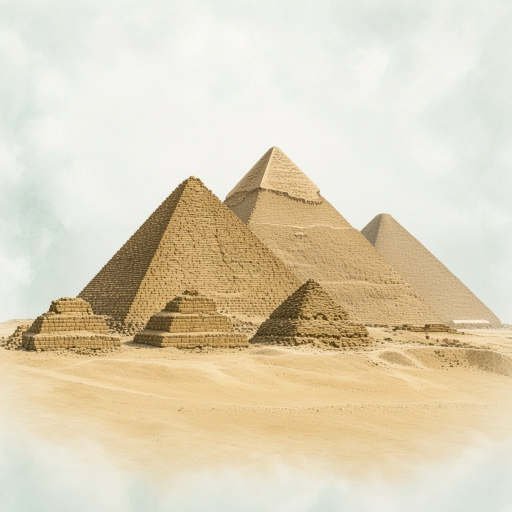
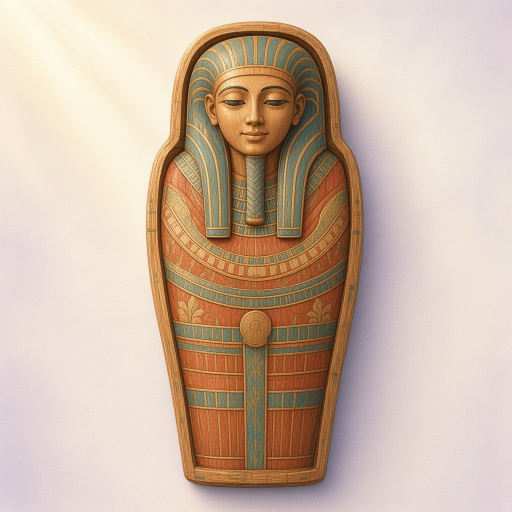
A pyramid is a building with a square bottom and four flat sides that lean in and meet at a point on top. The most famous pyramids are giant stone tombs in Egypt, a country in northern Africa. A tomb is a special building where a body is placed after a person dies. The biggest one, called the Great Pyramid, was built about 4,500 years ago and is still standing today.
Why pyramids are tricky to understand
Pyramids look simple, but they are huge. The Great Pyramid in Egypt is taller than a 40-story building. It was made by stacking about 2.3 million heavy stone blocks, and many of those blocks weigh more than a car. Workers cut the stone, dragged it, and lifted it into place without any trucks or cranes.
The pyramids are also very old. The Great Pyramid was already ancient when the Roman army marched across the world. It was the tallest building people had ever made for more than 3,800 years. A tall church in England, called Lincoln Cathedral, finally grew taller in the year 1311.
Many people think all pyramids are in Egypt. That is not true. The country of Sudan, right next to Egypt, has more than 200 ancient pyramids. That is more than Egypt has. People in ancient Mexico built pyramids too, with flat tops and steps up the sides.
Key facts about pyramids
The Great Pyramid was built for a king named Khufu around 4,500 years ago. The pyramid was his tomb.
It is made of about 2.3 million stone blocks. Each block is heavy, about as heavy as a large car or more.
When it was new, it stood about 481 feet (147 m) tall. Today it is a little shorter, about 454 feet (138 m), because the smooth outer stones at the top fell away or were taken.
Three big pyramids stand together at a place called Giza in Egypt. They were built for three kings: Khufu, Khafre, and Menkaure.
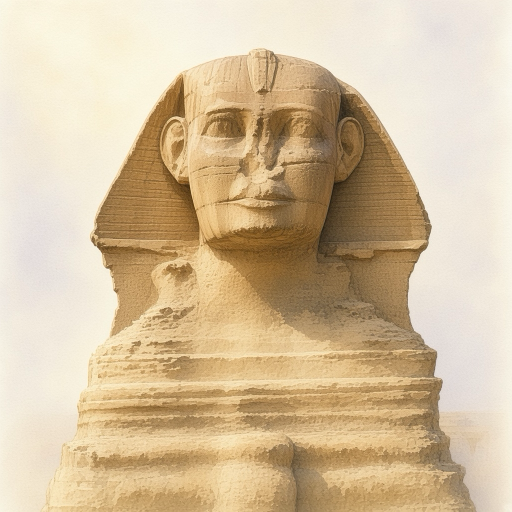
A giant statue called the Great Sphinx sits near the pyramids. It has the body of a lion and the head of a person, and it was carved from one huge rock.
The oldest big Egyptian pyramid is the Step Pyramid. It was built for a king named Djoser about 4,700 years ago and looks like giant stone steps stacked up.
The Great Pyramid is not solid all the way through. It has hidden rooms and narrow tunnels inside, including a room lined with hard pink stone.
The country of Sudan has more than 200 ancient pyramids, more than Egypt has. They are much smaller than Egypt’s, and their sides are much steeper, so they look tall and narrow.
Common myths about pyramids
Myth: Slaves built the pyramids. The pyramids were not built by slaves. They were built by skilled Egyptian workers who were given food and lived in towns near the building site. Working on a pyramid was a real job.
Myth: Aliens built the pyramids. People built the pyramids, not aliens. We know this because workers left tools, towns, and even their names written in paint inside the Great Pyramid. The ancient Egyptians were very good builders.
Myth: Egypt has more pyramids than any other country. Egypt is the most famous place for pyramids, but it does not have the most. More than 100 pyramids have been found in Egypt. The country of Sudan has more than 200.
Myth: The Great Pyramid is a solid block of stone with nothing inside. The Great Pyramid is not solid. It has rooms and passages built deep inside, including the King’s Chamber, where the king was meant to rest.
Frequently asked questions about pyramids
Who built the pyramids in Egypt?
The ancient Egyptians built them. The workers were not slaves. They were skilled builders and helpers who were given food like bread, beer, and meat, and who lived in special worker towns close to the pyramids. Many of them did this work as a job for part of the year.
How old is the Great Pyramid?
The Great Pyramid is about 4,500 years old. It was built around 2,500 years before the year 0. That makes it older than almost any other large building still standing in the world.
Why were the pyramids built?
The biggest Egyptian pyramids were built as tombs for kings, called pharaohs. The Egyptians believed a king would live on in an afterlife, so they built a giant stone pyramid to hold his body and his treasures and keep them safe.
Is the Great Pyramid solid inside?
No. It has rooms and tunnels inside. The most important room is the King’s Chamber, which is lined with hard pink stone. A long, sloping hallway leads up toward it.
Are there pyramids outside of Egypt?
Yes. The country of Sudan, next to Egypt, has more than 200 pyramids of its own, even more than Egypt. Ancient people in Mexico and Central America built pyramids too. Some of those have flat tops and big steps up the sides.
Each of this topic’s quiz questions cites a source for the fact it tests. You can play at any level: Rookie, Curious, Sharp, or Expert.
A pyramid is a monument with a square base and four triangle-shaped sides that slope up to a single point. The most famous pyramids are stone tombs built by the ancient Egyptians more than 4,000 years ago. The largest, the Great Pyramid at Giza, was built for a king named Khufu and held the record as the tallest building in the world for over 3,800 years. Pyramids were also built in other places, including ancient Sudan and ancient Mexico.
Why pyramids are surprising
The size of the Great Pyramid is hard to picture until you look at the numbers. It is made of about 2.3 million stone blocks, and the whole structure weighs millions of tons. The base is so wide that each side runs about 755 feet (230 m). The ancient Egyptians lifted all of that stone into place using ramps, ropes, wooden sleds, and large teams of workers, without any engines or cranes.
The builders were also amazingly careful. The four sides of the Great Pyramid point almost exactly toward north, south, east, and west. Each side is off from the true direction by only a tiny fraction of one degree. They reached that accuracy thousands of years before the compass was invented.
Another surprise is how spread out pyramid building really was. Egypt is the most famous pyramid land, but it does not hold the record for the most pyramids. That title belongs to the country of Sudan, which sits just south of Egypt and holds more than 200 ancient pyramids. People across the ocean in Mexico and Central America built their own pyramids too, with a completely different style.
Key facts about pyramids
The Great Pyramid was built for King Khufu during Egypt’s Fourth Dynasty, roughly 4,500 years ago. The Greeks later called him Cheops.
It stood about 481 feet (147 m) tall when new. Today it is roughly 454 feet (138 m) tall, because the smooth outer stones and the pointed cap are gone.
The base is almost a perfect square, with each side about 755 feet (230 m) long. The whole bottom covers an area larger than several soccer fields.
Three large pyramids stand at Giza, built for Khufu, Khafre, and Menkaure. The pyramid of Khafre looks taller because it sits on higher ground, but it is actually a little shorter.
The Great Sphinx, a statue with a lion’s body and a human head, was carved from a single huge block of limestone. It stretches about 240 feet (73 m) long.
The Great Pyramid has rooms and passages inside, including the King’s Chamber, which is lined with hard pink granite, and a tall sloping hallway called the Grand Gallery.
A wooden boat was buried beside the Great Pyramid. Found in 1954 in more than 1,000 pieces, the cedar-wood boat was rebuilt and measures about 140 feet (43 m) long.
Ancient Nubia, in what is now Sudan, holds more than 200 pyramids, more than Egypt. They are smaller and much steeper: the faces at Meroe rise at 60 to 73 degrees, against about 52 degrees for the Great Pyramid.
The Maya in Mexico built step pyramids. At one called El Castillo, sunlight makes a shadow shaped like a snake slide down the stairs twice a year.
Common myths about pyramids
Myth: Slaves built the pyramids. The pyramids were not built by enslaved people. Archaeologists who dug up the workers’ towns near Giza found evidence of paid Egyptian laborers who received rations of bread, beer, and meat. The workers were organized into named teams, and some were even treated for injuries by doctors. Building a pyramid was demanding work, but it was real, organized labor.
Myth: Aliens built the pyramids. Aliens had nothing to do with it. We know human beings built the pyramids because they left tools, ramps, worker villages, written records, and even painted graffiti with their own names inside the Great Pyramid. The ancient Egyptians were skilled engineers.
Myth: Egypt has more pyramids than any other country. More than 100 pyramids have been found in Egypt, but the ancient kingdom of Kush, in the Nubia region of what is now Sudan, left more than 200 of its own still standing. The royal cemetery north of Meroe alone holds 44 of them.
Myth: The Great Pyramid is solid stone with nothing inside. The Great Pyramid is not a solid block. It contains several chambers and narrow passages, including the granite-lined King’s Chamber and the steep Grand Gallery that leads up to it.
Frequently asked questions about pyramids
How were the pyramids built?
The Egyptians cut limestone blocks with copper tools, then dragged them on wooden sleds over prepared roads. They often poured water in front of the sled to make the sand slick and easier to pull. To raise the blocks higher, they built ramps, though archaeologists still debate what shape those ramps took. A huge team of workers, perhaps 20,000 to 30,000 people at Giza, did the job over about 20 years. A real Egyptian record, the diary of an official named Merer, describes a crew hauling stone for the Great Pyramid by boat.
Who was Khufu?
Khufu was an Egyptian pharaoh who ruled during the Fourth Dynasty, around 4,500 years ago. The Great Pyramid was built as his royal tomb. Strangely, the only complete statue of Khufu ever found is tiny, a carved ivory figure about 3 inches (7.5 cm) tall, even though he built the largest pyramid in the world.
What is inside the Great Pyramid?
Inside are several rooms and tunnels. The King’s Chamber, lined with pink granite, once held a stone coffin. Below it is another room often called the Queen’s Chamber. A tall, sloping hallway called the Grand Gallery connects the passages. The smooth granite walls have almost no decoration, which is unusual for an Egyptian royal tomb.
Why does Sudan have so many pyramids?
The ancient kingdom of Kush, in the Nubia region of what is now Sudan, kept building royal pyramids long after Egypt had mostly stopped. Kushite kings and queens were buried under steep, narrow pyramids, especially at a city called Meroe. Because they built for so many centuries, and at other sites including Nuri, el-Kurru, and Sedeinga as well, Sudan ended up with more than 200 pyramids, more than Egypt has.
Are the pyramids in Mexico like the ones in Egypt?
Not quite. The pyramids in Mexico and Central America were usually step pyramids with flat tops, where a temple stood at the summit. Egyptian pyramids were smooth-sided tombs that came to a point. The two traditions developed completely separately, on different continents, with no contact between them.
Each quiz question for this topic cites a source for the specific fact it tests. You can play at any level: Rookie, Curious, Sharp, or Expert.
A pyramid is a monumental structure with a polygonal base, usually square, whose sloping sides rise to a single apex. The best-known examples are the royal tombs of ancient Egypt, built mainly during the Old Kingdom, around 2700 to 2200 BCE. The Great Pyramid of Giza, raised for the pharaoh Khufu around 2560 BCE, was the tallest human-made structure on Earth for more than 3,800 years. Pyramids were built independently by other cultures as well, including the kingdom of Kush in what is now Sudan and several civilizations in ancient Mexico, where they served as temple platforms rather than tombs.
What is commonly misunderstood about pyramids
The Great Pyramid was not built by slaves. Excavations led by Mark Lehner and Zahi Hawass at the workers’ settlement south of the Giza plateau uncovered bakeries, breweries, dormitories, and cemeteries, along with skeletons that show healed fractures set by physicians. The labor force was made up of paid and conscripted Egyptians, organized into named work-gangs, fed on rations of bread, beer, and meat, and rotated through the project. The popular image of whip-driven slaves comes from later storytelling, not from the archaeological record.
The pyramids are also not uniquely Egyptian. More than 100 pyramids have been identified in Egypt, but the kingdom of Kush, centered on the Nile in modern Sudan, left more than 200 standing: the royal cemetery north of Meroe holds 44, Nuri holds 82 tombs of which most carried pyramids, and further groups stand at el-Kurru, Jebel Barkal, and Sedeinga. The Kushite pyramids are smaller and far steeper, and most were raised long after Egypt had largely abandoned the form. Separately, the pyramids of Mexico and Central America belong to an entirely unrelated tradition that developed across the ocean with no contact with Egypt.
A third misconception treats the Great Pyramid as a solid mountain of rock. It is not solid. Inside are the King’s Chamber, lined with red granite, the so-called Queen’s Chamber below it, a steep ascending corridor known as the Grand Gallery, and a descending passage cut into the bedrock. Builders even left a series of compartments above the King’s Chamber to relieve the weight of the masonry overhead.
Key facts about pyramids
The Great Pyramid of Giza was built for Khufu around 2560 BCE during the Fourth Dynasty. Its original height was about 481 feet (147 m); erosion and the loss of its outer casing have reduced it to roughly 454 feet (138 m).
Block count and mass. The structure contains an estimated 2.3 million stone blocks and a total mass on the order of 5.9 million tons (5.3 million metric tons). Most blocks are local limestone; the inner chambers use granite hauled from Aswan, about 500 miles (800 km) to the south.
Base precision. A 2015 survey found each side of the base running about 756 feet (230 m), with the longest and shortest sides differing by only a few inches. The base is leveled and aligned to the cardinal directions to within a fraction of a degree.
The Giza trio. Three main pyramids stand at Giza, built for Khufu, his son Khafre, and Menkaure. Khafre’s pyramid looks the tallest because it sits on bedrock about 33 feet (10 m) higher, though it is slightly shorter than Khufu’s.
The Step Pyramid of Djoser at Saqqara, built around 2670 BCE, is the oldest large stone pyramid in Egypt. It rises as six stacked terraces and is credited to Imhotep, often described as the first architect in history known by name.
The Bent Pyramid at Dahshur, built for Sneferu, changes slope partway up, from about 54 degrees in its lower section to about 43 degrees above. The shift is usually read as a mid-project correction to keep the structure stable.
The largest pyramid by volume is not in Egypt. It is the Great Pyramid of Cholula in Mexico, with an estimated volume of around 4.45 million cubic meters. It is shorter than Giza’s Great Pyramid but covers far more ground.
The word “pyramid” comes from the ancient Greek pyramis, the term Greek visitors used for these monuments. The Egyptians used their own, unrelated words.
The Pyramid Texts, among the oldest religious writings in the world, were first carved inside the Pyramid of Unas at Saqqara around 2350 BCE, centuries before the better-known Book of the Dead.
Common myths about pyramids
Myth: The pyramids were built by slaves. No primary source supports this. The settlement of the Giza pyramid builders shows organized, paid, and conscripted Egyptian laborers living in dedicated villages, eating state-supplied rations, and receiving medical care. The slave narrative entered popular culture through much later religious and cinematic retellings.
Myth: Aliens built the pyramids. Human builders left a dense trail of evidence: quarries with tool marks, abandoned ramps, worker towns, administrative records, and red-paint graffiti naming their own gangs inside the Great Pyramid. There is no archaeological gap that requires an extraterrestrial explanation.
Myth: Egypt has more pyramids than any other country. More than 200 ancient pyramids still stand in modern Sudan, built by the kingdom of Kush, and that total exceeds Egypt’s. At the city of Meroe and nearby sites, Kushite rulers continued the form for centuries after Egypt had stopped.
Myth: The Great Pyramid is a solid block with no chambers. The pyramid holds the King’s Chamber, the Queen’s Chamber, the Grand Gallery, a bedrock descending passage, and five relieving chambers above the burial chamber. In 2017 a large additional void was even detected above the Grand Gallery using cosmic-ray imaging.
Myth: The bent shape of the Bent Pyramid was caused by an earthquake. The change in slope was part of the original construction, not later damage. The builders deliberately laid the upper courses at a shallower angle, most likely after problems appeared in the steeper lower section.
Frequently asked questions about pyramids
How were the pyramids actually built?
The consensus relies on several independent lines of evidence. Workers cut limestone with copper tools, then moved blocks on wooden sledges over prepared roadways, sometimes wetting the sand ahead of the sled to cut friction, a method shown in the tomb of Djehutyhotep. To raise blocks, they used earthen or wraparound ramps. The Giza workforce numbered roughly 20,000 to 30,000, organized into named crews, and the Great Pyramid was completed in about 20 years. Papyri found at Wadi al-Jarf in 2013, the diary of an official named Merer, record a crew transporting limestone by boat for the casing of Khufu’s pyramid during the 27th year of his reign.
Who designed the first Egyptian pyramid?
The Step Pyramid of Djoser, around 2670 BCE, is credited to Imhotep, the king’s chief minister. He is widely regarded as the earliest architect, engineer, and physician whose name has survived in the historical record. The Egyptians honored him for so long that he was eventually worshipped as a god of medicine.
Why does Khafre’s pyramid look taller than the Great Pyramid?
It stands on higher bedrock, about 33 feet (10 m) above the base of the Great Pyramid, so its summit reaches a greater elevation. It is also steeper and still keeps a cap of smooth casing stones near the top. Despite all that, its actual height is slightly less than Khufu’s.
What is the largest pyramid in the world?
By volume, it is the Great Pyramid of Cholula in Mexico, with an estimated volume near 4.45 million cubic meters, the largest of any pyramid on Earth. It is not the tallest; the Great Pyramid of Giza stands much higher. Cholula was built up in stages by several cultures over many centuries, and it is so overgrown that a church now sits on its summit.
Are the Mexican pyramids related to the Egyptian ones?
No. The pyramids of Teotihuacan, Cholula, and the Maya cities arose in the Americas with no contact with Egypt. They generally served as temple platforms, supporting a shrine on a flat top, rather than as sealed tombs. The Pyramid of the Sun at Teotihuacan, about 215 feet (66 m) tall, was built by a culture whose rulers are not even known by name, and no royal burial chamber has ever been confirmed inside it.
Why do the Nubian pyramids look so different?
The pyramids of Kush, in what is now Sudan, are much smaller than the Egyptian giants and rise at far steeper angles, usually 60 to 73 degrees at Meroe against about 52 degrees for the Great Pyramid, with a funerary chapel of one to three rooms attached to the east face. Construction at Meroe began around the 3rd century BCE, long after the Egyptian pyramid age, and continued for centuries. The result is that Sudan today holds more than 200 standing ancient pyramids, more than Egypt.
Each quiz question for this topic cites a primary source for the specific fact it tests. You can play at any level: Rookie, Curious, Sharp, or Expert.
A pyramid is a monumental structure whose sloping faces rise from a polygonal base to a single apex. In Egypt the form emerged as a royal funerary monument during the Third Dynasty and reached its structural and dimensional peak in the Fourth Dynasty at Giza. The Great Pyramid of Khufu, completed around 2560 BCE, was the tallest human-made structure on Earth for more than 3,800 years, until the central spire of Lincoln Cathedral in England surpassed it around 1311 CE. The Egyptian tradition was one of several independent pyramid-building traditions, alongside the Kushite pyramids of Nubia and the temple-pyramids of Mesoamerica, which share a geometry but not an origin.
Why the pyramids resist simple summary
The Egyptian pyramid was not a single design executed at scale. It was an evolving engineering experiment, and several of its most instructive monuments are the failures and transitional forms rather than the polished result at Giza.
The starting point was the mastaba, a flat-roofed rectangular tomb of mudbrick or stone with sloping sides, built over a burial shaft. The Step Pyramid of Djoser at Saqqara, attributed to Imhotep around 2670 BCE, was in effect a stack of six diminishing mastabas, the first monumental stone building in Egypt and the conceptual leap from a single tomb to a stepped tower. The true smooth-sided pyramid then arrived through trial and error under Sneferu, who is associated with three large pyramids. The pyramid at Meidum began as a step pyramid, was later packed to a true profile, and partially collapsed: its outer mantle was founded in part on sand rather than solid rock and was poorly bonded to the core, so much of it slid away, leaving a tower-like core in a skirt of debris that earned it the name the “collapsed pyramid.” The Bent Pyramid at Dahshur shifts from roughly 54 degrees in its lower section to about 43 degrees above, a mid-project correction, before Sneferu’s Red Pyramid achieved a stable true pyramid at a shallow angle throughout.
The civilization also changed its building economy over time. Old Kingdom pyramids were largely solid stone. By the Middle Kingdom, around 2000 BCE, royal builders often filled the cores with mudbrick, rubble, and sand behind a fine limestone casing, as at Lisht for Amenemhat I and Senusret I. The trade-off was durability: once stone robbers stripped the limestone, the soft cores eroded badly, which is why many Middle Kingdom pyramids survive only as low mounds while the great stone monuments still stand. The intuition that the largest and oldest pyramids should be the most degraded runs backward to the actual record.
A final point of confusion is the interior. The finished Great Pyramid is famously undecorated, which fuels the idea that it is solid or anonymous. Neither is true. It contains the King’s Chamber lined in red granite, the lower Queen’s Chamber, the corbelled Grand Gallery (a high passage roofed by successive courses of stone stepped inward until they nearly meet), a bedrock descending passage, and five relieving chambers above the burial chamber that distribute the load of the masonry overhead. When those upper compartments were reached by tunneling in 1837, explorers found red-ochre work-gang graffiti, including Khufu’s name in formulas such as “The White Crown of Khnum-Khufu is Powerful,” the only contemporary inscriptions inside the pyramid that name its owner.
Key facts
Dimensions and mass. The Great Pyramid rose to about 481 feet (147 m) and now stands near 454 feet (138 m) after losing its casing stones and apex. Each base side runs about 756 feet (230 m), with the four sides differing by only a few inches, and the structure totals an estimated 2.3 million blocks and roughly 5.9 million tons (5.3 million metric tons) of material.
Casing stones. The pyramid was originally sheathed in polished white Tura limestone, laid as fitted casing stones that gave a smooth reflective surface. Most were quarried away in the medieval period for construction in Cairo, exposing the stepped core masonry visible today.
The pyramidion. The capstone that crowned a pyramid is called a pyramidion, linked in Egyptian belief to the sacred benben stone of the sun cult at Heliopolis. The Great Pyramid’s pyramidion is long gone, leaving a flat summit. An intact stone pyramidion from the pyramid of Amenemhat III at Dahshur survives, about 4.5 feet (1.4 m) tall and inscribed with the king’s names, now in the Egyptian Museum in Cairo.
The Pyramid Texts. The earliest known corpus of Egyptian funerary spells was carved on the chamber and passage walls of the Pyramid of Unas, last king of the Fifth Dynasty, around 2350 BCE. These are among the oldest religious writings in the world and predate the Coffin Texts and the Book of the Dead.
Astronomical alignment. The descending passage of the Great Pyramid was cut into the bedrock from the north face at an inclination of about 26.5 degrees, running toward the northern circumpolar sky; Petrie measured its axis to within four arcminutes of true north. Because of axial precession, no bright star sat at the celestial pole in Khufu’s reign. Thuban in Draco, the nearest naked-eye star and the pole star of the earlier third millennium BCE, had already drifted about two degrees off it. Kate Spence proposed in Nature in 2000 that the builders fixed north instead from the simultaneous transit of two circumpolar stars.
The 2017 void. The ScanPyramids collaboration used cosmic-ray muon imaging to detect a previously unknown cavity at least 100 feet (30 m) long above the Grand Gallery, reported in Nature in November 2017. It was the first major internal structure identified since the 19th century, and its function remains unknown.
The Khufu ship. A disassembled cedar vessel of more than 1,000 pieces was found in a sealed pit beside the Great Pyramid in 1954 and reconstructed to about 140 feet (43 m) in length, one of the oldest planked boats ever recovered.
Surviving image of Khufu. The only complete three-dimensional likeness of the king who built the largest pyramid is an ivory statuette about 3 inches (7.5 cm) tall, excavated by Flinders Petrie at Abydos in 1903, now in Cairo.
Common misconceptions at expert level
Misconception: The Great Pyramid was the original entry on the Seven Wonders list and the only survivor by chance. It was the only one of the canonical Seven Wonders of the Ancient World to survive, but not by chance. The pyramid was finished around 2560 BCE, while the Lighthouse of Alexandria and the Colossus of Rhodes were both finished around 280 BCE, so the Great Pyramid was already more than 2,000 years old when the youngest wonders went up. Earthquakes took three: the Colossus about 226 BCE, and the Mausoleum at Halicarnassus and the Lighthouse far later, between the 11th and 15th centuries CE. The Goths destroyed the Temple of Artemis at Ephesus in 262 CE, and the Statue of Zeus was lost either when its temple fell in 426 CE or in a fire at Constantinople about 50 years afterward. The pyramid’s mass and simple geometry left little to topple.
Misconception: The relieving chambers held a star map or astronomical text. The five compartments above the King’s Chamber are structural, built to spread the weight of overlying masonry, and the markings inside them are utilitarian construction graffiti left by work gangs, including the inscriptions that name Khufu. They are not a deliberate celestial diagram.
Misconception: The Pyramid Texts are building instructions. They are funerary and ritual spells concerned with the king’s passage into the afterlife, not engineering records. No surviving Egyptian text functions as a construction manual for a pyramid; what survives of the building process is administrative, such as the diary of Merer.
Misconception: Meidum collapsed because of a deliberate medieval demolition. The outer layers of the Meidum pyramid failed because of structural flaws in the mantle and its foundation, not because of gunpowder or sabotage. Gunpowder was not available in Egypt during the period when the collapse is usually placed, and the debris pattern is consistent with a structural slide.
Misconception: Khufu’s mummy was found inside the Great Pyramid. No body of Khufu has ever been recovered. The pyramid’s own burial chamber was found empty in the medieval period. The richly furnished shaft tomb labeled G7000X, discovered in 1925 by George Reisner’s expedition, belonged to Khufu’s mother, Queen Hetepheres I; her sealed alabaster sarcophagus, opened in 1927, held no body, a puzzle still debated.
Frequently asked questions
What is the actual evidence for how the blocks were raised?
The reconstruction rests on converging sources rather than a single proof. Quarry faces around Giza preserve copper-tool marks; the tomb of Djehutyhotep shows a colossal statue dragged on a sledge with liquid poured ahead to reduce friction; abandoned ramps and embankments survive at several pyramid sites; and the administrative papyri from Wadi al-Jarf, the diary of Merer, record a crew ferrying Tura limestone by boat for the casing during Khufu’s 27th regnal year. The workforce is estimated at roughly 20,000 to 30,000, organized into named crews and smaller gangs, and the project is generally placed at about 20 years. The fine detail of ramp geometry, whether straight, zigzag, or wrapping the faces, remains debated, but the broad logistics are well attested.
Why is the Great Pyramid’s interior almost undecorated when later royal tombs are covered in text?
Decoration conventions shifted over time. Fourth Dynasty pyramid interiors at Giza were left plain; the practice of carving funerary spells on chamber walls, the Pyramid Texts, begins only in the late Fifth Dynasty with Unas, around 2350 BCE. By the New Kingdom, rock-cut tombs in the Valley of the Kings carried elaborate painted programs. The Great Pyramid sits before that tradition of inscribed interiors, which is why its granite chambers are bare apart from the construction graffiti hidden in the relieving chambers.
How were the cardinal alignment and base precision achieved?
The four sides of the Great Pyramid align to true north, south, east, and west to within a fraction of a degree, and the base sides match in length to within a few inches over more than 750 feet (230 m). The leading explanations for the cardinal alignment involve stellar observation, such as tracking the rise and set points of a circumpolar star, or solar methods using the shadow of a vertical pole at equal intervals around noon. The leveling of the base was likely achieved with water channels or sighting instruments. These results predate the magnetic compass by millennia and rely on naked-eye astronomy and careful surveying.
What did the 2017 muon survey actually find, and what did it not?
The ScanPyramids team placed muon detectors inside and around the pyramid and measured the absorption of cosmic-ray muons passing through the stone; regions of lower density absorb fewer muons, revealing cavities. This non-invasive method detected a large void above the Grand Gallery, at least 100 feet (30 m) long, published in Nature in 2017. Nothing inside it has been entered, imaged directly, or dated, so claims that it is a tomb, a hidden chamber of treasure, or a Roman-era addition are unsupported. Its purpose, whether structural like the relieving chambers or something else, is still open.
Why does Nubia hold more pyramids than Egypt, and how do they differ?
The kingdom of Kush in what is now Sudan adopted the pyramid as a royal tomb form and continued building it long after Egypt had largely stopped, with construction at Meroe beginning around the 3rd century BCE; the first Meroitic pyramid securely attributed to a ruler belongs to Arakamani, who reigned around 280 BCE. More than 200 Kushite pyramids still stand, a total that exceeds Egypt’s: the royal Northern Cemetery at Meroe holds 44, Nuri holds 82 tombs of which most carried pyramidal superstructures, and further groups stand at el-Kurru, Jebel Barkal, and Sedeinga. They are much smaller, with bases running from about 15 to 57 feet (4.5 to 17.5 m) square, and far steeper, the faces usually pitched between 60 and 73 degrees against 51 degrees 52 minutes for the Great Pyramid. A funerary chapel of one to three rooms, often carved with reliefs, was attached to the east face, and the burial itself lay in a rock-cut tomb beneath the solid pyramid, reached by a long sloping stairway. They represent a distinct architectural tradition that drew on Egyptian precedent rather than preceding it.