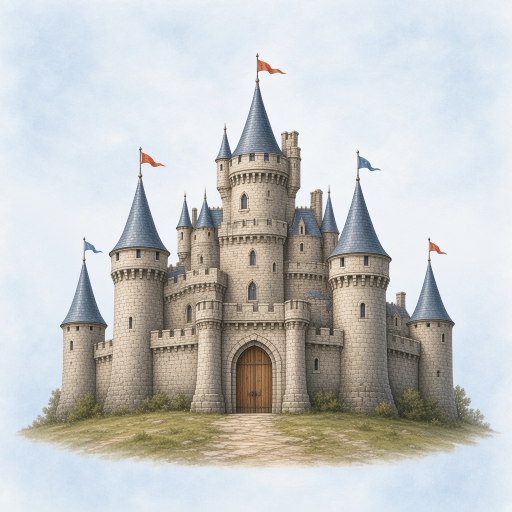
A medieval knight was a person granted knightly rank, often after military service and training. Knights are famous as armored horsemen, but they could also fight on foot. Not every soldier in armor was a knight. A castle was a fortified residence: a protected home that could also serve as a center of power, work, and local government.
Knights and castles appeared in different forms across medieval Europe, so there was no single design or life story that applied everywhere. In England, castle building expanded rapidly after the Norman Conquest of 1066. Many early Norman castles used earth and timber because those materials allowed builders to establish a defended site quickly.
Why knights and castles are surprising
A complete suit of field armor usually weighed about 45 to 55 pounds (20 to 25 kilograms). That was heavy, but its weight was spread across the wearer’s body. The joints were built to bend, allowing a trained wearer to walk, run, climb, get up from the ground, and mount a horse without a crane.
Early castles were not all stone. One common Norman design had a defended enclosure called a bailey, sometimes beside an artificial earth mound called a motte. A strongpoint of timber could stand on the motte. Ringworks, which enclosed an area with earthworks rather than using a motte, were another early castle form.
Castles were more than battle stations. The Tower of London, for example, has served at different times as a fortress, royal residence, prison, mint, and store for weapons. William the Conqueror began its White Tower in the 1070s, and construction took about 20 years.
Key facts about knights and castles
Mail is armor made from linked metal rings. It is flexible and was used alongside other protection for centuries.
Plate armor uses shaped metal plates. By about 1420, complete plate protection had been developed in Europe, although mail continued to protect gaps and remained in use.
A moat is a defensive ditch. Some moats held water, while others were dry.
Not every castle had a drawbridge. Where one was used, it helped control passage across a ditch or into a defended entrance.
Mottes and baileys were parts of some early castles. A motte was an earth mound, and a bailey was a defended enclosure.
Stone did not replace timber everywhere at once. Builders chose materials and designs according to money, location, available labor, and military needs.
Knights could fight mounted or on foot. Horses were important for travel, status, charges, and some kinds of combat.
Heraldry used recognizable designs. Arms could identify particular people, family lines, or organizations, but a surname alone does not give everyone the same coat of arms.
Common myths about knights and castles
Myth: A crane had to lift a knight onto his horse. Field armor allowed movement, and a trained wearer could mount without a crane. The Metropolitan Museum of Art traces the familiar crane image to much later humor and film, not medieval practice.
Myth: Every person wearing armor was a knight. Armor was equipment, while knighthood was a social rank. Soldiers who were not knights could own or wear armor too.
Myth: Every moat was filled with water. A moat could be wet or dry. Either kind created an obstacle and made it harder to approach a wall or gateway.
Myth: All castles followed one path from wood to stone. Castle forms overlapped. Some sites were rebuilt many times, while others kept earthworks or timber structures for long periods.
Myth: A coat of arms belongs to everyone with the same last name. The College of Arms explains that arms belong to particular people and their descendants under heraldic rules, not automatically to everyone who shares a surname.
Frequently asked questions about knights and castles
How did someone become a knight?
Training often happened in a noble household, where a young person could serve and learn riding, weapons, and courtly behavior. The familiar path from page to squire to knight is a useful model, but ages and customs varied, and not every knight followed exactly the same steps.
How heavy was a knight’s armor?
A complete field harness generally weighed about 45 to 55 pounds (20 to 25 kilograms). The armor’s fitted pieces distributed the load over the body instead of hanging all of it from the shoulders.
Could knights move in plate armor?
Yes. Articulated joints allowed a trained wearer to bend and move. Armor made activity more tiring, but it did not turn a knight into a motionless metal statue.
Why did a castle have a moat?
A moat kept people and equipment farther from the walls and made access more difficult. Water was not required: a deep dry ditch could also be a serious barrier.
Why were symbols painted on shields?
Heraldic colors and figures helped display identity in war, tournaments, seals, and ceremonies. These designs followed traditions and rules; they were not simply pictures that every knight invented on the spot.
Each quiz question for this topic cites a source for the fact it tests. You can play at any level: Rookie, Curious, Sharp, or Expert.
Medieval knights are strongly associated with cavalry, armor, and service to rulers or lords, but knighthood was a rank rather than a name for every mounted soldier. Knights sometimes fought from horseback and sometimes on foot. Their roles and social standing changed across regions and centuries.
A castle was a fortified residence, not simply any fort with thick walls. It could house a lord’s household, soldiers, servants, workshops, stores, and administrative activity. Castle designs answered local terrain, resources, politics, and weapons, so their history was not one neat sequence in which every new design replaced the last.
What is surprising about knights and castles
Field armor balanced protection with movement. A complete plate harness usually weighed about 45 to 55 pounds (20 to 25 kilograms), distributed over the wearer. Its plates overlapped and moved at the joints. Specialized tournament armor could be much heavier or more restrictive, which helps explain some exaggerated ideas about battle armor.
After 1066, Norman rulers established many castles in England. Mottes and baileys are famous, but ringworks were also built. Timber and earth offered speed, while stone required more time, skilled labor, and expense. Later defenses included stone curtain walls, projecting towers, and, at some sites, two mutually supporting rings of walls called concentric defenses.
Even familiar ideas about medieval horses need caution. Archaeological research found that most known medieval English horses stood around 13 to 14 hands, but bone size alone cannot reveal whether an animal was ridden in combat. Medieval people selected horses for several qualities, not height alone.
Key facts about knights and castles
The page-squire-knight path was not a fixed schedule. Household service and apprenticeship were important, but the surviving evidence does not support one universal set of ages or ceremonies.
Mail and plate overlapped. Mail remained useful at gaps even after complete plate harnesses developed.
The word “mail” is historically sufficient. “Chain mail” is a modern way to distinguish linked-ring armor, but medieval sources did not need that extra word.
A field harness was mobile. Its articulated pieces let a trained wearer walk, run, mount, and rise from the ground.
Some moats were dry. The ditch itself impeded attackers whether or not it contained water.
Mining could bring down masonry. Besiegers tunneled beneath a wall or tower, supported the opening with timbers, then burned the supports.
Rochester Castle’s keep was breached in 1215. English Heritage records that King John’s miners used the fat of 40 pigs to help burn supports beneath one corner.
Arms were not owned by a surname. A coat of arms belonged to a particular bearer, lineage, or authorized organization under heraldic practice.
Common myths about knights and castles
Myth: Every future knight became a page at seven, a squire at fourteen, and a knight at twenty-one. Some popular accounts use those ages to describe a typical path. Historical training was less standardized, and direct evidence about how every knight learned is limited.
Myth: Armor prevented a knight from getting up. Well-fitted field armor used moving joints and distributed weight. A trained wearer could get up without mechanical help.
Myth: The biggest horse must have been the best warhorse. Medieval breeders and buyers valued behavior, strength, agility, and suitability as well as size. Archaeologists also warn that a large skeleton cannot automatically be labeled a warhorse.
Myth: Stone castles made earth and timber obsolete. Older forms and materials continued, and many castles combined work from different building periods.
Myth: Heraldry gave one coat of arms to everyone in a family name. Heraldic rights followed specific grants and lines of descent. Commercial “surname arms” often ignore those rules.
Frequently asked questions about knights and castles
How did people train for knighthood?
One common route was service in an aristocratic household, first in a junior role and later as a squire attached to an experienced knight. Riding, weapon practice, household duties, and learning elite behavior could all be involved. Sources are too uneven to turn this into one universal medieval curriculum.
How did castle design change?
Earth-and-timber castles, ringworks, stone keeps, curtain walls, towered enclosures, and concentric defenses all belonged to the medieval story. They overlapped rather than forming a single ladder of progress. Builders altered existing sites and borrowed useful features according to circumstances.
What is the difference between mail and plate?
Mail consists of many linked metal rings and bends with the body. Plate armor uses larger shaped pieces. A late medieval harness could combine the two, using plates over much of the body and mail where flexible coverage was still helpful.
How did attackers undermine a castle?
Miners, also called sappers, dug under a chosen section of masonry while holding the tunnel up with wood. Burning those supports could make the ground and wall above collapse. Defenders might try to locate and counter the tunnel.
What did heraldry do?
Heraldry provided a recognizable visual identity on shields, banners, seals, and buildings. It also expressed lineage and authority. The College of Arms still grants and records arms in England, Wales, Northern Ireland, and much of the Commonwealth.
Each quiz question for this topic cites a source for the specific fact it tests. You can play at any level: Rookie, Curious, Sharp, or Expert.
Knighthood and castle building changed greatly across medieval Europe. A knight held a recognized rank associated with martial service, status, and elite culture; the term did not mean every armored cavalryman. A castle was a fortified residence that joined defense with household, administration, and the public display of lordship.
These definitions matter because popular summaries often flatten centuries of variation. Knights could fight mounted or dismounted. Castles could have timber, earth, stone, or combinations of all three. Neither institution followed one identical pattern from place to place.
What is commonly misunderstood about knights and castles
Plate harness was engineered for movement. A complete field harness generally weighed about 45 to 55 pounds (20 to 25 kilograms), roughly comparable to loads carried by some modern soldiers. Its fitted pieces distributed the weight, while articulated lames and joints let the wearer bend. Tournament armor designed for a specialized event could be heavier and more restrictive than ordinary field armor.
Castle development was not a simple march from primitive timber to perfect concentric stone. The Norman occupation of England produced many earth-and-timber castles after 1066, including mottes and baileys as well as ringworks. Later owners rebuilt some sites in stone, added curtain walls or projecting towers, or abandoned them. Concentric defenses, where an outer wall and inner wall supported each other, were one response to siege warfare rather than a final design adopted everywhere.
Chivalry was not one statute book that every knight obeyed. Historians use the word for shifting martial, aristocratic, religious, and courtly ideals. Prowess and honor were central themes, but literature about ideal conduct cannot prove that real warriors always behaved that way.
Key facts about knights and castles
Knighthood was a status, not an equipment checklist. The Metropolitan Museum notes that people below knightly rank also fought in armor.
Mail and plate were complementary technologies. By about 1420, armorers could make complete plate protection, while mail still covered flexible gaps.
The crane-mounted knight is a modern myth. Field armor permitted independent movement and mounting.
A lance rest did not simply carry a lance’s weight. It stopped the couched lance from sliding backward at impact and helped transfer the force through the cuirass.
Armor and firearms coexisted for more than 300 years. Armorers altered plate to meet changing weapons instead of abandoning it as soon as guns appeared.
Motte-and-bailey was not the only early English castle form. Ringworks surrounded a defended area without a motte.
Concentric walls created mutually supporting defensive lines. A higher inner line could remain effective while an outer line was contested.
Mining attacked the support beneath masonry. At Rochester in 1215, attackers collapsed a corner of the keep after burning tunnel supports with the aid of fat from 40 pigs.
Heraldry identified particular bearers and lineages. Sharing a surname does not automatically confer the same coat of arms.
Common misconceptions at the sharp level
Misconception: A knight was always a noble horseman who held land in exchange for service. That description fits some settings, but routes into knighthood, property arrangements, and battlefield roles varied. Rank, service, and reputation mattered more than a single universal formula.
Misconception: Every aspiring knight followed fixed page and squire ages. Household apprenticeship and service as a squire were real, but evidence for training is patchy. The familiar seven-fourteen-twenty-one schedule should not be treated as a rule for all medieval Europe.
Misconception: Round towers solved every weakness of square keeps. Curved or polygonal towers could improve flanking views and resist some forms of attack, but their value depended on the whole site. Builders continued using varied tower shapes for military, financial, and symbolic reasons.
Misconception: A moat mainly existed to stop tunneling. A wet or dry ditch increased the distance and difficulty of reaching a wall, gate, or foundation. It could hinder several forms of assault, not only mining.
Misconception: Chivalry reliably protected everyone from violence. Chivalric writing promoted ideals, but practice could fall short. The concept itself changed with author, region, and period.
Frequently asked questions about knights and castles
How did mail differ from plate armor?
Mail forms a flexible mesh from linked rings. Plate uses shaped solid pieces that can deflect a blow and spread its force. Mature harnesses layered protection, using textiles, plates, and mail according to the needs of each part of the body.
Why could a knight move in a full harness?
Armorers shaped plates around the body and joined moving sections at the shoulders, elbows, hips, knees, and other joints. The weight was distributed instead of hanging from one point. Protection still increased heat and effort, but did not eliminate mobility.
How did a concentric castle work?
Two defensive circuits could support one another, often with an outer wall lower than the inner one. Defenders on the higher line could operate over or beyond the outer defenses. The result was defense in depth, although no arrangement made a castle impossible to besiege.
How were stone walls undermined?
Sappers dug a gallery below a chosen section and used timber to hold it open. They then burned the supports so the earth and masonry above could collapse. Rochester’s damaged keep still preserves the rounded replacement for the corner destroyed in the 1215 siege.
Was heraldry just battlefield identification?
Recognition was one important function, especially when faces were obscured or viewers were distant. Arms also appeared on seals, banners, clothing, buildings, and monuments, expressing authority, family connection, and corporate identity.
Each quiz question for this topic cites a source for the specific fact it tests. You can play at any level: Rookie, Curious, Sharp, or Expert.
The technical history of knights and castles resists a single evolutionary story. Knighthood combined military function, social status, household service, and cultural ideals in proportions that varied over time. Castles combined residence, administration, symbolic authority, and defense, while their architecture reflected local terrain and particular threats.
The same caution applies to familiar superlatives. A celebrated building may be exceptionally large without having a universally agreed “largest castle” title, because measurements can compare an enclosed complex, building volume, or land area. A famous siege engine may be one of the largest recorded without enough evidence to rank every medieval machine.
Fortification and armor in context
Concentric fortification used two or more defensive circuits whose positions allowed them to support each other. A higher inner wall could command a lower outer line, but the concept was adapted differently at different sites. It was not an automatic endpoint of castle design, and military value also depended on garrison, supply, terrain, water, maintenance, and the attacker’s resources.
Caerphilly Castle in Wales was begun in 1268 by Gilbert de Clare. Cadw emphasizes both its concentric defenses and its extensive artificial lakes and dams. The defended site covers about 30 acres, showing how water engineering could be as important to the design as towers and masonry.
The mature plate harness was an articulated system of shaped parts. Overlapping plates and sliding joints balanced coverage with motion, while mail could guard gaps. A field harness generally weighed about 45 to 55 pounds (20 to 25 kilograms). Jousting equipment made for a narrow sporting task could be substantially heavier or restrict movement in ways that battlefield armor did not.
Key facts about knights and castles
The Order of the Garter dates to 1348. Edward III founded it, and its motto is Honi soit qui mal y pense.
The Garter is a secular order of chivalry. It should not be confused with military religious orders whose members took religious vows.
The Warwolf was built for Edward I’s 1304 siege of Stirling Castle. Historic Environment Scotland calls it one of the largest trebuchets ever made rather than proving it was the single largest.
Stirling’s garrison tried to surrender before the Warwolf was used. Edward refused until he had displayed the machine’s effect.
Malbork was built by the Teutonic Order. UNESCO describes it as a fortified monastery that was greatly enlarged after 1309 and as an outstanding example of a brick castle.
UNESCO’s listed Malbork property has an 18-hectare boundary. That figure does not by itself settle every “world’s largest castle” claim.
The rule of tincture promotes visual contrast. Its familiar form discourages placing a heraldic color on a color or a metal on a metal.
The rule of tincture has exceptions. Historical arms do not obey it without qualification, so it is a convention rather than a law with no departures.
A lance rest is an arrest, not a shelf. It helps stop a couched lance from sliding backward and transfers impact through the cuirass.
Gunpowder did not instantly end armor. Firearms and plate armor coexisted for centuries while armorers changed thickness, coverage, and design.
Common misconceptions at the expert level
Misconception: Concentric castles were always the strongest and latest type. Multiple wall circuits could create defense in depth, but design labels do not predict the outcome of a siege by themselves. Some later fortifications answered artillery with lower, thicker, differently shaped works rather than ever taller concentric walls.
Misconception: Malbork has one uncontested world-size record. UNESCO supports Malbork’s exceptional scale, Teutonic history, and brick construction. Ranking it against every structure called a castle requires a stated measurement method, so the broad superlative needs that qualification.
Misconception: Warwolf is proven to have been the largest trebuchet of the Middle Ages. Surviving accounts establish its exceptional scale and Edward I’s determination to use it. They do not provide a complete measured list of every trebuchet from the period.
Misconception: The rule of tincture made medieval arms perfectly uniform. Contrast was an important heraldic principle, but historical practice contains exceptions, contested cases, and regional variation. The gold crosses on a silver field associated with Jerusalem are a famous exception to the ordinary metal-on-metal guidance.
Misconception: Armor disappeared when firearms arrived. Armor remained useful, especially when shaped or thickened to resist contemporary threats. The long overlap between guns and armor was a process of adaptation, not an overnight replacement.
Frequently asked questions about knights and castles
What did concentric defenses accomplish?
They placed attackers against more than one coordinated defensive line. Inner positions could overlook parts of the outer circuit, and a breach did not necessarily expose the castle’s core. This arrangement increased defensive options but still depended on people, supplies, and sound construction.
Why is Caerphilly important?
Its building began in 1268 amid conflict between Gilbert de Clare and the Welsh prince Llywelyn ap Gruffudd. Caerphilly joined concentric masonry defenses with a large system of lakes and dams. Cadw presents it as the biggest castle in Wales, second in Britain only to Windsor, with sprawling water defenses.
What made Warwolf unusual?
Edward I ordered the great counterweight trebuchet during the 1304 Stirling siege. Sources describe five master carpenters and dozens of workers participating in its construction. Its value was also theatrical: refusing the garrison’s attempted surrender let Edward demonstrate the enormous engine.
How should “largest castle” claims be checked?
First identify what is being measured: the entire fortified site, the area inside walls, the footprint of buildings, floor area, or volume. Then confirm that all compared sites use the same category and method. Malbork is unquestionably an enormous and internationally significant brick castle complex, while a bare “largest” label hides those measurement choices.
What does the rule of tincture actually say?
In a common formulation, heraldic colors should not be placed directly on colors, and metals should not be placed directly on metals. The aim is strong visual contrast. Historical exceptions mean the rule helps interpret normal practice but cannot invalidate every armorial design that departs from it.