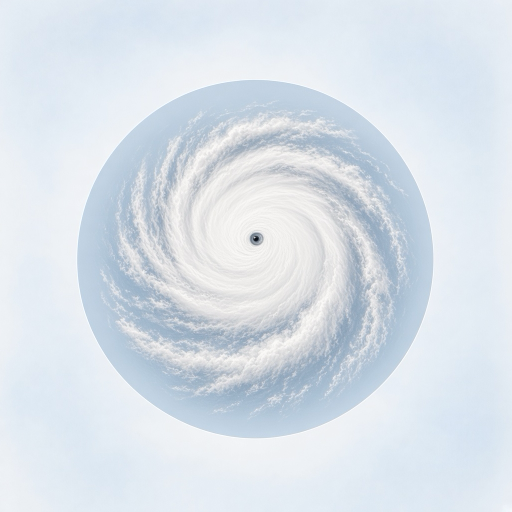
A hurricane is a giant spinning storm that forms over warm ocean water. It has very strong winds and brings heavy rain. The warm water gives the storm the energy it needs to grow. A hurricane is one of the biggest storms on Earth.
Why hurricanes are tricky to understand
A hurricane is huge, often hundreds of miles wide. That is so big you cannot see the whole thing from the ground. You can only see a whole hurricane in a picture taken from space.
The center of a well-organized hurricane can have a surprise: a relatively calm spot called the eye. Winds are usually much lighter there and patches of blue sky may appear, although an eye is not always clear or harmless. The surrounding eyewall usually contains the storm’s strongest winds.
Hurricanes draw energy from warm water. They usually weaken after moving over land because they lose that ocean heat source and encounter more friction, although their rain, wind, and flooding can remain dangerous far inland.
Key facts about hurricanes
A hurricane is a giant spinning storm. It forms over warm ocean water and brings strong winds and heavy rain.
The center is called the eye. A well-formed eye usually has much lighter winds than the surrounding eyewall.
The strongest winds are in the eyewall. This is the ring of tall clouds right around the eye.
Hurricanes favor warm water. About 80 degrees Fahrenheit (27 degrees Celsius) is a useful rule of thumb, but depth of warm water and atmospheric conditions matter too.
Hurricanes usually get weaker over land. They lose their main ocean heat source, but can still cause severe rain, wind, and flooding.
A storm is a hurricane at 74 miles per hour. Its winds must reach at least 74 miles per hour (119 km/h) to count as a hurricane.
Tropical storms get people’s names. Naming begins once a system reaches tropical-storm strength, before it necessarily becomes a hurricane.
The same storm has other names. In the Northwest Pacific Ocean, it is called a typhoon instead of a hurricane.
Hurricanes are very big. A typical hurricane is about 300 miles (480 km) across.
Hurricane lifetimes vary. Many last several days, while some remain tropical cyclones for much longer.
Common myths about hurricanes
Myth: The eye in the middle is the strongest part. The eye is usually much calmer than the surrounding eyewall, which contains the strongest winds. Conditions in an eye can still be hazardous, and the opposite eyewall arrives after the temporary lull.
Myth: Hurricanes need cold water. Hurricanes favor warm water, with about 80 degrees Fahrenheit (27 degrees Celsius) used as a common threshold. Ocean heat below the surface and the surrounding atmosphere also determine whether a storm grows.
Myth: A hurricane normally gets stronger over land. Tropical cyclones generally weaken over land because they lose their ocean heat source and encounter more friction. Their hazards can remain severe inland, and unusual conditions can slow the weakening.
Myth: A hurricane is small. A hurricane is one of the biggest storms on Earth, often about 300 miles (480 km) wide. Its clouds and hazards can span a very large region.
Myth: Every spinning ocean storm is called a hurricane everywhere. The same kind of storm has different names in different places. It is a hurricane in some oceans and a typhoon in others.
Frequently asked questions about hurricanes
What is a hurricane?
A hurricane is a giant spinning storm that forms over warm ocean water and has strong winds and heavy rain. A well-organized hurricane may develop a relatively calm center called the eye. A storm becomes a hurricane once its winds reach at least 74 miles per hour (119 km/h).
How do hurricanes form?
Hurricanes form over warm parts of the ocean. The warm water heats the air above it, and that warm, wet air rises and forms clouds. As more warm air rises and the storm starts to spin, it can grow into a hurricane. The warm ocean keeps feeding the storm with energy.
What is the eye of a hurricane?
The eye is the relatively calm region in the center of a well-organized hurricane. Its winds are much lighter than those in the eyewall, and the sky may partly clear, but not every eye is cloud-free. Around it is the eyewall, where the storm’s strongest winds usually occur.
Why do hurricanes have names?
Tropical cyclones are given names so people can talk about them and follow where they go. In the Atlantic, naming begins at tropical-storm strength, using a list prepared in advance. Using names is easier and clearer than using long numbers.
What is a hurricane called in other parts of the world?
The same class of storm has different regional names. In the North Atlantic and central or eastern North Pacific it is called a hurricane. In the Northwest Pacific it is called a typhoon. In the South Pacific and Indian Ocean, forecasters use tropical cyclone or regional intensity terms.
Each of this topic’s quiz questions cites a source for the fact it tests. You can play at any level: Rookie, Curious, Sharp, or Expert.
A hurricane is a powerful spinning storm that forms over warm tropical ocean water, with sustained winds of at least 74 miles per hour (119 km/h). It is a type of storm scientists call a tropical cyclone. A well-organized hurricane may have a relatively calm eye surrounded by an eyewall and bands of heavy rain and strong wind. The warm ocean supplies the heat and moisture that power the storm.
Why hurricanes are surprising
The relatively calm center of a well-organized hurricane catches many people off guard. In the middle of all that wind and rain sits the eye, where winds are usually much lighter and clouds may partly clear. If a hurricane’s eye passes over you, the weather can turn calmer for a while before the other side of the storm arrives.
Another surprise is how a hurricane gets its energy. It does not run on lightning or thunder. It runs on heat from the warm ocean. When warm seawater evaporates and the vapor later condenses into clouds, it releases heat that can sustain the circulation. Losing that ocean source is one reason a hurricane usually weakens over land.
The same general class of storm has different regional names and operational conventions. It is called a hurricane in the North Atlantic and central or eastern North Pacific, a typhoon in the Northwest Pacific, and a tropical cyclone in the South Pacific and Indian Ocean.
Key facts about hurricanes
A hurricane favors warm ocean water. About 80 degrees Fahrenheit (27 degrees Celsius) is a common rule of thumb, but warm-water depth and atmospheric conditions also matter.
The eye is relatively calm; the eyewall is fierce. A well-formed eye usually has much lighter winds, while the eyewall holds the storm’s strongest winds.
Hurricanes are rated in five categories. The Saffir-Simpson scale runs from Category 1 to Category 5, based on wind speed.
A storm is a hurricane at 74 miles per hour. Below that, a named storm with winds of 39 miles per hour (63 km/h) or more is called a tropical storm.
Storm surge is the rising seawater. A hurricane’s winds push ocean water onto the coast. Storm surge has historically caused the largest share of direct U.S. tropical-cyclone deaths.
Hurricanes spin counterclockwise up north. In the Northern Hemisphere they turn counterclockwise; in the Southern Hemisphere they spin the other way.
The Atlantic season runs June 1 to November 30. This is when Atlantic hurricanes are most likely to form.
Hurricanes get names from set lists. A storm is named once it reaches tropical storm strength, with winds of 39 miles per hour (63 km/h).
Some storm names get retired. When a hurricane is especially deadly or costly, its name can be removed from that basin’s rotating lists.
Hurricanes are huge. A typical hurricane is about 300 miles (480 km) across.
Common myths about hurricanes
Myth: The eye is the most dangerous part of a hurricane. When a hurricane has a well-defined eye, winds there are much lighter than in the surrounding eyewall. The eyewall usually contains the storm’s strongest winds.
Myth: Hurricanes are rated by how much rain they drop. Hurricanes are rated on the Saffir-Simpson scale by their wind speed, not their rainfall. The scale looks only at how fast the steady winds are blowing.
Myth: A hurricane and a typhoon are unrelated kinds of storms. Both are regional terms for the same general class of warm-core tropical cyclone. Forecast agencies can use different intensity scales and wind-averaging rules.
Myth: Hurricanes form just as readily at the equator. The Coriolis effect is zero at the equator and very weak nearby, so tropical cyclone formation is exceptionally rare within about 5 degrees of it. A rare storm can develop there when another weather pattern supplies enough starting rotation.
Myth: Every hurricane name is used only once and then thrown away. Most Atlantic names are reused on a repeating list every six years. Especially deadly or costly storm names are often retired, and committees can remove names for other reasons too.
Frequently asked questions about hurricanes
How do hurricanes form?
Hurricanes favor tropical ocean water near 80 degrees Fahrenheit (27 degrees Celsius) or warmer, ideally with warmth extending below the surface, but that number is a guideline rather than a guarantee. Warm, moist air rises and forms tall clouds. If the atmosphere and winds are also favorable, heat released when water vapor condenses can help the circulation organize and intensify.
What is the Saffir-Simpson scale?
The Saffir-Simpson Hurricane Wind Scale is the system used to rate hurricanes from Category 1 to Category 5. The rating is based only on a hurricane’s maximum sustained wind speed. Category 1 has the weakest winds, and Category 5 has the strongest. Hurricanes in Category 3 and above are called major hurricanes.
What is storm surge?
Storm surge is ocean water that a hurricane’s winds push onto the coast, raising the water above the predicted tide. It can flood low areas near the shore and reach well inland. Storm surge caused about half of direct U.S. tropical-cyclone deaths in a 1963 through 2012 study, which is why people in evacuation zones must follow local instructions.
How are hurricanes named?
Hurricanes are given names from lists prepared ahead of time and kept by an international weather group. A storm gets its name once it reaches tropical storm strength, with winds of 39 miles per hour (63 km/h). The lists rotate and repeat every six years. If a storm is especially deadly or costly, its name is retired and replaced.
When is hurricane season?
The official Atlantic hurricane season runs from June 1 to November 30, and its climatological peak is around September 10. Those dates contain most Atlantic tropical cyclone activity, but storms can form outside them when ocean and atmospheric conditions align.
Each of this topic’s quiz questions cites a source for the fact it tests. You can play at any level: Rookie, Curious, Sharp, or Expert.
A hurricane is a tropical cyclone with maximum sustained winds of at least 74 miles per hour (119 km/h) in the North Atlantic or central or eastern North Pacific. It is an organized, rotating system of clouds and thunderstorms built around a low-pressure center. A mature hurricane may develop a relatively calm eye ringed by an eyewall, the band that usually contains its strongest winds. Hurricanes draw heat and moisture from warm ocean water, so favorable ocean and atmospheric conditions can support intensification, while landfall usually promotes weakening. Forecasters rate hurricane strength on the Saffir-Simpson Hurricane Wind Scale, from Category 1 to Category 5.
Why hurricanes are easy to misunderstand
The first thing people get wrong is the eye. When a hurricane has a well-defined eye, that central region has lighter winds, the lowest pressure, and often broken clouds, while the eyewall around it usually contains the strongest winds. When an eye passes overhead, the calmer interval is temporary: the far side of the eyewall, with winds blowing from the opposite direction, follows soon after.
The second misunderstanding is about fuel. A hurricane is a heat engine that runs on the ocean. Warm seawater evaporates, rises, and condenses into clouds, and that condensation releases latent heat. That released heat warms the storm’s core and drives rising air that sustains the circulation. The system depends on ocean heat plus a favorable atmosphere, so moving over land or cold water usually promotes weakening.
The third is scale and naming. A hurricane is enormous, often around 300 miles (480 km) across, far larger and longer-lived than a tornado. The same general class of storm is called a typhoon in the Northwest Pacific and a tropical cyclone in the South Pacific and Indian Ocean, although regional agencies use their own intensity scales and operational rules.
How hurricanes form
A hurricane needs several ingredients at once. Sea-surface temperatures near or above 80 degrees Fahrenheit (about 26.5 to 27 degrees Celsius), with warmth extending below the surface, are a common rule of thumb rather than an absolute cutoff. It also needs moist air, a pre-existing disturbance, relatively weak vertical wind shear, and enough Coriolis force away from the equator to organize rotation.
The Coriolis effect is zero at the equator and very weak nearby, so tropical cyclones almost always form at least several degrees of latitude away from it. Rare exceptions can occur when a pre-existing circulation supplies enough background rotation, as happened with Typhoon Vamei near 1.5 degrees north in 2001. The hemisphere normally sets the direction of cyclonic spin: counterclockwise in the Northern Hemisphere and clockwise in the Southern.
When the ingredients line up, warm moist air rises over the warm sea, water vapor condenses, and the latent heat released warms the column and lowers the surface pressure. Air rushes in toward the low and rises, more moisture condenses, and the process feeds itself. As winds increase, the Atlantic and Northeast Pacific classifications progress from a tropical depression with winds up to 38 miles per hour (61 km/h), to a named tropical storm at 39 to 73 miles per hour (63 to 118 km/h), and then a hurricane at 74 miles per hour (119 km/h) and above.
Rating hurricanes and their hazards
The Saffir-Simpson Hurricane Wind Scale assigns a Category 1 to 5 rating based only on a hurricane’s maximum sustained wind speed. The current scale is wind-only; earlier versions also referenced central pressure and storm surge, but those were dropped because surge and flooding depend on many factors beyond wind. Category 1 covers 74 to 95 miles per hour (119 to 153 km/h), and the categories step up to Category 5 at 157 miles per hour (252 km/h) or higher, with no upper bound. Hurricanes of Category 3 and above, starting at 111 miles per hour (178 km/h), are called major hurricanes.
The category measures wind, but wind is not always the deadliest hazard. Storm surge, the abnormal rise of seawater a storm pushes ashore above the normal tide, is historically the leading cause of hurricane deaths in the United States. It can flood low-lying coast quickly and reach far inland. Heavy rainfall causes its own inland flooding, sometimes hundreds of miles from the coast and days after landfall. A relatively low-category storm can still bring catastrophic surge or flooding, which is why officials warn against judging a hurricane’s threat from its category alone.
Watching hurricanes from the air
Satellites track hurricanes from above, but some of the most important data comes from inside the storm. Hurricane Hunter crews, flown by NOAA and the U.S. Air Force Reserve, fly aircraft directly through the eyewall and into the eye. They release small instrument packages called dropsondes that fall through the storm, radioing back measurements of pressure, temperature, humidity, and wind as they descend. These readings sharpen forecasts of a storm’s intensity and track in ways that satellite images alone cannot, and they feed the computer models that guide evacuation decisions.
Key facts about hurricanes
A hurricane is a tropical cyclone with winds of at least 74 miles per hour (119 km/h). Below that, the same system is a tropical storm or a tropical depression.
The eye is calmer; the eyewall is strongest. In a well-defined eye, winds are much lighter, while the eyewall usually holds the highest winds and heaviest rain.
Hurricanes favor deep warm water. A sea-surface temperature near 80 degrees Fahrenheit (27 degrees Celsius), with warmth extending below the surface, is a common guideline rather than a strict threshold.
The Coriolis effect organizes the usual spin. Tropical cyclones rotate counterclockwise in the Northern Hemisphere and clockwise in the Southern, and formation very near the equator is exceptionally rare.
The Saffir-Simpson scale runs Category 1 to 5 by wind speed. Category 5 is 157 miles per hour (252 km/h) or higher; Category 3 and up are major hurricanes.
Storm surge has caused the largest share of direct U.S. deaths. Rainfall flooding is another major and widespread killer.
The Atlantic season runs June 1 to November 30. Its peak is around September 10; the eastern Pacific season starts earlier, on May 15.
The storm class has regional names. Hurricane in the North Atlantic and central or eastern North Pacific, typhoon in the Northwest Pacific, and tropical cyclone in the South Pacific and Indian Ocean.
Storms are named at tropical storm strength. A name is assigned at 39 miles per hour (63 km/h), and deadly or costly names are retired.
Hurricane Hunters fly into the storm. NOAA and Air Force Reserve crews release dropsondes to measure conditions from the inside.
Common myths about hurricanes
Myth: The eye is the most dangerous part of a hurricane. In a well-defined eye, winds are much lighter than in the surrounding eyewall, where the most extreme winds usually occur. The calm of a passing eye is a temporary lull before the opposite eyewall arrives.
Myth: A hurricane’s category tells you its full danger. The Saffir-Simpson category rates wind only. A lower-category storm can still produce deadly storm surge and inland flooding, which is why category is a poor stand-in for overall threat.
Myth: Hurricanes and typhoons have unrelated physics. Both are regional terms for the same general class of warm-core tropical cyclone, although operational intensity conventions vary among forecast agencies.
Myth: Hurricanes form just as readily at the equator. The Coriolis force is too weak there to organize most developing systems, so formation within about 5 degrees of the equator is exceptionally rare. Typhoon Vamei shows that unusual pre-existing rotation can produce an exception.
Myth: Landfall normally makes a hurricane stronger. Tropical cyclones usually weaken over land as they lose the ocean heat and moisture source, while friction and drier air disrupt the circulation. Their rain, surge, and winds can remain deadly, and rare wet-land environments can slow the decay.
Frequently asked questions about hurricanes
What is the difference between a hurricane, a typhoon, and a cyclone?
They are regional terms for the same general class of rotating warm-core storm. In the North Atlantic and central or eastern North Pacific, a tropical cyclone at 74 miles per hour (119 km/h) is a hurricane. The Northwest Pacific uses typhoon, while the South Pacific and Indian Ocean use tropical cyclone plus regional intensity classifications. Operational thresholds and wind-averaging conventions can differ by agency.
Why is the eye of a hurricane calm?
The eye sits at the center of the storm’s circulation, where sinking air suppresses clouds and winds are light. The strong rotation is concentrated in the eyewall surrounding the eye, not in the center itself. That is why skies in the eye can briefly clear even while the storm rages a short distance away.
What is the deadliest hazard from a hurricane?
For direct U.S. tropical-cyclone deaths from 1963 through 2012, storm surge was the largest single cause, accounting for about 49 percent. Rainfall floods and mudslides accounted for about 27 percent and occurred in more deadly storms than any other hazard, sometimes far from the coast and after the strongest wind had ended.
How are hurricanes named, and why are some names retired?
Names come from rotating lists maintained by an international committee, and a storm is named once it reaches tropical storm strength at 39 miles per hour (63 km/h). The lists repeat every six years. When a storm is especially deadly or costly, its name is retired and replaced so the name is not reused, both out of sensitivity and to avoid confusion.
When is hurricane season?
The Atlantic hurricane season runs from June 1 to November 30, with peak activity around September 10. The eastern Pacific season begins on May 15 and also ends November 30. These are climatological windows containing most activity, not hard physical boundaries; storms can occur outside them.
Each of this topic’s quiz questions cites a source for the fact it tests. You can play at any level: Rookie, Curious, Sharp, or Expert.
A hurricane is a tropical cyclone in the North Atlantic or central or eastern North Pacific with maximum sustained surface winds of at least 74 miles per hour (119 km/h). Structurally it is a warm-core, low-pressure system with organized deep convection. Mature hurricanes often develop a central eye bounded by an eyewall, the ring of intense convection that usually contains the strongest winds. The storm is a thermodynamic engine that converts part of the heat extracted from a warm ocean surface into kinetic wind energy. Warm water is necessary but not sufficient for intensification, and landfall usually promotes decay. Intensity is reported on the Saffir-Simpson Hurricane Wind Scale, a five-category classification keyed solely to maximum sustained wind speed.
Why hurricanes are conceptually tricky
Three features routinely trip up intuition. The first is the role of the eye. In a mature hurricane with a well-defined eye, subsiding air produces lighter winds and sometimes partially clear sky, while the peak winds sit in the surrounding eyewall. A passing eye therefore produces a deceptive lull bracketed by two eyewall passages with winds from opposing directions.
The second is the energetics. A hurricane is not powered by an external collision or by electrical activity; it runs on the latent heat of condensation released as ocean-derived water vapor condenses in its clouds. An idealized NOAA estimate puts condensation heat release near 600 trillion watts and wind kinetic-energy production near 1.5 trillion watts, showing that only a small fraction of the heat becomes wind energy. The storm is, in effect, a heat engine tapping a warm sea surface and venting to the cold upper troposphere.
The third is classification. The Saffir-Simpson category rates wind alone, yet the deadliest hazards are usually water. Storm surge and freshwater flooding from rainfall can be catastrophic in storms that never reach a high wind category. Treating the category number as a complete measure of threat is a persistent and dangerous oversimplification.
Tropical cyclogenesis and the heat engine
Tropical cyclogenesis requires several conditions to align. Sea-surface temperatures near or above 80 degrees Fahrenheit (about 26.5 degrees Celsius) are a common empirical guideline, and a deeper reservoir of warm water reduces cooling from wind-driven mixing, but neither value is a universal cutoff. The atmosphere must also be sufficiently unstable and moist, a pre-existing disturbance must organize convergence, vertical wind shear must be limited, and the system must lie far enough from the equator for Coriolis effects to help organize a rotating vortex.
The Coriolis constraint is fundamental. The Coriolis parameter vanishes at the equator and grows with latitude, so ordinary convergence cannot efficiently generate a balanced cyclone there. Tropical cyclones almost never form within about 5 degrees of the equator. Typhoon Vamei formed near 1.5 degrees north in 2001 because persistent weather patterns supplied unusually large background vorticity, demonstrating a rare exception. Away from the equator, cyclonic flow is counterclockwise in the Northern Hemisphere and clockwise in the Southern Hemisphere.
Once initiated, the system can intensify through a positive feedback often described as wind-induced surface heat exchange. Stronger surface winds increase evaporation from the warm ocean, which adds water vapor; condensation aloft releases latent heat, warms the core, lowers the central pressure, and can drive still stronger winds. In the Atlantic and Northeast Pacific, the intensity stages are a tropical depression up to 38 miles per hour (61 km/h), a named tropical storm at 39 to 73 miles per hour (63 to 118 km/h), and a hurricane at 74 miles per hour (119 km/h) and above. At landfall the circulation usually weakens as it loses its oceanic moisture source and encounters increased surface friction and often drier air, though rainfall can remain deadly well inland.
The Saffir-Simpson scale and its limits
The Saffir-Simpson Hurricane Wind Scale assigns categories 1 through 5 from maximum sustained wind speed: Category 1 at 74 to 95 miles per hour (119 to 153 km/h), Category 2 at 96 to 110 miles per hour (154 to 177 km/h), Category 3 at 111 to 129 miles per hour (178 to 208 km/h), Category 4 at 130 to 156 miles per hour (209 to 251 km/h), and Category 5 at 157 miles per hour (252 km/h) or higher, with no upper bound. Categories 3 and above are designated major hurricanes. The scale was developed in the early 1970s by Herbert Saffir, a civil engineer, and Robert Simpson, a meteorologist who directed the National Hurricane Center.
The operational scale is now wind-only. Earlier versions tied categories to central-pressure and storm-surge ranges, but surge and inundation depend strongly on coastline shape, bathymetry, storm size, and approach angle, so the surge and pressure components were removed to keep the classification a clean statement about wind. That change makes the scale more internally consistent but reinforces the caution that category is not a measure of total impact. A large Category 1 or 2 storm can drive a surge and rainfall total that exceed those of a compact Category 4, which is why the National Hurricane Center stresses hazard-specific warnings over category alone.
Storm surge, the dominant water hazard
Storm surge is the abnormal rise of water generated by a storm, over and above the predicted astronomical tide. It is driven principally by wind stress pushing water against the coast, with a smaller contribution from the low atmospheric pressure beneath the storm. Surge magnitude depends on wind speed, storm size, forward motion, angle of approach, and continental-shelf slope; a gently sloping shelf allows water to pile up far more than a steep one. In a study of direct U.S. tropical-cyclone deaths from 1963 through 2012, storm surge caused about 49 percent and rainfall-induced floods or mudslides about 27 percent. Rainfall flooding occurred in more deadly storms than any other hazard and frequently struck inland communities far from a coast.
Naming, records, and observation
Tropical cyclones are named from rotating lists maintained by World Meteorological Organization committees, with a name assigned once a system reaches tropical storm strength at 39 miles per hour (63 km/h). The Atlantic uses six lists that rotate and repeat every six years. When a storm is sufficiently deadly or costly that reusing its name would be inappropriate, the WMO committee retires the name and substitutes a replacement; retired Atlantic names include Andrew, Katrina, Maria, and Harvey. When an exceptionally active season exhausted its list, the Greek alphabet was formerly used as overflow, in 2005 and again in 2020. The WMO Hurricane Committee discontinued the Greek alphabet in 2021, judging that it distracted from hazard communication and caused confusion, and replaced it with a supplemental list of conventional names.
Records sharpen the physical picture. The lowest central pressure measured in an Atlantic hurricane is 882 millibars, set by Hurricane Wilma in October 2005, breaking the previous Atlantic record held by Hurricane Gilbert in 1988. Because central pressure correlates inversely with intensity, that reading marks Wilma as the most intense Atlantic hurricane on record by pressure. Lifespans vary widely: an Atlantic hurricane lasts about 5.8 days on average, but some persist far longer. Hurricane Ginger in 1971 lasted about 27 days over open, warm water, one of the longest-lived Atlantic hurricanes on record (the 1899 San Ciriaco hurricane lasted slightly longer).
Direct observation inside the core remains essential. Hurricane Hunter aircraft operated by NOAA and the U.S. Air Force Reserve penetrate the eyewall to sample the storm directly. Crews release dropsondes, expendable instrument packages that descend by parachute and radio back vertical profiles of pressure, temperature, humidity, and wind. These in-situ measurements, together with airborne radar, constrain estimates of central pressure and wind structure that satellites cannot resolve as precisely, and they materially improve the intensity and track guidance on which evacuation decisions depend.
Key facts about hurricanes
Definition. A hurricane is a tropical cyclone with maximum sustained winds of at least 74 miles per hour (119 km/h) in the North Atlantic or central or eastern North Pacific.
Energy source. Latent heat of condensation, with an idealized NOAA estimate near 600 trillion watts of condensation heat release and 1.5 trillion watts of wind kinetic-energy production.
Ocean-energy guideline. Sea-surface temperatures near 80 degrees Fahrenheit (26.5 degrees Celsius) and a deeper warm layer are favorable, not universal thresholds.
Coriolis constraint. Formation within about 5 degrees of the equator is exceptionally rare, but not impossible; rotation is normally counterclockwise in the Northern Hemisphere and clockwise in the Southern.
Saffir-Simpson categories. 1: 74 to 95, 2: 96 to 110, 3: 111 to 129, 4: 130 to 156, 5: 157 or higher miles per hour; Category 3 and up are major hurricanes.
Wind-only scale. Central pressure and storm-surge ranges were removed from the operational Saffir-Simpson scale.
Water hazards. From 1963 through 2012, storm surge caused about 49 percent of direct U.S. tropical-cyclone deaths and rainfall floods or mudslides about 27 percent.
Records. Lowest Atlantic central pressure 882 millibars (Wilma, 2005); among the longest-lived Atlantic hurricanes, Ginger (1971) at about 27 days.
Naming. Six rotating Atlantic lists repeating every six years; deadly or costly names retired; Greek-alphabet overflow discontinued in 2021.
Common misconceptions at expert level
Misconception: The Saffir-Simpson category measures a storm’s total destructive potential. It quantifies maximum sustained wind only. Surge and rainfall flooding together caused most direct U.S. tropical-cyclone deaths in a 1963 through 2012 study, yet they depend on storm size, motion, coastal geometry, and rainfall rates that the wind category does not capture.
Misconception: Central pressure and category are equivalent measures. They are correlated but distinct. The operational scale is keyed to wind, and the relationship between minimum pressure and maximum wind varies with storm size and environment, so two storms of the same category can have markedly different central pressures.
Misconception: Warm water makes equatorial formation routine. Warm water is necessary but not sufficient. The Coriolis force vanishes at the equator, so ordinary convergence cannot efficiently create a balanced vortex and formation within about 5 degrees is exceptionally rare. Vamei shows that an unusual pre-existing circulation can provide enough background rotation for an exception.
Misconception: Hurricane, typhoon, and tropical cyclone describe unrelated storm physics. They are regional terms for the same general class of warm-core tropical cyclone. Forecast agencies can use different wind-averaging periods and intensity labels, so the operational classifications are not perfectly interchangeable.
Misconception: Most of a hurricane’s energy appears as wind. The overwhelming majority of the released energy is latent heat that warms the core and is exported aloft; the kinetic energy of the surface winds is a small fraction of the total heat budget.
Frequently asked questions about hurricanes
Why can hurricanes not form at the equator?
Tropical cyclogenesis normally relies on Coriolis effects to help organize inflowing air into a coherent vortex. The Coriolis parameter is zero at the equator and increases with latitude, so formation within about 5 degrees is exceptionally rare even over very warm water. Vamei developed near 1.5 degrees north only because a persistent Borneo vortex and cold surge supplied unusually strong background rotation.
How is hurricane intensity actually determined if winds are rarely measured at the surface?
Surface winds in the core are seldom sampled directly, so intensity is estimated from a combination of sources: aircraft reconnaissance, including flight-level winds, stepped-frequency microwave radiometer retrievals, and dropsondes; satellite techniques such as the Dvorak method; and radar. Forecasters synthesize these to estimate the maximum sustained wind, which then sets the Saffir-Simpson category. The category is therefore a best estimate, not a single instrument reading.
Why was the Greek alphabet dropped for naming?
After the 2020 Atlantic season again exhausted the standard list and reverted to Greek letters, the WMO Hurricane Committee concluded in 2021 that the Greek alphabet distracted from hazard and warning communication and created confusion, including over similar-sounding letters and the awkwardness of retiring a Greek-letter name. It replaced the Greek alphabet with a supplemental list of conventional names for future overflow seasons.
What makes storm surge so dangerous compared with wind?
Surge moves enormous masses of water, and water is far denser than air, so even modest currents exert large forces and inundate low ground quickly. Surge height depends on wind stress, storm size and speed, approach angle, and especially the slope of the continental shelf, so a broad storm over a shallow shelf can produce extreme inundation. For U.S. direct deaths from 1963 through 2012, storm surge was the largest single cause, while rainfall flooding affected more deadly storms.
How long can a hurricane last, and why do they weaken on land?
Atlantic hurricanes last about 5.8 days on average, while Hurricane Ginger lasted roughly 27 days in 1971 over open ocean, one of the longest-lived on record. A hurricane weakens after landfall because it loses access to the warm ocean water that supplies the moisture and latent heat driving it, while increased surface friction and entrainment of drier continental air accelerate the decay.