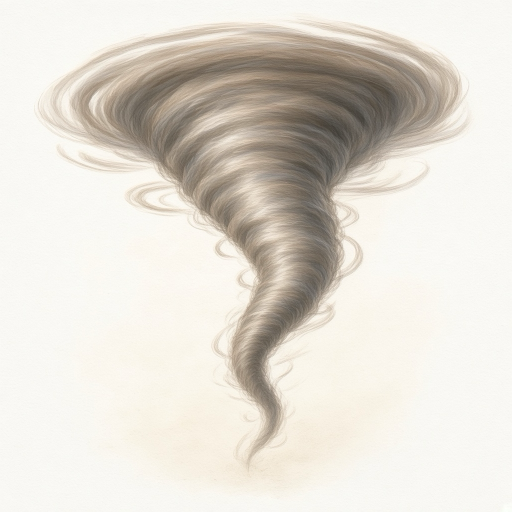
A tornado is a spinning tube of air that reaches from a storm cloud all the way down to the ground. It spins very fast, and it can pick up dust, dirt, and pieces of buildings. Weather scientists only call it a tornado when the spinning air touches the ground. A tornado is one of the strongest kinds of weather on Earth.
Why tornadoes are tricky to understand
A tornado is made of air, and air is invisible. So at first a tornado can be hard to see. It usually becomes easy to spot once it lifts dust and dirt into its spinning tube. On a dry day, a tornado might be almost see-through until it reaches something to pick up.
People also think a tornado is huge and lasts a long time. Most tornadoes are actually small and over fast. A lot of them last only a few minutes. A few big ones can last much longer and grow very wide, but those are rare.
Another surprise is where tornadoes come from. They drop down out of big thunderstorm clouds, the same clouds that bring lightning and thunder. The strongest tornadoes come from giant spinning storms.
Key facts about tornadoes
A tornado is a spinning column of air. It reaches from the bottom of a storm cloud down to the ground and spins very fast.
Tornadoes come from thunderstorms. The biggest ones form inside giant spinning storms called supercells.
The United States gets the most tornadoes. About 1,200 tornadoes touch down there every year, more than in any other country.
Tornadoes can have winds above 300 miles per hour (480 km/h). Mobile radars have measured such extreme winds a short distance above the ground in a few tornadoes.
A spinning column over water is a waterspout. Some waterspouts are tornadoes over water, while weaker fair-weather waterspouts form in a different way.
Tornadoes have been documented on almost every continent. Standard climatology references report them on every continent except Antarctica.
Most tornadoes are short. Many last only a few minutes before they fade away.
A tornado can be hard to see at first. It often becomes easy to spot once it picks up dust and debris.
You should not open windows during a tornado. It does not help and only wastes time you need to get to safety.
The safest place is a small room on the lowest floor. Stay away from windows, like in a closet or bathroom, or go to a basement if there is one.
Common myths about tornadoes
Myth: You should open the windows to keep your house safe. This is not true. Opening windows does not stop a tornado and only wastes time. Weather experts say to go to a safe spot right away instead.
Myth: Tornadoes only happen in one place. Tornadoes have been documented on every continent except Antarctica. The United States records the most, but they also occur in Canada, Europe, Australia, and many other regions.
Myth: A river or a hill will stop a tornado. Tornadoes can cross rivers, hills, and even big cities. The spinning air is high up, so the land below does not stop it.
Myth: A tornado lasts for hours and hours. Most tornadoes last only a few minutes. A small number last longer, but most are over fast.
Myth: Every tornado is a giant monster. Most tornadoes are small and weak. The huge, powerful ones make the news, but they are rare.
Frequently asked questions about tornadoes
What is a tornado?
A tornado is a violently spinning column of air connected to a storm cloud and in contact with the ground. It can lift dust, dirt, and pieces of buildings. The visible funnel does not have to reach the ground: swirling debris can reveal that the circulation itself has surface contact.
How do tornadoes form?
Tornadoes form from thunderstorms. In one common pathway, changing winds create rolling air, and a storm’s rising air tilts and stretches that spin. If rotation tightens all the way to the surface, a tornado can form. Scientists are still studying why some rotating storms produce tornadoes and others do not. The strongest tornadoes usually come from giant spinning storms called supercells.
Where do tornadoes happen the most?
The United States records more tornadoes than any other country, averaging roughly 1,200 each year. Many happen in the central states, including Texas, Oklahoma, and Kansas. Moisture, rising air, instability, and changing winds can come together there to support tornado-producing storms.
Are tornadoes dangerous, and how do I stay safe?
Tornadoes can be dangerous, but staying safe is simple. Go to the lowest floor of a building and find a small room with no windows, like a closet or bathroom. A basement is even better. Stay away from windows, and do not waste time opening them.
What is a tornado over water called?
A spinning column of air over a lake or ocean is called a waterspout. Tornadic waterspouts are tornadoes over water, but fair-weather waterspouts usually form by a different process and are generally weaker. A waterspout that moves onto land can still be dangerous.
Each of this topic’s quiz questions cites a source for the fact it tests. You can play at any level: Rookie, Curious, Sharp, or Expert.
A tornado is a violently spinning column of air that connects a thunderstorm cloud to the ground. It forms when the air inside a storm starts rotating and that spinning reaches all the way down to the surface. The strongest tornadoes drop out of large rotating storms called supercells. Tornadoes can lift heavy objects, but most are weaker and shorter than people expect.
Why tornadoes are surprising
Most people picture every tornado as a giant, mile-wide monster. The truth is that most tornadoes are weak and small. The huge, violent ones are rare, but they are the ones that end up in news reports and videos.
Tornadoes are also harder to see than you might think. A tornado is made of spinning air, and air is invisible. A tornado becomes visible when the low pressure inside it makes water droplets form, or when it sucks up dust and debris from the ground. On a dry day, a tornado can be nearly see-through until it reaches loose dirt or objects to lift.
One more surprise is how fast a tornado comes and goes. Many tornadoes last only a few minutes from start to finish. A storm can produce a tornado, watch it fade, and then spin up another one a short time later.
Key facts about tornadoes
The strongest tornadoes usually form from supercells. A supercell is a powerful thunderstorm with a rotating updraft, but other thunderstorms can also produce tornadoes.
The EF scale runs from EF0 to EF5. Tornadoes are rated on the Enhanced Fujita Scale by the damage they cause, with EF0 the weakest and EF5 the strongest.
Most tornadoes are weak. The great majority are rated EF0 or EF1. Violent EF4 and EF5 tornadoes are rare.
The deadliest US tornado was in 1925. The Tri-State Tornado crossed Missouri, Illinois, and Indiana on March 18, 1925. Its damage swath exceeded 219 miles, although modern analysis questions how much was one continuous tornado.
Tornado Alley is a nickname. It is an informal name for part of the central United States, including Texas, Oklahoma, and Kansas, where tornadoes are common.
Spring is the busiest season. In the United States, May is the busiest tornado month, followed by June and April.
Tornadoes can cross rivers and cities. Rivers, hills, and downtown areas do not stop tornadoes. The Mississippi River has been crossed many times.
A funnel aloft is a funnel cloud. It is a tornado when the circulation reaches the ground, which a debris cloud can reveal even if the condensation funnel does not extend all the way down.
Overpasses are not safe shelter. They leave people exposed to extreme winds and flying debris, and bridge geometry provides no reliable protection.
The safest place is a small interior room. Go to the lowest floor, away from windows, or to a basement if one is available.
Common myths about tornadoes
Myth: You should open windows to stop your house from exploding. Weather experts say this is false. Opening windows does not help, and it wastes time you need to reach safety. A house does not explode from the pressure of a tornado.
Myth: A highway overpass is a safe place to hide. This is one of the most dangerous myths. An overpass leaves people exposed to extreme winds and flying debris, and its shape provides no dependable shelter. The safer choice is a sturdy building, on the lowest floor, away from windows.
Myth: Rivers, hills, and big cities stop tornadoes. None of these stop a tornado. Tornadoes have crossed the Mississippi River many times and have struck the downtowns of large cities like St. Louis and Oklahoma City. A tornado is high in the air, so the land below cannot block it.
Myth: Every spinning funnel in the sky is a tornado. A rotating condensation funnel aloft is a funnel cloud. It is classified as a tornado when its circulation reaches the ground, sometimes shown by a debris cloud even though the visible funnel remains above the surface.
Myth: Almost every tornado is a giant EF5. EF5 tornadoes are very rare. Most tornadoes are weak EF0 or EF1 storms.
Frequently asked questions about tornadoes
How do tornadoes form?
Many strong tornadoes form inside supercells, which are thunderstorms with a rotating updraft. When winds change speed or direction with height, they can create horizontal spin. The storm’s rising air can tilt and stretch that spin. If rotation tightens near the surface, a tornado can form, although scientists are still studying why most supercells do not produce one. Other pathways can produce tornadoes without a mesocyclone.
What is the EF scale?
The EF scale, short for the Enhanced Fujita Scale, is the system used to rate tornadoes in the United States. It runs from EF0 for the weakest to EF5 for the strongest. The rating is based on the damage a tornado causes, because the actual wind speed is almost never measured directly. Survey teams look at the damage and estimate how strong the winds must have been.
Where is Tornado Alley?
Tornado Alley is a nickname for a region of the central United States where tornadoes happen often. It usually includes states like Texas, Oklahoma, Kansas, and Nebraska. It is not an official boundary on a map, and tornado risk extends well beyond it. Moisture, instability, lift, and wind shear frequently come together in this broad region to support severe storms.
What was the deadliest tornado in US history?
The deadliest tornado in United States history was the Tri-State Tornado of March 18, 1925. Its damage swath crossed Missouri, Illinois, and Indiana and extended more than 219 miles (352 km). Modern analysis suggests the most likely continuous segment was about 151 miles (243 km), so the famous 219-mile single-tornado path is not certain. People at the time had no modern tornado-warning system.
When is tornado season?
Across the United States as a whole, tornado reports peak in spring, with May usually the busiest month. The timing varies by region, and tornadoes can occur in any month. Seasonal combinations of moisture, instability, lift, and wind shear help create the peak.
Source notes
The facts in this article come from the weather authorities listed above. The science of how tornadoes form and the meaning of Tornado Alley come from NOAA’s National Severe Storms Laboratory. The Enhanced Fujita Scale details come from the National Weather Service, and the safety guidance comes from the Storm Prediction Center. The Tri-State Tornado record and modern path analysis come from the National Weather Service, and the funnel cloud definition comes from the NWS Glossary.
Each of this topic’s quiz questions cites a source for the fact it tests. You can play at any level: Rookie, Curious, Sharp, or Expert.
A tornado is a violently rotating column of air that is in contact with both the ground and the base of a cumulonimbus (thunderstorm) cloud. Most strong tornadoes form within supercells, the rotating thunderstorms that dominate severe-weather outbreaks. A tornado is rated after the fact on the Enhanced Fujita Scale, from EF0 to EF5, based on the damage it leaves behind. The United States records about 1,200 tornadoes a year, more than any other country.
Why tornadoes are hard to pin down
Tornadoes resist easy prediction. Supercells are the storms most likely to produce them, yet by NSSL estimates only about 20 percent of supercells actually spawn a tornado. Forecasters can identify a storm with all the right ingredients and still not know whether it will drop a tornado in the next ten minutes. This gap between favorable conditions and an actual tornado is a central problem in severe-weather science.
A tornado’s strength is also estimated rather than measured. Instruments almost never sit directly in a tornado’s path, and the few that do rarely survive a violent hit. So the Enhanced Fujita Scale works backward from damage: survey teams match what was destroyed against a standard list of indicators and infer the wind that likely caused it. The rating is an engineering estimate, not a wind reading.
Size and lifespan add to the confusion. The popular image is a wide, long-lived funnel, but most tornadoes are weak, narrow, and brief. The majority are rated EF0 or EF1, and many last only a few minutes. The violent, wedge-shaped tornadoes that fill news coverage are a small fraction of the total.
How tornadoes form
A tornado begins with the parent storm, not with the funnel. The key ingredient is wind shear: a change in wind speed or direction with height. This shear creates a horizontal tube of rotating air near the surface. When a thunderstorm’s updraft, the current of rising warm air, tilts that horizontal tube into the vertical and stretches it, the rotation tightens and speeds up. The result is a mesocyclone, a rotating updraft 2 to 6 miles (3 to 10 km) across that defines a supercell.
The mesocyclone is much larger than any tornado it produces. The final step, the tightening of rotation right at the ground, is the least understood part of the process. In a common conceptual model, a sinking current called the rear-flank downdraft wraps around the low-level mesocyclone and participates in concentrating spin near the surface, where a tornado can form. The process is not a simple recipe, and exactly why some supercells complete this step while others do not remains an open research question.
Detecting tornadoes on radar
Doppler radar transformed tornado warnings because it measures the motion of rain and debris toward and away from the radar, not just where the rain is. Two radar signatures matter most. The first is the hook echo, a curved appendage on the back side of a supercell that traces rain wrapping around the storm’s rotation. The hook marks the region where a tornado is most likely to form. The second is a velocity couplet, a tight pairing of winds moving toward the radar right beside winds moving away, which reveals rotation directly.
When that rotation is intense and concentrated, it produces a Tornado Vortex Signature, first identified by researchers at NSSL in the 1970s using experimental Doppler radar. These signatures give forecasters minutes of lead time, the warning window people use to reach shelter.
Key facts about tornadoes
Most strong tornadoes form from supercells via a mesocyclone. The rotating updraft, often several kilometers wide, can be detectable on radar before a tornado appears; other tornadoes form without this pathway.
The EF scale runs EF0 to EF5. It became operational in the United States on February 1, 2007, replacing the original Fujita Scale, and rates tornadoes by damage.
EF5 means estimated winds above 200 miles per hour (322 km/h). The rating requires damage consistent with that range; a house being swept away is not automatically EF5 because construction and anchoring matter.
Mobile radar has found tornado winds above 300 miles per hour (480 km/h). Bridge Creek in 1999 and Greenfield in 2024 produced extreme radar estimates, but comparisons depend on sampling height, method, resolution, and uncertainty.
The widest tornado on record was about 2.6 miles (4.2 km) across. It struck near El Reno, Oklahoma on May 31, 2013.
The United States leads the world in tornadoes. It averages about 1,200 a year; Canada is second with roughly 100.
Most tornadoes are weak. EF0 and EF1 ratings dominate; violent EF4 and EF5 tornadoes are rare.
Spring is the peak season. May is the busiest month in the United States, followed by June and April.
Most Northern Hemisphere tornadoes rotate counterclockwise. A small fraction are anticyclonic and rotate clockwise instead.
Tornadoes occur on every continent except Antarctica. Outside the United States, frequent tornadoes occur in places such as Canada, Argentina, Bangladesh, and parts of Europe.
Common myths about tornadoes
Myth: Open the windows to equalize pressure. This is false and dangerous. A house does not explode from pressure, and the Storm Prediction Center notes that opening windows wastes time you need to reach shelter. Use that time to get to a safe interior room instead.
Myth: A highway overpass is good shelter. An overpass leaves people exposed to extreme winds and flying debris, while its geometry offers no reliable protection and may concentrate flow in some locations. Forecasters specifically warn against sheltering under overpasses. A sturdy building is far safer.
Myth: The southwest corner of a basement is safest. This old rule assumed debris would fall away from that corner. Research showed tornado winds spin and can drive debris into any corner. The safest plan is to shelter under something sturdy on the lowest floor, away from windows.
Myth: Rivers, hills, and cities stop tornadoes. None do. Tornadoes have crossed the Mississippi River many times, passed over high ground, and struck the downtowns of major cities. The vortex extends thousands of feet up, so surface terrain does not block it.
Myth: Tornadoes can be outrun easily in a car. Vehicles are among the most dangerous places in a tornado. Roads can be blocked, and tornadoes can change speed and direction. The safer option is almost always a sturdy building.
Frequently asked questions about tornadoes
What is the difference between a tornado watch and a tornado warning?
A tornado watch means conditions are favorable for tornadoes over a broad area; the Storm Prediction Center issues watches, often covering multiple counties or states. A tornado warning is more urgent: a tornado has been sighted or detected on radar, and people in the path should take shelter immediately. Local National Weather Service offices issue warnings, which cover a smaller area for a shorter time.
What is the fastest wind speed ever recorded in a tornado?
There is no single uncontested surface-anemometer record for a tornado. Mobile Doppler radar estimated about 302 miles per hour (486 km/h), with substantial uncertainty, above the ground in the 1999 Bridge Creek tornado; NOAA’s current FAQ summarizes that event with a peak of 318 miles per hour (512 km/h). Analysis of the 2024 Greenfield tornado found ground-relative winds around 304 miles per hour (489 km/h) at roughly 30 meters above ground. These remote estimates cannot be ranked as simple, exact readings because their heights, sampling methods, resolution, and uncertainty differ.
What is the biggest tornado ever recorded?
The widest tornado on record formed near El Reno, Oklahoma on May 31, 2013, reaching about 2.6 miles (4.2 km) across. That is wider than many towns. Most tornadoes are far narrower, often only a few hundred yards wide.
How are tornadoes rated?
Tornadoes are rated on the Enhanced Fujita Scale, from EF0 to EF5, based on the damage they cause. Survey teams compare observed damage against a list of standard damage indicators and degrees of damage, then estimate the wind that likely produced it. Because tornado winds are almost never measured directly, the rating is an estimate inferred from damage.
Which way do tornadoes spin?
Most tornadoes in the Northern Hemisphere rotate counterclockwise, matching the rotation of their parent storm. A small fraction are anticyclonic and spin clockwise instead. In the Southern Hemisphere, cyclonic rotation is usually clockwise, though local storm processes can produce either direction.
Each of this topic’s quiz questions cites a source for the fact it tests. You can play at any level: Rookie, Curious, Sharp, or Expert.
A tornado is a violently rotating column of air, in contact with the ground and pendant from a cumulonimbus cloud, with rotation strong enough to be hazardous and, in most cases, to leave a damage signature. The defining diagnostic is ground contact: a rotating condensation funnel aloft is a funnel cloud until it reaches the surface or produces a debris cloud beneath it, at which point it is a tornado. Most intense tornadoes are mesocyclonic, descending from the rotating updraft of a supercell, though non-mesocyclonic tornadoes (landspouts and waterspouts) form by a different route. Tornado intensity is assigned retrospectively on the Enhanced Fujita Scale from EF0 to EF5, an estimate inferred from damage rather than a direct wind measurement.
Why tornadoes resist prediction
Three features make tornadoes scientifically stubborn. The first is the weak link between favorable environments and actual tornadoes. Supercells are the principal producers of significant tornadoes, yet only about 20 percent of supercells produce a tornado at all. The large-scale ingredients (instability, moisture, lift, and vertical wind shear) can be diagnosed hours ahead, but whether a given storm completes the final step to a surface vortex often comes down to storm-scale and near-surface details that current observations resolve poorly.
The second is that intensity is estimated, not measured. The fluid speeds inside a tornado are rarely sampled directly: in-situ instruments almost never lie in the path, and those that do seldom survive. As a result, the operational intensity scale is a damage scale. It maps observed structural and vegetative damage to a wind-speed estimate, with all the uncertainty that implies when the same wind can produce different damage depending on construction quality.
The third is the multiscale structure of the vortex itself. The parent mesocyclone spans several kilometers; tornadoes commonly span tens to hundreds of meters but can exceed a kilometer; and many violent tornadoes contain still-smaller suction vortices that orbit the center. Peak ground-relative winds, and the most extreme localized damage, are frequently concentrated in those subvortices, which means the worst damage can be confined to narrow arcs within an otherwise less-damaged swath.
Tornadogenesis and mesocyclone dynamics
Supercell tornadogenesis is a sequence, not a single event. It begins with environmental vertical wind shear, which generates horizontal vorticity, a tube of spin oriented parallel to the ground. A developing updraft tilts that horizontal vorticity into the vertical and stretches the resulting vertical vorticity, intensifying the rotation by conservation of angular momentum. The product is a mid-level mesocyclone, a rotating updraft typically 2 to 6 miles (3 to 10 km) in diameter, far broader than any tornado it may produce.
The decisive and least-understood phase is the development of strong rotation at and just above the surface. In a widely used conceptual model, the rear-flank downdraft, a region of descending air that wraps cyclonically around the low-level mesocyclone, plays an important role. Descending and converging air can transport and concentrate vorticity near the ground, where stretching can intensify a tornado-scale vortex. Rear-flank outflow thermodynamics can matter, but observations and simulations show several pathways and do not support a single deterministic recipe. Even with mobile-radar and in-situ field programs, the precise conditions that tip a rotating storm into a tornado remain an active research frontier.
Not all tornadoes follow this path. Landspouts and the closely related waterspouts develop from pre-existing near-surface vertical vorticity, often along a boundary, that is stretched by a growing updraft from the bottom up, without requiring a mesocyclone. Tornadic waterspouts develop downward from a severe convective cloud and are simply tornadoes over water; fair-weather waterspouts build upward from the surface under developing cumulus and are typically weaker, often reaching maturity by the time a condensation funnel is visible.
The Fujita scale and its enhanced successor
Tetsuya Theodore Fujita, the University of Chicago meteorologist nicknamed Mr. Tornado, introduced the Fujita Scale in 1971. Fujita, who also identified the downburst and microburst as distinct phenomena, designed the F scale to bridge tornado damage and wind speed across six categories, F0 through F5. The original scale tied its top category, F5, to estimated winds of 261 to 318 miles per hour (420 to 512 km/h).
Engineering analysis later concluded that the original F-scale winds were too high for the damage actually observed, particularly at the upper end, in part because the scale did not account for variations in construction quality. The Enhanced Fujita Scale, developed by a forum of wind engineers and meteorologists, addressed this by anchoring ratings to a structured catalog of 28 damage indicators, building types and vegetation such as one- and two-family residences, schools, and hardwood trees, each with several degrees of damage from minor to total destruction. Each degree of damage carries an expected wind-speed range, with lower and upper bounds, calibrated to typical construction.
The Enhanced Fujita Scale became operational in the United States on February 1, 2007, preserving the EF0-through-EF5 ranking while realigning the wind estimates downward to match the damage. On the EF scale, EF5 corresponds to estimated winds greater than 200 miles per hour (322 km/h). A residence swept from its foundation is not automatically rated EF5: evaluators consider anchoring, construction quality, debris, and the applicable degree of damage, and the current residence indicator can place even a well-constructed swept-away home in EF4 territory. The remaining categories span EF0 at 65 to 85 miles per hour (105 to 137 km/h) up through EF4 at 166 to 200 miles per hour (267 to 322 km/h). Because the rating derives from damage indicators, a violent tornado crossing open country may receive a lower rating than its peak winds would suggest, or an EF-Unknown classification, when suitable indicators are absent.
Measuring tornado winds remotely
Direct wind measurement inside tornadoes is rare, so many extreme estimates come from mobile Doppler radar. The 1999 Bridge Creek tornado yielded a widely reported estimate near 302 miles per hour (486 km/h), with substantial uncertainty, above the surface; NOAA’s current FAQ summarizes that event with a 318 mile-per-hour (512 km/h) peak. Mobile-radar analysis of the 2024 Greenfield tornado found radial velocities near 270 miles per hour (435 km/h) and ground-relative winds around 304 miles per hour (489 km/h) at roughly 30 meters above ground. These are remote, short-duration samples at different heights and resolutions, so treating them as exact, directly comparable surface records is not justified.
Doppler radar also underpins detection and warning. Two signatures are central. The hook echo, recognized in early radar studies, is a curved reflectivity appendage on the rear-right flank of a supercell, tracing precipitation drawn around the mesocyclonic circulation; it flags the region most favorable for tornado formation. The velocity couplet, or gate-to-gate shear, appears in the radial-velocity field as adjacent inbound and outbound maxima that reveal rotation directly. When such rotation is sufficiently intense and concentrated, it constitutes a Tornado Vortex Signature, identified by researchers at the National Severe Storms Laboratory in the 1970s using experimental Doppler radar. These signatures, combined with spotter reports, generate the warning lead time on which public safety depends.
Key facts about tornadoes
Mesocyclone scale. The supercell’s rotating updraft is typically 2 to 6 miles (3 to 10 km) across, an order of magnitude wider than the tornado it can spawn.
Tornado production rate. Only about 20 percent of supercells produce a tornado, a major source of forecast uncertainty.
EF transition. The Enhanced Fujita Scale became operational on February 1, 2007, lowering the F-scale wind estimates while keeping the six-category structure.
EF5 threshold. EF5 corresponds to estimated winds above 200 miles per hour (322 km/h); the original F5 had been tied to 261 to 318 miles per hour (420 to 512 km/h).
Damage-indicator basis. The EF scale uses 28 damage indicators, each with multiple degrees of damage, to infer wind speed.
Extreme radar estimates. Mobile radar has estimated winds above 300 miles per hour (480 km/h) in the 1999 Bridge Creek and 2024 Greenfield tornadoes, but the values are not simple surface readings and depend on method, height, and uncertainty.
Multiple-vortex structure. The most violent tornadoes often contain suction vortices, small embedded whirls that carry the most extreme local winds.
Rotation direction. Most Northern Hemisphere tornadoes are cyclonic (counterclockwise); a small minority are anticyclonic, but rotation direction alone does not determine intensity.
Distribution. The United States averages about 1,200 tornadoes annually, the most of any country; tornadoes occur on every continent except Antarctica.
Common misconceptions at expert level
Misconception: The EF rating is a measured wind speed. It is an inferred estimate. Survey teams assign the rating by matching damage to the catalog of 28 damage indicators and their degrees of damage; the wind value is read off the calibrated range for the worst well-documented damage, not from an anemometer in the vortex. This is why rating a tornado that crosses open terrain is difficult.
Misconception: A condensation funnel reaching cloud base but not the ground is already a tornado. By definition it is a funnel cloud until it reaches the surface or generates a debris cloud. Conversely, a tornado need not display a full condensation funnel; in dry conditions the circulation may be visible only as a debris cloud near the ground.
Misconception: F-scale and EF-scale numbers are interchangeable. They share a ranking but not the same wind values. The EF scale deliberately reduced the wind estimates associated with each category, so an event rated F5 under the old winds and EF5 under the new winds reflects different stated wind speeds for comparable damage.
Misconception: The mesocyclone and the tornado are the same circulation. They are nested but distinct. The mesocyclone is the kilometers-wide parent rotation detectable on radar minutes ahead; the tornado is a much smaller, more intense vortex that may or may not develop within it. Radar can show a strong mesocyclone with no tornado, and weak or non-mesocyclonic storms can still produce tornadoes.
Misconception: Peak tornado winds occur uniformly across the funnel. In multiple-vortex tornadoes, the extreme winds are concentrated in the orbiting suction vortices rather than spread evenly. This produces the characteristic pattern of narrow streaks of severe damage adjacent to lighter damage within the same path.
Frequently asked questions about tornadoes
Why is tornadogenesis still considered an open problem?
The large-scale environment that supports supercells is well understood and routinely forecast, but the storm-scale and near-surface processes that convert a rotating updraft into a surface tornado are not fully resolved. The role and thermodynamics of the rear-flank downdraft, the source and concentration of near-ground vorticity, and why most supercells never produce a tornado are all subjects of active field and modeling research. Current operational observations often cannot resolve the lowest few hundred meters in detail, which is exactly where the decisive physics occurs.
Is 301 miles per hour the definitive tornado wind record?
No. It is a historically important estimate from the 1999 Bridge Creek tornado, but it was a remote radial-velocity retrieval above the surface and carried substantial uncertainty. NOAA now summarizes that event with a 318 mile-per-hour (512 km/h) peak, while recent analysis of the 2024 Greenfield tornado found ground-relative winds around 304 miles per hour (489 km/h) at about 30 meters. Differences in height, radar geometry, spatial averaging, storm motion, and uncertainty prevent a clean ranking as if these were identical anemometer readings.
Why did the Enhanced Fujita Scale lower the wind estimates?
Wind-engineering analysis found that the original Fujita Scale overestimated the winds required to produce the observed damage, especially at the high end, because it did not account for construction quality. The EF scale recalibrated the wind ranges against a detailed set of damage indicators and degrees of damage, so an EF5 is now set at winds above 200 miles per hour (322 km/h) rather than the original F5 range of 261 to 318 miles per hour (420 to 512 km/h).
What distinguishes a tornadic waterspout from a fair-weather waterspout?
A tornadic waterspout is a tornado over water; it develops downward from a severe convective storm and shares the dynamics and hazards of a land tornado. A fair-weather waterspout forms differently, building upward from the water surface beneath developing cumulus in light-wind conditions, and is generally weaker. By the time a fair-weather waterspout shows a visible funnel, it is often already near peak intensity.
Source notes
The dynamics of tornadogenesis, mesocyclone scale, and the rear-flank downdraft in this article follow NOAA’s National Severe Storms Laboratory tornado pages and the detection section. The Enhanced Fujita Scale, its damage indicators, and the EF5 threshold come from the National Weather Service; its engineering limitations are discussed in a recent critical review. Wind-measurement context comes from NOAA’s Tornado FAQ and the American Meteorological Society’s mobile-radar research summary. Rotation statistics come from the Storm Prediction Center’s Online Tornado FAQ, and the two classes of waterspout are documented by NOAA.
Each of this topic’s quiz questions cites a source for the fact it tests. You can play at any level: Rookie, Curious, Sharp, or Expert.
Think you know Tornadoes?
Test yourself. Can you spot the true fact among 3 convincing bluffs?