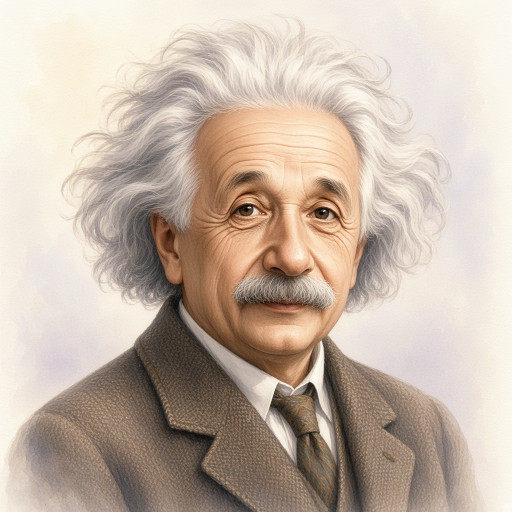
Albert Einstein was a famous scientist who studied big ideas about space, time, and gravity. He was born in Germany in 1879 and later moved to the United States. People know him as one of the smartest thinkers ever. His name is now a fun way to say that someone is very clever.
Why Albert Einstein is tricky to understand
Einstein studied things that are hard to see, like space and time. Most people think space and time always stay the same. Einstein showed that they can stretch and bend, which is a strange idea. You do not notice it in everyday life, but it is true.
Some people say Einstein was bad at math when he was a kid. That is not true at all. He was actually very good at math from a young age. He had learned hard math before he was 15 years old.
Einstein liked to figure things out by imagining pictures in his head. He once imagined what it would be like to ride next to a beam of light. Thinking in pictures helped him come up with his big ideas.
Key facts about Albert Einstein
Einstein was a scientist called a physicist. A physicist studies how things move and how the universe works.
Einstein was born in Germany in 1879. He was born in a town called Ulm.
Einstein played the violin. He started learning as a young boy and played music to relax.
Einstein had wild, fluffy white hair. His messy hair is one of the most famous things about him.
Einstein was very good at math. He learned hard math while he was still a young teenager.
Einstein won the Nobel Prize. This is one of the biggest prizes in all of science.
Einstein moved to the United States in 1933. He lived in a town called Princeton, in New Jersey.
Einstein liked thought experiments. He worked out his ideas by imagining pictures in his mind.
There is a famous photo of Einstein sticking out his tongue. A photographer took it on his birthday in 1951.
Einstein lived to be 76 years old. He died in 1955, about a hundred years ago.
Common myths about Albert Einstein
Myth: Einstein was bad at math. This is a famous myth, and it is wrong. Einstein was very good at math and learned hard math, like calculus, before he was 15 years old.
Myth: Einstein won his big prize for the theory of relativity. Einstein did win the Nobel Prize, but not for relativity. He won it for his work on how light can knock tiny bits out of metal.
Myth: Einstein was born in the United States. Einstein was born in Germany. He only moved to the United States later, when he was a grown man.
Myth: Einstein had neat, tidy hair. Einstein is famous for his wild, fluffy white hair that stuck out in all directions. People still draw cartoon scientists with hair like his.
Myth: Einstein could not play any music. Einstein loved music and played the violin for most of his life.
Frequently asked questions about Albert Einstein
Who was Albert Einstein?
Albert Einstein was a scientist who studied space, time, and gravity. He is one of the most famous scientists who ever lived. People use his name to mean a very smart person.
Where was Albert Einstein born?
Einstein was born in a town called Ulm, in the country of Germany, in 1879. When he grew up, he moved to other countries. He moved to the United States in 1933 and lived there for the rest of his life.
Was Einstein really bad at math?
No. That is a famous myth. Einstein was actually very good at math from a young age. He had already learned hard math before he turned 15 years old.
What instrument did Einstein play?
Einstein played the violin. He started learning when he was a young boy and kept playing for most of his life. He often played music to relax when he was not working on science.
Why is Einstein’s hair so famous?
In many famous photos, Einstein has wild, fluffy white hair that sticks out everywhere. His messy hairstyle became one of the most well-known things about him. Many cartoons draw smart scientists with hair just like his.
What prize did Einstein win?
Einstein won the Nobel Prize in Physics, one of the biggest prizes in science. He won it for his work on how light can knock tiny bits called electrons out of metal. Many people are surprised it was not for his theory of relativity.
Each of this topic’s quiz questions cites a source for the fact it tests. You can play at any level: Rookie, Curious, Sharp, or Expert.
Albert Einstein was a German-born physicist whose ideas changed the way scientists understand space, time, and gravity. He was born in 1879 and became one of the most famous scientists in history. His theory of relativity showed that space and time are linked together and can stretch and bend. His face, with its wild white hair, is known all over the world.
Why Albert Einstein is tricky to understand
Einstein studied ideas that go against everyday common sense. In normal life, a minute is always a minute and a meter is always a meter. Einstein showed that this is not always true. Near very fast motion or strong gravity, time can run slower and distances can shrink. These effects are tiny in daily life, which is why we never notice them.
Another tricky part is what Einstein is famous for. Most people connect his name with the theory of relativity. But the official prize he won, the Nobel Prize in Physics, was not given for relativity at all. It was given for a different discovery about light.
Einstein also did not look like a typical genius at first. For several years he worked an ordinary office job, far from any university. He came up with some of his greatest ideas during this time, while reviewing other people’s inventions.
Key facts about Albert Einstein
Einstein had a miracle year in 1905. He published four groundbreaking science papers in a single year, when he was only 26 years old.
One of his ideas links energy and mass. It is written as E equals m c squared, where c is the speed of light. It means a tiny bit of mass holds a huge amount of energy.
He won the Nobel Prize in Physics. He won it for the photoelectric effect, not for the theory of relativity that made him famous.
He worked at a patent office. Before he was famous, his job in Bern, Switzerland, was to review drawings of new inventions.
He left Germany in 1933. Einstein was Jewish, and when the Nazis took power, he moved to the United States for safety.
He became a US citizen in 1940. He kept his Swiss citizenship as well.
He was offered the presidency of Israel in 1952. Einstein was honored but turned the offer down.
He had a younger sister named Maja. The two were close their whole lives.
He solved problems with thought experiments. He worked out ideas by imagining pictures in his mind.
He played the violin. Music was one of his favorite ways to relax.
Common myths about Albert Einstein
Myth: Einstein won the Nobel Prize for relativity. The Nobel Prize honored his work on the photoelectric effect, which explains how light can knock electrons out of metal. The prize committee did not name relativity, partly because it was still being tested at the time.
Myth: Einstein was bad at math. This is one of the most repeated myths about him, and it is false. Einstein was excellent at math and had mastered hard math, like calculus, before he was 15.
Myth: Einstein invented the atomic bomb. Einstein did not build the bomb or work on the project that created it. In 1939 he signed a letter warning the United States that powerful new bombs might be possible, but his role ended there.
Myth: Einstein served as president of Israel. Einstein was offered the job in 1952 but turned it down. He felt he was better suited to science than to leading a country.
Myth: Einstein was an only child. Einstein had a younger sister named Maja, who he stayed close to all his life.
Frequently asked questions about Albert Einstein
What was Einstein’s miracle year?
Einstein’s miracle year was 1905. In that single year, he published four science papers that each changed physics. They covered light, atoms, motion, and energy. He was only 26 years old and was working an ordinary office job at the time.
What did Einstein win the Nobel Prize for?
Einstein won the Nobel Prize in Physics for his discovery of the law of the photoelectric effect. This explains how light can knock tiny bits called electrons out of a metal surface. Many people are surprised the prize was not given for his famous theory of relativity.
Why did Einstein leave Germany?
Einstein was Jewish, and when the Nazi government took power in Germany, it became dangerous for him to stay. He left Germany in 1933 and moved to the United States. He never returned to live in Germany.
Did Einstein really get offered the presidency of Israel?
Yes. In 1952, leaders in Israel offered Einstein the job of being the country’s president. Einstein was honored by the offer but said no. He explained that he was better suited to science than to dealing with people in politics.
What does E equals m c squared mean?
It means that energy and mass are two forms of the same thing. The letter c stands for the speed of light, which is very large. Because of that, even a tiny amount of mass holds a huge amount of energy.
What job did Einstein have before he was famous?
Before he became famous, Einstein worked at the Swiss patent office in the city of Bern. His job was to look at drawings of new inventions and check how they worked. He did much of his famous 1905 thinking while holding this everyday job.
Each trivia question in this topic cites a source for the fact it tests. You can play at any level: Rookie, Curious, Sharp, or Expert.
Albert Einstein (1879 to 1955) was a German-born theoretical physicist whose theories of relativity reshaped the modern understanding of space, time, gravity, and light. He is best known for the special theory of relativity (1905) and the general theory of relativity (1915), and for the relationship between mass and energy expressed as E equals m c squared. He won the 1921 Nobel Prize in Physics, settled in the United States in 1933, and became a US citizen in 1940. His name has become a worldwide shorthand for genius.
What is often misunderstood about Albert Einstein
The most common error about Einstein is that he failed mathematics as a student. The opposite is true. He excelled at math from childhood and had worked through differential and integral calculus before the age of 15. The myth appears to trace back to a misread school grading scale and a later “Believe It or Not” item. Einstein himself dismissed it, noting that he never failed in mathematics.
A second misunderstanding concerns his Nobel Prize. People often assume Einstein won it for relativity. The official 1921 citation honored him “for his services to Theoretical Physics, and especially for his discovery of the law of the photoelectric effect.” Relativity is not named. At the time, relativity was still considered controversial and not fully confirmed by all physicists, so the prize committee chose the safer, experimentally grounded photoelectric work. The 1921 prize was itself unusual: the committee reserved it during 1921 and awarded it in 1922.
A third point of confusion is Einstein’s role in nuclear weapons. He is frequently described as the inventor of the atomic bomb. He was not. In 1939 he signed a letter to President Franklin Roosevelt, drafted mainly by the physicist Leo Szilard, warning that a nuclear chain reaction in uranium could make extremely powerful bombs possible and that Germany might pursue such research. That letter helped prompt early American interest in nuclear physics. Einstein himself did not work on the Manhattan Project that built the bomb, and he was denied the security clearance that such work required.
A fourth surprise is how ordinary Einstein’s life looked during his most creative year. In 1905, his miracle year, he was not a professor. He was a patent clerk in Bern, Switzerland, reviewing applications for new inventions. He produced four landmark papers that year while holding that everyday job.
Key facts about Albert Einstein
Born in Germany, died in the United States. Einstein was born in Ulm, Germany, on March 14, 1879, and died in Princeton, New Jersey, on April 18, 1955, at age 76.
The miracle year of 1905. Einstein published four groundbreaking papers in 1905, covering the photoelectric effect, Brownian motion, special relativity, and the equivalence of mass and energy.
Nobel Prize for the photoelectric effect. His 1921 Nobel Prize in Physics was awarded for the law of the photoelectric effect, not for relativity. The prize was decided and presented in 1922.
Two theories of relativity. Special relativity came in 1905; the general theory of relativity, which describes gravity, followed a decade later in 1915.
The 1919 eclipse confirmation. General relativity predicted that the Sun’s gravity bends starlight. Expeditions led by Arthur Eddington measured this during the total solar eclipse of 1919, and the result made Einstein an international celebrity.
The patent office years. Einstein worked at the Swiss patent office in Bern starting in 1902, as a technical expert reviewing inventions, and did his 1905 work while employed there.
Escape from Nazi Germany. Einstein, who was Jewish, left Germany in 1933 as the Nazis came to power and joined the Institute for Advanced Study in Princeton, New Jersey.
The 1939 Roosevelt letter. Einstein signed a 1939 letter to President Roosevelt, drafted by Leo Szilard, warning of the possibility of powerful uranium-based bombs.
Offered the presidency of Israel. In 1952, Einstein was offered the largely ceremonial role of president of Israel after the death of Chaim Weizmann. He declined.
The famous tongue photo. A press photographer captured Einstein sticking out his tongue on his 72nd birthday, March 14, 1951. Einstein liked the image and asked for copies.
A lifelong violinist. Einstein played the violin from boyhood and turned to music often as a way to think and relax.
Person of the Century. Time magazine named Einstein its Person of the Century at the close of 1999, choosing him over political and military leaders of the era.
His brain was studied. After Einstein died in 1955, the pathologist who performed the autopsy removed and preserved his brain, which researchers examined for decades without reaching clear conclusions.
Common myths about Albert Einstein
Myth: Einstein failed math in school. Einstein was strong in mathematics from a young age and had mastered calculus before 15. The story that he failed math is false.
Myth: Einstein won the Nobel Prize for relativity. The 1921 prize citation named the photoelectric effect, not relativity. The committee avoided relativity because it was still seen as unconfirmed.
Myth: Einstein invented the atomic bomb. Einstein did not design the bomb or work on the Manhattan Project. His involvement was limited to signing a 1939 warning letter to President Roosevelt.
Myth: Einstein was a professor when he discovered relativity. During his 1905 miracle year, Einstein was a clerk at the Swiss patent office in Bern, not a university professor.
Myth: Einstein was born American. Einstein was born in Germany and became a Swiss citizen in 1901 and a US citizen in 1940.
Myth: The 1919 eclipse disproved Einstein. The 1919 measurements supported Einstein’s prediction that gravity bends light, helping to confirm general relativity rather than refute it.
Frequently asked questions about Albert Einstein
What did Einstein actually win the Nobel Prize for?
Einstein won the 1921 Nobel Prize in Physics for his discovery of the law of the photoelectric effect, the way light can eject electrons from a metal surface. The official citation does not mention relativity. Relativity was still considered controversial at the time, so the committee credited the more firmly established photoelectric work. The prize was reserved during 1921 and awarded in 1922.
What were the four papers of Einstein’s miracle year?
In 1905, Einstein published four papers that transformed physics. One explained the photoelectric effect by proposing that light comes in small packets of energy. One explained Brownian motion and gave strong evidence that atoms and molecules are real. One introduced the special theory of relativity. The fourth established the equivalence of mass and energy, the idea behind E equals m c squared.
How was Einstein’s theory of relativity tested?
General relativity predicted that the Sun’s gravity would bend the path of light passing near it. During the total solar eclipse of 1919, British expeditions led by Arthur Eddington photographed stars near the darkened Sun and measured a shift in their apparent positions that matched Einstein’s prediction. The result was announced in November 1919 and turned Einstein into a global celebrity.
Did Einstein help build the atomic bomb?
No. In 1939, Einstein signed a letter to President Roosevelt, written mainly by Leo Szilard, warning that uranium could be used to make extremely powerful bombs and that Germany might be working on them. The letter helped spur American nuclear research. Einstein did not work on the Manhattan Project that produced the bomb, and he was denied the security clearance such work required.
Why did Einstein move to the United States?
Einstein was Jewish, and the rise of the Nazi government in Germany made it dangerous for him to remain there. In 1933 he settled in the United States and joined the Institute for Advanced Study in Princeton, New Jersey. He became a US citizen in 1940 and lived in the United States for the rest of his life.
Is it true Einstein was offered the presidency of Israel?
Yes. After the death of Israel’s first president, Chaim Weizmann, in 1952, Einstein was offered the largely ceremonial post of president. He declined, explaining that he lacked the natural ability and experience to deal properly with people in such a position. He continued his scientific work instead.
Each trivia question in this topic cites a primary source for the specific fact it tests. You can play at any level: Rookie, Curious, Sharp, or Expert.
Albert Einstein (1879 to 1955) was a German-born theoretical physicist whose work on relativity, the quantum nature of light, and statistical mechanics reshaped twentieth-century physics. He produced the special theory of relativity and the mass-energy relationship in 1905, completed the general theory of relativity in 1915, and won the 1921 Nobel Prize in Physics for the law of the photoelectric effect. He spent his final two decades at the Institute for Advanced Study in Princeton, New Jersey, where he pursued a unified field theory and argued against the prevailing interpretation of quantum mechanics. His name remains a cultural byword for scientific genius.
What is often misunderstood about Albert Einstein
The popular image of Einstein flattens a career of distinct, separable achievements into a single vague idea of relativity. In practice his 1905 output alone spanned four different problems, and his later contributions to quantum theory and cosmology are frequently overlooked. Three points are worth correcting at the outset.
First, the Nobel citation. The 1921 Nobel Prize in Physics was awarded “for his services to Theoretical Physics, and especially for his discovery of the law of the photoelectric effect.” Relativity is conspicuously absent. The general theory had been confirmed by the 1919 eclipse measurements, but it remained contentious, and the committee preferred to honor the photoelectric work, which rested on a clear, testable law. The award itself was procedurally unusual: the committee found no 1921 nomination met the criteria, reserved the prize under the Nobel Foundation’s statutes, and conferred it in 1922. Einstein was traveling in Asia at the time and did not attend the ceremony.
Second, the distinction between his two relativity theories is routinely blurred. Special relativity (1905) treats inertial frames, observers in uniform relative motion, and rests on two postulates: the laws of physics are the same in all inertial frames, and the speed of light in a vacuum is invariant for all observers. From these follow time dilation, length contraction, the relativity of simultaneity, and the equivalence of mass and energy. General relativity (1915) is a theory of gravitation that extends the principles to accelerated frames and recasts gravity as the curvature of spacetime produced by mass and energy. Special relativity is not abandoned by the general theory; it is recovered as the local, weak-gravity limit.
Third, Einstein’s relationship to quantum mechanics is misremembered. He helped launch the quantum era by treating light as discrete quanta in his photoelectric paper, and he contributed foundational results in quantum statistics. Yet he spent his later years as one of the theory’s most penetrating critics, convinced that quantum mechanics, while empirically successful, offered an incomplete description of physical reality.
A fourth point concerns his final decades. After settling at the Institute for Advanced Study in 1933, Einstein devoted much of his remaining effort to a unified field theory, an attempt to combine gravitation and electromagnetism within a single geometric framework. The program did not succeed and ran against the grain of mainstream physics, which was moving toward quantum field theory and, later, the study of the strong and weak nuclear forces that Einstein’s geometric approach did not address. He continued the search until the end of his life. The work is sometimes read as a long failure, but it reflected a consistent conviction that the deep structure of nature should be describable by definite field equations rather than by probabilities alone.
Key facts about Albert Einstein
Four 1905 papers. Einstein’s miracle year produced the photoelectric-effect paper, the Brownian-motion paper, the special-relativity paper, and the mass-energy paper, all in the journal Annalen der Physik.
The photoelectric Nobel. The 1921 Nobel Prize was awarded for the law of the photoelectric effect, reserved in 1921 and conferred in 1922, with no mention of relativity.
Brownian motion as proof of atoms. Einstein’s 1905 analysis of the random motion of suspended particles provided some of the strongest quantitative evidence then available that atoms and molecules are real.
General relativity in 1915. Einstein presented the final field equations of general relativity in late 1915, describing gravity as spacetime curvature rather than a force.
The 1919 eclipse test. Expeditions associated with Arthur Eddington measured the gravitational deflection of starlight during the 1919 total solar eclipse, matching general relativity’s prediction and bringing Einstein worldwide fame in late 1919.
Bose-Einstein statistics. In the mid-1920s, building on work sent to him by Satyendra Nath Bose, Einstein developed the statistics governing identical bosons and predicted a low-temperature condensate, now called the Bose-Einstein condensate, first realized experimentally in 1995.
The cosmological constant. In 1917 Einstein added a cosmological constant to his equations to permit a static universe, a step he later regretted once cosmic expansion was established by observation.
The EPR argument. In 1935, Einstein, Boris Podolsky, and Nathan Rosen published a paper arguing that quantum mechanics, as then formulated, could not be considered a complete description of reality.
Quantum skepticism. Einstein’s discomfort with intrinsic quantum randomness is captured in his much-paraphrased remark about God not playing dice, drawn from a 1926 letter to Max Born.
Citizenship path. Einstein renounced German citizenship around 1896, became a Swiss citizen in 1901, emigrated to the United States in 1933, and naturalized as a US citizen in 1940.
Common myths about Albert Einstein
Myth: Einstein failed mathematics. He excelled at mathematics from childhood, mastering calculus before 15. The failed-math story is a durable fabrication that Einstein personally rejected.
Myth: Einstein won the Nobel Prize for relativity. The 1921 citation named the photoelectric effect. The committee deliberately avoided relativity, which it still regarded as insufficiently settled.
Myth: Einstein created quantum mechanics or fully accepted it. Einstein helped seed quantum theory with his light-quanta hypothesis and his quantum statistics, but the mature theory was built largely by Heisenberg, Schrodinger, Born, Dirac, and Bohr, and Einstein remained a committed critic of its completeness.
Myth: The cosmological constant was meant to predict an expanding universe. Einstein introduced it in 1917 to allow a static universe, the reverse of expansion. Expansion was an observational discovery that made the original motivation obsolete.
Myth: Einstein built the atomic bomb. Einstein signed a 1939 warning letter to President Roosevelt drafted by Leo Szilard but played no role in the Manhattan Project and held no relevant security clearance.
Frequently asked questions about Albert Einstein
What is the difference between special and general relativity?
Special relativity, published in 1905, applies to inertial frames and is built on the invariance of the speed of light and the equivalence of all inertial observers. It yields time dilation, length contraction, the relativity of simultaneity, and the mass-energy relationship. General relativity, completed in 1915, is a theory of gravitation that generalizes these ideas to accelerated frames and treats gravity as the curvature of spacetime caused by mass and energy. General relativity contains special relativity as its local limit when gravity is weak.
Why did the Nobel committee avoid relativity?
When the prize was decided, the general theory had only recently been tested by the 1919 eclipse, and relativity remained the subject of active dispute among physicists and philosophers. The photoelectric effect, by contrast, was governed by a precise, repeatedly verified law. Awarding the prize for the photoelectric work let the committee honor Einstein without endorsing a theory it considered unsettled. The citation therefore credits the law of the photoelectric effect specifically.
What is the Bose-Einstein condensate?
In the mid-1920s, the Indian physicist Satyendra Nath Bose sent Einstein a new derivation of the statistics of light quanta. Einstein extended the approach to atoms with mass and predicted that, at temperatures near absolute zero, a large fraction of such particles would occupy the same lowest quantum state, forming a single coherent quantum entity now called the Bose-Einstein condensate. Particles that obey these statistics are called bosons. The condensate was first produced in the laboratory in 1995, using ultracold rubidium atoms, work that earned a later Nobel Prize.
What was the cosmological constant, and why did Einstein regret it?
In 1917, Einstein applied general relativity to the universe as a whole and found that the equations did not naturally permit a static cosmos; gravity would tend to make it contract. He introduced a cosmological constant, an additional term that could counterbalance gravity and keep the universe static, in keeping with the assumptions of the time. After observations established that the universe is expanding, the static-universe rationale collapsed, and Einstein came to view the addition as a serious misstep. The cosmological constant has since returned to cosmology in connection with the accelerating expansion of the universe.
What was the EPR paradox?
In 1935, Einstein, Boris Podolsky, and Nathan Rosen published a paper titled “Can Quantum-Mechanical Description of Physical Reality Be Considered Complete?” They argued that for certain pairs of particles, quantum mechanics implies correlations that, on their reasoning, require either faster-than-light influence or a description that is incomplete. Einstein favored the conclusion that the theory was incomplete. The strange correlations at the heart of the argument are now understood as quantum entanglement, and later experiments supported the quantum predictions over Einstein’s expectation of a more definite underlying reality.
Why was the photoelectric effect so important?
Classical wave theory could not explain why light below a certain frequency ejected no electrons from a metal, no matter how intense the beam, while light above that threshold did, with electron energy set by frequency rather than brightness. Einstein resolved this in 1905 by proposing that light energy is delivered in discrete quanta whose energy depends on frequency. The hypothesis was one of the first concrete signs that energy at the atomic scale is quantized, and it helped open the path to modern quantum theory. The precise photoelectric law it predicted was later confirmed experimentally, which is the work the Nobel committee cited in 1921.
Did Einstein reject quantum mechanics outright?
Not as a working tool. Einstein accepted that quantum mechanics made accurate predictions and had himself contributed to its foundations. What he rejected was the claim that it was a complete and final account of nature, particularly its reliance on irreducible probability. His resistance to randomness at the deepest level is summed up in his often-quoted line, paraphrased from a 1926 letter, that he was convinced nature does not operate by chance, popularly rendered as God not playing dice.
Source notes
The dates, the verbatim Nobel citation, and the physics characterizations in this article follow the sources listed above. The Nobel facts and the reserved-then-awarded timing follow the Nobel Foundation. The 1915 completion of general relativity and the description of gravity as spacetime curvature follow NASA Goddard Space Flight Center. The Bose-Einstein condensate, its origin in Bose’s work, and the 1995 laboratory realization follow NIST. The EPR argument follows the Stanford Encyclopedia of Philosophy, and the broader biography follows Encyclopaedia Britannica.
Each trivia question in this topic cites a primary source for the specific fact it tests. You can play at any level: Rookie, Curious, Sharp, or Expert.
Think you know Albert Einstein?
Test yourself. Can you spot the true fact among 3 convincing bluffs?