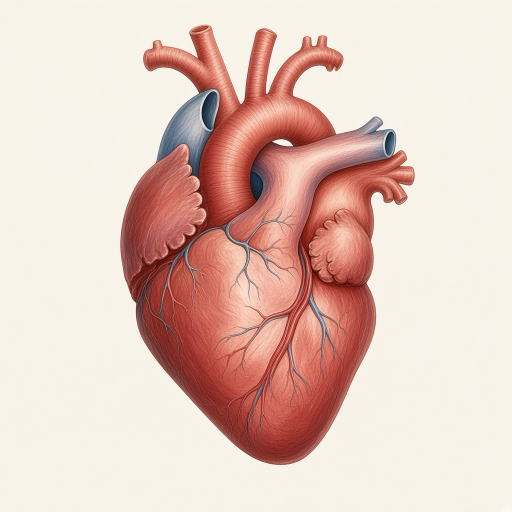
The heart is a muscle near the middle of your chest that pumps blood through your body. It is about the size of your fist, and at a typical resting rate it beats roughly 100,000 times a day without conscious effort. Its right side sends oxygen-poor blood to the lungs, and its left side sends oxygen-rich blood to the rest of the body. The heart works continuously, with brief relaxation and filling between contractions.
Why the heart is tricky to understand
The heart is not shaped like the heart on a Valentine card. The real heart is more like a lumpy upside-down pear, and it sits roughly behind the middle of your chest. The bottom tip points a little to the left, which is why people put their hand on the left side of the chest when they think of their heart.
The heart is a muscle, but it is not the same kind of muscle that moves your arms and legs. Its normal rhythm begins in pacemaker cells inside the heart, while the brain, nerves, hormones, activity, and emotions can make the rate change. During transplantation, a donor heart is usually cooled and temporarily stopped with a protective solution. Its own pacemaker can resume a rhythm after surgeons reconnect the vessels and restore warm, oxygen-rich blood.
The heart works like two coordinated pumps side by side. The right side sends blood to the lungs to pick up oxygen. The left side sends oxygen-rich blood to the rest of your body. The two atria contract before the two ventricles, and the ventricles normally contract together.
Key facts about the heart
Your heart is about the size of your fist. In a grown-up it weighs around 0.66 pounds (300 g), which is less than a can of soup.
The heart beats about 100,000 times every day. Over an 80-year life that adds up to roughly 3 billion beats.
A grown-up’s resting heart commonly beats about 60 to 100 times a minute. Newborn reference ranges are higher, often around 100 to 160 times a minute. Heart rate also changes with sleep, activity, temperature, health, emotion, and medicine.
The heart has four rooms inside, called chambers. The two on top are atria, and the two on the bottom are ventricles. Blood flows from the atria down into the ventricles, then out to the lungs or the body.
The “lub-dub” sound follows the heart’s valves closing. The first sound begins when the valves between the atria and ventricles close. The second begins when the outlet valves close. The sounds come from vibrations in the valves, blood, and surrounding heart structures as flow changes.
Your heart pumps about 2,000 gallons (7,500 liters) of blood every day. That is enough to fill a small swimming pool by the end of the week.
The left ventricle has a thicker muscle wall than the right. It pumps at higher pressure through the body’s systemic circulation, while the right ventricle pumps through the nearby, lower-pressure lung circulation.
Blood inside your body is always red, never blue. Veins look blue through the skin, but the blood inside is dark red because it has less oxygen.
Common myths about the heart
Myth: The heart is on the left side of the chest. The heart sits in the middle of the chest, behind the breastbone. It tilts a little to the left, so a bit more of it is on the left side, but it is not stuck way over to one side.
Myth: Your heart switches off between beats. During diastole, the heart muscle relaxes and the chambers fill with blood. That relaxation is part of each heartbeat, not a shutdown of the heart’s electrical system.
Myth: Today’s implanted heart devices run only on a person’s movements. Pacemakers use implanted batteries, while current artificial-heart systems and assist pumps need an internal or external power supply. Researchers study energy-harvesting devices, but motion alone does not power the clinical systems described here. Heart muscle uses chemical energy made from nutrients and oxygen.
Myth: A heart attack and cardiac arrest are the same thing. A heart attack usually happens when coronary blood flow is blocked or greatly reduced and heart muscle is injured. In cardiac arrest, the heart suddenly stops pumping effectively; an abnormal rhythm is a common cause. One can lead to the other, but they are different emergencies.
Myth: Your heart has a fixed supply of beats. The heart does not have a preset number of beats that exercise uses up. Training often lowers resting heart rate because an athlete’s heart can pump more blood per beat, while heart health still depends on age, disease, genes, and lifestyle.
Frequently asked questions about the heart
How does the heart know when to beat?
The heart has its own tiny built-in pacemaker, a patch of special cells called the sinoatrial node (or SA node) in the upper right chamber. The SA node sends a small electrical signal across the heart about once a second when you are resting. The signal makes the heart muscle squeeze in the right order, top first and then bottom.
Why does my heart beat faster when I run?
When you run, your muscles need more oxygen. Nerves and hormones make your heart beat faster and more forcefully so more blood reaches the muscles. After exercise, the rate gradually moves back toward rest. The response varies with age, fitness, health, temperature, medicine, and exercise intensity.
What does the heart do for the rest of my body?
Your heart helps deliver oxygen and nutrients and carry wastes toward organs that remove them. When the heart stops pumping effectively, the brain can be injured within minutes. CPR cannot replace a normal heartbeat, but chest compressions can provide limited blood flow while someone calls emergency services and gets an automated external defibrillator.
Why do doctors put a stethoscope on my chest?
The stethoscope lets a clinician hear vibrations associated with heart-valve closure and blood flow. A murmur is an extra sound caused by turbulent flow. Some murmurs signal a valve or structural problem, while many childhood murmurs are innocent and may come and go without treatment.
Can a person live with a broken heart?
Yes, in two ways. Clinicians can treat many heart problems with medicine, devices, or surgery. They can also replace a failing heart with a donated organ. The first human-to-human heart transplant was performed in 1967, and thousands of heart transplants are now performed worldwide each year.
Source notes
The anatomy and physiology in this article are checked against the listed NIH and American Heart Association sources. The emergency distinctions follow the current American Heart Association heart-attack and cardiac-arrest pages, and the transplant scale is checked against the listed federal registry report.
The heart is a muscular pump near the center of your chest, about the size of a closed fist, that drives blood through the circulatory system. At typical resting values it contracts around 100,000 times and moves roughly 2,000 gallons (7,500 liters) in a day, although both figures vary. Its four chambers and four valves form two coordinated pumps: the right side sends blood through the lungs, and the left side sends blood through the rest of the body.
Why the heart is tricky to understand
The heart does not look like the cartoon shape on a Valentine card. The organ sits behind the breastbone in the mediastinum and tilts so that its apex points down and left. Roughly two-thirds of its mass lies left of the body’s midline. Clinicians use standard landmarks to locate the apical impulse and valve-listening areas rather than relying on the nipple as a universal marker.
The normal heartbeat begins in the heart rather than requiring a separate command from the brain. The sinoatrial (SA) node generates impulses spontaneously, while the autonomic nervous system and circulating hormones adjust its rate. During transplantation, the donor heart is normally cooled and arrested for preservation; after reconnection and reperfusion, its intrinsic pacemaker can resume a rhythm.
The heart is built from a third type of muscle called cardiac muscle, distinct from the skeletal muscle in your arms and the smooth muscle in your gut. Cardiac muscle is striped like skeletal muscle but involuntary like smooth muscle. Connections within intercalated discs, including gap junctions, let electrical current spread rapidly and coordinate contraction across neighboring cells.
Key facts about the heart
Size and weight. An adult heart weighs about 0.66 pounds (300 g), roughly 0.4 to 0.5 percent of body weight. It is about the size of the owner’s clenched fist.
Output at rest. A healthy adult heart pumps roughly 1.3 gallons (5 liters) of blood per minute when sitting still, which adds up to about 2,000 gallons (7,500 liters) per day. During hard exercise, output can rise four or five times higher.
Resting heart rate. A typical adult resting heart rate is 60 to 100 beats per minute. Newborn reference ranges are higher, often around 100 to 160 beats per minute, and change with age, activity, sleep, health, and measurement conditions.
Four chambers, four valves. The two upper chambers are atria (right and left), and the two lower chambers are ventricles (right and left). Each side has an inflow valve and an outflow valve. The valves are passive flaps of fibrous tissue, not muscles; they open and close because of pressure differences in the blood.
The lub-dub. The first heart sound (S1, “lub”) is the closure of the mitral and tricuspid valves at the start of contraction. The second sound (S2, “dub”) is the closure of the aortic and pulmonary valves when the ventricles relax.
The left ventricle works at higher pressure. Its wall is roughly three to four times thicker than the right ventricle’s. Both ventricles pump the same amount per beat, but the left drives the high-resistance systemic circulation while the right pumps through the lower-pressure pulmonary circulation.
The heart is a double pump. The right side delivers oxygen-poor blood to the lungs (the pulmonary circuit). The left side delivers oxygen-rich blood to the body (the systemic circuit). The two loops run in parallel, and both ventricles contract together.
Coronary arteries feed the heart muscle itself. Oxygen cannot diffuse far enough from chamber blood to supply the thick myocardium. Coronary arteries branch over and into the heart muscle. Flow to the left ventricular myocardium occurs mainly during diastole, while right-coronary flow is less restricted during systole.
Common myths about the heart
Myth: The heart pumps about 200 gallons a day. The real figure is roughly 2,000 gallons (7,500 liters), about ten times more. The misunderstanding usually comes from confusing one minute’s output (about a gallon) with one day’s output.
Myth: Heart valves squeeze blood through. The valves are passive flaps. They open when blood pushes them open and close when blood tries to flow backward. The squeezing comes from the muscle of the chambers, not from the valves themselves.
Myth: Veins are blue. Blood inside the body is always some shade of red. Oxygen-rich blood from the lungs is bright red; oxygen-poor blood returning to the heart is darker red. Veins under the skin look blue because of how skin and tissue scatter light, not because the blood inside them is blue.
Myth: A heart attack means the heart stops. A heart attack (myocardial infarction) is heart-muscle injury caused by too little blood flow, commonly after a coronary clot forms. The heart often keeps beating during the event. In cardiac arrest, the heart suddenly stops pumping effectively, often because of an abnormal rhythm. The conditions can occur together but are not the same.
Myth: Every slow resting heart rate means a weak heart. Endurance training can increase stroke volume, allowing the same resting output with fewer beats. Some trained, asymptomatic athletes have rates in the 40s. Bradycardia can also result from medicine or conduction disease, especially when symptoms are present, so context matters.
Myth: The first heart transplant happened in the United States. The first successful human-to-human heart transplant was performed by Christiaan Barnard in Cape Town, South Africa, on 3 December 1967. The patient, Louis Washkansky, lived 18 days. American teams performed transplants soon after, and Stanford became a leading center, but the first was Barnard’s.
Frequently asked questions about the heart
Why is my heart on the left?
It is mostly in the middle. About two-thirds of the heart’s mass sits left of the body’s midline because the lower tip, called the apex, points down and to the left. The right and left lungs are not symmetric: the left lung has only two lobes (instead of three) to make room for the heart’s tilt.
What makes the lub-dub sound?
The first sound, “lub,” begins with mitral and tricuspid valve closure as the ventricles start to contract. The second, “dub,” begins with aortic and pulmonary valve closure near the end of ejection. The audible sounds reflect vibrations in blood and cardiac structures, not simply leaflets hitting one another. A murmur is an extra flow sound; some indicate disease, while many childhood murmurs are innocent and may come and go.
What happens during a heart attack?
Many heart attacks begin when an atherosclerotic plaque inside a coronary artery ruptures or erodes and a blood clot obstructs the artery. Heart muscle downstream stops receiving enough oxygen, and injury progresses with time. Rapid treatment, often a procedure using a balloon and metal-mesh stent, can limit how much muscle dies.
How is a heart attack different from cardiac arrest?
A heart attack usually involves reduced or blocked coronary blood flow that injures heart muscle. Symptoms vary and can be subtle or absent, so suspected symptoms require an immediate emergency call. In cardiac arrest, the person is unresponsive and is not breathing normally; gasping can occur. Bystanders should call emergency services, begin CPR, and use an AED as soon as available. The AED analyzes the rhythm and shocks only when appropriate.
Why do athletes have slow heart rates?
Endurance training can enlarge the left-ventricular chamber and increase stroke volume, so the same resting output may require fewer beats. Some well-trained, asymptomatic athletes have resting rates in the 40s. A low rate accompanied by fainting, dizziness, unusual fatigue, chest symptoms, or exercise intolerance still needs medical assessment.
Is “broken heart syndrome” a real thing?
Yes. The medical name is takotsubo cardiomyopathy. It is a sudden weakening of the heart’s pumping, often after intense emotional or physical stress. In the classic pattern, the heart’s apex balloons while the base contracts, although other patterns occur. It can resemble a heart attack on initial tests, but obstructive coronary disease does not explain the wall-motion pattern. Most patients recover ventricular function within weeks.
How do you live without your own heart?
Surgeons can replace a failing heart with a donor heart in a transplant. They can also use a mechanical pump called a left ventricular assist device (LVAD) to support the left ventricle, either while awaiting transplant or as longer-term therapy. Total artificial heart systems can replace the pumping function of both ventricles in selected patients. Current clinical pumps require a powered controller or driver; none runs only on the wearer’s body motion.
Source notes
The anatomy and physiology are checked against the listed NIH, NCBI Bookshelf, and American Heart Association sources. Emergency guidance follows the current heart-attack and cardiac-arrest pages listed above. The transplant and mechanical-pump sections use the listed transplant overview and the NHLBI explanation of the powered driver used by a total artificial heart.
The heart is a muscular pump roughly the size of an adult fist that drives blood through two circuits in series. The right ventricle pumps oxygen-poor blood through the lungs, and the left ventricle pumps oxygen-rich blood through the systemic circulation. Typical resting values of about 70 beats and 1.3 gallons (5 liters) per minute illustrate how a lifetime could total billions of beats and hundreds of millions of liters moved, but actual totals vary with body size, age, activity, health, and lifespan.
What is often misunderstood about the heart
The heart is not located entirely on the left side of the chest. It sits in the mediastinum behind the sternum, with roughly two-thirds of its mass left of the body’s midline and the apex pointing down and left. The left lung has two lobes and a cardiac notch, while the right usually has three lobes.
The normal beat originates in cardiac pacemaker tissue, while the brain and autonomic nerves modulate its rate. The sinoatrial (SA) node, near the junction of the superior vena cava and right atrium, depolarizes spontaneously. Activation spreads through atrial tissue to the atrioventricular (AV) node, then through the bundle of His, bundle branches, and Purkinje fibers. A donor heart is normally arrested during preservation, but its intrinsic pacemaker can resume after reperfusion; a denervated transplanted heart can maintain a rhythm without direct neural initiation.
A heart attack is not the same as cardiac arrest. A myocardial infarction (MI) is myocardial injury caused by ischemia; a common mechanism is an acute coronary clot after plaque rupture or erosion, but other mechanisms exist. Cardiac arrest is the loss of effective circulation. Ventricular fibrillation and pulseless ventricular tachycardia are shockable arrest rhythms, while asystole and pulseless electrical activity are not treated with defibrillation.
The valves of the heart are not muscular. All four (mitral, tricuspid, aortic, pulmonary) are passive fibrous structures that open and close in response to pressure differences across them. The familiar “lub-dub” of auscultation comes from valve closures: S1 from mitral and tricuspid closure at the start of ventricular systole, S2 from aortic and pulmonary closure at its end.
Key facts about the heart
Mass and proportion. Adult heart mass averages around 0.66 pounds (300 g), about 0.4 to 0.5 percent of total body weight, not the often-repeated “10 percent.” Trained endurance athletes show physiologic hypertrophy with proportional wall thickening and chamber enlargement.
Cardiac output. A typical resting cardiac output is about 1.3 gallons (5 liters) per minute, the product of stroke volume (about 70 mL per beat) and heart rate (about 70 bpm). Maximal output during intense exercise can reach 6.5 gallons (25 liters) per minute in healthy adults and over 10 gallons (40 liters) per minute in elite endurance athletes.
Resting heart rate by age. Reference ranges vary by age and measurement conditions. Common resting ranges are about 100 to 160 bpm for newborns and 60 to 100 bpm for adults, with age-specific pediatric ranges between them. Some well-trained, asymptomatic endurance athletes have rates in the 40s, but a low rate can also require clinical evaluation when accompanied by symptoms or conduction disease.
Chamber wall thickness. The left ventricular free wall is roughly 8 to 12 mm thick at end-diastole, three to four times the right ventricular wall. Both ventricles eject the same stroke volume per beat, but at different pressures: about 120 mmHg systolic on the left versus 25 mmHg on the right.
Coronary perfusion. The right and left coronary arteries arise from the aortic root. The left main typically divides into the left anterior descending (LAD) and circumflex branches. Systolic compression makes left-ventricular coronary flow predominantly diastolic; right-coronary flow is distributed more across both phases.
Conduction velocity. The SA node fires at roughly 60 to 100 times per minute at rest. Conduction is fastest in Purkinje fibers (about 2 to 4 m/s) and slowest at the AV node (about 0.05 m/s), where the deliberate delay allows the atria to finish emptying before the ventricles contract.
Cholesterol synthesis. Most body cholesterol is made endogenously in multiple tissues, with the liver central to whole-body regulation; diet supplies a smaller and variable share. Statins inhibit HMG-CoA reductase and increase hepatic clearance of LDL from blood.
Patent foramen ovale (PFO). A persistent flap-like communication between the atria is found in roughly one-quarter of adults, and most are asymptomatic. In carefully selected patients, especially some younger adults with an otherwise unexplained embolic stroke, closure can reduce recurrence when weighed against procedural risks.
Common myths about the heart
Myth: The heart pumps about 200 gallons per day. Adult cardiac output of about 5 L/min works out to roughly 2,000 gallons (7,500 liters) per day, an order of magnitude higher. The 200-gallon figure typically reflects confusion between per-minute and per-day units.
Myth: Every heart attack is caused by an artery slowly closing. Many acute coronary syndromes follow sudden plaque rupture or erosion and thrombus formation. The culprit plaque need not have produced severe narrowing beforehand. Other mechanisms, including spasm and spontaneous coronary artery dissection, can also cause myocardial infarction.
Myth: Veins are blue. Blood inside the body is always red. Deoxygenated venous blood is darker red than arterial blood. The blue appearance of subcutaneous veins is an optical effect of how skin scatters light, not a property of the blood itself.
Myth: Defibrillators can restart any stopped heart. Defibrillators can terminate ventricular fibrillation and pulseless ventricular tachycardia, creating an opportunity for an organized rhythm to resume. Asystole and pulseless electrical activity are nonshockable rhythms treated with high-quality CPR, correction of reversible causes, and indicated medications.
Myth: Salt narrows the heart’s chambers directly. High sodium intake can promote fluid retention and higher blood pressure, with effects that vary among people. Chronic hypertension increases afterload and can drive left ventricular hypertrophy and dysfunction over time. Salt does not directly shrink a chamber.
Myth: Heart attack symptoms are the same in everyone. Chest discomfort is common in all sexes, but symptoms and descriptions vary. Shortness of breath, nausea, sweating, unusual fatigue, or pain in the jaw, back, shoulder, arm, or stomach may occur with or without prominent chest pain. Older adults and people with diabetes can have subtle or silent events. Suspected symptoms require emergency evaluation rather than self-diagnosis from a stereotype.
Myth: A transplanted heart will not beat without a brain signal. A donor heart resumes beating once perfused because its own pacemaker tissue is intact. Transplanted hearts are denervated at first; they respond more slowly to demands such as exercise because they rely on circulating catecholamines rather than direct vagal and sympathetic input.
Frequently asked questions about the heart
What makes the heart beat?
The sinoatrial node, a small cluster of specialized pacemaker cells near the top of the right atrium, depolarizes spontaneously about 60 to 100 times per minute at rest. The resulting electrical wave spreads through the atria, pauses briefly at the atrioventricular node to allow ventricular filling, and then sweeps through the bundle of His and Purkinje fibers to trigger ventricular contraction. The autonomic nervous system speeds this up (sympathetic input) or slows it down (vagal input), but the rhythm itself is intrinsic to the heart.
Why does the heart make a “lub-dub” sound?
The first heart sound (S1) is the closure of the mitral and tricuspid valves at the start of ventricular contraction. The second sound (S2) is the closure of the aortic and pulmonary valves at the end of ejection. A stethoscope picks up these mechanical events; their timing and quality help clinicians screen for valve disease.
What happens during a heart attack?
Many acute MIs begin when an atherosclerotic plaque ruptures or erodes and triggers clot formation. Reduced coronary flow causes ischemia, and irreversible injury grows with the duration and severity of blockage. Treatment aims to restore flow urgently, often by percutaneous coronary intervention (PCI) and sometimes with fibrinolytic medicine when timely PCI is unavailable and the clinical criteria are met.
Why do athletes have such low resting heart rates?
Endurance training can increase left-ventricular end-diastolic volume and stroke volume. Because cardiac output equals stroke volume times heart rate, a larger stroke volume can meet the same resting demand at a lower rate. Resting rates in the 40s occur in some trained athletes, but symptoms or conduction abnormalities can make bradycardia clinically important.
What is broken heart syndrome?
Takotsubo cardiomyopathy is a sudden, usually reversible pattern of left-ventricular dysfunction, classically apical ballooning after intense emotional or physical stress. It can mimic acute MI, but no culprit coronary obstruction explains the wall-motion pattern; coronary disease can coexist. Many patients recover ventricular function within weeks, although serious complications can occur. The name refers to a Japanese octopus trap whose shape resembles the classic pattern.
How does CPR work?
Manual chest compressions generate limited forward blood flow when the heart is not pumping effectively, with priority on coronary and brain perfusion. For an average adult, current guidance calls for 100 to 120 compressions per minute at a depth of at least 2 inches (5 cm) while avoiding depths greater than about 2.4 inches (6 cm) and allowing full recoil. Early CPR, emergency activation, and prompt AED use are central links in the cardiac-arrest chain of survival.
What is the difference between an ECG and an echocardiogram?
An electrocardiogram (ECG) records the heart’s electrical activity at the body surface, producing P waves, QRS complexes, and T waves. An echocardiogram uses ultrasound to image chambers, walls, valves, and blood flow and can estimate ejection fraction. ECGs are central to rhythm analysis and can show patterns of ischemia or infarction; echocardiograms assess structure and mechanical function. Neither test answers every cardiac question by itself.
Who performed the first heart transplant?
Christiaan Barnard performed the first successful human-to-human heart transplant at Groote Schuur Hospital in Cape Town, South Africa, on 3 December 1967. The recipient, Louis Washkansky, lived 18 days before dying of pneumonia. American teams performed transplants within weeks; the field expanded rapidly through the 1970s and 1980s as immunosuppression improved.
The heart is a four-chambered muscular pump enclosed by the pericardium, with walls composed of an inner endocardium, a thick middle myocardium of striated cardiac muscle, and an outer epicardium. It maintains pulmonary and systemic circulations in series, and its output is governed by preload, afterload, contractility, and heart rate. At a typical resting cardiac output of 1.3 gallons (5 liters) per minute, it moves a volume comparable to the body’s blood volume each minute. Its mechanical power is only a few watts at rest, yet it performs billions of contractions over a long life while cardiomyocytes turn over slowly.
Why cardiac physiology is non-intuitive
Three features of cardiac function disagree with naive expectation. First, the heart is autorhythmic. Pacemaker tissue in the sinoatrial (SA) node, near the junction of the superior vena cava and right atrium, depolarizes through interacting HCN, calcium, potassium, and intracellular calcium-clock currents. Activation spreads across atrial myocardium to the atrioventricular (AV) node, where slow conduction helps separate atrial and ventricular activation. It then travels through the bundle of His, bundle branches, and fast Purkinje tissue to coordinate the ventricles. A donor heart is normally cooled and arrested during preservation, then reperfused after implantation. Its intrinsic pacemaker can resume without direct neural initiation, although denervation changes its resting rate and response to exercise.
Second, the relationship between filling and output is nonlinear and partly self-balancing. The Frank-Starling mechanism describes how, within physiologic limits, greater end-diastolic fiber length increases developed force and stroke volume through length-dependent activation, including altered myofilament calcium sensitivity. This intrinsic response helps the ventricles accommodate changes in venous return and keep their average outputs matched. The Wiggers diagram, developed from Carl Wiggers’s early-twentieth-century work, aligns pressure, volume, electrical, valve, and heart-sound events across one cardiac cycle.
Third, perfusion timing differs across the myocardium. Systolic intramyocardial pressure strongly compresses vessels in the left ventricular wall, so left-coronary flow occurs predominantly during diastole. Right-coronary flow is less suppressed during systole. Tachycardia shortens diastole and raises oxygen demand, which can worsen supply-demand imbalance in patients with flow-limiting coronary disease.
A complementary point is that natural valve opening and closure are passive responses to changing transvalvular pressure and flow. The chordae tendineae and papillary muscles maintain atrioventricular-valve competence during systole; they do not actively pull the leaflets shut. The first heart sound (S1) accompanies mitral and tricuspid closure at the onset of ventricular contraction, and the second (S2) accompanies aortic and pulmonary closure near the end of ejection. The sounds reflect vibration of blood and cardiac structures, not just leaflet collision.
Key facts
Mass and proportion. Adult heart mass averages 0.55 to 0.66 pounds (250 to 300 g), about 0.4 to 0.5 percent of body weight. Hypertrophic remodeling occurs in athletic conditioning (physiologic) and in chronic pressure or volume overload (pathologic), with distinct molecular signatures.
Cardiac output and reserve. Resting cardiac output is roughly 1.3 gallons (5 liters) per minute. Maximal output during heavy exercise reaches about 6.5 to 10.5 gallons (25 to 40 liters) per minute, with the highest values in elite endurance athletes. Both sides eject the same average stroke volume against very different pressures: systemic systolic pressure is roughly 120 mmHg versus about 25 mmHg in the pulmonary artery, consistent with a left ventricular wall about three to four times thicker than the right.
Action potential phases. The ventricular myocyte action potential has five phases: phase 0 rapid depolarization driven by the fast inward sodium current; phase 1 transient outward potassium current; phase 2 plateau driven by L-type calcium influx balanced by potassium efflux; phase 3 repolarization by delayed rectifier potassium currents; phase 4 the resting potential maintained by the inward rectifier. The plateau is the longest phase and underlies the long absolute refractory period that prevents tetany of cardiac muscle.
Refractory period. The effective refractory period of ventricular myocardium occupies much of the several-hundred-millisecond action potential and prevents tetanic summation. Refractory-period duration and spatial dispersion also influence whether re-entry can form; refractoriness does not make the normal heart generally immune to re-entrant arrhythmias.
Cardiac output as the product of stroke volume and heart rate. Stroke volume equals end-diastolic volume minus end-systolic volume, and ejection fraction is stroke volume divided by end-diastolic volume. Common reference ranges put left-ventricular ejection fraction near 55 to 70 percent. Heart failure classification requires symptoms and clinical evidence, not ejection fraction alone; contemporary categories commonly use 40 percent or less for HFrEF and 50 percent or more for HFpEF, with additional structural or filling-pressure evidence for HFpEF.
Pressure measurement.Nikolai Korotkov reported the sounds used for auscultatory blood-pressure measurement in 1905. The first repeated sound estimates systolic pressure. In adults, disappearance of the sounds usually estimates diastolic pressure, although muffling may be used in situations where sounds persist to very low cuff pressure.
Coronary anatomy. The right coronary artery and the left main, branching into the left anterior descending (LAD) and circumflex arteries, arise from the sinuses of Valsalva at the aortic root. Left-dominant, right-dominant, and codominant patterns refer to which artery supplies the posterior descending branch. Coronary perfusion to the left ventricle is largely diastolic; right ventricular perfusion proceeds through both phases.
Acute coronary syndromes often follow plaque disruption. Plaque rupture and plaque erosion can expose thrombogenic material and produce a rapidly obstructing clot. Culprit lesions do not always have severe prior narrowing, while stable flow-limiting disease often produces exertional angina. Infarction also has less common mechanisms, including spasm, embolism, and spontaneous coronary artery dissection.
Cholesterol synthesis. Most body cholesterol is synthesized endogenously across multiple tissues, while absorption from diet and bile varies among individuals. The liver has a central regulatory role. Statins inhibit HMG-CoA reductase and increase hepatic LDL-receptor activity, lowering circulating LDL even when dietary intake is already limited.
Patent foramen ovale. A persistent flap-valve communication at the fossa ovalis is present in roughly one-quarter of adults and is usually silent. Randomized trials support percutaneous closure for selected, generally younger patients with an otherwise unexplained embolic stroke and an appropriate PFO, after competing causes and procedure-related risks are considered.
First successful human-to-human heart transplant. Performed by Christiaan Barnard at Groote Schuur Hospital, Cape Town, on 3 December 1967. The recipient, Louis Washkansky, survived 18 days. Norman Shumway’s Stanford team performed the first US adult human heart transplant in January 1968.
Common misconceptions at expert level
Misconception: The heart’s electrical signal must be initiated by the brain. The SA node is autorhythmic. Cardiac transplantation works because the donor heart resumes its intrinsic rhythm on perfusion; the recipient’s vagal and sympathetic nerves do not regenerate completely, but rate control via circulating catecholamines and intrinsic pacemaker activity is sufficient.
Misconception: A defibrillator can restart any stopped heart. Defibrillation depolarizes the entire myocardium and is effective only against rhythms in which uncoordinated electrical activity is the problem, principally ventricular fibrillation and pulseless ventricular tachycardia. Asystole and pulseless electrical activity require chest compressions, identification of reversible causes, and pharmacologic agents such as epinephrine; shocks have no role.
Misconception: Infarction always results from a plaque slowly narrowing an artery to closure. Many acute coronary syndromes follow plaque rupture or erosion with rapid thrombus formation, and the culprit lesion need not have caused severe narrowing beforehand. A prior stress test assesses inducible ischemia rather than guaranteeing that no plaque will later destabilize. Plaque burden and high-risk imaging features can add prognostic information, but individual-event prediction remains limited.
Misconception: Aspirin’s antithrombotic effect occurs in heart muscle. Aspirin irreversibly acetylates platelet COX-1, reducing thromboxane A2 and platelet aggregation for the affected platelets’ remaining lifespan. Bleeding risk reflects impaired platelet function, while gastrointestinal injury also involves local mucosal effects and reduced protective prostaglandins. Whether aspirin is appropriate depends on clinical context and bleeding risk.
Misconception: Takotsubo cardiomyopathy is a heart attack with normal arteries. Takotsubo cardiomyopathy is its own entity. The classic phenotype is apical ballooning with preserved basal contraction following intense emotional or physical stress, often with normal coronary anatomy. Catecholamine surge is the leading proposed mechanism. Recovery of left ventricular function within weeks is typical, distinguishing it from infarction.
Misconception: All cardiomyopathies are dilated. Hypertrophic cardiomyopathy (HCM) commonly involves pathogenic variants in sarcomeric-protein genes and often follows autosomal-dominant inheritance, but phenocopies and genotype-negative disease also occur. HCM is an important recognized cause of sudden cardiac death in young athletes, not invariably the leading cause in every population. Dilated, restrictive, and arrhythmogenic cardiomyopathies have different structural and functional patterns.
Misconception: Athlete’s heart is necessarily pathologic hypertrophy. Sustained training can produce physiologic remodeling whose pattern varies by sport, body size, sex, ancestry, and training load. Preserved function and partial regression with detraining can help distinguish adaptation from disease, but overlap exists and suspicious findings require clinical assessment rather than a single wall-thickness rule.
Misconception: A salt-rich diet directly narrows the heart’s chambers. High sodium intake can increase fluid retention and blood pressure, with substantial individual variation. Sustained hypertension raises afterload and can promote left-ventricular hypertrophy and dysfunction over time. Dietary sodium does not directly contract or narrow a cardiac chamber.
Frequently asked questions
Why is the cardiac action potential so much longer than the skeletal muscle action potential?
The plateau in phase 2 is the difference. Calcium influx through L-type channels balances potassium efflux for hundreds of milliseconds, sustaining depolarization long after the initial sodium spike. The resulting absolute refractory period overlaps most of the contraction itself, which prevents tetanic summation; the heart cannot be driven into sustained contraction the way skeletal muscle can. The plateau also lets calcium-induced calcium release from the sarcoplasmic reticulum proceed long enough for the contractile machinery to develop force.
How does the Frank-Starling law keep right and left ventricular outputs matched?
Any small mismatch between ventricular outputs shifts blood volume between the pulmonary and systemic circuits and changes subsequent filling. Within physiologic limits, greater filling increases force and stroke volume through length-dependent activation, helping restore average balance over following beats. The mechanism is intrinsic to myocardium and does not require an immediate neural command, although intact circulation also depends on many interacting controls.
What does ejection fraction measure, and what does it miss?
Ejection fraction is stroke volume divided by end-diastolic volume, normally 55 to 70 percent. It captures global systolic function but misses regional wall-motion abnormalities, diastolic dysfunction, and load-dependence. A patient with HFpEF can have a normal ejection fraction but markedly impaired filling, exercise tolerance, and natriuretic peptide profile. Newer measures, such as global longitudinal strain on speckle-tracking echocardiography, capture subtler dysfunction earlier.
Why is cardioplegia used during open-heart surgery?
Many intracardiac operations require a still, protected field after the aorta is cross-clamped. Cardioplegic solution, often potassium-rich, arrests the myocardium and reduces metabolic demand, while cardiopulmonary bypass supports circulation and oxygenation. Techniques vary by operation and patient, and some cardiac procedures are performed on a beating heart. After cross-clamp release, reperfusion allows electrical and mechanical activity to return, sometimes with pacing or cardioversion.
Why do most heart attacks happen at sites of moderate stenosis rather than the worst lesions?
Angiographic narrowing measures the lumen, not all features of the vessel wall. Some plaques that later cause acute events were not severely flow-limiting beforehand; rupture or erosion can then trigger rapid thrombosis. Overall plaque burden and high-risk features can add prognostic information beyond stenosis alone, but no current scan predicts each future culprit lesion with certainty.
Why does CPR work even though it is far less efficient than normal cardiac contraction?
External chest compressions generate limited forward flow through contributions from direct cardiac compression and changes in intrathoracic pressure; their relative importance varies. The goal is enough coronary and cerebral perfusion to make defibrillation and advanced care possible. Adult guidance calls for 100 to 120 compressions per minute, a depth of at least 2 inches (5 cm) but not more than about 2.4 inches (6 cm), full recoil, and minimal interruptions.
What is the molecular basis of caffeine’s effect on heart rate?
Caffeine antagonizes adenosine receptors, including A1 and A2A, and can influence autonomic and catecholamine responses. Its measured effect on heart rate varies with dose, habitual use, individual sensitivity, and reflex responses; it does not reliably produce the same increase in every person. This differs from directly stimulating beta-adrenergic receptors.
What is the empirical evidence for atherogenesis as an arterial, not venous, disease?
Atherosclerosis is an arterial-wall disease favored at sites with disturbed flow and complex shear patterns. Native veins usually do not develop the same process, but a vein graft placed in arterial circulation remodels under arterial pressure and flow and can develop graft atherosclerosis. Thrombosis, intimal hyperplasia, and later atherosclerotic degeneration all contribute to saphenous-vein graft failure.