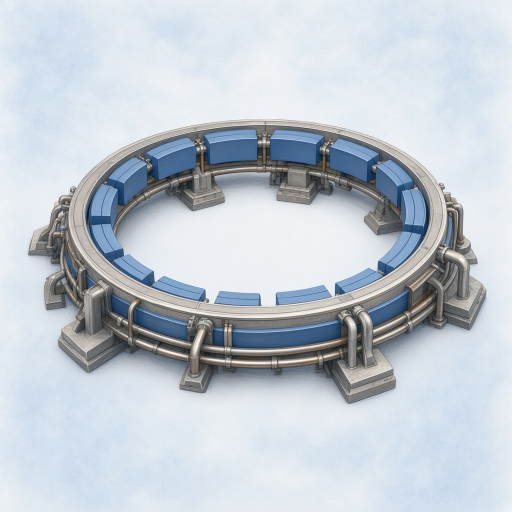
CERN is a giant science laboratory in Europe where scientists study the smallest pieces of matter. It sits on the border between France and Switzerland, near the city of Geneva. CERN’s most famous machine is the Large Hadron Collider, or LHC for short. The LHC is the biggest machine humans have ever built, a tunnel shaped like a ring that is 17 miles (27 km) all the way around.
Why CERN and the LHC are tricky
Most science labs fit inside a building. CERN’s main machine does not fit in any building at all. The LHC ring is so wide it crosses two countries. At normal walking speed, it would take about six hours to walk all the way around.
The LHC is also buried about 300 feet (100 m) underground. That is roughly as deep as a 30-story building is tall. The rock above blocks stray radiation and helps hold the tunnel steady. From the surface, you cannot tell anything is down there. Cows graze in fields right above the busiest part of the machine.
The other strange thing is what the LHC does. It takes tiny particles called protons, which are found in atomic nuclei, and pushes them around the ring at almost the speed of light. Then it crashes them into each other on purpose. From those crashes, scientists can spot particles that have never been observed before.
Key facts about CERN and the LHC
CERN was founded in 1954. It was built right after World War II so scientists from many countries could work together in peace. Today, more than 17,000 people from over 70 countries work with CERN, including about 12,000 scientists.
CERN sits on the France-Switzerland border. The main entrance is in Meyrin, Switzerland, near Geneva. Parts of the LHC ring sit under French farmland.
The LHC is 17 miles (27 km) around. The ring is shaped like a circle, and it is the largest scientific instrument ever made.
The LHC is buried about 300 feet (100 m) underground. The tunnel is wide enough for a small truck to drive through.
The LHC has four giant detectors with the names ATLAS, CMS, ALICE, and LHCb. The biggest one, ATLAS, is about 82 feet (25 m) tall and as heavy as the iron in the Eiffel Tower.
The LHC’s magnets are colder than space. The magnets that bend the proton beams are cooled to about 1.9 K, which is colder than the leftover chill of the Big Bang in deep space.
Protons in the LHC travel at 99.9999991% the speed of light. They go around the 17-mile ring more than 11,000 times every second.
The Higgs boson was discovered at CERN on July 4, 2012. Scientists had been searching for this tiny particle for almost 50 years.
The World Wide Web was invented at CERN in 1989. A British scientist named Tim Berners-Lee built it so researchers could share documents over their computer network. CERN gave the Web away for free in 1993.
The LHC has not created any black holes that have eaten Earth. It has not created any dimensional portals either. Earth is fine.
Common myths about CERN and the LHC
Myth: The LHC will create a black hole that destroys Earth. This worry made the news before the LHC turned on in 2008, but the science behind it does not hold up. Cosmic rays from space hit Earth’s atmosphere with even more energy than the LHC produces, and they have been doing it for billions of years without making a dangerous black hole. Even if the LHC could create a tiny black hole, it would vanish in less than a billionth of a second. After running for over a decade, the LHC has produced exactly zero black holes that ate anything.
Myth: CERN opens portals to other dimensions. The LHC does not open portals. It is a particle accelerator, which means it takes very small bits of matter and gives them a huge amount of speed before crashing them. Scientists do test ideas about extra dimensions by looking at the patterns of particles flying out of collisions, but no portal, doorway, or gateway to another world has ever been found at CERN.
Myth: The LHC found God. The Higgs boson is sometimes called the “God particle.” That nickname came from the title of a 1993 book by physicist Leon Lederman. Lederman has said the title was his publisher’s idea, not his. Peter Higgs, the scientist the particle is actually named after, did not like the nickname at all. The Higgs boson is the particle linked to a special field in space that gives many other particles their mass. It is not a religious discovery.
Myth: The LHC tunnel was dug just for the LHC. The 17-mile ring was actually dug in the 1980s for an older machine called LEP, which ran from 1989 to 2000. When LEP shut down, CERN took out the old equipment and put the LHC inside the same tunnel.
Myth: The LHC smashes whole atoms together. Most of the time, the LHC smashes single protons against single protons. Atoms have electrons buzzing around them, and the LHC strips those off first. Sometimes the LHC also smashes lead nuclei (the centers of lead atoms) together for special experiments.
Frequently asked questions about CERN and the LHC
What does CERN stand for?
CERN stands for the European Organization for Nuclear Research. The letters come from the original French name, Conseil Européen pour la Recherche Nucléaire. The lab kept the short name “CERN” even after its full name changed.
Why is the LHC underground?
The LHC sits in a tunnel about 300 feet (100 m) below the surface for a few reasons. The rock around the tunnel blocks stray radiation from the experiments and helps protect people and animals on the surface. It also keeps the tunnel at a steady temperature. Building underground means CERN does not have to clear any farms, roads, or towns to make room for the 17-mile ring.
How fast do the protons go?
When the LHC is running at full power, protons travel at 99.9999991% the speed of light. That is about 670 million miles per hour. Each proton zips around the 17-mile ring more than 11,000 times every second. Nothing with mass can ever reach the exact speed of light, so the protons get very, very close, but never all the way.
What is the Higgs boson?
The Higgs boson is a tiny particle linked to something called the Higgs field. The field is invisible and fills all of space. When other particles move through the field, the field tugs on some of them and gives them mass. Without it, atoms could not exist the way they do. Scientists predicted the Higgs boson in 1964, and the LHC finally found it in 2012.
Did the World Wide Web really start at CERN?
Yes. In 1989, a scientist at CERN named Tim Berners-Lee wrote a proposal for a system that would let researchers share documents on different computers. He called it the World Wide Web. The first website ever was hosted at CERN. In April 1993, CERN released the software for free, which let the Web spread around the world.
Each of this topic’s quiz sets cites a primary source for the specific fact tested. Play at any level: Rookie, Curious, Sharp, or Expert.
CERN is a physics laboratory on the French-Swiss border near Geneva, where scientists from more than 100 countries study the smallest pieces of matter. Its biggest machine is the Large Hadron Collider, or LHC, a circular tunnel about 17 miles (27 km) around that pushes protons to nearly the speed of light and crashes them together. CERN was founded in 1954, and the LHC first switched on in September 2008. Each crash briefly recreates conditions from a tiny fraction of a second after the Big Bang.
Why CERN and the LHC are tricky to understand
Most science labs fit inside one building. The LHC does not fit inside any city block. Its ring crosses the France-Switzerland border and sits 165 to 575 ft (50 to 175 m) below ground. The depth changes because the rock above tilts, so one part of the ring is just under the surface while another runs under a small mountain.
The protons inside the LHC reach 99.9999991% of the speed of light, circling the 17-mile ring more than 11,000 times every second. To bend them around a curve, the LHC uses 1,232 superconducting magnets, magnets cooled so cold that electricity flows through them with no resistance. The magnets sit at about 1.9 K, colder than the empty space between galaxies.
A second tricky part is what the LHC studies. Protons are made of smaller pieces called quarks and gluons. The LHC collides single protons, and from the spray of new particles that flies out, scientists can spot ones never seen before. The most famous is the Higgs boson, the particle linked to the field that gives other particles their mass.
Key facts about CERN and the LHC
CERN was founded in 1954. Its acronym comes from the French Conseil Européen pour la Recherche Nucléaire. The official name is now the European Organization for Nuclear Research, but the original acronym stuck. CERN has 25 member states and hosts about 17,000 scientists.
The LHC started up on September 10, 2008 after more than 20 years of planning. Before the LHC, the same tunnel held LEP (Large Electron-Positron Collider), which ran from 1989 to 2000.
The LHC ring is about 17 miles (27 km) around, the largest scientific instrument ever built. Walking it would take about six hours.
The LHC’s main magnets are 50 feet (15 m) long. Each weighs 35 metric tons, and there are 1,232 around the ring. They generate fields up to 8.3 tesla, enough to bend a 7 TeV proton beam into a circle.
The magnets are cooled with liquid helium to 1.9 K, colder than outer space, where the leftover glow of the Big Bang sits at about 2.7 K.
The LHC has four main detectors: ATLAS, CMS, ALICE, and LHCb. ATLAS is about 82 feet (25 m) tall and 151 feet (46 m) long, and weighs 7,000 metric tons, more iron than the Eiffel Tower.
The Higgs boson was discovered on July 4, 2012. ATLAS and CMS announced compatible signals at about 125 GeV the same day. Peter Higgs and François Englert won the 2013 Nobel Prize for predicting the particle in 1964.
The W and Z bosons were discovered at CERN in 1983 at an earlier machine, the Super Proton Synchrotron. Carlo Rubbia and Simon van der Meer shared the 1984 Nobel.
The World Wide Web was invented at CERN in 1989 by Tim Berners-Lee, who proposed it so physicists could share documents. CERN released the source code into the public domain in April 1993.
Common myths about CERN and the LHC
Myth: The LHC will create a black hole that destroys Earth. This worry made the news before the LHC turned on in 2008. Cosmic rays hit Earth’s atmosphere with higher energies than the LHC produces, and they have done so for billions of years without making a dangerous black hole. CERN’s 2008 LHC Safety Assessment Group report explained this with sources. Even if the LHC could make a tiny black hole, it would evaporate in less than a billionth of a second through Hawking radiation.
Myth: The Higgs boson is the “God particle.” That nickname comes from a 1993 book by physicist Leon Lederman, whose publisher liked the catchy title. Peter Higgs himself disliked the nickname. The Higgs boson is the particle linked to the Higgs field, the invisible field that gives mass to certain particles. It has nothing to do with religion.
Myth: The LHC tunnel was dug just for the LHC. The 17-mile ring was excavated between 1983 and 1988 for LEP, which ran from 1989 to 2000. When LEP shut down, CERN installed the LHC in the same tunnel.
Myth: CERN could weaponize antimatter. CERN does produce antimatter at the Antiproton Decelerator and ALPHA experiment, and has trapped antihydrogen for over 16 minutes (1,000 seconds). But the amounts are tiny. Producing 1 gram of antimatter at current rates would take longer than the age of the universe. Antimatter is studied to test physics, not for weapons.
Frequently asked questions about CERN and the LHC
What does CERN actually do?
CERN runs particle accelerators, machines that speed up protons and crash them together to study what comes out. The collisions produce new particles that exist for only a tiny fraction of a second. Measuring those particles tests theories about how the universe works at the smallest scales.
How fast do the protons go inside the LHC?
Protons reach 99.9999991% of the speed of light, about 670 million miles per hour. Each proton circles the 17-mile ring more than 11,000 times every second. Nothing with mass can reach the exact speed of light, so the protons get very close but never all the way.
What is the Higgs boson and why was it a big deal?
The Higgs boson is the particle linked to the Higgs field, an invisible field that fills all of space and gives mass to certain particles. Without it, the W and Z bosons that carry the weak nuclear force would have no mass, and atoms would not exist as they do. Scientists predicted the Higgs in 1964, but it took 48 years and the LHC to find it. ATLAS and CMS announced the discovery together on July 4, 2012, because two teams seeing the same signal made the result hard to dismiss.
Why are there four detectors instead of one?
Each detector specializes. ATLAS and CMS are general-purpose detectors that look for many particles at once, including the Higgs. They were built by separate teams using different technologies, so each can cross-check the other. ALICE focuses on heavy-ion collisions, where lead nuclei smash together to create a hot soup of quarks and gluons called quark-gluon plasma, the kind of matter that filled the universe a microsecond after the Big Bang. LHCb studies particles containing the bottom quark (also called “beauty”) to look for tiny differences between matter and antimatter.
How did the World Wide Web start at CERN?
In 1989, Tim Berners-Lee at CERN wrote a proposal for a system to let scientists share documents across different computers. He combined hypertext, the internet, and a way to view pages into the World Wide Web. The first website was hosted at CERN and is still online at info.cern.ch. CERN released the source code to the public for free in April 1993.
You can play this topic at any level: Rookie, Curious, Sharp, or Expert. Each quiz set cites a primary source for the specific fact tested.
CERN (Conseil Européen pour la Recherche Nucléaire, the European Organization for Nuclear Research) is an intergovernmental physics laboratory founded on 29 September 1954, located in Meyrin on the Swiss-French border near Geneva. Its flagship machine, the Large Hadron Collider (LHC), is a 17-mile (27 km) circular particle accelerator buried 330 feet (100 m) underground that accelerates protons to 99.9999991% the speed of light and collides them at four detector sites. Run 3, which began in 2022, operates at 13.6 TeV center-of-mass energy, the highest ever achieved. CERN has 25 member states and hosts approximately 17,000 scientists from more than 100 countries. Tim Berners-Lee invented the World Wide Web at CERN in 1989 while developing a document-sharing system for the laboratory’s own network.
What is often misunderstood about CERN and the LHC
The LHC tunnel is not new construction. The 17-mile (27 km) ring was excavated between 1983 and 1988 for CERN’s previous machine, the Large Electron-Positron Collider (LEP), which ran from 1989 to 2000. When LEP shut down, CERN installed entirely new magnets, cryogenics, and detector systems in the existing tunnel to create the LHC.
The LHC does not smash atoms. It collides individual protons, or sometimes heavy lead ions, that have been stripped of their electrons. The distinction matters because a proton-proton collision probes the quarks and gluons inside, which is the physics the LHC is designed to study.
The temperatures the LHC operates at span an enormous range. The superconducting dipole magnets run at 1.9 K, colder than outer space (the cosmic microwave background is about 2.7 K). The ALICE detector, during heavy-ion runs, creates quark-gluon plasma at roughly 5.5 trillion K, making it the hottest substance ever produced on Earth.
The 2013 Nobel Prize in Physics went to two theorists, Peter Higgs and François Englert, not to the ATLAS and CMS experimental collaborations. Nobel rules permit no more than three individual laureates; the collaborations, each with about 3,000 members, are ineligible as institutions.
Key facts about CERN and the LHC
LHC dimensions: 17 miles (27 km) circumference, 330 feet (100 m) underground, straddling the Swiss-French border between Meyrin and Saint-Genis-Pouilly.
Dipole magnets: 1,232 main superconducting dipole magnets, each about 50 feet (15 m) long and 35 metric tons, generating an 8.33 T field using niobium-titanium (NbTi) superconductor cooled to 1.9 K with superfluid helium.
Beam bunches: approximately 2,800 proton bunches per beam, each containing roughly 10¹¹ protons, crossing every 25 nanoseconds (40 million crossings per second).
Stored beam energy: about 360 megajoules per beam, enough to melt roughly 1,100 pounds (500 kg) of copper.
Higgs boson: ATLAS and CMS jointly announced the discovery on 4 July 2012, measuring a new boson at approximately 125.25 GeV/c². The 2013 Nobel Prize in Physics was awarded to Peter Higgs and François Englert.
ATLAS detector: 82 feet (25 m) tall, 151 feet (46 m) long, 7,000 metric tons. Uses a toroidal magnet system. About 3,000 collaborating scientists from more than 40 countries.
CMS detector: 49 feet (15 m) tall, 70 feet (21 m) long, 14,000 metric tons. Uses a 4 T solenoidal superconducting magnet that stores about 2.6 GJ of energy when fully energized.
ALICE: specialized for heavy-ion runs; creates quark-gluon plasma at approximately 5.5 trillion K, reproducing conditions about one microsecond after the Big Bang.
LHCb: focuses on b-quark physics and CP violation. Confirmed the first pentaquark states (Pc⁺(4380) and Pc⁺(4450)) in 2015 and the tetraquark Tcc⁺ in 2021.
Computing: the Worldwide LHC Computing Grid (WLCG) links more than 170 computing sites in 42 countries to store and process the many petabytes of data produced each week.
World Wide Web: Tim Berners-Lee proposed the system in 1989 at CERN. CERN released the Web’s source code into the public domain in April 1993.
Future: the High-Luminosity LHC (HL-LHC) upgrade is planned for around 2030, targeting a luminosity about five times the current design value. The Future Circular Collider (FCC), a proposed 57-mile (90+ km) tunnel, is under study.
Common myths about CERN and the LHC
Myth: The LHC tunnel was built for the LHC. The 17-mile (27 km) tunnel was excavated starting in 1983 for LEP, the Large Electron-Positron Collider, which operated from 1989 to 2000. The LHC reused the existing tunnel after LEP shut down.
Myth: The LHC could create a black hole that destroys Earth. Cosmic ray protons strike the atmosphere at energies far exceeding those in the LHC. If LHC collisions could produce dangerous black holes, cosmic rays would have destroyed Earth billions of years ago. Any microscopic black holes that might form would evaporate almost instantly via Hawking radiation.
Myth: ATLAS is named after the Greek titan Atlas because it holds up the tunnel above it. ATLAS is an acronym: A Toroidal LHC ApparatuS, describing the toroidal magnet geometry that defines the detector’s design. The titan association is informal wordplay.
Myth: The 2013 Nobel Prize was awarded to the ATLAS and CMS collaborations. Nobel Prizes go to individuals, with a maximum of three per prize. The 2013 prize went to Peter Higgs and François Englert for their 1964 theoretical prediction of the Higgs mechanism. Robert Brout, who co-published with Englert, died in 2011 before the experimental confirmation.
Myth: The LHC operates at the highest temperatures on Earth. The LHC’s dipole magnets operate at 1.9 K, among the coldest large-scale environments anywhere. The ALICE detector creates the hottest recorded temperatures (about 5.5 trillion K) during heavy-ion runs, but this is a localized, short-lived effect in a collision fireball, not in the machine hardware itself.
Myth: CERN has found supersymmetric particles. Run 1 and Run 2 of the LHC produced no confirmed evidence for supersymmetric partners. Most natural supersymmetry scenarios predicting partners at a few hundred GeV have been ruled out, with current exclusion limits typically above 1.5 to 2 TeV for squarks and gluinos.
Frequently asked questions about CERN and the LHC
What did LEP discover before the LHC?
LEP, which ran from 1989 to 2000 in the same tunnel now occupied by the LHC, made the most precise measurements of the Z boson mass and width up to that point. The Z boson width established that exactly three light neutrino species exist. LEP also set tight limits on the Higgs boson mass, narrowing the search range that the LHC ultimately used to find the particle.
Why does the LHC need such powerful magnets?
Bending a beam of protons traveling at close to the speed of light around a 17-mile (27 km) circular path requires an extremely strong magnetic field directed perpendicular to the beam. The 1,232 main dipole magnets generate 8.33 T by running superconducting NbTi coils at 1.9 K. Weaker magnets would require a much larger tunnel to keep the protons on a circular path.
What is the Higgs boson and why did finding it matter?
The Higgs boson is the quantum particle associated with the Higgs field, which permeates all of space. The field interacts with certain particles to give them mass. Without this mechanism, the W and Z bosons that carry the weak nuclear force would be massless, and atoms could not exist in their present form. The particle was predicted in 1964 but took 48 years to confirm because producing it requires very high collision energies.
What is a pentaquark?
A pentaquark is an exotic hadron made of four quarks and one antiquark bound together, as distinct from ordinary protons and neutrons (three quarks) or mesons (one quark and one antiquark). Quantum chromodynamics (QCD) does not forbid such states, but none had been confirmed until LHCb announced two pentaquark states in 2015 from the decay of lambda-b baryons.
What is pile-up and why does it matter?
At the LHC’s design luminosity, each bunch crossing produces dozens of simultaneous proton-proton collisions rather than just one. These overlapping events are called pile-up. Detectors must record all of them, and reconstruction software must then identify which tracks and energy deposits belong to the rare collision of interest. The HL-LHC is designed for roughly 140 to 200 interactions per crossing, requiring upgraded detectors and new analysis techniques.
How does CERN handle the LHC’s data?
The LHC experiments produce many petabytes of data each week, far more than CERN’s on-site systems can process alone. The Worldwide LHC Computing Grid (WLCG) distributes storage and processing across more than 170 sites in 42 countries. CERN provides the central data-processing service and about one-fifth of the grid’s resources, while collaborating centers around the world store, reconstruct, and analyze the data.
What has the LHC not found?
Despite a decade of running, the LHC has not found supersymmetric particles, large extra dimensions, heavy gauge bosons (Z’ or W’) below roughly 5 TeV in most models, or microscopic black holes. These null results have excluded many theoretical scenarios that were considered plausible before the LHC turned on and have placed the hierarchy problem of particle physics in a more difficult position.
Source notes
Facts about the LHC’s physical parameters (circumference, magnet count, magnetic field, operating temperature, beam energy) and the Higgs boson discovery are drawn from the Large Hadron Collider and Higgs boson Wikipedia articles and the original ATLAS and CMS discovery papers published in Physics Letters B 716 (2012). ATLAS detector dimensions and collaboration size come from the ATLAS experiment article. CMS magnet specifications come from the Compact Muon Solenoid article. ALICE quark-gluon plasma temperatures are documented in the ALICE experiment article. The LEP predecessor history is in the Large Electron-Positron Collider article. The 2015 pentaquark discovery is documented in the Pentaquark article. The Antimatter Decelerator and antimatter experiments are covered in the Antiproton Decelerator article. The WLCG is documented at Worldwide LHC Computing Grid. The World Wide Web’s origin at CERN is covered in the World Wide Web article.
Each of this topic’s four quiz sets cites a primary source for the specific fact tested: Rookie, Curious, Sharp, and Expert.
The Large Hadron Collider (LHC) is a proton-proton and heavy-ion synchrotron operated by CERN at the Swiss-French border near Geneva, currently the highest-energy particle accelerator in the world at a center-of-mass energy of 13.6 TeV during Run 3. Its 17-mile (27 km) ring uses 1,232 superconducting niobium-titanium dipole magnets at 8.33 Tesla, cooled by superfluid helium to 1.9 K, to bend two counter-rotating beams that collide at four detector caverns: ATLAS, CMS, ALICE, and LHCb. The headline result is the joint ATLAS and CMS observation of the Higgs boson on 4 July 2012, which completed the particle content of the Standard Model and earned Peter Higgs and François Englert the 2013 Nobel Prize in Physics. The broader physics program covers precision measurements of the Higgs sector, searches for new heavy particles, rare-decay studies of bottom and strange mesons, exotic-hadron spectroscopy, and the production of quark-gluon plasma in lead-lead and lead-proton collisions.
Why LHC physics is non-intuitive
Three features of LHC physics resist casual intuition. The first is that the most abundant Higgs decay was not the discovery channel. The Higgs boson decays to a bottom-quark and antibottom-quark pair about 58 percent of the time, but that signature sits under an overwhelming background of multijet events from quantum chromodynamics. The actual discovery used two rare but very clean channels: the diphoton channel, with a branching ratio near 0.2 percent, and the four-lepton channel through two Z bosons, near 0.013 percent in its four-charged-lepton final state. Both produce sharp invariant-mass peaks against modest backgrounds. The bottom-quark coupling was confirmed only later, with much larger datasets and aggressive use of jet substructure techniques.
The second is that “discovery” of a new particle at a hadron collider is rarely a direct sighting. The Higgs lifetime is roughly 10 to the minus 22 seconds; it never reaches a detector layer. Every reported observation reconstructs the parent particle from its decay products, requires precise alignment of two independent detectors, and is qualified by the local and global statistical significance of the excess at a candidate mass. The 2012 result reached five-sigma local significance jointly across ATLAS and CMS at about 125 GeV, with the diphoton and four-lepton peaks lining up between collaborations using completely independent magnet systems, tracker technologies, and analysis chains.
The third is that null results carry as much weight as discoveries. The original physics case for the LHC anticipated that natural solutions to the hierarchy problem, especially weak-scale supersymmetry, would yield superpartners at the few-hundred-GeV scale. After more than a decade of running, ATLAS and CMS have set lower mass bounds typically above 1.5 to 2 TeV for squarks and gluinos in standard scenarios, with reach extending past 2 to 5 TeV for many heavy-resonance searches such as Z prime and W prime bosons or leptoquarks. None of these states has appeared. The exclusion of natural-supersymmetry parameter space is a substantive scientific result, even though it disappoints the pre-LHC theoretical landscape.
Key facts
Run 3 operating point. Center-of-mass energy of 13.6 TeV, achieved in July 2022. Each beam carries about 6.8 TeV. Stored beam energy is roughly 360 megajoules, enough to melt about 1,100 pounds (500 kg) of copper.
Instantaneous luminosity. Design value of about 10 to the 34 per square centimeter per second; routinely exceeded during Run 2 and Run 3. Bunch crossings occur every 25 nanoseconds, with roughly 2,800 proton bunches per beam containing about 100 billion protons each.
High-Luminosity LHC (HL-LHC). A major upgrade scheduled to begin operation around 2030. The upgrade increases peak luminosity by roughly a factor of 5 over the original LHC’s design value and targets an integrated luminosity near 3,000 inverse femtobarns over its lifetime, about ten times the integrated total of the pre-HL-LHC program. The hardware program includes new inner-triplet quadrupole magnets at the interaction points, niobium-tin (rather than niobium-titanium) high-field accelerator magnets, upgraded pixel trackers in ATLAS and CMS, and superconducting RF crab cavities.
Crab cavities. Superconducting radio-frequency cavities that impart a transverse, position-dependent kick along the length of each bunch. The kick tilts the bunches so they overlap more completely at the collision point despite the beam crossing angle. The name comes from the bunches’ apparent sideways motion, not from any scientist. Prototypes have been validated with proton beams in the Super Proton Synchrotron.
Higgs discovery channels. ATLAS and CMS jointly announced the new boson on 4 July 2012 using the diphoton channel and the four-lepton channel through two Z bosons, where the photon and lepton resolution allowed clean mass peaks despite the small branching ratios.
Higgs mass precision. The combined ATLAS and CMS measurement places the Higgs mass at about 125.10 GeV with an uncertainty near 0.11 GeV, near 0.1 percent precision. This matters for vacuum-stability calculations in the Standard Model, which depend sensitively on both the Higgs mass and the top-quark mass.
Higgs couplings. ATLAS and CMS have observed Higgs decays to W and Z bosons, tau leptons, bottom quarks, and muons, and the top-quark coupling through associated production with a top-antitop pair. The kappa-framework fits agree with Standard Model predictions across all measured channels at roughly 10 to 20 percent precision; the HL-LHC is expected to drive several of these toward percent-level precision.
Rare B-meson decays. The decay of the Bs meson to a muon-antimuon pair, predicted in the Standard Model with a branching ratio near 3 in 10 billion, was first observed at five-sigma significance in the combined LHCb and CMS analysis published in Nature in 2015, after LHCb alone reported 3.5-sigma evidence in November 2012. The measured rate is consistent with the Standard Model prediction within current uncertainties, ruling out large classes of supersymmetric models that predicted enhancements.
Lepton flavor universality at LHCb. Tests of B-meson decays to a kaon plus an electron pair versus a muon pair, denoted R_K and R_K-star, showed two-to-three-sigma tensions with Standard Model predictions for several years. An updated analysis in December 2022, with improved lepton identification and background modeling, brought the ratios back into agreement with the Standard Model. The earlier tensions are now attributed to systematic effects in the older measurements.
Exotic hadrons. LHCb has observed multiple states beyond the conventional three-quark baryon and quark-antiquark meson pictures. The first confirmed pentaquark states, near 4380 and 4450 MeV, were reported in 2015 from lambda-b baryon decays. The doubly-charmed tetraquark near 3875 MeV was reported in 2021. A strange pentaquark followed in 2022. These states extend the QCD spectroscopy and refine models of how quarks and gluons bind into composite hadrons.
Quark-gluon plasma at ALICE. Lead-lead collisions at multi-TeV per nucleon-pair produce a deconfined plasma of quarks and gluons at temperatures near 5.5 trillion K, conditions resembling the universe roughly one microsecond after the Big Bang. Measurements of azimuthal flow harmonics, including the elliptic and triangular flow coefficients, indicate a very low shear-viscosity-to-entropy-density ratio. Comparisons with the conjectured Kovtun-Son-Starinets value from AdS/CFT are model-dependent, but the measurements support describing the plasma as a strongly coupled, nearly perfect fluid.
Search reach for new physics. Direct searches for supersymmetric partners, heavy gauge bosons, leptoquarks, vector-like quarks, and microscopic black holes have produced no confirmed signals. Lower mass bounds run from 1.5 TeV to 5 TeV depending on the model, ruling out the most natural pre-LHC parameter space for weak-scale supersymmetry.
Common misconceptions at expert level
Misconception: The Higgs was discovered through its dominant decay to bottom quarks. The dominant decay accounts for about 58 percent of Higgs events but is buried under multijet QCD backgrounds at hadron colliders. The 2012 discovery used the diphoton channel and the four-lepton channel through two Z bosons, with branching ratios near 0.2 percent and 0.013 percent. The bottom-quark coupling was observed only in 2018, after years of additional data and refined jet-substructure analyses by ATLAS and CMS.
Misconception: The High-Luminosity LHC is a planned downgrade or a simple lifetime extension. The HL-LHC is an upgrade that targets roughly five times the original peak luminosity and roughly ten times the integrated luminosity over its operational lifetime. The defining feature is increased collision rate per unit time, achieved through new inner-triplet magnets, crab cavities, and detector upgrades, not just longer running of unchanged hardware.
Misconception: LHCb cannot test lepton universality because it specializes in baryons. LHCb’s flagship subject is the heavy-flavor meson sector, particularly B mesons. The R_K and R_K-star observables, which test the equality of B-meson decay rates to kaon-electron and kaon-muon final states, fall squarely in LHCb’s program. The collaboration is the world-leading source of these measurements.
Misconception: The R_K anomaly was confirmed as a discovery of new physics. The earlier two-to-three-sigma tensions in R_K and R_K-star generated significant theoretical interest. The December 2022 LHCb update, with refined electron identification and re-examined backgrounds, brought the ratios back into agreement with the Standard Model. The anomaly is now best explained as a systematic effect in the older measurements rather than as a sign of beyond-Standard-Model physics.
Misconception: Exotic hadrons such as tetraquarks and pentaquarks have been ruled out by the LHC. The opposite holds. Tetraquark candidates date to 2003 with the X(3872) seen at the Belle experiment, and LHCb has confirmed and characterized many such states. The first confirmed pentaquarks were announced by LHCb in 2015. Multiple new tetraquark and pentaquark states have followed, including the doubly-charmed Tcc tetraquark in 2021. These states are part of the established QCD hadron spectrum.
Misconception: The Bs to dimuon decay is forbidden in the Standard Model. The decay is allowed but highly suppressed, proceeding only at one-loop level with helicity suppression and CKM factors. The Standard Model prediction for the branching ratio is approximately 3 in 10 billion. Both LHCb and CMS have observed the decay at this rate, ruling out many supersymmetric and two-Higgs-doublet scenarios that would have enhanced the rate by orders of magnitude.
Misconception: Supersymmetric particles have already been observed at the LHC. No supersymmetric signal has been confirmed in any ATLAS or CMS analysis. The mass bounds on squarks, gluinos, and electroweak gauginos in standard scenarios run from about 1.5 TeV up to several TeV, depending on the search and the assumed decay topology. The natural-supersymmetry framework that motivated weak-scale partners is now under significant pressure, with implications for how the hierarchy problem is addressed.
Frequently asked questions
Why did ATLAS and CMS announce the Higgs discovery jointly rather than competitively?
The two collaborations agreed in advance to present results together once both reached a five-sigma local significance at a consistent mass. ATLAS uses a toroidal magnet system; CMS uses a 4 Tesla solenoid; their trackers, calorimeters, and analysis pipelines are independent. Two independent detectors finding the same diphoton and four-lepton peaks at 125 GeV made the result very difficult to attribute to a detector artifact.
What does percent-level Higgs coupling precision actually buy at the HL-LHC?
Higgs couplings to other particles encode how strongly the Higgs field interacts with each species. In the Standard Model these couplings are predicted exactly given the particle masses. New physics, including additional Higgs doublets, composite Higgs models, or supersymmetric extensions, generically modifies the couplings at the few-percent level. Reaching one-to-five-percent precision on couplings to the W and Z bosons, the tau lepton, the bottom quark, the muon, and the top quark would either expose such deviations or set strong constraints on entire classes of beyond-Standard-Model theories.
Why does the quark-gluon plasma flow with such a small shear viscosity?
The Kovtun-Son-Starinets result, derived for a class of strongly coupled theories using AdS/CFT correspondence, gives a shear-viscosity-to-entropy-density ratio near one over four-pi in natural units and motivated a broader conjectured lower bound. Measurements of azimuthal flow harmonics in lead-lead collisions at ALICE indicate a similarly low ratio, although the numerical comparison depends on the model used to infer it. The physical interpretation is that the plasma is strongly coupled rather than a weakly interacting gas of free quarks and gluons.
Why is the Bs to dimuon branching ratio such a sensitive probe of new physics?
In the Standard Model the decay proceeds only through penguin and box diagrams, with helicity suppression that drives the predicted rate down to about 3 in 10 billion. Many extensions, especially supersymmetric models with large tan-beta, can enhance the rate by factors of ten to a thousand because new tree or loop contributions evade the Standard Model suppression. The observed agreement with the Standard Model prediction, now established by LHCb and CMS, has eliminated large regions of parameter space in supersymmetric and other beyond-Standard-Model frameworks.
What is pile-up and why is HL-LHC pile-up a detector challenge?
At LHC luminosities, each bunch crossing produces multiple simultaneous proton-proton interactions; the additional collisions on top of any signal candidate are called pile-up. Run 2 operated with 30 to 40 interactions per crossing. The HL-LHC targets up to 200. Tracking and calorimetry must distinguish particles from the primary vertex against many overlapping vertices within nanoseconds. The HL-LHC pixel-detector and timing-detector upgrades address this with finer spatial granularity and picosecond-level timing resolution.
What does it mean experimentally that the original LHC tunnel hosted LEP?
The 17-mile (27 km) tunnel was excavated between 1983 and 1988 for the Large Electron-Positron Collider, which ran from 1989 to 2000 and produced the most precise measurements of the Z boson mass and the number of light neutrino species. After LEP shut down, CERN replaced the magnets, cryogenics, and detectors entirely while reusing the civil footprint. LEP’s lower bound on the Higgs mass near 114 GeV sharpened the search range that the LHC used to find the particle at 125 GeV.
Source notes
The LHC’s mechanical and beam parameters are drawn from the Large Hadron Collider reference. HL-LHC scope, schedule, and luminosity targets follow the High-Luminosity Large Hadron Collider entry, including the role of crab cavities at the interaction points. Higgs discovery, decay channels, mass measurement, and coupling fits are documented in the Higgs boson article and the original ATLAS and CMS observation papers in Physics Letters B 716 (2012). Lepton flavor universality results and the 2022 R_K update are reviewed in the Lepton universality article. Tetraquark and pentaquark observations follow the Exotic hadron reference. Quark-gluon plasma viscosity bounds and AdS/CFT context are documented in the Quark-gluon plasma article. Beyond-Standard-Model search bounds appear in Physics beyond the Standard Model. Detector specifications come from ATLAS experiment, Compact Muon Solenoid, and LHCb experiment. The Bs to dimuon measurement is documented in the B_s meson article.
Trivia question references throughout this topic’s Rookie, Curious, Sharp, and Expert quiz sets each cite a primary source for the specific fact tested.
Think you know CERN & the LHC?
Test yourself. Can you spot the true fact among 3 convincing bluffs?