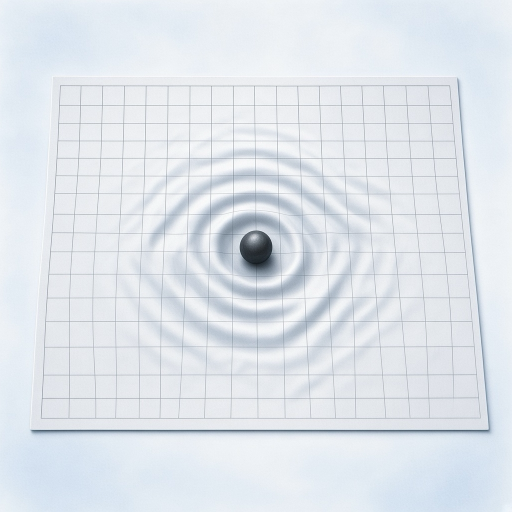
Gravity is the interaction that makes objects with mass attract one another in the simple Newtonian picture. In Einstein’s more complete description, mass and energy curve spacetime. Gravity makes a dropped ball fall, keeps the Moon circling Earth, and holds the planets in their paths around the Sun. When two huge objects like black holes crash into each other, they can send out ripples through spacetime called gravitational waves.
Why gravity is tricky to understand
Gravity feels simple. Things fall down. But it is stranger than it looks. The same pull that makes an apple drop from a tree reaches all the way to the Moon, more than 238,000 miles (380,000 km) away, and keeps it from flying off into space. Isaac Newton was the first person to figure that out in 1687.
Gravity also acts on things that look like they have nothing to do with falling. Ocean tides happen because the Moon’s gravity gently tugs on Earth’s water. Astronauts inside the International Space Station look like they have no gravity at all, but they do. They are just falling around Earth at the same rate as the station, so they float instead of dropping to the floor.
Gravity is not a magnet, and it is not glue. It affects metal, plastic, water, air, and even light. A plastic toy and an iron rock dropped together in a vacuum fall at the same rate. No known material can shield an object from a static gravitational field the way metal can shield some electromagnetic fields.
Key facts about gravity
Gravity affects mass and energy. A feather, a brick, a planet, and a star all respond to gravity, and gravity can bend the path of light.
Gravity travels at the speed of light, about 186,000 miles per second (300,000 km/s). Fast, but not instant.
Changes in the Sun’s gravitational field would not reach Earth instantly. In a hypothetical sudden change, Earth would continue on its existing path for about 8 minutes and 20 seconds, the same average travel time as sunlight from the Sun.
In a vacuum, all objects fall at the same rate. A hammer and a feather hit the ground together when there is no air. Astronaut David Scott proved this on the Moon in 1971.
Astronauts float in orbit because they are falling, not because there is no gravity. Gravity at the height of the space station is still about 90% as strong as on the ground.
The Moon’s gravity is the main cause of ocean tides. Many coastlines get roughly two high tides and two low tides each lunar day, but coastlines and ocean basins make local tide patterns vary.
Black holes pack mass inside an event horizon. From within that boundary, every future path leads farther inward, so not even light can escape.
Gravitational waves are ripples in space itself. When two black holes spiral into each other, they shake the fabric of space. Scientists detected these ripples for the first time in 2015 using a tool called LIGO.
Gravity is the weakest of nature’s main forces. A small magnet can lift a paperclip against the gravity of the entire Earth.
Common myths about gravity
Myth: There is no gravity in space. There is plenty of gravity in space. The Moon, the planets, and the Sun all pull on each other constantly. Astronauts on the space station float because they and the station are falling around Earth together, not because gravity has switched off.
Myth: Heavier things always fall faster than lighter things. This is only true when air is in the way. Without air, gravity pulls on everything with the same acceleration. A bowling ball and a tennis ball dropped in a vacuum land at the same moment.
Myth: Gravity can be shielded by a thick wall. No known material screens a static gravitational field the way a conductor can screen an electric field. A building does not cancel Earth’s gravity, so you weigh essentially the same indoors as outdoors.
Myth: Gravity is the same thing as magnetism. Familiar magnets strongly affect certain materials such as iron. Gravity responds to mass-energy and affects plastic, water, air, and even light. The Moon orbits Earth because of gravity, not magnetism.
Myth: A change in the Sun’s gravity would affect Earth instantly. In a hypothetical sudden change, its effect would reach Earth after about 8 minutes and 20 seconds. Changes in a gravitational field propagate at the speed of light.
Frequently asked questions about gravity
Why do astronauts float in space?
Astronauts float because they are in free fall. The International Space Station is constantly falling toward Earth, but it is also moving forward so fast (about 17,500 miles per hour, or 28,000 km/h) that it keeps missing the ground. The astronauts inside fall at the same rate as the station, so they do not press against the floor. Gravity is still pulling on them, just like on the ground.
What are gravitational waves?
Gravitational waves are ripples in space and time. When two huge objects like black holes or neutron stars spiral into each other, they stir up the space around them, a little like a stone dropped into a pond. The ripples spread out at the speed of light. Albert Einstein predicted them in 1916. Scientists finally detected them on September 14, 2015, using the LIGO instruments. The first ripple came from two black holes that crashed together 1.3 billion light-years away.
What causes ocean tides?
Differences in the Moon’s gravitational pull across Earth are the main cause of ocean tides, with the Sun also contributing. An idealized ocean would have two broad tidal bulges. Real continents, seafloor shape, and ocean-basin resonances alter that simple pattern, so local coastlines can have two, one, or mixed high tides each lunar day.
Why do all things fall at the same rate?
Gravity pulls harder on heavier objects, but heavier objects also need more pull to speed up. Those two effects cancel out exactly, so every object falls with the same acceleration. On Earth, air slows down light, fluffy things like feathers. In a vacuum, the feather and a hammer drop side by side. Astronaut David Scott did this experiment on the Moon in 1971.
How fast does gravity travel?
Gravity travels at the speed of light, about 186,000 miles per second (300,000 km/s). Scientists confirmed this in August 2017 when light and gravitational waves from two crashing neutron stars arrived at Earth within about 1.7 seconds of each other, after traveling 130 million light-years.
Each of this topic’s quiz questions cites a primary source for the specific fact tested. You can play at any level: Rookie, Curious, Sharp, or Expert.
Gravity is the pull that every object with mass has on every other object, holding planets in orbit and keeping your feet on the floor. Gravitational waves are tiny ripples in space itself, set off when very heavy objects like black holes crash together. Albert Einstein predicted these ripples in 1916, and scientists caught one for the first time on September 14, 2015. Gravity is the weakest of nature’s four basic forces, but it shapes the entire universe because it never lets up and reaches across any distance.
Why gravity and gravitational waves are tricky to understand
Gravity feels obvious. Things fall down. But the modern picture is much stranger than that. Isaac Newton wrote the first working math for gravity in 1687, treating it as an invisible force pulling two masses toward each other. In 1915, Einstein replaced Newton’s idea: massive objects bend the fabric of spacetime (the combined three dimensions of space and one of time), and other objects roll along the curves.
A bowling ball on a stretched rubber sheet can help picture part of the idea, although the sheet analogy is incomplete. Mass-energy curves four-dimensional spacetime, and freely falling objects follow paths through that geometry. Earth orbits the Sun along such a path rather than being pulled by an invisible string.
When two heavy objects swing around each other, they jiggle the curvature of spacetime, and the jiggle spreads outward at the speed of light. Einstein figured this out on paper in 1916 but doubted anyone would ever build a tool sensitive enough to catch the ripples. It took 100 years and the most precise ruler ever built.
Key facts about gravity and gravitational waves
Gravity is the weakest of the four fundamental interactions at particle scales. For two protons, their electric repulsion is roughly 10³⁶ times stronger than their gravitational attraction. A small refrigerator magnet can lift a paperclip against the gravity of the entire Earth.
Gravity travels at the speed of light, about 186,000 miles per second (300,000 km/s). The 2017 GW170817 event confirmed this to better than one part in 1,000,000,000,000,000.
Einstein’s theory replaced Newton’s at the extremes. Newton’s law works for everyday cases like throwing a baseball or tracking a satellite. Einstein’s general relativity is essential near black holes, near the speed of light, and for gravitational waves.
The first direct detection was GW150914. On September 14, 2015, both LIGO detectors caught a signal from two black holes, about 36 and 29 solar masses, spiraling together 1.3 billion light-years away. The merger turned about 3 solar masses into pure gravitational-wave energy in under a second.
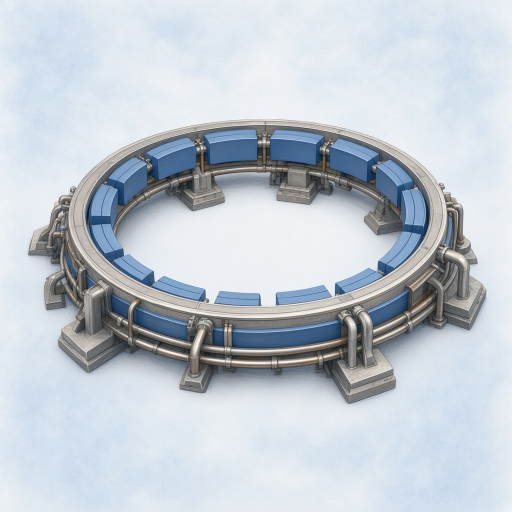
LIGO’s arms are 4 km, about 2.5 miles each. Each detector is L-shaped with two perpendicular arms, and the two observatories sit about 1,900 miles (3,000 km) apart, in Hanford, Washington and Livingston, Louisiana. A passing wave changes one arm’s length by less than one ten-thousandth the diameter of a proton.
Your weight depends on local gravity. A person who weighs 165 lbs (75 kg) on Earth would weigh about 27 lbs (12 kg) on the Moon and roughly 391 lbs (177 kg) on Jupiter. Mass stays the same; weight is mass times gravity.
Gravity slows down time, an effect called gravitational time dilation. Clocks tick slower in stronger gravity, and GPS satellites correct for tiny daily time offsets to keep map apps accurate.
Apollo 15’s hammer-and-feather drop confirmed the equivalence principle. Astronaut David Scott dropped them together on the Moon in 1971, and they hit the ground at the same instant, as Galileo had argued 350 years earlier.
Ordinary matter is almost transparent to gravitational waves. The waves interact so weakly with matter that planets and stars usually cause negligible attenuation, allowing LIGO to receive signals from billions of light-years away.
Common myths about gravity and gravitational waves
Myth: There is no gravity in space. There is plenty of gravity in space. The Sun, Moon, and planets all pull on each other. Astronauts on the International Space Station float because they and the station are falling around Earth together. Gravity at that altitude is still about 90% as strong as on the ground.
Myth: Heavier objects always fall faster. Without air, every object falls with the same acceleration, no matter the weight. Gravity pulls harder on heavier objects, but those objects also need more pull to speed up, and the two effects cancel exactly. Air resistance is what slows down feathers and parachutes on Earth.
Myth: Gravity acts instantly across any distance. Newton treated gravity as instantaneous, which was a mathematical convenience, not a measured fact. Einstein replaced it with a finite speed equal to c, the speed of light. The 2017 GW170817 event confirmed Einstein’s prediction.
Myth: LIGO listens for sound from space. Sound cannot travel through the vacuum of space. LIGO uses lasers in two L-shaped tunnels on the ground, in Louisiana and Washington State, to measure tiny stretches of space caused by passing gravitational waves.
Frequently asked questions about gravity and gravitational waves
What exactly is a gravitational wave?
A gravitational wave is a ripple in spacetime itself. When two heavy objects like black holes spiral around each other, they shake the geometry of space, and the shake travels outward at the speed of light. As the wave passes, it stretches space slightly in one direction and squeezes it in the perpendicular direction, then reverses. The change is real but minuscule, even strong waves stretch a 4 km LIGO arm by less than one ten-thousandth the width of a proton.
How did LIGO detect a wave that small?
Each detector fires a laser down two perpendicular 2.5-mile (4 km) arms, bounces it off mirrors, and recombines the two beams. If the arms are the same length, the recombined laser light cancels in a specific pattern. A passing gravitational wave changes one arm’s length, and the pattern shifts. Two detectors 1,900 miles (3,000 km) apart must register the same signal almost simultaneously to count as real, not local noise like a passing truck.
Why is gravity so weak compared to other forces?
Nobody knows. This puzzle is called the hierarchy problem. For two protons, gravity is roughly 10³⁶ times weaker than their electric repulsion. It feels strong on Earth because the planet contains so much mass-energy, while positive and negative electric charges in bulk matter usually cancel. Why the fundamental scales differ so enormously remains an open question.
Did Einstein see gravitational waves detected?
No. Einstein predicted them in 1916 but died in 1955, 60 years before the first detection. He even doubted at one point that they were real, then later doubted they could ever be measured. The first detection came on September 14, 2015. The 2017 Nobel Prize in Physics went to Rainer Weiss, Barry Barish, and Kip Thorne for the LIGO project.
What is GW170817 and why was it special?
GW170817 was a gravitational-wave signal detected on August 17, 2017, from two neutron stars (the ultra-dense cores of dead stars) merging about 130 million light-years away. Within seconds, gamma-ray telescopes saw a burst of light from the same spot, and dozens of other telescopes followed up. It was the first cosmic event ever both heard with gravitational waves and seen with light. The collision produced an r-process kilonova. Spectra identified strontium, and the same rapid neutron-capture process is expected to forge heavier elements such as gold and platinum, although those two elements were not directly identified in that event’s spectrum.
You can play this topic at any level: Rookie, Curious, Sharp, or Expert. Each quiz set cites a primary source for the specific fact tested.
Gravity is the curvature of spacetime caused by mass and energy, described mathematically by Einstein’s general theory of relativity, published in 1915. When mass accelerates, it disturbs that curvature and sends ripples outward at the speed of light; those ripples are gravitational waves. Isaac Newton’s 1687 law of universal gravitation described the force between two masses accurately enough for most practical purposes, but could not explain the fine-scale behavior that general relativity predicts and experiments confirm. Einstein predicted gravitational waves in 1916 and doubted they would ever be detected; LIGO proved him wrong on September 14, 2015. The 2017 Nobel Prize in Physics went to Rainer Weiss, Barry Barish, and Kip Thorne for building the detector that made the first direct observation possible.
What is often misunderstood about gravity and gravitational waves
General relativity replaces Newton’s force description with curved spacetime. Mass-energy determines the geometry, and freely falling objects follow geodesics through it. What looks like gravitational attraction is motion along those paths, although an observer standing on a surface feels an upward contact force that prevents free fall.
Gravitational waves are not radio waves, light, or sound. They are oscillations of spacetime geometry itself. They interact extraordinarily weakly with matter and therefore cross ordinary intervening material with negligible attenuation. No known material provides practical gravitational-wave shielding or screens a static gravitational field.
The first direct detection in 2015 was not the first evidence for gravitational waves. Indirect evidence came 41 years earlier. In 1974, Russell Hulse and Joseph Taylor discovered binary pulsar PSR B1913+16, a pair of neutron stars losing orbital energy at exactly the rate general relativity predicts for gravitational-wave emission. The orbital period shrinks by about 76 microseconds per year, matching the theory to within 0.2%. Hulse and Taylor received the 1993 Nobel Prize in Physics for that work.
Eddington’s 1919 solar eclipse expedition is often described as confirming gravity but is more precisely described as confirming general relativity’s prediction of light deflection. Stars photographed near the Sun during totality appeared shifted by about 1.75 arcseconds, matching Einstein’s calculation and ruling out the Newtonian prediction of half that value.
Key facts about gravity and gravitational waves
Newton’s constant: G is approximately 6.674 × 10⁻¹¹ N m² kg⁻². Cavendish’s 1798 torsion-balance experiment measured Earth’s mean density; later authors recast the result as a value of G.
Speed of gravitational waves: general relativity predicts c, the speed of light in vacuum. GW170817 found the observed speeds consistent to within a few parts in 10¹⁵.
GW150914 source: two black holes of approximately 36 and 29 solar masses, roughly 1.3 billion light-years away, merging into a single black hole of about 62 solar masses. About 3 solar masses of energy were radiated as gravitational waves in under a second.
LIGO arm length: each of the two L-shaped detectors in Hanford, Washington, and Livingston, Louisiana, has two perpendicular arms 4 km (2.5 miles) long. The measured spacetime strain in GW150914 was about 10⁻²¹, corresponding to a length change of roughly 10⁻¹⁹ meters, one ten-thousandth the diameter of a proton.
Hulse-Taylor pulsar: PSR B1913+16, discovered in 1974. Its orbital period decreases by about 76 microseconds per year due to gravitational-wave energy loss, matching general relativity to within 0.2%. Hulse and Taylor won the 1993 Nobel Prize.
Mercury’s perihelion precession: Newton’s gravity leaves 43 arcseconds per century of Mercury’s perihelion advance unexplained. General relativity accounts for exactly 42.98 arcseconds per century.
Eddington 1919: measured light deflection of approximately 1.75 arcseconds near the Sun, consistent with general relativity and twice the Newtonian prediction.
GW170817: detected August 17, 2017, from two merging neutron stars about 130 million light-years away. Gamma-ray, optical, X-ray, and radio follow-up revealed an r-process kilonova; strontium was identified spectroscopically, while models predict production of still-heavier elements such as gold and platinum. This was the first gravitational-wave event with an electromagnetic counterpart.
2023 pulsar timing arrays: NANOGrav, the European Pulsar Timing Array, the Parkes Pulsar Timing Array, and the Chinese Pulsar Timing Array announced evidence for a stochastic gravitational-wave background at nanohertz frequencies, likely from supermassive black hole binaries across the universe.
Hierarchy problem: comparisons of gravitational and electrostatic forces between elementary charged particles differ by roughly 10³⁶ to 10⁴², depending on the particles chosen. A small magnet can lift a paperclip against Earth’s gravity. No confirmed explanation for the enormous scale disparity exists.
Common myths about gravity and gravitational waves
Myth: LIGO directly detected gravitons. LIGO measures collective gravitational waves, which correspond to vast numbers of gravitons acting in concert. No experiment has yet detected an individual graviton. Theoretical arguments suggest a detector massive enough to absorb a single graviton would collapse into a black hole.
Myth: Newtonian gravity proved that changes in gravity travel instantly. Newton’s model uses instantaneous action at a distance, but it did not measure a propagation speed. In general relativity, changes in the gravitational field propagate at c. A hypothetical change at the Sun would reach Earth after about the same 8 minutes 20 seconds as sunlight.
Myth: Dense material provides practical gravitational-wave shielding. Gravitational waves can interact with matter in principle, but the coupling is so weak that ordinary intervening material causes negligible absorption. This near-transparency helps LIGO detect events from billions of light-years away.
Myth: GW150914 was the first evidence that gravitational waves carry energy. The Hulse-Taylor binary pulsar demonstrated energy loss from gravitational radiation starting in 1974, 41 years before LIGO’s detection. GW150914 was the first direct detection, not the first evidence.
Myth: Einstein’s general relativity has never been tested beyond the solar system. General relativity has been confirmed across scales from Earth-based laboratory experiments to the orbital dynamics of pulsars thousands of light-years away, the speed of gravitational waves across 130 million light-years, and the image of the supermassive black hole Sagittarius A* at the center of the Milky Way captured by the Event Horizon Telescope in 2022.
Myth: Gravitational lensing always produces a perfect Einstein ring. A perfect ring appears only when the source, lens, and observer are exactly aligned. Most observations produce arcs, partial rings, or multiple images depending on the geometry between source, lensing mass, and observer.
Frequently asked questions about gravity and gravitational waves
What exactly is a gravitational wave?
A gravitational wave is a propagating oscillation in the curvature of spacetime. When two massive objects accelerate around each other, they disturb the fabric of spacetime and the disturbance spreads outward at the speed of light. As the wave passes, it stretches space in one direction and compresses it in the perpendicular direction, then reverses. The stretching and compressing are real physical effects but are measured in units as small as 10⁻²¹ of a meter for events 1 billion light-years away.
How does LIGO detect something so small?
Each LIGO detector fires a laser beam down two perpendicular 4 km arms and bounces it between mirrors at the ends. When both beams recombine at the center, the interference pattern reveals whether the arm lengths are identical. A passing gravitational wave changes one arm’s length relative to the other by a fraction of a proton’s diameter. The laser power inside each arm is amplified to about 750 kW, the mirrors are polished to atomic smoothness, and the whole system operates in a vacuum to eliminate air turbulence. Two detectors separated by about 1,900 miles (3,000 km) must register coincident signals to rule out local noise.
What happened during GW150914?
On September 14, 2015, both LIGO detectors registered a signal that lasted 0.2 seconds. Analysis matched the waveform predicted for two black holes of about 36 and 29 solar masses spiraling inward and merging. The merger produced a black hole of about 62 solar masses, with the remaining 3 solar masses radiated as gravitational waves. The source was approximately 1.3 billion light-years away. The detection was announced February 11, 2016.
Why does Mercury’s orbit help confirm general relativity?
Mercury orbits close enough to the Sun that the curvature of spacetime there is measurable. Newton’s gravity predicts the perihelion (closest approach point) of Mercury’s orbit should precess by a certain amount due to the gravitational pull of other planets. Astronomers had observed an additional 43 arcseconds per century of precession that Newtonian gravity could not explain. General relativity provides exactly 42.98 arcseconds per century from the curvature of spacetime near the Sun, matching observations.
What did GW170817 reveal about where gold comes from?
When two neutron stars merged on August 17, 2017, gravitational-wave detectors and dozens of telescopes observed the event in close succession. The electromagnetic follow-up showed a kilonova, a burst of light powered by radioactive decay in freshly synthesized material. Spectral analysis identified strontium and found signatures consistent with lanthanide-rich ejecta produced by the rapid neutron-capture process, or r-process. Models of that process also produce gold and platinum, but GW170817 did not directly identify those two elements. Neutron-star mergers are one important source of cosmic r-process material, although their exact contribution to Earth’s gold remains uncertain.
What is the pulsar timing array gravitational-wave background?
Millisecond pulsars are neutron stars that rotate hundreds of times per second with very high regularity, making them natural cosmic clocks. If a very long-wavelength gravitational wave, one with a period of years to decades, passes through the galaxy, it shifts the arrival times of pulsar pulses in a specific quadrupole pattern called the Hellings-Downs curve. In June 2023, four independent collaborations (NANOGrav, EPTA, PPTA, CPTA) detected this pattern, providing strong evidence for a stochastic background of nanohertz gravitational waves. The most likely source is the combined signal from millions of supermassive black hole pairs across the universe, each containing tens of millions to billions of solar masses.
How fast do gravitational waves travel?
Gravitational waves travel at c, the speed of light in vacuum, approximately 186,000 miles per second (300,000 km/s). GW170817 established this empirically: gravitational waves and a gamma-ray burst from the same neutron-star merger arrived within 1.7 seconds of each other after traveling about 130 million light-years. The fractional speed difference is constrained to less than 10⁻¹⁵.
Source notes
The LIGO detection announcement for GW150914, including arm length, strain sensitivity, and source parameters, is documented at LIGO’s February 2016 press release. The Hulse-Taylor binary pulsar, its orbital decay rate, and the 1993 Nobel Prize citation are covered in the Wikipedia gravitational wave article. Eddington’s 1919 eclipse results, Mercury’s perihelion precession, and other solar system tests of general relativity are detailed in Wikipedia: Tests of general relativity. GW170817 and its electromagnetic follow-up, including r-process heavy element production, are described in the Wikipedia GW170817 article. The GW170817 speed-of-gravity constraint is sourced from Wikipedia: Speed of gravity. Gravitational lensing applications to dark matter mapping and deep-field imaging are documented in Wikipedia: Gravitational lens. The 2023 pulsar timing array stochastic background announcement is covered in Wikipedia: Pulsar timing array.
Gravity is the curvature of spacetime produced by the energy and momentum content of matter, described by Einstein’s general theory of relativity, published in November 1915. Gravitational waves are propagating, transverse oscillations of that curvature, predicted by Einstein in 1916 and first directly detected by the LIGO observatories on September 14, 2015. The field equations relate the geometry of spacetime to its source: matter and energy tell spacetime how to curve, and the curvature tells matter how to move along geodesics. General relativity reduces to Newton’s 1687 law of universal gravitation in the weak-field, low-velocity limit, but departs from it whenever masses are dense, fields are strong, or velocities approach the speed of light.
Why gravitational physics is non-intuitive
Two features of general relativity disagree sharply with the Newtonian picture. The first is that gravity is not a force in the operational sense used elsewhere in physics. A particle in free fall experiences no proper acceleration; an accelerometer attached to it reads zero. What feels like the force of gravity standing on the ground is the floor pushing up, preventing free fall through the curved geometry beneath. Einstein’s elevator thought experiment, the foundation of the equivalence principle, captures this exactly: a uniformly accelerating elevator in empty space is locally indistinguishable from a stationary one in a uniform gravitational field. The weak equivalence principle was confirmed at the 10⁻¹⁵ level by the MICROSCOPE satellite in 2017; the Einstein and strong equivalence principles add local Lorentz invariance and gravitational self-energy universality, tested by lunar laser ranging.
The second is that gravitational radiation has no monopole or mass-dipole component in an isolated system. Conservation of mass-energy forbids monopole radiation, and conservation of momentum makes the center-of-mass dipole non-radiative. The leading term is quadrupolar, requiring a time-varying mass-quadrupole moment. A perfectly spherically pulsating star emits no gravitational waves. An isolated two-body system can radiate because both bodies orbit their common barycenter, changing the system’s quadrupole moment. As a compact binary loses energy, its orbit tightens, the radiation intensifies, and the system runs away to merger.
Matter also gravitates differently than in Newton’s picture. Pressure, internal stresses, and electromagnetic fields all contribute through the stress-energy tensor. A perturbative quantum description of general relativity associates its tensor field with a hypothetical spin-2 graviton. Observations place extremely tight bounds on any graviton mass, but no individual graviton has been detected, and a complete quantum theory of gravity remains unknown.
Key facts
Cavendish experiment. Henry Cavendish published his torsion-balance measurement in 1798, refining an apparatus designed by John Michell before Michell’s death in 1793. Two small lead spheres suspended on a wire were deflected by two large lead spheres nearby. The deflection set Earth’s mean density at 5.448 g/cm³, within 1% of the modern value, and was later reinterpreted to give Newton’s gravitational constant at roughly 6.674 × 10⁻¹¹ in SI units, still the least precisely known of the fundamental constants.
Mercury’s perihelion precession. Newtonian gravity, with all planetary perturbations included, leaves 43 arcseconds per century of Mercury’s perihelion advance unexplained. General relativity predicts 42.98 arcseconds per century from spacetime curvature near the Sun, the first major empirical success of the theory.
1919 Eddington eclipse. The Sobral and Príncipe expeditions led by Arthur Eddington measured starlight deflection of approximately 1.75 arcseconds at the solar limb during the May 29, 1919 total eclipse, twice the Newtonian prediction and consistent with general relativity.
Pound-Rebka 1959-1960. Robert Pound and Glen Rebka used the Mössbauer effect on iron-57 to measure gravitational redshift in a 22.5 meter (74 foot) shaft inside the Jefferson tower at Harvard. The shift came in at about 2.5 parts in 10¹⁵, the first ground-based confirmation of the redshift prediction.
Cassini Shapiro delay. During the June 2002 solar conjunction, NASA’s Cassini probe transmitted radio signals that passed near the Sun on the way to Saturn (results published in Nature in 2003). The Shapiro time delay was measured at the 2 × 10⁻⁵ level, the most precise test of general relativity outside dedicated laboratory experiments.
Gravity Probe B. A NASA mission that flew gyroscopes in a 401 mile (642 km) polar orbit from 2004 to 2010 to measure two general relativistic effects: the geodetic effect (about 6,602 milliarcseconds per year) and frame dragging (about 37 milliarcseconds per year). Final 2011 results confirmed the geodetic effect to about 0.28% and frame dragging to about 19%.
GPS time dilation. GPS satellites at 12,550 mile (20,200 km) altitude run a net +38 microseconds per day relative to the geoid: special relativity slows them about 7 microseconds per day, while gravitational blueshift speeds them up about 45 microseconds per day. Without onboard relativistic corrections, position fixes would drift by roughly 6 miles (10 km) per day.
Hulse-Taylor binary pulsar. PSR B1913+16, discovered by Russell Hulse and Joseph Taylor in 1974, is a pair of neutron stars in a 7.75 hour orbit. Its period decays at about 76.5 microseconds per year from gravitational-wave energy loss, matching general relativity to within 0.2%. Hulse and Taylor received the 1993 Nobel Prize, the first indirect evidence for gravitational radiation.
GW150914. Both LIGO detectors registered a 0.2 second waveform on September 14, 2015. The source was two black holes of approximately 36 and 29 solar masses merging at about 1.3 billion light-years, leaving a final black hole of roughly 62 solar masses and radiating about 3 solar masses as gravitational waves. Peak strain was about 10⁻²¹ at 150 Hz; peak gravitational-wave power was about 3.6 × 10⁴⁹ W, briefly some 50 times the combined electromagnetic luminosity of every star in the observable universe.
LIGO sensitivity band. Advanced LIGO covers about 10 to 1,000 Hz, set by the size and isolation of its 2.5 mile (4 km) Fabry-Perot arms. Below 10 Hz, seismic and gravity-gradient noise dominate; above 1,000 Hz, photon shot noise from the about 750 kW circulating laser power dominates. Two observatories operate in Hanford, Washington and Livingston, Louisiana, separated by about 1,900 miles (3,000 km).
GW170817. A binary neutron-star merger detected on August 17, 2017 at about 130 million light-years in NGC 4993. A short gamma-ray burst arrived 1.74 seconds after the gravitational-wave peak, constraining the gravitational-wave speed to within a few parts in 10¹⁵ of light speed. The kilonova counterpart supplied strong evidence for r-process nucleosynthesis, including a spectroscopic identification of strontium and signatures of lanthanide-rich ejecta.
Pulsar timing arrays. In June 2023, four collaborations (NANOGrav, EPTA, PPTA, and CPTA) reported evidence for a stochastic gravitational-wave background at nanohertz frequencies, with quadrupolar Hellings-Downs correlations. The most likely source is the population of supermassive black-hole binaries with 10⁸ to 10¹⁰ solar masses across cosmic time.
LISA mission. ESA’s Laser Interferometer Space Antenna was adopted in January 2024 with launch expected in the mid-2030s. Three spacecraft will fly in a triangle with 1.55 million mile (2.5 million km) arms, sensitive to 0.1 millihertz to 1 hertz, covering supermassive black-hole mergers, extreme mass-ratio inspirals, and galactic compact-binary backgrounds. LISA Pathfinder demonstrated the required free-fall accuracy from December 2015 through June 2017.
Hierarchy problem. Gravitational and electrostatic forces between two protons differ by a factor of about 10³⁶ to 10⁴⁰ in favor of electromagnetism. Proposed explanations include large extra dimensions, supersymmetry, and anthropic selection; none has direct experimental support.
Antimatter gravity. CERN’s ALPHA-g collaboration reported in September 2023 that antihydrogen falls in Earth’s gravitational field at the same acceleration as ordinary hydrogen, ruling out negative gravitational mass at the level of the experimental precision.
Common misconceptions at expert level
Misconception: Cavendish was attempting to measure gravitational waves. Cavendish’s 1798 torsion-balance experiment measured the static gravitational attraction between lead spheres. Gravitational waves were not predicted until Einstein’s 1916 paper, more than a century later. The result was reported as a measurement of Earth’s mean density; the gravitational constant emerged from later reformulations of the data.
Misconception: The graviton must be a fermion because it transmits gravity to fermions. In a perturbative quantum treatment of general relativity, the metric perturbation is quantized as a spin-2 boson. A strictly massless graviton reproduces general relativity’s long-range behavior; observations put very small upper bounds on a possible graviton mass. This remains a theoretical description, not a detected particle.
Misconception: GW150914 was a low-energy event because gravitational waves are weak. Gravitational coupling is weak per particle, but the binary black-hole merger radiated about 3 solar masses of mass-energy in roughly 0.2 seconds. Peak luminosity reached about 3.6 × 10⁴⁹ watts, around 50 times the combined photon luminosity of all stars in the observable universe. The detected strain at Earth was 10⁻²¹ only because the source was 1.3 billion light-years distant.
Misconception: A single graviton can be detected with a sufficiently large collector. Freeman Dyson argued in a 2013 essay that any conceivable single-graviton detector would require enough mass concentrated in so small a volume that the detector itself would collapse into a black hole before completing a measurement. LIGO measures the classical, coherent superposition of vast numbers of gravitons that constitutes a gravitational wave.
Misconception: General relativity is just Newtonian gravity with a small correction term. The two theories share the weak-field, low-velocity limit, but general relativity is conceptually different. It predicts event horizons, gravitational-wave radiation, frame dragging, metric-dependent time dilation, and cosmological expansion. None arises in Newton’s framework. The Schwarzschild radius is about 1.83 miles (2.95 km) per solar mass; a body compressed inside that radius forms a black hole.
Misconception: Antimatter falls upward and could be used to shield gravity. The 2023 ALPHA-g result at CERN showed antihydrogen falls in Earth’s field at the same acceleration as hydrogen, within the measurement precision. Mass-energy contributes positively to the gravitational source regardless of particle-antiparticle character. Gravity has a single sign of source, and no gravitational shield analogous to a Faraday cage is possible in mainstream physics.
Frequently asked questions
How does general relativity differ from Newtonian gravity at the conceptual level?
Newton treated gravity as an instantaneous, attractive force between point masses, written as a scalar field on absolute space and time. General relativity treats gravity as a metric field on a pseudo-Riemannian spacetime whose curvature is sourced by the stress-energy tensor through Einstein’s field equations. Test particles follow geodesics of the resulting metric. The two predictions agree in the weak-field, slow-motion limit, but general relativity additionally predicts gravitational time dilation, light deflection at twice the Newtonian value, perihelion precession, frame dragging, gravitational waves, and event horizons.
Why is the Schwarzschild radius defined the way it is?
The Schwarzschild solution is the unique static, spherically symmetric vacuum solution to the Einstein field equations, derived by Karl Schwarzschild in 1916. Its coordinate singularity at twice the gravitational mass parameter marks the event horizon: the surface of no return for light, and therefore for any signal. For a 1 solar mass black hole the Schwarzschild radius is about 1.83 miles (2.95 km); for Sagittarius A* at 4.3 million solar masses, about 7.5 million miles (12 million km).
What was the first direct detection of gravitational waves?
GW150914, recorded simultaneously by the Hanford and Livingston LIGO observatories at 09:50:45 UTC on September 14, 2015. Public announcement followed on February 11, 2016. The 2017 Nobel Prize in Physics was awarded to Rainer Weiss, Barry Barish, and Kip Thorne for the conception, instrumentation, and project leadership of LIGO. The observed waveform matched numerical-relativity templates for two stellar-mass black holes in the inspiral, merger, and ringdown phases. The ringdown is the brief settling of the final black hole into its Kerr stationary state, characterized by the quasi-normal modes whose frequencies and damping times depend only on the mass and spin of the remnant.
Why is the LIGO strain sensitivity around 10⁻²¹?
The figure 10⁻²¹ is the dimensionless strain corresponding to a 4 km arm length changing by about 4 × 10⁻¹⁸ meters, roughly one one-thousandth the diameter of a proton. Achieving it requires Fabry-Perot arm cavities for optical path enhancement, multistage pendulum suspensions and active isolation for seismic noise suppression, and high circulating laser power with squeezed-light injection for quantum-noise reduction. Below about 10 Hz, seismic and Newtonian gravity-gradient noise dominate; above about 1,000 Hz, photon shot noise dominates.
How do pulsar timing arrays detect gravitational waves at nanohertz frequencies?
Millisecond pulsars are neutron stars that rotate hundreds of times per second with stable periods. Radio observatories measure the times of arrival of their pulses to within tens of nanoseconds over decades. A gravitational wave with a period of years to decades passing through the galaxy shifts the arrival times in a quadrupolar pattern across the sky, the Hellings-Downs correlation. The 2023 announcements reported evidence for that pattern in the combined NANOGrav, EPTA, PPTA, and CPTA dataset, attributed to a stochastic background from supermassive black-hole binaries.
What science is LISA designed to do that LIGO cannot?
LISA is sensitive to about 0.1 millihertz to 1 hertz, three to seven orders of magnitude below LIGO’s band. Targets include mergers of supermassive black holes from 10⁴ to 10⁷ solar masses out to high redshift, extreme mass-ratio inspirals into supermassive black holes, the resolved galactic population of compact white-dwarf binaries, and a possible cosmological gravitational-wave background. The 1.55 million mile (2.5 million km) arm length is set by the target frequency band; free-fall test masses inside drag-free spacecraft replace the suspended mirrors of ground-based detectors.
Source notes
The Cavendish experiment’s 1798 torsion-balance result and its reinterpretation in terms of Newton’s gravitational constant are documented in the Cavendish experiment Wikipedia article. LIGO’s first direct detection, including arm length, strain sensitivity, peak gravitational-wave power, and source parameters of GW150914, is reported in LIGO Caltech’s February 11, 2016 press release. The GW170817 binary neutron-star merger, the kilonova counterpart, and the speed-of-gravity constraint are summarized in the GW170817 Wikipedia article. Solar-system tests including the Eddington 1919 expedition, Pound-Rebka 1959-60, and the Cassini Shapiro delay are detailed in Wikipedia: Tests of general relativity. Predictions for the graviton’s spin and mass and Dyson’s argument against single-graviton detection appear in the linked entry. The LISA mission profile, including the January 2024 ESA adoption and the LISA Pathfinder precursor, is documented in the same source. The 2023 pulsar timing array stochastic-background announcement is covered in the linked Wikipedia entry. Frame-dragging and geodetic measurements from Gravity Probe B are reported by the Stanford and NASA mission team.
Each of the four quiz sets at this topic, Rookie, Curious, Sharp, and Expert, cites a primary source for each tested fact.
Think you know Gravity & Gravitational Waves?
Test yourself. Can you spot the true fact among 3 convincing bluffs?