Matter is the stuff everything around you is made of: your body, your bed, the air, and the stars. Many matter particles have antiparticles with the same mass and opposite charge and other reversed quantum properties. The electron’s antiparticle is the positron, while some neutral particles, including the photon, are their own antiparticles. Antimatter is real, scientists make it in labs, and your body even produces a tiny bit every day.
Why antimatter is tricky
Antimatter sounds like something from a movie, but it is a real part of nature. The first antimatter particle was found in 1932 by an American scientist named Carl Anderson. He was studying cosmic rays from space and saw a particle that looked just like an electron, except it had a positive charge instead of a negative one. He called it the positron. That single discovery proved antimatter exists.
When a particle meets its matching antiparticle, they can annihilate, converting their rest mass and kinetic energy into other particles. A low-energy electron and positron usually produce gamma-ray photons. Annihilation does not blow a hole in the universe or send anything to another dimension; it follows the ordinary conservation laws of particle physics.
That sounds dramatic, but it happens at very small scales all the time. A single positron meeting a single electron makes a tiny burst of light that no one can feel. The amount of antimatter scientists have ever produced, added all together, is far less than a grain of sand. So while annihilation is powerful for the size of the particles, it is harmless in the amounts found in nature or made in labs.
Key facts about matter and antimatter
Matter particles have corresponding antiparticles. The electron’s antiparticle is the positron, and the proton’s is the antiproton. They have the same mass as their partners and opposite charge. Some neutral particles are their own antiparticles.
The first antimatter particle was discovered in 1932. Carl Anderson photographed a positron in a cosmic-ray experiment. He won the Nobel Prize in Physics in 1936 for the discovery.
Paul Dirac predicted antimatter four years earlier, in 1928. He used a math equation that combined quantum physics with Einstein’s relativity, and the math said an antimatter electron had to exist.
When matter meets antimatter, both particles disappear and turn into light. This is called annihilation. An electron and a positron usually turn into two gamma-ray photons that fly off in opposite directions.
Your body makes antimatter every day. A small amount of natural potassium called potassium-40 sits inside your body, mostly in your muscles. About one in every 100,000 times a potassium-40 atom breaks apart, it fires out a positron. That positron annihilates right away with an electron in your body.
Doctors use antimatter to take pictures inside the body. A scan called a PET scan (short for “positron emission tomography”) uses a tiny safe dose of positron-emitting material to find diseases or to see how the brain works.
The early universe left a tiny matter excess. Observations imply roughly one surviving baryon for every billion or so photons, consistent with an early imbalance of about one extra matter particle per billion matter-antimatter pairs in simple accounts. How that imbalance arose is still unknown.
Cosmic rays from space contain a small amount of antimatter. Powerful events like exploding stars send positrons flying through the galaxy. A detector called AMS-02, on the International Space Station, has counted millions of them.
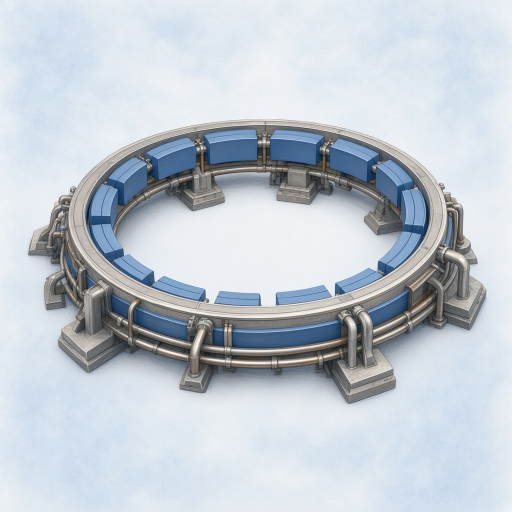
Scientists at CERN have trapped antimatter atoms. Since 2010, an experiment called ALPHA has held atoms of antihydrogen (an antimatter version of the simplest atom) inside a magnetic trap so they can study them.
Common myths about antimatter
Myth: Antimatter is just science fiction. Antimatter is real and has been studied for almost 100 years. The first one was photographed in 1932. Scientists make and trap antimatter in labs today, and your own body produces a small amount.
Myth: A spaceship could fly across the galaxy with an antimatter engine, like in Star Trek. Antimatter does release a lot of energy when it meets matter, but making antimatter is incredibly slow and costly. All of the antimatter scientists have ever produced, added together, would not power a light bulb for very long. Real antimatter rockets do not exist yet.
Myth: A small amount of antimatter could blow up the whole universe. Antimatter only annihilates with the matter it directly touches, and the amount of energy released matches the amount of mass involved. A tiny bit of antimatter only makes a tiny burst of energy. The universe is in no danger from antimatter.
Myth: Antimatter falls upward because it has anti-gravity. In 2023, CERN’s ALPHA-g experiment observed antihydrogen responding to Earth’s gravity in the downward direction. Within the experiment’s roughly 20 percent precision, the result was consistent with ordinary attractive gravity; more precise tests continue.
Myth: Antimatter is the same thing as dark matter. They are completely different. Antimatter is made of antiparticles like positrons and antiprotons, and we have produced it in real labs. Dark matter is something else entirely, never directly seen, and not made of antimatter.
Frequently asked questions about antimatter
What is antimatter, in simple words?
Antimatter is built from antiparticles. The electron’s antiparticle is the positively charged positron, and the proton’s is the negatively charged antiproton. Antiparticles have matching masses and reversed charge and other additive quantum properties. A particle and its matching antiparticle can annihilate into photons or other allowed particles.
Does antimatter really exist, or is it just an idea?
Antimatter really exists. The first antimatter particle, the positron, was photographed in 1932. Scientists at CERN make positrons and antiprotons every day in particle accelerators, and they have even built whole atoms of antimatter called antihydrogen. Tiny amounts of antimatter are also produced in nature inside stars and in cosmic rays.
Why isn’t the universe made of antimatter too?
The hot early universe contained particles and antiparticles, yet observations show a small surviving excess of matter, roughly one baryon per billion or so photons today. Scientists do not yet know which early-universe process generated that asymmetry. The cosmic microwave background formed much later, when the universe became transparent, so it is not simply a surviving flash from individual matter-antimatter annihilations.
How do PET scans use antimatter to take pictures inside the body?
A doctor injects a very small, safe amount of material that releases positrons. As soon as a positron leaves a nearby atom, it bumps into an electron and both annihilate, sending out two gamma rays in opposite directions. A ring of detectors around the patient catches the gamma rays and uses them to build a 3D picture. PET scans help doctors find diseases like cancer and study how the brain works.
Is antimatter dangerous?
In the amounts that exist in nature or that scientists make in labs, antimatter is not dangerous. Each annihilation only releases as much energy as the mass involved, and the masses are very small. Your body makes positrons every day from natural potassium-40, and you do not feel a thing. Doctors safely use antimatter inside the body during PET scans every day around the world.
Each of this topic’s quiz questions cites a primary source for the specific fact tested. You can play at any level: Rookie, Curious, Sharp, or Expert.
Matter is what every object you can touch is made of: atoms, molecules, your body, the air, and the stars. Many matter particles have antiparticles with the same mass and reversed charge and other additive quantum properties. Some neutral particles, including photons, are their own antiparticles. A particle and its matching antiparticle can annihilate into photons or other allowed particles. Antimatter is real, and tiny amounts occur in the Sun, cosmic rays, laboratories, and the human body.
Why matter and antimatter are tricky to understand
The word “antimatter” sounds like science fiction, but it has been part of physics for almost 100 years. The British physicist Paul Dirac wrote down an equation in 1928 that combined quantum physics with Einstein’s relativity. The math gave him two solutions, and the second one described a particle with the same mass as an electron but the opposite electric charge. Dirac realized his equation was predicting a new kind of particle that nobody had ever seen.
Four years later, in 1932, the American physicist Carl Anderson photographed exactly that particle. He was studying cosmic rays, high-energy particles from space that crash into Earth’s air. One of his cloud-chamber images showed a particle that curved like an electron in a magnetic field, but in the opposite direction. He named it the positron, and won the Nobel Prize in 1936.
A particle and its matching antiparticle can annihilate, converting rest mass and kinetic energy into other particles. A low-energy electron-positron pair most often produces gamma-ray photons. The conversion follows mass-energy equivalence and conservation laws. The total quantity of antimatter made and retained by humans remains minuscule.
Key facts about matter and antimatter
Antimatter was predicted before it was found. Paul Dirac predicted it in 1928 from a math equation. Carl Anderson detected the first positron in 1932. Dirac shared the 1933 Nobel Prize for the prediction.
The antiproton came later. Emilio Segre and Owen Chamberlain detected the antiproton at Berkeley in 1955, sharing the 1959 Nobel Prize. It has the same mass as a proton but a negative charge.
Annihilation makes a very specific kind of light. When an electron meets a positron, the most common result is two gamma-ray photons flying in opposite directions, each with an energy of 511 keV. PET scanners are built to detect this exact back-to-back pair.
Your body produces antimatter every day. A natural form of potassium called potassium-40 sits in tiny amounts throughout your body, most of it inside muscle cells. About one in every 100,000 of its decays emits a positron, and those positrons annihilate within nanoseconds against electrons inside you.
Sunlight is partly powered by antimatter. The Sun’s core fuses four hydrogen nuclei into one helium nucleus through the proton-proton chain. Two steps release positrons, which annihilate against electrons and contribute to the photons that become sunlight.
The early universe left a tiny matter excess. The present baryon-to-photon ratio is about 6 parts in 10 billion. Simple accounts describe this as roughly one extra matter particle per billion matter-antimatter pairs, but the process that generated the asymmetry is unknown.
CERN traps whole atoms of antimatter. Since 2010, an experiment called ALPHA has held antihydrogen atoms (one antiproton with one positron) inside a magnetic trap, with trapping times reaching 1,000 seconds.
Antihydrogen responded downward to Earth’s gravity. CERN’s 2023 ALPHA-g result excluded upward free fall and was consistent with ordinary attractive gravity within about 20 percent precision. Experiments continue to refine the comparison.
Complete annihilation converts the combined rest mass. Mass-energy equivalence gives about 1.8 × 10¹⁷ joules for a kilogram of antimatter annihilating with a kilogram of matter. That is around 43 megatons of TNT equivalent, taking a ton of TNT as the standard 4.184 gigajoules. Present production and storage rates are so small that kilogram quantities are far outside any realistic plan.
Common myths about matter and antimatter
Myth: Dirac discovered antimatter in his lab. Dirac was a theoretical physicist, meaning he worked with equations rather than experiments. He predicted antimatter on paper in 1928. Carl Anderson was the experimentalist who photographed a positron in 1932.
Myth: A small amount of antimatter could destroy the universe. The energy released by annihilation always matches the mass involved. A small amount of antimatter makes a small amount of energy. The total ever produced by scientists is less than a grain of sand, harmless at that scale.
Myth: Antimatter and dark matter are the same thing. They are completely different. Antimatter is made of antiparticles like positrons and antiprotons, and laboratories produce it every day. Dark matter has never been directly detected and is not made of antiparticles. Astronomers infer it only from how its gravity bends light and shapes galaxies.
Myth: Only charged particles have antimatter twins. Even neutral particles have antimatter partners. The neutron has a separate antiparticle called the antineutron, made of antiquarks. Even nearly massless particles called neutrinos have antineutrino partners, though scientists are still testing whether the two are truly distinct.
Frequently asked questions about matter and antimatter
What exactly is antimatter?
Antimatter is built from antiparticles. The positron and antiproton have the same masses as the electron and proton but opposite electric charges and reversed additive quantum numbers. Some neutral particles are their own antiparticles. A particle-antiparticle pair can annihilate into photons or other particles allowed by its energy and conservation laws.
How do PET scans use antimatter?
A PET scan, short for positron emission tomography, injects a tiny safe dose of a chemical that releases positrons. Each positron travels only a millimeter or two inside the body before hitting an electron. The two annihilate, releasing two 511 keV gamma rays in opposite directions. A ring of detectors around the patient catches both gamma rays at the same instant and uses the timing to pinpoint where the annihilation happened. PET scans help doctors find cancer and study brain activity.
Why does the universe have any matter left at all?
The hot early universe contained particles and antiparticles, but today’s baryon-to-photon ratio shows a small surviving matter excess. Simple accounts describe it as about one extra matter particle per billion pairs. The cosmic microwave background was released much later, when the universe became transparent, and its photon-to-baryon ratio preserves information about the early thermal history rather than being a direct image of individual annihilations.
Could a faraway galaxy be made of antimatter?
An isolated antimatter star could emit an ordinary-looking spectrum because photons are their own antiparticles. Matter falling onto it, or a boundary between large matter and antimatter regions, would create characteristic gamma rays across a range of energies. Searches have found no confirmed antimatter star or galaxy, and observations strongly constrain large nearby antimatter domains without proving none exist beyond the observable limits.
Could we ever build an antimatter rocket?
One gram of antimatter annihilating with one gram of matter would release about 1.8 × 10¹⁴ joules by mass-energy equivalence, roughly 43 kilotons of TNT equivalent on the standard 4.184 gigajoules per ton of TNT. The obstacle is producing, slowing, trapping, and storing charged antiparticles or neutral anti-atoms with extremely poor overall efficiency. Laboratories handle microscopic numbers of anti-atoms, far short of propulsion needs, so an antimatter rocket is not a practical current technology.
You can play this topic at any level: Rookie, Curious, Sharp, or Expert. Each quiz set cites a primary source for the specific fact tested.
Antimatter consists of antiparticles with the same mass and spin as their partners but opposite additive quantum numbers such as electric charge or baryon number. Some neutral bosons are self-conjugate, and whether neutrinos are their own antiparticles is unknown. Dirac’s 1928 relativistic electron equation led to the positron prediction, confirmed by Carl Anderson in 1932. A particle-antiparticle pair can annihilate into photons or other allowed particles, conserving total energy, momentum, and quantum numbers. The observed universe contains overwhelmingly more baryonic matter than antimatter, and the origin of that asymmetry remains unsolved.
What is often misunderstood about antimatter
Antimatter is not rare in nature. Your body carries about 0.1 microcurie (close to 4,000 becquerels) of naturally radioactive potassium-40, and about one decay in 100,000 proceeds by beta-plus emission rather than beta-minus decay or electron capture. That leaves a few thousand positrons produced inside you each day, annihilating within nanoseconds against nearby electrons. The Sun produces positrons continuously as a byproduct of the proton-proton fusion chain; they annihilate instantly inside the dense solar plasma and contribute to the photons that eventually become sunlight.
Antimatter is also not silent when it meets matter. Each electron-positron annihilation produces two 511 keV gamma-ray photons traveling in opposite directions. That specific signal is what a PET scanner detects when imaging the brain or other organs.
The phrase “matter-antimatter annihilation releases energy” is accurate but easily misread. In complete annihilation, the initial rest mass contributes to the energy of the final particles; the products are not required to be photons at sufficiently high energy. The conversion fraction far exceeds chemical or nuclear reactions. Antimatter propulsion remains impractical because production, deceleration, capture, and storage are extraordinarily inefficient, and existing traps hold quantities many orders of magnitude below propulsion needs. A defensible present cost per gram cannot be obtained by simply scaling a laboratory demonstration.
Key facts about matter and antimatter
Dirac’s equation (1928): Combined quantum mechanics with special relativity for the electron; yielded two solutions, predicting the positron four years before it was observed.
Anderson’s positron (1932): Photographed in a cloud chamber exposed to cosmic rays; Anderson received the 1936 Nobel Prize in Physics.
Antiproton (1955): Owen Chamberlain and Emilio Segrè produced and detected the antiproton at the Bevatron accelerator at Berkeley; they received the 1959 Nobel Prize.
Antineutron (1956): Observed just one year after the antiproton. Despite being electrically neutral, the antineutron is a distinct particle composed of antiquarks (one anti-up and two anti-down), with baryon number -1 instead of +1.
First antihydrogen (1995): CERN’s PS210 experiment synthesized 9 atoms of antihydrogen (one antiproton orbited by one positron) briefly.
Trapped antihydrogen (2010): CERN’s ALPHA experiment trapped 38 antihydrogen atoms. In 2011, trapping times extended to 1,000 seconds, enabling spectroscopic measurements.
Antihydrogen and gravity (2023): ALPHA-g observed a downward response and excluded repulsive “antigravity.” Its result was consistent with ordinary gravitational acceleration within roughly 20 percent precision, not a precision confirmation of exact equivalence.
Baryon-to-photon ratio: Approximately 6 × 10⁻¹⁰, meaning about 1.6 billion CMB photons exist for every baryon (proton or neutron) today. The asymmetry implies roughly one extra matter particle per billion matter-antimatter pairs in the early universe.
CP violation (1964): James Cronin and Val Fitch observed CP violation in neutral kaon decays at a level of about 0.2%, earning the 1980 Nobel Prize.
CP violation in B mesons (2001): BaBar at SLAC and Belle at KEK confirmed CP violation in B-meson systems, supporting the CKM matrix predictions and contributing to Kobayashi and Maskawa’s 2008 Nobel Prize.
AMS-02 (2011-present): The Alpha Magnetic Spectrometer on the International Space Station has measured millions of cosmic-ray positrons and antiprotons, and has reported a small number of unconfirmed antihelium candidate events.
Annihilation energy accounting: complete annihilation converts the initial particles’ combined rest mass into the energy of photons or other final particles. Typical fission and hydrogen-fusion reactions convert only a fraction of the starting rest mass.
Common myths about antimatter
Myth: Antimatter does not exist naturally. Antimatter forms continuously in natural processes. Beta-plus decay in radioactive nuclei releases positrons. Positrons are produced in specific weak-reaction stages of the Sun’s proton-proton chain, not at every step. Pulsars, supernova remnants, and cosmic-ray interactions are candidate or established sources of high-energy positrons.
Myth: Electrically neutral particles have no antiparticles. A neutral electric charge does not mean a particle is its own antiparticle. The neutron and antineutron are distinct particles with opposite baryon numbers and opposite quark composition. They annihilate when they meet. Only certain neutral bosons, such as the photon, are their own antiparticles.
Myth: CP violation explains the matter-antimatter asymmetry completely. CP violation has been measured in kaons (1964), B mesons (2001), and D mesons (2019 at LHCb). The Standard Model’s CKM matrix encodes this violation, but quantitative calculations using the Jarlskog invariant (J approximately 3 × 10⁻⁵) predict a baryon asymmetry many orders of magnitude smaller than the observed 6 × 10⁻¹⁰. Standard Model CP violation alone cannot account for the universe as it exists.
Myth: Antimatter falls upward. The 2023 ALPHA-g result at CERN observed a downward response and found antihydrogen acceleration consistent with ordinary attractive gravity within about 20 percent precision. It excluded simple upward free fall but did not yet match the precision of matter-gravity tests. No gravitational anomaly for antimatter has been confirmed.
Myth: The Sakharov conditions require equal amounts of matter and antimatter initially. The Sakharov conditions are the requirements for generating an asymmetry from a symmetric state, not a description of initial conditions. The three conditions are: baryon number violation, C and CP violation, and departure from thermal equilibrium. Meeting all three is necessary; the Standard Model satisfies each only partially.
Frequently asked questions about antimatter
What are the Sakharov conditions?
Andrei Sakharov identified in 1967 the three conditions that any process must satisfy to produce more matter than antimatter from a symmetric starting state. First, there must be processes that violate baryon number, changing the count of baryons. Second, those processes must violate C-symmetry and CP-symmetry so they favor matter over antimatter. Third, the universe must be out of thermal equilibrium so the asymmetry is not washed back out by the reverse process. The Standard Model satisfies all three conditions in principle, but the magnitudes are insufficient by many orders of magnitude to explain the observed asymmetry.
Why does CERN trap antihydrogen?
A trapped antihydrogen atom is the antimatter counterpart of hydrogen: one antiproton bound to one positron. Spectroscopic comparisons test CPT symmetry, while ALPHA-g tests gravitational response. The attainable precision depends on the transition and experiment; agreement in one observable does not transfer automatically to every antihydrogen property. A reproducible difference beyond controlled uncertainties would signal new physics, but interpreting it would require identifying which symmetry or interaction failed.
What is the positron excess detected by AMS-02?
At cosmic-ray energies above several GeV, PAMELA and AMS-02 measured a rising positron fraction relative to simple secondary-production models. Nearby pulsars are a leading class of explanations, while improved propagation and secondary-production models also matter. Dark-matter annihilation remains constrained but model-dependent; the positron data alone do not uniquely identify the source.
Could an entire galaxy be made of antimatter?
If a large antimatter region bordered a matter region, collisions across the boundary would produce gamma rays with a spectrum that includes, but is not limited to, electron-positron annihilation features. Surveys find no confirmed antimatter galaxy and constrain large domains within the observable region. The exact distance limits depend on assumptions about boundaries, gas mixing, and cosmic history, so observations do not justify the phrase “at any scale astronomers can probe.”
What is leptogenesis?
Leptogenesis is a proposed mechanism for generating the matter-antimatter asymmetry through the behavior of leptons rather than baryons directly. In the scenario proposed by Fukugita and Yanagida in 1986, heavy right-handed neutrinos at the GUT scale decay with CP violation, creating an excess of leptons over antileptons. Electroweak sphaleron processes then partially convert that lepton asymmetry into a baryon asymmetry. Leptogenesis is one of the leading candidate mechanisms because it can produce the observed baryon-to-photon ratio and connects naturally to the seesaw mechanism for neutrino masses.
Source notes
The history of antimatter detection, including Dirac’s 1928 prediction, Anderson’s 1932 Nobel-winning observation, and the 1955 antiproton discovery by Chamberlain and Segrè, is documented in Wikipedia: Antimatter and the Nobel Prize records. The proton-proton chain article at Wikipedia describes the beta-plus decay step that produces solar positrons. The Sakharov conditions and the baryon-to-photon ratio of approximately 6 × 10⁻¹⁰ are documented in Wikipedia: Baryogenesis. CP violation in kaons (Cronin-Fitch 1964, Nobel 1980), B mesons (BaBar and Belle 2001), and D mesons (LHCb 2019) is covered in Wikipedia: CP violation. ALPHA experiment results, including the 2010 trapping milestone and the 2023 ALPHA-g gravitational measurement, are described at CERN: Antimatter. AMS-02 cosmic-ray measurements are documented at Wikipedia: Alpha Magnetic Spectrometer. PET scanner physics is described in Wikipedia: Positron emission tomography. The adult potassium-40 body burden of about 0.1 microcurie is given in the Argonne National Laboratory human health fact sheets, and the 0.001 percent beta-plus branch in Wikipedia: Potassium-40.
The four quiz sets for this topic cover progressively deeper material: Rookie, Curious, Sharp, and Expert.
Antimatter consists of antiparticles associated with Standard Model matter fields, with equal masses required by CPT symmetry and opposite additive quantum numbers such as electric charge or baryon number. Some neutral bosons are self-conjugate, and whether neutrinos are Majorana particles remains unknown. Dirac’s relativistic electron equation led to the positron prediction in 1928; Carl Anderson confirmed it in 1932. The deeper question is why the observed universe is dominated by baryonic matter at a baryon-to-photon ratio of about 6 parts in 10 billion. Sakharov’s conditions, CKM CP violation, sphalerons, and proposed leptogenesis scenarios connect particle physics to this cosmological problem.
Why baryogenesis is non-intuitive
Three features make the matter-antimatter problem nontrivial. Thermal production after reheating tends to create particles and antiparticles symmetrically unless conserved charges or an asymmetry-generating process intervene. Starting from a symmetric state, conventional baryogenesis requires the conditions Andrei Sakharov set out in 1967: baryon-number violation, C and CP violation, and departure from thermal equilibrium. The Standard Model contains relevant ingredients, including anomalous baryon-plus-lepton violation and CP violation, but its electroweak crossover and quantitative suppression do not yield the observed asymmetry.
The second is that CP violation in the Standard Model, encoded in the Cabibbo-Kobayashi-Maskawa (CKM) matrix’s irreducible complex phase, is parameterized by the Jarlskog invariant. The Jarlskog invariant is a basis-independent measure built from CKM mixing angles and the CP phase, and its measured value is roughly 3 parts in 100,000. Substituted into electroweak baryogenesis calculations, the resulting asymmetry falls many orders of magnitude below the observed value. Standard Model CP violation alone cannot account for the matter-dominated universe.
The third is that the Higgs mass of about 125 GeV, fixed at the LHC after 2012, decided a question that had remained open for decades. Lattice studies of finite-temperature electroweak symmetry restoration show that for a 125 GeV Higgs the electroweak transition is a smooth crossover, not a strong first-order phase transition. Without bubble walls separating high- and low-Higgs-vacuum-expectation phases, the out-of-equilibrium step Sakharov’s third condition demands does not occur in the pure Standard Model, and electroweak baryogenesis fails twice over.
Key facts
The Jarlskog invariant. A basis-independent quantity built from products of CKM matrix elements and their complex conjugates that captures all CP violation in the Standard Model quark sector. Its measured value sits at roughly 3 parts in 100,000, fixed by the mixing angles and the CKM CP phase. Substituted into Standard Model baryogenesis calculations, it gives an asymmetry many orders of magnitude smaller than the observed baryon-to-photon ratio of about 6 parts in 10 billion.
Sphalerons. Non-perturbative finite-energy field configurations of the electroweak gauge sector that mediate transitions between vacua of the SU(2) gauge theory carrying different Chern-Simons numbers. Each transition changes baryon number and lepton number by 3 units each while conserving B minus L. Above the electroweak scale near 100 GeV, sphaleron rates are unsuppressed and the processes were efficient in the early universe.
Sakharov conditions. Andrei Sakharov’s 1967 paper identified the three requirements for generating a baryon asymmetry from a symmetric initial state: baryon number violation, both C and CP violation, and a departure from thermal equilibrium. Sakharov did not propose a specific mechanism; he identified the conditions any mechanism must satisfy.
Electroweak baryogenesis in the Standard Model. Disfavored on two counts. The CKM-phase CP violation is too small by many orders of magnitude, and the electroweak phase transition for a 125 GeV Higgs is a lattice-confirmed smooth crossover rather than a first-order transition, so no bubble walls form. Beyond-Standard-Model versions with extended scalar sectors, including two-Higgs-doublet models, can restore a first-order transition and remain active research subjects.
Leptogenesis. Proposed by Masataka Fukugita and Tsutomu Yanagida in 1986. CP-violating decays of heavy right-handed (Majorana) neutrinos near the seesaw scale generate a net lepton asymmetry before sphalerons freeze out. Sphalerons then partially convert that asymmetry into a baryon asymmetry through a factor of approximately 28/79 in standard field content. For Majorana mass scales near 10 to the ninth GeV and a CP phase of order unity, leptogenesis reproduces the observed baryon-to-photon ratio.
Indirect CP violation in kaons. James Cronin and Val Fitch observed CP violation through neutral kaon mixing in 1964, with the parameter epsilon at roughly 2 parts per thousand, and received the 1980 Nobel Prize. The result motivated Makoto Kobayashi and Toshihide Maskawa’s 1973 proposal that a third quark generation could accommodate CP violation in the Standard Model, work recognized with the 2008 Nobel Prize.
Direct CP violation in kaons. The NA48 experiment at CERN and KTeV at Fermilab established direct CP violation in K to two-pion decays around the year 2000, measuring the real part of epsilon prime over epsilon at about 1.6 parts per thousand. The result confirmed that CP violation appears in decay amplitudes themselves, beyond the mixing-induced effect found by Cronin and Fitch.
CP violation in heavier mesons. BaBar at SLAC and Belle at KEK confirmed CP violation in the B-meson system in 2001 through the time-dependent asymmetry in B to J/psi K-short. LHCb at CERN reported the first observation of CP violation in charm-meson decays in 2019, in the difference of CP asymmetries between D-zero to K-plus-K-minus and D-zero to pi-plus-pi-minus.
CPT tests with antiprotons. The BASE (Baryon Antibaryon Symmetry Experiment) collaboration at CERN’s Antiproton Decelerator uses Penning traps to compare proton and antiproton properties at extreme precision. Magnetic moments (g-factors) agree in magnitude to about 1 part in a billion, and charge-to-mass ratios agree to about 1 part in a trillion. These remain among the most stringent tests of CPT symmetry to date.
CP violation in the lepton sector. T2K and NOvA probe the leptonic CP phase through long-baseline neutrino and antineutrino appearance. Their combined constraints have not established CP violation at discovery significance. DUNE and Hyper-Kamiokande are being built to improve sensitivity, but no future experiment can guarantee a definitive result because sensitivity depends on the true parameter values and achieved exposure.
The cosmic-ray positron excess. PAMELA reported in 2008 that the cosmic-ray positron fraction rises with energy from a few GeV upward, contrary to the simple secondary-production prediction. AMS-02 on the International Space Station has measured millions of positrons since 2011 and confirmed that the fraction climbs from about 5 GeV to several hundred GeV before flattening. Pulsars and supernova remnants are the leading astrophysical explanation.
The neutron lifetime puzzle. Free neutrons beta-decay with a lifetime near 880 seconds. Two measurement methods, beam (counting decay protons in a flux of cold neutrons) and bottle (timing surviving ultracold neutrons in a trap), disagree by roughly 10 seconds, about 1 percent of the lifetime, at greater than 4 sigma. CPT predicts identical lifetimes for the antineutron, but the discrepancy is internal to neutron measurements.
Neutrinoless double beta decay. A hypothetical second-order weak process in which two neutrons convert to two protons emitting two electrons but no antineutrinos. Observation would prove the neutrino is a Majorana fermion and demonstrate lepton-number violation by 2 units. KamLAND-Zen, GERDA and LEGEND, CUORE, and the planned nEXO have set half-life lower bounds in the 10 to the 25th to 10 to the 26th year range. No detection has been reported.
Common misconceptions at expert level
Misconception: Sakharov’s 1967 paper proposed leptogenesis. Sakharov set out the three conditions and outlined a baryon-number-violating GUT-scale process consistent with them, but did not propose the leptogenesis mechanism in its modern form. Leptogenesis was Fukugita and Yanagida’s 1986 proposal, exploiting CP-violating decays of heavy right-handed Majorana neutrinos and partial sphaleron conversion of the lepton asymmetry.
Misconception: Sphalerons are particles produced at the LHC. Sphalerons are non-perturbative classical field configurations, saddle points that interpolate between electroweak vacua of different Chern-Simons number. They are not asymptotic-state particles. At LHC energies, sphaleron processes remain exponentially suppressed by the small zero-temperature tunneling rate.
Misconception: Sphalerons conserve baryon number. Sphalerons violate both baryon and lepton number, changing each by 3 units per transition while conserving the difference B minus L. That violation is precisely why sphalerons are central to leptogenesis: they reshuffle a primordial lepton asymmetry into a baryon asymmetry.
Misconception: Direct CP violation in kaons was Cronin and Fitch’s 1964 discovery. Cronin and Fitch observed indirect (mixing-induced) CP violation through the long-lived neutral kaon’s small two-pion branching fraction. Direct CP violation, the inequality of CP-conjugate decay amplitudes, was not established until NA48 at CERN and KTeV at Fermilab measured the real part of epsilon prime over epsilon around the year 2000.
Misconception: T2K and NOvA have discovered lepton-sector CP violation at high significance. Their data constrain the leptonic CP phase and may favor portions of parameter space, but they have not established CP violation at the conventional discovery threshold. DUNE and Hyper-Kamiokande aim for substantially greater sensitivity rather than a guaranteed outcome.
Misconception: BASE has detected proton-antiproton differences indicating CPT violation. BASE has found no such differences. Proton and antiproton magnetic moments agree at the part-per-billion level and charge-to-mass ratios agree at the part-per-trillion level. CPT remains an extraordinarily well-tested symmetry of local Lorentz-invariant quantum field theory.
Misconception: AMS-02 cosmic-ray positrons match secondary-production predictions. Simple secondary production predicts a falling positron fraction with energy. AMS-02 confirmed PAMELA’s earlier result that the fraction rises from about 5 GeV to several hundred GeV. Pulsars and supernova remnants are the favored sources.
Misconception: The neutron lifetime puzzle compares neutron and antineutron lifetimes. The puzzle is internal to neutron measurements: beam and bottle results disagree by about 10 seconds. CPT requires identical antineutron lifetimes, but no antineutron measurement of comparable precision exists.
Misconception: Neutrinoless double beta decay has been observed. No experiment has reported a confirmed observation. A Heidelberg-Moscow signal claim in germanium-76 from 2001 to 2004 was not reproduced by GERDA. Current half-life lower bounds reach the 10 to the 26th year range for xenon-136 in KamLAND-Zen.
Frequently asked questions
Why is Standard Model CP violation insufficient for baryogenesis?
The Jarlskog invariant fixes the magnitude of CP violation the CKM mechanism makes available at roughly 3 parts in 100,000. Calculations translating that phase into a baryon asymmetry give a value many orders of magnitude smaller than the observed baryon-to-photon ratio. The deficit stems from the small CKM phase combined with quark-mass hierarchies that suppress the relevant amplitudes. Most successful baryogenesis scenarios introduce additional CP-violating sectors: supersymmetric extensions, two-Higgs-doublet models, or the heavy-neutrino sector exploited by leptogenesis.
Why does the electroweak phase transition for a 125 GeV Higgs not work?
A first-order phase transition proceeds by nucleation of bubbles of the symmetry-broken phase inside the symmetric phase. CP-violating reflections of fermions off the bubble walls produce a net particle-antiparticle asymmetry behind the wall. Lattice studies of the finite-temperature Standard Model with a 125 GeV Higgs show no first-order transition; the system passes through a smooth analytic crossover. Without bubble walls there is no out-of-equilibrium dynamics of the kind Sakharov’s third condition requires.
How does leptogenesis convert a lepton asymmetry into a baryon asymmetry?
Heavy right-handed Majorana neutrinos decay into final states with both leptons and antileptons. If the decay rates differ through a CP-violating phase, the result is a net lepton asymmetry. While the universe is hotter than the electroweak scale, sphalerons redistribute the asymmetry between baryons and leptons in proportions fixed by the conserved B minus L, with an asymptotic conversion factor of approximately 28/79. After the crossover, sphalerons freeze out and the surviving baryon excess sets the present baryon-to-photon ratio.
What does the BASE measurement test?
CPT symmetry, the combined operations of charge conjugation, parity, and time reversal, is an exact symmetry of any local Lorentz-invariant quantum field theory. CPT requires that a particle and its antiparticle share the same mass, lifetime, and magnetic moment in magnitude. BASE found agreement of proton and antiproton g-factors at the part-per-billion level. A confirmed disagreement would indicate either a violation of Lorentz invariance or a breakdown of locality in the underlying field theory.
What would a positive observation of neutrinoless double beta decay imply?
A confirmed neutrinoless double-beta signal would establish lepton-number violation by two units and, through the black-box theorem, imply a Majorana mass component for neutrinos. Translating the decay rate into an effective Majorana mass and constraining the mass spectrum requires assumptions about the dominant decay mechanism and nuclear matrix elements. The result would be profound, but not every interpretation follows without those inputs.
What might explain the cosmic-ray positron excess?
PAMELA and AMS-02 measured a positron fraction above several GeV that rises relative to older simple secondary-production models. Nearby pulsars can plausibly supply hard electron-positron spectra, while updated cosmic-ray propagation and secondary-production models affect the inferred excess. Dark-matter interpretations face strong multi-messenger constraints, but the positron data alone do not select one unique source or require a simple primary-source split.
Source notes
The CKM matrix and the Jarlskog invariant are documented in Wikipedia: Cabibbo-Kobayashi-Maskawa matrix, with the magnitude of about 3 parts in 100,000 derived from current Particle Data Group values for the mixing angles and CP phase. Sphaleron-mediated baryon-plus-lepton number violation is reviewed in Wikipedia: Sphaleron; the conversion factor of approximately 28/79 from lepton to baryon asymmetry assumes Standard Model field content. The Sakharov conditions, the failure of pure Standard Model electroweak baryogenesis at a 125 GeV Higgs, and Fukugita and Yanagida’s 1986 leptogenesis proposal are documented in Wikipedia: Baryogenesis. The history and current state of CP violation, including indirect CP violation in kaons (Cronin and Fitch 1964), direct CP violation measurements by NA48 and KTeV around 2000, and CP violation in B and D mesons, is summarized in Wikipedia: CP violation. BASE Penning-trap comparisons of proton and antiproton g-factors and charge-to-mass ratios are described at CERN: BASE Collaboration and in Wikipedia: Antimatter. The cosmic-ray positron fraction measurements by AMS-02 are documented at Wikipedia: Alpha Magnetic Spectrometer. The free-neutron beam-bottle lifetime discrepancy is reviewed in Wikipedia: Free neutron decay. Neutrinoless double beta decay, the Majorana hypothesis, and current half-life bounds in xenon-136, germanium-76, and tellurium-130 are described in Wikipedia: Double beta decay.
Trivia question references throughout this topic’s Rookie, Curious, Sharp, and Expert quiz sets each cite a primary source for the specific fact tested.
Think you know Matter & Antimatter?
Test yourself. Can you spot the true fact among 3 convincing bluffs?