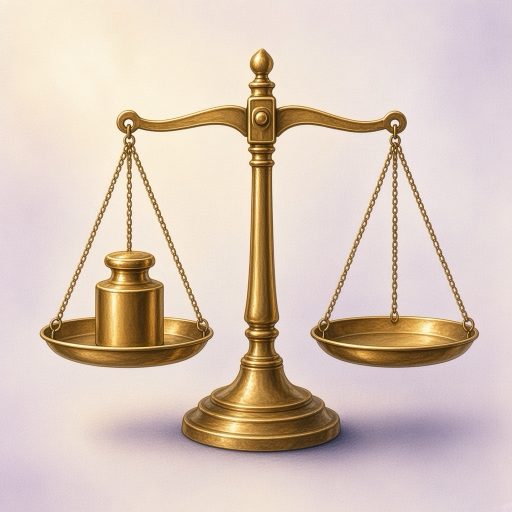
Mass measures an object’s inertia, or how strongly it resists being accelerated. A bowling ball usually has more mass than a soccer ball and is harder to speed up or stop. Mass is not the same as weight. Weight is the gravitational force on an object, so it changes with local gravity while mass does not.
Why mass is tricky
Imagine you stand on a scale on Earth and it reads 80 pounds (36 kg). Then you fly to the Moon and step on the same scale. It reads only about 13 pounds (6 kg). Did you lose any stuff? No. You have the exact same body, the same atoms, and the same mass. The Moon has weaker gravity, so it pulls on you less hard. Weight changed. Mass did not.
Mass is also strange because atoms contain enormous separation between their tiny nuclei and their electron clouds. If an atom were as wide as a football stadium, its nucleus would be only around pinhead or small-bead size, depending on the atom and stadium. Almost all of the atom’s mass would be concentrated in that tiny center.
Even stranger, mass and energy are related. Adding energy to a closed system increases that system’s mass. A sealed hot cup of coffee therefore has a tiny bit more mass than the same sealed cup after it cools, if none of the heat has escaped. The difference is far too small for a kitchen scale.
Key facts about mass
Mass and weight are not the same. Mass measures inertia. Weight is gravitational force. An astronaut floating in the International Space Station experiences apparent weightlessness but retains the same mass.
Atomic nuclei are tiny compared with atoms. A typical atomic scale is around 10⁻¹⁰ meter, while nuclear scales are around 10⁻¹⁵ to 10⁻¹⁴ meter. Almost all an ordinary atom’s mass is concentrated in its nucleus.
Almost all of your body’s mass is in atomic nuclei. Over 99.9% of an atom’s mass is in its nucleus. Electrons are about 1,800 times lighter than the protons and neutrons inside the nucleus.
Albert Einstein discovered E = mc² in 1905. It says that mass (m) and energy (E) are connected. The “c” is the speed of light, which is a huge number, so a tiny bit of mass turns into a giant amount of energy.
In 2019, scientists redefined the kilogram. The kilogram used to be set by a special metal cylinder kept near Paris, France. Now it is defined using a fixed number from physics that never changes.
The Higgs boson was discovered at CERN on July 4, 2012. Two giant experiments called ATLAS and CMS spotted it. It is linked to a thing called the Higgs field, which gives many particles their mass.
Photons, the particles of light, have no mass at all. That is why they can travel at the speed of light. Anything with mass would need infinite energy to go that fast.
Neutron stars contain the densest stable matter astronomers can directly observe. A teaspoon-sized sample at characteristic neutron-star density would have a mass around a trillion kilograms, comparable to a mountain.
Nuclear reactions release binding energy. The products can have slightly less mass than the starting system, with the difference appearing as released energy in accordance with E = mc². This powers the Sun and nuclear reactors.
Common myths about mass
Myth: Mass and weight are the same thing. Mass measures inertia and remains unchanged when you merely move to a different world. Weight is gravitational force and changes with local gravity. You weigh less on the Moon, but your mass stays the same.
Myth: Solid contact means atoms behave like tiny hard balls whose surfaces meet. Ordinary contact force arises mainly from electromagnetic interactions and the quantum-mechanical exclusion principle between electron clouds. Whether that counts as atoms “touching” is a matter of definition, but there are no classical hard atomic surfaces pressing together.
Myth: The Higgs boson gives you all of your mass. The Higgs field gives mass to small particles like electrons and quarks, but most of your body’s mass does not come from that. About 99% of the mass of a proton or neutron comes from the energy of the tiny particles whizzing around inside them, not from the Higgs field.
Myth: Photons have a tiny bit of mass. Photons have zero mass. They do carry energy and can push small things, like a solar sail in space, but they have no mass. That is what lets them travel at the speed of light.
Myth: Adding heat cannot change a system’s mass. Added internal energy raises the invariant mass of a closed system by E/c². A sealed hot cup therefore has slightly more mass than the same sealed cup after losing that heat, though the change is far too small for a normal scale.
Frequently asked questions about mass
What is the difference between mass and weight?
Mass measures an object’s inertia and is measured in kilograms or grams. Weight is gravitational force and is measured in newtons; pounds-force is also commonly used. On Mars your mass would remain the same, while your weight near the surface would be about 38 percent of its Earth value.
What does E = mc² actually mean?
For an object at rest, E = mc² relates its mass to its rest energy. The letter E stands for energy, m stands for mass, and c is the speed of light. Because c is so big, even a small decrease in mass can correspond to a huge release of energy. Nuclear reactions in the Sun and in power plants release binding energy, leaving products with slightly less mass than the starting system.
If atoms are mostly empty space, why does the world feel solid?
The world feels solid because overlapping electron clouds resist one another through electromagnetic interactions and the quantum exclusion principle. When you press your hand on a desk, those interactions produce the contact force you feel. Atomic nuclei occupy only a tiny part of an atom’s scale, but an atom is not a set of hard balls surrounding a classical empty void.
What does the Higgs boson have to do with mass?
The Higgs boson is an excitation of the Higgs field, which has a nonzero value throughout space. An electron’s interaction with that field sets its rest mass; this is not friction and does not slow a moving electron. Without the Higgs mechanism, electrons and quarks would be massless in the Standard Model, so familiar stable atoms and chemistry would not exist.
Why do scientists say a teaspoon of a neutron star weighs billions of tons?
A neutron star is the collapsed core left by some stellar explosions. Its matter is compressed to around nuclear density and consists mainly of neutrons, with protons, electrons, and possibly other phases deeper inside. A teaspoon-sized sample at characteristic density would contain around a trillion kilograms, comparable to a mountain. Black-hole “density” is not a simple material comparison because an event horizon hides the interior and average density depends strongly on black-hole mass.
Each of this topic’s quiz questions cites a primary source for the specific fact tested. You can play at any level: Rookie, Curious, Sharp, or Expert.
Mass is an invariant property that measures a body’s inertia and contributes to its gravitational behavior. Mass is not the same as weight: your mass stays the same when location changes, while weight depends on local gravity. A person weighing 100 pounds-force on Earth would weigh about 17 pounds-force on the Moon while retaining the same mass. Almost all an everyday object’s mass lies in atomic nuclei, and most nucleon mass emerges from quark and gluon dynamics rather than the quarks’ Higgs-generated rest masses.
Why mass is tricky to understand
Mass feels obvious until you ask where it comes from. An atomic electron cloud is roughly 10,000 to 100,000 times wider than its nucleus. Blow an atom up to the width of a football stadium and the nucleus would be around pinhead or small-bead size, depending on the atom and stadium. That tiny nucleus holds more than 99.9% of an ordinary atom’s mass.
It gets stranger inside the nucleus. A nucleus is built from protons and neutrons, and each of those is built from three smaller particles called quarks. The three quarks account for only about 1% of a proton’s mass. The other 99% is the energy of the strong force holding the quarks together, converted into mass through E=mc². Most of your weight is energy locked up inside protons and neutrons.
Mass-energy equivalence needs a system boundary. A photon has energy but zero invariant mass; however, adding internal energy to a closed system increases the system’s invariant mass. A sealed hot cup has slightly more mass than the same cup after losing heat, and a latched compressed spring has slightly more than its relaxed state.
Key facts about mass
Mass and weight are different. Mass measures inertia; weight is gravitational force. An astronaut on the International Space Station experiences apparent weightlessness but has the same mass as on the ground.
Nuclei are tiny compared with atoms. A typical atomic scale is about 10⁻¹⁰ meter, while nuclear dimensions are around 10⁻¹⁵ to 10⁻¹⁴ meter. The language of “empty space” is a useful scale analogy, but quantum electron clouds are not miniature planets orbiting through a classical void.
The nucleus holds the mass. More than 99.94% of an atom’s mass sits in its nucleus. A single proton is about 1,836 times heavier than an electron, so electrons add almost nothing to the total weight.
Most of a proton’s mass is energy. The three quarks inside a proton account for only about 1% of its mass. The other 99% comes from the energy of gluons (the particles that carry the strong force) and the motion of the quarks, all converted to mass by E=mc².
The Higgs field gives elementary particles their mass. The Higgs field fills all of space. Particles that interact with it strongly (like the top quark) become heavy. Particles that interact weakly (like the electron) stay light. Particles that do not interact at all (like the photon, the particle of light) stay massless.
The Higgs boson was confirmed at CERN on July 4, 2012. Two detectors called ATLAS and CMS spotted it. Peter Higgs and Francois Englert shared the 2013 Nobel Prize for predicting it in 1964.
Mass and energy are interchangeable. When the Sun fuses hydrogen into helium, only about 0.7% of the input mass is converted to energy. That tiny fraction powers the Sun for billions of years.
Free fall is independent of composition to extraordinary precision. The MICROSCOPE satellite’s final 2022 result found no difference between titanium and platinum test masses at the level of a few parts in 10¹⁵. This supports the weak equivalence principle that underlies general relativity.
The kilogram was redefined in 2019. From 1889 to 2019, the kilogram was set by a platinum-iridium cylinder kept near Paris. In May 2019, scientists redefined it using the Planck constant, a fixed number from quantum physics.
Common myths about mass
Myth: Mass and weight are the same thing. Mass measures inertia and remains invariant when an object merely changes location. Weight is the local gravitational force on the object. You weigh less on the Moon, but your mass stays the same.
Myth: The Higgs boson is responsible for most of your weight. The Higgs field gives mass to elementary particles like quarks and electrons, but those rest masses make up only about 1% of a proton or neutron. Since protons and neutrons make up more than 99.9% of your body mass, only about 1 to 2% of your total mass traces back to the Higgs. The other ~99% is energy from the strong force.
Myth: Photons have a small mass because they carry energy. Photons have zero rest mass. They still carry momentum equal to their energy divided by the speed of light, which is how sunlight can push a solar sail in space, as Japan’s IKAROS spacecraft demonstrated in 2010.
Myth: Adding heat cannot change a system’s mass. Added internal energy increases the invariant mass of a closed system by E/c². The effect is real but tiny; an open hot object also radiates energy away, so the comparison must specify the system and state.
Frequently asked questions about mass
What is the difference between mass and weight?
Mass measures inertia and is expressed in kilograms or grams. Weight is gravitational force, expressed in newtons or pounds-force. Near Jupiter’s cloud tops the gravitational acceleration is roughly 2.5 times Earth’s, while on the Moon it is about one sixth. Your mass would not change.
Where does most of a proton’s mass come from?
A proton is built from three quarks bound together by gluons, the carriers of the strong force. The quark masses add up to only about 1% of the proton’s total. The other 99% comes from the energy of the gluons and the motion of the quarks, converted to mass through E=mc². Physicist Frank Wilczek, who won the 2004 Nobel Prize for work on the strong force, calls this “mass without mass.”
What does the Higgs field do?
The Higgs field has a nonzero value throughout the universe. Elementary particles’ couplings to it set their rest masses, without acting as friction. Without the Higgs mechanism, electrons, quarks, and the W and Z bosons would be massless in the Standard Model, and familiar atoms and chemistry would not form.
Why can sunlight push a solar sail if photons have no mass?
Photons carry momentum even though they have no rest mass. When a photon bounces off a shiny surface, it transfers that momentum and shoves the surface slightly. In space, with no air to slow the sail down, the pushes add up. Japan’s IKAROS mission in 2010 was the first spacecraft to use sunlight as its main thrust.
Are inertial mass and gravitational mass really the same?
Yes, within current experimental precision. MICROSCOPE’s final 2022 analysis found no composition-dependent difference in the free fall of titanium and platinum at the level of a few parts in 10¹⁵. Einstein built general relativity on this universality, treating freely falling test bodies as following the same spacetime geometry.
You can play this topic at any level: Rookie, Curious, Sharp, or Expert. Each quiz set cites a primary source for the specific fact tested.
Mass is an invariant property that determines a body’s inertia and enters its gravitational behavior. The MICROSCOPE satellite’s final 2022 results found no composition-dependent free-fall difference between titanium and platinum at the level of a few parts in 10¹⁵, strongly supporting the weak equivalence principle. In ordinary matter, protons and neutrons supply more than 99.9% of the mass, and most nucleon mass emerges from QCD dynamics rather than the light quarks’ Higgs-generated rest masses. The Higgs mechanism therefore accounts for only a small fraction of ordinary body mass.
What is often misunderstood about mass
The most common misunderstanding is that the Higgs boson discovery in 2012 explained where most ordinary mass comes from. It did not. The Higgs field sets elementary-particle rest masses through Yukawa couplings, but the light-quark contribution to nucleon mass is small. A proton’s rest energy is about 938 MeV, while representative running masses for two up quarks and one down quark total only around 9 MeV at a specified renormalization scale. The remainder emerges from interacting quark and gluon fields in QCD. Any precise decomposition among quark motion, gluon energy, condensates, and the trace anomaly depends on the chosen scheme and scale.
A second common confusion is between invariant mass and the older term relativistic mass. Invariant mass does not change with a particle’s speed. Some historical and educational treatments still define relativistic mass from total energy divided by c², but modern particle physics generally states the growing quantities as energy and momentum and uses mass to mean invariant mass.
A third misunderstanding is that mass and weight are the same thing. Mass is an intrinsic property of a body. Weight is the force exerted by support against gravity in common usage and depends on circumstances. An astronaut in orbit experiences apparent weightlessness during continuous free fall but has the same mass as on the ground.
Key facts about mass
Proton mass: about 938.272 MeV/c². Light-quark rest masses supply only around 1 percent of that scale. Published QCD decompositions divide the remainder among quark and gluon energy, condensate terms, and the trace anomaly, but individual percentages depend on renormalization conventions.
Higgs vacuum expectation value (vev): approximately 246 GeV. This is the energy scale at which the Higgs field settles into a nonzero value and breaks electroweak symmetry. Fermion rest masses are set by: m = y * v / sqrt(2), where y is the Yukawa coupling and v is the vev.
Fermion mass hierarchy: Yukawa couplings span six orders of magnitude. The top quark’s coupling is y_t approximately 1, giving it a mass of about 173 GeV. The electron’s coupling is y_e approximately 3 x 10^-6, giving it a mass of 0.511 MeV/c2. No part of the Standard Model explains why couplings take these specific values.
Higgs boson mass: about 125 GeV/c². ATLAS and CMS announced discovery of a new Higgs-like boson at CERN on 4 July 2012. The Higgs boson is an excitation of the Higgs field above its vacuum value; within the Standard Model, its mass is related to the vacuum value and Higgs self-coupling.
Kilogram redefinition: since 20 May 2019, one kilogram is defined by fixing the Planck constant at exactly h = 6.62607015 x 10^-34 J*s, using the Kibble balance method. The previous definition was a physical prototype, the International Prototype of the Kilogram, a platinum-iridium cylinder kept near Paris.
Equivalence principle precision: MICROSCOPE’s final 2022 analysis found no composition-dependent difference between titanium and platinum free fall at the level of a few parts in 10¹⁵.
Atomic nucleus size: nuclei have dimensions of roughly 10⁻¹⁵ to 10⁻¹⁴ meter, while atoms are around 10⁻¹⁰ meter across. The nucleus contains more than 99.9 percent of an ordinary atom’s mass.
Mass-energy in gravitational waves: the event GW150914 (detected 14 September 2015) was the first direct detection of gravitational waves, produced by two merging black holes with a combined initial mass of about 65 solar masses. About 3 solar masses of mass-energy were radiated as gravitational waves, consistent with E = mc2.
Common myths about mass
Myth: The Higgs boson gives you most of your mass. The Higgs field sets elementary-particle masses, but light-quark rest masses account for only a small share of proton and neutron mass. Most ordinary mass emerges from interacting QCD fields and quark-gluon dynamics, sometimes summarized as “mass without mass.”
Myth: The sum of material rest masses stays fixed in every reaction. In an exothermic nuclear reaction, the material products can have less rest mass than the inputs, with energy carried as motion or radiation. Energy-momentum of the complete isolated system is conserved. Converting four protons into helium through the solar chain releases about 0.7 percent of the initial rest-energy scale.
Myth: Photons are massless so they carry no momentum. Photons have zero rest mass but carry momentum. The full relativistic energy-momentum relation is E2 = (pc)2 + (mc2)2. For a massless particle, this reduces to E = pc. Solar radiation pressure, which is photon momentum transferred to a surface, is measurable and drives solar sails.
Myth: Heavier atoms have nuclei that take up proportionally more of the atom’s volume. Nuclear radius scales roughly as the cube root of mass number. A gold-197 nucleus has a radius near 7 × 10⁻¹⁵ meter, or a diameter near 14 × 10⁻¹⁵ meter, while a gold atom’s diameter is on the order of 3 × 10⁻¹⁰ meter.
Myth: A particle’s invariant mass increases without limit as it accelerates. Invariant mass stays fixed. Energy and momentum grow without bound as a massive particle approaches c, so no finite energy input can accelerate it to light speed. The older “relativistic mass” terminology packages total energy as a speed-dependent mass but is generally avoided in particle physics.
Frequently asked questions about mass
What exactly does the Higgs field do?
The Higgs field has a nonzero vacuum expectation value of about 246 GeV throughout space. Elementary fermion masses are proportional to their Yukawa couplings, while electroweak symmetry breaking gives mass to the W and Z bosons. Without this mechanism, familiar atomic structure and chemistry would not exist. The Higgs boson discovered in 2012 is an excitation of the field around its vacuum value.
Why do protons and neutrons have almost the same mass?
A proton (938.272 MeV/c2) and neutron (939.565 MeV/c2) differ in mass by only 1.293 MeV/c2, less than 0.14%. Both are made of three quarks bound by QCD. The proton contains two up quarks and one down quark; the neutron contains one up quark and two down quarks. Because the up and down quark masses (approximately 2.2 MeV/c2 and 4.7 MeV/c2) are both tiny compared to the 938 MeV total, the mass difference between proton and neutron is dominated by electromagnetic corrections and the slight difference in quark masses rather than by the bulk QCD binding energy, which is nearly the same for both.
What is inertial mass and how does it differ from gravitational mass?
Inertial mass quantifies resistance to acceleration. The weak equivalence principle says freely falling test bodies follow the same motion regardless of composition. MICROSCOPE’s final result found no titanium-platinum difference at the level of a few parts in 10¹⁵, the most precise such test. General relativity incorporates this local universality through geodesic motion in curved spacetime.
How was the kilogram defined before 2019 and why was it changed?
From 1889 to 2019, one kilogram was defined as the mass of the International Prototype of the Kilogram (IPK), a cylinder of platinum-iridium alloy kept at the Bureau International des Poids et Mesures near Paris. Periodic comparisons found differences of up to roughly 50 micrograms between the IPK and some official copies, without revealing which artifact had changed. The 2019 redefinition fixed the Planck constant at an exact value, tying the kilogram to a physical constant rather than one object.
Does mass create gravity or does gravity create mass?
Mass-energy is the source of spacetime curvature in general relativity. All forms of energy, including kinetic energy, pressure, electromagnetic field energy, and rest mass, contribute to the stress-energy tensor that determines the curvature. Mass does not “create” gravity in the sense of producing a separate substance; rather, mass-energy curves spacetime, and objects follow the straightest possible paths (geodesics) through that curved spacetime. From the perspective of a nearby observer, this appears as gravitational attraction.
What is the Yang-Mills mass gap problem?
The Clay problem concerns pure four-dimensional quantum Yang-Mills theory: construct it rigorously and prove a positive mass gap. QCD is a Yang-Mills gauge theory with quarks, and its dynamically generated scale is central to hadron masses, but it is not identical to the pure-theory theorem being requested. Lattice calculations strongly support a gap in the pure theory; a mathematical proof remains open with a $1 million prize.
Source notes
Proton mass composition and the breakdown into quark kinetic, gluon kinetic, condensate, and trace-anomaly contributions are documented in Wikipedia: Proton and in lattice QCD reviews. The Higgs vacuum expectation value of approximately 246 GeV and the formula for fermion masses via Yukawa couplings are covered in Wikipedia: Standard Model and Wikipedia: Higgs boson. The Higgs boson mass of 125.25 GeV/c2 was announced by ATLAS and CMS at CERN on 4 July 2012; the 2013 Nobel Prize was awarded to Peter Higgs and Francois Englert. Frank Wilczek’s “mass without mass” framing and the 2004 Nobel for asymptotic freedom are described in Wikipedia: Asymptotic freedom. The 2019 kilogram redefinition via the Planck constant is documented in Wikipedia: Kilogram and NIST publications. MICROSCOPE satellite final results (2022) are summarized in Wikipedia: MICROSCOPE. The mass-energy radiated as gravitational waves during GW150914 is described in Wikipedia: GW150914. The Yang-Mills mass gap prize is documented at the Clay Mathematics Institute and summarized in Wikipedia: Yang-Mills existence and mass gap. Mass-energy equivalence and the relativistic energy-momentum relation are covered in Wikipedia: Mass-energy equivalence.
Trivia question references throughout this topic’s Rookie, Curious, Sharp, and Expert quiz sets each cite a primary source for the specific fact tested.
Mass is the invariant Lorentz scalar in an isolated system’s energy-momentum relation, equal to rest energy divided by c² in the system’s center-of-momentum frame. In the Standard Model, elementary fermion masses arise through Yukawa couplings to the Higgs field, whose vacuum expectation value of about 246 GeV breaks electroweak symmetry. Composite hadron masses are dominated instead by QCD dynamics: only a small share of the proton’s roughly 938.272 MeV rest energy comes from light-quark rest masses. MICROSCOPE’s final analysis found no composition-dependent free-fall difference at the level of a few parts in 10¹⁵, strongly supporting the weak equivalence principle.
Why mass is non-trivial at field-theory level
Three features of mass disagree with the introductory picture. The first is that the Higgs mechanism sets elementary-particle masses, while composite hadron masses emerge mostly from QCD. Representative running masses for two up quarks and one down quark total around 9 MeV at a specified scale, far below the proton’s total rest energy. QCD decompositions assign the remainder among quark and gluon energy, mass terms, and the trace anomaly, but the individual shares depend on renormalization scheme and scale. The trace anomaly is a quantum breaking of classical scale invariance and remains nonzero in the chiral limit.
The second is that quark “mass” denotes different technical quantities. A current quark mass is a renormalized, scale- and scheme-dependent Lagrangian parameter ultimately linked to a Yukawa coupling; it is not the unobservable bare mass. A constituent mass is a model-dependent effective scale used to describe a dressed quark inside a hadron. Values near 2.2 MeV for the running up-quark mass and roughly 300 to 350 MeV for a constituent-model scale should not be treated as two direct measurements of one object.
The third is the hierarchy or naturalness problem. In cutoff-based estimates, a fundamental scalar’s mass parameter is quadratically sensitive to much higher scales, making the electroweak scale appear finely adjusted if new physics extends to the Planck scale. Statements about a cancellation to roughly 30 decimal places are heuristic and depend on treating the cutoff as physical; dimensional regularization does not display the same quadratic term. The unexplained separation of electroweak and Planck scales remains distinct from the fermion Yukawa hierarchy.
Key facts
Higgs vacuum expectation value. The Higgs field acquires a nonzero vacuum value of about 246 GeV through electroweak symmetry breaking. Fermion rest masses are proportional to the Yukawa coupling times this vacuum value, divided by the square root of two. The top quark’s coupling is near unity, giving 173 GeV; the electron’s is three parts per million, giving 0.511 MeV. The Standard Model offers no explanation for the six-order-of-magnitude span of Yukawa couplings.
Higgs boson and self-coupling. The Higgs boson mass is about 125 GeV. Within the minimal Standard Model potential, that mass and the vacuum value imply a quartic coupling near 0.13 at electroweak scales. Directly constraining the Higgs self-interaction requires processes such as Higgs-pair production and remains much less precise than the mass measurement. Vacuum-stability conclusions depend sensitively on the top-quark mass, strong coupling, and extrapolation of the Standard Model to very high scales.
W and Z masses. The W boson mass of about 80.4 GeV follows from the SU(2) gauge coupling and the Higgs vacuum value: half their product gives the gauge-boson mass. The Z boson at about 91.2 GeV involves both SU(2) and hypercharge couplings. Gravity plays no role here.
QCD trace anomaly. The trace anomaly is the quantum breaking of classical scale invariance and makes a substantial contribution in common proton mass decompositions. Quoted percentages, including figures near 20 percent for an anomaly term in some schemes, are not unique observables separated independently from every other term.
Goldberger-Treiman relation. A non-trivial low-energy QCD identity connecting the nucleon mass and the axial-vector coupling to the pion decay constant of about 92 MeV and the strong pion-nucleon coupling. It follows from partial conservation of axial current and is confirmed experimentally to about 3 percent.
Chiral perturbation theory. The low-energy effective field theory of QCD, expanding observables in powers of pion momentum and quark mass. Pions are pseudo-Goldstone bosons of spontaneously broken chiral symmetry, light by symmetry, which makes the expansion controlled. It remains active and complementary to lattice QCD.
Current versus constituent quark mass. Renormalized running masses for the up and down quarks are around 2 and 5 MeV at a conventional scale. Constituent-quark models use effective values around 300 to 350 MeV to encode dressing and chiral-symmetry-breaking effects inside hadrons. The latter are model parameters, not gauge-invariant pole masses of confined quarks.
Mass renormalization. In QED, self-energy diagrams generate logarithmically divergent corrections to the bare electron mass. Renormalization absorbs these into a redefinition of the bare parameter, leaving the physical mass finite. The procedure was systematized by Bethe, Schwinger, Tomonaga, and Feynman in the late 1940s; Schwinger, Tomonaga, and Feynman shared the 1965 Nobel Prize. Kenneth Wilson’s renormalization-group reformulation, recognized by the 1982 Nobel, supplied the modern foundation. The photon stays massless to all orders by gauge invariance and requires no mass renormalization.
Yang-Mills mass gap. The Clay problem asks for a rigorous construction of pure four-dimensional quantum Yang-Mills theory with a strictly positive gap above the vacuum. Pure-gauge lattice simulations support such a gap, but the theorem remains unproved. Confinement and the mass gap are closely related in QCD discussions but are not interchangeable statements.
Proton-to-electron mass ratio. The ratio is approximately 1836.152673. Atomic and molecular spectroscopy places stringent, model-dependent bounds on any temporal or spatial variation of this dimensionless quantity; the exact limit depends on the transition set and assumed relation among constants.
Equivalence principle. MICROSCOPE compared titanium and platinum test masses in orbit. Its final 2022 result found no differential acceleration at the level of a few parts in 10¹⁵, the most precise composition-dependent free-fall test to date.
Common misconceptions at expert level
Misconception: The QCD trace anomaly vanishes in the chiral limit. The anomaly comes from renormalization of the gauge theory and persists when the light-quark masses go to zero. Its separately quoted share of proton mass depends on the decomposition convention, but it cannot simply be reassigned to Higgs-generated quark masses.
Misconception: Current and constituent quark masses are equal up to notation. The current mass is a renormalized running Lagrangian parameter. The constituent mass is a model-dependent effective scale that packages nonperturbative dressing inside hadrons. Their numerical difference reflects QCD dynamics, but the ratio is not itself a scheme-independent observable.
Misconception: The hierarchy problem is the proton-electron mass ratio puzzle. That is part of the fermion mass-hierarchy puzzle, which asks why Yukawa couplings span roughly six orders of magnitude. The hierarchy problem usually denotes the separation between the electroweak and much higher scales and the sensitivity of a fundamental scalar mass parameter. The Higgs mechanism does not explain that separation.
Misconception: The Yang-Mills mass gap is proven. Perturbative asymptotic freedom was established in 1973 and is experimentally supported. A nonperturbative mathematical construction and proof of a positive gap in pure four-dimensional Yang-Mills theory remain open as a Clay Millennium Prize problem, despite strong lattice evidence.
Misconception: Mass renormalization predicts the electron mass from theory alone. Renormalization handles scale dependence and divergences; the electron mass remains an experimental input fixing a renormalization condition. The anomalous magnetic moment provides an extraordinarily precise QED test, but its comparison also depends on the independently supplied fine-structure constant and on higher-order calculations.
Misconception: A particle’s invariant mass increases with velocity. Invariant mass is unchanged. Energy and momentum diverge as a massive particle approaches light speed. The older speed-dependent “relativistic mass” convention is still definable but is generally avoided in particle physics.
Frequently asked questions
Why is most of a proton’s mass independent of the Higgs field?
Representative renormalized up- and down-quark masses at a conventional scale sit near 2.2 and 4.7 MeV. Two up quarks and one down quark total about 9 MeV, around 1 percent of the proton’s 938 MeV rest-energy scale. Most of the remainder emerges dynamically from interacting quark and gluon fields in QCD. How that total is divided among named terms depends on the chosen decomposition, renormalization scheme, and scale.
What does the trace anomaly actually represent?
In a classically scale-invariant theory, the trace of the energy-momentum tensor vanishes. Massless QCD has this property classically. Quantization and renormalization introduce scale dependence, and the trace acquires a term involving the QCD beta function and gluon field strength. This trace anomaly contributes to the proton’s rest energy, but a standalone percentage is not a unique observable and depends on the mass-decomposition convention, scheme, and scale.
Why does chiral perturbation theory work at low energy when QCD is strongly coupled there?
Perturbative QCD breaks down near and below the QCD scale of about 200 MeV because the strong coupling becomes large. Chiral perturbation theory replaces quarks and gluons with pions and nucleons and expands in powers of pion momentum and quark mass divided by a chiral symmetry breaking scale of about 1 GeV. Pions are pseudo-Goldstone bosons of spontaneously broken chiral symmetry; their squared mass is proportional to the up and down quark masses through the Gell-Mann-Oakes-Renner relation. The expansion converges so long as energies remain well below the chiral scale.
How does the Goldberger-Treiman relation tie strong and weak physics together?
The relation states that the nucleon mass times the axial-vector coupling is approximately equal to the pion decay constant times the strong pion-nucleon coupling. The axial-vector coupling is measured in beta decay; the pion decay constant near 92 MeV in pion leptonic decay; the pion-nucleon coupling in scattering experiments. Four quantities from disparate measurements fit a single equation to about 3 percent. The relation follows from partial conservation of axial current.
Why is the hierarchy problem considered a problem at all?
In a cutoff-based effective-field-theory treatment, a fundamental scalar mass parameter is quadratically sensitive to much higher physical thresholds, whereas chiral symmetry protects fermion masses from analogous additive corrections. The minimal Standard Model contains no comparable protective symmetry for the Higgs. Calling the resulting scale separation “fine-tuning” is a naturalness judgment rather than a regulator-independent observable, and no experimentally confirmed extension currently resolves it.
What does the Yang-Mills mass gap conjecture imply about confinement?
Pure non-abelian gauge theory in four dimensions is conjectured to have a strictly positive minimum excitation energy above the vacuum. Pure SU(3) lattice calculations predict a lightest glueball in the roughly 1.5 to 1.7 GeV range. A mass gap does not by itself constitute a proof of confinement; the relation between the two is subtle, and the Clay statement asks for the gap rather than a separate confinement theorem.