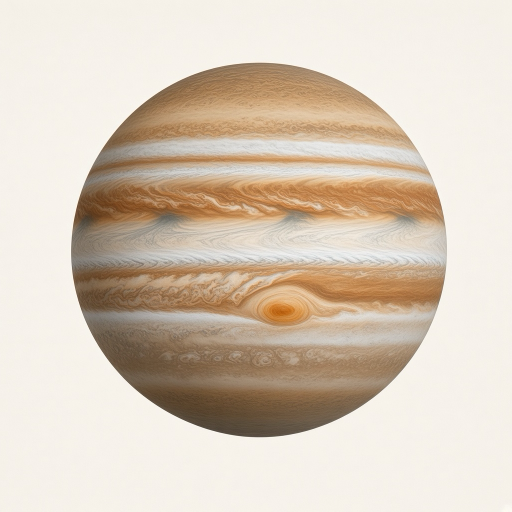
Jupiter is the largest planet in the solar system. It is a giant planet made mostly of hydrogen and helium, with no hard ground to stand on. Jupiter is the fifth planet from the Sun, much farther out than Earth. It is so big that about 1,000 Earths could fit inside it.
Why Jupiter is tricky to understand
Jupiter looks like a bright star in the night sky, but it is a planet, not a star. It does not produce the visible light we see from it; that light is sunlight bouncing off its cloud tops.
Jupiter is huge but has a low average density compared with rocky Earth. It consists mostly of the light elements hydrogen and helium, which become compressed fluids deep inside. Jupiter is the most massive planet because there is so much material in its enormous volume. It has more than twice the combined mass of the other seven planets.
The hardest thing to picture is that Jupiter has no solid outer surface. Its atmosphere becomes denser, hotter fluid with depth, and scientists infer a deep, dilute core of heavier material. A spacecraft could not land because there is no clear ground-like boundary to stop on.
Key facts about Jupiter
Jupiter is the biggest planet. It is about 11 times wider than Earth, which is about 89,000 miles (143,000 km) across.
Jupiter is the heaviest planet. It weighs more than all the other planets put together, more than twice over.
Jupiter consists mostly of hydrogen and helium. These are the two lightest elements and also make up most of the Sun, but high pressure turns much of Jupiter’s hydrogen into dense fluid.
A day on Jupiter is short. Jupiter spins around once in only about 10 hours. That is the fastest spin of any planet. Earth takes 24 hours.
A year on Jupiter is long. It takes about 12 Earth years for Jupiter to travel once around the Sun, because it is so far away.
Jupiter has a giant storm called the Great Red Spot. In a January 2026 image, it was still roughly as wide as Earth, and related storms have been observed for centuries.
Jupiter has 101 recognized moons. That was the International Astronomical Union count in March 2026, and future discoveries can change it.
Jupiter’s moon Ganymede is the biggest moon in the solar system. It is even bigger than the planet Mercury.
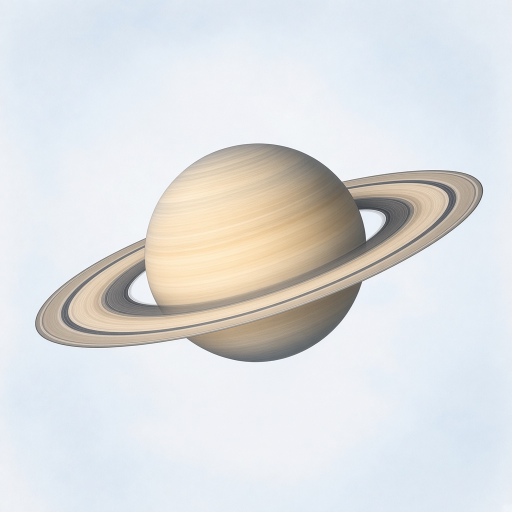
Jupiter has faint rings. They are much thinner and dustier than Saturn’s bright rings, so they are hard to see from Earth.
Common myths about Jupiter
Myth: Jupiter is a failed star. Jupiter shares the Sun’s main elements, but it formed and remains a planet. Sustained ordinary hydrogen fusion requires roughly 75 to 80 Jupiter masses, depending on composition. Jupiter is nowhere close.
Myth: The Great Red Spot is getting bigger. Long-term measurements show that the Great Red Spot has generally been shrinking. NASA reported a record-small measurement in 2014, and a January 2026 image showed it at roughly Earth’s width. Its size and shape can change over shorter periods.
Myth: You could land on Jupiter. Jupiter has no solid outer surface. A descending spacecraft would encounter denser fluid, crushing pressure, and rising heat rather than a ground-like landing place.
Myth: Jupiter is bigger than the Sun. The Sun is much bigger than Jupiter. Its volume is roughly 1,000 times Jupiter’s. Jupiter is the biggest planet, but the Sun is far larger than any planet.
Myth: Jupiter has only a few moons. The International Astronomical Union recognized 101 Jovian moons in March 2026. Saturn currently has many more, and both counts can change as small satellites are confirmed.
Frequently asked questions about Jupiter
How big is Jupiter compared to Earth?
Jupiter is about 11 times wider than Earth. If you lined Earths up side by side across the middle of Jupiter, you would need about 11 of them. By size inside, about 1,000 Earths could fit within Jupiter.
Could you stand on Jupiter?
No. Jupiter has no hard outer surface to stand on. With depth, its hydrogen-rich atmosphere becomes a dense fluid under extreme pressure rather than turning into a ground-like surface.
Why does Jupiter have a giant red spot?
The Great Red Spot is a giant high-pressure storm in Jupiter’s clouds. Astronomers have followed the present feature since the 1800s, although an earlier spot reported in the 1600s may not have been the same storm. It is still there today, and long-term measurements show an overall shrinking trend.
How many moons does Jupiter have?
Jupiter had 101 moons recognized by the International Astronomical Union in March 2026. The four biggest, called the Galilean moons, were first reported by Galileo Galilei in 1610. Many others are small, distant objects, and surveys continue to find candidates.
Why is Jupiter named Jupiter?
The planet bears the Roman name Jupiter, the king of the gods and god of the sky. Its modern English name does not come from a later measurement of the planet’s size; the planet was visible and named long before telescopes revealed its scale.
Each of this topic’s quiz questions cites a source for the fact it tests. You can play at any level: Rookie, Curious, Sharp, or Expert.
Jupiter is the fifth planet from the Sun and the largest planet in the solar system. It is a gas giant made mostly of hydrogen and helium, with no solid outer surface; deeper material is compressed into hot fluid. Jupiter is about 11 times wider than Earth, at roughly 89,000 miles (143,000 km) across. It is so massive that it weighs more than all the other planets combined.
Why Jupiter is surprising
Jupiter spins faster than any other planet, even though it is the biggest. A full day on Jupiter, one complete spin, takes only about 10 hours. On Earth a day takes 24 hours. Because Jupiter spins so fast and is made of fluid gas, it bulges out a little at its middle, like a slightly squashed ball.
Jupiter is huge but not dense. Its average material is only a little heavier than water, far lighter than Earth’s rock and metal. The planet is enormous, so it adds up to a great deal of mass, but the stuff it is made of is light.
Jupiter strongly changes the paths of comets and asteroids. It can capture or eject some objects, but it can also redirect others toward the inner solar system. Scientists model both effects, so calling Jupiter simply Earth’s shield is misleading.
Key facts about Jupiter
Jupiter is about 11 times wider than Earth. It measures roughly 89,000 miles (143,000 km) across, compared with Earth’s 8,000 miles (13,000 km).
A day lasts about 10 hours. Jupiter has the shortest day of any planet because it spins so fast.
A year lasts about 12 Earth years. Jupiter is about five times farther from the Sun than Earth, so it has a long way to travel around its orbit.
Jupiter has 101 recognized moons. That was the International Astronomical Union count in March 2026; Saturn currently has more.
Ganymede is the largest moon in the solar system. This moon of Jupiter is bigger than the planet Mercury.
Europa probably hides a salty ocean. Beneath its icy crust, this moon may hold about twice as much water as all of Earth’s oceans combined.
Io is the most volcanic world we know. This moon has hundreds of active volcanoes, more than anywhere else in the solar system.
Jupiter has the strongest magnetic field of any planet, many times stronger than Earth’s. It traps charged particles and powers bright glowing lights near Jupiter’s poles.
Jupiter has faint rings, made mostly of dust. The Voyager 1 spacecraft discovered them in 1979.
NASA’s Juno spacecraft entered orbit on July 4, 2016. NASA still listed it as an active mission in August 2026, although older schedule text on the same mission page names September 2025 as the planned end of its extended mission.
Common myths about Jupiter
Myth: Jupiter is a failed star. Jupiter is a planet, not a star that narrowly missed ignition. Sustained ordinary hydrogen fusion requires roughly 75 to 80 Jupiter masses depending on composition, far above Jupiter’s actual mass.
Myth: The Great Red Spot is growing. Long-term measurements show that the Great Red Spot has generally been shrinking. NASA reported a record-small measurement in 2014, and a January 2026 image showed it at roughly Earth’s width. The storm also changes size and shape over shorter periods.
Myth: You could land a spacecraft on Jupiter. Jupiter has no solid surface, so there is nowhere to land. A spacecraft would sink into thicker and thicker gas, with the pressure and heat climbing the deeper it went. No rover could drive on Jupiter the way rovers drive on Mars.
Myth: Jupiter is the only planet with rings. Saturn is famous for its bright rings, but Jupiter, Uranus, and Neptune all have rings too. Jupiter’s rings are simply faint and dusty, which makes them hard to see from Earth.
Myth: Jupiter glows because it is on fire. Visible Jupiter mostly reflects sunlight. It also emits internal heat as it continues cooling and contracting, but this is thermal radiation and gravitational energy release, not burning or nuclear fusion.
Frequently asked questions about Jupiter
Is Jupiter a star?
No. Jupiter is a planet. It shares the Sun’s main elements but lacks anything close to the mass required for sustained hydrogen fusion. The approximate lower stellar boundary is 75 to 80 Jupiter masses and varies somewhat with composition.
What is Jupiter made of?
Jupiter is made mostly of hydrogen and helium, the two lightest elements. Deep inside, the pressure is so high that the hydrogen behaves more like a liquid metal. Jupiter may have a dense core at its center, but it has no solid outer surface.
Why is the Great Red Spot red?
The Great Red Spot is a giant high-pressure storm in Jupiter’s clouds. Scientists think chemicals in the clouds, changed by sunlight, give it its reddish color. The exact recipe is still being studied. In January 2026, the storm was roughly as wide as Earth.
Does Jupiter have water?
Jupiter itself has water vapor mixed into its clouds, but no oceans on a surface, because it has no surface. Its moon Europa is the watery one: scientists believe a deep ocean of liquid water lies hidden beneath Europa’s icy crust.
How do we know so much about Jupiter?
Spacecraft have studied Jupiter up close. Voyager 1 flew past in 1979 and discovered the rings. NASA’s Juno spacecraft arrived in 2016 and has measured Jupiter’s gravity, magnetic field, atmosphere, rings, and moons; NASA still labeled the mission active in August 2026.
Each of this topic’s quiz questions cites a source for the fact it tests. You can play at any level: Rookie, Curious, Sharp, or Expert.
Jupiter is the fifth planet from the Sun and the largest in the solar system, a gas giant composed mostly of hydrogen and helium with no solid outer surface. Juno measurements published in 2026 imply an equatorial diameter of about 88,841 miles (142,976 km), roughly 11 times Earth’s, and its mass is about 318 Earth masses. Jupiter is the innermost of the four giant planets, orbiting at an average 5.2 astronomical units. It has more than twice the combined mass of the other seven planets.
What is often misunderstood about Jupiter
Jupiter is the most massive planet, yet one of the least dense. Its average density is about 1.33 grams per cubic centimeter, roughly a quarter of Earth’s rocky density and only slightly greater than water. Jupiter outweighs Earth not because its material is heavy but because there is so much of it. Mass and density are different measurements, and Jupiter sits at the high end of one and the low end of the other.
Jupiter spins faster than any other planet despite being the largest. It completes one rotation in about 9 hours and 56 minutes. Because it is a fluid body rather than a rigid one, different latitudes rotate at slightly different speeds, with the equator turning a few minutes faster than regions nearer the poles. The rapid spin flings the equator outward, so Jupiter’s equatorial radius is about 7 percent longer than its polar radius.
Jupiter is sometimes called a failed star, but the label is misleading. Sustained ordinary hydrogen fusion begins near 0.075 to 0.08 solar masses, depending on composition, or roughly 75 to 80 Jupiter masses. The conventional deuterium-burning boundary used for many brown-dwarf definitions is around 13 Jupiter masses and is also composition-dependent. Jupiter is far below both ranges.
Key facts about Jupiter
Equatorial diameter: about 88,841 miles (142,976 km) from Juno measurements published in 2026, the widest of any planet and roughly 11 times Earth’s diameter.
Mass: about 318 times Earth’s mass, the largest of any planet, exceeding the combined mass of all other planets by more than a factor of two.
Rotation period: about 9 hours 56 minutes, the fastest of any planet, giving Jupiter the shortest day in the solar system.
Orbital period: about 12 Earth years to complete one trip around the Sun.
Distance from the Sun: about 484 million miles (778 million km), or 5.2 astronomical units. Sunlight takes about 43 minutes to reach Jupiter, compared with about 8 minutes to reach Earth.
The Great Red Spot: a long-lived high-pressure storm, an anticyclone. Hubble measured its long axis at about 10,250 miles (16,500 km) in 2014, then the smallest recorded, while a January 2026 image showed the changing storm at roughly Earth’s width.
Wind speeds: jet streams near the equator can exceed 300 miles per hour (over 480 km/h), faster than the strongest hurricanes on Earth, with neighboring belts blowing in opposite directions.
Cloud-top temperature: averages about minus 234 °F (minus 145 °C); the temperature climbs sharply with depth inside the planet.
Magnetic field and auroras: the strongest planetary magnetic field in the solar system, which drives the most powerful auroras of any planet.
Moons: 101 recognized by the International Astronomical Union as of March 2026. Saturn currently has the larger known family.
Ganymede: Jupiter’s largest moon and the largest moon in the solar system, bigger than the planet Mercury.
Rings: a faint, dusty system discovered by Voyager 1 in 1979. Uranus’s rings had been found in 1977, so Jupiter became the third planet known to have rings after Saturn and Uranus.
Common myths about Jupiter
Myth: Jupiter is a failed star. Jupiter is a planet, not a star that narrowly fell short. Approximate mass boundaries for deuterium-burning brown dwarfs and hydrogen-burning stars depend on composition, but Jupiter is far below both conventional values of about 13 and 75 to 80 Jupiter masses.
Myth: The Great Red Spot is growing. The Great Red Spot has been shrinking for over a century. Historic measurements from the late 1800s put its long axis near 25,500 miles (41,000 km). By the 1979 Voyager flybys it had shrunk to about 14,500 miles (23,300 km), and Hubble measured it near 10,000 miles in the 2010s, the smallest on record.
Myth: You could land on Jupiter. Jupiter has no solid surface. A descending spacecraft would meet steadily denser gas, rising pressure, and rising temperature, with no firm boundary to land on. Below the visible clouds, hydrogen gradually transitions to a hot, dense fluid, never a rocky floor.
Myth: The Great Red Spot is a hurricane. Hurricanes on Earth are low-pressure cyclones. The Great Red Spot is a high-pressure anticyclone, so its winds circulate in the opposite sense to a terrestrial hurricane. It also sits in Jupiter’s southern hemisphere and is far larger and longer-lived than any storm on Earth.
Myth: Jupiter is the densest planet because it is the most massive. Jupiter is one of the least dense planets, about a quarter of Earth’s density. The densest planet is Earth, a rocky world. Jupiter’s enormous mass comes from its size, not from heavy material.
Frequently asked questions about Jupiter
Why is Jupiter not a star?
A hydrogen-burning star needs central conditions reached near 0.075 to 0.08 solar masses, with the exact boundary depending on composition. A frequently used deuterium-burning boundary for brown dwarfs is about 13 Jupiter masses, also with caveats. Jupiter is far below either threshold.
What is the Great Red Spot?
The Great Red Spot is a giant high-pressure storm, an anticyclone, in Jupiter’s atmosphere. Astronomers have tracked the present feature since the 1800s, while an earlier spot reported in the 1600s may have been different. Its long-term size has declined, but it also varies over shorter periods; a January 2026 image showed it at roughly Earth’s width. Its reddish color likely comes from chemical compounds in the clouds altered by sunlight.
How many moons does Jupiter have?
Jupiter had 101 moons recognized by the International Astronomical Union in March 2026, after four newly confirmed satellites raised the count. Saturn currently has more. The four largest Jovian moons are Io, Europa, Ganymede, and Callisto, first reported by Galileo Galilei in 1610. Ganymede is the largest moon in the solar system, bigger than Mercury.
Why is a day on Jupiter so short?
Jupiter rotates once in about 9 hours 56 minutes, faster than any other planet. Rapid rotation contributes to a noticeable equatorial bulge and organizes atmospheric dynamics, while convection and alternating zonal jets also shape the banded clouds. Rotation alone is not a complete explanation for the bands.
Does Jupiter have a solid surface?
No. Jupiter is a gas giant. Moving inward from the cloud tops, the atmosphere grows denser and hotter, and hydrogen gradually changes from gas to a hot fluid and then to a metallic fluid under crushing pressure. There may be a dense core deep inside, but there is no solid surface to stand on.
Why does Jupiter have such bright auroras?
Jupiter has the strongest planetary magnetic field, which accelerates and guides charged particles into its upper atmosphere. Its auroras are powered largely by the rotation of the magnetosphere, with volcanic material from Io supplying much of the plasma and the solar wind also contributing. They reach energies far beyond typical terrestrial auroras.
Each of this topic’s quiz questions cites a source for the specific fact tested. You can play at any level: Rookie, Curious, Sharp, or Expert.
Jupiter is the fifth planet from the Sun and the largest in the solar system, a gas giant of roughly 318 Earth masses composed predominantly of hydrogen and helium in proportions close to those of the early Sun. Juno measurements published in 2026 put its equatorial diameter at about 88,841 miles (142,976 km), and its mean density is about 1.33 grams per cubic centimeter, lower than any of the terrestrial planets. Jupiter is the innermost of the four giant planets, orbiting at about 5.2 astronomical units, and it dominates the solar system’s planetary mass budget, outweighing the other seven planets combined by more than a factor of two. It has no solid surface: the atmosphere grades continuously into a fluid interior with increasing depth.
Why Jupiter’s physics is non-intuitive
Jupiter is the most massive planet and one of the least dense, which separates two quantities that everyday intuition tends to merge. Its mean density of about 1.33 grams per cubic centimeter is roughly a quarter of Earth’s. The planet’s mass arises from sheer volume: about 1,000 Earths would fit inside it, since volume scales with the cube of the linear size and Jupiter is about 11 times Earth’s diameter. Under its own weight, the interior is far denser than the cloud-top average, but the bulk composition of light elements keeps the mean low.
Jupiter is sometimes labeled a failed star, a description that conflates composition with the mass needed for fusion. Sustained hydrogen fusion begins near 0.075 to 0.08 solar masses depending on composition. A conventional deuterium-burning boundary near 13 Jupiter masses is often used to distinguish brown dwarfs, but that limit is not universal. Jupiter sits well below either range. Its internal luminosity is not fusion: it emits more energy than it absorbs from sunlight as it continues to cool and contract, releasing gravitational and thermal energy.
Jupiter does not rotate as a rigid body. Because it is fluid, it exhibits differential rotation, tracked by convention in three systems. System I applies to the equatorial zone and turns in about 9 hours 50 minutes. System II applies to higher latitudes and turns about 5 minutes slower. System III is keyed to the rotation of the magnetic field and stands in for the deep interior, giving the planet’s canonical rotation period of about 9 hours 56 minutes. The rapid spin produces strong oblateness: the equatorial radius is about 7 percent larger than the polar radius.
Key facts about Jupiter
Bulk properties. Mass about 318 Earth masses, equatorial diameter about 88,841 miles (142,976 km) from Juno measurements published in 2026, and mean density about 1.33 grams per cubic centimeter. Surface gravity at the 1-bar level is roughly 2.5 times Earth’s.
Rotation and oblateness. System III rotation period about 9 hours 56 minutes, the fastest of any planet. Differential rotation gives the equatorial System I a period a few minutes shorter than the higher-latitude System II. Equatorial radius about 7 percent longer than polar radius.
Interior. Beneath the molecular hydrogen envelope, pressure drives a transition to liquid metallic hydrogen, an electrically conducting fluid whose circulation generates the magnetic field. Juno gravity data favor a diluted, possibly partially eroded core rather than a sharp rock-ice boundary.
Magnetosphere. Jupiter has the strongest planetary magnetic field and an enormous magnetosphere. NASA reports a tail extending more than 600 million miles (1 billion km), as far as Saturn’s orbit under representative conditions; its dimensions vary with the solar wind.
Atmospheric dynamics. Banded zonal jets alternate in direction with latitude. Peak winds exceed 300 miles per hour (over 480 km/h). The visible weather layer sits atop a deep, convecting atmosphere; cloud-top temperatures average about minus 234 °F (minus 145 °C).
The Great Red Spot. A high-pressure anticyclone in the southern hemisphere, persistent for well over a century. Its long axis spanned about 25,500 miles (41,000 km) in the late 1800s, about 14,500 miles (23,300 km) at the 1979 Voyager flybys, and about 10,250 miles (16,500 km) in 2014, then the smallest recorded. Its dimensions continue to vary; a January 2026 image showed it at roughly Earth’s width.
Galilean moons. Io, Europa, Ganymede, and Callisto, first reported by Galileo Galilei in 1610. Ganymede is the largest moon in the solar system and exceeds Mercury in diameter. The International Astronomical Union recognized 101 Jovian moons as of March 2026, a date-sensitive count.
Laplace resonance. Io, Europa, and Ganymede occupy a 1:2:4 mean-motion resonance, first analyzed by Pierre-Simon Laplace: Io completes four orbits for every two of Europa and one of Ganymede. The resonance forces and maintains orbital eccentricity in the inner moons.
Io’s tidal heating. The forced eccentricity drives time-varying tides as Jupiter’s gravity flexes Io through each orbit. The resulting frictional dissipation, tidal heating, makes Io the most volcanically active body in the solar system, with hundreds of active volcanoes.
Galileo probe composition. The Galileo atmospheric probe entered Jupiter on December 7, 1995, and measured a helium abundance close to but slightly below the primordial solar ratio, consistent with helium settling toward the interior. Helium accounted for roughly 14 percent of the atmosphere by number of molecules.
Current exploration. NASA’s Juno spacecraft entered orbit on July 4, 2016, on a highly elliptical polar orbit. Each perijove dives close to the cloud tops, partly to limit cumulative dose in the intense radiation belts, while mapping gravity and the magnetic field to constrain the interior.
Common misconceptions at expert level
Misconception: Jupiter’s internal heat comes from ongoing fusion. Jupiter cannot fuse ordinary hydrogen. Its intrinsic heat reflects continued cooling and gravitational contraction, with interior evolution more complex than a single precisely measured annual shrinkage rate. The visible planet mostly reflects sunlight, while its infrared emission includes this internal energy.
Misconception: The Great Red Spot is a cyclone like a terrestrial hurricane. The Great Red Spot is an anticyclone, a high-pressure system whose vorticity is opposite in sense to a low-pressure terrestrial hurricane in the same hemisphere. It is confined to the upper atmosphere, with Juno gravity and microwave data indicating roots a few hundred miles deep, not a conduit to the core.
Misconception: The Galilean moons orbit independently. Io, Europa, and Ganymede occupy the Laplace 1:2:4 resonance, which maintains forced eccentricities and continuing tidal flexing. This powers Io’s extraordinary volcanism and contributes tidal energy within Europa; Europa’s ocean and heat budget should not be reduced to this one mechanism alone.
Misconception: Io’s heat is primarily primordial or radiogenic. Radiogenic and leftover accretional heat are far too small to explain Io’s observed heat flow. Most of that heat is supplied continuously by tidal dissipation driven by the resonance-forced eccentricity.
Misconception: Jupiter’s atmosphere resembles Earth’s air. The Galileo probe confirmed a hydrogen-helium atmosphere, not a nitrogen-oxygen one. Helium relative to hydrogen came out close to the solar value, slightly depleted, evidence that Jupiter formed from the same reservoir as the Sun and that helium has been redistributing toward depth.
Misconception: Being a gas giant prevents a strong magnetic field. Jupiter has the strongest magnetic field of any planet. The dynamo is seated in the liquid metallic hydrogen layer, where high pressure makes hydrogen electrically conducting and convective motions sustain the field. Composition does not preclude a dynamo; it sets where the dynamo operates.
Frequently asked questions about Jupiter
Why is Jupiter not a star or even a brown dwarf?
Sustained ordinary hydrogen fusion begins near 0.075 to 0.08 solar masses, depending on composition. The conventional 13-Jupiter-mass deuterium-burning boundary used in many brown-dwarf definitions also varies with composition and definition. Jupiter is far below both. Its status as a solar-system planet is clear, while models continue to test details of whether its growth was dominated by core accretion, disk instability, or a more complex history.
What is metallic hydrogen, and why does it matter for Jupiter?
At high pressures inside Jupiter, molecular hydrogen becomes an electrically conducting metallic fluid, though the detailed transition depends on pressure and temperature. Motion in this conducting region, together with rapid rotation, sustains the dynamo that produces Jupiter’s magnetic field. Juno’s gravity and magnetic measurements constrain this otherwise inaccessible interior.
How does the Laplace resonance power Io’s volcanoes?
The 1:2:4 resonance among Io, Europa, and Ganymede continually pumps Io’s orbital eccentricity. An eccentric orbit means the strength and direction of Jupiter’s tidal pull on Io vary through each orbit, flexing the moon. That mechanical flexing dissipates as heat through internal friction, the process called tidal heating, which melts rock at depth and feeds Io’s hundreds of active volcanoes.
Why does Jupiter rotate differentially?
Jupiter has no rigid surface to enforce a single rotation rate. As a fluid body, it supports zonal flows that vary with latitude, so the equatorial atmosphere (System I) laps the higher latitudes (System II) by a few minutes per rotation. The magnetically defined System III period stands in for the deep interior, where the metallic hydrogen and the dynamo it drives rotate more coherently.
What did the Galileo probe measure as it descended?
The probe entered Jupiter’s atmosphere on December 7, 1995, and transmitted measurements of composition, temperature, pressure, winds, radiation, lightning, and clouds during its descent. Its entry site was an unusually dry hot spot, so some results are local rather than global. Winds strengthened with depth along that trajectory, evidence that cannot by itself map every Jovian jet.
How does Juno study Jupiter’s interior without landing?
Juno flies a highly elliptical polar orbit, repeatedly passing close to the cloud tops. Precise tracking of the spacecraft reveals tiny variations in Jupiter’s gravity field, which constrain how mass is distributed inside, including the nature of the core. Its magnetometer maps the field in detail, and microwave instruments probe below the visible clouds. The polar, looping orbit also limits the time spent in Jupiter’s harsh radiation belts.
Source notes
Bulk parameters are drawn from NASA’s JPL planetary physical parameters and Jupiter facts page; the revised dimensions are from NASA’s 2026 Juno report. NASA’s facts page also documents the metallic-hydrogen interior, dilute core, magnetosphere, atmospheric winds, and Great Red Spot depth. NASA JPL’s brown dwarf comparison gives the conventional 13-to-80-Jupiter-mass range. The Galileo mission record documents the probe and its measurements. The Laplace resonance and tidal heating are described by NASA’s Europa facts and the linked Io sources. Great Red Spot dimensions come from NASA JPL’s long-term report and the January 2026 image. Juno’s orbit and current status come from the NASA mission page.
Each of this topic’s quiz questions cites a source for the specific fact tested. You can play at any level: Rookie, Curious, Sharp, or Expert.
Think you know Jupiter?
Test yourself. Can you spot the true fact among 3 convincing bluffs?