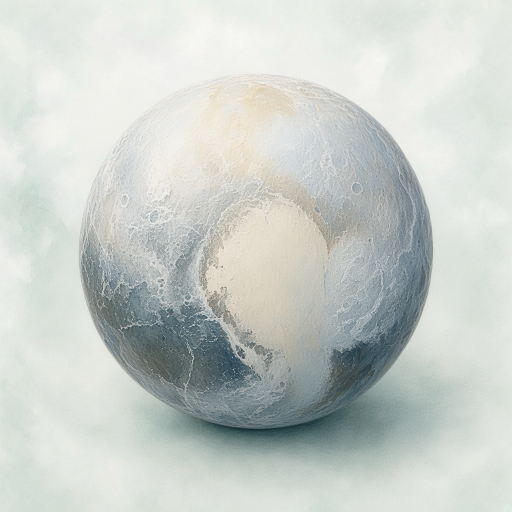
Pluto is a small, round world that travels around the Sun beyond Neptune. The International Astronomical Union, or IAU, classifies Pluto as a dwarf planet. Under the IAU definition, planets and dwarf planets are separate groups, even though both travel around the Sun and are rounded by their own gravity.
Why Pluto is tricky to understand
Pluto was listed as the ninth planet for most of the twentieth century. In 2006, the IAU adopted a definition that requires a planet in our solar system to clear the neighborhood around its orbit. Pluto shares its distant region with many other icy bodies, so it does not meet that part of the definition. The IAU therefore classifies it as a dwarf planet.
That change was about a scientific label. Pluto did not shrink or move to a different orbit. Some planetary scientists prefer broader definitions of the word planet, so the classification is still discussed.
Pluto is extremely far from the Sun. At an average distance of about 39 astronomical units, it receives much less sunlight and warmth than Earth does. An astronomical unit is the average distance between Earth and the Sun.
Key facts about Pluto
Pluto is smaller than Earth’s Moon. Its diameter is about 1,477 miles (2,377 kilometers), roughly two-thirds the Moon’s diameter.
Pluto is extremely cold. NASA gives an average surface temperature of about -387 degrees Fahrenheit (-232 degrees Celsius).
A Pluto year is very long. One trip around the Sun takes about 248 Earth years.
A Pluto day is long too. One rotation takes about 153 hours, or about 6.4 Earth days.
Pluto has five known moons. They are Charon, Styx, Nix, Kerberos, and Hydra.
Charon is unusually large beside Pluto. It is about half Pluto’s diameter.
Pluto has a heart-shaped region. The bright feature is called Tombaugh Regio.
Part of the heart contains nitrogen ice. Its broad left side includes Sputnik Planitia, a plain filled with frozen nitrogen.
Clyde Tombaugh discovered Pluto in 1930. He found it while comparing telescope photographs at Lowell Observatory in Arizona.
New Horizons visited in 2015. The robotic spacecraft made the first close flight past Pluto and its moons.
Common myths about Pluto
Myth: Pluto stopped existing as a planet because it became smaller. Pluto’s size did not suddenly change. The IAU changed the classification rules and placed Pluto in the separate dwarf-planet group.
Myth: Every small round world is a dwarf planet. Under the IAU definition, a dwarf planet must orbit the Sun, be nearly round, not be a moon, and not have cleared its orbital neighborhood.
Myth: Pluto was named after a cartoon dog. Eleven-year-old Venetia Burney suggested the name Pluto in 1930, drawing on the Roman god of the underworld. Astronomers accepted her mythology-based suggestion.
Myth: Astronauts painted Pluto’s heart. No person has traveled to Pluto. Tombaugh Regio is a natural region made of different surface materials, and New Horizons photographed it from space.
Myth: Pluto and Charon are about the same size. Charon is enormous for a moon, but Pluto is still about twice as wide.
Frequently asked questions about Pluto
Is Pluto a planet?
The IAU classifies Pluto as a dwarf planet, a class separate from the eight planets in its 2006 definition. People may use broader scientific definitions in debates, but the IAU classification has not changed.
Why is Pluto so cold?
Pluto orbits billions of miles from the Sun and receives little solar energy. At its temperatures, substances such as nitrogen, methane, and carbon monoxide can exist as ice on the surface.
How many moons does Pluto have?
Five moons are known. Charon is the largest, while Styx, Nix, Kerberos, and Hydra are much smaller and irregularly shaped.
Has a spacecraft landed on Pluto?
No spacecraft has landed or entered orbit there. New Horizons flew past Pluto on July 14, 2015, after a journey of more than nine years.
Why does Pluto have a heart?
The heart is the outline of a bright natural region called Tombaugh Regio. Sputnik Planitia, the nitrogen-ice plain in its left side, helps create the familiar shape seen in New Horizons images.
Pluto is a dwarf planet in the Kuiper Belt, a distant region populated by icy bodies beyond Neptune. It is smaller than Earth’s Moon, has five known moons, and carries a thin atmosphere dominated by nitrogen. For most of the twentieth century Pluto appeared in textbooks as the ninth planet, but the International Astronomical Union, or IAU, placed it in the separate dwarf-planet class in 2006.
Why Pluto’s classification changed
The change was not simply a response to Pluto being small. The IAU definition says that a planet in our solar system must orbit the Sun, be rounded by its own gravity, and clear the neighborhood around its orbit. Pluto meets the first two conditions but not the third. It belongs to a large population of trans-Neptunian objects rather than dominating its orbital zone.
The discovery of Eris helped bring the issue to a decision. Eris is slightly smaller in diameter than Pluto but more massive. Its discovery showed that Pluto was not the only large, round world in the distant solar system. Under the IAU resolution, planets and dwarf planets are distinct classes, and Pluto and Eris are dwarf planets. Some scientists continue to advocate a different, geology-based definition.
Pluto’s orbit is unusual too. It ranges from about 30 to 49.3 astronomical units from the Sun. From 1979 through 1999, Pluto was closer to the Sun than Neptune was. The worlds do not collide because their orbits follow a stable repeating pattern: Pluto completes two solar orbits while Neptune completes three.
Key facts about Pluto
Pluto is about 1,477 miles (2,377 kilometers) wide. That is roughly two-thirds the diameter of Earth’s Moon.
Its average solar distance is about 39 astronomical units. One astronomical unit is Earth’s average distance from the Sun.
One orbit takes about 248 Earth years. Pluto has not completed a full orbit since its 1930 discovery.
One rotation takes about 153 hours. Pluto spins from east to west, opposite the direction in which Earth rotates.
The rotation axis is tilted about 57 degrees. Pluto therefore spins almost on its side.
The atmosphere is thin. It contains mostly nitrogen, plus methane and carbon monoxide.
The surface is varied. New Horizons found water-ice mountains, volatile-ice plains, valleys, craters, and glaciers.
Sputnik Planitia is rich in nitrogen ice. The plain occupies the left side of the bright Tombaugh Regio heart.
Five moons are known. Charon is the largest; Styx, Nix, Kerberos, and Hydra are much smaller.
New Horizons is the only mission to explore Pluto up close. It flew through the system on July 14, 2015.
Common myths about Pluto
Myth: A dwarf planet is just a small planet. In the IAU system, a dwarf planet is a separate class. It must be nearly round and orbit the Sun, but unlike a planet it has not cleared its orbital neighborhood.
Myth: Pluto and Neptune will eventually crash. Their 3:2 orbital resonance creates a stable repeating geometry that prevents a close approach. Pluto’s orbit is also tilted relative to the main planetary plane.
Myth: Pluto is a featureless ice ball. New Horizons revealed terrains of very different ages and materials. Some plains have few impact craters, while other areas are older and heavily cratered.
Myth: Charon travels around a stationary Pluto. Pluto and Charon both orbit their shared center of mass. Because each keeps the same face toward the other, Charon would remain in the same part of Pluto’s sky for an observer on the hemisphere where it is visible.
Myth: Pluto’s whole atmosphere disappears every winter. Nitrogen frost and gas exchange as seasons change, but observations and models do not justify saying the entire atmosphere always collapses. Its long-term pressure changes remain a subject of study.
Frequently asked questions about Pluto
What is the Kuiper Belt?
It is a broad region of small icy bodies beyond Neptune. Pluto is its largest known object by size, while Eris, in the more distant scattered disk, is slightly more massive.
What is Pluto’s heart made of?
Tombaugh Regio includes several terrains. Its left lobe contains Sputnik Planitia, a roughly 1,000-kilometer-wide basin filled with nitrogen ice that can flow as a glacier.
Why is Charon unusual?
Charon’s diameter is about half Pluto’s, making it exceptionally large compared with the body it accompanies. The pair are mutually tidally locked, so the same hemispheres always face each other.
How did New Horizons reach Pluto?
The spacecraft launched on January 19, 2006. A Jupiter gravity assist in 2007 increased its speed, and it reached Pluto after more than nine years of travel.
Did New Horizons orbit Pluto?
No. It made one fast flyby, coming about 7,800 miles (12,500 kilometers) above Pluto’s surface. Sending the full encounter data to Earth then took more than 15 months because of the great distance and low transmission rate.
Pluto is a dwarf planet and the largest known Kuiper Belt object by size. Its diameter is about 1,477 miles (2,377 kilometers), smaller than Earth’s Moon, and its average distance from the Sun is about 39 astronomical units. Pluto has a thin nitrogen atmosphere, five known moons, and a geologically complex surface that the New Horizons spacecraft explored in 2015.
What is often misunderstood about Pluto
Pluto’s 2006 reclassification was not an arbitrary size cutoff. The International Astronomical Union, or IAU, defined a solar-system planet as a body that orbits the Sun, is nearly round because of its own gravity, and has cleared the neighborhood around its orbit. Pluto satisfies the first two conditions but not the third. The same resolution defines dwarf planets as a distinct class, not as a subclass of planets.
Eris helped force the classification question. It is slightly smaller in diameter than Pluto but more massive, showing that another Pluto-scale world existed beyond Neptune. The IAU’s decision left eight objects in its planet class and placed Pluto, Eris, and Ceres in the dwarf-planet class. Current NASA dwarf-planet materials also include Haumea and Makemake.
The phrase “cleared its neighborhood” does not mean that a planet’s orbit must be completely empty. It refers to gravitational dominance over the other bodies sharing its orbital zone. Pluto is one member of a large trans-Neptunian population and does not dominate that region the way each of the eight planets dominates its own zone.
Key facts about Pluto
Orbit: Pluto travels from about 30 to 49.3 astronomical units from the Sun and completes one orbit in about 248 Earth years.
Resonance: Pluto completes two solar orbits for every three completed by Neptune. This stable 3:2 resonance prevents close encounters.
Inclination: Pluto’s orbit is tilted about 17 degrees relative to the plane in which most major planets orbit.
Rotation: One sidereal rotation takes about 153 hours, and Pluto rotates in the retrograde direction.
Obliquity: Its axis is tilted about 57 degrees with respect to its orbital plane, producing extreme seasonal lighting patterns.
Temperature: NASA gives an average surface temperature near -387 degrees Fahrenheit (-232 degrees Celsius).
Atmosphere: The tenuous atmosphere consists mainly of nitrogen, with methane and carbon monoxide.
Surface: Volatile nitrogen, methane, and carbon-monoxide ices cover parts of a water-ice crust.
Tombaugh Regio: The bright heart-shaped region is named for discoverer Clyde Tombaugh.
Sputnik Planitia: A roughly 1,000-kilometer-wide basin in the heart is filled with mobile nitrogen ice.
Moons: Pluto’s five known moons are Charon, Styx, Nix, Kerberos, and Hydra.
Exploration: New Horizons remains the only spacecraft to have explored the Pluto system up close.
Common myths about Pluto
Myth: Pluto is now classified as a minor planet only because it is smaller than Mercury. The IAU criterion that separates it from the eight planets is orbital-neighborhood clearing, not a stated diameter threshold.
Myth: Pluto’s path crosses Neptune’s, so a collision is inevitable. Pluto sometimes lies closer to the Sun than Neptune, but the 3:2 resonance keeps the two bodies in a repeating configuration that prevents close approaches. Their inclined orbital planes add further separation.
Myth: New Horizons found active volcanoes erupting. Researchers have interpreted the Wright Mons region as the product of large-scale cryovolcanic resurfacing, but the spacecraft did not witness an eruption. The evidence concerns landforms and their likely history.
Myth: The IAU classified Pluto and Charon as a double dwarf planet in 2006. The pair are often described as a double system because Charon is large and their center of mass lies outside Pluto. Barycenter location was not part of the IAU’s 2006 planet or dwarf-planet criteria.
Myth: All five moons keep one face toward Pluto. Pluto and Charon are mutually tidally locked, but the four small irregular moons rotate rather than keeping one hemisphere pointed at Pluto.
Frequently asked questions about Pluto
How large is Pluto compared with the Moon?
Pluto’s 2,377-kilometer diameter is about 68 percent of the Moon’s 3,475-kilometer diameter. Charon is about 1,214 kilometers wide, a little more than half Pluto’s diameter.
Why can Pluto be closer to the Sun than Neptune?
Pluto has a more eccentric orbit. It most recently lay inside Neptune’s solar distance from 1979 through 1999, yet orbital resonance prevented the worlds from approaching one another.
What moves on Pluto’s surface?
Nitrogen ice in Sputnik Planitia behaves as a glacier. Polygonal cells are interpreted as convection in solid nitrogen ice, while surrounding glaciers flow into the basin. These are slow geological processes, not liquid nitrogen rivers.
Does Pluto have an atmosphere all year?
Surface nitrogen ice and atmospheric nitrogen exchange through sublimation and condensation. Pluto’s eccentric orbit and high obliquity drive complicated seasons, so scientists use occultations and climate models to study how its very low atmospheric pressure changes.
What did the New Horizons flyby measure?
The spacecraft imaged Pluto, Charon, and the small moons; mapped surface composition; studied atmospheric structure and haze; and measured the surrounding plasma and dust. It passed about 7,800 miles (12,500 kilometers) above Pluto on July 14, 2015, then spent more than 15 months transmitting the encounter data.
Pluto is a dwarf planet in the trans-Neptunian region and the largest known Kuiper Belt object by diameter. New Horizons measured a diameter near 2,377 kilometers and revealed a volatile-rich world with complex geology, a tenuous atmosphere, and five moons. Pluto’s behavior cannot be summarized by size alone: its IAU classification depends on orbital context, its safety from Neptune depends on resonance, and conclusions about its differentiated interior remain model-based rather than directly measured.
Classification and orbital dynamics
IAU Resolution B5 defines a solar-system planet as a body that orbits the Sun, has enough self-gravity to assume a nearly round equilibrium shape, and has cleared the neighborhood around its orbit. A dwarf planet meets the first two tests, has not cleared the neighborhood, and is not a satellite. The resolution explicitly treats planets and dwarf planets as distinct classes. Resolution B6 assigns Pluto to the dwarf-planet class and recognizes it as the prototype of a trans-Neptunian category.
The difficult phrase is “cleared the neighborhood.” It is a dynamical criterion, not a requirement that every asteroid or dust grain vanish. Quantitative formulations compare a body’s capacity to scatter, accrete, or control nearby small bodies over the solar system’s lifetime. Pluto shares its zone with a large population of trans-Neptunian objects and falls far below the eight planets on such dominance measures. Whether that dynamical property should define the noun planet remains a scientific and semantic debate.
Pluto’s heliocentric orbit is eccentric and inclined. Its distance from the Sun varies from about 30 to 49.3 astronomical units, and the orbital plane is tilted about 17 degrees. A 3:2 mean-motion resonance with Neptune means Pluto completes two orbits while Neptune completes three. The resonant phase protects Pluto from close encounters even when Pluto lies inside Neptune’s solar distance. This is why orbit diagrams that appear to cross do not imply a future collision.
Key facts about Pluto
Bulk size: about 2,377 kilometers in diameter, or roughly 68 percent of the Moon’s diameter.
Mean distance: about 39 astronomical units from the Sun, with an orbital period near 248 Earth years.
Rotation: about 153 hours in the retrograde direction, with an axial tilt near 57 degrees.
Interior: density and composition models imply a large rock fraction surrounded by water-rich material, but no spacecraft has directly sampled the interior.
Volatile inventory: nitrogen, methane, and carbon monoxide occur as surface ices and atmospheric gases, while water ice supplies strong crustal material.
Atmosphere: nitrogen dominates a microbar-scale atmosphere containing methane, carbon monoxide, and photochemical haze.
Charon: about 1,214 kilometers in diameter and mutually tidally locked with Pluto.
Barycenter: the Pluto-Charon center of mass lies outside Pluto’s surface, motivating the informal binary or double-system description.
Small moons: Styx, Nix, Kerberos, and Hydra are irregular bodies that rotate rather than remaining synchronously locked to Pluto.
Sputnik Planitia: a deep basin roughly 1,000 kilometers across, filled with a thick sheet of nitrogen-rich ice.
Mission encounter: New Horizons made a single flyby on July 14, 2015, rather than entering orbit.
Coverage limit: the flyby produced much sharper data for the encounter hemisphere than for terrain that faced away during closest approach.
Geology without overclaiming
Sputnik Planitia’s polygonal surface is interpreted as solid-state convection in nitrogen ice. Modeling published in 2021 showed that sublimation at the surface can drive convection matching the observed flat polygons and narrow troughs under suitable heat-flux and viscosity conditions. The result strengthens the convection interpretation while showing that the energy balance is more nuanced than simply labeling the cells as proof of strong internal heating.
The low crater abundance in parts of Sputnik Planitia indicates geologically young or repeatedly renewed terrain. Nitrogen ice can flow as glaciers, sublimate into the atmosphere, condense elsewhere, and overturn within the basin. None of those processes requires liquid nitrogen at the surface.
Researchers also identify the Wright and Piccard Montes region as cryovolcanic terrain. A 2022 analysis concluded that multiple large rises probably formed through emplacement of water-ice-rich material from subsurface sources. That supports large-scale cryovolcanic resurfacing late in Pluto’s history, but it is not an observation of an eruption happening today.
Common misconceptions at expert level
Misconception: Pluto is both a planet and a dwarf planet under the IAU definition. Resolution B5 says the two are distinct classes. A researcher may adopt a different scientific definition, but that should not be presented as the content of the IAU resolution.
Misconception: The external Pluto-Charon barycenter made the pair a formal binary dwarf planet under the 2006 resolution. Barycenter location is a useful dynamical fact, but it was not one of that resolution’s adopted criteria. “Double dwarf planet” is an informal description in this context.
Misconception: Resonance means the orbital periods are merely close to a 3:2 ratio. A mean-motion resonance also involves libration of a resonant angular combination, which constrains conjunction geometry. That phase protection, together with Pluto’s inclined orbit, prevents dangerous Neptune encounters.
Misconception: A young surface proves that Pluto is geologically active today. Crater counts and morphology constrain when resurfacing occurred, but New Horizons observed only a brief interval. Evidence for recent geologic processes is not equivalent to seeing an active eruption.
Misconception: Pluto’s subsurface ocean has been detected. No instrument directly detected liquid water. The ocean remains an inference tested through thermal, tectonic, loading, and reorientation models.
Frequently asked questions about Pluto
Why is Sputnik Planitia linked to an ocean hypothesis?
The basin lies close to the Pluto-Charon tidal axis. One model requires a positive mass anomaly and explains the resulting reorientation through ice-shell thinning over a liquid-water layer, followed by nitrogen loading. This makes a surviving ocean plausible under that model, not observationally certain.
Is there a serious oceanless alternative?
Yes. A 2024 impact study reproduced important aspects of the basin using a low-velocity oblique collision in an oceanless Pluto, leaving dense impactor material as a rocky mass concentration. It is an alternative model rather than proof that no ocean exists.
How does the atmosphere interact with the surface?
Nitrogen sublimation and condensation couple surface frost to atmospheric pressure. Pluto’s eccentric orbit, high obliquity, changing illumination, and topography make the volatile cycle spatially and seasonally complex. A simple claim that the atmosphere completely freezes away at aphelion is not established.
What does mutual tidal locking mean for Pluto and Charon?
Their rotation periods equal their orbital period around the shared barycenter, about 6.4 Earth days. Each body therefore keeps the same hemisphere directed toward the other, but both still rotate relative to distant stars.
What were the limits of New Horizons?
The spacecraft passed about 12,500 kilometers above Pluto’s surface at high speed. It mapped composition and geology, probed the atmosphere, and observed all five moons, but it did not orbit, land, or monitor seasonal change over time. The complete encounter dataset took more than 15 months to transmit to Earth.