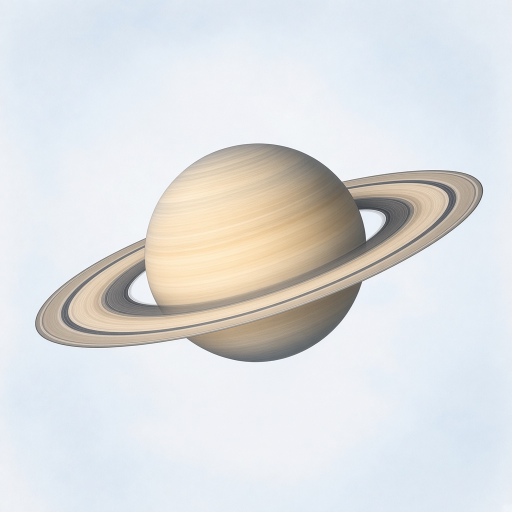
Saturn is the planet with the famous bright rings around it. It is a giant ball of gas, mostly hydrogen and helium, with no hard ground to stand on. Saturn is the sixth planet from the Sun, much farther out than Earth. It is the second-largest planet, after Jupiter.
Why Saturn is tricky to understand
Saturn looks like it has solid rings, but the rings are not solid at all. They are made of billions of pieces of ice and rock, all circling the planet together. The pieces are different sizes. Some are as small as a grain of sand. Some are as big as a house or a mountain.
Saturn is huge, but it is not heavy the way a rock is heavy. It is made of gas, which is very light. In fact, Saturn is so light for its size that it would float if you could find a bathtub big enough to hold it. No other planet would do that.
The hardest thing to picture is that Saturn has no defined solid surface to land on. On Earth you can stand on the ground. On Saturn the atmosphere becomes hotter and denser with depth, gradually changing into compressed fluid. A spaceship trying to land would have no firm boundary on which to stop.
Key facts about Saturn
Saturn is the second-largest planet. It is about 9 times wider than Earth. You could line up about 9 Earths across the middle of Saturn.
Saturn has bright rings. The rings are made mostly of ice. They reach far out from the planet but are very thin, only about as thick as a 3-story building.
Saturn is made of gas, mostly hydrogen and helium. These are the two lightest gases in the universe, the same ones that make up most of the Sun.
A day on Saturn is short. Saturn spins all the way around in only about 11 hours. Earth takes 24 hours.
A year on Saturn is very long. It takes about 29 Earth years for Saturn to travel once around the Sun, because it is so far away.
Saturn has more moons than any other planet. The International Astronomical Union count reached 285 in March 2026.
Saturn’s biggest moon is Titan. Titan is bigger than the planet Mercury. It even has a thick, hazy air around it.
Saturn would float in water. It is so light for its size that it is lighter than water.
Saturn is named after a Roman god. The ancient Romans named it after Saturn, a god of farming.
Common myths about Saturn
Myth: Saturn’s rings are solid, like a hula hoop. The rings are not solid. They are made of billions of separate pieces of ice and rock, all going around the planet. From far away the pieces look like smooth rings, but up close you would see a swarm of icy chunks.
Myth: Saturn is the only planet with rings. Jupiter, Uranus, and Neptune all have rings too. Saturn’s rings are just the brightest and easiest to see. The other planets have rings that are faint and dark.
Myth: You could land a spaceship on Saturn. You could not land on Saturn because it has no defined solid surface. A descending spacecraft would encounter hotter, denser gas and fluid, with rising pressure, but no firm boundary on which to land.
Myth: Saturn is the biggest planet. Jupiter is bigger than Saturn. Saturn is the second-largest planet. It is still huge, about 9 times wider than Earth, but Jupiter is wider still.
Myth: Saturn’s rings have been there forever and never change. The rings are always changing. The icy pieces bump and spread, and one small moon, Enceladus, even shoots fresh ice into a faint outer ring. Some scientists think the bright rings may be much younger than the planet itself.
Frequently asked questions about Saturn
Why does Saturn have rings?
Saturn’s rings are made of billions of pieces of ice and rock that circle the planet. Scientists are not fully sure how the rings formed. The pieces may be leftover bits of a moon or comet that broke apart long ago. Whatever they came from, they now spread out into wide, bright rings.
Can you stand on Saturn?
No. Saturn has no hard surface to stand on. The deeper you went, the hotter and denser its hydrogen-rich material would become, but there is no firm surface like the ground on Earth.
How many moons does Saturn have?
Saturn has more recognized moons than any other planet: 285 as of March 2026. Most are small. The biggest is Titan, which is larger than Mercury. Surveys may raise the count again.
Would Saturn really float in water?
Yes, if you had a big enough bathtub. Saturn is so light for its size that it weighs less than the same amount of water. It is the only planet that would float. The reason is that Saturn is made of light gases, not heavy rock.
Why is Saturn named Saturn?
The ancient Romans named the planet after Saturn, their god of agriculture. They could see Saturn in the night sky without a telescope, so they gave it a god’s name. Many planets in our solar system are named after Roman gods.
Each of this topic’s quiz questions cites a source for the fact it tests. You can play at any level: Rookie, Curious, Sharp, or Expert.
Saturn is the sixth planet from the Sun and the second-largest planet in the solar system. It is a gas giant, which means it is made mostly of the gases hydrogen and helium and has no solid surface. Saturn is about 9 times wider than Earth, and it is wrapped in bright rings made mostly of ice. It is famous for those rings and for having more moons than any other planet.
Why Saturn is surprising
Saturn is huge, but it is not dense. Density is how tightly packed something is. Saturn is so light for its size that its average material is lighter than water. That means Saturn would float if you had an ocean big enough to drop it in. It is the only planet in the solar system that would do this.
Saturn spins very fast, even though it is so big. One full spin, which is one Saturn day, takes only about 10.7 hours. On Earth a day takes 24 hours. Because Saturn spins so fast and is made of fluid gas, it bulges out a little at its middle, like a slightly squashed ball.
The rings are surprising in a different way. They look thick and solid from far away, but they are extremely thin. The rings spread out very wide from the planet, yet from top to bottom most of them are only about as tall as a 3-story building. If you shrank Saturn down to the size of a dinner plate, its rings would be far thinner than a sheet of paper.
Key facts about Saturn
Saturn is about 9 times wider than Earth. Its width across the middle is about 74,897 miles (120,500 km), compared with Earth’s 8,000 miles (13,000 km).
A day lasts about 10.7 hours. Saturn spins so fast that a day there is less than half as long as a day on Earth.
A year lasts about 29 Earth years. Saturn is about 9.5 times farther from the Sun than Earth, so it has a long way to travel around its orbit.
Saturn’s rings are mostly water ice. They reach up to about 175,000 miles (282,000 km) from the planet but are only about 30 feet (10 m) thick in most places.
Saturn has 285 recognized moons. That was the International Astronomical Union count in March 2026, the most of any planet.
Titan is Saturn’s largest moon. It is bigger than the planet Mercury and has lakes and seas of liquid methane instead of water.
Enceladus shoots icy water into space. This small moon has geysers near its south pole that spray ice particles and water vapor hundreds of miles high.
Saturn has a six-sided cloud pattern at its north pole. This strange shape, called the hexagon, is a giant jet stream of wind.
Saturn would float in water. Its average material is lighter than water, which makes it the only planet that would float.
A spacecraft named Cassini studied Saturn up close. NASA’s Cassini orbited Saturn for 13 years and sent back thousands of pictures.
Common myths about Saturn
Myth: Saturn’s rings are solid. The rings are not solid sheets. They are made of billions of separate pieces of ice and rock, ranging from grains of sand to chunks the size of a mountain. Each piece orbits Saturn on its own, like a tiny moon.
Myth: Saturn is the only planet with rings. Jupiter, Uranus, and Neptune all have rings too. Saturn’s rings are simply the brightest and widest. The rings of the other gas giants are faint and dark, so they are hard to see from Earth.
Myth: Titan is a frozen, lifeless rock with nothing happening. Titan is meteorologically active. It has a thick atmosphere, clouds, rain, river channels, lakes, and seas. The rain and surface liquids are methane and ethane rather than water because Titan’s surface is far too cold for liquid water.
Myth: You could land a spacecraft on Saturn itself. Saturn has no solid surface, so there is nowhere to land. A spacecraft would sink into thicker and thicker gas, with the pressure and heat climbing the deeper it went. Spacecraft can land on Saturn’s moons, like Titan, but not on the planet.
Myth: Saturn’s rings will last forever. The rings are slowly changing. Tiny ice grains drift inward and rain down onto the planet over time. Some scientists think the bright rings may be only a few hundred million years old, much younger than Saturn itself.
Frequently asked questions about Saturn
What are Saturn’s rings made of?
Saturn’s rings are made almost entirely of water ice, mixed with a little rocky dust. The pieces range from tiny grains to chunks the size of a house or a mountain. They all orbit Saturn together, and they reflect sunlight, which is why the rings look so bright.
Does Saturn really float in water?
Yes, in theory. Saturn is so light for its size that its average material is lighter than water. If you had an ocean big enough, Saturn would float in it. It is the only planet that would. The reason is that Saturn is made of light gases, not heavy rock and metal.
What is the hexagon on Saturn?
The hexagon is a six-sided pattern of clouds at Saturn’s north pole. It is a jet stream, a fast river of wind that stays in a six-sided shape as it circles the pole. The whole hexagon is wider than two Earths side by side. Scientists are still studying why the wind forms such a neat shape.
Why is Titan special?
Titan is the only moon in the solar system with a thick atmosphere, and the only world besides Earth known to have liquid lakes and seas on its surface. Those lakes are not water, though. They are liquid methane and ethane, kept liquid by Titan’s freezing cold. Titan even has clouds and rain made of these chemicals.
How do we know so much about Saturn?
Spacecraft have studied Saturn up close. NASA’s Cassini spacecraft arrived in 2004 and orbited Saturn for 13 years, taking thousands of images and measurements. It carried a European probe named Huygens, which landed on Titan in 2005, the first landing ever in the outer solar system.
Each of this topic’s quiz questions cites a source for the fact it tests. You can play at any level: Rookie, Curious, Sharp, or Expert.
Saturn is the sixth planet from the Sun and the second-largest in the solar system, a gas giant composed mostly of hydrogen and helium with no solid surface. Its equatorial diameter is about 74,897 miles (120,500 km), roughly 9 times that of Earth, and its mass is about 95 times Earth’s. Saturn orbits at about 886 million miles (1.4 billion km) from the Sun, or 9.5 astronomical units, taking about 29.4 Earth years to complete one trip. It is best known for its bright ring system, the most extensive of any planet, and for hosting more known moons than any other world.
What is often misunderstood about Saturn
Saturn is the only planet in the solar system with an average density lower than water. Its mean density is about 0.69 grams per cubic centimeter, roughly 70 percent that of water. If you could find an ocean large enough, Saturn would float in it. This is not a trick of how mass is spread out; it reflects what the planet is made of. Saturn is built from light gases compressed into an enormous volume, so it adds up to great mass without great density.
Saturn spins faster than nearly any other planet despite being the second-largest. It completes one rotation in about 10.7 hours, giving it the second-shortest day in the solar system after Jupiter. Because Saturn is a fluid body rather than a rigid one, the rapid spin flings its equator outward. Saturn is the most oblate, or flattened, of the planets: its equatorial radius is noticeably larger than its polar radius, enough that the squashed shape is visible in telescope images.
The rings are the most misread feature. They look like solid disks, but they are swarms of separate particles, almost entirely water ice, ranging from dust grains to boulders the size of a mountain. The main rings stretch up to about 175,000 miles (282,000 km) from the planet, yet they average only about 30 feet (10 m) thick. That ratio of width to thickness is extreme. Scaled to the diameter of a football field, the rings would be far thinner than a sheet of paper.
Key facts about Saturn
Equatorial diameter: about 74,897 miles (120,500 km), the second-widest of any planet, roughly 9 times Earth’s diameter.
Mass: about 95 times Earth’s mass, the second-largest of any planet after Jupiter.
Mean density: about 0.69 grams per cubic centimeter, the only planet less dense than water, so it would float.
Rotation period: about 10.7 hours, the second-shortest day in the solar system, giving Saturn a strong equatorial bulge.
Orbital period: about 29.4 Earth years, or 10,756 Earth days, to complete one trip around the Sun.
Distance from the Sun: about 886 million miles (1.4 billion km), or 9.5 astronomical units. Sunlight takes about 80 minutes to reach Saturn.
Axial tilt: about 26.7 degrees, close to Earth’s tilt, which gives Saturn distinct seasons over its long year.
The rings: made almost entirely of water ice, extending up to about 175,000 miles (282,000 km) from the planet while averaging only about 30 feet (10 m) thick.
The Cassini Division: a low-density gap about 2,920 miles (4,700 km) wide between the bright A and B rings, strongly shaped by resonances that include the 2:1 resonance with the moon Mimas.
Moons: 285 confirmed as of March 2026, the most of any planet, after announcements added 128 in 2025 and 11 in 2026.
Titan: Saturn’s largest moon and the second-largest in the solar system, larger than the planet Mercury, with a thick nitrogen atmosphere and lakes of liquid methane.
Enceladus: a small icy moon with the most reflective surface in the solar system, venting geysers of water ice from its south pole.
The hexagon: a six-sided jet stream at the north pole, spanning about 20,000 miles (30,000 km), wider than two Earths placed side by side.
Common myths about Saturn
Myth: Saturn’s rings are solid sheets. The rings are not solid. They are made of billions of individual particles, almost all water ice, that each orbit Saturn independently. The particles range from microscopic grains to chunks several yards across. From a distance they blend into smooth bands, but up close they are a vast swarm.
Myth: Saturn is the only planet with rings. All four giant planets, Jupiter, Saturn, Uranus, and Neptune, have rings. Saturn’s are unique only in being so bright and broad. The rings of the other three are faint, dark, and made of dustier or rockier material, which makes them far harder to detect.
Myth: You could land a spacecraft on Saturn. Saturn has no solid surface. A descending probe would meet steadily denser gas, rising pressure, and rising temperature, with no firm boundary to land on. Below the visible clouds, hydrogen gradually transitions to a hot, dense fluid, never a rocky floor. NASA’s Cassini ended its mission by deliberately burning up in this atmosphere in 2017.
Myth: Scientists know Saturn’s rings are as old as the planet. Saturn formed about 4.5 billion years ago, while Cassini measurements led several studies to estimate that the main rings may be only a few hundred million years old. The rings are also losing material as ice grains drift inward. Their formation age remains debated, however, because newer impact simulations suggest the rings may resist pollution and could look cleaner than their true age would imply.
Myth: Saturn is the largest planet. Jupiter is larger and more massive than Saturn. Saturn is the second-largest planet by both diameter and mass, about 9 times Earth’s width and 95 times its mass. Saturn only looks like the showpiece of the solar system because of its rings.
Frequently asked questions about Saturn
Why is Saturn less dense than water?
Saturn is composed mostly of hydrogen and helium, the two lightest elements, with only a relatively small dense core deep inside. Spread across a volume large enough to hold more than 700 Earths, that light material gives Saturn a mean density of about 0.69 grams per cubic centimeter, below water’s 1.0. So Saturn would float if a large enough body of water existed. No other planet shares this trait.
What are Saturn’s rings made of, and how thick are they?
The rings are almost entirely water ice, with a small fraction of rocky dust. Particle sizes run from dust grains to boulders. The main rings extend up to about 175,000 miles (282,000 km) from Saturn, yet they are astonishingly thin, averaging only about 30 feet (10 m) thick. This makes them one of the flattest large structures known in the solar system.
How many moons does Saturn have?
As of March 2026, Saturn has 285 confirmed moons, the most of any planet. Deep imaging surveys added 128 in March 2025 and 11 more in March 2026. Most are small, irregular bodies only a few miles across. The largest, Titan, is bigger than Mercury, and the total may keep rising as fainter objects are confirmed.
What makes Titan and Enceladus interesting?
Titan is the only moon with a thick atmosphere, mostly nitrogen like Earth’s air, and the only world besides Earth known to have stable liquid on its surface. Its lakes and seas are liquid methane and ethane, not water. Enceladus, a much smaller moon, has the most reflective surface in the solar system and erupts geysers of water ice from a hidden ocean beneath its crust. Those geysers help supply Saturn’s faint outer E ring.
What is the hexagon at Saturn’s north pole?
The hexagon is a persistent six-sided jet stream encircling Saturn’s north pole. It spans about 20,000 miles (30,000 km), wide enough to hold nearly four Earths within its area, and it has kept its six-sided shape for decades. The Voyager spacecraft first spotted it in the early 1980s, and Cassini imaged it in detail. The shape is thought to arise from the way fast bands of wind interact at that latitude.
How do we know so much about Saturn?
Most detailed knowledge of Saturn comes from the Cassini mission. NASA’s Cassini orbiter reached Saturn in 2004 and studied the planet, its rings, and its moons for 13 years. It delivered the European Space Agency’s Huygens probe to Titan’s surface in 2005. In 2017, running low on fuel, Cassini was sent on a controlled plunge into Saturn’s atmosphere to avoid contaminating the moons.
Source notes
Saturn’s diameter, mass, density, rotation period, orbital period, distance, axial tilt, moon count, and the dimensions of the rings and the Cassini Division come from NASA’s Saturn facts page and the NASA rings overview. Titan’s atmosphere, size, and surface liquids are from the NASA Titan facts page, and Enceladus’s reflectivity, geysers, and link to the E ring are from the NASA Enceladus page. The competing young-ring and pollution-resistance interpretations are described in NASA’s Cassini ring-age report and a 2025 Nature Geoscience study. The hexagon is described in NASA’s feature on Saturn’s strange hexagon, and the Cassini mission and its 2017 finale are documented in NASA’s Grand Finale overview.
Each of this topic’s quiz questions cites a source for the specific fact tested. You can play at any level: Rookie, Curious, Sharp, or Expert.
Saturn is the sixth planet from the Sun and the second-largest in the solar system, a gas giant of roughly 95 Earth masses composed predominantly of hydrogen and helium in proportions close to those of the early Sun. Its equatorial diameter is about 74,897 miles (120,500 km), and its mean density is about 0.69 grams per cubic centimeter, the lowest of any planet and below that of liquid water. Saturn orbits at about 9.5 astronomical units, taking about 29.4 Earth years per revolution, and rotates in about 10.7 hours, fast enough to make it the most oblate planet in the solar system. It has no solid surface: the atmosphere grades continuously into a fluid interior with increasing depth, and it carries the most massive and extensive ring system of any planet.
Why Saturn’s physics is non-intuitive
Saturn is the only planet with a mean density below that of water, about 0.69 grams per cubic centimeter, so in principle it would float. The figure follows from composition rather than from any unusual mass distribution. Saturn is built almost entirely of hydrogen and helium, the two lightest elements, with a comparatively small core of heavier rock and ice. Spread across a volume that could hold more than 700 Earths, that light material yields a low bulk density even though the deep interior is strongly compressed and far denser than the cloud-top average.
Saturn radiates substantially more energy than it absorbs from sunlight, and homogeneous residual cooling alone does not reproduce its thermal evolution. A 2024 Cassini-based analysis estimated time-averaged emitted and absorbed fluxes of 4.88 and 2.04 watts per square meter, a ratio of roughly 2.4; the older Voyager-era ratio was about 1.8. Hydrogen-helium demixing and helium rain are major ingredients in current evolution models because sinking helium releases gravitational energy and changes the planet’s composition gradient. Layered convection and uncertain atmospheric helium abundance leave the relative contributions incompletely constrained.
Saturn’s visible atmosphere rotates differentially, with the equatorial region circulating faster than higher latitudes. Its nearly axisymmetric magnetic field made the deep-interior rotation hard to infer from radio signals, whose measured periods varied between missions. Ring seismology now provides a stronger constraint: a 2019 analysis estimated 10 hours 33 minutes 38 seconds, with an uncertainty of roughly two minutes, and later interior reviews report convergence near 10 hours 33 minutes.
Key facts about Saturn
Bulk properties. Mass about 95 Earth masses, equatorial diameter about 74,897 miles (120,500 km), mean density about 0.69 grams per cubic centimeter, the lowest of any planet. The volume could enclose more than 700 Earths.
Rotation and oblateness. The visible atmosphere has latitude-dependent rotation, while ring seismology places the deep-interior period near 10 hours 33 minutes. The rapid spin and fluid structure make Saturn the most oblate planet, with the equatorial radius about 10 percent larger than the polar radius.
Interior. Beneath a molecular hydrogen envelope, increasing pressure drives a transition to liquid metallic hydrogen, an electrically conducting fluid. A layer in which helium is immiscible and rains toward the interior separates the envelopes, and Cassini gravity data favor a diffuse, diluted core rather than a sharp boundary.
Magnetic field. Generated in the metallic hydrogen layer, the field is unusual in being closely aligned with the rotation axis, which is why pinning down Saturn’s true rotation period from radio periodicity is so hard.
Energy balance. A Cassini-based full-orbit analysis gives time-averaged emitted and absorbed fluxes of 4.88 and 2.04 watts per square meter, respectively, a ratio of roughly 2.4. Thermal-evolution models invoke helium rain, composition gradients, layered convection, and residual cooling, with their relative contributions still constrained imperfectly.
Atmospheric dynamics. Banded zonal jets alternate with latitude. Equatorial winds reach roughly 1,100 miles per hour (about 1,800 km/h), among the fastest planetary winds in the solar system, second to Neptune’s. Cloud-top temperatures at the 1-bar level average roughly minus 218 °F (minus 139 °C).
The hexagon. A six-sided polar jet stream at the north pole spans about 20,000 miles (30,000 km), with each side longer than Earth’s diameter. First seen by Voyager in the early 1980s and imaged in detail by Cassini, it has persisted for decades.
The ring system. Almost pure water ice, extending up to about 175,000 miles (282,000 km) from the planet while averaging only about 30 feet (10 m) thick in the main rings. The Cassini Division, about 2,920 miles (4,700 km) wide, is a low-density region strongly shaped by resonances including the 2:1 mean-motion resonance with Mimas.
Ring mass and age. The main rings hold roughly 0.4 times the mass of Mimas, on the order of a few times 10¹⁹ kilograms. Some interpretations of Cassini’s measured infall and pollution rates give ages and remaining lifetimes on the order of hundreds of millions of years. Those estimates are model-dependent, and newer impact simulations allow the possibility that the rings are much older.
Moons. 285 confirmed as of March 2026, the most of any planet, after 128 were announced in 2025 and 11 more in 2026. Most are small irregular satellites.
Titan. The largest moon and second-largest in the solar system, about 2 percent smaller in diameter than Jupiter’s Ganymede and larger than Mercury. It has a dense atmosphere roughly 95 percent nitrogen, a surface pressure about 60 percent above Earth’s, and a working hydrologic cycle of liquid methane and ethane.
Enceladus. A 310-mile (500 km) icy moon with the most reflective surface in the solar system, venting plumes of water ice and vapor through south-polar fractures from a global subsurface ocean. The plume feeds Saturn’s diffuse E ring.
Common misconceptions at expert level
Misconception: Saturn’s excess heat is fully explained by homogeneous Kelvin-Helmholtz cooling. Saturn formed at roughly the same time as Jupiter but has much less mass, and simple homogeneous evolution models underpredict its present luminosity. Hydrogen-helium demixing and sinking helium droplets can release additional gravitational energy, while composition gradients can produce layered convection. Current models treat these as important, partly coupled processes rather than one completely measured explanation.
Misconception: Saturn’s rotation period comes directly from one clock-like signal. Saturn’s nearly axisymmetric magnetic field prevents radio periodicity from serving as a stable deep-interior clock, and Voyager and Cassini radio periods differed by several minutes. Ring seismology provides an independent and tighter estimate near 10 hours 33 minutes, still with model-dependent uncertainty of roughly a few minutes.
Misconception: Cassini settled the age of the rings. Cassini measured ring mass, incoming dust, composition, and material falling toward Saturn. Several models combine those observations to favor an origin within roughly the last few hundred million years. Other simulations find that impactor material may be removed efficiently instead of accumulating, allowing the rings to remain bright for billions of years. The formation age and mechanism therefore remain open questions.
Misconception: The Cassini Division is empty because nothing ever entered it. The gap is dynamically maintained, not primordial emptiness. Particles orbiting at that radius complete two orbits for every one of Mimas, a 2:1 resonance whose repeated gravitational tugs clear the region. Resonances with Saturn’s moons sculpt much of the ring structure, including sharp edges and density waves.
Misconception: Titan’s lakes are water. Titan’s surface, near minus 290 °F (minus 179 °C), is far too cold for liquid water. Its lakes and seas are liquid methane and ethane, fed by methane rain from a nitrogen-dominated atmosphere. Titan runs a full hydrologic cycle, with evaporation, clouds, rainfall, rivers, and standing liquid, but the working fluid is hydrocarbons, not water.
Frequently asked questions about Saturn
Why does Saturn radiate more energy than it receives, and why is that surprising?
A Cassini-based analysis estimated Saturn’s time-averaged emitted flux at 4.88 watts per square meter and absorbed flux at 2.04 watts per square meter, a ratio near 2.4. Saturn is less massive than Jupiter but approximately the same age, and homogeneous cooling models leave it dimmer than observed. Hydrogen-helium demixing can release gravitational energy as helium-rich droplets sink, while the resulting composition gradients may suppress large-scale convection. These processes are central to current models, but their balance remains uncertain because Saturn’s atmospheric helium abundance is poorly measured.
What is metallic hydrogen, and what does it do inside Saturn?
Under the megabar pressures of Saturn’s interior, hydrogen transitions from a molecular fluid to a metallic, electrically conducting fluid. Convective motion of this conducting layer, combined with rapid rotation, drives the dynamo that generates Saturn’s magnetic field. The same layer is where helium becomes immiscible and rains out, linking the planet’s magnetism, its anomalous luminosity, and its atmospheric helium depletion to a single deep region.
Why is Saturn’s rotation period hard to pin down?
For other giant planets, a periodic radio signal linked to a tilted magnetic field can track the deep interior. Saturn’s field is exceptionally well aligned with its rotation axis, and its measured radio periods changed between the Voyager and Cassini eras. Oscillations inside Saturn launch waves in the rings, providing a different clock. A 2019 ring-seismology analysis found 10 hours 33 minutes 38 seconds, with a model interval of roughly minus 1 minute 19 seconds to plus 1 minute 52 seconds; current reviews round the deep period to about 10 hours 33 minutes.
How old are Saturn’s rings, and how do we know?
The age cannot be read directly, but Cassini supplied important constraints. The main rings have roughly 0.4 times the mass of Mimas, contain little non-icy material, and lose material toward Saturn. Models that assume incoming dark dust is retained efficiently infer an exposure age and lifetime of only a few hundred million years. Simulations published in 2025 found that hypervelocity impacts may instead eject much of that pollutant, which would let older rings remain clean. Ring structure and transport models add other constraints, but no single formation age is settled.
What makes Titan unique among moons?
Titan is the only moon with a substantial atmosphere, about 95 percent nitrogen, and the only world besides Earth with stable surface liquid. Its surface conditions place methane near its triple point, so methane plays the role water plays on Earth: it evaporates, forms clouds, rains, carves river channels, and pools into lakes and seas, mainly near the poles. The Cassini-Huygens mission mapped this methane cycle, and the Huygens probe returned the first images from Titan’s surface.
How did the Cassini-Huygens mission study the Saturn system?
NASA’s Cassini orbiter entered orbit around Saturn in 2004 and operated for 13 years, returning data on the planet, rings, magnetosphere, and moons. It carried the European Space Agency’s Huygens probe, which descended through Titan’s atmosphere and landed in January 2005, the first landing in the outer solar system. Cassini’s close ring-grazing and proximal orbits late in the mission measured the ring mass and the gravity field that constrains the core. In 2017, low on propellant, Cassini was deliberately steered into Saturn’s atmosphere to ensure the potentially habitable moons were not contaminated by the spacecraft.
Source notes
Bulk parameters (mass, diameter, density, distance, axial tilt), ring dimensions, and the Cassini Division width are from NASA’s Saturn facts page; the March 2026 total of 285 moons is from the International Astronomical Union. Titan’s atmosphere, size relative to Ganymede and Mercury, surface pressure, and methane cycle are from the NASA Titan facts page, and Enceladus’s reflectivity, south-polar plumes, subsurface ocean, and link to the E ring are from the NASA Enceladus page. The young-ring evidence and ring mass near 0.4 Mimas masses are described in NASA’s Cassini ring-age report; the competing pollution-resistance interpretation comes from a 2025 Nature Geoscience study. The current energy-flux values are from a 2024 Nature Communications analysis. The post-Cassini interior review covers metallic hydrogen, helium demixing, composition gradients, the dilute core, and current uncertainties, while the deep rotation estimate comes from ring seismology. The Cassini mission timeline and its 2017 finale are documented in NASA’s Grand Finale overview.
Each of this topic’s quiz questions cites a source for the specific fact tested. You can play at any level: Rookie, Curious, Sharp, or Expert.
Think you know Saturn?
Test yourself. Can you spot the true fact among 3 convincing bluffs?