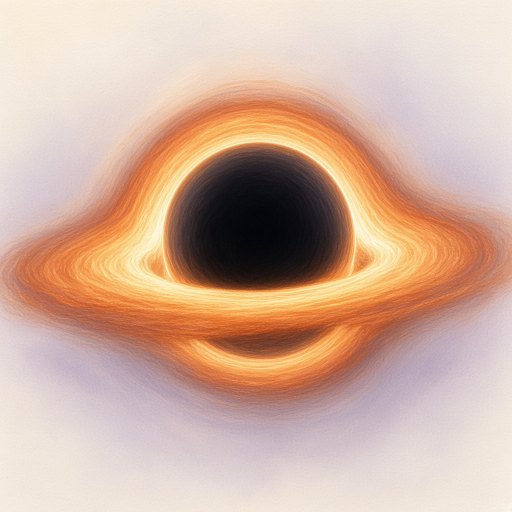
A black hole is a region of space with an event horizon, a boundary from inside which no signal can escape to the outside universe. Not even light can cross outward through that boundary. Some black holes form when massive stars run out of fuel and their cores collapse.
Why black holes are surprising
Black holes do not roam through space sucking up everything like vacuum cleaners. Far away, their gravity acts like the gravity of any other object with the same mass. Objects can orbit a black hole without falling in.
If the Sun could somehow be replaced by a non-spinning black hole with exactly the same mass, Earth’s orbit would stay nearly the same. Earth would become dark and cold because the sunlight was gone, but the black hole would not pull our planet straight inward.
The event horizon is not a hard shell. It is a one-way boundary in spacetime. A traveler crossing the horizon of a sufficiently massive black hole would not hit a wall, although the growing difference in gravity across the traveler’s body would eventually be fatal.
Key black hole facts
Black holes come in different mass ranges. Stellar-mass black holes are associated with collapsed stars, while supermassive black holes have millions or billions of times the Sun’s mass. Intermediate-mass candidates fall between those groups.
Sagittarius A* is the compact object at the center of the Milky Way. Observations of stars orbiting it provide compelling evidence that it is a black hole with about 4 million times the Sun’s mass.
The first black hole image was released on April 10, 2019. Eight radio observatories in the Event Horizon Telescope collected the data in 2017 and worked together like an Earth-sized telescope.
That first target was M87.* It is about 55 million light-years away and has about 6.5 billion times the Sun’s mass.
The image shows a shadow, not the inside. Hot material around M87* produced the bright ring, while captured and bent light created a dark central region consistent with a black hole shadow.
The Milky Way’s black hole was imaged next. The Event Horizon Telescope published an image of Sagittarius A* in 2022.
Black holes can merge. Their collisions create gravitational waves, which are changes in spacetime that travel outward.
LIGO made the first direct gravitational-wave detection on September 14, 2015. The signal, named GW150914, came from two merging black holes.
Hawking radiation is a prediction, not a telescope observation. Quantum theory predicts a faint thermal glow from black holes, but radiation from an astrophysical black hole has not been detected directly.
Gaia BH1 is the nearest confirmed black hole system currently known. It is about 1,560 light-years away and was identified through the orbit of its visible companion star.
Common black hole myths
Myth: A black hole pulls in everything around it. Matter can remain in a stable orbit. It falls in only if its path carries it close enough or if it loses the energy and angular momentum that keep it in orbit.
Myth: The bright ring in a black hole image is the black hole. The ring comes from glowing material outside the event horizon. The black hole itself does not send visible light outward.
Myth: The event horizon is a solid surface. It is a boundary defined by which paths through spacetime can still reach the outside universe.
Myth: Time runs backward inside a black hole. General relativity predicts extreme differences between how distant and falling observers compare clocks, but it does not say that a falling person’s clock reverses.
Myth: The Large Hadron Collider has made dangerous black holes. No microscopic black hole has been detected there. CERN explains that speculative models predicting such objects also predict immediate disintegration, and independent safety reviews found no danger.
Frequently asked questions about black holes
How can scientists find something that gives off no light?
They measure its effects. Stars and gas can orbit an unseen massive object, hot material can shine before crossing the horizon, and a merger can produce gravitational waves. The Event Horizon Telescope can also image the shadow that a nearby supermassive black hole creates against glowing material.
What would happen if you fell into a black hole?
Gravity would pull more strongly on the nearer part of your body than the farther part. This tidal stretching is nicknamed spaghettification. The effect becomes severe farther outside the horizon of a smaller black hole and can be much gentler at the horizon of a supermassive one.
Can anything escape after crossing the event horizon?
No signal or object can travel from inside the event horizon back to the outside universe under standard general relativity. Hawking radiation is a quantum effect associated with the black hole as a whole, not ordinary matter climbing back across the boundary.
Will Sagittarius A swallow Earth?*
No. It is about 26,000 light-years away, and Earth is held in orbit around the Sun. The Sun and many other stars orbit the Milky Way’s center from safe distances.
Source notes
The definitions, types, anatomy, and detection methods come from NASA and its black hole anatomy guide. The Event Horizon Telescope documents the first images of M87* and Sagittarius A*. LIGO documents the first gravitational-wave detection, the discovery paper reports Gaia BH1, and CERN provides the collider safety finding.
A black hole is a region of spacetime bounded by an event horizon. Once a signal crosses inward through that boundary, it cannot return to distant observers. The horizon is not a solid surface, and the black hole itself is not the bright disk often shown around it.
Gravity without the vacuum-cleaner myth
A black hole does not pull unusually hard merely because it is black. At a safe distance, the orbit around a spherical black hole depends on its mass in the same way an orbit around another spherical object does.
If the Sun were replaced by a non-spinning black hole with the same mass, Earth’s orbit would remain nearly unchanged. The loss of sunlight would be disastrous, but Earth would not suddenly be swallowed.
Matter usually reaches a black hole only after losing enough orbital energy or angular momentum. Gas can spiral inward through an accretion disk, heat to extreme temperatures, and radiate before it crosses the horizon.
Key black hole facts
Black hole masses span broad ranges. NASA describes stellar-mass, intermediate-mass, and supermassive groups, while also noting that the intermediate population is the hardest to establish.
The Schwarzschild radius scales with mass. For a non-spinning black hole, the horizon radius is about 1.85 miles (3 kilometers) per solar mass, so the full diameter for one solar mass is about 3.7 miles (6 kilometers).
Sagittarius A* lies at the center of the Milky Way about 26,000 light-years away. Stellar orbits indicate a compact object with roughly 4 million solar masses.
Reinhard Genzel and Andrea Ghez shared half of the 2020 Nobel Prize in Physics. The award cited the discovery of a supermassive compact object at the center of our galaxy.
M87 became the first imaged black hole.* The Event Horizon Telescope released the result on April 10, 2019, using 2017 data from eight linked radio observatories.
M87 is about 55 million light-years away.* The EHT collaboration gives it a mass near 6.5 billion Suns.
Sagittarius A received its own image in 2022.* The broad bright ring and central dim region were consistent with the expected appearance of its shadow.
A shadow is larger than the event horizon. Gravity captures some light and bends other rays, producing a dark central depression against surrounding emission.
The photon sphere is an idealized feature of a non-spinning black hole. At 1.5 times the Schwarzschild radius, circular light paths are possible but unstable.
Distant and falling observers compare time differently. Signals from a falling clock arrive increasingly delayed and redshifted, while the traveler crosses the horizon in finite time according to the traveler’s own clock.
Hawking radiation is a quantum prediction. Hawking’s 1975 calculation gives a thermal spectrum whose temperature decreases as black hole mass increases.
Astrophysical Hawking radiation has not been directly detected. For stellar and supermassive black holes, the predicted signal is far too faint for current telescopes.
GW150914 was the first direct gravitational-wave detection. LIGO observed it on September 14, 2015, from a merger that left a black hole of about 62 solar masses.
Gaia BH1 remains the nearest confirmed black hole system known. Its visible star orbits a dark companion of roughly 10 solar masses about 1,560 light-years from Earth.
What the images really show
The Event Horizon Telescope links distant radio observatories using very-long-baseline interferometry. Combining their recordings produces the resolving power of an Earth-sized virtual telescope, though the result is reconstructed from measurements rather than taken by one ordinary camera.
The broad ring around M87* and Sagittarius A* comes from luminous plasma whose light is bent by strong gravity. The dark center is consistent with the predicted shadow. The event horizon lies inside that shadow and is not directly photographed.
M87* is much more massive than Sagittarius A*, so its environment changes more slowly during an observing night. Sagittarius A* varies quickly, making its image especially difficult to reconstruct even though it is much closer.
Common black hole myths
Myth: A distant observer watches an astronaut frozen forever as a clear picture. The astronaut’s signals become delayed, dim, and redshifted until they can no longer be detected. “Frozen at the horizon” is an incomplete coordinate description, not an endlessly visible scene.
Myth: Smaller black holes are gentler. Tidal differences near the horizon grow more severe as black hole mass decreases. A stellar-mass black hole can tear a person apart outside its horizon, while a supermassive horizon can have much weaker local tides.
Myth: Hawking radiation is matter escaping from inside. The prediction comes from quantum fields in curved spacetime. The popular particle-pair story is only a teaching analogy and should not be read as ordinary particles climbing outward through the horizon.
Myth: Black holes themselves power bright quasars by shining. Observable light comes from matter outside the horizon, especially hot accretion flows and jets. The black hole supplies the deep gravitational environment but does not emit that ordinary light from its interior.
Myth: General relativity tells us exactly what is at the center. Classical equations predict a singularity in idealized solutions, signaling that the theory has reached a limit. A tested theory of quantum gravity that resolves the interior is not yet available.
Frequently asked questions about black holes
How are black holes detected?
Astronomers track orbiting stars, measure X-rays or other radiation from surrounding matter, observe gravitational lensing, reconstruct shadows with radio interferometry, and detect gravitational waves from mergers. A black hole does not need an active glowing disk to reveal its gravity.
What would falling into one feel like?
You would initially feel weightless in free fall. Tidal gravity would eventually stretch you along the direction of fall and squeeze you sideways. Whether disruption begins outside or inside the horizon depends strongly on the black hole’s mass.
Does time stop at the event horizon?
Not for the falling traveler. The traveler’s clock reaches and crosses the horizon in finite proper time. A distant observer instead receives increasingly delayed and redshifted signals.
Did Hawking prove that information is destroyed?
Hawking’s semiclassical calculation created a conflict between thermal evaporation and quantum unitarity known as the information paradox. Modern theoretical results have clarified parts of the puzzle in simplified models, but the complete mechanism for realistic four-dimensional black holes remains unsettled.
A black hole is a region of spacetime whose interior cannot send signals to distant observers. Its event horizon is a causal boundary, not a material shell. In idealized general relativity, the horizon is distinct from the singularity predicted deeper inside, where the classical description itself becomes incomplete.
Black holes are observed through gravity, surrounding radiation, and gravitational waves. Stellar orbits reveal the compact object at the Milky Way’s center, radio interferometry reconstructs the shadows of M87* and Sagittarius A*, and laser interferometers measure spacetime disturbances from mergers.
Why ordinary intuition fails
Far from an approximately spherical black hole, the exterior gravitational field depends on mass just as it does for another spherical body with that mass. Replacing the Sun with a non-spinning one-solar-mass black hole would remove the sunlight but leave Earth’s orbit nearly unchanged.
The event horizon is locally passable. A freely falling observer does not collide with it, though tidal forces may destroy the observer before or after crossing depending on black hole mass and spin.
Time descriptions require two viewpoints. The infaller crosses a horizon in finite proper time. A distant observer receives signals that become increasingly delayed, redshifted, and faint, so the infaller disappears from view rather than remaining as a permanently sharp frozen image.
Key facts about black holes
Population labels describe ranges, not rigid boxes. Stellar-mass black holes originate in stellar evolution or mergers, supermassive black holes occupy many galactic centers, and intermediate-mass candidates bridge the broad gap.
The Schwarzschild radius is proportional to mass. For a non-rotating uncharged black hole, rₛ = 2GM/c², about 1.85 miles (3 kilometers) per solar mass.
A solar-mass horizon would be compact. Its diameter would be about 3.7 miles (6 kilometers), while an Earth-mass black hole would have a diameter of roughly 0.7 inches (1.8 centimeters).
Sagittarius A* has roughly 4 million solar masses and lies about 26,000 light-years away. Decades of stellar-orbit observations provide the strongest evidence for its black hole identity.
The 2020 Nobel Prize wording was careful. Reinhard Genzel and Andrea Ghez were honored for discovering a supermassive compact object at the center of our galaxy, while Roger Penrose received the other half for showing black hole formation is a robust prediction of general relativity.
M87 was the first imaged black hole.* The Event Horizon Telescope released its reconstruction on April 10, 2019, after eight observatories collected 1.3-millimeter radio data in April 2017.
The EHT gives M87 a mass near 6.5 billion Suns and a distance near 55 million light-years.* Its great mass makes horizon-scale changes slow enough to combine observations more readily than for Sagittarius A*.
Sagittarius A was imaged in 2022.* Its measured ring diameter was consistent with a roughly 4-million-solar-mass black hole under general relativity.
Current EHT images show broad emission rings and central brightness depressions. They do not expose the event horizon or resolve an infinitely thin photon ring.
For Schwarzschild geometry, the unstable circular light orbit is at 1.5 times the horizon radius. Rotating Kerr geometry has a more complicated family of photon orbits.
Hawking radiation is thermal in the semiclassical calculation. For a Schwarzschild black hole, temperature varies inversely with mass, making astrophysical black holes exceptionally cold.
No astrophysical Hawking signal has been confirmed. Laboratory analog experiments test related mathematics but are not detections from actual gravitational black holes.
GW150914 was detected on September 14, 2015. The source merged black holes of about 36 and 29 solar masses into a remnant of about 62 solar masses, with the difference carried away chiefly as gravitational-wave energy.
Gaia BH1 is a dormant binary. A Sun-like star orbits a dark object near 10 solar masses every 186 days at a distance of about 1,560 light-years.
Accretion, spin, and jets
Visible radiation associated with a black hole comes from matter outside it. Gas in an accretion flow converts gravitational binding energy into heat and light before reaching the horizon, sometimes making an active galactic nucleus brighter than its host galaxy.
A rotating uncharged black hole is modeled by the Kerr metric. Rotation drags spacetime and changes the positions of the horizon, photon orbits, and the innermost stable circular orbit, so disk spectra can contain information about spin.
Spin estimates are model-dependent. X-ray continuum fitting and reflection spectroscopy infer an inner disk radius under assumptions about mass, distance, inclination, ionization, and disk structure. EHT data constrain horizon-scale structure but do not yet yield a precise model-independent spin for M87* or Sagittarius A*.
Jets do not emerge from inside the event horizon. Magnetic fields and plasma outside and near a rotating black hole can channel energy into relativistic outflows; the Blandford-Znajek mechanism describes electromagnetic extraction of rotational energy.
Common black hole myths
Myth: Every large galaxy certainly has a central black hole. Supermassive black holes are found in many well-studied massive galaxies, but observation supports a population statement, not an exceptionless law about every galaxy.
Myth: A black hole shadow is the same size as its horizon. Strong lensing makes the observed shadow larger than the horizon, and the surrounding plasma affects the reconstructed bright ring.
Myth: The singularity is a photographed object. No image sees inside the horizon. A singularity is a prediction of an incomplete classical solution, not a resolved astronomical feature.
Myth: Information loss has been experimentally settled. Hawking’s calculation creates a deep conflict with quantum unitarity. Modern island and holographic results recover unitary behavior in important theoretical settings, but no observation has revealed the full information-recovery mechanism of a realistic evaporating black hole.
Myth: The collider has produced microscopic black holes. None has been detected. Speculative extra-dimensional models motivated searches, and CERN’s reviewed safety case explains why the proposed objects would not present a hazard.
Frequently asked questions about black holes
What is actually visible in the EHT images?
A broad ring of synchrotron emission from magnetized plasma surrounds a central dim region consistent with the predicted black hole shadow. Gravity bends many light paths, while other paths end at the horizon. The image is a reconstruction from interferometric data, not a photograph of the interior.
Why can a supermassive horizon be gentler than a stellar-mass horizon?
For comparable positions measured in horizon radii, tidal gradients decrease as black hole mass increases. A small black hole can disrupt a person before horizon crossing, while a very massive one can have weak horizon-scale tides even though escape is still impossible once inside.
How do astronomers find dormant black holes?
They measure an orbit caused by an unseen companion and rule out visible stars or multiple lower-mass objects. Gaia BH1 was identified through astrometry and confirmed with radial-velocity measurements of its Sun-like companion.
What is the evidence for Hawking radiation?
It is a strong theoretical result of quantum field theory on curved spacetime, but direct emission from a real black hole has not been measured. The prediction for known astrophysical black holes is overwhelmed by warmer cosmic and local environments.
Could a black hole swallow the universe?
No known black hole has a mechanism to capture everything regardless of distance. Cosmic expansion, orbital motion, and the finite reach of any object’s gravitational influence prevent the popular runaway-vacuum-cleaner scenario.
A black hole is defined globally: its black hole region is the part of spacetime that cannot communicate with future null infinity, and the event horizon is the boundary of that region. This definition makes the horizon causal rather than material and also explains why locating an event horizon can require knowledge of the spacetime’s future.
Astrophysical observations do not inspect a classical interior. They test external geometry, orbital dynamics, accretion, lensing, and gravitational radiation. Statements about singularities, information recovery, or the final stage of evaporation therefore need a different evidentiary status from measurements of masses, rings, and merger waveforms.
Classical solutions and the limits of no hair
The Schwarzschild solution describes a static, spherically symmetric vacuum exterior. The Kerr solution describes a stationary, rotating, uncharged black hole. Reissner-Nordström and Kerr-Newman add electric charge, which is mathematically important even though surrounding plasma should strongly limit sustained charge on ordinary astrophysical black holes.
The phrase no-hair theorem compresses a family of uniqueness results. Under restrictive assumptions that include four-dimensional, stationary, asymptotically flat Einstein-Maxwell spacetime and suitable regularity, the exterior is characterized by mass, angular momentum, and electric charge. The slogan is not a theorem about dynamical holes, arbitrary matter fields, higher dimensions, or modified gravity.
The Schwarzschild horizon at r = 2GM/c² is a coordinate singularity in Schwarzschild coordinates, not a divergence of local curvature. Other coordinate systems extend smoothly across it. The curvature singularity at r = 0 is different and marks geodesic incompleteness in the classical solution.
The maximally extended eternal Schwarzschild geometry contains regions absent from the spacetime of a star that collapses to form a black hole. Its Einstein-Rosen bridge is not a traversable shortcut, and the second exterior region should not be presented as an astrophysical destination.
Kerr geometry, ISCO, and spin inference
Kerr geometry introduces frame dragging and an ergosphere outside the event horizon. Within the ergosphere, no observer can remain stationary relative to infinity, although every local observer still measures nearby light traveling at c.
For equatorial prograde orbits, the innermost stable circular orbit moves inward as spin increases. It lies at 6GM/c² for Schwarzschild and approaches GM/c² in the formal extremal prograde Kerr limit.
In the standard thin-disk model, the ideal radiative efficiency is about 5.7 percent for Schwarzschild and approaches about 42 percent in the formal extremal prograde limit. Captured disk radiation leads to the commonly cited equilibrium spin near a* = 0.998, for which the ideal efficiency is lower than the extremal value.
X-ray continuum fitting and reflection spectroscopy infer an inner disk scale associated with the ISCO. The result depends on assumptions about disk thickness, inclination, ionization, coronal illumination, mass, and distance, so a published spin estimate is not a direct reading of one geometric parameter.
Current EHT images test horizon-scale structure but do not separately resolve narrow photon subrings. Spin constraints from those images remain model-dependent, especially because plasma dynamics and viewing geometry also shape the observed ring.
Mechanics, entropy, and Hawking temperature
Bardeen, Carter, and Hawking formulated four laws of black hole mechanics in 1973. Their first law relates changes in mass to horizon area, angular momentum, and charge, while the classical area theorem states that total event-horizon area cannot decrease under its stated assumptions.
Bekenstein proposed a black hole entropy proportional to horizon area. Hawking’s quantum-field calculation fixed the normalization, yielding S = kBc³A/(4Gℏ) for the Bekenstein-Hawking entropy.
For a Schwarzschild black hole, the Hawking temperature is TH = ℏc³/(8πGMkB). The inverse dependence on mass makes stellar-mass and supermassive black holes colder than the cosmic microwave background today.
Hawking radiation has not been detected from an astrophysical black hole. Analog systems can reproduce related horizon mathematics, but they do not constitute observation of radiation from a gravitational event horizon.
The familiar story about virtual particle pairs separating at the horizon is a heuristic, not Hawking’s derivation. The calculation compares quantum-field modes in a curved collapse spacetime and obtains an approximately thermal outgoing spectrum.
The information paradox and Page curve
If complete evaporation produces only exactly thermal radiation, distinct initial quantum states appear to lead to the same final mixed state. That conflicts with unitary quantum evolution and creates the black hole information paradox.
For unitary evaporation, the Page curve describes radiation entropy rising at first and later falling as correlations return information to the exterior. The original semiclassical Hawking result instead gives continuing entropy growth when backreaction and quantum-gravity effects are treated incompletely.
Replica-wormhole and island calculations reproduce a Page curve in important semiclassical and holographic models. They are a major theoretical advance, but they do not yet provide an experimentally tested description of information escaping from a realistic four-dimensional astrophysical black hole.
The paradox therefore should not be summarized as either “information is definitely destroyed” or “the mechanism is solved.” Unitary models have strong support in modern quantum gravity research, while the spacetime interpretation and realistic evaporation process remain active subjects.
Energy extraction and jets
The Penrose process shows that particles in the Kerr ergosphere can exchange energy so that one escapes with more energy than the original incoming particle, reducing the hole’s rotational energy.
The Blandford-Znajek mechanism uses large-scale magnetic fields threading a rotating black hole’s near-horizon region to produce outward electromagnetic energy flux. It is a leading framework for relativistic jets, but observed jets also depend on the accretion flow, magnetic flux, and surrounding plasma.
Jets and accretion luminosity originate outside the event horizon. They are not matter or light emerging from the black hole interior.
Observational tests
Stellar orbits around Sagittarius A* supplied compelling evidence for a roughly 4-million-solar-mass compact object at the Galactic Center. The 2020 Nobel Prize recognized Reinhard Genzel and Andrea Ghez for that discovery, alongside Roger Penrose’s theoretical result on black hole formation.
The Event Horizon Telescope published M87* in 2019 and Sagittarius A* in 2022. Both reconstructions show a broad ring and central brightness depression consistent with the predicted black hole shadow, across central masses differing by roughly three orders of magnitude.
GW150914 was the first direct gravitational-wave detection and the first observation of a binary black hole merger. Its inferred component masses were about 36 and 29 solar masses, with a remnant near 62 solar masses.
GW190521 produced a remnant around 142 solar masses under the collaboration’s preferred quasi-circular binary interpretation, providing direct evidence for an intermediate-mass remnant. The short signal allows alternative source interpretations, so the exact formation story is less secure than the detection itself.
The 2023 NANOGrav 15-year analysis found evidence for a correlated nanohertz gravitational-wave background. A population of supermassive black hole binaries is a leading explanation, but the data did not identify one individual binary and did not by themselves exclude every other cosmological or astrophysical contribution.
Gaia BH1 demonstrates a different detection method. Astrometry and radial velocities reveal a roughly 10-solar-mass dark companion orbiting with a Sun-like star about 1,560 light-years away, making it the nearest confirmed black hole system currently known.
Common misconceptions at expert level
Misconception: The horizon must be locally detectable. For a sufficiently large black hole, a small freely falling laboratory can cross the horizon without encountering a material surface or a local curvature divergence. The horizon’s definition is global.
Misconception: The no-hair slogan applies to every theory and every black hole. Uniqueness relies on stated field equations, dimensionality, boundary conditions, stationarity, and regularity. Relaxing those assumptions can permit additional fields or structures.
Misconception: A black hole image directly measures spin. Ring scale and morphology constrain models, but variability, plasma state, inclination, magnetic fields, and reconstruction choices create degeneracies.
Misconception: Hawking radiation has been experimentally observed from a celestial black hole. It has not. Its status is theoretical, despite its central role in semiclassical gravity.
Misconception: Primordial black holes are either ruled out or established as dark matter. Constraints vary strongly with mass and modeling assumptions. No primordial black hole population has been confirmed, and viable fractional contributions remain an active research topic.
Frequently asked questions
What does no hair actually establish?
It establishes uniqueness only within a defined mathematical class. The standard Einstein-Maxwell result concerns regular stationary asymptotically flat black holes in four dimensions; it does not erase the assumptions or settle every extension of gravity.
Why does spin change disk efficiency?
Prograde frame dragging moves the ISCO inward, allowing matter in a thin disk to release more binding energy before plunging. Turning that relation into a measured spin requires an astrophysical disk model, not just the Kerr equations.
What does the Page curve resolve?
It states the entropy behavior required by unitary evaporation. Island calculations recover that behavior in important models, narrowing the paradox, but they do not yet constitute an observationally verified account of a four-dimensional evaporating black hole.
What is the cleanest strong-field evidence?
No single observation answers every question. Stellar orbits probe the Galactic Center potential, EHT images probe horizon-scale lensing and plasma, and gravitational-wave inspiral and ringdown probe dynamical compact-object geometry. Their agreement with general relativity across different regimes is more informative than any one result alone.