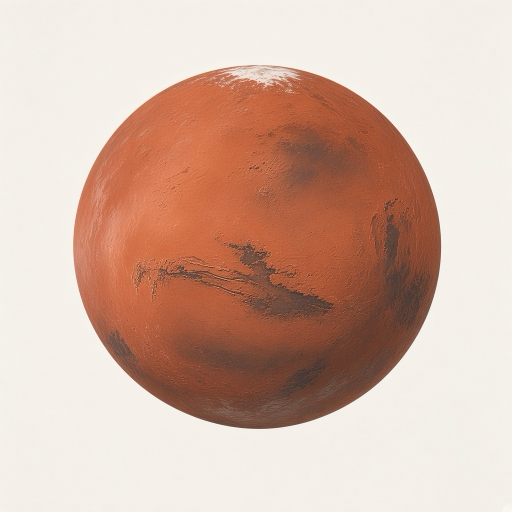
Mars is the fourth planet from the Sun and the next planet out past Earth. It is a cold, dry, rocky world with a thin air layer, reddish dust, two tiny moons, and the biggest volcano in the whole solar system. People call Mars the Red Planet because iron-oxide minerals in its dust make the ground and sky look orange and pink.
Why Mars is tricky to understand
Mars looks like a small red dot in the night sky, but it is a real planet about half the size of Earth. The Romans named it after their god of war because the color reminded them of blood. The red is not paint or fire. It comes from oxidized iron minerals in the dust, chemically similar to rust on Earth. Scientists are still studying exactly how and when those minerals formed.
Mars is extremely cold, and its air is so thin that ordinary liquid water is unstable across most of the surface. Depending on local pressure, temperature, and dissolved salts, exposed water can freeze, boil, evaporate, or turn directly into vapor. On Mars, space suits do two jobs at once: they keep an astronaut warm, and they keep the air pressure right around the body.
A day on Mars is almost the same length as a day on Earth. One Mars day, called a sol, is about 24 hours and 39 minutes. A Mars year, though, takes 687 Earth days, almost twice as long as ours.
Key facts about Mars
Mars is the fourth planet from the Sun. It sits between Earth and Jupiter, about 142 million miles (228 million km) from the Sun.
Mars is smaller than Earth. It is about half as wide. You could fit about 6 Marses inside Earth.
A Mars day (a “sol”) is 24 hours and 39 minutes long. That is just 39 minutes longer than a day on Earth.
A Mars year is 687 Earth days. That is almost twice as long as our year.
Mars has 2 moons, named Phobos and Deimos. Their names mean “Fear” and “Dread” in Greek. They are small and lumpy, more like potatoes than balls. An astronomer named Asaph Hall found them in 1877.
Mars is home to the biggest volcano in the solar system, Olympus Mons. It is about 13.6 miles (22 km) tall, about two and a half times the elevation of Mount Everest above sea level. Its base would cover most of Arizona.
Mars has a giant canyon called Valles Marineris. It runs about 2,500 miles (4,000 km) long, longer than the United States is wide. It is up to 4 miles (7 km) deep in places.
Both poles of Mars have ice. The north pole cap is mostly water ice. The south pole has water ice too, with a layer of frozen carbon dioxide (the same gas as dry ice) on top.
Mars has dust storms. Sometimes a single storm covers the whole planet for weeks.
Robots have been driving around Mars for years. NASA has landed rovers like Sojourner, Spirit, Opportunity, Curiosity, and Perseverance, plus a tiny helicopter called Ingenuity.
Common myths about Mars
Myth: The sky on Mars looks blue like Earth’s. The daytime Mars sky looks pinkish-tan because of red dust in the air. The sunset is the strange part. The sky right around the setting Sun turns blue, the opposite of what happens on Earth. Robot cameras on Mars have photographed this blue sunset.
Myth: Gravity on Mars is barely any gravity at all. Gravity on Mars is about 38% of Earth’s. A 100-pound (45 kg) person on Earth would weigh about 38 pounds (17 kg) on Mars. You would jump higher and feel lighter, but you would not float away.
Myth: Mars is hot because it looks fiery red. Mars is cold. The average surface temperature is about minus 81 °F (-63 °C), colder than Antarctica. The red color comes from rusty iron dust, not from heat.
Myth: You could breathe the air on Mars. The air is mostly carbon dioxide (about 95%) and has almost no oxygen. The pressure is also less than 1% of Earth’s, so without a space suit a person would not survive.
Myth: Aliens live on Mars right now. No one has ever found life on Mars. Scientists are still looking for tiny microbes in places where Mars used to have liquid water billions of years ago. There are no Martians, no cities, and no canals.
Frequently asked questions about Mars
Why is Mars red?
Mars is covered in fine dust containing iron-oxide minerals, which are chemically similar to rust on an old metal fence. In 2025, scientists matched the dust to a mineral called ferrihydrite, which forms when iron, water, and oxygen mix in cool conditions. That means the rust most likely formed long ago, while Mars still had liquid water. The dust coats much of the planet, which is why Mars looks red from far away.
Could a person stand on Mars without a space suit?
No. Mars has very thin air, only about 1% as thick as Earth’s, and almost no oxygen. The cold would be a problem, but the air is the bigger problem. Without a space suit, the low pressure would make the gases in your blood expand and you would pass out in seconds.
How long does it take to get to Mars?
A trip to Mars takes about 6 to 9 months, depending on where Earth and Mars are in their orbits. Mars and Earth move at different speeds around the Sun, so they line up close to each other only about every 26 months. Mission planners launch when the trip is shortest.
Why do Mars’s two moons look like potatoes?
Phobos and Deimos are very small. Phobos is about 14 miles (22 km) wide, and Deimos is only about 8 miles (12 km) wide. They are too small for gravity to pull them into round balls. Phobos races around Mars so fast that it rises in the west and sets in the east, the opposite of how the Sun moves across the sky.
Has anyone ever been to Mars?
No people have walked on Mars yet. Only robots have visited. NASA’s Perseverance rover has sealed selected rock and soil samples in tubes for study on Mars and for a possible future return to Earth. The design, funding, and schedule of any return campaign are not yet assured.
Mars is the fourth planet from the Sun, a cold rocky world about half the diameter of Earth. Its surface is covered in iron-oxide dust, which gives the planet its trademark red color. The atmosphere is about 95% carbon dioxide and less than 1% as dense as Earth’s, which is why liquid water cannot stay liquid on the surface today. Mars has two small moons, the largest volcano in the solar system, a canyon system longer than the United States is wide, and water ice at both poles.
Why Mars is tricky to understand
Mars looks like Earth’s closest cousin in some ways and nothing like Earth in others. A Martian day is only 39 minutes longer than ours: 24 hours 39 minutes 35 seconds, called a sol. The axial tilt is 25.19°, almost the same as Earth’s 23.44°, so Mars has spring, summer, fall, and winter just like we do. Each Martian season lasts about twice as long because the year is 687 Earth days, and no Martian summer ever feels like an Earth summer; the average surface temperature is about minus 81 °F (-63 °C).
The atmosphere surprises most people. Surface pressure is less than 1% of Earth’s at sea level, lower than the pressure on Mount Everest’s summit. Without a pressure suit, the low pressure on Mars would harm a person before the cold did. Ordinary liquid water is unstable across most of the surface, although its behavior depends on local pressure, temperature, and dissolved salts.
The Martian sky also looks different from Earth’s. The daytime sky is pinkish-tan because of fine red dust suspended in the atmosphere. Near the setting Sun, though, the sky turns blue. Mars rovers including Spirit, Opportunity, and Curiosity have all photographed this blue twilight.
Key facts about Mars
Mars is the fourth planet from the Sun, orbiting at an average distance of about 142 million miles (228 million km). Earth’s average distance is 93 million miles (150 million km).
Mars is much smaller than Earth. Its diameter is roughly 4,212 miles (6,779 km), about 53% of Earth’s. Its mass is only about 11% of Earth’s.
Surface gravity on Mars is about 38% of Earth’s. A 100-pound (45 kg) person on Earth would weigh 38 pounds (17 kg) on Mars. They could jump roughly two and a half times higher.
A Martian day, the “sol,” is 24 hours 39 minutes 35 seconds long. A Martian year is 687 Earth days, or 668 sols.
The Martian atmosphere is about 95% carbon dioxide, 2.6% nitrogen, and 1.9% argon, with traces of oxygen and water vapor. Earth’s atmosphere is mostly nitrogen and oxygen.
Surface pressure averages about 0.6% of Earth’s sea-level pressure. That is too low for liquid water to be stable on the surface.
Olympus Mons is the largest volcano in the solar system. Its summit is about 13.6 miles (22 km) above the surrounding plains, about two and a half times the elevation of Mount Everest above sea level. The base spans about 370 miles (600 km), wide enough to cover the state of Arizona.
Valles Marineris is one of the largest canyon systems known. It runs about 2,500 miles (4,000 km) along the Martian equator, reaches up to 125 miles (200 km) wide, and plunges as deep as 4 miles (7 km) in places.
Mars has two moons, Phobos and Deimos, discovered by Asaph Hall in 1877 and named after the Greek words for “Fear” and “Dread,” sons of Ares (Mars) in Homer’s Iliad.
Both polar caps contain water ice. The north cap is mostly water ice year-round. The south cap is water ice with a permanent layer of frozen carbon dioxide on top.
Mars lost its global magnetic field early in its history, probably around 4 billion years ago, though the exact timing is still debated. NASA’s MAVEN orbiter measured how solar radiation and the solar wind strip gases from the upper atmosphere. NASA declared the mission complete in June 2026 after the spacecraft went silent in December 2025.
Common myths about Mars
Myth: Mars is Earth’s closest planetary neighbor. Mercury is closer on average. Mars reaches opposition roughly every 26 months, but the distance at opposition varies. The especially close approach in 2003 brought Mars within about 34.6 million miles (55.8 million km) of Earth; idealized orbital calculations allow a theoretical minimum near 33.9 million miles (54.6 million km). The rest of the time Mars can be much farther away.
Myth: An astronaut on Mars would freeze to death first. The bigger threat is the lack of pressure. Mars’s atmosphere is less than 1% as dense as Earth’s. Without a pressure suit, dissolved gases in body tissues would expand within seconds and the person would lose consciousness long before the cold became fatal.
Myth: Solar panels do not work on Mars because the atmosphere blocks sunlight. Mars receives about 43% as much sunlight as Earth (the same fraction Earth would get if it were 1.5 times farther from the Sun), and the thin carbon dioxide atmosphere does not block visible light. Spirit, Opportunity, and the Ingenuity helicopter all ran on solar power for years. Dust accumulating on the panels is the bigger long-term issue.
Myth: Mars is geologically dead. Mars has no plate tectonics in the Earth sense, but the InSight lander recorded more than 1,300 marsquakes between 2018 and 2022, including a magnitude-4.7 event in May 2022. A 2021 study of a young volcanic ash deposit in Elysium Planitia suggested volcanic activity may have occurred as recently as 50,000 years ago, geologically very recent.
Myth: Phobos and Deimos look like Earth’s Moon, just smaller. Both Martian moons are tiny and irregularly shaped. Phobos measures about 17 miles (27 km) along its longest axis, with a mean diameter of about 14 miles (22 km); Deimos is only about 8 miles (12 km). Neither is round; both look more like potatoes. Phobos orbits Mars in only 7 hours 39 minutes, faster than Mars rotates, so from much of the Martian surface it appears to rise in the west and set in the east, an unusual direction compared with the Sun and background stars.
Frequently asked questions about Mars
Why is Mars red?
The reddish color comes from iron-oxide dust covering the surface and suspended in the atmosphere. These oxidized minerals are chemically similar to rust. A 2025 study in Nature Communications compared orbital, rover, and laboratory spectra and found that ferrihydrite, an iron oxide that forms in cool water, is the dominant iron-bearing mineral in the dust, which points to rusting during an early wet period rather than slow dry weathering. The dust is fine enough to spread through the atmosphere, which is why even the Martian sky carries a pink-tan tint.
Why is the Martian sunset blue?
Fine dust in the Martian atmosphere scatters red light more strongly than blue light, the opposite of what happens in Earth’s clearer atmosphere. Near the horizon, sunlight passes through more atmosphere, so red light is scattered away while a halo of blue light passes through near the Sun. Earth shows the reverse: red sunsets, blue sky.
How long is a year on Mars?
A Martian year is 687 Earth days, almost twice as long as Earth’s, because Mars is farther from the Sun and moves more slowly along a longer orbit. A Martian winter at high latitude can last more than 150 sols.
Could humans terraform Mars?
There is no current technology that could turn Mars into an Earth-like world within a human lifetime. A NASA-sponsored study found that Mars does not have enough readily accessible carbon dioxide to create the required warming and pressure with present-day technology. Atmospheric escape would also matter over long timescales, but the lack of an Earth-like global magnetic field is not by itself proof that a manufactured atmosphere would quickly vanish. Realistic future bases would rely on local resources such as water ice and CO2, with astronauts living in pressurized habitats.
How do rovers on Mars stay powered?
Solar-powered rovers like Spirit, Opportunity, and the Ingenuity helicopter use sunlight, which reaches the surface clearly through Mars’s thin atmosphere. Heavier rovers like Curiosity and Perseverance use radioisotope thermoelectric generators (RTGs), which convert heat from decaying plutonium-238 into electricity and keep working through dust storms and Martian winters.
Has there ever been life on Mars?
No life has ever been confirmed on Mars. NASA’s two Viking landers ran biology experiments in 1976; the results were ambiguous and have been debated ever since, but most scientists do not consider them evidence of life. The current focus is on biosignatures: chemical or fossil traces of past microbial life from the era when Mars had stable liquid water at the surface. Perseverance has sealed selected samples for study on Mars and for a possible future return to Earth; a return campaign has no assured design or schedule.
Mars is the fourth planet from the Sun, a cold desert world with a diameter of about 4,212 miles (6,779 km), roughly 53% of Earth’s, and a surface gravity of 38% of Earth’s. Its atmosphere is about 95% carbon dioxide at less than 1% of Earth’s surface pressure, dense enough to drive global dust storms and seasonal frosts but too thin to keep liquid water stable on the surface. Mars carries the largest known shield volcano (Olympus Mons), one of the longest canyon systems in the solar system (Valles Marineris), water ice at both poles, and signs of ancient surface water that flowed during the warmer, wetter early Martian climate.
What is often misunderstood about Mars
The biggest misconception is that the cold is what would kill an unprotected astronaut on Mars. The atmosphere matters more. Surface pressure averages around 6.1 millibars (610 Pa), less than 1% of Earth’s sea-level pressure of about 1,013 millibars. That is below the Armstrong limit, the pressure at which water boils at body temperature. Without a pressure suit, dissolved gases in body tissues would expand and consciousness would be lost within seconds, well before the cold became the immediate threat.
Mars is not Earth’s closest planetary neighbor on average; Mercury is. Mars reaches opposition roughly every 26 months, but its distance from Earth varies from one opposition to another. The 2003 approach was about 34.6 million miles (55.8 million km), while 33.9 million miles (54.6 million km) is an idealized theoretical minimum. Most of the time Mars is much farther away.
The Sun does not look brighter on Mars than on Earth. Mars sits at about 1.52 AU on average and receives roughly 43% of the solar irradiance Earth receives. Visible light passes through the thin Martian CO2 atmosphere with little extinction, which is why solar-powered rovers and the Ingenuity helicopter operated successfully on solar arrays for years. Long-term solar operation is limited not by atmospheric absorption but by dust accumulation on the panels and by global dust storms.
Mars is not geologically dead. NASA’s InSight lander recorded more than 1,300 marsquakes between 2018 and 2022, including a magnitude-4.7 event on 4 May 2022 attributed to subsurface tectonic stress rather than meteorite impact. A 2021 study of young volcanic deposits in Elysium Planitia suggested volcanism may have occurred there within the last 50,000 years, very recent on geological timescales.
Phobos’s apparent westward rise is real. Phobos orbits Mars at about 5,827 miles (9,378 km), inside the synchronous orbital radius. Its orbital period of 7 hours 39 minutes is shorter than the Martian sol, so as seen from the equator Phobos rises in the west and sets in the east, completing the sky-crossing in 4 hours 15 minutes or less.
Key facts about Mars
Orbital distance: average 142 million miles (228 million km) from the Sun, with a noticeable orbital eccentricity of 0.0934 that varies the Mars-Sun distance from about 128 to 155 million miles (206 to 249 million km).
Diameter: 4,212 miles (6,779 km). About 53% of Earth’s, with a mass roughly 10.7% of Earth’s.
Sol length: 24 hours 39 minutes 35 seconds. Axial tilt 25.19°, very close to Earth’s 23.44°. Year length: 687 Earth days, or 668.6 sols.
Atmosphere: 95.1% CO₂, 2.59% N₂, 1.94% Ar, 0.16% O₂, 0.058% CO, with trace water vapor that varies seasonally. Mean surface pressure 6.1 mbar.
Surface temperature: averages around minus 81 °F (-63 °C). Equatorial summer afternoons can reach 70 °F (21 °C); polar winter nights drop below minus 195 °F (-126 °C), cold enough for atmospheric CO₂ to freeze directly onto the surface.
Olympus Mons: a shield volcano with a summit roughly 13.6 miles (22 km) above the surrounding plains, the tallest known volcano and one of the tallest mountains in the solar system. Base diameter approximately 370 miles (600 km) measured to the basal scarp, comparable to the state of Arizona. Surveys that take in the lower flanks give a larger figure.
Valles Marineris: a canyon system about 2,500 miles (4,000 km) long, up to 125 miles (200 km) wide, and as deep as 4 miles (7 km). The system formed largely by extension of the crust, not by river erosion, though water modified its floors later.
Two moons: Phobos (about 14 miles / 22 km mean diameter) and Deimos (about 8 miles / 12 km mean diameter), both irregular and likely related to captured C-type asteroids or to a giant-impact origin. Discovered by Asaph Hall at the U.S. Naval Observatory in August 1877.
Polar caps: both poles host water-ice deposits. The seasonal caps consist primarily of frozen CO₂ that sublimates and re-deposits annually. The southern residual cap retains a thin permanent CO₂ layer over its water-ice base.
Magnetic field: Mars has no internally generated global magnetic field today. Strong remanent magnetism in parts of the southern highland crust shows that an early dynamo once operated. MAVEN documented solar-wind and radiation-driven atmospheric escape before NASA declared the mission complete in June 2026.
Soil chemistry: The Phoenix lander measured perchlorate at roughly 0.4 to 0.6% by weight at its site, and Curiosity later detected oxychlorine compounds consistent with perchlorate or related salts in Gale Crater. Such salts can lower the freezing point of brines, but recurring slope lineae are not confirmed liquid flows and many observations favor dry granular movement.
Common myths about Mars
Myth: Mars is the closest planet to Earth on average. Venus can come closer to Earth than Mars does, but calculations weighted over an entire orbital cycle place Mercury, surprisingly, closer to Earth on long-term average than either Venus or Mars. Mars reaches opposition about every 26 months, though only some oppositions are especially close. Its 2003 approach was about 34.6 million miles (55.8 million km); roughly 33.9 million miles (54.6 million km) is a theoretical minimum rather than a regularly reached distance.
Myth: Mars’s gravity is about a tenth of Earth’s. Surface gravity on Mars is about 38% of Earth’s, not 10%. The Moon, by comparison, is about 17%. A 100-pound person on Earth would weigh 38 pounds on Mars, jump roughly 2.6 times higher, and feel substantially heavier than they would on the Moon.
Myth: Mars dust storms can lift heavy machinery, like in The Martian. The atmosphere is far too thin to exert serious mechanical force. Even at hurricane wind speeds of 60 mph (100 km/h), the dynamic pressure on Mars is comparable to a gentle breeze on Earth. The 2018 global dust storm that ended Opportunity’s mission did so by blocking sunlight from reaching the rover’s solar panels, not by physical force.
Myth: Mars sunsets are red like Earth’s. The opposite is observed. Fine Martian dust scatters red light more efficiently than blue light, so the daytime sky is pinkish-tan and the region around the setting Sun turns blue. Spirit, Opportunity, Curiosity, and Perseverance have all returned images confirming the blue sunset effect.
Myth: The Viking landers found life on Mars in 1976. Viking’s biology package returned ambiguous results. The labeled-release experiment showed reactions consistent with biological metabolism, but pyrolytic-release and gas-exchange results did not support a biological interpretation, and the gas chromatograph mass spectrometer found no organic compounds at the detection limits of the day. The scientific consensus has remained that Viking did not detect life. Subsequent missions including Curiosity have detected organic carbon in Martian rocks, but organics are not themselves evidence of life.
Myth: There is liquid water on the Martian surface today. A 2018 study using radar reflections from the Mars Express SHARAD-style instrument MARSIS suggested a buried liquid lake beneath the south polar cap, but follow-up analyses have proposed that hydrated clays or other materials may produce the same radar signature. No surface liquid water has been confirmed; conditions are too cold and the pressure too low for stable liquid water above the freezing point of pure water.
Frequently asked questions about Mars
Why does a sol differ from an Earth day by only 39 minutes?
Mars and Earth happen to have similar rotational angular momentum per unit mass and similar axial tilts. The 24 hour 39 minute 35 second sol and the 25.19° tilt are coincidental products of how each planet accreted and was struck by impacts in the early solar system. Other planets show no such match: a Venusian solar day is 116.75 Earth days; a Jovian day is under 10 hours.
What is the air on Mars made of?
The Martian atmosphere is dominated by carbon dioxide at 95.1%, with 2.59% nitrogen, 1.94% argon, 0.16% molecular oxygen, and 0.058% carbon monoxide, plus trace water vapor that varies with season and location. NASA’s MOXIE demonstration on Perseverance used solid-oxide electrolysis of CO₂ to produce small amounts of breathable O₂, the first in-situ resource utilization for a life-support consumable on another planet.
Why are Olympus Mons and Tharsis so much larger than terrestrial volcanoes?
Mars has no global plate tectonics. On Earth, a hot mantle plume produces a chain of volcanoes (such as Hawaii) as the overlying plate slides over the plume. On Mars, the crust above a plume stays put and a single edifice grows to extreme height. Combined with lower surface gravity, the result is shield volcanoes far larger than anything on Earth. Olympus Mons has roughly 30 times the volume of Mauna Loa, Earth’s largest active volcano.
Why did Mars lose its atmosphere?
Solar radiation and the solar wind drove substantial atmospheric escape, especially early in Martian history, and the loss of the internally generated global magnetic field changed how the atmosphere interacted with the solar wind. MAVEN measured several escape mechanisms and showed that solar storms can accelerate them. Atmospheric loss is not a one-cause story, however: gases can also be locked into rocks and ice, and escape depends on gravity, chemistry, radiation, and the induced magnetosphere as well as any intrinsic field.
Has Mars ever been habitable?
The geological record points to widespread surface water during the Noachian epoch (roughly 4.1 to 3.7 billion years ago), with rivers and lakes; the existence and extent of a northern ocean remain debated. Curiosity has documented past environments in Gale Crater that could have supported microbial life. No fossil or chemical biosignatures have been confirmed. Perseverance has sealed samples from Jezero Crater for study on Mars and for a possible future return to Earth, but the return campaign’s design, funding, and schedule remain unsettled.
What killed Opportunity?
A planet-encircling dust storm in June 2018 raised so much dust into the atmosphere that sunlight reaching Opportunity’s solar panels fell below the level needed to maintain battery charge and survive the cold Martian night. Engineers attempted to recover the rover for months after the skies cleared. Opportunity had operated since January 2004 against an original 90-sol design lifetime, exceeding it by more than 50 times.
Could humans live on Mars without terraforming?
A long-term presence may be possible inside pressurized habitats using local resources, particularly water ice and oxygen produced from atmospheric CO₂ by systems like MOXIE. Full terraforming is well beyond current technology: a NASA-sponsored inventory found too little readily accessible CO₂ to produce Earth-like pressure and warming. Atmospheric escape would matter on geological timescales, but the absence of an Earth-like global magnetic field alone does not establish the fate of a hypothetical engineered atmosphere.
Source notes
Atmospheric composition, orbital parameters, and gravitational data are taken from NASA’s Mars facts page and NASA Science Mars. Olympus Mons and Valles Marineris dimensions follow USGS Astrogeology mapping and standard reference sources. Marsquake counts are from NASA JPL’s InSight mission summaries, and the magnitude of the 4 May 2022 event (S1222a) follows the peer-reviewed analysis by Kawamura and colleagues in Geophysical Research Letters (2022); atmospheric escape findings and the early Martian magnetic field follow results from the MAVEN mission. Perchlorate detections and their implications for brines are summarized in the reference entry on perchlorates on Mars. NASA’s terraforming assessment and the 2026 Mars 2020 Senior Review support the current wording about accessible CO2 and possible sample return.
Mars is a terrestrial planet with a basaltic crust, a silicate mantle, and a metallic core that seismic and geophysical models indicate is at least partly liquid. Its 4,212-mile (6,779 km) diameter and 0.107 Earth-mass place it at the small end of the inner solar system. Its thermal evolution helps explain the lack of active plate tectonics and a present intrinsic global magnetic field, but neither outcome follows from size alone. Areology, the geology of Mars, is organized around three first-order features: the crustal dichotomy between northern lowlands and southern highlands, the Tharsis bulge with its giant shield volcanoes, and the Hellas, Argyre, and Isidis impact basins. The Martian stratigraphic column is commonly divided into the Noachian, Hesperian, and Amazonian periods, with a proposed older Pre-Noachian interval; boundaries depend on crater chronology and mapped geology.
Why areology is non-intuitive
Mars preserves extensive ancient terrain, especially in the southern highlands, although erosion, impacts, volcanism, and alteration have made the record incomplete. Earth recycles much oceanic crust through plate tectonics while retaining far older continental rocks; Venusian resurfacing was regionally extensive, but a single catastrophic global event is not established. Absolute crater chronologies for Mars and most other rocky bodies are anchored primarily to radiometrically dated lunar samples, then transferred through impact-flux and crater-scaling models. Martian crater counts therefore estimate ages within model-dependent uncertainties rather than serving as the primary calibration for the rest of the inner solar system.
The crustal dichotomy is the first-order feature any model of Mars must explain, and its origin remains debated. The northern third of the planet sits about 3 to 5 miles (5 to 8 km) lower than the southern two-thirds, with a boundary that is approximately circular in broad outline. Two leading hypotheses compete: one or more giant impacts associated with the proposed Borealis basin, potentially among the largest impact structures in the solar system; and an internal mechanism such as hemispheric mantle convection that thinned northern crust during early differentiation. Strong remanent magnetization preserved primarily in southern crust is a key constraint, because either model must explain why the southern hemisphere recorded the dynamo while much of the north did not preserve a comparable signal.
A second non-intuition is the volume scaling of Olympus Mons. The summit sits about 13.6 miles (22 km) above the surrounding plains, with a basal diameter of roughly 370 miles (600 km) and a basal scarp that locally exceeds 4 miles (6 km) of relief. The volcano’s exposed volume of roughly 580,000 cubic miles (about 2.4 million km³) is roughly 30 times that of Mauna Loa. Static loading on the lithosphere produces a flexural moat around the edifice and contributes to the broader Tharsis-induced tilt of the Martian geoid. The maximum sustainable height of a shield volcano on a planet varies inversely with surface gravity and in direct proportion to crustal yield strength; the lower surface gravity, 38 percent of Earth’s, and the absence of plate motion combine to allow Mars to build single edifices that no terrestrial setting can match.
Liquid surface water on Mars today is thermodynamically and chemically constrained. The triple-point pressure of pure water, 6.11 mbar, is close to the global mean Martian surface pressure, so pure liquid is generally unstable at the surface. Local pressure, temperature, nucleation, and evaporation rates matter, and salty solutions can remain liquid below 0 °C under a narrow range of conditions. Perchlorate-bearing material can deliquesce in laboratory simulations, but that does not establish persistent surface films at every site. Recurring slope lineae (RSL) were initially proposed as evidence of seasonal brine flow on warm slopes; subsequent work has favored granular dry-flow explanations for many examples, with the role of water reduced relative to early interpretations.
Key facts
Stratigraphy. The geologic time scale divides Martian history into the Pre-Noachian (before about 4.1 Gya), Noachian (about 4.1 to 3.7 Gya), Hesperian (about 3.7 to 3.0 Gya), and Amazonian (about 3.0 Gya to present). Those boundary ages come from crater counts calibrated against dated lunar samples, so they shift by a few hundred million years between the Hartmann and Neukum chronology systems. Global mapping by the OMEGA spectrometer on Mars Express placed three alteration eras in sequence: phyllosilicate clays in the oldest terrains, sulfates during a following acidic interval, and anhydrous ferric oxides from about 3.5 Gya onward, a long-term shift toward drier, more oxidizing surface chemistry.
Crustal dichotomy. The northern lowlands sit 3 to 5 miles (5 to 8 km) below the southern highlands, with crustal thickness roughly 20 miles (32 km) in the north versus over 36 miles (58 km) in the south. The boundary forms a near-great-circle 5 to 6 mi (8 to 10 km) elevation step. Origin candidates include the Borealis basin megaimpact and degree-1 mantle convection.
Tharsis bulge. A volcanotectonic plateau covering about a quarter of the surface and rising 6 mi (10 km) above the datum. Hosts Olympus Mons, plus Arsia, Pavonis, and Ascraeus Montes (the Tharsis Montes chain) and Alba Patera. Tharsis loading deformed the entire planet and is thought to have driven the formation of Valles Marineris extensional graben.
Olympus Mons. Summit at about 13.6 mi (22 km) above the surrounding plains, basal diameter approximately 370 mi (600 km) measured to the basal scarp, exposed volume about 580,000 cubic miles (2.4 million km³), roughly 30 times that of Mauna Loa. Published widths vary with where the edge of the flank is judged to lie: Plescia measures 840 by 640 km taking in the lower flanks. The summit caldera complex is 2 mi (3.2 km) deep. The USGS geologic map of the caldera measures it at 50 by 40 mi (80 by 65 km) and resolves six nested paterae within it, while Plescia’s MOLA-based survey gives a wider 91 by 72 km. Crater-count ages for individual flows on the western flank run as young as 2 million years, indicating geologically recent activity, while Neukum and colleagues put the five caldera segments at 100 to 200 million years in their 2004 crater counts.
Hellas, Argyre, Isidis.Hellas Planitia is the largest clearly visible impact structure on Mars. MOLA topography from Mars Global Surveyor makes it nearly 6 mi (9 km) deep and about 1,300 mi (2,100 km) across, and its floor holds the lowest elevations on the planet. The USGS Gazetteer of Planetary Nomenclature lists the mapped Hellas plains at 1,370 mi (2,200 km), Isidis Planitia at 750 mi (1,200 km), and Argyre Planitia at 500 mi (800 km); measured out to its main topographic scarp, the Argyre impact structure is about twice as wide as the plains it encloses (Hiesinger and Head, 2002, Planetary and Space Science). Crater chronology places these basins very early in Martian history, but exact ages and their relationship to a proposed late bombardment spike remain model-dependent.
Crustal magnetism.Mars Global Surveyor magnetometry revealed strong remanent magnetization in southern highland crust, with magnetic anomalies up to about 1,500 nT, an order of magnitude stronger than typical terrestrial seafloor anomalies. The southern stripes record a Martian dynamo that operated until roughly 4.0 to 4.1 Gya. Northern lowlands lack comparable magnetic structure.
Atmospheric escape.MAVEN measured multiple present-day escape channels, including photochemical escape, ion outflow, pickup, and sputtering. Rates vary strongly with species and solar conditions, so a single present rate cannot simply be multiplied across 4 billion years. Isotopic and atmospheric models nevertheless indicate that escape to space removed a substantial share of Mars’s early atmosphere. NASA declared MAVEN’s mission complete in June 2026 after contact was lost in December 2025.
Polar layered deposits. The north polar cap reaches about 2 mi (3 km) thick, dominated by water ice with dust laminae recording orbital climate cycles. The south polar residual cap retains a thin permanent CO₂ veneer over water ice. Both seasonal caps consist primarily of CO₂ frost that condenses and sublimates with the Martian year, exchanging roughly a quarter of the planet’s atmospheric mass between hemispheres.
Internal structure. Seismic data from InSight constrained the Martian core to a radius of about 1,120 mi (1,830 km), or roughly half the planetary radius, with a density consistent with a Fe-S-light element alloy still partly liquid. The core is large for the planet’s size and has implications for the timing and termination of the dynamo.
Marsquakes. InSight cataloged more than 1,300 marsquakes, including a magnitude-4.7 event on 4 May 2022 (event S1222a) that originated thousands of kilometers from the lander near the crustal dichotomy boundary, indicating tectonic stress in the Martian interior rather than impact-driven seismicity. Spectral analysis distinguished low-frequency events propagating through the mantle from high-frequency events trapped in the crust.
Phobos and Deimos. Both moons orbit close to Mars’s equatorial plane, consistent with either capture from the asteroid belt followed by orbital circularization or, in newer models, accretion from a giant-impact debris disk. Phobos’s orbit is decaying at about 1.8 cm/yr through tidal interaction; the satellite is expected to either disrupt within the Roche limit or impact Mars within roughly 30 to 50 million years.
Perchlorates. Phoenix measured perchlorate at roughly 0.4 to 0.6% by weight at its landing site. Curiosity later detected oxychlorine compounds during heated-sample analyses in Gale Crater, consistent with perchlorate or chlorate salts but not a planet-wide uniform concentration. Some such salts can depress water’s freezing point substantially and are central to discussions of transient liquid stability.
ALH84001. The Martian meteorite Allan Hills 84001 attracted attention in 1996 when McKay et al. reported features in carbonate globules they argued might be evidence of ancient Martian microbial life. Subsequent work showed the magnetite chains, polycyclic aromatic hydrocarbons, and putative nanofossils could be produced abiotically. The biogenic interpretation is not the consensus position; ALH84001 is now generally cited as a cautionary case in biosignature interpretation.
Common misconceptions at expert level
Misconception: The Martian dichotomy is the result of plate tectonics. Mars shows no sustained evidence of mid-ocean-ridge magnetic striping, transform faults, or trench-arc systems. The dichotomy is most likely a product of a single megaimpact (Borealis) or of degree-1 mantle convection during the Pre-Noachian. Linear magnetic stripes in southern crust are not seafloor-spreading analogs; their wavelength and geometry are inconsistent with that interpretation, although they do resemble it superficially.
Misconception: Recurring slope lineae are flowing brine. Early HiRISE-era interpretations of RSL emphasized seasonal liquid brines stabilized by perchlorates. Subsequent thermodynamic modeling and granular-flow studies have demonstrated that many RSL behave more like dry granular avalanches, with water playing a smaller role than initially proposed. The current literature treats RSL as evidence of small amounts of subsurface water vapor or hydrated salt activity in some cases, not as confirmed liquid flow.
Misconception: Mars’s crustal magnetic anomalies are weaker than Earth’s. Several southern-hemisphere magnetic stripes reach amplitudes of about 1,500 nT at orbital altitude, around an order of magnitude stronger than typical Earth seafloor anomalies. The lack of a present-day global field is consistent with dynamo termination roughly 4 Gya; remanent magnetization in pre-Hellas crust records that earlier era.
Misconception: Olympus Mons could not exist on Earth because of plate motion. Plate motion is one factor, but lithospheric strength and gravity matter as well. The maximum sustainable shield-volcano height varies inversely with surface gravity and in direct proportion to the yield strength of the crust. Mars’s surface gravity is 3.71 m/s², about 38 percent of Earth’s 9.80 m/s², so for the same crustal yield strength a Martian edifice can stand roughly 2.6 times taller than a terrestrial one. Combined with stationary loading from a long-lived plume, the result is a volcano roughly 30 times the volume of Mauna Loa.
Misconception: ALH84001 confirmed past life on Mars. The 1996 McKay et al. paper proposed possible biogenic features, but follow-up work demonstrated abiotic explanations for the magnetite chains, the polycyclic aromatic hydrocarbon distribution, and the nanofossil-like structures. The biogenic interpretation has not become consensus. ALH84001 remains a useful test case for biosignature criteria, not an established detection.
Misconception: Phobos’s westward rise comes from retrograde orbital motion. Phobos orbits Mars prograde (in the same direction as the planet’s rotation). The westward rise is geometric: Phobos’s orbital period of about 7 hours 39 minutes is shorter than the Martian sol of 24 hours 39 minutes, so Phobos overtakes the rotating surface and moves opposite to the apparent diurnal motion of background stars. Deimos, with a longer orbital period (30.3 hours), rises in the east like the Sun and stars.
Frequently asked questions
Why did the Martian dynamo shut down?
The cause and exact timing remain active research questions. Proposed mechanisms include a decline in heat flow across the core-mantle boundary as the mantle cooled, impact-driven reductions in that heat flow after the largest basin-forming collisions (Roberts, Lillis, and Manga, 2009, Journal of Geophysical Research), and high thermal conductivity in an iron-sulfur core that weakens convection and builds thermal stratification (Hsieh and colleagues, 2024, Science Advances). Mars’s size influenced its cooling history, but it does not by itself specify when a dynamo must stop. Crustal magnetization shows that an early dynamo operated and later ceased or weakened, and MAVEN magnetometer data over the 3.7-billion-year-old lava flows of Lucus Planum indicate a core field still operating then, which leaves room for a more complex history than one abrupt shutdown at 4.0 to 4.1 Gya.
What does the Noachian-Hesperian boundary actually mark?
The transition is defined by the dominant aqueous mineralogy preserved in the rock record: phyllosilicates (clays) below, sulfates above. Widespread valley-network incision ceased near the boundary, about 3.7 billion years ago, and aqueous alteration shifted from neutral-to-alkaline chemistry to acidic, evaporitic chemistry. Proposed drivers include declining greenhouse warming as the atmosphere thinned, loading by the Tharsis rise, and the waning of the large impacts that delivered and mobilized volatiles. Phillips and colleagues (Science, 2001) concluded that the Tharsis load was largely in place by the end of the Noachian and controlled the location and orientation of valley networks. No single driver is established.
How do you reconcile widespread Noachian valley networks with a faint young Sun?
The early Sun was roughly 25% to 30% less luminous than today. Many climate models find that a CO₂-H₂O atmosphere alone struggles to keep early Mars continuously above freezing because of CO₂ condensation and scattering, though outcomes depend on pressure, clouds, topography, and model assumptions. Proposed additions include H₂, CH₄, or SO₂ from impacts and volcanism, as well as episodic warming. The evidence permits competing warm-and-wet, cold-and-icy, and episodic scenarios; it does not establish one temperature history for most of the Noachian.
What is the consensus on S1222a, the largest InSight marsquake?
The 4 May 2022 event (S1222a) was located far from the InSight lander near the crustal dichotomy boundary, with a moment magnitude of 4.7, the largest event recorded during the InSight mission. NASA’s preliminary press estimate of magnitude 5 was refined to 4.7 in the peer-reviewed seismic analysis. Orbital imaging found no fresh crater or blast zone at the location, and the event carries a lower P-wave to S-wave energy ratio at high frequency than the confirmed impacts, which points to a double-couple fault rather than an isotropic explosive source. Cerberus Fossae itself has hosted other moderate seismic events and is associated with young volcanic and tectonic activity in Elysium Planitia.
Why are perchlorates important?
Perchlorate salts, chiefly Mg(ClO₄)₂ and Ca(ClO₄)₂, depress the freezing point of aqueous solutions to as low as about minus 70 °C and are deliquescent under Martian conditions, meaning they can absorb water vapor from the atmosphere. They constrain the thermodynamic stability window for transient liquid brines, complicate any in-situ life-detection chemistry by destroying organics during pyrolysis (the proposed explanation for some of the Viking gas-chromatograph anomalies), and present a toxicity issue for any future human exploration. They are also a potential resource: electrolysis of perchlorate-bearing brines could produce O₂.
Why are Phobos and Deimos so different from Earth’s Moon in shape and origin?
Both moons are too small for self-gravity to make them spherical. Their low albedos and spectra resembling dark asteroids initially favored capture, but achieving the observed near-equatorial, low-eccentricity orbits is dynamically difficult without additional dissipation. Giant-impact models can instead produce an equatorial debris disk, though they also face compositional and orbital constraints. JAXA’s MMX (Martian Moons eXploration) mission is scheduled to launch in Japanese fiscal year 2026 and aims to return a Phobos sample that could help discriminate between origin scenarios.
Source notes
Bulk-planet parameters and atmospheric composition follow NASA’s Mars facts page. Stratigraphic boundaries and surface mineralogy follow the standard reference on Martian geological history. The Tharsis volcanic-tectonic system is reviewed in the Tharsis entry, with the Olympus Mons edifice geometry following USGS Astrogeology mapping. The crustal dichotomy and competing megaimpact and mantle-convection origins are summarized in the linked entry. Hellas, Isidis, and Argyre dimensions follow the USGS Gazetteer of Planetary Nomenclature, and the Hellas depth follows MOLA topography from NASA Goddard. Atmospheric escape mechanisms follow results from the MAVEN mission. Recurring slope lineae interpretations track the post-2017 shift toward granular-flow models. Allan Hills 84001 reviews summarize the abiotic counter-explanations to the 1996 biogenic hypothesis. Internal-structure and seismic results are from NASA JPL’s InSight science team papers, and the current MMX schedule comes from JAXA’s mission overview.