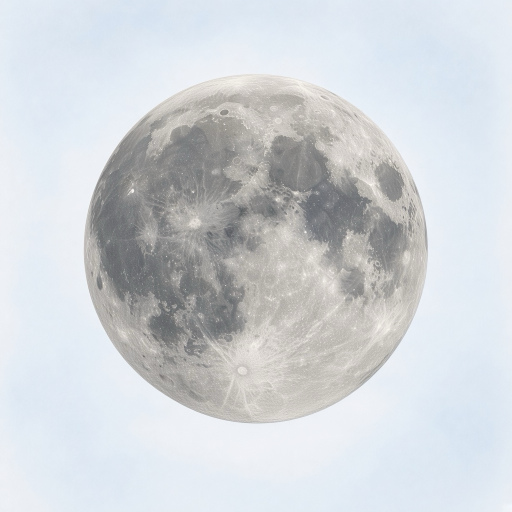
The Moon is a big rocky ball that circles Earth in space. It is Earth’s only natural satellite, which means it is the only large object that goes around Earth on its own. The Moon is about 238,855 miles (384,400 km) away from us, and it does not make its own light. It looks bright because it reflects light from the Sun, like a mirror made of rock and dust.
Why the Moon is tricky to understand
The Moon looks like it changes shape every night, but it never really does. The Moon is always a round ball. What changes is the side that is lit up by the Sun. When we see a thin sliver, only a small piece of the lit side is facing us. When we see a full Moon, the whole lit side is facing us. The shape we see is called a phase.
The Moon also looks like it is not spinning, but it is. It spins once for every trip it makes around Earth, about every 27.3 days. This tidal locking keeps the same hemisphere pointed roughly toward Earth. A gentle apparent wobble called libration lets observers see about 59 percent of the surface over time, but never the center of the far side from the ground.
The Moon does not have any air, so it has no wind, no rain, and no clouds. The footprints the Apollo astronauts left in 1969 are still there today, and they will probably stay for about a million years. There is nothing to wash them away or blow them around.
Key facts about the Moon
The Moon is about 2,159 miles (3,475 km) wide. That is about a quarter of Earth’s width. It is the fifth-biggest moon in the whole solar system.
It is about 238,855 miles (384,400 km) from Earth on average. Light from the Moon takes about 1.3 seconds to reach your eyes.
The Moon’s gravity is about one sixth of Earth’s. A person who weighs 60 pounds on Earth would weigh only about 10 pounds on the Moon.
The Moon has no air to breathe. It has only a very thin layer of gas called an exosphere, which is so thin that it acts like a vacuum.
It gets very hot and very cold. In direct sunlight the surface can reach 260 °F (127 °C). In the dark it can drop to about -280 °F (-173 °C).
There is no sound on the Moon. Sound needs air to travel, and the Moon has none. The astronauts talked using radios.
The Moon has water ice. Frozen water hides in deep craters near the Moon’s poles where sunlight never reaches.
The Moon is moving away from Earth slowly. Every year it gets about 1.5 inches (3.8 cm) farther.
Twelve people have walked on the Moon. They were all NASA astronauts during the Apollo missions between 1969 and 1972.
Common myths about the Moon
Myth: The Moon makes its own light. The Moon does not glow on its own. It is a rock. We only see it because it reflects light from the Sun, the same way a bike reflector reflects a car’s headlights.
Myth: There is a permanently “dark side” of the Moon. The far side receives sunlight over the lunar month just as the near side does. Tidal locking points the same hemisphere roughly toward Earth, although libration reveals strips beyond its edges. Far side is the accurate geographic name.
Myth: The flag the astronauts left is waving in the wind. The Moon has no wind because it has no air. The flag stays in place because the astronauts attached a stiff metal bar across the top to hold it open in the picture.
Myth: You could easily jump 30 feet on the Moon in an Apollo spacesuit. Lower gravity permits higher jumps, but the suit and life-support pack added inertia, restricted joint motion, and made balance difficult. Apollo astronauts usually used short hops rather than giant leaps.
Myth: Tides are caused by the Moon’s magnetism. Tides come from the Moon’s gravity pulling on Earth’s oceans. The Moon does not have a strong magnetic field at all.
Frequently asked questions about the Moon
Why do we always see the same side of the Moon?
The Moon’s average rotation period matches its 27.3-day orbit, a state called tidal locking. That keeps one hemisphere pointed roughly toward Earth. Because the orbit is not a perfect circle and the spin axis is tilted, libration lets us see about 59 percent of the surface over time.
Why does the Moon change shape during the month?
The shape does not really change. The Moon is always round. As it travels around Earth, sunlight hits it from different angles. Sometimes we see all of the lit side, which is a full Moon. Sometimes we see only a thin slice, which is a crescent. Sometimes we see none of it, which is a new Moon. The full cycle takes about 29.5 days.
Why does the Moon cause ocean tides?
The Moon’s gravity pulls on the water in Earth’s oceans. The water on the side of Earth closest to the Moon gets pulled toward it, making a high tide. There is also a high tide on the opposite side of Earth at the same time. As Earth turns, different places pass through the high and low spots, which is why the tide goes up and down twice a day in most places.
Could I jump really high on the Moon?
You could jump higher than on Earth, but height would not scale by a simple factor for a suited astronaut. The suit and life-support pack retain inertia even though they weigh less in lunar gravity, and their stiff joints limit movement. Apollo crews generally used short hops for stability.
How did the Moon get there?
Most scientists think a Mars-sized rocky body crashed into the young Earth about 4.5 billion years ago. The crash threw a huge cloud of melted rock into orbit. Over time, that material clumped together by gravity and formed the Moon. This idea is called the Giant Impact Hypothesis.
Source notes
The numbers in this article come from NASA’s Moon facts page and the NASA Earth’s Moon site, plus the Apollo 11 mission page for the 1969 landing. General background is from the Wikipedia Moon article, whose own references trace back to NASA and other primary sources.
The Moon is a rocky world about 2,159 miles (3,475 km) across that orbits Earth at an average distance of 238,855 miles (384,400 km). It is Earth’s only permanent natural satellite and the fifth largest moon in the solar system. It shines by reflecting sunlight. Lunar gravity is the largest astronomical contribution to ocean tides, and dynamical models show that the Moon reduces long-term variations in Earth’s axial tilt, although the size of that stabilizing effect depends on model assumptions.
Why the Moon is tricky to understand
The Moon looks like it changes shape every night, but its shape is constant. What changes is how much of its lit side is facing Earth. As the Moon orbits us, sunlight strikes it from a shifting angle. The cycle from one new Moon back to the next, called a synodic month, takes 29.5 days. The Moon’s actual orbit around Earth, measured against the stars, takes 27.3 days. The two numbers are different because Earth is also moving around the Sun, so the Moon has to travel a bit further each cycle to “catch up” with the Sun.
The Moon’s average rotation period matches its 27.3-day orbit, a 1:1 tidal lock produced by long-term tidal evolution. The same hemisphere therefore points roughly toward Earth, but optical libration exposes about 59 percent of the surface over time. The far side is not permanently dark; it receives sunlight on the same monthly cycle as the near side, although its central region cannot be seen directly from Earth’s surface.
A third surprise is that the Moon is moving away from us. Lasers fired from Earth at retroreflectors left by the Apollo astronauts measure the distance to the millimeter. The Moon recedes by about 1.5 inches (3.8 cm) every year. Earth’s day is also lengthening, very slowly, as a result of the same tidal effect.
Key facts about the Moon
Diameter and mass. The Moon is 2,159 miles (3,475 km) across, about 27 percent of Earth’s diameter. Its mass is about 1.2 percent of Earth’s. Surface gravity is roughly one sixth of Earth’s, so a 120-pound person on Earth would weigh about 20 pounds on the Moon.
Distance. The average Earth-Moon distance is 238,855 miles (384,400 km), but the orbit is slightly elliptical. Closest approach (perigee) is about 222,000 miles (357,000 km); farthest (apogee) is about 252,000 miles (406,000 km).
Surface temperature swings. With almost no atmosphere to hold heat, the lunar surface reaches about 260 °F (127 °C) in direct sunlight and drops to about -280 °F (-173 °C) in shadow.
Atmosphere. The Moon has only an exosphere, a layer of gas so thin that the molecules rarely collide with each other. For practical purposes, the surface is in a vacuum, and there is no weather, no wind, and no sound.
Surface features. The dark patches you can see by eye are maria (Latin for “seas”), large basins flooded with cooled basalt lava billions of years ago. The bright areas are older highland crust made of a rock called anorthosite. The craters are almost all from impacts, not volcanoes.
Water ice at the poles. NASA’s LCROSS mission slammed an impactor into a permanently shadowed crater near the south pole in 2009 and confirmed water ice in the debris plume. The Lunar Reconnaissance Orbiter has mapped these polar cold traps in detail since 2009.
Magnetism. The Moon has no active global dynamo today but retains patchy crustal magnetization from ancient fields. Its small, partly molten core is not convecting strongly enough to sustain a present dynamo; the thermal and mechanical history of the ancient dynamo remains debated.
Apollo program. Twelve astronauts walked on the Moon between July 1969 and December 1972 during NASA’s Apollo missions. Apollo 11 landed on 20 July 1969; Neil Armstrong and Buzz Aldrin walked on the surface while Michael Collins orbited above in the command module.
The Moon helps stabilize Earth’s tilt. Earth’s axis currently tilts about 23.4°. Models agree that the Moon reduces long-term obliquity variations, but Moonless-Earth simulations produce different ranges depending on starting rotation, orbital conditions, and model duration. The often-quoted tens-of-degrees swing is a scenario, not a single certain forecast.
Common myths about the Moon
Myth: There is a permanent “dark side” of the Moon. The far side gets sunlight on the same 29.5-day cycle as the near side. The colloquial phrase can mean hidden or mysterious, but it is misleading if read as unilluminated. The Soviet probe Luna 3 first photographed the far side in 1959.
Myth: The Moon’s craters were made by volcanoes. The great majority are impact craters. Volcanism instead flooded some impact basins to form the maria. Returned samples show eruptions billions of years ago, and irregular mare patches may be much younger, although their ages and whether they record very recent volcanism remain debated.
Myth: The Moon causes tides because of its magnetism. Tides are produced by gravity, not magnetism. The Moon’s gravitational pull is stronger on the side of Earth nearest the Moon and weaker on the far side, which stretches the oceans into a small bulge on each side. As Earth rotates beneath those bulges, coastal locations pass through high and low tide twice a day.
Myth: The Sun and Moon are the same size. They are not even close. The Sun’s diameter is about 400 times the Moon’s. The Moon happens to be about 400 times closer than the Sun, which is why they appear roughly the same size in the sky and why a total solar eclipse is possible. The match is a coincidence of this point in Earth’s history.
Myth: Apollo astronauts could easily jump 20 feet in the air. Lower gravity permits higher ballistic jumps, but height does not scale simply for a suited person. The suit and backpack retained inertia, restricted joint motion, and made balance difficult, so crews generally used short hops.
Frequently asked questions about the Moon
Why do we only ever see one side of the Moon?
The Moon’s rotation period and orbital period are the same, both 27.3 days. That is not a coincidence: tidal forces from Earth slowed the Moon’s spin over billions of years until the spin and the orbit matched. The same effect, called tidal locking, traps many large moons in the solar system in the same configuration with their parent planets.
What is a lunar eclipse, and why does the Moon turn red?
A lunar eclipse happens when Earth passes directly between the Sun and the Moon, blocking direct sunlight from reaching the Moon. Some sunlight still bends around Earth and through Earth’s atmosphere on its way to the lunar surface. The atmosphere filters out most of the blue light and lets red light through, the same effect that turns sunsets red. The result is a coppery or red-tinted Moon during totality.
How did we get water ice on the Moon if it is so hot?
The Moon does swing through huge temperature extremes, but craters near the poles have floors that have not seen direct sunlight for billions of years. These permanently shadowed regions stay near -400 °F (-240 °C). Water ice delivered by comets and asteroids, or formed by the solar wind interacting with the surface, gets trapped in these cold pockets. The 2009 LCROSS impactor confirmed water ice in one such crater near the south pole.
Why is the Moon moving away from Earth?
Earth’s tides bulge slightly toward the Moon, but Earth rotates faster than the Moon orbits, so the bulge is dragged a little ahead of the Moon. The bulge’s gravity gives the Moon a tiny forward tug, which lifts it into a higher orbit by about 1.5 inches (3.8 cm) per year. By conservation of angular momentum, Earth’s rotation has to slow down to compensate, which is why the day is gradually lengthening.
Where did the Moon come from?
The leading family of models is the Giant Impact Hypothesis: a large body struck the forming Earth and placed debris into orbit that assembled into the Moon. The impactor’s size, impact geometry, mixing, and accretion timescale vary among simulations. The models aim to explain the Moon’s small iron core, volatile depletion, angular momentum, and close isotopic similarity to Earth’s mantle.
The Moon is a differentiated rocky body 2,159 miles (3,475 km) in diameter that orbits Earth at a mean distance of 238,855 miles (384,400 km). It is the fifth-largest natural satellite in the solar system after Ganymede, Titan, Callisto, and Io, and the only one whose surface has been directly sampled by humans. The Moon is in 1:1 spin-orbit resonance, completes one sidereal orbit in 27.3 days, and reflects sunlight from a regolith composed of mafic basalt in the maria and feldspathic anorthosite in the highlands. Its surface gravity is about 0.165 g, its mean surface temperature swings from roughly 260 °F (127 °C) in direct sun to -280 °F (-173 °C) in shadow, and its only atmosphere is a tenuous surface-bounded exosphere.
What is often misunderstood about the Moon
The Moon does not have a permanently dark hemisphere. Both sides receive sunlight on the same 29.5-day synodic cycle. “Dark side” is misleading when interpreted as lightless; far side is the geographic term. Luna 3 first photographed it in 1959. The far side has far fewer maria and more preserved highland terrain, an asymmetry linked to crustal thickness and the Moon’s thermal history, with multiple origin models still under study.
The Moon’s craters are predominantly impact craters, not volcanic. Lunar volcanism flooded pre-existing basins to form the dark maria. Returned basalts record eruptions billions of years ago. Small irregular mare patches have crater-count model ages below 100 million years in some studies, but whether those ages represent eruptions or unusual surface processes remains debated.
The Moon is receding from Earth, not approaching. Lunar laser ranging using the Apollo retroreflectors has measured the recession rate at 1.49 inches (3.8 cm) per year continuously since 1969. The recession is driven by tidal coupling: Earth’s tidal bulge leads the Moon’s instantaneous position because Earth rotates faster than the Moon orbits, transferring angular momentum outward and lengthening Earth’s day at the same time.
The Sun-Moon angular diameter coincidence is real but transient. The Sun’s diameter is about 400 times the Moon’s, and the Sun is currently about 400 times farther from Earth, so both subtend roughly half a degree on the sky. Total solar eclipses are possible only when the Moon is near perigee. As the Moon recedes, total eclipses will become impossible in roughly 600 million years.
Key facts about the Moon
Mean radius: 1,079.6 miles (1,737.4 km). Mass: 7.342 × 10²² kg, about 1.2% of Earth’s. Mean density: about 3.34 g/cm³, lower than Earth’s 5.51 g/cm³, indicating a much smaller iron core.
Orbit. Sidereal period 27.3 days; synodic period (new moon to new moon) 29.5 days. Mean orbital velocity about 2,288 mi/h (1.022 km/s). Orbital eccentricity 0.0549, giving perigee 222,000 miles (357,000 km) and apogee 252,000 miles (406,000 km).
Spin-orbit resonance. The Moon is tidally locked in 1:1 resonance with Earth. Optical libration in longitude (from orbital eccentricity) and latitude (from axial tilt) lets a ground observer see roughly 59% of the lunar surface over time.
Surface composition. Highlands: feldspar-rich anorthosite, lighter in color, dating to the magma ocean phase about 4.4 billion years ago. Maria: low-titanium and high-titanium mare basalt, emplaced largely between 3.9 and 3.0 billion years ago, although extending to roughly 1 to 2 Gyr ago.
Crater record. Most large basins formed early in lunar history. Apollo impact-melt ages once motivated a sharp Late Heavy Bombardment spike around 4.1 to 3.8 billion years ago, but sample bias and alternative declining-flux histories remain active subjects of research. South Pole-Aitken, about 1,550 miles (2,500 km) across, is the Moon’s largest recognized impact basin.
Magnetic field. No active dynamo today. Crustal remanent magnetism is patchy and locally strong (up to a few hundred nanoteslas), interpreted as preserving fields from an extinct early dynamo that operated roughly 4.2 to 3.5 billion years ago and possibly later.
Polar volatiles. Permanently shadowed regions (PSRs) near the poles maintain temperatures around -400 °F (-240 °C). The 2009 LCROSS impact into Cabeus crater confirmed water ice in the debris plume, with subsequent Lunar Reconnaissance Orbiter and SOFIA observations refining the inventory.
Apollo program. Six crewed landings between 20 July 1969 (Apollo 11) and 14 December 1972 (Apollo 17) returned 842 pounds (382 kg) of lunar samples. Apollo 11 deployed retroreflectors that remain in active use for lunar laser ranging.
Origin. The favored model is the Giant Impact Hypothesis: a Mars-sized body, often referred to as Theia, struck the proto-Earth around 4.5 billion years ago. Debris launched into orbit accreted into the Moon. The model accounts for the Moon’s small iron core, its bulk depletion in volatiles, and its near-identical oxygen-isotope ratios with Earth’s mantle.
Common myths about the Moon
Myth: The Moon’s far side is permanently dark. The far side receives sunlight on the same 29.5-day synodic cycle as the near side. “Dark” referred to its hidden character before 1959, not its illumination. The far side is dramatically less mare-covered than the near side, with the largest expanse of highland terrain on the lunar surface.
Myth: Tides are caused by the Moon’s magnetism. Tides arise from the differential gravitational pull of the Moon (and to a lesser extent the Sun) across Earth’s diameter. The Moon has no significant global magnetic field. Coastal tides occur twice daily because Earth rotates beneath two opposite gravitational bulges.
Myth: Lunar craters were formed by volcanoes. The vast majority of lunar craters are impact craters. Lunar volcanism produced the maria, large basaltic lava plains that fill older impact basins, but did not produce the bowl-shaped, raised-rim crater morphology that dominates the surface.
Myth: The Moon is approaching Earth. Lunar laser ranging since 1969 confirms a recession of about 1.49 inches (3.8 cm) per year, driven by tidal angular-momentum transfer. The Moon was significantly closer in the deep past; its current orbital evolution is outward.
Myth: The Apollo footprints will eventually wash away. With no atmosphere, no liquid water, and no biological activity, the only surface-modifying processes are micrometeorite gardening and the solar wind. Both are very slow. Apollo footprints are expected to remain recognizable for on the order of a million years.
Myth: Astronauts could easily jump tens of feet on the Moon. Surface gravity of 0.165 g permits higher ballistic jumps, but Apollo suits and equipment retained inertia, restricted joint motion, and made balance difficult. Film shows crews favoring short, controlled hops rather than exploiting a simple sixfold height scaling.
Frequently asked questions about the Moon
Why does the Moon always show the same face?
The Moon’s rotation period and orbital period are both 27.3 days, the result of billions of years of tidal dissipation. Earth’s gravity raised tidal bulges in the early Moon, and friction on those bulges torqued the Moon’s spin until rotation and revolution matched. This 1:1 spin-orbit resonance is the lowest-energy stable configuration. Most large moons in the solar system are similarly locked to their planets.
Why does the Moon look so different in size depending on when you look at it?
Two effects matter. First, the orbit is slightly elliptical, so the apparent diameter varies by about 14% between perigee and apogee, the basis of the popular “supermoon” label. Second, the Moon illusion makes the Moon look larger near the horizon than near the zenith. The illusion is psychological, not optical. Photographs taken hours apart show identical angular diameters.
What causes lunar phases?
Phases reflect the changing geometric relationship between the Sun, Earth, and Moon. As the Moon orbits, the fraction of its lit hemisphere visible from Earth changes. The full cycle from one new Moon to the next, the synodic month, is 29.5 days, slightly longer than the 27.3-day sidereal month because Earth has moved along its own orbit during the interval.
Where did the Moon come from?
The Giant Impact Hypothesis, developed in the 1970s and quantified by simulations published by Canup and Asphaug in 2001, holds that a Mars-sized body struck the proto-Earth and ejected enough material to form the Moon. The model accounts for the Moon’s depletion in iron and volatile elements, its near-identical oxygen-isotope composition to Earth’s mantle, and the angular momentum of the Earth-Moon system. Alternative models (capture, fission, co-formation) fail one or more of those tests.
Why is the lunar dust dangerous to astronauts?
Lunar regolith is mechanically pulverized rock that has never been weathered by water or wind. Particles are jagged, electrostatically charged, and very fine. Apollo astronauts reported that dust adhered to suits, abraded seals, fouled mechanisms, and produced respiratory irritation when tracked into the lunar module. Long-duration surface operations under Artemis and similar programs treat dust mitigation as a primary engineering constraint.
Has there ever been life on the Moon?
There is no evidence of past or present lunar life, and the surface conditions (vacuum, ionizing radiation, temperature extremes, no liquid water at the surface) make indigenous life implausible. Some early Apollo samples were quarantined out of caution; the protocol was discontinued after no biological signatures were found.
Is there water on the Moon?
Yes, in several forms. The 2009 LCROSS impact into Cabeus crater confirmed water ice in a permanently shadowed region near the south pole. SOFIA detected molecular water in sunlit areas at concentrations of about 100 to 400 parts per million. Hydroxyl groups bound in the regolith have been mapped over wide regions. Total polar ice mass estimates range from hundreds of millions to several billion metric tons.
Source notes
Bulk physical and orbital parameters come from NASA’s Moon facts page and the NASA Earth’s Moon overview. Apollo program details, including Apollo 11’s 20 July 1969 landing and the deployed retroreflectors, are documented on NASA’s Apollo 11 mission page. The 1.49 inch (3.8 cm) per year recession rate is the result of decades of Lunar Laser Ranging measurements bouncing pulses off those retroreflectors. Polar ice was confirmed by LCROSS in 2009 and refined by ongoing Lunar Reconnaissance Orbiter observations. The Giant Impact origin and the role of a Mars-sized impactor (Theia) are described in standard references on the giant-impact hypothesis, tracing back to peer-reviewed simulations including Canup and Asphaug (Nature, 2001).
The Moon is a differentiated silicate body of 7.346 × 10²² kg and mean radius 1,079.6 miles (1,737.4 km), in 1:1 spin-orbit resonance with Earth and a Cassini-state configuration. Its ancient surface preserves a long impact record, while samples have been returned from six Apollo sites, three Luna sites, and the Chang’e 5 and 6 sites, the last including the first far-side return. The Moon’s small iron core, volatile depletion, angular momentum, and close isotopic similarities to Earth support a giant-impact family of origins. Impact geometry, mixing, impactor properties, and reaccretion timescales remain model-dependent rather than fixing one Mars-sized Theia scenario.
Why lunar science is non-intuitive
The Moon looks like the simplest body in the inner solar system: a tenuous surface-bounded exosphere in place of an atmosphere, volcanoes dormant since the last maria were emplaced, and a surface mapped globally from orbit at 100 meters per pixel by the Lunar Reconnaissance Orbiter’s wide-angle camera. The interesting features are precisely the ones that defy the simple picture. Three are central.
First, the lunar interior is not symmetric. Crustal thickness on the far side is roughly 18 to 28 miles (30 to 45 km) greater than on the near side, biasing all later geology. The near-side maria, which contain almost all the lunar basalt by volume, sit on the thinner crust. Far-side mare basalt is rare. The asymmetry is encoded in gravity-field maps from the GRAIL mission and in elemental maps from Lunar Prospector and Kaguya. Models invoking a low-velocity collision with a smaller companion moon, or asymmetric ejecta from the South Pole-Aitken impact, remain under active discussion.
Second, the Moon’s spin-orbit dynamics are governed by Cassini’s laws, formalized by Giovanni Cassini in 1693. Three statements: the rotation period equals the orbital period; the spin axis is tilted 1.54° from the orbit normal; and the spin axis, the orbit normal, and the ecliptic normal are coplanar, with the spin axis precessing in step with the regression of the orbital nodes (an 18.6-year cycle). Optical librations of about 7.9° in longitude (driven by orbital eccentricity) and 6.7° in latitude (driven by the spin-axis tilt) expose about 59% of the surface to terrestrial observers over time, with a much smaller true physical libration in rotation rate of order 100 arcseconds.
Third, lunar gravity is highly non-uniform. Mass concentrations, or mascons, were first identified in 1968 from anomalous Lunar Orbiter trajectories. They are dense, partially uplifted mantle plugs beneath impact basins, especially Imbrium, Serenitatis, and Crisium. GRAIL’s 2012 dual-spacecraft gravity survey mapped them at unprecedented resolution and showed that the mascon signature is a primary diagnostic of basin-forming impacts on any rocky body. The same technique now constrains crustal porosity to depths of several kilometers.
The Moon also breaks an everyday intuition about color and reflectance: the surface is photometrically dark, with a visual geometric albedo of 0.12, about the reflectance of worn asphalt. Its visual brightness comes from the size of the disk and from a steep opposition surge in the last few degrees before zero phase angle. Measurements on Apollo soils by Hapke, Nelson, and Smythe (1998) attribute that surge to shadow hiding and coherent backscatter contributing in roughly equal amounts.
Key facts
Geochronology of the lunar magma ocean. The Moon’s primary highland crust, dominantly ferroan anorthosite (FAN), crystallized from a global magma ocean. Published ages for the earliest crust span roughly 4.51 to 4.36 Gyr, a spread interpreted as either prolonged crystallization or partial isotopic resetting. Uranium-lead and hafnium data on Apollo 14 zircons place Moon formation at or before 4.51 Gyr; zircon in Apollo 17 impact-melt breccia 72255 gives a concordant uranium-lead date of 4,460 ± 31 Myr, the oldest lunar zircon reported; and Apollo 16 ferroan anorthosite 60025 gives concordant Pb-Pb and Sm-Nd ages near 4.36 Gyr.
KREEP. A geochemical reservoir enriched in incompatible elements (potassium, rare earth elements, phosphorus, plus thorium and uranium) that segregated to the last residual liquid of the magma ocean. KREEP-rich basalts on the near side trace the “Procellarum KREEP Terrane,” a province of elevated heat-flow and prolonged volcanism distinct from the cooler, lower-Th far-side highlands.
Mascons. Positive gravity anomalies coincident with multi-ring impact basins. GRAIL high-resolution maps confirm that mascons reflect Moho uplift plus dense mare basalt fill, with surrounding annular gravity lows from low-density impact-disturbed crust. The same architecture, scaled, is observed on Mercury and Mars.
Lunar swirls. High-albedo curvilinear features (Reiner Gamma is the type example, on the western Oceanus Procellarum) co-located with crustal magnetic anomalies. The leading explanation is that local crustal fields deflect the solar wind, slowing the optical maturation of the regolith and preserving its native brightness. Alternative cometary-impact and dust-levitation models remain in the literature.
Heat flow and core. Apollo 15 and Apollo 17 heat-flow probes returned surface conductive fluxes near 0.021 W/m² and 0.016 W/m² respectively. Recent reanalysis lowered the global mean somewhat. Selenoseismic data and lunar laser ranging support a partially molten outer core surrounding a small solid inner core; total core radius about 220 to 290 miles (350 to 450 km), about 1 to 2% of total lunar mass.
Magnetic record. Paleomagnetic measurements on Apollo samples and lunar meteorites indicate a core dynamo operating with surface fields of tens of microteslas around 4.2 to 3.5 Gyr, declining through 3.0 Gyr, and persisting weakly to roughly 1 to 2 Gyr. The mechanism, mantle-driven thermal convection, mechanical stirring by impacts, or precession-driven flow, remains contested.
Volatiles. Far from being bone-dry, lunar samples contain hydrogen at sub-ppm to several-hundred-ppm levels in pyroclastic glass beads and in nominally anhydrous minerals. SOFIA detected molecular water at 100 to 400 ppm in sunlit Clavius. Polar permanently shadowed regions (PSRs) trap water ice and other supervolatiles delivered by impacts and produced by solar-wind reduction of regolith oxides.
Tidal evolution and lunar laser ranging. Apollo 11, 14, and 15 deployed corner-cube retroreflectors. Continuous ranging since 1969 yields a current recession rate of 1.49 inches (3.8 cm) per year and a fractional change in the gravitational constant constrained to better than one part in 10¹³ per year. Tidal Q of Earth deduced from the recession is roughly 12; the corresponding lengthening of the day is about 1.7 milliseconds per century.
Late Heavy Bombardment. A spike in inner-solar-system impactor flux around 4.1 to 3.8 Gyr ago, originally inferred from the clustering of Apollo basin-melt ages near 3.9 Gyr. The cataclysm interpretation has been re-examined; updated work suggests at least some of the apparent peak reflects sample bias toward Imbrium ejecta. The basic large-basin formation epoch in the first 600 Myr is, however, secure.
Sample inventory. The six Apollo missions returned 842 pounds (382 kg) of regolith, breccias, basalts, and pristine highland material from the near side. Three Luna sample-return missions (Luna 16, 20, 24) returned about 11 ounces (326 g). Chang’e 5 (2020) and Chang’e 6 (2024) returned the first samples in 44 years, including the first samples from the far side (Apollo basin region). Lunar meteorites recovered on Earth provide a more globally distributed sample of unknown but constrainable provenance.
Total Earth-Moon angular momentum is about 3.5 × 10³⁴ kg m²/s, most of it carried by the Moon’s orbit rather than by Earth’s spin. Tidal coupling redistributes angular momentum from Earth’s spin into the lunar orbit, the source of the recession.
Surface composition statistics. Maria cover about 31% of the near side and only about 2% of the far side. Highland crust dominates by area (about 83% of the total surface). Mare basalts have FeO contents of 15 to 22 wt%; FAN highland crust has FeO near 4 wt% and Al₂O₃ above 28 wt%.
Common misconceptions at expert level
Misconception: The Moon’s far side is heavily cratered because it shields the Earth from impacts. The “shield” framing is wrong on basic geometry. The Moon’s solid angle as seen from Earth is about 6 × 10⁻⁵ steradians; it intercepts a negligible fraction of incoming impactors. The far-side crater density excess relative to the near side is overwhelmingly because the thicker far-side crust suppressed mare emplacement. Mare basalt resurfacing on the near side erased older craters there. Far-side highlands preserve the original heavy-cratering signature.
Misconception: Earth’s tilt axis would chaotically swing in the absence of the Moon. This is the Laskar-Robutel-Joutel (1993) result, often misquoted. Their numerical experiments showed that Earth without the Moon could enter a chaotic regime with axial obliquity excursions of tens of degrees over million-year timescales, but Lissauer, Barnes, and Chambers (2012) showed that the chaotic excursion magnitudes depend strongly on assumed initial conditions and on Earth’s rotation rate, and that obliquity excursions could be more bounded than originally suggested. The qualitative claim, that the Moon stabilizes Earth’s obliquity, is still accepted; the quantitative bounds are looser than the textbook version implies.
Misconception: The Late Heavy Bombardment is settled science. Apollo basin-melt clustering near 3.9 Gyr was originally interpreted as a discrete cataclysm. Subsequent work, including work on lunar meteorite breccias and on Imbrium ejecta contamination of the Apollo sites, has shown that the apparent peak is partly a sampling artifact dominated by Imbrium. A monotonically declining bombardment with a less pronounced spike, or a milder cataclysm at a slightly different time, is consistent with current evidence. The original “terminal cataclysm” model is no longer the consensus.
Misconception: Lunar craters can date the surface only via crater counts. Crater counting calibrated against Apollo radiometric ages provides the standard chronology for the Moon and, by extrapolation, for Mars and Mercury. The calibration has known nonlinearities: secondary craters from Tycho and Copernicus contaminate near-impactor-size populations, and the assumed flux is not constant in time. Modern work uses crater size-frequency distributions cross-checked against ³⁸Ar-³⁷Ar exposure ages and Sm-Nd or Pb-Pb radiometric ages on returned samples.
Misconception: The synodic month is the Moon’s orbital period. It is not. The sidereal month of 27.32 days is the orbital period relative to the inertial frame. The synodic month of 29.53 days is the period of phases, longer because Earth has advanced about 27° around the Sun during the interval and the Moon must travel further to recover the same illumination geometry. Anomalistic (perigee to perigee), draconic (node to node), and tropical (relative to the vernal equinox) months differ further at the day level.
Misconception: Lunar mascons are surface features. Mascons are interior mass anomalies, located in the upper mantle and crust beneath multi-ring basins. The visible surface manifestation, mare-filled basins, is correlated but not identical. Some mascons (e.g., associated with the Smythii basin) lack significant mare fill. GRAIL’s gravity gradient maps separate the surface and interior contributions cleanly.
Misconception: Lunar swirls are dust deposits. Reiner Gamma and similar features show no measurable topographic relief at meter scales. Their high albedo is a consequence of slowed space weathering inside crustal magnetic anomalies, where the local field deflects the proton flux of the solar wind that ordinarily darkens regolith over hundreds of millions of years. The dust-levitation hypothesis remains a minority view.
Frequently asked questions
Why does Cassini’s 1.54° tilt matter for lunar dynamics?
The 1.54° tilt of the lunar spin axis from the orbit normal places the Moon in the Cassini state 2 configuration: the spin axis precesses in resonance with the regression of the lunar orbit’s ascending node on the ecliptic. The 18.6-year nodal regression therefore drives the long-period component of physical libration. Departures from exact Cassini state 2, modeled in lunar laser ranging analyses, constrain the lunar moments of inertia and the existence of a fluid outer core.
How was the small iron core inferred?
Three independent lines: bulk density (3.34 g/cm³, only marginally above mantle silicate density, leaves little room for iron), moment-of-inertia factor C/MR² of about 0.394, and selenoseismic detection of a deep low-velocity zone with reflections consistent with a partial melt at the core-mantle boundary near 480 km depth. Lunar laser ranging additionally constrains a fluid outer core through dissipative coupling between the core and the mantle.
What is the current best Moon-formation model?
The canonical Giant Impact Hypothesis from Canup and Asphaug (Nature, 2001) launched a Mars-sized Theia into the proto-Earth at low velocity, producing a disk that accretes the Moon. Variants address the oxygen-isotope match between Earth and the Moon (which the canonical model marginally fails) by invoking a higher-energy impact with extensive vapor mixing (Cuk and Stewart 2012, Canup 2012), a synestia phase (Lock and Stewart 2017), or multiple smaller impacts (Rufu, Aharonson, and Perets 2017). The community remains active. Common to all is the requirement that mantle material from both bodies fully mix before disk solidification.
Why is regolith maturity used as a chronometer?
Solar-wind exposure, micrometeorite gardening, and cosmic-ray spallation modify regolith optical and isotopic properties on geologically meaningful timescales. The optical maturity index (OMAT), derived by Lucey and colleagues from Clementine reflectance at 750 nm and the 950/750 nm ratio, tracks the buildup of submicroscopic metallic iron in exposed soil. Radial OMAT profiles separate fresh crater ejecta from mature background, but the ejecta of craters older than Copernicus (inferred age about 810 Myr) is already optically mature, so the index stops discriminating beyond that age. Cosmogenic nuclide concentrations (²¹Ne, ³⁸Ar, ¹⁰Be, ²⁶Al) yield exposure ages directly.
What are the strongest constraints on a possible past lunar dynamo?
Apollo basalts and breccias retain natural remanent magnetization with paleointensities that, in the highest-quality samples (Apollo 17 troctolite 76535, Apollo 11 mare basalts), reach tens of microteslas, comparable to Earth’s present surface field. The decline through 3.0 Gyr suggests a thermally driven core dynamo failed as the core cooled. Recent paleomagnetic work on samples as young as 1 to 2 Gyr suggests a weak late dynamo phase, possibly maintained by precession-driven flow rather than thermal convection.
Is the Moon a planet?
By IAU definition (2006), the Moon is a satellite, not a planet, because it orbits Earth rather than the Sun directly. Some planetary scientists advocate a geophysical definition under which the Moon would qualify on the grounds of size and differentiation. Under either definition, the Moon’s interior structure (crust, mantle, partially differentiated core) and surface processes are studied with the same tool set used for the terrestrial planets.
Source notes
Bulk parameters and orbital elements come from NASA’s Moon facts page. The mascon detection and high-resolution gravity field follow from NASA’s GRAIL mission. The 1.49 inch (3.8 cm) per year recession rate and core inference are products of half a century of lunar laser ranging on Apollo retroreflectors. Sample provenance, ages, and chemistry are cataloged in NASA’s Apollo lunar sample database, while NASA’s Moon missions inventory records the successful Chang’e 5 and first far-side Chang’e 6 returns. The geochemistry of KREEP, the gravity signature of mascons, the photometry of lunar swirls, and the dynamics of Cassini’s laws are described in their respective Wikipedia entries with onward citations to peer-reviewed work. Origin scenarios are reviewed in the giant-impact hypothesis entry, with primary references Canup and Asphaug (Nature 2001), Cuk and Stewart (Science 2012), and Lock and Stewart (JGR Planets 2017).