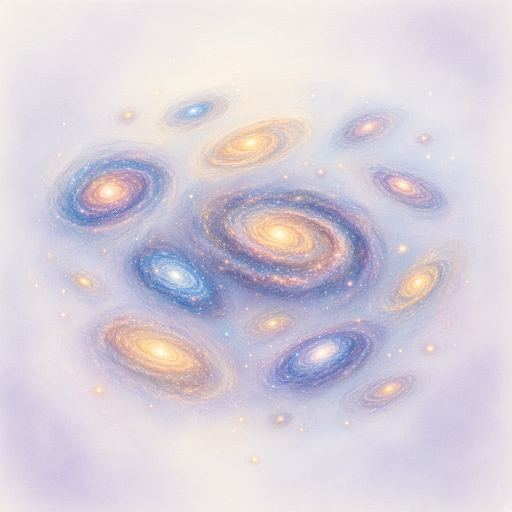
The universe includes all space, time, matter, and energy. The observable universe is the region we can study from Earth because signals from it have had enough time to reach us. The universe is about 13.8 billion years old, and the observable region is roughly 93 billion light-years across. Scientists study it using telescopes, satellites, and careful math.
Why the universe is tricky to understand
The universe is so large and so old that everyday words barely fit. A light-year is the distance light travels in one year, about 6 trillion miles. The observable universe is 93 billion of those. That number is impossible to picture, but it helps to know that even the nearest star to our Sun is more than 4 light-years away.
The universe has also been getting bigger since the moment it began. Because space stretches as it expands, things that were once close are now far apart. This is why the observable universe is 93 billion light-years across even though it is only 13.8 billion years old. Light has been traveling, and the universe has been stretching, at the same time.
Looking deep into space also means looking back in time. Light from very distant galaxies has been traveling for billions of years. When you see that galaxy through a telescope, you see it as it looked billions of years ago, not as it looks today.
Key facts about the universe
The universe is about 13.8 billion years old. Astronomers figured this out by measuring how fast the universe is expanding and by studying the oldest stars.
The observable universe is about 93 billion light-years across. A light-year is about 6 trillion miles, so this is an enormous distance. The universe kept stretching while light was traveling, which is why the size is bigger than the age in years would suggest.
There are at least hundreds of billions of galaxies. Surveys directly reveal enormous numbers, while estimates that include galaxies too faint for current telescopes range as high as roughly two trillion. The total depends on what counts as a galaxy and how unseen populations are modeled.
The universe is expanding. Every large group of galaxies is moving away from every other large group, like dots on a balloon being blown up. This was first shown by astronomer Edwin Hubble in 1929.
You can see back in time with a telescope. Because light takes time to travel, a galaxy 10 billion light-years away looks like it did 10 billion years ago.
About 5 percent of the cosmic energy budget is ordinary matter. That includes every star, planet, rock, and living thing. Roughly 27 percent is attributed to dark matter and 68 percent to dark energy, whose underlying nature remains unknown.
The observable universe may contain around 10²² to 10²⁴ stars. Popular comparisons with grains of beach sand are rough illustrations, not precise counts, because both quantities carry large uncertainties.
Common myths about the universe
Myth: The Big Bang was an explosion in space, like a bomb going off. The hot Big Bang model describes space expanding from an extremely hot, dense early state, not matter exploding outward from one location into a surrounding void. The expansion has no known central point.
Myth: The universe is 13.8 billion light-years across, since that is its age. The universe is 13.8 billion years old, but it is about 93 billion light-years across. Space has been expanding the whole time light has been traveling, so the universe is much wider than its age in light-years would suggest.
Myth: The observable universe has a special center and a wall at its edge. Every observer has an observable boundary set by how far signals could have traveled. On sufficiently large scales, observers in typical galaxies see the same general expansion pattern. The horizon is not a physical wall, and observations reveal no preferred cosmic center.
Myth: Cosmic expansion is only galaxies flying through fixed space like rockets. At large scales, cosmologists describe increasing distances through metric expansion. Galaxies also have local motions caused by gravity, so the raisin-bread analogy captures the Hubble flow but not every galaxy’s movement.
Frequently asked questions about the universe
How do scientists know how old the universe is?
They measure how fast the universe is expanding and trace that expansion backward. They also check the ages of the oldest stars using their light, and they study a faint glow of microwave light called the Cosmic Microwave Background, or CMB. The CMB is leftover light from when the universe was about 380,000 years old. All three methods point to about 13.8 billion years.
What is a galaxy?
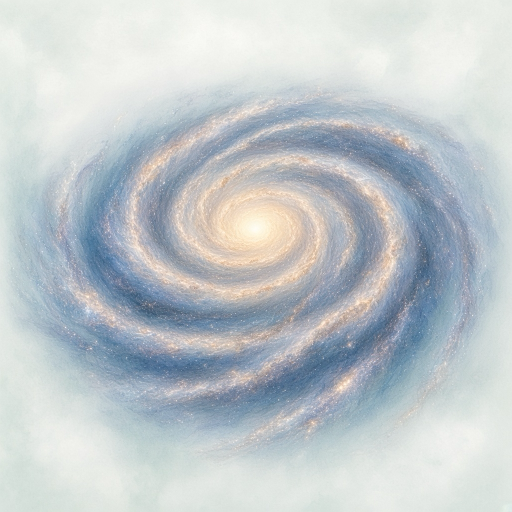
A galaxy is a giant group of stars, gas, and dust held together by gravity. Our galaxy is called the Milky Way. It contains about 200 to 400 billion stars, including our Sun. The Milky Way is just one of hundreds of billions of galaxies in the observable universe.
What are dark matter and dark energy?
Dark matter is the name for a non-luminous component inferred from gravity, including galaxy motions and gravitational lensing. It makes up about 27 percent of the cosmic energy budget. Dark energy is the name for the component associated with accelerating expansion, about 68 percent of the budget. It is not established to be a conventional force or material, and scientists do not yet know the underlying nature of either component.
Is there anything beyond the observable universe?
Most scientists think so. The observable universe is just the part we can see because signals from those regions have had time to reach us. There is no evidence that the universe stops at that boundary. It likely continues much farther, but signals from some regions have not arrived and, in an accelerating universe, some never will.
Why does looking far away mean looking back in time?
Light travels at about 186,000 miles per second. That is very fast, but it still takes time to cross huge distances. Light from the Sun takes about 8 minutes to reach Earth. Light from a galaxy 10 billion light-years away takes 10 billion years. When that light arrives, you see the galaxy as it looked 10 billion years ago.
The observable universe is the part of space we can study from Earth, because light from those regions has had time to reach us since the universe began. It is about 13.8 billion years old, and the farthest point we can see now sits about 46.5 billion light-years away in every direction. That gives the observable universe a diameter of roughly 93 billion light-years. Only about 5 percent of it is matter you can see and touch. The other 95 percent is dark matter and dark energy, two things scientists can measure but have not yet identified.
Why the visible universe is tricky to understand
The age and the size do not seem to match. The universe is 13.8 billion years old, but the observable part is 93 billion light-years across. Space itself has been stretching the whole time light has been traveling. A photon that left a distant region soon after the Big Bang is just arriving now, but the place it started is much farther away than it was back then.
The Big Bang was also not an explosion in the usual sense. The hot Big Bang model describes an early universe that was hot and dense, followed by expansion everywhere rather than outward from a central point. On sufficiently large scales, observers in typical galaxies see the same general pattern: distant galaxies recede on average, with recession rate increasing with distance. Local gravitational motions add exceptions.
Looking far into space also means looking back in time. Light from a galaxy 10 billion light-years away has been traveling for 10 billion years. When it arrives today, you see the galaxy as it looked back then, not as it looks now. Telescopes are time machines that point backward.
Key facts about the visible universe
The universe is 13.787 billion years old. The number comes from the Planck satellite, a European mission that mapped leftover light from the early universe between 2009 and 2013. The age is known to within 20 million years, only 0.1 percent uncertainty.
The observable universe is about 93 billion light-years across. The boundary, called the particle horizon, sits about 46.5 billion light-years away in every direction. Light from beyond has not yet had time to reach us.
The universe is expanding. Every distant group of galaxies is moving away from every other, like dots on a balloon being blown up. Edwin Hubble showed this in 1929 from Mount Wilson Observatory.
The expansion is speeding up. In 1998, teams led by Saul Perlmutter, Brian Schmidt, and Adam Riess found that distant Type Ia supernovae looked dimmer than expected. They shared the 2011 Nobel Prize.
About 5 percent of the universe is ordinary matter. Stars, planets, gas, and people are made of this. About 27 percent is dark matter and about 68 percent is dark energy. Neither has been directly detected in a lab.
The early universe was mostly hydrogen and helium. In the first 20 minutes after the Big Bang, a process called Big Bang nucleosynthesis built about 75 percent hydrogen and 25 percent helium by mass, with traces of deuterium and lithium. Heavier elements came later, inside stars.
The universe was opaque for the first 380,000 years. It was so hot that light kept bouncing off free electrons. As space cooled below about 3,000 K, electrons joined protons to form neutral atoms, and light was free to fly. Astronomers call this moment recombination.
That released light is the cosmic microwave background. The cosmic microwave background, or CMB, is a faint microwave glow coming from every direction. Its temperature is 2.7255 K, near absolute zero. Tiny ripples in it, about one part in 100,000, hold the seeds of every galaxy that later formed.
JWST has spotted galaxies from less than 400 million years after the Big Bang. Launched in late 2021, the James Webb Space Telescope sits about 1 million miles (1.5 million km) from Earth at the Sun-Earth L2 point. Its infrared cameras pick up light stretched by cosmic expansion, revealing the earliest galaxies known.
Common myths about the visible universe
Myth: The Big Bang was an explosion in empty space. The hot Big Bang model describes an early hot, dense universe followed by expansion everywhere. It does not describe matter flying into a surrounding void from a central spot.
Myth: The universe is 13.8 billion light-years across because it is 13.8 billion years old. The universe is 13.8 billion years old, but the observable part is about 93 billion light-years across. Space has been stretching while light has been traveling.
Myth: Dark matter is just normal stuff that is too dim to see. Dark matter cannot be ordinary matter. The light elements made in the first 20 minutes after the Big Bang cap ordinary matter at about 5 percent of the universe. Dark matter is roughly 27 percent, so it has to be something different.
Myth: Dark matter and dark energy are the same thing. Dark matter clumps under gravity and helps explain galaxy motions and structure. Dark energy is the name for the smooth component associated with accelerated cosmic expansion.
Myth: Cosmic expansion is only galaxies flying through fixed space like rockets. On large scales, the space between comoving galaxies expands, like gaps growing between raisins in rising dough. Real galaxies also have peculiar velocities caused by nearby gravity, so they do not literally stay fixed.
Frequently asked questions about the visible universe
How do scientists measure the age of the universe?
They use a few methods that all agree. The most precise uses the cosmic microwave background, the leftover light from when the universe was 380,000 years old. Tiny ripples in that light fit a model of cosmic expansion that gives 13.787 billion years. The ages of the oldest stars and the leftover hydrogen and helium both match.
How can the observable universe be 93 billion light-years across if it is only 13.8 billion years old?
Space has been expanding the whole time light has been traveling. A photon from a distant region has been moving toward us for billions of years, but the region itself has been carried farther away by the stretching of space. The farthest point we can see is now about 46.5 billion light-years away.
What is dark matter, and how do we know it is there?
Dark matter is the name for a non-luminous matter component inferred through gravity. Astronomer Vera Rubin and her colleagues produced influential 1970s evidence that galaxy rotation cannot be explained by visible matter alone. Gravitational lensing and the CMB support the same component, with about five times the cosmic density of ordinary matter in the standard model.
What is dark energy?
Dark energy is the name for whatever drives the accelerating expansion of the universe and accounts for about 68 percent of the standard cosmic energy budget. A cosmological constant is the simplest model. DESI’s three-year results, when combined with some supernova datasets and the cosmic microwave background, strengthen but do not establish hints that the effect may evolve with time.
Is there anything beyond the observable universe?
Most cosmologists think yes. The observable universe is just the part close enough for its light to have reached Earth. The cosmos very likely continues farther in every direction, but light from those regions has not arrived, and some may never arrive because space keeps expanding.
Why do scientists disagree about how fast the universe is expanding?
The current expansion rate is called the Hubble constant. Two methods give different answers. Planck, using the cosmic microwave background, gets about 67.4 km/s per megaparsec. The SH0ES team, using Cepheid variable stars and Type Ia supernovae, gets about 73. The gap is small but statistically strong. It is called the Hubble tension, one of the deepest unsolved puzzles in cosmology.
You can play this topic at any level: Rookie, Curious, Sharp, or Expert. Each quiz set cites a primary source for the specific fact tested.
The observable universe is the region of space from which light has had time to reach Earth since the Big Bang 13.8 billion years ago. Because space has been expanding throughout that travel time, the boundary, called the particle horizon, now sits roughly 46.5 billion light-years away in every direction, giving the observable universe a diameter of about 93 billion light-years. About 5 percent of its energy budget is ordinary atomic matter; the remaining 95 percent is dark matter and dark energy, neither of which has been directly detected. The cosmological model that fits the data, ΛCDM, requires only about six free parameters to reproduce the cosmic microwave background, large-scale galaxy structure, baryon acoustic oscillations, and Big Bang nucleosynthesis at once.
What is often misunderstood about the visible universe
The age of 13.8 billion years and the diameter of 93 billion light-years do not match because the universe has been expanding while light has been traveling. A photon emitted shortly after the Big Bang has spent nearly the full age of the cosmos reaching Earth, but the patch of space where that photon started is now around 46 billion light-years away. The 13.8 billion year figure is light-travel time. The 93 billion light-year figure is current proper distance.
The hot Big Bang was not an explosion from one point into surrounding space. It describes an early hot, dense universe followed by expansion of the metric itself. Observations reveal no preferred center or physical wall at the observable horizon. On sufficiently large scales, typical observers see recession rate increase with distance, the pattern described by the Hubble-Lemaître law; local gravitational motions create exceptions.
Galaxies that are now beyond a certain distance recede from us faster than the speed of light. This does not violate special relativity, which forbids local motion through space faster than light. Cosmological recession is the stretching of the space between galaxies, not local motion within space. No information is transmitted faster than light.
The terms dark matter and dark energy label two distinct sets of measured phenomena whose underlying physics is unknown. Galaxy dynamics, gravitational lensing, the CMB acoustic spectrum, and large-scale structure support a non-luminous matter component. Supernova distances, BAO, and the CMB support accelerated expansion. Big Bang nucleosynthesis independently limits ordinary baryonic matter, helping show that unseen ordinary matter cannot supply the full dark-matter density.
Key facts about the visible universe
Age of the universe: 13.787 ± 0.020 billion years (Planck 2018).
Diameter of the observable universe: about 93 billion light-years. The particle horizon, the maximum proper distance from which light has had time to reach us, is currently about 14.4 gigaparsecs (about 46.5 billion light-years).
Number of galaxies: estimates range from hundreds of billions to roughly two trillion when models include systems too faint for current surveys. The number remains definition- and model-dependent rather than a direct complete count.
CMB temperature today: 2.7255 ± 0.0006 K, with anisotropies of order 10⁻⁵ on top of a near-uniform background.
Composition by energy density: roughly 5 percent baryonic matter, 27 percent cold dark matter, 68 percent dark energy.
ΛCDM parameter count: the minimal model has six core parameters. A common CMB basis uses baryon density, cold-dark-matter density, acoustic angular scale, reionization optical depth, scalar spectral index, and primordial amplitude; quantities such as H₀ and ΩΛ are then derived within the model.
Hubble constant: Planck CMB analysis gives H₀ ≈ 67.4 km/s/Mpc; the SH0ES distance ladder using Cepheid variables and Type Ia supernovae gives H₀ ≈ 73.0 km/s/Mpc. The disagreement, called the Hubble tension, exceeds 5σ.
Recombination: at redshift z ≈ 1100, when the universe was about 380,000 years old and had cooled to roughly 3,000 K, electrons and protons combined into neutral hydrogen and the universe became transparent. Photons released then are what telescopes today record as the CMB.
Reionization: between z ≈ 20 and z ≈ 6, roughly 200 million to 1 billion years after the Big Bang, the first stars and quasars re-ionized the neutral hydrogen left after recombination.
Cosmic neutrino background: relic neutrinos that decoupled about 1 second after the Big Bang have cooled with the expansion to about 1.95 K. The CνB has not yet been directly detected.
Inflation: a family of models proposes a brief period of accelerated expansion in the very early universe. Its duration, energy scale, and growth factor depend on the model. Inflation can explain the observed near-flatness and seed the primordial fluctuations seen in the CMB, but the responsible field and detailed mechanism remain unconfirmed.
Baryon acoustic oscillations: sound waves in the early photon-baryon plasma left a characteristic scale of roughly 150 megaparsecs in the later distribution of galaxies. The relevant standard ruler is the sound horizon at the baryon-drag epoch, slightly after photon decoupling, and surveys including SDSS, BOSS, eBOSS, and DESI measure it across redshift.
Common myths about the visible universe
Myth: The Big Bang was an explosion that flung matter outward through space. The hot Big Bang model describes metric expansion from an early hot, dense state. There is no observed central point or preferred direction. At large distances, typical observers see the Hubble flow, while nearby gravitationally bound galaxies can approach one another.
Myth: The universe is 13.8 billion light-years across. It is 13.8 billion years old, not 13.8 billion light-years across. The observable universe is about 93 billion light-years in diameter because space has expanded during the time light has been traveling.
Myth: Galaxies receding faster than light violate special relativity. Special relativity forbids local motion through space faster than light. The recession of distant galaxies is the stretching of the space between us and them. No information is transmitted faster than light.
Myth: Dark matter is just normal matter we have not yet detected. Dark matter does not absorb, emit, or reflect light at any wavelength. Galaxy rotation curves measured by Vera Rubin and Kent Ford in the 1970s, gravitational lensing maps, the CMB acoustic peak structure, and large-scale structure surveys all require a non-baryonic component about five times more abundant than ordinary matter. Big Bang nucleosynthesis sets a tight upper bound on the total density of baryons that rules out hidden ordinary matter as the explanation.
Myth: Edwin Hubble discovered cosmic expansion alone. Vesto Slipher had measured galaxy redshifts at Lowell Observatory through the 1910s. Georges Lemaître published a paper in 1927 deriving an expanding-universe solution to general relativity and an estimate of the expansion rate. Hubble’s 1929 paper combined his Cepheid distances with Slipher’s redshifts to establish the linear distance-velocity relation now called Hubble’s law.
Myth: Cosmologists know what dark energy is. Observations show accelerated expansion, and a cosmological constant with w = -1 remains the simplest explanation. DESI’s three-year BAO analysis combined with CMB and supernova datasets finds dataset-dependent preferences of roughly 2.8 to 4.2 standard deviations for an evolving equation of state, not enough to establish a discovery. Comparisons between observed dark-energy density and naive high-energy cutoffs in quantum field theory are often quoted as differing by as much as about 120 orders of magnitude, but the exact figure depends on how the theoretical estimate is framed.
Myth: ΛCDM has dozens of free parameters and is therefore unfalsifiable. ΛCDM has about six free parameters that fit the CMB, BAO, supernova, and large-scale structure data simultaneously. The model’s economy is what makes it testable, and the Hubble and σ_8 tensions show that the data are precise enough to challenge it.
Frequently asked questions about the visible universe
How big is the observable universe?
About 93 billion light-years across. The particle horizon, the maximum distance from which light has had time to reach Earth, is currently about 46.5 billion light-years. Light from beyond that boundary has not yet had time to arrive.
How old is the universe?
About 13.787 billion years, with an uncertainty of about 20 million years. The age comes from fitting the CMB power spectrum to the ΛCDM model, cross-checked against the ages of the oldest globular cluster stars and the abundances of light elements from Big Bang nucleosynthesis.
How many galaxies are there?
Estimates range from a few hundred billion to about two trillion. The higher figure comes from a 2016 deep-field analysis that modeled galaxies too faint to detect directly. It is an extrapolation rather than a settled census, and the answer depends on survey depth, modeling, and the definition of a galaxy.
What is the cosmic microwave background?
The afterglow of the recombination epoch. About 380,000 years after the Big Bang, the universe cooled enough for electrons to bind to protons, ending the era when photons and matter were tightly coupled. Those photons have been redshifting with cosmic expansion ever since and now appear as a near-uniform 2.725 K microwave glow with anisotropies of order 10⁻⁵.
What is dark matter?
A non-luminous, non-baryonic mass component that interacts gravitationally but not electromagnetically. It accounts for about 27 percent of the cosmic energy budget. Candidates include weakly interacting massive particles, axions, sterile neutrinos, and primordial black holes. No direct detection has been confirmed.
What is dark energy?
A component used to describe accelerating cosmic expansion, accounting for about 68 percent of the standard-model energy budget. The simplest description is a cosmological constant Λ with equation of state w = -1. DESI’s three-year BAO results strengthen dataset-dependent hints of evolution when combined with CMB and supernova data, but the evidence has not reached the threshold for a discovery.
What is the Hubble tension?
A persistent disagreement between two methods of measuring the present-day expansion rate. CMB-based analysis (Planck) gives H₀ ≈ 67.4 km/s/Mpc. Distance-ladder analysis with Cepheid variables and Type Ia supernovae (SH0ES) gives H₀ ≈ 73 km/s/Mpc. The two values differ by more than 5σ. Whether the resolution lies in unknown systematics or new physics beyond ΛCDM is unsettled.
What was Population III?
The first generation of stars, formed from primordial hydrogen and helium with effectively no metals. Theory predicts they were very massive, perhaps 100 solar masses or more, and short-lived. None has been directly identified to date. JWST’s near-infrared sensitivity is the leading prospect for detection.
What came before the Big Bang?
The question is unsettled. General relativity breaks down at the singularity, so any honest answer requires a quantum theory of gravity that physics does not yet possess. Eternal-inflation, cyclic-cosmology, and string-theory multiverse proposals exist, but none has been confirmed by observation.
Trivia question references throughout this topic’s Rookie, Curious, Sharp, and Expert quiz sets each cite a primary source for the specific fact tested.
The observable universe is the region from which signals could in principle have reached an observer at Earth over cosmic history, bounded by the particle horizon. Its present proper diameter is about 93 billion light-years. That distance comes from integrating photon propagation through an expanding metric, not simply multiplying the 13.8 billion year age by the present speed of light. Electromagnetic observations themselves begin at the surface of last scattering because the earlier plasma was opaque. The minimal ΛCDM model uses six core parameters to fit the cosmic microwave background acoustic spectrum and, with linked physics, BAO, supernova, and nucleosynthesis observations. Persistent disagreements such as the Hubble tension and weaker clustering tensions drive much current research.
Why observational cosmology is non-intuitive
Distance in cosmology is not a single quantity. Cosmologists distinguish comoving distance, proper distance, light-travel distance, angular-diameter distance (which decreases at very high redshift because the source was closer when the light was emitted), and luminosity distance (which grows faster than the others because of redshift dimming and time dilation). The five agree only at low redshift. The 46.5 billion light-year particle horizon is a present proper distance; the 13.8 billion year age is a proper time interval. Quoting either as the “size” of the universe without specifying which collapses a meaningful distinction.
The cosmological constant introduces the second source of confusion. A positive Λ does not merely add a uniform repulsive force; in the Friedmann equations it acts as a vacuum energy density with negative pressure and equation-of-state parameter w = -1, driving accelerating expansion at late times. Comparisons with naive quantum-field cutoffs are often quoted as overshooting the observed density by as much as roughly 120 orders of magnitude, although the number depends on the assumptions and regularization used. No widely accepted resolution exists.
The Hubble tension is the third. Two methods measure the present-day expansion rate. CMB-anchored inference within ΛCDM gives a value near 67.4 km/s/Mpc. The local distance ladder, anchored on geometric parallax, Cepheid period-luminosity calibration, and Type Ia supernova standardization, gives a value near 73.0 km/s/Mpc. The discrepancy exceeds five sigma. Whether the resolution lies in systematics or in physics beyond ΛCDM (early dark energy, evolving dark-energy equation of state, modified neutrino sectors) is unsettled.
Key facts
Planck 2018 cosmological parameters. A flat ΛCDM fit gives Ωm = 0.3153 ± 0.0073, ΩΛ = 0.6847 ± 0.0073, with total Ω consistent with one to better than 0.4 percent. The matter density splits as Ωb ≈ 0.049 (baryons) and Ωdm ≈ 0.265 (cold dark matter). The age of the universe is 13.787 ± 0.020 billion years.
CMB acoustic spectrum. The temperature power spectrum displays acoustic peaks from baryon-photon oscillations in the pre-recombination plasma. The first peak sits near multipole ℓ ≈ 220 and strongly constrains spatial curvature when combined with the model’s other parameters. Relative peak heights constrain baryon and dark-matter densities, while the damping tail adds sensitivity to recombination physics, radiation content, and helium abundance.
Recombination and last scattering. Recombination occurred at redshift z ≈ 1100, when the universe was about 380,000 years old and the photon temperature dropped to roughly 3,000 K, allowing electrons to bind to protons and the universe to become transparent. The CMB photons today are observed at 2.7255 ± 0.0006 K with anisotropies of order 10⁻⁵ on the dipole-subtracted background.
Baryon acoustic oscillations. A characteristic comoving scale of about 150 megaparsecs, set by the sound horizon at the baryon-drag epoch slightly after photon decoupling, imprints the galaxy correlation function. SDSS, BOSS, eBOSS, and DESI use this scale as a standard ruler at multiple redshifts to constrain expansion history and the dark-energy equation of state.
Hubble tension. Planck CMB analysis within ΛCDM gives H₀ ≈ 67.4 km/s/Mpc. The SH0ES distance ladder using parallax, Cepheid variables, and Type Ia supernovae gives H₀ ≈ 73.0 km/s/Mpc. The discrepancy exceeds 5σ in the most recent analyses.
σ8 tension. The amplitude of matter clustering on 8 megaparsec-per-h scales, σ8, derived from the CMB sits modestly higher than the value inferred from low-redshift weak gravitational lensing surveys (KiDS, DES, HSC). The disagreement is at the 2 to 3 sigma level, less severe than the Hubble tension but still motivating systematic checks and beyond-ΛCDM proposals.
Dark-energy equation of state. A pure cosmological constant has w = -1 exactly. DESI’s three-year BAO analysis combined with CMB and different supernova compilations finds preferences ranging from about 2.8 to 4.2 standard deviations for a time-varying equation of state. That is stronger than the first-year hint but remains dataset-dependent and below discovery significance.
Type Ia supernovae as standardizable candles. Type Ia supernovae are thermonuclear explosions of carbon-oxygen white dwarfs in binary systems, with more than one progenitor channel under study, including sub-Chandrasekhar and near-Chandrasekhar scenarios. Their luminosities can be standardized using light-curve shape and color relations, enabling the 1998 acceleration discovery and modern distance-ladder work.
JWST high-redshift galaxies. Deep-field campaigns such as JADES and CEERS have spectroscopically confirmed luminous galaxies beyond z = 10. Their early abundance and brightness prompted revisions to galaxy-formation models, but inferred stellar masses and redshifts for some initial candidates changed with spectroscopy, emission-line treatment, and improved modeling. The observations test star-formation efficiency and feedback; they do not by themselves establish a failure of ΛCDM.
Cosmological event horizon. In a ΛCDM-like accelerating future, the present proper radius of the boundary beyond which signals emitted now will never reach us is roughly 16 billion light-years. We can still observe older light from some galaxies currently beyond that boundary, but their newly emitted signals cannot cross it toward us. This differs from the roughly 46.5 billion light-year particle horizon.
Neutrino mass bounds from cosmology. Massive neutrinos suppress small-scale structure through free streaming. In minimal ΛCDM extensions, combinations of CMB, BAO, and other structure data often constrain the summed mass near or below the 0.1 eV scale, but the numerical bound is model- and dataset-dependent. Laboratory beta-decay limits are weaker but rely on fewer cosmological assumptions.
Dark-matter halos. Galaxy rotation curves remain flat well beyond the optical disk, requiring extended halos. Stellar-stream kinematics and cosmological simulations place the Milky Way’s halo virial radius near 600,000 to 1,000,000 light-years, with a total mass near 10¹² solar masses, dominated by dark matter.
Gravitational lensing. Strong lensing produces multiple images, arcs, and Einstein rings; weak lensing produces statistical shape distortions. In the Bullet Cluster, the lensing-inferred mass is separated from most of the hot baryonic gas, strong evidence consistent with a largely collisionless dark-matter component. JWST’s observations of the lensed star Earendel at z ≈ 6.2 behind WHL0137-08 illustrate how clusters function as cosmic telescopes.
Common misconceptions at expert level
Misconception: Planck data establish substantial cosmic curvature. A small preference for closed geometry in parts of the Planck-only analysis disappears when polarization, BAO, and lensing data are combined. Within the joint ΛCDM analysis, Ωk is consistent with zero at sub-percent precision.
Misconception: The first CMB acoustic peak sits at the dipole. The dipole at multipole ℓ = 1 is dominated by the solar system’s roughly 230 mi/s (370 km/s) motion through the CMB rest frame, not by primordial physics. The first acoustic peak sits at ℓ ≈ 220 and reflects the angular size of the sound horizon at last scattering. Mistaking the dipole for an acoustic peak is a common confusion in introductory treatments.
Misconception: Type Ia supernovae are intrinsically standard candles. Their peak luminosities scatter by roughly half a magnitude before correction. Mark Phillips’s 1993 result showed that brighter Type Ia events decline more slowly, and applying that brightness-decline relation along with color corrections compresses the residual scatter to about 10 percent. The candles are standardizable, not standard.
Misconception: Dark energy and the cosmological constant are interchangeable terms. The cosmological constant Λ is a specific model with equation of state w = -1 exactly and constant energy density. Dark energy is the broader phenomenological label for whatever drives accelerating expansion, including dynamical models whose w may vary. Λ remains the minimal explanation, while DESI’s three-year combinations provide notable but not decisive evidence for departures in some dataset choices.
Misconception: The cosmological event horizon equals the particle horizon. The particle horizon at roughly 46.5 billion light-years marks the present limit of past causal contact; the event horizon at roughly 16 billion light-years marks the present boundary for future signals in ΛCDM. They encode different integrals over expansion history, and in many non-accelerating cosmologies no finite event horizon exists at all.
Misconception: Cosmological recession greater than c violates relativity. Special relativity forbids local motion through space at speeds exceeding c. Cosmological recession is the rate of growth of proper distance under a time-dependent metric, not local motion. Galaxies beyond the Hubble radius recede superluminally without violating any local Lorentz constraint, and no information is transmitted.
Misconception: ΛCDM has dozens of free parameters and cannot be falsified. Minimal ΛCDM uses six core parameters. A common CMB basis contains baryon density, cold-dark-matter density, acoustic angular scale, reionization optical depth, scalar spectral index, and primordial amplitude; H₀ and ΩΛ are derived within that basis. Its economy makes cross-dataset tensions meaningful.
Frequently asked questions
Why do the particle horizon and the age of the universe give different distances?
Both are computed from the same cosmic history but integrate different quantities. The age is the proper-time integral along a comoving observer’s worldline from the singularity to today. The particle horizon is the comoving distance a photon has traveled, the integral of c divided by the scale factor. Because the scale factor was very small at early times, every unit of cosmic time multiplied the comoving reach by a factor much greater than c times that interval. The present particle horizon proper distance comes out near 46.5 billion light-years, larger than 13.8 billion light-years by roughly a factor of 3.36 in flat ΛCDM.
What sets the location of the first CMB acoustic peak?
The angular scale of the sound horizon at last scattering, projected onto the sky from redshift z ≈ 1100. In a spatially flat baseline model, that scale places the first peak near ℓ ≈ 220. Curvature changes the projection, but the inference is geometrically degenerate with other cosmological parameters, so precise flatness constraints come from combining the CMB spectrum with BAO, lensing, and other data rather than from one peak alone.
How does the Hubble tension differ from the σ8 tension?
The Hubble tension is a 5σ-plus disagreement on the present-day expansion rate between the high-redshift CMB inference and the low-redshift distance ladder, both anchored by independent calibrations. The σ8 tension is a 2 to 3 sigma disagreement on the late-time amplitude of matter clustering between the CMB-extrapolated value and direct weak-lensing measurements. The two could share a common explanation in a beyond-ΛCDM model that suppresses late-time growth, but no single proposed extension cleanly resolves both at present.
Why is the dark-energy equation of state so close to minus one?
A constant Λ adds a term to the stress-energy tensor proportional to the metric, with energy density independent of cosmic time. Conservation of stress-energy then forces the pressure to equal minus the energy density, giving w = -1 exactly. Many datasets remain well described by Λ, but DESI’s three-year BAO results combined with CMB and supernova data now show dataset-dependent preferences for an evolving equation of state. These combinations do not yet establish evolution, and continued observations and independent systematics checks are needed.
How do JWST early-galaxy results stress ΛCDM?
ΛCDM supplies the halo population, while baryonic galaxy-formation prescriptions predict how luminous those halos become. JWST has confirmed unexpectedly bright galaxies at z > 10, but some early redshift and mass estimates were revised after spectroscopy and improved emission-line modeling. Current work focuses on star-formation efficiency, feedback, dust, stellar populations, and active galactic nuclei. The observations challenge galaxy-formation prescriptions more directly than the underlying ΛCDM expansion model.
Why are dark-matter halos so much larger than galactic disks?
Disks form from the dissipative collapse of baryonic gas, which radiates energy and settles into a rotationally supported plane. In the standard model, cold dark matter does not dissipate energy this way and forms an extended, roughly spheroidal halo. Flat rotation curves beyond much of the visible disk imply that enclosed mass continues to increase with radius. Simulations, satellite motions, and stellar streams indicate that the Milky Way’s dark halo extends many times farther than its bright stellar disk.
What does the cosmological event horizon mean for the deep future?
In a Λ-dominated future, the event horizon has a finite present proper radius, while its comoving radius shrinks as time advances. More galaxies outside the Local Group will cross the horizon for newly emitted signals, and their already received light will redshift toward undetectability. Eventually gravitationally bound systems will dominate the accessible sky, and evidence such as the CMB, distant supernovae, and BAO will become extraordinarily difficult to observe.
Trivia question references throughout this topic’s Rookie, Curious, Sharp, and Expert quiz sets each cite a primary source for the specific fact tested.
Think you know The Visible Universe?
Test yourself. Can you spot the true fact among 3 convincing bluffs?