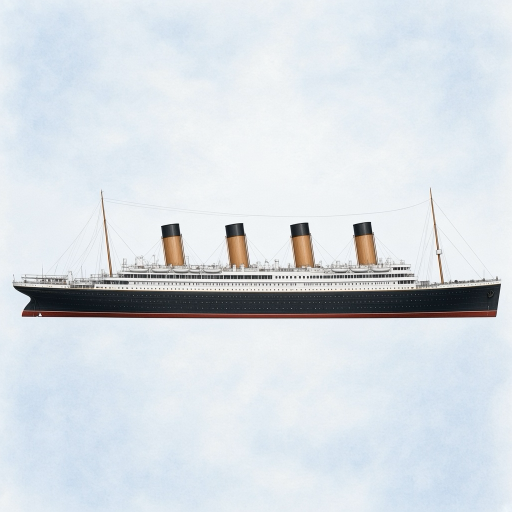
The Titanic was a giant passenger ship that carried people across the ocean. It was one of the biggest ships in the whole world at the time. On its very first trip in 1912, it hit an iceberg and sank. About 1,500 people on board were lost.
Why the Titanic is still so famous
The Titanic was supposed to be the safest ship on the sea. People thought it was almost impossible to sink. Then it sank on its first voyage, which surprised the whole world.
The ship was also huge. It was about 882 feet (269 m) long. That is longer than three football fields lined up end to end. It had four tall smokestacks, called funnels, on the top deck. Some of the rooms looked like a fancy hotel.
The saddest part is the lifeboats. The Titanic did not carry enough lifeboats for everyone on board. When the ship was sinking, there was no room in the boats for many of the people. After that, leaders around the world made new rules so every ship would carry enough lifeboats. The story of the Titanic still teaches people to be careful at sea.
Key Titanic facts
Where it was built. The Titanic was built in a shipyard in the city of Belfast, in a place called Harland and Wolff. The builders gave it the number 401.
How big. The ship was about 882 feet (269 m) long. It was almost as long as the height of a tall skyscraper laid on its side.
Where it was going. The Titanic left England and was sailing to New York City in the United States. It stopped in France and in Ireland on the way.
What RMS means. The letters RMS in front of the name stand for Royal Mail Ship. That means the Titanic carried mail across the ocean, not just people.
The iceberg. Late at night on April 14, 1912, the Titanic hit a giant iceberg in the dark. The ice split open several narrow gaps along the side of the ship below the water.
When it sank. The ship sank in the early hours of the next morning, on April 15, 1912.
How many people. About 2,224 people were on board, counting passengers and the crew who ran the ship.
The rescue. Another ship called the Carpathia raced to the spot and picked up the people from the Titanic’s lifeboats. It carried them safely to New York.
Found again. The wreck of the Titanic was lost for many years. A team found it deep on the ocean floor in 1985.
How the Titanic was found again
After the Titanic sank, nobody knew exactly where it was for more than 70 years. The ocean is very deep and very dark, and the ship was hard to find.
In 1985, a scientist named Robert Ballard led a team to look for it. They used cameras pulled along behind a ship to look at the ocean floor. They did not look for the huge ship first. They looked for small pieces that had fallen off and spread out. Following those pieces led them straight to the wreck. The Titanic was sitting about 12,500 feet (3,800 m) down, which is more than 2 miles (3.8 km) deep.
Common myths about the Titanic
Myth: The company promised the Titanic could never sink. No one ever made an official promise that it was unsinkable. A magazine for ship builders called the design “practically unsinkable,” which means almost, not totally. Newspapers and people left out the word “practically.”
Myth: The Titanic did not carry any lifeboats. The Titanic did have lifeboats. It carried 20 of them. The problem was that 20 boats had room for only about half the people on board.
Myth: The Titanic was the only ship that could have helped. Another ship, the Carpathia, did rush to the rescue. It was the Carpathia that saved the people in the lifeboats and took them to New York.
Myth: People have lifted the whole Titanic out of the water. The wreck is still on the ocean floor today. It is far too big and too broken to lift. Only small objects have been brought up.
Frequently asked questions about the Titanic
How big was the Titanic?
The Titanic was about 882 feet (269 m) long. That is longer than three football fields in a row. It was one of the largest ships in the world when it was built.
Why did the Titanic sink?
The Titanic hit an iceberg late at night. The ice split open several narrow gaps along the side of the ship below the water. Water poured in faster than the ship could handle, and it sank a few hours later.
Where was the Titanic built?
The Titanic was built in Belfast, a city in Northern Ireland, at a shipyard called Harland and Wolff. The builders gave it the number 401 while they were making it.
How many lifeboats did the Titanic have?
The Titanic had 20 lifeboats. Those boats had room for only about half of the people on board. That is why so many people could not get a seat when the ship was sinking.
Where is the Titanic now?
The wreck of the Titanic sits on the floor of the North Atlantic Ocean. It is about 12,500 feet (3,800 m) deep. A team found it there in 1985.
Each quiz question cites a source for the fact it tests. You can play the Titanic trivia quiz at the Rookie level, a 10-question true-or-bluff round for kids.
The Titanic was a British ocean liner that carried passengers across the Atlantic Ocean and sank on its first voyage in 1912. It was one of the largest ships in the world, measuring about 882 feet (269 m) from end to end. The ship struck an iceberg late on April 14, 1912, and sank in the early hours of April 15. About 1,500 of the roughly 2,224 people aboard were lost, making it one of the worst peacetime disasters at sea.
Why the Titanic surprised the world
The Titanic was meant to be a triumph of engineering. It was built to be huge, fast, and comfortable, with a clever safety design that many people believed made it nearly impossible to sink. When it went down on its very first crossing, the gap between that promise and what happened shocked people everywhere.
Part of the shock was timing. The Titanic was brand new. It was carrying some of the most famous and wealthy people of its day, along with hundreds of families hoping to start new lives in America. The disaster also showed that the rules meant to keep ships safe had not kept up with how large ships had become. That lesson changed the way every ship at sea is run.
Key Titanic facts
Builder. The Titanic was built by Harland and Wolff in Belfast, where it carried the yard number 401. It was owned by a company called the White Star Line.
Size. About 882 feet (269 m) long and rated at about 46,328 gross register tons. That tonnage number measures the enclosed space inside the ship, not its weight.
Sister ships. The Titanic had 2 nearly identical sister ships, the Olympic and the Britannic. The 3 were built to the same Olympic-class design.
Four funnels. The ship had 4 tall funnels, but only 3 of them carried smoke from the boilers. The fourth was added partly for looks and for ventilation.
Maiden voyage. The first trip began in Southampton, England, then stopped in Cherbourg, France, and Queenstown (now Cobh), Ireland, before heading for New York.
The collision. The Titanic struck the iceberg at about 11:40 p.m. on April 14, 1912. The lookouts had no binoculars that night, and lookout Frederick Fleet spotted the iceberg with his eyes.
The sinking. The ship sank at about 2:20 a.m. on April 15, 1912, less than 3 hours after the collision.
Lifeboats. The Titanic carried 20 lifeboats with room for about 1,178 people, only about half of those aboard.
The rescue. The Cunard liner Carpathia picked up the distress call and raced through the ice to reach the lifeboats. It rescued the survivors and carried them to New York.
The wreck. The Titanic rests about 12,500 feet (3,800 m) down on the floor of the North Atlantic. A team led by Robert Ballard found it in 1985.
The lifeboat shortage
The most important fact about the Titanic is that it did not carry enough lifeboats. With 20 boats and room for about 1,178 people, the ship could seat only about half of the roughly 2,224 people aboard.
Here is the surprising part: the Titanic broke no law. British lifeboat rules at the time were written in 1894, when the biggest ships were far smaller. Those rules set the number of lifeboats by a ship’s tonnage and stopped at vessels over 10,000 tons, which had to carry 16 boats. The Titanic was more than 4 times that size, yet it only had to meet the 16-boat minimum. It actually carried 20, more than the law required. The rule was simply far out of date.
When the ship was sinking, the shortage got worse because some boats were lowered only partly full. The very first lifeboat to leave carried only about 28 people, even though it had room for 65. In the confusion and the cold, crews launched boats before they were full.
The rescue and the ship that did not come
After the collision, the Titanic sent out radio distress calls and fired white rockets into the night sky to signal for help. The Carpathia, about 58 miles (93 km) away, heard the call. Its captain, Arthur Rostron, ordered full speed and steered through a field of ice to reach the lifeboats around 4:00 in the morning.
A second ship, the Californian, was stopped in the ice much closer. Its only radio operator had gone off duty, so the Titanic’s calls went unheard. Crew on watch saw white rockets but did not act in time. Both the American and British investigations later criticized the Californian for not coming to help.
Common myths about the Titanic
Myth: The Titanic was officially called “unsinkable.” It was always called the Titanic. A 1911 trade journal said its design made it “practically unsinkable,” a careful phrase. The press and the public dropped the word “practically” and spread the flat claim.
Myth: The watertight compartments should have saved it. The Titanic was divided into 16 watertight compartments, but the walls between them did not reach all the way up. Once the bow tipped down, water spilled over the tops of the walls from one compartment into the next.
Myth: The Titanic could float no matter how much was flooded. It was designed to stay afloat with up to 4 of its forward compartments flooded. The iceberg damaged more than that, which is why it sank.
Myth: The whole Titanic was raised and put in a museum. The hull was never raised and is still on the ocean floor. Only smaller artifacts have been recovered. The wreck is too large and too fragile to lift.
Frequently asked questions about the Titanic
How many people died on the Titanic?
About 1,500 of the roughly 2,224 people aboard were lost. Around 705 to 710 survived in the lifeboats and were rescued by the Carpathia. The exact totals differ slightly between the American and British inquiries.
Why did the Titanic not have enough lifeboats?
The lifeboat rules of 1912 were written in 1894 and were based on a ship’s tonnage, not the number of people aboard. The rules stopped at ships over 10,000 tons and required only 16 boats. The Titanic was much larger but still only had to meet that old minimum.
What were the Titanic’s sister ships?
The Olympic and the Britannic. All 3 were built by Harland and Wolff to the same Olympic-class design. The Olympic had a long career, while the Britannic sank during the First World War.
What ship rescued the survivors?
The Carpathia, a Cunard passenger liner commanded by Captain Arthur Rostron. It raced about 58 miles (93 km) through the ice and reached the lifeboats around 4:00 a.m.
What changed after the Titanic sank?
Nations agreed on shared safety rules. The first International Convention for the Safety of Life at Sea, known as SOLAS, was adopted in 1914. Its rules called for lifeboat space for everyone aboard and a constant radio watch, and a version of SOLAS is still the leading sea-safety treaty today.
Each quiz question cites a source for the fact it tests. You can play the Titanic trivia quiz at the Curious level, a 10-question true-or-bluff round.
The Titanic was a British ocean liner that struck an iceberg and sank on its maiden voyage across the North Atlantic in April 1912. Built by Harland and Wolff in Belfast for the White Star Line, it ran about 882 feet 9 inches (269 m) long and was rated at about 46,328 gross register tons, among the largest ships in the world at the time. It hit the iceberg at about 11:40 p.m. on April 14, 1912, and sank about 2 hours and 40 minutes later, at roughly 2:20 a.m. on April 15. Of the roughly 2,224 people aboard, about 1,500 were lost.
Why the Titanic still draws attention
The Titanic is the most famous shipwreck in history for reasons that go beyond its size. It was a state-of-the-art vessel that sank on its first commercial crossing, undone not by a storm or a war but by a single iceberg on a calm, clear night. The contrast between the ship’s reputation for safety and the speed of its loss is the core of the story.
The disaster also sits at a turning point in technology and rules. The Titanic carried wireless radio, watertight compartments, and a hybrid steam-power plant, all near the cutting edge of 1912. Yet the regulations that governed lifeboats had been written in 1894, before ships approached the Titanic’s scale. The gap between the ship’s engineering and the law that governed its safety equipment is what makes the Titanic a case study, not just a tragedy. Within 2 years, that gap produced the first international maritime safety treaty.
How the ship was built and powered
The Titanic was constructed at the Harland and Wolff shipyard in Belfast, where it carried the builder’s yard number 401. Its keel was laid in March 1909, the hull was launched in May 1911, and after fitting out and a single day of sea trials on April 2, 1912, it was delivered to the White Star Line. The home port of Liverpool was painted on the stern, which sometimes causes confusion, but the ship was Belfast-built throughout.
Power came from an unusual hybrid system. Two large reciprocating (piston) steam engines turned the 2 outer, or wing, propellers. The low-pressure exhaust steam left over from those engines was then fed into a central turbine that spun the middle propeller, recovering energy that would otherwise have been wasted. This piston-and-turbine combination, shared with the sister ship Olympic, gave a good cruising speed without the fuel cost of an all-turbine plant. The ship had 4 tall funnels, but only 3 vented the boilers; the fourth served mainly for ventilation and balance in the ship’s profile.
The maiden voyage
The Titanic left Southampton, England, on April 10, 1912. As it pulled away, the water it displaced created a suction that snapped the mooring lines of the docked liner New York, whose stern swung toward the passing Titanic. A tugboat and quick maneuvering kept the 2 ships a few feet apart, and the departure was delayed about an hour. The Titanic then crossed to Cherbourg, France, and on to Queenstown (now Cobh), Ireland, before turning out into the open Atlantic, bound for New York.
Among those aboard were the ship’s designer, Thomas Andrews of Harland and Wolff, who sailed to observe how the new vessel performed, and J. Bruce Ismay, chairman and managing director of the White Star Line. The captain was Edward Smith, one of the line’s most senior officers, who had commanded White Star’s newest ships on their maiden voyages for years, including the Olympic in 1911.
The collision and the sinking
On the night of April 14, the lookouts had no binoculars, and lookout Frederick Fleet spotted the iceberg by eye with little time to react. The ship turned and reversed, but at about 11:40 p.m. the iceberg scraped along the starboard side below the waterline, opening the hull across several of the forward watertight compartments.
The Titanic was designed to stay afloat with up to 4 of its forward compartments flooded. The damage flooded more than that. As the bow settled lower, water spilled over the tops of the watertight bulkheads, which did not extend high enough to seal each compartment, and poured into the next compartment in turn. The ship sent wireless distress calls and fired white distress rockets. It sank at about 2:20 a.m. on April 15, roughly 2 hours and 40 minutes after the impact.
The lifeboat shortage
The central safety failure was the number of lifeboats. The Titanic carried 20 of them, with a combined capacity of about 1,178 people, against the roughly 2,224 aboard, room for only about half.
The ship had broken no rule. British lifeboat regulations of 1912 came from the Merchant Shipping Act of 1894, when the largest vessels in service were far smaller. Those rules set lifeboat numbers by gross tonnage and stopped at ships over 10,000 tons, which had to carry 16 boats. The Titanic was more than 4 times that tonnage, yet it only had to meet the same 16-boat minimum. By carrying 20, it actually exceeded the legal requirement. The standard was simply obsolete for a ship of its scale.
The shortage was compounded on the night itself. Several boats were lowered before they were full. The first lifeboat launched carried about 28 people despite room for 65. The 2 officers running the boats also read the loading order differently: on the port side, Second Officer Charles Lightoller enforced “women and children only” and lowered boats with empty seats, while on the starboard side, First Officer William Murdoch read it as “women and children first” and allowed some men to board once nearby women and children had been seated.
The rescue and the Californian
The Cunard liner Carpathia, about 58 miles (93 km) away, picked up the Titanic’s distress call near midnight. Its captain, Arthur Rostron, ordered full speed and steered through the same ice field that had sunk the Titanic, reaching the lifeboats around 4:00 a.m. The Carpathia took the survivors aboard, about 705 to 710 people, and carried them to New York.
A nearer ship did not respond. The SS Californian had stopped for the night, surrounded by ice, within sight of distant lights that may have been the Titanic. Its single wireless operator had gone off duty, so the Titanic’s radio calls went unheard. Crew on watch saw white rockets but did not act in time. Both the United States Senate inquiry and the British Wreck Commissioner’s inquiry criticized the Californian’s response, although the exact distance and what its crew could have done remain debated.
Finding the wreck in 1985
The Titanic’s resting place was unknown for more than 70 years. In 1985, a joint expedition led by Robert Ballard of the Woods Hole Oceanographic Institution and Jean-Louis Michel of the French agency IFREMER located it. Rather than search for the hull directly, the team used towed cameras to scan the seabed for the lighter debris that had drifted from the ship, then followed that trail to the wreck. They confirmed the find in the early hours of September 1, 1985, after identifying one of the Titanic’s boilers.
The wreck lies about 12,500 feet (3,800 m) down, in 2 main sections, the bow and the stern, separated by roughly 2,000 feet (600 m) of seabed and a wide field of debris. The split confirmed that the ship had broken apart as it sank, settling a question debated since 1912. The wreck is heavily corroded. Communities of iron-consuming microbes, including a bacterium later named Halomonas titanicae, form reddish formations called rusticles and are slowly eating the hull, which has continued to collapse over the decades.
Common myths about the Titanic
Myth: The White Star Line officially declared the Titanic unsinkable. No such formal guarantee was issued. A 1911 trade journal, The Shipbuilder, described the watertight-compartment design as making the vessel “practically unsinkable,” a phrase with a deliberate qualifier. The press and public dropped “practically,” and the absolute claim spread, especially after the sinking.
Myth: The watertight compartments made the ship unsinkable. The 16 compartments could be sealed by closing watertight doors, but the bulkheads between them did not reach high enough up the hull. Once the bow tipped, water flowed over the tops from one compartment to the next, defeating the system.
Myth: The Titanic was breaking the law by carrying too few lifeboats. It met and exceeded the 1894-based rules, which required only 16 boats for vessels of its tonnage. The failure was in the outdated regulation, not in the ship’s compliance with it.
Myth: A nearby ship rescued the survivors from the water. The Carpathia rescued the survivors, and it did so from the lifeboats, arriving more than an hour after the Titanic sank. The much nearer Californian did not respond in time.
Myth: The Titanic has been raised, or could be. The hull remains on the seabed and is far too large and fragile to lift. Only smaller artifacts have been recovered, and the wreck continues to decay in place.
Frequently asked questions about the Titanic
How many people died on the Titanic, and how many survived?
About 1,500 of the roughly 2,224 people aboard were lost. Around 705 to 710 survived in the lifeboats and were picked up by the Carpathia. The American inquiry counted 1,517 deaths and the British inquiry about 1,490, which is why “about 1,500” is the figure most often cited.
Where was the Titanic built, and who owned it?
It was built by Harland and Wolff in Belfast, with the yard number 401, and owned by the White Star Line. Its sister ships, the Olympic and the Britannic, were built to the same Olympic-class design.
Why did the watertight compartments fail to keep it afloat?
The Titanic could survive flooding in up to 4 forward compartments, but the iceberg breached more than that. Because the bulkheads did not extend high enough, water spilled over their tops as the bow sank, flooding compartments in sequence until the ship went down.
What ship rescued the Titanic’s survivors?
The Carpathia, a Cunard liner under Captain Arthur Rostron. It raced about 58 miles (93 km) through ice to reach the lifeboats around 4:00 a.m. and carried the survivors to New York.
What safety reforms followed the disaster?
The first International Convention for the Safety of Life at Sea, known as SOLAS, was adopted in 1914 in direct response to the Titanic. It called for lifeboat space for everyone aboard and a continuous radio watch, and an International Ice Patrol was established to track icebergs in the North Atlantic shipping lanes. A modern version of SOLAS remains the principal maritime safety treaty.
You can test these facts on the Titanic trivia quiz, a 10-question true-or-bluff round at the Sharp reading level.
The Titanic was a British Olympic-class ocean liner that struck an iceberg and sank on its maiden voyage across the North Atlantic in April 1912. Built by Harland and Wolff in Belfast as yard number 401 for the White Star Line, it measured about 882 feet 9 inches (269 m) overall and was rated at about 46,328 gross register tons, a measure of enclosed volume rather than weight. It struck the iceberg at about 11:40 p.m. on April 14, 1912, and foundered at roughly 2:20 a.m. on April 15, about 2 hours and 40 minutes later. Of the roughly 2,224 people aboard, about 1,500 were lost, a toll the United States Senate inquiry put at 1,517 and the British Wreck Commissioner’s inquiry at about 1,490.
Why the Titanic remains a defining case
The Titanic endures as the standard reference for maritime disaster because it failed at the intersection of advanced engineering and obsolete regulation. The ship embodied the best commercial naval architecture of 1912: a cellular double bottom, 15 transverse bulkheads forming 16 watertight compartments, remotely closable watertight doors, wireless telegraphy, and a hybrid reciprocating-and-turbine power plant. None of that prevented the loss, and the gap between the ship’s capability and the rules governing its safety equipment is the reason the disaster reshaped international law within 2 years.
The story is also a caution about single-point reasoning. No one factor sank the Titanic. The casualty toll was the product of a flooding scenario that exceeded the design margin, bulkheads that did not extend high enough, a lifeboat standard fixed in 1894, partly filled boats, a nearby ship that did not respond, and water near the freezing point. Each element is verifiable, and together they explain why a survivable collision became a catastrophe.
Construction and the Olympic class
The Titanic was the second of 3 Olympic-class liners built at Harland and Wolff in Belfast for the White Star Line, alongside the Olympic and the Britannic. Its keel was laid in March 1909, the hull was launched bow-first down a slipway into the River Lagan in May 1911, and after fitting out the ship ran a single day of sea trials in Belfast Lough on April 2, 1912 before delivery. The registered home port of Liverpool was carried on the stern, a detail that has caused recurring confusion about where the ship was built; the answer is Belfast throughout.
The hull was assembled from mild-steel plates joined by roughly 3 million rivets, a mix of hydraulically driven steel rivets in the central hull and hand-driven wrought-iron rivets toward the bow and stern, where the hull curvature limited access for the riveting machines. A later metallurgical study by the National Institute of Standards and Technology, analyzing rivets recovered from the wreck, found that the wrought iron contained about 3 times the slag content allowed by modern standards, which would have made those rivets more brittle in near-freezing water. The study’s authors argued that this brittleness may have helped the impact pop rivet heads and open the seams between hull plates. The finding is a contributing-factor hypothesis from recovered samples, not a claim that defective rivets alone caused the loss.
The propulsion plant
The Titanic used a combination machinery arrangement that was unusual for so large a liner and was shared with the Olympic. Two 4-cylinder, triple-expansion reciprocating steam engines drove the 2 wing propellers. Their low-pressure exhaust steam, instead of being condensed directly, was passed to a central low-pressure Parsons turbine that drove the middle propeller. The reciprocating engines produced on the order of 30,000 horsepower combined and the turbine roughly 16,000 horsepower, for a designed output near 46,000 horsepower and a service speed of about 21 knots (24 mph / 39 km/h), with a higher figure attainable on trials.
Steam came from 29 boilers, 24 double-ended and 5 single-ended, fired through 159 furnaces and fed by a fleet of coal-trimmers and firemen in the boiler rooms. The arrangement recovered energy from exhaust steam that an all-reciprocating plant would have wasted and avoided the high fuel consumption of an all-turbine plant at cruising speed. The 4 funnels are often miscounted as evidence of 4 uptakes; in fact only the forward 3 vented boiler gases, while the aftmost funnel served ventilation and the galley, and balanced the profile.
The flooding scenario and the bulkhead limit
The Titanic’s watertight subdivision was designed to keep the ship afloat with any 2 adjacent compartments flooded, or with all 4 of the forward compartments flooded, an unusually large margin for the period. The collision defeated that margin. The iceberg, struck along the starboard bow at about 11:40 p.m., did not cut a single long gash; the damage was a series of separated openings spread across roughly the first 5 or 6 compartments, consistent with sprung seams and failed rivets rather than a continuous tear.
The decisive design weakness was the height of the transverse bulkheads. Most rose only as high as E deck, and the forward pair only to D deck, rather than to a continuous bulkhead deck high in the hull. With the forward compartments flooding, the bow trimmed down until the waterline rose above the top of a bulkhead, at which point water spilled over the top into the next compartment aft, and the process repeated. The subdivision could contain water within compartments only while the ship floated near its design trim; once the bow dropped far enough, the bulkheads were progressively overtopped, and the flooding propagated. The ship sent wireless distress calls, fired white pyrotechnic distress signals, and broke apart at or near the surface before the 2 sections sank at about 2:20 a.m.
The lifeboat standard
The lifeboat shortfall is the disaster’s central regulatory failure. The Titanic carried 20 boats with a combined capacity of about 1,178, against roughly 2,224 aboard, providing seats for only about 53 percent of the complement. Yet the ship exceeded the legal requirement. British lifeboat regulations derived from the Merchant Shipping Act of 1894, whose davit-and-boat table was indexed to gross tonnage and terminated at “10,000 tons and upwards,” for which the minimum was 16 boats under davits. When the rules were written, the largest liners were around a fifth of the Titanic’s tonnage; the table was never revised upward as ships grew, so a 46,000-ton vessel and a 10,000-ton vessel faced the same 16-boat floor. The White Star Line’s choice to fit 20, including 4 collapsibles, was a modest voluntary excess over an obsolete minimum.
The execution on the night compounded the deficit. Several boats were lowered well below capacity. Lifeboat 1, for example, was launched with about 12 occupants against a capacity of 40, and the first boat away, Lifeboat 7, carried about 28 against 65. The 2 officers supervising the boats also applied the evacuation order differently. On the port side, Second Officer Charles Lightoller read the order as women and children only and lowered boats with empty seats rather than admit men; on the starboard side, First Officer William Murdoch read it as women and children first and allowed men to board once no women or children were waiting at his boats. The result was an evacuation that filled far fewer seats than even the inadequate boat capacity allowed.
The Carpathia and the Californian
The Cunard liner Carpathia, about 58 miles (93 km) distant, received the distress call near midnight, and Captain Arthur Rostron drove the ship at and beyond its rated speed through the ice to reach the lifeboats around 4:00 a.m., recovering the survivors, about 705 to 710 people, and carrying them to New York. Rostron’s conduct, including posting extra lookouts and preparing his ship to receive casualties while still steaming toward the scene, became a model of emergency seamanship.
The conduct of the SS Californian became one of the inquiries’ central controversies. The Californian had stopped for the night in field ice and was within sight of a vessel’s lights and of white rockets fired during the night. Its sole wireless operator had retired, so the Titanic’s calls were not received aboard. The British Wreck Commissioner’s inquiry, presided over by Lord Mersey, concluded that the Californian could have reached the Titanic in time to save many or all of those who were lost had it responded to the signals it saw. That conclusion has been contested ever since over questions of exact distance, the identity of the lights, and whether the intervening ice was navigable in darkness, and it remains an open historical debate rather than a settled verdict.
The 1912 inquiries and the reforms
Two formal investigations followed within months. The United States Senate inquiry, chaired by Senator William Alden Smith, opened in New York days after the survivors landed. The British inquiry, conducted by the Wreck Commissioner’s Court under Lord Mersey, followed in London. Both examined the speed maintained in a known ice region, the lifeboat shortfall, the loading of the boats, the wireless arrangements, and the Californian. The inquiries reached broadly compatible conclusions on the principal failures while differing on emphasis and on apportioning responsibility.
The reforms were rapid and international. The first International Convention for the Safety of Life at Sea, known as SOLAS, was adopted at a conference in London in 1914 in direct response to the Titanic. Its provisions required lifeboat and lifejacket capacity for every person aboard, a continuous wireless watch on passenger ships, and emergency drills. The 1914 convention was overtaken by the First World War before it entered into force as drafted, but its principles carried into successive SOLAS conventions, and a modern version remains the principal international maritime safety treaty. A parallel reform created the International Ice Patrol, established in 1914 and operated by the United States Coast Guard, to monitor and warn shipping of icebergs drifting into the North Atlantic lanes.
The wreck
The wreck’s position was unknown for more than 70 years. A joint expedition led by Robert Ballard of the Woods Hole Oceanographic Institution and Jean-Louis Michel of IFREMER located it in 1985, using the towed deep-sea camera sled Argo. Rather than search for the hull, the team scanned the seabed for the dispersed debris field, on the reasoning that the lighter wreckage would form a trail, and followed that trail to the ship; the find was confirmed in the early hours of September 1, 1985 after a boiler was sighted. The wreck lies about 12,500 feet (3,800 m) deep in 2 principal sections, the bow and the stern, separated by roughly 2,000 feet (600 m) and a broad debris field, confirming that the ship broke apart in the sinking.
The wreck is degrading. Microbial communities, including the species Halomonas titanicae described in 2010 from wreck samples, oxidize the iron and produce the porous orange formations called rusticles. The decay is structural as well as cosmetic: sections of the hull have collapsed since the discovery, the crow’s nest and parts of the deckhouses are gone, and estimates of how long recognizable structure will remain vary. The site lies in international waters and is subject to an agreement intended to protect it and to treat it as a memorial.
Common myths about the Titanic
Myth: The White Star Line officially proclaimed the Titanic unsinkable. No such formal guarantee exists. The 1911 trade journal The Shipbuilder described the watertight subdivision as making the vessel “practically unsinkable,” a qualified phrase. The unqualified claim is a product of contemporary press and later retellings, not of an official company statement.
Myth: A single 300-foot gash sank the ship. The damage was a discontinuous series of openings across the forward compartments, consistent with sprung plate seams and failed rivets rather than one long cut. Naval-architecture analysis of the flooding rate supports a total opening far smaller in area than a continuous gash.
Myth: The bulkheads were a design blunder unique to the Titanic. The subdivision met the practice of its era; the specific weakness was that the bulkheads stopped at E or D deck rather than running to a high bulkhead deck. Carrying them higher, as later ships did, would have changed the flooding outcome.
Myth: The Titanic exceeded the speed limit or was racing for a record. There was no speed limit, and the Olympic class was not built to take the transatlantic speed record from the faster Cunard liners. The ship was maintaining a high cruising speed in a known ice region, which the inquiries criticized as imprudent, but it set no record and broke no speed rule.
Myth: The Californian’s guilt is settled fact. The British inquiry concluded the Californian could have helped, but the distance, the identity of the lights, and the navigability of the ice remain disputed among historians. The matter is unresolved rather than closed.
Myth: The wreck can be raised. The hull is fragmented, corroded, and far too fragile to lift; the 2 main sections would not survive recovery. Only smaller artifacts have been brought to the surface, and the wreck continues to decay in place.
Frequently asked questions about the Titanic
Why did the watertight compartments fail despite a large flooding margin?
The ship could float with its 4 forward compartments flooded, but the iceberg breached more than 4, and the transverse bulkheads rose only to E or D deck. As the bow trimmed down, water overtopped each bulkhead and spilled into the next compartment aft, so the subdivision could not contain the flooding once the design trim was exceeded.
How many lifeboats did the Titanic carry, and was that legal?
It carried 20 boats with capacity for about 1,178 people, seats for roughly half those aboard. That exceeded the British legal minimum of 16 boats, which derived from an 1894 tonnage-based table that was never updated for ships of the Titanic’s size. The shortfall was a regulatory failure, not a violation.
What did the metallurgical analysis of the rivets find?
A NIST study of rivets recovered from the wreck found that the wrought-iron rivets contained about 3 times the modern allowable slag content, which would have made them brittle in near-freezing water and may have helped the impact pop rivet heads and open hull seams. It is presented as a contributing factor identified from recovered samples, not as the sole cause.
Who found the wreck, and what condition is it in?
A joint WHOI-IFREMER expedition led by Robert Ballard and Jean-Louis Michel located it in 1985 by following the debris field. It lies about 12,500 feet (3,800 m) down in 2 main sections and is being consumed by iron-oxidizing microbes, including Halomonas titanicae, with progressive structural collapse since the discovery.
What lasting changes did the disaster produce?
The first SOLAS convention in 1914 required lifeboat capacity for everyone aboard, continuous wireless watch, and drills, principles carried into the modern SOLAS treaty. The International Ice Patrol was created the same year to track North Atlantic icebergs. Together these reforms reshaped commercial maritime safety.
Each quiz question cites a primary source for the specific fact tested. You can play the Titanic trivia quiz at the Expert level, a 10-question true-or-bluff round.
Think you know The Titanic?
Test yourself. Can you spot the true fact among 3 convincing bluffs?