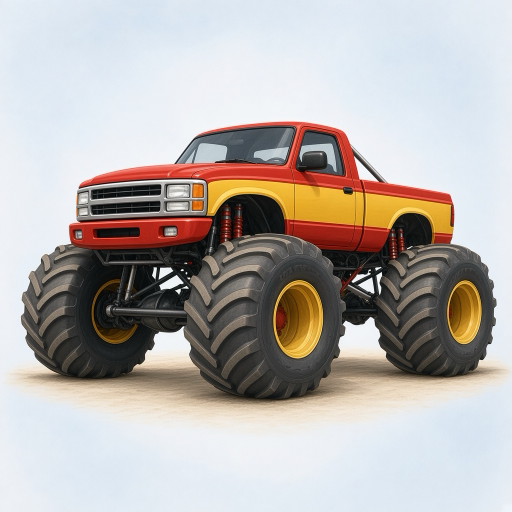
A monster truck is a vehicle built or heavily modified to drive on enormous tires and perform at motorsport shows. Early monster trucks grew out of pickup trucks, but a current competition truck is a specialized machine. It can race, jump from ramps, spin in circles called donuts, and balance on two wheels.
The exact size depends on the truck and the event. A current Monster Jam truck is about 10.5 feet (3.2 meters) tall, 12.5 feet (3.8 meters) wide, and 17 feet (5.2 meters) long. It weighs about 12,000 pounds (5,400 kilograms).
Why monster trucks are surprising
Monster Jam tires are 66 inches (1.68 meters) across and 43 inches (1.09 meters) wide. A tire with its wheel weighs about 645 pounds (293 kilograms). At 5 feet 6 inches tall, the tire is about as tall as many adults.
The bright outside body looks like a truck body, but it is custom-made from fiberglass. The driver’s compartment is a protective steel structure made from tubing and mounted to the truck’s frame. This means the colorful shell and the safety structure have different jobs.
The engine produces about 1,500 horsepower with help from a supercharger. It runs on methanol fuel rather than the gasoline used by most family cars. Monster Jam says the engine can consume methanol at about 3 gallons (11 liters) per minute while running at competition intensity.
Key facts about monster trucks
Monster Jam tires are 66 inches tall and 43 inches wide. Those measurements apply to that series, not necessarily to every monster truck ever built.
A current Monster Jam truck weighs about 12,000 pounds. Older sources that say 10,000 pounds do not match the series’ present specification.
The tires use about 23 pounds per square inch of air pressure. Each tire and wheel together weighs about 645 pounds.
The body is made from fiberglass. A steel tube structure helps protect the driver.
The suspension can move through about 30 inches. Nitrogen-charged shocks help control the movement.
BIGFOOT is recognized by Guinness as the first monster truck. Its first public appearance was in 1979.
BIGFOOT made the first recorded monster-truck car crush in April 1981. It drove over two cars near St. Louis.
Dennis Anderson created Grave Digger in 1982. Monster Jam later made him part of its first Hall of Fame class.
Common myths about monster trucks
Myth: A modern competition truck is just a pickup with larger wheels. The original BIGFOOT began as a Ford F-250 that Bob Chandler modified. Today’s Monster Jam trucks use custom fiberglass bodies, racing suspension, and a steel driver-safety structure.
Myth: Every monster truck weighs exactly the same. Designs and rules differ among trucks and organizers. The 12,000-pound figure is Monster Jam’s current approximate specification.
Myth: Bigger tires must always use higher pressure. Monster Jam lists about 23 psi for its 66-inch tires. Tire size by itself does not tell you the correct pressure.
Myth: Grave Digger was the first monster truck. Guinness recognizes BIGFOOT’s 1979 public appearance. Dennis Anderson created Grave Digger in 1982.
Myth: A jump record tells us how high a truck went. A ramp-jump distance measures the space from takeoff to landing, not the greatest height above the ground.
Frequently asked questions about monster trucks
How big are monster truck tires?
Monster Jam tires are 66 inches (1.68 meters) in diameter and 43 inches (1.09 meters) wide. Other monster trucks can use different tires, so those numbers should be labeled as series specifications.
How much does a monster truck weigh?
Monster Jam currently lists about 12,000 pounds (5,400 kilograms). That is an approximate competition-truck figure, not a rule for every historic or exhibition vehicle.
What was the first monster truck?
Guinness World Records recognizes BIGFOOT as the first. Bob Chandler began modifying his Ford F-250 in the mid-1970s, and BIGFOOT first appeared in public in 1979.
How far has a monster truck jumped?
Guinness lists a longest ramp jump of 237 feet 7 inches (72.42 meters). Joe Sylvester made that jump in Bad Habit on September 1, 2013. Records can change, so the record page is the best place to check for an update.
What keeps the driver safer?
Monster Jam lists a steel tube safety structure, a five-point harness, a fire-resistant suit, a helmet, and a head-and-neck restraint among its protections. A remote ignition interrupter also lets an official send a signal that shuts off the engine.
Each quiz question for this topic cites a source for the fact it tests. You can play at any level: Rookie, Curious, Sharp, or Expert.
Monster trucks began as greatly enlarged pickup trucks, but today’s competition vehicles can be purpose-built around frames and safety structures. That distinction explains why a fiberglass body shaped like a pickup does not make the machine underneath a normal road truck.
The best-known numbers often describe Monster Jam, not every monster truck series. Its current trucks are approximately 10.5 feet (3.2 meters) tall, 12.5 feet (3.8 meters) wide, and 17 feet (5.2 meters) long. Each weighs about 12,000 pounds (5,400 kilograms) and produces about 1,500 horsepower.
How a Monster Jam truck works
Each of the four tires is 66 inches (1.68 meters) in diameter and 43 inches (1.09 meters) wide. With its wheel, one weighs about 645 pounds (293 kilograms). Monster Jam lists an inflation pressure of 23 psi.
A supercharger forces more air and fuel into the engine, helping it make its quoted 1,500 horsepower. The engine burns methanol from a specially built safety fuel cell and can consume about 3 gallons (11 liters) per minute under competition conditions.
The four-link racing suspension connects the axles to the frame. Clusters of nitrogen-charged shocks provide about 30 inches (76 centimeters) of suspension travel. That is a large range of movement, but it is not the four feet claimed in some older summaries.
Key facts about monster trucks
Monster Jam truck bodies are custom-built from fiberglass. The driver’s compartment is a separate steel tube safety structure.
The current listed weight is about 12,000 pounds. A frequently repeated 10,000-pound number is not Monster Jam’s present figure.
Racing is a bracket competition. Trucks race on a set course, and winners advance until a final decides the racing champion.
Freestyle is judged. Drivers perform tricks across the floor for a designated time.
The Skills Challenge and donut competition are also judged. Fans can submit scores for several competitions through JudgesZone.
A remote ignition interrupter can stop the engine. An official uses a special radio to send the shutoff signal.
BIGFOOT first appeared publicly in 1979. Guinness recognizes it as the first monster truck.
Grave Digger dates to 1982. Dennis Anderson created it and later became a four-time Monster Jam World Finals champion.
Cam McQueen set a precisely named record in 2010. Guinness credits him with the first monster-truck backflip successfully performed in a scored competition.
Common myths about monster trucks
Myth: BIGFOOT began with 66-inch tires. Guinness says BIGFOOT #1 had 48-inch tires when it introduced the monster-truck concept publicly in 1979. The 66-inch measurement is the current Monster Jam tire specification.
Myth: A fiberglass body protects the driver by itself. The official safety description identifies a steel tube driver’s compartment mounted to the frame. The fiberglass body supplies the truck’s outward shape and design.
Myth: Every stunt is scored by a panel of professional judges. Monster Jam invites fans to submit scores for Skills, Donut, and Freestyle competitions. Racing is decided by progress through the bracket rather than an artistic score.
Myth: Cam McQueen performed the first monster-truck backflip of any kind. Guinness uses narrower wording: first successful backflip in a scored competition. That wording does not rule out practice, exhibition, or differently categorized attempts.
Myth: A world record is permanent. Guinness notes that records change and online pages may not update immediately. A date and category belong with any record claim.
Frequently asked questions about monster trucks
Why are some published monster-truck weights different?
The sport includes different eras, builders, and organizers. Monster Jam’s current guide says approximately 12,000 pounds. A historic BIGFOOT, another competition series, or an exhibition vehicle may have a different mass.
How are Monster Jam events scored?
Racing advances the first truck to finish a prescribed course legally. Skills, donuts, and freestyle are judged events, and fans can provide scores through the series’ online judging system.
What was BIGFOOT’s first car crush?
Guinness records that BIGFOOT #1 drove over and crushed two cars in a field near St. Louis in April 1981. It identifies that demonstration as the first recorded monster-truck car crush.
Who created Grave Digger?
Dennis Anderson created Grave Digger in 1982. Monster Jam inducted Anderson into its inaugural Hall of Fame class and describes him as a four-time World Champion.
What is the longest ramp-jump record listed by Guinness?
The page lists 237 feet 7 inches (72.42 meters), achieved by Joe Sylvester in Bad Habit on September 1, 2013. The measurement is horizontal jump distance, not maximum height.
Each quiz question for this topic cites a source for the specific fact it tests. You can play at any level: Rookie, Curious, Sharp, or Expert.
A modern monster truck should be described with its rule set attached. The familiar 66-inch tire, 12,000-pound mass, and 1,500-horsepower engine figures are current Monster Jam specifications. Historic BIGFOOT vehicles and trucks built for other promoters do not necessarily match them.
Monster Jam trucks are custom competition vehicles with fiberglass bodies. The official guide describes a steel tube driver’s compartment mounted to the frame, four-link racing suspension, clusters of nitrogen-charged shocks, and a supercharged engine using methanol. Those details make the vehicle fundamentally different from a showroom pickup even when the body has pickup styling.
Current Monster Jam engineering figures
A truck is approximately 10.5 feet (3.2 meters) tall, 12.5 feet (3.8 meters) wide, and 17 feet (5.2 meters) long. Its listed weight is about 12,000 pounds (5,400 kilograms), not the 10,000 pounds repeated in some older summaries.
Each BKT tire is 66 inches (1.68 meters) in diameter and 43 inches (1.09 meters) wide. With the wheel included, it weighs about 645 pounds (293 kilograms) and is inflated to 23 psi. The phrase “with the wheel” matters: 645 pounds is not presented as the rubber tire’s weight alone.
The engine produces about 1,500 horsepower. A supercharger forces air and fuel into it, and its methanol can be consumed at approximately 3 gallons (11 liters) per minute. The fuel is carried in a specially constructed safety cell.
Four main suspension bars link the front and rear axles to the frame. Nitrogen-charged shocks offer approximately 30 inches (76 centimeters) of travel. Long travel gives the wheels and frame substantial room to move relative to one another during rough driving and landings.
Safety and competition
The Remote Ignition Interrupter, or RII, lets an official transmit a signal that shuts down the truck’s engine. Monster Jam also lists a secondary on-off switch at the rear of the frame. Its driver equipment includes a multi-layer fire-resistant suit, a helmet, flame-resistant gloves and shoes, a head-and-neck restraint, and a five-point harness.
The Monster Truck Racing Association requires RII receivers and transmitters under its safety rules. It also requires testing the system before a car crush or exhibition. These rules show why the RII should be described as a safety system, not as a stunt-control device.
Monster Jam racing uses a prescribed course and an elimination bracket. Skills, donut, and freestyle competitions are judged, and fans can submit scores for several of them. A truck can therefore win a timed racing segment and receive a different result in a judged stunt segment.
Key facts and records
Guinness recognizes BIGFOOT as the first monster truck. Its first public appearance was in 1979, after Bob Chandler had begun modifying the Ford F-250 in the mid-1970s.
The first recorded monster-truck car crush came in April 1981. BIGFOOT #1 drove over two cars in a field near St. Louis.
Dennis Anderson created Grave Digger in 1982. Monster Jam describes him as a four-time World Champion.
Cam McQueen landed the first backflip in a scored monster-truck competition on February 27, 2010. The exact record category avoids claiming that no one had completed a backflip in practice or exhibition.
Guinness lists the longest ramp jump as 237 feet 7 inches (72.42 meters). Joe Sylvester achieved it in Bad Habit on September 1, 2013.
Guinness lists the fastest monster-truck speed as 101.84 mph (163.89 km/h). Joe Sylvester achieved it in Norwalk, Ohio, on August 6, 2022.
Common misconceptions
Misconception: 10,000 pounds is the universal modern weight. Monster Jam’s current page says approximately 12,000 pounds. Other organizers or older trucks may use different specifications.
Misconception: Suspension travel is about four feet. The current official Monster Jam figure is 30 inches. Confusing an older truck’s design with the current series specification creates a false universal number.
Misconception: The RII replaces all other safety equipment. It is one layer. The driver compartment, restraints, clothing, helmet, rear shutoff, event procedures, and separation from spectators are separate protections.
Misconception: Freestyle and racing use the same scoring method. Racing advances winners through a bracket. Freestyle is a judged performance, and Monster Jam invites fans to score it.
Misconception: Record claims need only a distance or speed. A responsible record statement includes the category, holder, date, unit, and source. Guinness also warns that records can change before its public pages are updated.
Frequently asked questions
Why does the 645-pound tire figure need a label?
Monster Jam states that a tire weighs 645 pounds with its wheel. Leaving out those words changes what the measurement describes.
How does the remote shutoff work?
The truck carries an RII receiver. An authorized official can use a special radio to send a signal that shuts off the engine. MTRA rules require the system to be tested before applicable runs.
What competitions happen at a Monster Jam event?
The official guide describes bracket racing, a Skills Challenge, donuts, and freestyle. Racing is based on advancing first finishers, while the other listed segments are judged.
Did BIGFOOT begin as a purpose-built competition frame?
No. The original began as a Ford F-250 that Bob Chandler modified. That history does not mean current competition trucks are ordinary pickups with large wheels.
Are the Guinness jump and speed records held by the same driver?
The current public pages list Joe Sylvester for both. His 2013 jump was 237 feet 7 inches, and his 2022 speed was 101.84 mph.
Each quiz question for this topic cites a source for the specific fact it tests. You can play at any level: Rookie, Curious, Sharp, or Expert.
Monster-truck specifications are often repeated without identifying their scope. The familiar package of 66-inch tires, approximately 12,000 pounds, 1,500 horsepower, methanol fuel, and 30 inches of suspension travel comes from the current Monster Jam guide. It is not a timeless technical definition for every vehicle called a monster truck.
The sport’s history also spans two different construction stories. BIGFOOT #1 evolved from Bob Chandler’s Ford F-250, beginning with modifications in the mid-1970s. A present Monster Jam vehicle instead uses a custom fiberglass body, a tubular steel chassis, a frame-mounted steel tube driver compartment, and dedicated racing systems.
Engineering by the published numbers
The current Monster Jam envelope is approximately 10.5 feet tall, 12.5 feet wide, and 17 feet long, at about 12,000 pounds. Four tire-and-wheel assemblies at 645 pounds each total about 2,580 pounds, or roughly one-fifth of the quoted vehicle mass. That proportion is a simple calculation from the published figures, not a separate measured specification.
An official Monster Jam fact sheet says two technicians need about 80 hours to assemble a truck frame made from more than 800 feet of tubing. Those numbers describe the series’ frame-building process and should not be converted into a universal chassis recipe for independent builders.
Each tire is 66 inches in diameter and 43 inches wide on the series’ current BKT setup. The listed pressure is 23 psi. The official guide does not present that pressure as a complete explanation of landing behavior.
The four-link suspension uses four main bars to connect the front and rear axles to the frame. Clusters of nitrogen-charged shocks provide about 30 inches of travel. The official description supports those details, but it does not support the four-foot travel figure found in the older draft.
The engine’s quoted output is approximately 1,500 horsepower. A supercharger forces air and fuel into the engine, which burns methanol from a purpose-built safety cell at a listed rate of about 3 gallons per minute. That consumption figure describes demanding operation and should not be converted into a claim about an entire show’s total fuel use without knowing run time.
Monster Jam also describes its current engine as a supercharged, methanol-fueled V8. Planetary hub gearing is a separate, truck-specific subject. A detailed MotorTrend profile of Bigfoot 18 documents ZF axles with a 6.4:1 planetary ratio and a 16.192:1 final-drive ratio; it does not establish that every monster truck uses those exact ratios.
Layered safety rather than one magic device
Monster Jam lists a steel tube driver compartment, a five-point harness, a fire-resistant suit, a compliant helmet, a head-and-neck restraint, gloves, and shoes. The truck also carries a receiver for a Remote Ignition Interrupter and a secondary on-off switch at the rear of the frame.
The RII lets an authorized official transmit an engine-shutoff signal. MTRA safety rules require RII receivers and transmitters on covered monster trucks and require a qualified operator to test the system before a car crush or exhibition. Those rules also say the engine must not operate unless the RII is on.
Requirements can depend on jurisdiction and organizer. Georgia’s racetrack and grandstand rules, for example, require three ignition-interruption controls at monster-truck events: one controlled by the event safety official, one accessible to the driver in the cab, and one at the rear. That state rule is strong evidence for those Georgia events, not proof that every country uses identical wording.
Historical and record distinctions
Bob Chandler began creating BIGFOOT in 1975. SEMA and the Off-Road Motorsports Hall of Fame describe the modifications, while Guinness dates the first public appearance to 1979.
BIGFOOT #1 used 48-inch tires for its 1979 public debut. Applying today’s 66-inch Monster Jam specification to that debut would be an anachronism.
The first recorded monster-truck car crush occurred in April 1981. Guinness says BIGFOOT #1 crushed two cars in a field near St. Louis.
The RII is associated with Bob Chandler and George Carpenter. The Off-Road Motorsports Hall of Fame credits them with the safety innovation and says it became standard in the industry.
Planetary-axle specifications must identify the truck. Bigfoot 18’s published ratios are evidence about Bigfoot 18, not a Monster Jam-wide rule.
Grave Digger dates to 1982. Monster Jam credits Dennis Anderson with its creation.
Bigfoot 5 holds Guinness’s largest-monster-truck record. The record account gives a height of 15 feet 6 inches (4.7 meters), a weight of about 38,000 pounds (17,236 kilograms), and 10-foot tires.
Bigfoot 20 was the first fully electric monster truck recognized by Guinness. It was unveiled in November 2012 with a 350-horsepower motor and 36 batteries.
Joe Sylvester holds the public Guinness pages for both ramp-jump distance and speed. The listed results are 237 feet 7 inches in 2013 and 101.84 mph in 2022.
Common expert-level misconceptions
Misconception: “First monster truck” has one obvious construction date. Chandler started modifying BIGFOOT in 1975, but Guinness assigns its first-monster-truck record to the 1979 public appearance. Stating both dates explains the difference instead of forcing them into one label.
Misconception: Every 645-pound measurement refers to a bare tire. Monster Jam explicitly says the tire weighs 645 pounds with the wheel. Removing that qualifier overstates the rubber tire’s documented mass.
Misconception: 1,500 horsepower is a certified result for every run and every truck. It is the series’ published representative engine figure. Actual output can depend on engine setup and operating conditions.
Misconception: An RII makes a runaway truck stop immediately. The system shuts off engine power; it does not erase the vehicle’s momentum. Barriers, spectator separation, driver restraints, and operating procedures remain necessary.
Misconception: Modern monster-truck shows are defined by crushing cars. Car crushing is central to the sport’s early history, but current Monster Jam competition formats are racing, Skills, donuts, and freestyle on prepared courses. A show does not need a car crush to fit those formats.
Misconception: A record without a date is current forever. Guinness states that records change and are not always published online immediately. Record claims should name the category, result, holder, location or date, and the date the source was checked.
Frequently asked questions
What can be inferred from the tire mass?
Multiplying the published 645-pound tire-and-wheel figure by four gives 2,580 pounds. Dividing by the approximate 12,000-pound truck mass gives about 21.5 percent. Because both inputs are rounded series figures, the percentage should also remain approximate.
Why distinguish an RII from a brake?
The RII interrupts the engine through a remote signal. A moving 12,000-pound vehicle retains kinetic energy after engine power ends, so the interrupter works as one part of a larger safety system rather than as remote braking.
Do official rules agree on every shutoff detail?
No single cited rule governs every event worldwide. Monster Jam describes an RII receiver and rear switch, MTRA publishes association requirements, and Georgia law supplies enforceable provisions for events within that state’s regulatory scope.
How should historic and current truck specifications be compared?
Name the truck, series, and date. BIGFOOT #1’s 48-inch tires at its 1979 public appearance, Bigfoot 5’s 10-foot record tires, and current Monster Jam’s 66-inch competition tires describe three different vehicles or contexts.
Why are record categories so precise?
A ramp jump, a speed run, a scored-competition backflip, and the largest truck test different achievements. Exact categories prevent one kind of first or maximum from being misreported as another.