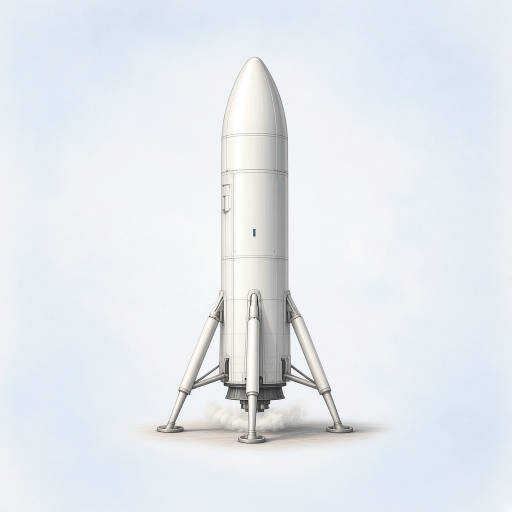
SpaceX is an American company that builds rockets and spacecraft. Elon Musk started it in 2002. It is famous for one big idea: instead of throwing a rocket away after one flight, SpaceX brings the bottom part back down, lands it standing up, and uses it again. SpaceX also built the Dragon capsule, which carries astronauts and supplies to the International Space Station.
Why SpaceX surprised people
For about fifty years, almost every rocket was used once. It lifted off, dropped away in pieces, and those pieces fell into the ocean. Imagine throwing away an airplane after every trip. That is a big reason getting to space cost so much.
Lots of engineers thought landing a booster was too hard. A rocket coming back down is tall, skinny, nearly empty, and falling fast. Balancing it upright is a bit like balancing a broom on your hand, except the broom is about 14 stories tall and going faster than a jet.
SpaceX did it anyway. On December 21, 2015, a Falcon 9 booster flew back to Cape Canaveral in Florida and landed on its legs. Since then SpaceX has landed boosters hundreds of times, and it happens so often now that it barely makes the news.
Key facts about SpaceX
SpaceX started in 2002. Its headquarters are in Starbase, Texas.
Its first rocket, Falcon 1, failed three times. The fourth try worked on September 28, 2008.
Falcon 9 is named after the Millennium Falcon from Star Wars. The 9 is how many engines are at the bottom.
The Dragon capsule carries cargo and astronauts to the space station.
In May 2020, SpaceX became the first company to launch astronauts into orbit.
SpaceX rockets sometimes land on robot ships in the ocean. Two of them are named Just Read the Instructions and Of Course I Still Love You.
Starlink is a group of thousands of small SpaceX satellites that beam internet down to Earth.
Starship is the tallest and most powerful rocket ever flown. It stands about 400 feet (121 m) tall.
SpaceX launches from Launch Complex 39A in Florida, the same pad that sent Apollo 11 to the Moon in 1969.
The rocket that catches itself
Starship is so big that SpaceX tried something new. Instead of landing on legs, the booster flies back to the launch tower, and two huge metal arms reach out and catch it in the air. People call the arms chopsticks.
That sounds impossible, and the first time SpaceX tried it, on October 13, 2024, it worked. Catching the booster means it does not have to carry heavy legs, and it lands right where it needs to be for the next flight.
Common myths about SpaceX
Myth: SpaceX is part of NASA.
SpaceX is its own company. NASA is a government agency that hires SpaceX, the way you might hire a moving company. They work together, but NASA does not own SpaceX.
Myth: SpaceX rockets land with parachutes.
The booster uses its own engines to slow down and lands on legs. Parachutes are used for the Dragon capsule when astronauts come home.
Myth: SpaceX invented the rocket.
Rockets have been around for centuries, and people have been flying to space since 1961. What SpaceX changed is landing the booster and flying that same booster again, instead of building a new one for every launch.
Myth: The first SpaceX rocket worked right away.
Falcon 1 failed three times in a row. The company almost ran out of money before the fourth flight finally reached space.
Frequently asked questions about SpaceX
Who started SpaceX?
Elon Musk founded it in 2002. Unlike Tesla, which he joined after other people started it, SpaceX is a company he started himself.
How does a rocket land?
After it pushes the top part of the rocket toward space, the booster flips around, fires its engines to slow down, steers with four fins near its top, and puts out four legs right before it touches the ground.
What is Dragon?
The capsule that rides on top of the Falcon 9 rocket. One version carries supplies to the space station, and another carries up to four astronauts.
Why are the landing ships named such strange things?
Elon Musk named them after spaceships in science fiction novels by the writer Iain M. Banks. In those books, giant spaceships pick their own funny names.
How big is Starship?
About 400 feet (121 m) tall when the booster and spaceship are stacked. That is taller than a 30-story building, and it has 33 engines at the bottom.
Has SpaceX been to the Moon?
Not yet with people. NASA picked a version of Starship in 2021 to carry astronauts down to the Moon’s surface on a future mission.
Source notes
The company’s founding and history come from the SpaceX encyclopedia entry, and the story of the first four Falcon 1 launches from the Falcon 1 record. The first successful booster landing in December 2015 is documented in the Falcon 9 flight 20 entry. NASA’s own page on the Demo-2 mission covers the first astronaut launch in 2020, and the landing ships and their names come from the drone ship entry.
SpaceX is an American rocket company founded by Elon Musk in 2002 and headquartered in Starbase, Texas. It designs and builds its own rockets, engines, and spacecraft, then sells launches to NASA, the US military, satellite operators, and private customers. Its central achievement is reusable rockets: the first stage of a Falcon 9 flies back to Earth, lands upright, and launches again, sometimes more than 30 times.
The flight that nearly ended the company
SpaceX did not begin with success. Its first rocket, the small Falcon 1, failed on its first flight in 2006, again in 2007, and again in August 2008. Each rocket was lost. The satellite on the 2006 flight separated and was later found on the island, damaged but not destroyed.
By the fourth attempt the company was almost out of money. On September 28, 2008, Falcon 1 finally reached orbit, carrying a metal test weight nicknamed RatSat instead of a real satellite. It became the first privately developed liquid-fueled rocket to reach orbit.
That flight changed everything. On December 23, 2008, NASA awarded SpaceX a fixed-price contract worth about $1.6 billion for 12 cargo flights to the International Space Station. Falcon 9 and Dragon were not flying yet. Their development had already been funded under an earlier NASA partnership.
Learning to land
Landing a rocket is a control problem. A returning booster is tall, mostly empty, and moving fast, and it has to slow down, steer to a precise spot, and stop exactly at ground level with almost no fuel to spare.
SpaceX practiced with a test rocket called Grasshopper, a Falcon 9 first stage fitted with landing legs and one engine. Between 2012 and 2013 it made a series of short hops at a Texas test site, going a little higher each time. The tallest hop reached about 2,440 feet (744 m).
Real landings came next, and the early attempts failed publicly. Boosters missed the ship, tipped over, or exploded on the deck. Then on December 21, 2015, a Falcon 9 first stage flew back to Cape Canaveral and landed upright on solid ground. Four months later, on April 8, 2016, another booster landed on a ship at sea for the first time.
Key facts about SpaceX
Founded in 2002 by Elon Musk; headquarters in Starbase, Texas. Its shares began trading on Nasdaq in June 2026.
Falcon 1 reached orbit on its fourth attempt, September 28, 2008.
Falcon 9 is named for the Millennium Falcon and its nine Merlin engines, which burn kerosene and liquid oxygen.
In May 2012, Dragon became the first commercial spacecraft to reach the International Space Station. The station crew caught it with a robotic arm.
The first successful booster landing was December 21, 2015; the first at-sea landing was April 8, 2016.
On March 30, 2017, SpaceX launched a used booster for a second time, the first reflight of an orbital-class rocket stage.
On May 30, 2020, SpaceX became the first private company to launch astronauts to orbit, the first crewed launch from the United States since July 2011.
Starlink test satellites launched in February 2018. The first batch of 60 flew in May 2019, and the constellation has since passed 10,000 satellites launched.
Landing ships are named after starships in Iain M. Banks novels, including Just Read the Instructions and A Shortfall of Gravitas.
What changed for everyone else
Cheap, frequent launches changed what other people can do in space. When a launch cost hundreds of millions of dollars and a slot had to be booked years ahead, only governments and large companies flew most of the time. Universities had already launched small satellites, including the first CubeSats in 2003, but those flights were rare.
SpaceX began selling rideshare flights, where dozens of small satellites share a single rocket the way passengers share an airliner. Universities, startups, and small countries now fly instruments they could not have afforded before. The number of working satellites in orbit has grown several times over in a decade, and most of that traffic rides on SpaceX rockets.
That growth has a downside worth knowing about. Astronomers have to work around bright satellite trails crossing their images, and the more crowded low Earth orbit becomes, the more carefully operators have to steer their satellites to avoid collisions.
Common myths about SpaceX
Myth: SpaceX and NASA are the same organization.
NASA is a US government agency. SpaceX is a separate company NASA pays to deliver cargo and crew. Its shares have traded on Nasdaq since June 2026. NASA sets the requirements and inspects the work, but it does not own SpaceX.
Myth: Taxpayers built SpaceX’s rockets.
NASA contracts were fixed-price agreements to deliver a service, paid when milestones were met, not grants covering whatever development cost. SpaceX kept ownership of the rockets it built.
Myth: Rocket reuse was invented by SpaceX.
The Space Shuttle orbiter was reused for 30 years, and its solid boosters were fished out of the ocean. What had never been done was landing and reflying the first stage of an ordinary orbital rocket.
Myth: Every SpaceX launch carries astronauts.
The large majority carry satellites, most of them Starlink. Crewed flights are a small fraction of the total.
Frequently asked questions about SpaceX
Why did SpaceX want reusable rockets?
Cost. Building a new first stage for every launch is like scrapping an airliner after one trip. Reusing the stage spreads the cost of building it across many flights.
How does a booster find its way back?
On a return to the launch site, it fires its engines to reverse course. Four grid fins unfold near the top and steer the booster. It fires again to slow down as the air thickens, and it makes a final landing burn as the legs deploy.
What is the difference between Falcon 9 and Starship?
Falcon 9 is the working rocket that flies most SpaceX missions and partly reuses itself. Starship is a much larger vehicle designed so that both stages come back, and it is still in testing.
Did SpaceX really put a car in space?
Yes. The first Falcon Heavy test flight in February 2018 carried Elon Musk’s red Tesla Roadster as its test weight, and it now orbits the Sun.
Who was on the first SpaceX crew flight?
NASA astronauts Bob Behnken and Doug Hurley, launched May 30, 2020, on a mission called Demo-2.
Is Starlink related to Starship?
They are different projects. Starlink is a satellite internet network, and Starship is a rocket. Falcon 9 launches most Starlink satellites.
Source notes
Company background comes from the SpaceX entry, and the Falcon 1 flight history from the Falcon 1 record. The 2012 station visit is documented in the Dragon entry and the landing-development hops in the Grasshopper entry. The first crewed flight comes from the Demo-2 record and the satellite network from the Starlink entry.
SpaceX is an American aerospace manufacturer and launch provider, founded by Elon Musk in 2002 and headquartered in Starbase, Texas. It designs and builds its own launch vehicles, rocket engines, and spacecraft, and it operates the Starlink satellite internet network. Its defining contribution is the routine recovery and reuse of orbital-class rocket stages, a capability no organization had demonstrated before 2015 and which now underpins the majority of the world’s launch activity.
Why the achievement is easy to misstate
Reuse was not a new idea. The Space Shuttle orbiter flew 135 missions across 30 years, and its solid rocket boosters were recovered from the Atlantic. What had never been done was landing the first stage of a conventional orbital rocket and flying it again with modest refurbishment.
The distinction matters because the Shuttle demonstrated that reuse alone does not lower costs. Refurbishing an orbiter between flights took months and a large workforce, and the program never approached its original cost targets. The question SpaceX had to answer was not whether a stage could be recovered but whether it could be turned around cheaply and quickly enough to matter.
The current evidence says yes. In 2025 SpaceX flew 165 orbital missions, and 157 of them used a previously flown booster. Individual boosters have passed 30 flights, well beyond the ten-flight target set for the Block 5 design in 2018.
The sequence of firsts
September 28, 2008. Falcon 1 reached orbit on its fourth attempt, after three failures had nearly exhausted the company’s funding. It was the first privately developed liquid-fueled rocket to reach orbit. A NASA cargo contract worth about $1.6 billion followed in December.
May 25, 2012. Dragon became the first commercial spacecraft to reach the International Space Station, captured by the station’s robotic arm and berthed by the crew.
December 21, 2015. A Falcon 9 first stage landed upright at Cape Canaveral after delivering satellites to orbit, the first recovery of an orbital-class booster.
April 8, 2016. A booster landed on a droneship at sea for the first time, on the CRS-8 resupply mission.
March 30, 2017. That same booster launched again, carrying the SES-10 satellite. It was the first reflight of a recovered orbital-class stage.
February 6, 2018. Falcon Heavy flew for the first time, with 27 engines at liftoff. Its two side boosters returned and landed within seconds of each other; the center core was lost.
May 30, 2020. Crew Dragon carried NASA astronauts Bob Behnken and Doug Hurley to the station on the Demo-2 mission, the first crewed orbital launch by a private company and the first from US soil since the Shuttle retired in July 2011.
September 2021 and September 2024. Inspiration4 flew the first orbital crew with no professional astronauts aboard. Three years later, the Polaris Dawn crew performed the first commercial spacewalk, venting the entire Dragon capsule because it has no airlock.
October 13, 2024. The launch tower at Starbase in Texas caught a returning Super Heavy booster in mid-air on the first attempt, using two arms nicknamed chopsticks.
How the landing works
After separation the booster is still traveling several thousand miles per hour. On a return to land, a boostback burn reverses its trajectory, and the turnaround happens near 50 miles (80 km) up. Four titanium grid fins unfold near the top of the stage and steer by shifting the vehicle’s center of pressure, working as lattice surfaces rather than solid fins because they stay effective at supersonic speed.
An entry burn slows the stage before it meets thicker air, limiting heating. A final landing burn begins seconds before touchdown, and the four legs deploy at the last moment. The margins are narrow: the engines cannot throttle low enough to hover, so the burn has to bring the vehicle to zero velocity exactly at ground level.
Key facts
Founded 2002; headquarters in Starbase, Texas, which incorporated as a city in May 2025. Falcon 9 manufacturing remains in Hawthorne, California. Shares began trading on Nasdaq in June 2026.
Falcon 9’s first stage uses nine Merlin engines burning refined kerosene and liquid oxygen.
Starship and its Super Heavy booster stand about 400 feet (121 m) stacked, with 33 Raptor engines producing roughly twice the liftoff thrust of a Saturn V. It is the tallest and most powerful rocket ever flown.
Raptor burns methane and liquid oxygen and is the first full-flow staged combustion engine to fly.
Starlink test satellites launched in February 2018. The first batch of 60 flew in May 2019, and the constellation has passed 10,000 satellites launched.
SpaceX launch cadence: 25 orbital missions in 2020, 61 in 2022, 96 in 2023, 134 in 2024, 165 in 2025.
In 2025 SpaceX carried more than 80 percent of the world’s payload mass to orbit.
NASA selected Starship in April 2021 as the crewed lunar lander for the Artemis program, in an award worth about $2.9 billion.
Starship, and what is still unfinished
Starship is a different proposition from Falcon 9. It is designed so both stages return, it is built from stainless steel rather than composite or aluminum alloy, and Starship V3 is designed to deliver about 110 tons (100 metric tons) to orbit with both stages reused. The first integrated flight test flew in April 2023 and ended in the vehicle’s destruction.
Progress since has been uneven, which is normal for a vehicle of this size and worth stating plainly. The booster catch has been demonstrated. Full reuse of the upper stage, orbital refueling, and the crewed lunar landing NASA has contracted for remain ahead. Reading SpaceX accurately means separating what has flown from what has been announced.
The economics, and the effect on everyone else
A Falcon 9 launch has a published list price in the neighborhood of $70 million, a figure SpaceX has adjusted upward over time. What matters more than the sticker is what it displaced. Comparable Western launches before Falcon 9 routinely ran well over $100 million, capacity was scarce, and a customer could wait years for a slot.
Two changes followed. First, price per kilogram to low Earth orbit fell by roughly an order of magnitude over two decades, which changed what is worth building. A satellite no longer has to justify a launch costing more than the satellite. Second, SpaceX began selling rideshare missions where dozens of small payloads share one rocket, giving universities, startups, and smaller national programs orbital access they previously could not buy.
The consequence is visible in the numbers. The count of active satellites in orbit has multiplied several times over in a decade, and a large majority of new spacecraft reach orbit on a Falcon 9. Government programs that once launched their own payloads now buy the ride.
The same trend carries costs. Optical astronomers contend with satellite trails crossing long exposures, radio astronomers with interference, and every operator in low Earth orbit with a more crowded environment requiring active collision avoidance. Whether the orbital regime stays manageable depends heavily on deorbit discipline at end of life, which is now a matter of regulation as much as engineering.
Common misconceptions
“SpaceX is part of NASA.” SpaceX is a separate company. Its shares have traded on Nasdaq since June 2026. NASA is a customer that buys launch and crew transport services under fixed-price contracts.
“SpaceX invented reusable rockets.” The Shuttle was partly reusable. The specific first is recovering and reflying the first stage of a conventional orbital launcher.
“Falcon 9 is fully reusable.” The first stage and the payload fairings are recovered. The second stage is expendable.
“The boosters land by parachute.” Boosters land under their own engine power on legs, or are caught by the tower in Starship’s case. Parachutes bring the Dragon capsule down.
“Starlink is a government system.” SpaceX owns and operates it and is its own largest launch customer.
Frequently asked questions
How many times can a Falcon 9 booster fly?
Block 5 was designed for ten flights before major refurbishment, and that ceiling has been raised repeatedly. Fleet leaders have passed 30 missions.
Why land at sea instead of returning to the launch site?
Flying back to shore costs fuel that would otherwise lift payload. A droneship placed downrange lets the booster land without reversing its whole trajectory.
What made Falcon 1’s fourth flight so important?
SpaceX was nearly out of money after three failures. Success secured a NASA cargo contract worth about $1.6 billion, which funded Falcon 9 and Dragon.
Why is Starship built from stainless steel?
Steel is heavier than carbon fiber composite, but it holds strength at cryogenic temperatures, tolerates reentry heat far better, and is cheap enough to build and scrap prototypes quickly.
What is the Polaris Dawn spacewalk significant for?
It was the first spacewalk conducted by a crew with no government astronauts, using suits SpaceX developed, from a capsule that has no airlock.
Has SpaceX landed anything on the Moon or Mars?
Not yet. NASA has contracted a Starship variant to land Artemis astronauts on the Moon, and Mars remains a stated goal rather than a flown mission.
Source notes
Company history and contract details come from the SpaceX record. The first booster landing is documented in Falcon 9 flight 20 and the first reflight in the SES-10 entry. The first crewed flight comes from Demo-2, the booster catch from Starship flight test 5, and the Artemis lander selection from Starship HLS. Launch-rate figures for 2025 come from Space.com.
SpaceX is an American launch vehicle and spacecraft manufacturer founded in 2002 that designs its engines, stages, avionics, and spacecraft in house and operates them as a service provider rather than selling hardware. Its technical program has pursued lower cost to orbit by recovering and reflying hardware. Engine cycle, materials, and architecture also serve a second goal: propellant that can be made on Mars for a return flight.
Why the achievement resists a simple summary
Partial reuse existed before SpaceX. The Space Shuttle orbiter flew 135 times and its solid boosters were recovered by parachute. The Shuttle also demonstrated the trap: recovery does not reduce cost unless turnaround is cheap. Orbiter processing between flights consumed months and thousands of staff, and the program’s per-flight cost never approached the original projections.
The relevant metric is therefore not whether hardware comes back but what it costs to fly it again. Falcon 9 Block 5, introduced in 2018, was designed around inspection rather than teardown, with an initial target of ten flights per booster before major refurbishment. That ceiling has been raised repeatedly as inspection data accumulated, and fleet leaders have passed 30 flights. In 2025, 157 of 165 Falcon 9 missions used a flown booster.
A second complication is timeline. SpaceX announces architectures years before they fly, and some change substantially in between. Crew Dragon was presented as a propulsively landing spacecraft and flies under parachutes. Starship was to be carbon fiber and is stainless steel. Accurate reading requires separating the flown record from the announced roadmap.
Propulsion: two different cycles
Merlin burns RP-1, a refined kerosene, with liquid oxygen, on a gas generator cycle. A small fraction of propellant is burned in a preburner to drive the turbopumps, and that exhaust is dumped overboard rather than fed to the main chamber. The cycle is simple and tolerant, and the dumped exhaust is the dark trail visible alongside the plume on a Falcon 9 ascent. The penalty is efficiency: propellant used to drive the pumps contributes almost nothing to thrust.
Raptor burns liquid methane with liquid oxygen on a full-flow staged combustion cycle. Two preburners run, one oxygen-rich and one fuel-rich, and each drives its own turbopump. Both streams then enter the main chamber as hot gas, so no propellant is discarded and the turbines run cooler than in a single-preburner staged combustion design because each handles a stream diluted with its own propellant. Engineers had studied the cycle since the 1960s and several programs attempted it, but Raptor was the first full-flow staged combustion engine to fly.
The propellant switch matters as much as the cycle. Methane is denser than hydrogen, coks the injector far less than kerosene, and can in principle be manufactured from carbon dioxide and water, which is the argument for it as a Mars return propellant.
Recovery engineering
After separation the booster is still traveling several thousand miles per hour. A boostback burn reverses the trajectory when the stage is returning to shore; downrange droneship landings skip or shorten it, which is why sea recovery preserves more payload capacity. An entry burn slows the vehicle from about 43 miles (70 km) down to about 25 miles (40 km). A landing burn brings it to rest.
Control during descent comes from four grid fins mounted near the interstage. A lattice surface is effective at supersonic speed, where a solid fin would stall or demand impractical actuator force, and the fins steer by shifting the vehicle’s center of pressure relative to its center of mass. At transonic speed a shock wave chokes the lattice and the fins perform poorly. Early aluminum fins with ablative coating needed replacement after heavy reentry heating; cast titanium fins replaced them and survive repeated flights.
The landing burn has no hover margin. A nearly empty Falcon 9 first stage weighs less than the minimum thrust of a single Merlin, so the vehicle cannot hold altitude. The burn is timed so velocity and altitude reach zero simultaneously, a profile sometimes called a suicide burn or, more precisely, a hoverslam.
Fairings are recovered separately. The two halves separate before orbital velocity, descend under parafoils with cold gas thrusters for orientation, and splash down for crane recovery. SpaceX experimented with catching them in nets aboard ships named Ms. Tree and Ms. Chief, achieved several catches, and then abandoned catching in favor of soft water landings. Recovered fairings were first reflown in 2019.
The second stage is expendable. Reaching orbital velocity means an order of magnitude more kinetic energy to dissipate on reentry, and the thermal protection and propellant reserves required would consume the payload the stage exists to deliver.
Crew Dragon
Eight SuperDraco engines are built into the capsule’s side walls, arranged in four pairs. They serve as the launch escape system, able to fire on the pad or during ascent and pull the capsule clear of a failing rocket. Unlike a tractor escape tower, which is jettisoned early in flight, an integrated pusher system remains available through ascent.
Those same engines were designed to land Dragon propulsively on legs. NASA preferred parachute descent and ocean splashdown for crew missions, and SpaceX dropped the landing application while retaining the engines for aborts, with propulsive landing kept as a contingency in the event of parachute failure. Orbital maneuvering uses much smaller Draco thrusters, not the SuperDracos.
Starship architecture
Super Heavy carries 33 Raptor engines in concentric rings, with the outer ring fixed and inner engines gimbaled for steering. Stacked height is about 400 feet (121 m), and liftoff thrust is on the order of 74 meganewtons against roughly 35 for Saturn V.
The vehicle is stainless steel. Steel is heavier than the carbon fiber composite originally planned, but it retains strength at cryogenic temperatures, has a far higher melting point than aluminum alloy, and tolerates reentry heating well enough to reduce the thermal protection required, though the windward side still carries thousands of ceramic tiles. Steel is also cheap and weldable in the open air, which suits a program that builds and expends prototypes rapidly.
Super Heavy has no landing legs. It returns to the launch tower and is caught by two arms, first demonstrated on October 13, 2024. Removing legs removes mass from the stage and returns the booster directly to the point where it will be stacked again.
Falcon Heavy and the crossfeed that was not built
Falcon Heavy joins three Falcon 9 first stages side by side, 27 Merlin engines at liftoff. The original design included propellant crossfeed, in which the side boosters would feed propellant to the center core so that the core separated with nearly full tanks. Crossfeed approximates the staging efficiency of a much larger vehicle without building one.
It was never developed. SpaceX instead throttles the center core down during the early ascent while the side boosters run at full thrust, then throttles the core back up after they separate. That keeps more propellant in the core without crossfeed plumbing.
The February 2018 debut illustrated the recovery limits of the architecture. Both side boosters returned to landing zones at Cape Canaveral and touched down within seconds of one another. The center core, traveling faster and further downrange, attempted a droneship landing and was lost when it ran short of the fluid used to ignite its engines for the landing burn.
The cost argument
Falcon 9’s published list price sits near $70 million, adjusted upward over time. The more useful comparison is the trend: price per kilogram to low Earth orbit has fallen roughly an order of magnitude across two decades, and rideshare missions now sell capacity to payloads that could never have bought a dedicated launch. Marginal cost to SpaceX is lower still, which is what makes a constellation of the scale of Starlink financially possible in the first place: the company is its own largest customer, buying launches from itself at cost.
Starlink as a network
Starlink satellites operate in low Earth orbit shells a few hundred miles up, close enough that round-trip latency is a fraction of what a geostationary satellite imposes. Later versions carry optical terminals that link satellites to one another directly, so traffic can cross the constellation rather than requiring a ground gateway in view of the serving satellite. That is what allows service over oceans and in places such as Antarctica where no gateway exists.
Two consequences follow from operating at that altitude. Atmospheric drag is significant, so satellites need propulsion to maintain orbit, and a failed satellite reenters within a few years rather than remaining as debris for centuries. SpaceX has committed to deorbiting satellites at end of life on a schedule faster than international guidelines require. The other consequence is visibility: the constellation’s size and brightness have prompted sustained discussion of its effect on optical and radio astronomy.
Key facts
Merlin: RP-1 and liquid oxygen, gas generator cycle, nine on the Falcon 9 first stage.
Raptor: methane and liquid oxygen, full-flow staged combustion, first of that cycle to fly, 33 on Super Heavy.
Recovery sequence: boostback burn, grid fin descent, entry burn, landing burn, no hover capability.
Grid fins are cast titanium, replacing earlier aluminum fins with ablative coating.
Fairings descend under parafoil for water recovery; net-catching was tried and abandoned; first fairing reflight in 2019.
Falcon 9’s second stage is expendable.
Crew Dragon’s eight SuperDraco engines provide integrated pusher abort; propulsive landing was dropped for parachutes and retained as a backup.
Starship stack: about 400 feet (121 m), roughly 74 meganewtons at liftoff, stainless steel, booster caught by tower arms from October 2024.
Block 5 boosters have exceeded 30 flights against an initial ten-flight design target.
Common misconceptions at expert level
“Full-flow staged combustion means no preburner.” It means two preburners, one per propellant stream, with both flows entering the main chamber as gas.
“The landing burn lets the booster hover and correct.” It cannot hover. Minimum single-engine thrust exceeds the empty stage’s weight, so the burn must terminate exactly at zero altitude and zero velocity.
“Grid fins provide lift like a wing.” They shift the center of pressure to control attitude. The lattice is used for supersonic control. At transonic speed a normal shock chokes the lattice and control suffers.
“Droneship landings are used because they are easier.” They are harder, on a small moving deck. They are used because skipping the return-to-launch-site maneuver preserves payload performance.
“Starship’s steel skin makes a heat shield unnecessary.” Steel raises the tolerable structural temperature, but the windward face still requires ceramic tiles.
Frequently asked questions
Why methane for Raptor rather than kerosene?
Methane avoids the coking that kerosene causes in regeneratively cooled passages, has better density than hydrogen, and is in principle manufacturable from local resources on Mars.
Why is the second stage not recovered?
It reaches orbital velocity, so reentry energy is far higher. The thermal protection and reserve propellant needed would consume the payload margin.
What does Block 5 actually change?
It was designed for reuse by inspection rather than teardown: thermal protection at the base, titanium grid fins, a strengthened structure, and engine changes aimed at rapid turnaround.
Why catch Super Heavy instead of landing it on legs?
Legs are mass carried the whole flight and add complexity. Catching returns the booster directly to the tower that stacks it.
How does Starlink serve regions with no ground station?
Optical inter-satellite links pass traffic between satellites in orbit until it reaches one with a gateway in view.
What happens to a Starlink satellite at end of life?
It is deorbited deliberately, and atmospheric drag at these altitudes brings down even a failed satellite within a few years rather than leaving long-lived debris.