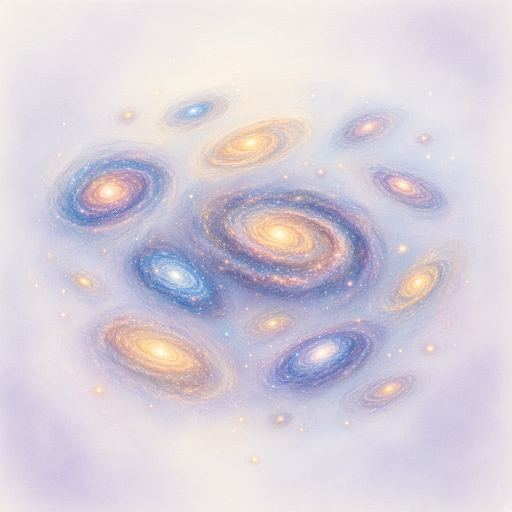
The Milky Way is the galaxy that contains the Sun, Earth, and the rest of our solar system. A galaxy is a huge collection of stars, gas, dust, and other matter held together by gravity.
From a dark place on Earth, part of the Milky Way looks like a pale band crossing the sky. We see that band because we are looking through the crowded disk of our own galaxy from inside it.
Key facts about the Milky Way
The starry disk spans more than 100,000 light-years. A light-year is a distance, not a time: it is how far light travels in one year.
The galaxy probably contains 100 billion to 400 billion stars. The large range shows how difficult it is to count faint stars while observing from inside the disk.
The Milky Way is a spiral galaxy with a central bar. Spiral arms curve through its flattened disk.
The Sun lies near the Orion Arm, also called the Orion Spur. This small, partial arm sits between the Sagittarius and Perseus arms.
The Sun is about 26,000 light-years from the galactic center. It is not in the middle of the galaxy.
One trip around the galaxy takes the solar system about 240 million years. That long orbit is sometimes called a galactic year.
The stellar disk is very flat compared with its width. The European Space Agency describes it as about 100,000 light-years across and about 1,000 light-years high.
A supermassive black hole sits at the center. It is called Sagittarius A*, pronounced “Sagittarius A-star.”
Sagittarius A has about four million times the Sun’s mass.* Nearby stars orbit this compact object.
The first image of Sagittarius A was released on May 12, 2022.* The Event Horizon Telescope linked eight radio observatories into one Earth-sized virtual telescope.
The Milky Way has a large, mostly invisible dark-matter halo. Astronomers infer it from gravity’s effects on stars and other objects.
The Milky Way belongs to the Local Group. NASA describes this neighborhood as containing more than 50 galaxies.
What the black-hole image shows
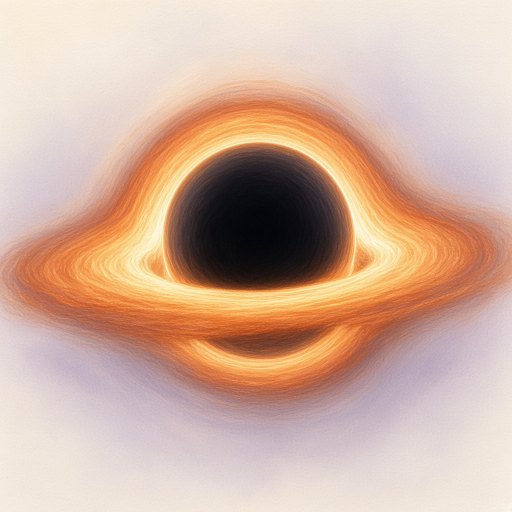
The Event Horizon Telescope did not photograph light coming from inside the black hole. A black hole is dark. Instead, the image shows a dark central shadow surrounded by bright, hot gas. Gravity bends the gas’s light on its way to the telescopes.
Sagittarius A* is about 27,000 light-years from Earth according to the Event Horizon Telescope. Its great distance means it does not pull Earth out of the solar system. The Sun and many other stars follow their own long orbits through the galaxy.
Common myths about the Milky Way
Myth: The white band is a cloud in Earth’s atmosphere. The band marks the Milky Way’s star-filled disk viewed from within. City lights can hide it, which is why it is easier to see far from bright towns.
Myth: The Sun is at the center. The Sun is about 26,000 light-years from the center, near the Orion Spur.
Myth: A picture of the entire Milky Way was taken from outside it. Spacecraft have not traveled beyond our galaxy to photograph it from above. Face-on pictures are illustrations built from measurements of stars, gas, dust, and motion.
Myth: Sagittarius A will swallow the whole galaxy.* Its gravity strongly controls nearby orbits, but it does not act like a vacuum cleaner pulling every distant object straight inward.
Myth: Andromeda will definitely crash into the Milky Way soon. A 2025 analysis using Hubble and Gaia data found about a 50 percent chance of a collision within the next 10 billion years. A pass without a collision also remains possible.
Frequently asked questions
Why is it called the Milky Way?
The faint band looks milky from Earth. People gave it names and stories long before telescopes revealed that it consists of distant stars in our own galaxy.
How can astronomers map a galaxy from inside it?
They measure the positions, distances, motions, and light of many stars. They also observe gas and dust with radio and infrared telescopes, which can reveal regions hidden in visible light.
Where is Earth in the galaxy?
Earth orbits the Sun, and the Sun lies near the Orion Spur. The whole solar system orbits the center of the Milky Way.
Is the Milky Way still changing?
Yes. Stars are born and die, the disk rotates, and the galaxy interacts with smaller neighbors. Its present shape is one moment in a history lasting more than 13 billion years.
The Milky Way is difficult to map because every telescope in the solar system observes it from inside its disk. Dust blocks visible light toward crowded regions, and nearby stars can hide the larger pattern. Astronomers combine distances, motions, infrared images, and radio maps to reconstruct the galaxy.
Structure and scale
The Milky Way is a barred spiral galaxy. A long concentration of stars crosses the center, and spiral arms extend through the disk.
NASA gives the starry disk a span greater than 100,000 light-years. The European Space Agency describes its vertical height as only about 1,000 light-years.
The galaxy probably contains 100 billion to 400 billion stars. ESA’s Gaia survey has measured nearly two billion of them, roughly one percent of the total.
The Sun is about 26,000 light-years from the center. It lies near the Orion Spur between the Sagittarius and Perseus arms.
The solar system takes about 240 million years to complete one galactic orbit. Since the Sun is about 4.6 billion years old, it has completed only about 19 such laps.
The disk and central bulge sit inside a stellar halo. ESA gives the stellar halo a radius of about 100,000 light-years.
An even larger dark-matter halo surrounds the visible galaxy. Dark matter does not emit light, so astronomers infer it from gravitational effects.
The Milky Way’s total mass is still uncertain. ESA summarizes estimates ranging from a few hundred billion to a few trillion solar masses.
Sagittarius A*
Sagittarius A* is the supermassive black hole at the galactic center. Observations of nearby stellar orbits show that it contains about four million solar masses. The Event Horizon Telescope released its first image on May 12, 2022.
The image is not a photograph of matter inside the event horizon. It shows a dark shadow surrounded by a ring-like glow from hot gas. The telescope network gathered the data in 2017 and averaged many reconstructions because the glowing gas changed rapidly during observation.
Sagittarius A* is about 27,000 light-years away. It dominates the motion of stars in its immediate neighborhood, but the distribution of matter across the galaxy determines the Sun’s orbit.
A galaxy built by mergers
The Milky Way did not grow in isolation. ESA reports that it began forming more than 13 billion years ago and grew by merging with smaller galaxies.
Gaia data revealed stars from an early merger called Gaia-Sausage-Enceladus. ESA dates that merger to about 10 billion years ago. The unusual stars move more strongly inward and outward instead of following the usual rotation around the disk.
The Sagittarius dwarf galaxy is interacting with the Milky Way now and is slowly being pulled apart. ESA links repeated passages of Sagittarius with warping, ripples, and unusual motions in the Milky Way’s disk.
Stellar streams are another clue. When the Milky Way disrupts a dwarf galaxy or cluster, its stars can stretch along related orbits. Astronomers use the streams to investigate both galactic history and the gravity of the dark-matter halo.
Neighbors and the Andromeda forecast
The Milky Way belongs to the Local Group, a neighborhood with more than 50 galaxies. It includes Andromeda, the Large Magellanic Cloud, the Small Magellanic Cloud, and many dwarf galaxies.
Andromeda is moving generally toward the Milky Way, but a collision is no longer described as certain. A 2025 analysis combined Hubble and Gaia measurements, considered 22 uncertain variables, and ran 100,000 simulations. It found about a 50 percent chance of a collision within the next 10 billion years.
The Large Magellanic Cloud affects that prediction. Its gravity pulls the Milky Way away from the direct orbital plane toward Andromeda, making a merger somewhat less likely in the simulations.
Common myths
Myth: Every spiral arm is a permanent group of the same stars. Stars and gas move through a changing disk. Gaia observations indicate that young clusters move differently by location and that arm-like structures may be transient rather than permanent.
Myth: The visible galaxy contains all its mass. The extended halo is dominated by matter that does not shine. Its gravity is studied through the motions of stars, streams, clusters, and dwarf galaxies.
Myth: The center’s black hole pulls the entire disk in the same way. Sagittarius A* dominates very nearby orbits. Across the disk, the combined gravity of stars, gas, dark matter, and the central regions shapes motion.
Myth: An Andromeda encounter would make stars collide everywhere. Galaxies are mostly empty space. Their gravity can change orbits and reshape both galaxies even though direct star-to-star hits remain rare.
Frequently asked questions
How do astronomers see through galactic dust?
They use wavelengths that pass through dust more easily, especially infrared and radio light. NASA’s Spitzer observations helped map the central bar and major arms.
What is dark matter?
It is the name for unseen matter inferred from gravity. Astronomers do not yet know what particle or particles make it, but visible stars and gas cannot by themselves explain all observed galactic motion.
Is the Milky Way flat?
Its stellar disk is very flat compared with its width, but the whole galaxy is not a thin plate. It includes a central bulge, a warped disk, a stellar halo, and a much larger dark-matter halo.
Will the Milky Way last forever?
Its structure will continue to change through star formation, stellar death, internal motion, and interactions. The exact long-term encounter with Andromeda remains uncertain.
The Milky Way is a barred spiral galaxy whose visible disk spans more than 100,000 light-years. We infer its plan view rather than photographing it from outside, combining stellar astrometry, infrared observations through dust, radio maps of gas, and comparisons with external galaxies.
The cleanest numbers depend on what is being measured. “Diameter” can mean the bright stellar disk, a fainter outer component, the stellar halo, or the much larger dark-matter halo. A single size without that label is incomplete.
Structure and location
Stellar disk: ESA gives a radius near 50,000 light-years and a vertical height near 1,000 light-years.
Stellar population: NASA estimates about 100 billion to 400 billion stars; Gaia has measured almost two billion.
Solar position: about 26,000 light-years from the Galactic Center, near the Orion Spur between the Sagittarius and Perseus arms.
Solar orbit: NASA gives about 240 million years for one revolution around the galaxy.
Central bulge and bar: the bulge is elongated, and NASA infrared mapping identifies two major arms connected to the ends of the bar.
Stellar halo: ESA describes a roughly spherical population of old stars and globular clusters extending to a radius near 100,000 light-years.
Dark-matter halo: it extends beyond the visible components and is inferred through gravitational effects, but its mass and shape remain active research questions.
ESA’s current synthesis gives total Milky Way mass estimates ranging from a few hundred billion to a few trillion solar masses. That uncertainty is a reason to avoid overly precise claims such as “dark matter is exactly 94 percent of the galaxy.”
Sagittarius A* as a precision laboratory
The compact object Sagittarius A* sits at the Galactic Center. The GRAVITY Collaboration’s multi-star orbital fit gives a central mass of 4.297 million solar masses and a distance of 8,277 parsecs, with separate statistical and systematic uncertainties.
The star S2 completes an orbit in about 16 years. At closest approach it comes within about 120 astronomical units and moves at nearly three percent of light speed. Long-term observations detected the forward rotation of its orbit called Schwarzschild precession, matching general relativity.
The Event Horizon Telescope added horizon-scale evidence in 2022. Eight radio observatories formed an Earth-sized virtual instrument. The published image shows a dark shadow and bright ring-like emission, with the ring size agreeing with general-relativity predictions for a roughly four-million-solar-mass black hole.
These measurements answer related but different questions. Stellar orbits constrain the mass and distance on scales of many astronomical units. The EHT image tests the compact object and surrounding plasma on scales near the event horizon.
Galactic archaeology
Gaia measures positions, parallaxes, proper motions, and for subsets of stars, radial velocities. Those data let astronomers identify groups that share unusual motion and chemistry.
Gaia-Sausage-Enceladus is debris from a galaxy that merged with the Milky Way about 10 billion years ago. ESA says roughly 30,000 stars with distinctive inward-and-outward motion first revealed this merger across much of the sky.
The Sagittarius dwarf provides a more recent disturbance. It has passed through or near the Milky Way’s disk repeatedly and is being disrupted. Gaia found ripples, warping, and a phase-space pattern resembling a snail shell. The evidence shows that the disk is not a perfectly settled, time-independent system.
Stellar streams also trace disrupted satellites and clusters. Because the stars follow the Galactic gravitational field, stream positions and velocities help constrain mass that cannot be seen directly.
From the Local Group to Laniakea
The Milky Way lies in the Local Group, which NASA describes as having more than 50 galaxies. The Local Group sits on the outer edge of the Laniakea supercluster.
A supercluster is not necessarily one gravitationally bound object. NASA describes superclusters as large collections of clusters, groups, and galaxies that are typically not all bound together. On larger scales, these structures form part of the cosmic web.
The Milky Way’s nearest large galactic neighbor is Andromeda. Their future depends on poorly known sideways velocities and the gravity of other Local Group members. A 2025 Hubble and Gaia analysis ran 100,000 simulations with 22 uncertain variables and found about a 50 percent chance of a collision within 10 billion years.
Only about two percent of those simulations produced a head-on collision in four to five billion years. The Large Magellanic Cloud pulled the Milky Way away from the direct orbital plane in the model, while Andromeda’s satellite M33 pulled in the opposite sense.
Common precision traps
“The Milky Way is exactly 100,000 light-years wide.” That figure describes the approximate bright stellar disk. Other components use different boundaries.
“The black hole image shows the event horizon.” The event horizon emits no light. The image resolves emission and a shadow produced by strong gravity around the hole.
“A galactic year is 225 million years.” Estimates depend on the adopted solar distance and orbital speed. NASA’s current overview uses about 240 million years, while other literature quotes nearby values.
“Gaia photographed the Milky Way from above.” Gaia measured celestial objects from within the solar system. Face-on Milky Way maps are evidence-based reconstructions.
“Laniakea is a giant galaxy cluster holding us tightly.” It is a supercluster-scale flow region. Superclusters are generally not bound in the same way as galaxy groups or clusters.
“Andromeda’s merger is inevitable.” The best current simulation study described by NASA gives nearly equal collision and non-collision probabilities over 10 billion years.
Frequently asked questions
Why do mass estimates vary so much?
The outer galaxy contains few bright tracers, and the Large Magellanic Cloud disturbs satellite motions. Different analyses use streams, globular clusters, dwarf galaxies, and other probes with different assumptions.
What makes S2 useful?
Its short, eccentric orbit samples the strong gravitational field close to Sagittarius A*. Repeated measurements provide both a mass estimate and a test of relativistic orbital precession.
What is a phase-space spiral?
It is a spiral-like pattern that appears when stellar height above the disk is plotted against vertical velocity. It is evidence that a disturbance has not yet fully mixed away.
Where does the Milky Way end?
There is no sharp wall. Stellar density fades, the stellar halo extends beyond the disk, and the dark-matter halo reaches farther still. The useful boundary depends on the scientific question.
Milky Way parameters are model-dependent because observers sit inside a dusty, non-axisymmetric, time-dependent disk. Precision therefore requires a stated tracer population, coordinate frame, radial boundary, and uncertainty model. Numbers for the bright disk, stellar halo, dark-matter halo, and virial mass are not interchangeable.
The Galactic Center potential
The GRAVITY Collaboration fit the orbits of S2, S29, S38, and S55 around Sagittarius A*. Its 2022 result gives a point mass of (4.297 ± 0.012) million solar masses and a Galactic Center distance of 8,277 ± 9 parsecs, where those quoted errors are statistical. The paper separately estimates systematics near 40,000 solar masses and 30 parsecs.
The fit constrains any extended mass inside S2’s apocenter to less than about 3,000 solar masses at one standard deviation under plausible density profiles. On that scale, the potential is overwhelmingly dominated by the compact central object.
S2 has a period near 16 years and a pericenter near 120 astronomical units. ESO observations detected its Schwarzschild precession, the forward rotation of the orbital ellipse predicted by general relativity. The 2022 multi-star analysis reports a seven-standard-deviation detection and consistency with a single central point mass.
The Event Horizon Telescope probes a different scale. Its 2017 radio data produced the image released in May 2022. The image is an average of many reconstructions because emission around Sagittarius A* varies on minute timescales; it shows a shadow and bright ring, not light from the event horizon itself.
What the M-sigma relation does and does not say
The M-sigma relation is an empirical correlation between a central black hole’s mass and the stellar velocity dispersion of its host bulge. A widely used 2009 fit found a slope near 4.24 for its full galaxy sample and an intrinsic scatter near 0.44 dex. The same study found larger scatter for spirals than for ellipticals.
Calling the Milky Way an “M-sigma anomaly” is not a complete result. The predicted mass changes with the chosen calibration, galaxy sample, definition of bulge dispersion, and treatment of the Milky Way’s barred central structure. Sagittarius A* has an unusually precise direct mass, but the comparison variable sigma is not a single scale-free constant.
The relation is therefore useful for population studies, not a replacement for the Galactic Center’s orbital measurement. A residual from one fitted line should be reported with that fit’s scatter and selection assumptions.
The uncertain dark-matter halo
ESA describes the visible Milky Way as embedded in an extended halo dominated by invisible dark matter. Its presence is inferred from gravitational effects on stars, stellar streams, clusters, and dwarf galaxies.
The total mass is substantially less precise than the central black-hole mass. ESA summarizes estimates from a few hundred billion to a few trillion solar masses. The uncertainty reflects sparse outer-halo tracers, assumptions about equilibrium and halo shape, and perturbations from massive satellites such as the Large Magellanic Cloud.
Gaia also revised the halo’s geometry. ESA reports a halo that appears elongated, tilted, and stretched rather than perfectly spherical and homogeneous. That statement refers to a data-informed structure, not a claim that one simple ellipsoid captures every halo component.
Phase space and a dynamically young disk
Gaia’s six-dimensional samples combine three positions with three velocity components. In 2018, researchers plotted roughly six million disk stars in different position-velocity projections and found ridges and a snail-shell pattern.
The phase-space spiral indicates incomplete phase mixing. The discovery paper inferred a perturbation roughly 300 million to 900 million years ago, consistent with estimates for a close passage of the Sagittarius dwarf galaxy. It also concluded that a time-independent, axisymmetric disk is an inadequate model for these data.
Attribution to Sagittarius is physically plausible but should remain tied to models. Bar resonances, spiral structure, satellite passages, and their interactions can all shape disk kinematics.
Gaia-Sausage-Enceladus records a much older merger, about 10 billion years ago. ESA identifies approximately 30,000 stars with distinctive elongated, partly retrograde motions as evidence for that event and its contribution to the inner halo.
Metal-poor stars and early fragments
Low metallicity means a star contains relatively few elements heavier than helium, not that it is made of metal in the everyday sense. Such chemistry can identify populations formed before many generations of stars enriched the interstellar medium.
Gaia helped identify the Shakti and Shiva streams near the Milky Way’s heart. ESA reports ages of about 12 billion to 13 billion years and masses near 10 million Suns for each structure. Their shared orbits and compositions suggest ancient fragments that joined the early Milky Way.
ESA’s “poor old heart” label refers to ancient, metal-poor stars in the inner galaxy. It does not mean every central star is old or metal-poor; the bulge and nuclear regions contain multiple populations.
The CMB dipole is a frame measurement
Planck’s 2018 result gives a solar dipole equivalent to 369.82 ± 0.11 kilometers per second for the Solar System barycenter relative to the cosmic microwave background frame. This is not the Sun’s orbital speed around the Galactic Center, which is about 220 kilometers per second.
It is also not automatically “the speed of the Local Group.” Converting between the solar, Galactic Center, Local Group, and CMB frames requires vector corrections for local motions. Quoting 369.82 kilometers per second without naming the Solar System barycenter and CMB frame changes the meaning of the number.
Model-dependent habitability and future encounters
The Galactic Habitable Zone is a modeling concept, not an observed ring with fixed edges. Early models balanced metallicity, planet formation, time for evolution, and hazards such as nearby supernovae. A published critique concluded that then-current uncertainties did not justify a firm boundary and that much or all of the disk could remain viable.
The same caution applies to the Milky Way’s future with Andromeda. A 2025 study included 22 uncertain variables in 100,000 simulations and found about a 50 percent collision probability within 10 billion years. Only about two percent produced a head-on collision in four to five billion years.
M33 and the Large Magellanic Cloud shift the result in opposite directions. The study therefore replaces an “inevitable merger” statement with a probability distribution that should change as proper-motion and mass estimates improve.
Frequently asked questions
Why is Sagittarius A’s mass so much more precise than the halo mass?*
Short-period stars trace a compact potential through repeated, high-resolution observations. The halo extends across far larger distances where tracers are sparse and disequilibrium effects are harder to model.
Does the phase-space spiral prove one Sagittarius passage caused it?
It proves the local disk is not fully phase mixed. The timing is consistent with Sagittarius, but the causal interpretation remains model-dependent.
Can the CMB define an absolute rest frame?
It supplies a useful cosmological frame in which the dipole is removed. Measuring velocity relative to that radiation does not overturn relativity; it states motion relative to a physical background.
Is the Milky Way’s dark halo a sphere?
No exact shape is established. Gaia results favor a more elongated and tilted stellar-halo structure than the old spherical cartoon, while dark-halo inference still depends on tracers and dynamical models.