Nuclear fusion means pushing two small atoms together so hard that they join into one bigger atom. When that happens, a tiny bit of their weight disappears and comes out as energy. This is how the Sun works, and it is why the Sun has been shining for about 4.6 billion years. Scientists have spent seventy years trying to make fusion work in a machine on Earth.
Fusion and fission are opposites
People mix these up constantly, so here is the difference.
Fission splits a big, heavy atom into smaller pieces. This is what happens inside today’s nuclear power plants. It works, but it leaves behind waste that stays dangerous for tens of thousands of years.
Fusion joins two tiny atoms into one. It is the opposite process. It leaves behind helium, the harmless gas in party balloons.
Both release energy, and for a strange reason: iron sits at the most stable point. Anything lighter than iron gives off energy when you join it with something. Anything heavier gives off energy when you split it. Everything is trying to become iron.
Why fusion is so hard
Every atom’s center carries a positive charge, and positive charges shove each other away. Try pushing two magnets together the wrong way round and you have felt exactly this.
To make two atoms touch, you have to throw them at each other very, very fast. Fast means hot. Fusion machines on Earth have to reach more than 180 million degrees Fahrenheit (100 million degrees Celsius), which is about seven times hotter than the center of the Sun.
Why hotter than the Sun? Because the Sun cheats. It has so much weight pressing inward that its own gravity does part of the squeezing. No machine on Earth can copy that, so it has to make up the difference with heat.
Key facts about fusion
Fusion joins light atoms. Fission splits heavy ones. They are opposites.
The Sun fuses hydrogen into helium in a core about 27 million degrees Fahrenheit (15 million degrees Celsius).
Fusion machines on Earth need over 180 million degrees Fahrenheit (100 million degrees Celsius).
At those temperatures nothing solid can touch the fuel, so magnets hold it in mid-air.
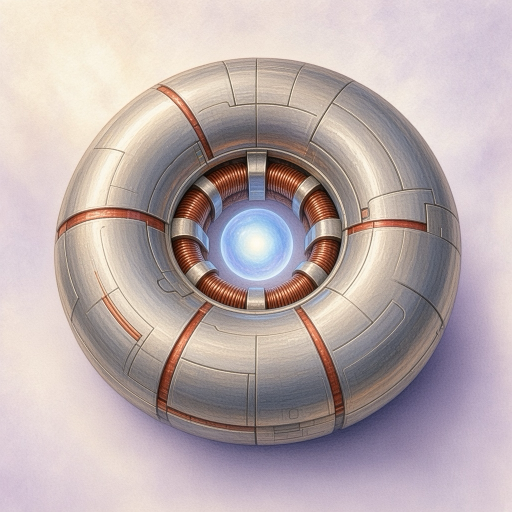
The donut-shaped magnetic machines are called tokamaks.
Fusion fuel comes from ordinary seawater and from lithium, the metal in phone batteries.
In December 2022, lasers in California got more energy out of a fusion reaction than they put into the fuel.
The biggest fusion machine ever, ITER, is being built in France by more than thirty countries.
No fusion machine has ever delivered electricity to anybody’s home.
Fusion cannot melt down, because there is only a tiny amount of fuel inside at once.
The Sun is lazier than a compost heap
Here is a fact almost nobody expects. If you took a block about a yard on each side (one cubic meter) from the center of the Sun, it would produce only a few hundred watts of heat, roughly what a pile of rotting garden waste produces, and less than your own body makes for its size.
The Sun is not blindingly bright because each part of it is fierce. It is bright because it is unimaginably huge. There are a lot of blocks like that in a star.
This is exactly why we cannot just copy the Sun’s recipe. The Sun gets away with a slow reaction because its own gravity holds a gigantic ball of fuel together for billions of years. No machine can hold fuel that way, so Earth machines use a different, much faster fuel instead.
Common myths about fusion
Myth: Fusion and fission are the same thing.
They are opposites. Fusion joins small atoms; fission splits big ones.
Myth: A fusion machine could explode like a bomb.
There is only a fraction of an ounce of fuel (a few grams) inside at any moment. If something goes wrong the reaction stops, because keeping it going is the hard part.
Myth: Fusion is completely clean with no waste at all.
The reaction makes harmless helium, but it also fires out fast particles called neutrons that make the machine’s own walls slightly radioactive. That waste fades in about a hundred years, instead of tens of thousands.
Myth: Fusion power plants already exist somewhere.
Not one. Every fusion machine ever built has been an experiment.
Frequently asked questions about fusion
What is nuclear fusion?
Joining two light atoms into one heavier atom, which releases energy. It is what powers the Sun and every star.
How is fusion different from what power plants use now?
Power plants split heavy atoms apart. That is fission. Fusion does the opposite and uses completely different fuel.
Why is fusion so hard to do?
Atoms push each other apart. Getting them close enough to stick takes more than 180 million degrees Fahrenheit (100 million degrees Celsius), and nothing solid can hold something that hot.
What holds the fuel if nothing can touch it?
Magnets. At those temperatures the fuel becomes a plasma, which carries electric charge, and magnetic fields can push charged things around.
Where does the fuel come from?
Seawater and lithium. There is enough to last an extremely long time, which is one of the main reasons people keep working on it.
When will fusion power my house?
Nobody knows. People have joked for decades that fusion is always thirty years away, and no fusion machine has yet produced electricity for anyone.
Source notes
How fusion works comes from the nuclear fusion entry, and the Sun’s temperature and surprisingly low power density from the solar core record. The 2022 laser result is documented by the US Department of Energy. Magnetic machines are described in the tokamak entry and the international project in the ITER entry.
Nuclear fusion is the process of forcing two light atomic nuclei together so they merge into a heavier one, releasing energy in the process. It powers the Sun and every other star. On Earth, physicists have been trying to build machines that do the same thing since the 1950s, and while they have produced fusion reactions many times, no machine has yet delivered electricity to a grid.
Everything wants to be iron
Both fusion and fission release energy, which sounds contradictory until you look at a graph physicists call the binding energy curve.
Iron sits near the top of that curve, meaning iron nuclei are among the most tightly bound of all. Elements lighter than iron release energy when they fuse toward it. Elements heavier than iron release energy when they split toward it.
So hydrogen fusing into helium gives off energy, and uranium splitting into lighter fragments gives off energy, and both are moving in the direction of iron. Fusing iron takes in energy instead of giving it off, which is why fusion in a massive star stops when its core turns to iron, and why that moment triggers a supernova.
The fuel: two kinds of heavy hydrogen
Ordinary hydrogen is a single proton. Fusion machines on Earth use two heavier versions:
Deuterium has one proton and one neutron. It occurs naturally in water, roughly one hydrogen atom in every 6,400, and can be separated from seawater.
Tritium has one proton and two neutrons. It is radioactive and decays with a half-life of about twelve years, which means almost none exists naturally on Earth.
When deuterium and tritium fuse they produce a helium nucleus, a fast neutron, and about 17.6 million electron volts of energy. Roughly 80 percent of that energy is carried away by the neutron.
The tritium problem is serious. Since it barely exists in nature, a fusion plant has to make its own. The plan is to line the reactor with a blanket containing lithium, so escaping neutrons hit lithium atoms and turn them into tritium. No machine has yet demonstrated this working at full scale.
Key facts about fusion
Fusion joins light nuclei; fission splits heavy ones. Both release energy because both move toward iron.
The Sun’s core runs at about 27 million degrees Fahrenheit (15 million degrees Celsius). Earth machines need over 180 million degrees Fahrenheit (100 million degrees Celsius).
Deuterium comes from seawater; tritium must be manufactured inside the reactor from lithium.
A deuterium-tritium reaction releases about 17.6 million electron volts, with the neutron taking about 80 percent.
Tritium decays with a half-life of about twelve years, so it cannot be stockpiled indefinitely.
In February 2024, the JET machine in Britain announced a record 69 megajoules from about seven millionths of an ounce (0.2 milligrams) of fuel.
JET ran from 1983 until its final pulse in December 2023 and is now being decommissioned.
ITER, in southern France, is funded by more than thirty countries and is now scheduled to start research operations in 2034.
In December 2022, lasers at the National Ignition Facility produced more fusion energy than they delivered to the target.
Fusion produces no long-lived high-level waste, but neutrons make reactor structures radioactive for about a century.
Two shapes of magnetic bottle
Since no wall can touch plasma at 180 million degrees Fahrenheit (100 million degrees Celsius), the fuel is held in a magnetic field. There are two main designs, and the difference matters.
A tokamak is a doughnut-shaped chamber that makes part of its magnetic field by driving a huge electric current through the plasma itself. This is relatively simple to build, and tokamaks have led fusion research for decades. The drawbacks are that the current is naturally pulsed rather than continuous, and that it can collapse suddenly in an event called a disruption, dumping enormous energy into the walls.
A stellarator produces the whole twisted magnetic field from external coils, so no plasma current is needed. It can run continuously and does not suffer disruptions. The catch is the coils: they are twisted three-dimensional shapes that had to be worked out by computer optimization, and building them to the required precision is extraordinarily difficult. Germany’s Wendelstein 7-X is the leading example, and it has set records for long-duration plasma performance.
Common myths about fusion
Myth: Fusion is just a cleaner version of today’s nuclear power.
It is a completely different reaction with different fuel and different waste. Neither the fuel nor the failure modes are the same.
Myth: Fusion has no waste.
Neutrons make reactor structures radioactive. That waste decays over roughly a century instead of tens of thousands of years, which is a large improvement rather than a clean slate.
Myth: The 2022 laser result means fusion energy is basically solved.
It compared fusion output against the laser energy that reached the target, not against the electricity the facility drew from the grid, which was far greater.
Myth: Fusion research has never achieved anything.
Fusion reactions have been produced routinely for decades, records climb steadily, and the 2022 ignition result was a genuine physics milestone. What has not happened is a machine producing net electricity.
Frequently asked questions about fusion
Why does fusion need to be hotter than the Sun?
The Sun uses its own crushing gravity to help squeeze its fuel together. A machine on Earth cannot do that, so it compensates with far higher temperature.
Why is tritium a problem?
It barely exists naturally and decays with a twelve-year half-life, so plants must breed their own from lithium. That has never been demonstrated at scale.
What is the difference between a tokamak and a stellarator?
A tokamak drives current through the plasma to twist the field; a stellarator twists it using complicated external coils. Tokamaks are easier to build, stellarators are steadier to run.
How much fuel does fusion need?
Very little. JET’s record used about seven millionths of an ounce (0.2 milligrams).
Is fusion dangerous?
It cannot melt down or run away, because only a fraction of an ounce of fuel (a few grams) is present at once and the reaction stops the moment conditions slip. Tritium handling and activated materials require care.
When will fusion produce electricity?
No date is reliable. ITER will not generate any, since it has no turbines. A later demonstration plant would be the first attempt.
Nuclear fusion is the merging of light atomic nuclei into heavier ones, releasing energy because the product is more tightly bound than the reactants. It is the energy source of every star and, on Earth, the subject of a research program running continuously since the 1950s. Fusion reactions have been produced in laboratories for decades and a laser experiment first released more energy than was delivered to its fuel in December 2022, but no device has yet generated net electricity.
Why anything releases energy at all
Binding energy per nucleon rises steeply from hydrogen, peaks near iron and nickel, and declines slowly toward uranium. Any reaction that moves nuclei toward that peak converts a small amount of mass into energy.
Light elements therefore release energy by fusing, heavy elements by fissioning, and both processes are moving toward the same destination. Fusing iron consumes energy rather than releasing it, which is why fusion in a massive star halts when its core becomes iron, and why that halt precipitates core collapse and a supernova.
The mass converted is tiny in absolute terms. A deuterium-tritium reaction releases about 17.6 million electron volts, which is roughly four million times the energy released when a carbon atom burns, from a fuel mass in the same ballpark.
The barrier, and the trick that gets around it
Two nuclei approaching one another face a rising electrostatic potential from their like charges, and only at very short range does the attractive strong force take over. Classically, fusion requires enough kinetic energy to climb that barrier entirely.
Quantum mechanics provides a shortcut. A nucleus has a finite probability of passing through the barrier rather than over it, and that tunneling probability rises steeply with energy. Without it, the Sun’s core at roughly 15 million kelvin would be far too cool to fuse hydrogen at any appreciable rate.
Even with tunneling, the Sun is extraordinarily unhurried. Its peak core power density is a few hundred watts per cubic meter, comparable to a compost heap and less than a human body produces per unit volume. Solar luminosity comes from having an enormous core, not an intense one, which is precisely why copying the Sun’s reaction would be useless in a machine.
What a fusion device must achieve
Fusion power rises with the square of density and steeply with temperature, while losses depend on how fast energy leaks out of the plasma. The Lawson criterion combines the three into a triple product of density, temperature, and energy confinement time that must exceed a threshold.
The three factors trade against one another, which is why competing approaches look so different:
Stars use enormous density and effectively unlimited confinement time at modest temperature.
Magnetic confinement uses very low density, roughly a millionth of atmospheric, held for seconds by magnetic fields, at temperatures above 100 million kelvin. Tokamaks and stellarators work this way.
Inertial confinement uses extreme density for a few billionths of a second, compressing a fuel capsule so violently that it burns before it can disassemble. The National Ignition Facility works this way.
Key facts
Binding energy peaks near iron; lighter nuclei release energy by fusing, heavier ones by splitting.
Deuterium-tritium fusion releases about 17.6 million electron volts, with roughly 80 percent carried by the neutron.
Deuterium is separated from seawater; tritium barely exists naturally and must be bred from lithium.
Tritium’s half-life is about twelve years, so world inventory decays at roughly 5 percent per year.
Solar core power density is a few hundred watts per cubic meter, lower than a human body’s.
JET set a record of 69 megajoules from about seven millionths of an ounce (0.2 milligrams) of fuel in its final campaign, announced in February 2024, and was retired in December 2023.
In December 2022 the National Ignition Facility delivered about 2.05 megajoules to a target and recovered about 3.15 megajoules of fusion energy.
ITER’s 2024 rebaselining replaced the first plasma milestone with a start of research operations in 2034 and moved deuterium-tritium operation to 2039.
ITER targets a scientific gain of ten but has no electricity generating equipment.
Fusion produces no long-lived high-level waste; activated structures decay over roughly a century.
Three meanings of gain, and why the distinction matters
Most confusion in fusion reporting comes from conflating three different ratios.
Target gain compares fusion energy released against energy delivered to the fuel. This is the figure that exceeded one at the National Ignition Facility in December 2022.
Scientific gain, usually written Q, compares fusion power against heating power injected into the plasma. ITER targets ten.
Engineering or wall-plug gain compares net electricity produced against total electricity consumed by the entire facility, including magnets, cryogenics, heating systems, tritium processing, and pumps, and it accounts for thermal-to-electric conversion at ordinary turbine efficiency.
The gap between the first and the third is enormous. The 2022 experiment drew far more grid electricity to charge its lasers than the lasers delivered to the target, so the facility consumed vastly more than it produced. That does not diminish the physics result, which was real and has been repeated with larger yields. It does mean the milestone was scientific rather than commercial, and closing the remaining gap is most of the engineering work that remains.
The problems that are not plasma physics
Even granting a plasma that satisfies the Lawson criterion, several distinct problems stand between that and a power station.
Tritium supply. Global civil inventory is measured in pounds (kilograms) and decays continuously. A plant must breed slightly more tritium than it burns, using its own neutrons striking lithium in a surrounding blanket. No device has demonstrated this at scale; ITER is intended to be the first to test blanket modules.
Materials. The 14 million electron volt neutrons that carry most of the energy also displace atoms in the structure and transmute them, producing helium within the metal that causes swelling and embrittlement. Fission reactor data does not transfer, because the spectrum is softer and produces less helium per displacement. No facility currently provides a full fusion neutron environment for qualifying candidate materials.
Exhaust. Helium ash must be removed continuously or it dilutes the fuel, and the power crossing the plasma edge is concentrated at the divertor, where target plates face heat fluxes roughly ten times those on a spacecraft reentry surface, 10 to 20 megawatts per square meter, continuously rather than briefly.
Disruptions. In a tokamak, loss of confinement terminates the plasma current over milliseconds, inducing large forces in the vessel and potentially accelerating relativistic electron beams into the wall.
Common misconceptions
“Fusion is a cleaner version of fission.” Different reaction, different fuel, different failure modes, different waste. Fusion cannot melt down because only grams of fuel are present and the reaction stops when conditions slip.
“Fusion produces no radioactive waste.” The reaction product is helium, but neutron activation of the structure produces waste that decays over about a century rather than tens of thousands of years.
“The 2022 result means net energy.” It means net energy at the target. The facility’s grid consumption was far higher.
“ITER will generate power.” It has no turbines. Its purpose is demonstrating sustained gain in the plasma.
“Fusion is always thirty years away.” The joke reflects a real record of slipping predictions, but confinement performance, triple product records, and target gain have all improved measurably over that period.
Frequently asked questions
Why do Earth machines need to be hotter than the Sun?
The Sun supplies gravitational confinement that no machine can match, so terrestrial devices compensate with far higher temperature and a much more reactive fuel.
What is the triple product?
Density multiplied by temperature multiplied by energy confinement time. It must exceed a threshold for a self-sustaining reaction, and different approaches trade the three factors differently.
Why deuterium and tritium rather than ordinary hydrogen?
Their reaction cross-section is many orders of magnitude larger. The Sun’s proton-proton chain depends on a weak-interaction step so improbable that it would be useless in a machine.
How much fuel does a fusion reaction consume?
Very little. JET’s 69 megajoule record used about seven millionths of an ounce (0.2 milligrams).
Is tritium dangerous?
It is radioactive and must be contained, but it emits weak beta radiation that does not penetrate skin. The concern is inhalation or ingestion, which drives containment design.
What would count as real success?
A device producing more electricity than the whole plant consumes, while breeding its own tritium and surviving neutron exposure for years. No machine has yet attempted all three at once.
Fusion energy research is often described as a plasma physics problem, and that description is now roughly a generation out of date. Confinement performance has improved steadily, target gain above unity has been demonstrated and repeated, and the remaining obstacles are predominantly nuclear engineering: breeding tritium faster than it is consumed, finding structural materials that survive a 14 million electron volt neutron flux for years, exhausting power and helium ash continuously, and closing an energy balance that includes the entire plant rather than the plasma alone.
Why the Sun is a bad model
The proton-proton chain begins with two protons forming a deuteron, which requires one to convert into a neutron through the weak interaction during the brief interval when the pair is within nuclear range. The weak interaction operates on timescales enormously longer than that interval, so the overwhelming majority of sufficiently energetic approaches fail.
The result is a mean waiting time for a given proton measured in billions of years and a peak core power density of a few hundred watts per cubic meter, below human metabolic power density per unit volume. Solar luminosity is a consequence of volume, not intensity.
Deuterium-tritium fusion avoids the bottleneck entirely, proceeding through the strong interaction with a cross-section many orders of magnitude larger and peaking at a conveniently accessible energy. It is chosen not because it is elegant but because it is the only reaction whose reactivity is high enough to be practical with achievable confinement, and its drawbacks, a scarce radioactive fuel and an intense neutron flux, follow directly from that choice.
Ignition, gain, and what each term excludes
Ignition in inertial confinement is a physical condition: alpha particles, which are charged and can be stopped within sufficiently dense compressed fuel, deposit their 3.5 million electron volts locally and heat neighboring fuel faster than energy is lost, so the burn propagates without further external drive. Achieving it requires adequate areal density, since alphas that escape deposit nothing.
Break-even is an accounting comparison, and which accounting matters enormously.
Target gain compares fusion yield to energy delivered to the capsule. Scientific gain compares fusion power to heating power injected into the plasma. Engineering gain compares net electrical output against total facility consumption, and it must absorb thermal conversion at ordinary turbine efficiency plus every parasitic load.
A device can achieve target gain well above unity while consuming vastly more grid electricity than it produces, which is the present situation. That is not a criticism of the physics result; it identifies which problem has been solved and which has not.
The triple product, and what each approach trades
The Lawson criterion requires the product of density, temperature, and energy confinement time to exceed a threshold. Because the three factors trade freely, machines that look nothing alike can occupy comparable positions.
Magnetic confinement operates at densities roughly a millionth of atmospheric, with confinement times measured in seconds and temperatures above 100 million kelvin. Inertial confinement inverts this: densities exceeding solid by orders of magnitude, confinement times of nanoseconds set purely by inertia. Both must satisfy the same product.
Within magnetic confinement, the field strength lever is unusually powerful. Fusion power density scales approximately with the fourth power of magnetic field, so a machine at 12 tesla can be dramatically smaller than one at 5 tesla for equivalent performance. High-temperature superconducting tapes sustain those fields at practical current densities, which is the quantitative basis of the compact high-field program, and the tradeoff is higher structural stress, harder quench protection, and a first wall closer to the plasma.
Failure modes specific to each configuration
Disruptions afflict tokamaks because they require a plasma current. Loss of confinement cools the plasma, resistivity rises, and the current quenches over milliseconds, inducing large electromagnetic forces in the vessel. The collapse can also accelerate a seed population of electrons to relativistic energies, producing a beam capable of melting localized regions of the first wall. Prediction and mitigation systems must act automatically, since no operator responds on that timescale.
Neoclassical transport afflicted classical stellarators, whose three-dimensional fields produced particle orbits that drained energy far faster than in an axisymmetric tokamak. Wendelstein 7-X addressed this by optimizing field geometry computationally before construction, and measurements have confirmed the predicted reduction. It has since set triple product records for long-duration plasmas with results comparable to JET despite roughly a third of the plasma volume, at the cost of coil geometry requiring extreme manufacturing precision.
The nuclear engineering that remains
Tritium. Global civil inventory is measured in pounds (kilograms), derives largely from heavy-water fission reactors, and decays at roughly 5 percent annually. A plant must achieve a breeding ratio above one, accounting for losses in processing and for the inventory needed to start subsequent plants. Neutron multipliers such as beryllium or lead are required because each fusion neutron must produce more than one tritium atom after accounting for parasitic absorption. No device has demonstrated a breeding blanket at scale.
Materials. Damage is quantified in displacements per atom, but displacement alone understates the problem: transmutation generates helium and hydrogen inside the metal, which accumulate at grain boundaries and drive swelling and embrittlement. The helium-to-displacement ratio under a fusion spectrum is far higher than under a fission spectrum, so fission irradiation data does not transfer. Reduced-activation ferritic-martensitic steels are the leading candidates, chosen so that activation products decay in about a century, and a dedicated high-flux irradiation source for qualifying them has been discussed for decades without being built.
Exhaust. Helium ash dilutes the fuel and must be pumped continuously. Power crossing the separatrix is concentrated onto divertor targets at fluxes roughly ten times those on a spacecraft reentry surface, 10 to 20 megawatts per square meter, sustained rather than transient. Detachment, in which impurities radiate the power volumetrically before it reaches a surface, is the leading approach and is not yet demonstrated in reactor-relevant conditions.
Plant energy balance
Recirculating power fraction is the metric that ultimately decides viability. A plant must run cryogenic systems for superconducting magnets, current drive systems whose wall-plug efficiency is poor, tritium extraction and processing, coolant pumping, and vacuum systems, all continuously.
Because the majority of deuterium-tritium energy arrives as neutron kinetic energy, it is captured as heat and converted through a conventional thermal cycle at ordinary efficiency. There is no route around that conversion loss for this fuel, which is one motivation for interest in aneutronic reactions despite their far more demanding confinement requirements.
The consequence is that the plasma gain required for a commercially useful surplus is substantially higher than the gain required to claim scientific break-even, and it is this figure, rather than the headline gain, that determines whether a design closes.
Alternative confinement schemes and why they persist
Beyond mainline tokamaks and stellarators, several approaches attract sustained private investment, and their appeal is easier to understand once the mainline difficulties are laid out.
Field-reversed configurations and other compact toroids aim at simpler geometry and higher plasma pressure relative to magnetic pressure, which would improve power density for a given magnet cost. Their historical weakness is stability: configurations sustained for milliseconds in experiments must reach seconds to be useful.
Pulsed and magneto-inertial schemes sit between the two mainline regimes, compressing a magnetized plasma target so that neither the density of inertial confinement nor the confinement time of magnetic confinement is required alone. The engineering burden shifts toward repetitive high-energy drivers and target manufacture at rates measured in pulses per second.
Aneutronic candidates, principally proton-boron, are pursued because they release energy predominantly in charged particles, which permits direct electrostatic conversion and largely eliminates neutron damage and tritium handling. The obstacle is arithmetic rather than engineering preference: the reaction requires substantially higher temperatures and a triple product well beyond deuterium-tritium requirements, while bremsstrahlung radiation losses rise with the higher atomic number of the fuel. No credible near-term path exists, which is why it remains a long-horizon option rather than a competitor to current programs.
What these schemes share is an attempt to move the difficulty from one part of the problem to another rather than to remove it. Evaluating any of them means asking which constraint has been relaxed and which has been made harder in exchange.
Key facts
The proton-proton chain’s weak-interaction step makes solar fusion extraordinarily slow per unit volume.
Ignition concerns alpha self-heating within the fuel; break-even is an accounting ratio, and the two are distinct.
Target gain, scientific gain, and engineering gain differ by large factors.
Fusion power density scales roughly with the fourth power of magnetic field strength.
Tokamak disruptions quench the plasma current over milliseconds and can produce relativistic electron beams.
Wendelstein 7-X demonstrated that computational optimization reduces neoclassical transport in stellarators.
Tritium breeding ratio must exceed one, requiring neutron multiplication, and has not been demonstrated at scale.
Fusion neutron damage produces far more helium per displacement than fission irradiation, so fission data does not transfer.
Divertor heat fluxes reach 10 to 20 megawatts per square meter, roughly ten times those on a spacecraft reentry surface, sustained continuously.
Common misconceptions at expert level
“Ignition means net energy.” Ignition is a condition on alpha self-heating. Net energy depends on accounting boundaries that ignition says nothing about.
“Fusion neutrons are a waste product.” They carry roughly 80 percent of the energy and are required for tritium breeding. They are the working fluid as much as the hazard.
“Displacements per atom captures neutron damage.” Helium and hydrogen generation from transmutation drive swelling and embrittlement independently of displacement count.
“Higher field is unambiguously better.” It raises structural stress, complicates quench protection, and concentrates heat flux on a nearer first wall.
“Aneutronic fuels sidestep the difficulties.” They avoid neutron damage and permit direct conversion, at the cost of confinement requirements far beyond what deuterium-tritium demands.
Frequently asked questions
Why is deuterium-tritium chosen despite the tritium problem?
Its cross-section peaks at an accessible energy and is orders of magnitude above alternatives. No other reaction is reachable with achievable confinement.
What sets the required areal density for ignition?
Alpha particles must be stopped within the fuel to deposit their energy locally. Insufficient areal density lets them escape and self-heating fails.
Why can’t fission irradiation data qualify fusion materials?
The fusion spectrum is harder and produces far more helium per displacement, and helium accumulation drives distinct failure mechanisms.
What makes disruptions specifically a tokamak problem?
They arise from the plasma current a tokamak requires for confinement. Stellarators carry no such current.
Why does recirculating power matter more than headline gain?
Cryogenics, current drive, tritium processing, and pumping run continuously, and thermal conversion is lossy. A design closes only after all of that is paid.
Has anything fundamental changed recently?
Repeated ignition with rising target gain, stellarator triple product records at long duration, and high-field magnet demonstrations are genuine advances. None of them addresses breeding, materials qualification, or exhaust.