A nuclear power plant makes electricity by splitting atoms. Splitting a uranium atom releases heat, the heat boils water into steam, the steam pushes a turbine around, and the spinning turbine drives a generator. Everything after the heat is exactly how a coal plant works. The difference is only what makes the heat.
Fission and fusion are opposites
These two words get mixed up constantly, so here is the difference.
Fission splits a big heavy atom into smaller pieces. Every nuclear power plant on Earth runs on fission.
Fusion joins two tiny atoms into one. That is what the Sun does. Nobody has built a fusion power plant yet.
Both release energy, which sounds strange until you know the reason: iron sits at the most stable point. Atoms lighter than iron give off energy when you join them. Atoms heavier than iron give off energy when you split them. Everything is trying to get closer to iron.
How much energy is in one atom?
An astonishing amount. Splitting a single uranium atom releases about a hundred million times more energy than burning a single atom of carbon.
You can see the difference in what the plants need. A coal power station needs trainloads of coal every week, arriving constantly. A nuclear plant runs for about a year and a half on a fuel load you could fit on a few trucks, and even then only part of it is replaced.
Key facts about nuclear power
Nuclear plants split uranium atoms to make heat, then use the heat to boil water.
The first controlled chain reaction happened on December 2, 1942, under the football stands at the University of Chicago.
The first plant to send electricity to a grid started in 1954 at Obninsk, in the Soviet Union.
Control rods absorb neutrons. Push them in and the reaction slows. Pull them out and it speeds up.
About 440 reactors operate in around 31 countries.
Nuclear supplies roughly 9 percent of the world’s electricity.
France gets about two thirds of its electricity from nuclear, the highest share of any country.
Only about 0.7 percent of natural uranium is the kind that splits easily, so most fuel has to be processed first.
A running nuclear plant releases no carbon dioxide, because nothing is burning.
Finland is building the world’s first permanent underground store for used fuel.
Those big towers are not chimneys
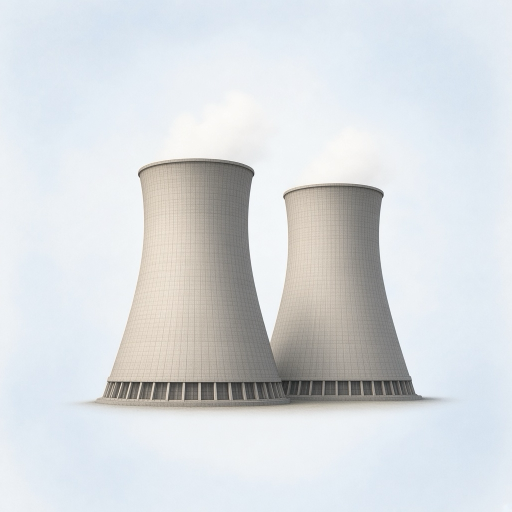
The wide curved towers at some power stations, with white clouds drifting from the top, are the picture most people have of nuclear power. They are often drawn as if they were smokestacks.
They are not. They are cooling towers, and what rises from them is water vapor, the same thing that comes off a hot bath. There is no smoke because nothing is being burned. The water in those towers never touches the nuclear fuel.
Coal and gas plants have cooling towers too. They just also have real chimneys next to them.
Common myths about nuclear power
Myth: A nuclear plant can explode like a nuclear bomb.
It cannot. A bomb needs uranium that is almost pure, usually 85 percent or more of the splitting kind. Reactor fuel is 3 to 5 percent. The physics simply does not allow it.
Myth: The steam from cooling towers is radioactive.
It is ordinary water vapor, and that water never touches the fuel.
Myth: Nuclear plants pollute the air.
Nothing is burned, so no carbon dioxide or soot comes out while the plant is running.
Myth: A reactor goes completely cold the moment you switch it off.
It does not. The leftover pieces of split atoms keep making heat for days, which is why cooling water has to keep flowing even after shutdown.
Frequently asked questions about nuclear power
How does a nuclear plant make electricity?
Splitting atoms makes heat, heat boils water, steam spins a turbine, and the turbine drives a generator.
What is the difference between fission and fusion?
Fission splits big atoms and is what power plants use. Fusion joins small atoms and is what the Sun does.
What are control rods for?
They soak up the neutrons that keep the chain reaction going. Pushing them in slows the reactor down or stops it.
Where did nuclear power start?
With the first chain reaction in Chicago in 1942, and the first grid-connected power plant at Obninsk in 1954.
What happens to used fuel?
It cools in a pool of water for years, then goes into sealed containers. Finland is building the first permanent underground store for it.
Is nuclear power safe?
Counting everything, including accidents, nuclear causes fewer deaths per unit of electricity than coal, oil, or gas. It is among the safest sources, alongside wind and solar.
Nuclear power generates electricity by splitting uranium atoms, a process called fission, and using the resulting heat to raise steam that drives a turbine. About 440 reactors operate in roughly 31 countries, supplying around 9 percent of the world’s electricity. The technology dates to 1942, when a team led by Enrico Fermi achieved the first controlled chain reaction in a squash court beneath the football stands at the University of Chicago.
Getting the fuel ready is most of the difficulty
Uranium dug out of the ground cannot go straight into most reactors, and the reason is which form of uranium it mostly contains.
Natural uranium is a mixture of two forms. Uranium-238 makes up over 99 percent of it and does not split easily. Uranium-235, which does, accounts for only about 0.72 percent. Most reactors need that share raised to roughly 3 to 5 percent.
Here is what makes it hard. The two forms are the same element, so no chemical reaction can tell them apart. They differ only in mass, by about one percent. Separating them means spinning uranium gas in centrifuges at enormous speed, thousands of times over, so the slightly heavier form drifts outward. It is one of the most demanding industrial processes anywhere, which is also why enrichment technology is tightly controlled internationally.
Slow neutrons split atoms better than fast ones
When a uranium atom splits, it throws out neutrons at tremendous speed. Those fast neutrons mostly bounce off other uranium-235 atoms rather than splitting them.
So reactors include a moderator, a material that slows neutrons down through repeated collisions. Ordinary water works, as does heavy water, and so does graphite. Slow neutrons are hundreds of times more likely to cause a fission, which is what makes a sustained chain reaction possible at all.
The choice of moderator shapes everything about a reactor. Ordinary water absorbs some neutrons, so fuel must be enriched. Heavy water absorbs almost none, which is why Canadian CANDU reactors can run on natural uranium straight out of the ground.
Key facts about nuclear power
Natural uranium is about 0.72 percent uranium-235; most reactors need 3 to 5 percent.
Fission of one uranium-235 atom releases about 200 million electron volts.
Control rods made of boron or cadmium absorb neutrons and slow or stop the reaction.
In a pressurized water reactor, the water around the fuel reaches over 570 °F (300 °C) but is held at roughly 150 times atmospheric pressure so it never boils.
The first grid-connected plant was Obninsk in the Soviet Union, June 1954.
Nuclear plants run above 80 percent of the hours in a year, the highest of any electricity source.
France generates about two thirds of its electricity from nuclear, the highest share anywhere.
A reactor keeps producing heat for days after shutdown, which is called decay heat.
Finland’s Onkalo will be the world’s first permanent deep repository for spent fuel once its operating license is granted.
Nuclear causes fewer deaths per unit of electricity than coal, oil, or gas, even counting major accidents.
The problem that does not switch off
Push the control rods in and the chain reaction stops within seconds. The reactor does not stop making heat.
The fragments left over from split atoms are themselves radioactive, and they keep releasing energy as they settle down. This is called decay heat, and immediately after shutdown it amounts to several percent of the reactor’s full power. For a large plant that is a couple of hundred megawatts, and it declines over days rather than minutes.
That single fact explains the shape of most nuclear accidents. The common thread in them is a loss of cooling rather than a runaway reaction:
Three Mile Island, 1979. A cooling fault combined with instrument displays that misled the operators, and part of the core melted. The containment building held, released radiation was small, and studies found no detectable health effects on the public. Its main legacy was sweeping changes to operator training and control room design.
Fukushima, 2011. A magnitude 9 earthquake shut the reactors down automatically, exactly as designed. Then the tsunami flooded the backup generators, so nothing could pump cooling water, and decay heat damaged three cores. Most of the harm came from the earthquake, the tsunami, and the long evacuation rather than from radiation.
Chernobyl, 1986, is the exception that proves the rule. That reactor design could increase its power as things went wrong rather than reducing it, and it had no Western-style containment shell. The remaining reactors of that design were modified afterward to remove the flaw.
Common myths about nuclear power
Myth: A reactor can explode like a nuclear weapon.
Weapons-grade uranium is usually enriched to 85 percent or more. Reactor fuel is 3 to 5 percent, and no arrangement of it produces a nuclear explosion.
Myth: Nuclear waste is a vast quantity of material.
A widely cited comparison holds that all the spent fuel produced by the United States in about seventy years of operation, roughly 99,000 short tons (90,000 metric tons), would cover a single football field to a depth of less than ten yards. The difficulty is how long it stays hazardous, not how much there is.
Myth: Nobody knows what to do with the waste.
The technical answer, deep geological disposal, has been agreed for decades. Finland is closest to opening the first one. The obstacles elsewhere have been political rather than scientific.
Myth: Nuclear plants are the most dangerous way to make electricity.
Studies counting deaths per unit of electricity, including accidents, place nuclear among the safest, alongside wind and solar, and far below fossil fuels.
Frequently asked questions about nuclear power
Why does uranium need enriching?
Only about 0.7 percent of natural uranium splits easily, and most reactor designs need 3 to 5 percent to sustain a chain reaction.
What does a moderator do?
It slows neutrons down. Slow neutrons are far more likely to split uranium-235, which is what keeps the chain reaction going.
Why does a reactor need cooling after being switched off?
Radioactive fragments left over from fission keep producing heat for days, starting at several percent of full power.
What was different about Chernobyl?
Its design could increase power as conditions worsened, and it lacked the strong containment structure Western reactors use.
How much waste does nuclear power produce?
Very little by volume, but it stays hazardous for thousands of years, which is why deep disposal is needed.
Is nuclear power growing?
Global output reached record levels recently, and several countries are building new plants, but nuclear’s share of world electricity has been roughly flat as total demand has grown.
Nuclear power generates electricity from fission, in which a neutron splits a heavy nucleus, releasing about 200 million electron volts and further neutrons that sustain a chain reaction. Roughly 440 reactors in about 31 countries supply around 9 percent of world electricity, with the global fleet running above 80 percent of the hours in a year, the highest capacity factor of any source. The technology’s defining characteristics, for good and ill, follow from two facts: the energy density of the fuel is extraordinary, and the reaction leaves behind material that keeps producing heat after it is switched off.
What makes a reactor controllable
The chain reaction sounds inherently unstable, and on prompt neutrons alone it would be. About 99.35 percent of fission neutrons appear within microseconds, and a system responding on that timescale could not be managed by any mechanical device.
Reactors are controllable because of the remaining fraction. A small share of neutrons is emitted seconds later by decaying fission fragments, and reactors are operated so that they are subcritical on prompt neutrons and reach criticality only when those delayed neutrons are counted. That stretches the effective response time from microseconds to seconds, which control rods can act within.
The threshold matters enough that reactivity is measured in units of the delayed fraction. Crossing it, so that the reaction sustains itself on prompt neutrons alone, is called prompt criticality, and it is an accident condition rather than an operating one.
The second stabilizing feature is negative feedback. In a light water reactor the coolant is also the moderator, so if the water heats or boils, moderation falls and the reaction slows on its own. That property is described by the void coefficient, and its sign is a fundamental safety characteristic of any design.
Why most accidents are cooling stories
Inserting control rods stops the chain reaction within seconds. It does not stop the heat.
Fission fragments are radioactive and continue releasing energy as they decay, at several percent of full thermal power immediately after shutdown, declining over days. For a large reactor running at 3,000 to 4,500 megawatts of heat, that is roughly 200 to 300 megawatts with nowhere to go unless something removes it. The common thread in the industry’s major accidents is exactly that problem:
Three Mile Island, 1979. A stuck relief valve drained coolant while instrument displays led operators to believe the opposite. Part of the core melted, the containment held, and released radiation produced no detectable health effects in the surrounding population. Its lasting consequence was a rebuilding of operator training, control room design, and regulatory practice.
Fukushima Daiichi, 2011. The reactors detected the magnitude 9 earthquake and shut down automatically. The tsunami that followed flooded the backup generators, removing every means of pumping coolant, and decay heat then damaged three cores. Hydrogen generated by overheated zirconium cladding reacting with steam accumulated in the buildings and exploded, which was a chemical event rather than a nuclear one.
Chernobyl, 1986, differed in kind. The RBMK design had a positive void coefficient under certain conditions, meaning coolant boiling increased reactivity instead of reducing it, and it lacked a full containment structure. A poorly conceived test at low power turned that characteristic into a runaway excursion. It remains the only commercial accident in which the reactor’s own physics drove the event rather than a failure to remove heat.
Key facts
Fission of uranium-235 releases about 200 million electron volts, roughly a hundred million times a chemical reaction per atom.
Natural uranium is about 0.72 percent uranium-235; most reactors require 3 to 5 percent.
Delayed neutrons, a fraction under one percent, are what make mechanical control possible.
Decay heat starts at several percent of full power after shutdown and declines over days.
The first controlled chain reaction was achieved on December 2, 1942, at the University of Chicago.
The first grid-connected plant was Obninsk, June 1954; Calder Hall followed in 1956.
About 440 reactors operate in roughly 31 countries, supplying around 9 percent of world electricity.
France generates about two thirds of its electricity from nuclear, the highest national share.
Fleet capacity factor exceeds 80 percent, the highest of any generating technology.
Finland’s Onkalo will be the first deep geological repository for spent fuel to enter operation; its operating license application is still pending.
The economics are the hard part
Nuclear’s cost structure is the inverse of a gas plant’s. Fuel is a small fraction of the cost of the electricity; capital and financing dominate. A large reactor costs billions and takes years to build, and interest accrues on that capital throughout construction while no revenue arrives.
Three consequences follow directly.
Schedule risk is financial risk of the first order. A delay of several years on a multi-billion-dollar project can cost more than the equipment, which is why recent Western projects that ran over have been so damaging to the sector’s reputation.
Plants run flat out. Since costs barely change with output, reducing generation wastes capital already committed. This is the real reason nuclear is described as baseload, and it is economic rather than technical: many designs can follow load, and French reactors do so routinely because their fleet share leaves no alternative.
Grid changes are squeezing that model. On systems with large solar and wind fleets, the hours of highest generation are increasingly the hours of lowest prices, which erodes revenue for any generator that runs constantly.
Small modular reactors are the sector’s proposed answer: build smaller units repeatedly in a factory and let learning-curve savings offset the loss of scale economies. It is a plausible hypothesis rather than a demonstrated result, and demonstrating it requires an order book that does not yet exist.
Waste, in proportion
Spent fuel is intensely radioactive on discharge, spends several years cooling in pools, then moves to dry casks. Its radioactivity falls steeply over the first decades as short-lived fission products decay; what remains after a few centuries is dominated by longer-lived actinides such as plutonium and americium.
The quantity is small. All spent fuel produced by United States commercial reactors across about seventy years of operation, roughly 99,000 short tons (90,000 metric tons), would cover one football field to a depth of less than ten yards. The problem is duration rather than volume.
Deep geological disposal has been the agreed technical answer for decades, and Finland is closest to opening one. Onkalo will place fuel in copper canisters with cast iron inserts, packed in swelling bentonite clay, in tunnels roughly 1,400 feet (430 m) down in bedrock about 1.8 billion years old. The safety case is deliberately multi-barrier: each element is expected to degrade eventually, on different timescales and by different mechanisms, and site geology carries much of the argument. Elsewhere the obstacles to disposal have been political rather than technical.
Common misconceptions
“A reactor can explode like a weapon.” Weapon primaries usually contain 85 percent or more uranium-235. Reactor fuel at 3 to 5 percent cannot produce a nuclear explosion in any configuration.
“Cooling tower plumes are emissions.” They are water vapor, and that water never contacts the fuel.
“Shutting a reactor down makes it safe immediately.” Decay heat continues for days, and losing the ability to remove it is the common thread in serious accidents.
“Nuclear is the most dangerous electricity source.” Deaths per unit of electricity, counting accidents, place it among the safest, alongside wind and solar and far below fossil fuels.
“Nobody knows what to do with the waste.” The technical solution is settled, and Finland is closest to putting it into practice. Implementation elsewhere has stalled on politics, not physics.
Frequently asked questions
What makes a chain reaction controllable?
Delayed neutrons. Reactors are held subcritical on prompt neutrons alone, so response times are seconds rather than microseconds.
What is a void coefficient?
The change in reactivity when coolant boils. Negative means the reaction slows as coolant is lost, which is self-correcting. The RBMK’s was positive under some conditions.
Why does decay heat matter so much?
It cannot be switched off. Removing it requires functioning cooling for days after shutdown, and losing that capability is the common thread in serious accidents.
Why is nuclear electricity expensive despite cheap fuel?
Capital cost and financing dominate. Construction time and interest during construction drive the final price far more than uranium does.
How much waste does a reactor produce?
Very little by volume, but it requires isolation for thousands of years. Volume is not the constraint; duration is.
Is nuclear growing or shrinking?
Global generation reached record levels recently and several countries are building, but nuclear’s share of world electricity has been roughly flat as total demand grows.
Reactor engineering is the management of two things that operate on very different timescales: a chain reaction that can change power in microseconds, and a decay heat load that cannot be switched off at all. Nearly every design decision, safety system, and operating rule in the industry traces to one or the other. The commercial history of the technology, meanwhile, has been shaped less by physics than by the capital intensity that follows from building a plant capable of containing both.
Kinetics and the margin that makes control possible
The effective neutron generation time in a fast-responding system would be on the order of microseconds, far below any mechanical actuation. Reactor control exists because a small fraction of neutrons, about 0.65 percent for uranium-235, is emitted by decaying fission product precursors over the following seconds.
Operation holds the core critical only with that delayed contribution counted, so the effective generation time is dominated by precursor decay. Reactivity is conventionally expressed in units of the delayed fraction for exactly this reason: the point at which reactivity insertion equals that fraction marks prompt criticality, beyond which the excursion outruns any control system.
Stability then rests on reactivity feedback. In a light water reactor, negative fuel temperature feedback acts within the fuel pellet almost instantly through Doppler broadening of absorption resonances in uranium-238, and negative moderator temperature and void feedback act on a slightly longer timescale. The Doppler term is the fastest inherent protection a reactor has, and it operates without any equipment functioning at all.
Fission product poisoning
Xenon-135 has one of the largest neutron absorption cross-sections known, and its behavior produces a counterintuitive operational constraint.
It is created partly directly in fission and partly by decay of iodine-135, and destroyed during operation by absorbing neutrons. After a power reduction, destruction slows immediately while the accumulated iodine inventory continues decaying into xenon, so xenon concentration rises for several hours before declining. The resulting negative reactivity can exceed available control margin, forcing a delay of roughly a day before restart is possible.
Operating into that condition, and compensating by withdrawing control rods far beyond normal limits, was part of the sequence preceding Chernobyl. The physics is universal; what varied was a design whose void coefficient turned the resulting configuration into an excursion rather than a shutdown.
Severe accident phenomenology
Decay heat immediately after shutdown is several percent of full thermal power and follows a slow decline. For a large reactor running at 3,000 to 4,500 megawatts of heat, that is roughly 200 to 300 megawatts at shutdown, falling to tens of megawatts a day later, and removing it is the whole of the post-shutdown safety problem.
If removal fails, the progression is well characterized. Coolant boils off, fuel temperature rises, and above about 2,200 °F (1,200 °C) the zirconium alloy cladding oxidizes rapidly in steam. That reaction is exothermic and autocatalytic in effect, adding heat that accelerates further oxidation, and it liberates hydrogen. At Fukushima that hydrogen accumulated in the reactor buildings and exploded, damaging structures in an event frequently misreported as a nuclear explosion.
Understanding this sequence explains the direction of current design work. Accident-tolerant fuels aim to replace or coat zirconium with materials that oxidize far more slowly. Passive decay heat removal replaces pumps with gravity drainage and natural circulation, targeting a defined grace period, commonly around three days, during which no power or operator action is required. The Fukushima lesson was specifically that redundant active systems can share a common failure mode, which redundancy alone does not address.
Fuel cycle economics and constraints
Discharge burnup, measured in gigawatt-days per tonne of heavy metal, is limited by material performance rather than by fissile depletion. Fuel leaves the core with substantial fissile content remaining, because cladding corrosion, hydrogen pickup, and fission gas pressure inside the rod set the practical limit. Burnups have roughly doubled over recent decades as cladding alloys improved, reducing fuel cost and waste volume per unit of electricity while raising specific activity and heat in the discharged assemblies.
Conversion complicates the accounting further. Uranium-238 captures neutrons and becomes plutonium-239, which fissions in place, so a significant share of energy produced late in a fuel cycle comes from plutonium bred during operation rather than from the original uranium-235.
Reprocessing to recover that material has been industrially demonstrated for decades in France, Russia, and Japan. Its limited adoption reflects two constraints unrelated to feasibility: separated plutonium is directly weapons-usable, and reprocessed fuel has generally cost more than fresh uranium at prevailing prices. The United States chose a once-through cycle in the 1970s primarily on proliferation grounds.
The capital problem
Levelized cost for nuclear is dominated by capital charges and financing, with fuel a minor term. That inverts the operating logic familiar from gas generation and produces several consequences at once.
Construction schedule becomes the dominant financial risk, since interest accrues on billions of dollars with no offsetting revenue. Output reduction saves almost nothing, so plants run at full power, and the resulting baseload operation is an economic conclusion rather than a technical requirement; many designs can follow load, and French reactors do.
That model is under pressure on grids with substantial variable renewable generation, where the hours of highest output increasingly coincide with the lowest prices. A generator that cannot economically reduce output during those hours captures declining revenue for the energy it produces.
Small modular designs propose to address the capital problem by abandoning economies of scale deliberately and recovering the difference through factory learning across many identical units. The scale penalty is real and well understood, since vessel and containment cost scale with surface area while output scales with volume. Whether learning offsets it is unresolved, and testing the hypothesis requires order volumes that themselves depend on the cost reductions being demonstrated.
Repository safety cases
Long-term disposal assessment cannot rely on testing, because the relevant timescales exceed recorded history by orders of magnitude. The methodology instead combines modeling with evidence from natural systems.
The Finnish concept places spent fuel in cast iron inserts within copper canisters, surrounded by swelling bentonite clay, in tunnels around 1,400 feet (430 m) deep in bedrock roughly 1.8 billion years old. Each barrier is expected to degrade eventually; the argument is that they degrade on different timescales and through different mechanisms, so no single failure is decisive.
Natural analogues carry substantial weight in the case. Uranium ore bodies that have remained immobile over geological time, and the natural fission reactors at Oklo in Gabon where fission products largely stayed in place for nearly two billion years, provide evidence about element migration that no laboratory program can supply. Site selection therefore matters as much as engineering, since predictions about stable, low-permeability rock are more defensible than predictions about engineered materials over the same intervals.
Proliferation as a design constraint
Civil nuclear power has never been separable from weapons concerns, and the coupling shapes technical choices in ways that are invisible from an engineering-only view.
Enrichment and reprocessing are the two sensitive steps, because both produce material closer to weapons usability. Enrichment technology that reaches 5 percent can, with more stages of the same equipment, reach far higher. Reprocessing separates plutonium in a chemically pure form. Everything between those two steps, including reactor operation itself, is comparatively unproblematic, which is why international safeguards concentrate on them.
The distinction shapes both verification and supply arrangements. Most reactors are classified as item facilities under IAEA safeguards, meaning nuclear material stays in discrete items, so verification rests on counting and identifying fuel assemblies and confirming their integrity rather than on bulk measurement. Proposals for internationally operated fuel banks exist to give countries assured supply without a national enrichment program.
The tension is genuine rather than rhetorical. Technologies that improve fuel utilization, particularly breeding and closed fuel cycles, are precisely the ones that increase access to separated plutonium. A country pursuing maximum energy security from a domestic uranium resource is pursuing the same capabilities that safeguards are designed to constrain, and no purely technical solution resolves that.
Key facts
The delayed neutron fraction for uranium-235 is about 0.65 percent, and prompt criticality marks the loss of mechanical controllability.
Doppler broadening in uranium-238 provides the fastest inherent negative feedback in a light water reactor.
Xenon-135 concentration rises for hours after a power reduction, potentially preventing restart for around a day.
Decay heat begins at several percent of full thermal power and persists for days.
Zirconium cladding oxidizes rapidly in steam above about 2,200 °F (1,200 °C), generating hydrogen exothermically.
Discharge burnup is limited by cladding and pellet performance, not by fissile depletion.
Plutonium bred in place supplies a meaningful share of energy late in a fuel cycle.
Reprocessing is technically demonstrated; its adoption is constrained by proliferation policy and economics.
Repository safety cases rely on multiple barriers and natural analogues rather than on any single engineered lifetime.
Common misconceptions at expert level
“Redundancy solves loss of cooling.” Redundant active systems share common failure modes, which is precisely what flooding demonstrated at Fukushima. Passive removal addresses the dependency rather than duplicating it.
“Burnup is limited by fuel depletion.” It is limited by material degradation. Substantial fissile content remains at discharge.
“Baseload operation is a technical constraint.” It is an economic conclusion from a capital-dominated cost structure. Load following is technically achievable and routinely practiced in France.
“Reprocessing eliminates the need for a repository.” It reduces volume and recovers material but leaves high-level waste requiring geological disposal.
“Small reactors are cheaper per kilowatt.” Scale economics favor large units. The small modular case depends on factory learning offsetting that, which remains unproven.
Frequently asked questions
Why is reactivity measured in units of the delayed neutron fraction?
Because that fraction defines the boundary of controllability. Reactivity insertion equal to it produces prompt criticality, beyond which mechanical systems cannot respond.
What makes Doppler feedback so important?
It acts within the fuel almost instantaneously as temperature rises, requiring no equipment to function, which makes it the most reliable protection a reactor has.
Why can a reactor be unable to restart after a shutdown?
Xenon-135 builds up for hours after a power reduction and can introduce negative reactivity exceeding available control margin.
Why did hydrogen explode at Fukushima?
Overheated zirconium cladding oxidized in steam, an exothermic reaction that liberates hydrogen, which accumulated in the buildings and exploded.
Why has reprocessing not been widely adopted?
Separated plutonium is weapons-usable and reprocessed fuel has generally cost more than fresh uranium. Neither obstacle is technical.
How is a 100,000 year safety case justified?
Through multiple independent barriers, geological stability at the chosen site, and natural analogues such as Oklo that provide evidence of element immobility over geological time.